Introduction
Kala zeera is an economically important medicinal spice and a perennial herb native to Europe and Western Asia (Zaky et al., Reference Zaky, Shim and Abd El-Aty2021). It grows naturally on the hills of northwestern Himalayas of India including Gurez valley at an altitude between 2000 and 3000 m above mean sea level (Bhartiya, Reference Bhartiya1967). High altitude regions of Gurez valley, Kashtiwar, Keran, Machil, Tangdhar, Paddar, Khrew, Char-e-Sharief, Drass and Harwan in Jammu and Kashmir; Lahaul spiti, Shuang, Pang, Bharmour in Himachal Pradesh and Almora hills of Uttarakhand states are important hot-spot areas of its production in India (Panwar et al., Reference Panwar, Agarwal and Sharma1993; Sofi et al., Reference Sofi, Zeerak and Singh2009; Singh et al., Reference Singh, Rathe, Kanth, Singh, Singh and Kour2017; Mushtaq and Modi, Reference Mushtaq and Modi2019).
High morphological variability has been observed in Kala zeera accessions, but the people from these areas often lift immature plants along with tubers for their immediate benefits. This has restricted propagation of Kala zeera and has also lead to its exploitation and genetic erosion. Hence the crop is becoming an immediate conservation concern in northwestern Himalayan hills. The efforts of conservation of genetic resources and breeding interventions could contribute towards enhancement of its production and productivity.
Experimental
Exploration and collection
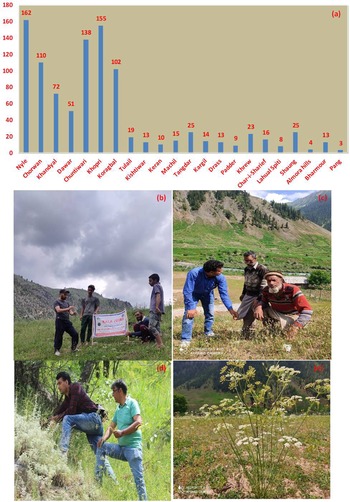
Efforts were made to systematically collect Kala zeera accessions from its natural habitats across northwestern Himalayas. The exploratory survey route covered ~3000 km in northern states of Himachal Pradesh, Uttarakhand and Jammu and Kashmir (Figs 1 and 2). The altitude of collection sites explored during the present study varied from 1524 to 4883 m above mean sea level (online Supplementary Table S1). The accessions were collected from these areas during years 2019 and 2020 for their establishment and morphological characterization at SKUAST-Kashmir, Gurez.
Exploration visits and germplasm accessions collected from different hot-spots/villages in northwestern Himalayas. The figure shows details of number of germplasm accessions collected from different villages in northwestern Himalayas of India (a), germplasm establishment site in Gurez (b), collection site in Chorwan, Gurez (c), collection site in Nyle-Valley, Gurez (d), and a Kala zeera plant at flowering stage in germplasm bank in Gurez on Indo-Pakistan border (e).

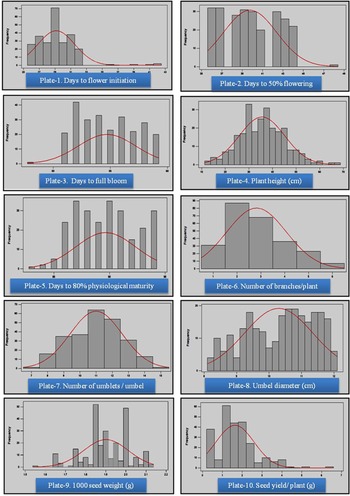
Variation available for morphological traits in Kala zeera collected from northwestern Himalayas of India. The histograms shows the kind of distribution shown by growth trait data (plate 1 to 5) and yield and yield attributing trait data (plate 6 to 10).

Seed and planting
Tubers of around 1000 collected accessions were planted at SKUAST-Kashmir, Gurez (longitude – 34°39′19.822°N, latitude – 74°41′23.087°E) in augmented block design (ABD) with spacing of 30 × 20 cm. Out of these, 252 diverse (Fig. S1) Kala zeera accessions have been characterized for morpho-agronomic traits at different growth stages.
Morpho-agronomic characterization
The data on minimum, maximum, mean values and coefficient of variability (CV) for 11 morpho-agronomic traits (days to flower initiation, days to 50% flowering, days to full bloom, plant height, number of branches per plant, number of umbelets per umbel, umbel diameter, days to 80% maturity, number of seeds per plant, 1000 seed weight and seed yield per plant) involving 252 genotypes are presented in online Supplementary Table S2 and Fig. S2. The analysis of trait data in ABD showed significant variation in all these traits (Fig. S1). The CV values for all the traits ranged from 3 to 58.53%. The morphological traits of Kala zeera showed normal distribution (Fig. S2) except for days to 50% flowering, days to full bloom, days to 80% maturity and umbel diameter. The highest mean value (Table S2) was observed for number of seeds per plant (110.85) followed by days to 80% maturity (89.66). The highest CV was found for seed yield per plant (58.53) followed by number of seeds per plant (49.84). However, lowest CV (3) was observed for days to 80% maturity. The high CV values could be attributed to diverse areas of collection and difference in plant types.
PCA analysis (online Supplementary Table S3 and Fig. S3) grouped the genotypes into four components. Component 1 has the major contribution of days to flower initiation (0.455), days to 50% flowering (0.518), days to full bloom (0.501), days to 80% maturity (0.481) to the total variability. Component 2 has the major contribution of number of branches per plant (0.492), number of umbels per plant (0.503), number of seeds per plant (0.530) and seed yield per plant (0.349) to the total variability. Similarly, plant height (0.586) and number of umbelets per umbel (0.658) and plant height (0.584) and seed yield per plant (0.449) have contributed to total variation from components 3 and 4, respectively.
Discussion
The study was aimed at characterization and conservation of Kala zeera accessions as germplasm bank that can serve as a base material for breeding interventions. The study revealed 24 accessions as earliest (26 days) flowering types. Full bloom started from 48 days after germination and was completed in all the entries till 59 day. The genotypes took 83–94 days for attaining 80% maturity. High genetic variability of Kala zeera collections was also reported by Mittal et al. (Reference Mittal, Chota and Gartan2006), Majeed et al. (Reference Majeed, Wani and Sharma2008) and Mushtaq and Modi (Reference Mushtaq and Modi2019). Crop maturity is an important trait, earlier accessions can vacate the field early for raising crops like buckwheat. In majority of these areas early maturity minimizes the shuttering loss as accessions escape the high winds that start blowing from 20th of July each year.
The highest seed yield per plant was recorded from two entries KZG112 (6.4 g) and KZG215 (5.0 g) collected from Nayal and Chuntiwari areas of Gurez valley of Jammu and Kashmir (J&K), respectively in comparison to Shalimar Kala zeera-1 (2.0 g). A Kala zeera entry from village Chorwan, Gurez viz., KZG192 and entry KZG255 from Shaung village, Himachal Pradesh each recorded seed yield of 4.0 g per plant, whereas 3 g seed yield per plant was harvested each from entry KZG272 collected from Dras (J&K) and entry KZG208 collected from Chorwan, Gurez (J&K). The promising Kala zeera entries identified from the study could be registered in national germplasm repository, National Bureau of Plant Genetic Resources (NBPGR), New Delhi, India.
The germplasm accessions identified on the basis of trait data could be explored as high-yielding Kala zeera varieties for northwestern Himalayas, as a genetic resource for a variety of genomics studies including transcriptomics, for identification of differentially expressing genes particularly of medicinal importance and in mapping genes for important traits through development of bi-parental mapping populations. This is as such the first comprehensive study (as per our knowledge) in Kala zeera from northwestern Himalayan region of India. Such efforts made will also help to conserve useful genetic diversity of Kala zeera in national/local gene banks for their further redistribution among breeders/farmers worldwide.
Supplementary material
The supplementary material for this article can be found at https://doi.org/10.1017/S1479262122000028.
Acknowledgement
The authors acknowledge the financial support provided by the National Mission on Himalayan Studies (NMHS), Ministry of Environment and Forests, Government of India in the form of a small grant (NMHS_MAH_SG_65) research project that has facilitated the exploration, collection and characterization of Kala zeera.