In the mid-nineteenth century, gas discharge research was dominated by attempts to produce and stabilize colourful luminous effects inside evacuated glass tubes of various shapes and under varying circumstances. For those researchers who were interested in understanding the conditions of their appearance, it became more and more evident that the phenomena were sensitively dependent on the shape of the tubes, the type and quality of glass, the type and pressure of the contained gases, the metals used for the electrodes, the type and intensity of the source of electricity and many other factors. The plasticity of both the phenomena and the experimental set-up (particularly the shape of glass tubes) provided ample opportunity for experimental manipulation and intervention – and for charging the phenomena with meaning.Footnote 1 The variation of colourful luminous patterns under changing experimental conditions could be interpreted as specific disturbances of the physical ether or as visual expressions of the interaction and conversation of various ‘modes of force’ or ‘imponderables’, such as heat, light, electricity or magnetism.Footnote 2
The following paper will focus on developments which began with the cooperation between a university professor of physics and mathematics and a brilliant glass-blower and instrument-maker, Julius Plücker and Heinrich Geissler, at Bonn University in the late 1850s. Both researchers contributed to the education and influenced the performance of the main protagonist of this paper, Plücker's student and later professor of physics and chemistry in Münster, Johann Wilhelm Hittorf. In an early phase of what turned out to be a long-term research project, Hittorf joined Plücker's investigation of gas discharge phenomena as a collaborator in the early 1860s. Primarily he was responsible for evacuating and preparing spectral tubes but at the same time began to explore the phenomenology of gas discharge in a playful empirical manner and fathomed the technical and epistemic potential of the new field of study.
A second, more systematic and explorative phase began with an emerging focus on a specific epistemic thing, namely the exploration of gaseous conduction. In Hittorf's understanding, the interaction between gas at low pressures and electricity at high voltage provided an exceptional opportunity to explore the electric properties of matter, but it posed extraordinary challenges as well, since he had to gather and bring together expertise from various fields of study. With the help of a conceptual framework and an experimental technology, which he transferred from his previous studies of electrolytic conduction to gas discharge research, Hittorf tried to correlate light, electric current, resistance and some properties of matter within a single experimental system. His preliminary goal was to acquire the experimental dexterity and provide the technical conditions for a continuous variation of intensity of electric current, electromotive force and vacuum, and consequently produce a continuous sequence of morphological transformations. Only if a particular phenomenon could be identified as an integral part of a coherent phenomenological manifold was it possible to understand the principles defining its appearance and conduct precise measurements of the physical properties governing the transformation processes.
Hittorf was conscious of various shortcomings of his equipment and in an iterative process he used the experience gained in previous experiments to improve the experimental apparatus and procedures for a repetitive re-evaluation of the results. These iterative processes were accompanied by a gradual clarification of the conceptual understanding and specification of measurement categories, and by the improvement of the measurement apparatus. Finally, in a third phase, Hittorf hoped to analyse the influence of electrical energy on the electrical properties of gases by means of exact and absolute measurements. This phase, however, was never completed due to health problems that haunted Hittorf in the early 1880s.
Inside and among the instrument-makers’ workshops
La lumière des appareils, répercutée par les petites facettes de la masse rocheuse, croisait ses jets de feu sous tous les angles, et je m'imaginais voyager à travers un diamant creux, dans lequel les rayons se brisaient en mille éblouissements.
Jules Verne, Voyage au centre de la terre, in idem, Les Voyages extraordinaires, vol. 10, Paris: Bonnot, 1977, p. 115.In his Voyage au centre de la terre of 1864, Jules Verne equipped his adventurers with a specific light source: stored in a leather bag was a battery connected to a Ruhmkorff inductor, which would produce several hundred volts. The battery and induction coil were then used to ignite gas residues in small, spiral glass tubes. This special arrangement of instruments had been suggested as a safety lamp for miners in 1862,Footnote 3 and Verne may have seen it when it was shown at a fair as a novelty. In his story, the minerals of a cave exploded into a fancy kaleidoscope of colours and shapes when the light was switched on. In consideration of the faint luminosity produced by these tubes, Verne's description rather appears as an externalization, or poetic projection to the exterior, of the complex luminous patterns that occurred in the tube's interior, using the cave walls as a huge screen. Demonstrations of various discharge effects in so called ‘electric eggs’ could be seen in the workshop of the Parisian instrument-maker Heinrich Daniel Ruhmkorff (1803–1877) or in a book sponsored by Ruhmkorff that further popularized his scientific work as much as his instruments.Footnote 4
In 1858 Ruhmkorff started to purchase evacuated glass tubes from a friend, the glass-blower and instrument-maker Heinrich Geissler in Bonn.Footnote 5 ‘Geissler tubes’ were filled with traces of various gases and featured platinum wires as electrodes; many of them were artfully shaped. In some cases several layers of glass were nested inside each other, resulting in complex architectures with cavities partly filled with fluorescent liquids. Some of these tubes were even sold as amusements, for example to Warren De La Rue in London, who reported that on the occasion of a visit to his laboratory, Geissler carried with him ‘some tubes through which no current had previously passed (virgin tubes, as he called them), which present most beautiful phenomena lost for ever after too brief a period’.Footnote 6 Thus oftentimes innovations Geissler introduced were meant to enhance the aesthetic attraction – a fact that annoyed several researchers who complained that the tubes only had a marginal scientific value.Footnote 7 Partly, these complaints mirrored the researchers’ frustration about their inability to produce their own equipment and to give new ideas an immediate material shape. Very few physicists had the necessary glass-blowing skills to produce their own tubes and skilled glass-blowers were rarely at hand.Footnote 8 The mercury vacuum pump that Geissler had constructed in 1857 was expensive and difficult to handle.Footnote 9 Therefore for several years most researchers had to rely on Geissler's skills and on the specifications he conveyed.Footnote 10 In contrast, the discharge tubes themselves could easily be transported and soon spread all over Europe and the rest of the world.Footnote 11
Geissler participated in a network of instrument-makers and scientists who exchanged information and demonstrated their newest achievements at fairs or in each other's laboratories or workshops. For example, Ruhmkorff used gas discharge phenomena at scientific meetings as an attraction and marketing instrument to promote his induction coil as a convenient and powerful high-voltage source.Footnote 12 In addition to his own changes, Geissler adopted many technical solutions suggested by other researchers and instrument-makers and incorporated new types of instrument into his programme. For example, William Crookes's radiometer was sold by Geissler under the name of ‘light mill’ almost immediately after its invention in 1875.Footnote 13 Similar to Ruhmkorff, Geissler supported the publication of a small book, which was prepared by Theodor Meyer, the curator of Bonn University's physics cabinet, on the occasion of the 1857 meeting of the Versammlung Deutscher Naturforscher und Aerzte. As a distinctive feature, the book contained coloured plates, which allowed a wider audience to get at least some impressions of what the luminous effects were about. It was a mere exemplary excursion, as Meyer complained: ‘I have seen about 40 to 50 tubes many times: what peculiar diversity and intrinsic individuality. To this day I have not observed two tubes that have a single detail in common although they were produced under the same circumstances.’Footnote 14 Oftentimes the only medium for a transmission of the tubes’ phenomenology was the tubes themselves.Footnote 15
A decisive factor for the proliferation of Geissler's instruments was his cooperation with Julius Plücker, the professor of mathematics and physics at Bonn University. The collaboration began immediately after Geissler had shown his tubes and the mercury air-pump in the university's physical cabinet and lasted several years. Plücker frequently visited colleagues in Paris and London and seized any opportunity to demonstrate the tubes in action, following the maxim: ‘but all such phenomena are very difficult to describe: I wished I could show them to you’.Footnote 16 In 1862, Geissler joined Plücker on a journey to the world fair in London, and both used the opportunity to demonstrate gas discharge experiments to Michael Faraday, Edward Sabine, John Peter Gassiot, John Tyndall, Henry Bence Jones and many others.Footnote 17 On several occasions, Plücker used Ruhmkorff's workshop in Paris as a laboratory, for example for an experimental ‘rendezvous’ with his French colleague Alexandre-Edmond Becquerel.Footnote 18
Plücker's geometrical laboratory
Plücker had been educated as a mathematician and was perceived by some of his contemporaries as a leading geometer of his generation. He studied in Bonn, Heidelberg, Berlin and Paris, where he made contact with the French school of polytechnicians and geometers in the succession of Gaspard Monge. After various employments at German universities he settled in Bonn as professor of mathematics. Until the mid-1840s he was mainly engaged in the further development of analytical and projective geometry by fostering the convergence of synthetic and analytic geometry. Curiously, from 1847 onwards, he switched to experimental physics and became a staunch follower of Michael Faraday's non-mathematical experimental style. His interest in geometry only revived in 1864, shortly before his death in 1868.Footnote 19 His work was continued by his student Felix Klein.
The mathematician Alfred Clebsch described Plücker as a type of scholar who entered a new field primarily in search of new problems, who was content with outlining possible solutions, and left their detailed elaboration to scientists preferring a more rigorous and systematic but also narrower approach. Clebsch summarized Plücker's mathematical style as ‘more of a productive than analytical manner. It offered him the complete satisfaction of the richness of new shapes and formations fed by the productive fertility of his unfailing imagination’.Footnote 20 For example, in his System der Analytischen Geometrie published in 1835 Plücker discussed and classified curves of the third order, distinguishing 219 different species.
The diversity and malleability of gas discharge phenomena intrigued Plücker, and here we may even find a bridge between his experimental and his mathematical research. Comparable to his geometrical studies, in which he further developed Gaspar Monge's and Jean-Victor Poncelet's understanding of projective geometry, he was searching for those properties of discharge phenomena which showed a certain sturdiness or invariance under changing experimental conditions and which combined analytic with geometric aspects of the phenomenology.Footnote 21 In his educational work, Plücker used wooden models of complex mathematical curves to illustrate their spatial presence and train visual perception. Although meant as a comment on Plücker's student Felix Klein, Herbert Mehrtens's description of Klein's use of models can be applied to Plücker's mathematical style as well and from there to the Gestalts and their embodiments that he produced in his vacuum tubes:
The models (and diagrams) were constructed to ‘grasp’ the form and to show the typical forms of a class of surfaces. If form or Gestalt is the epistemic thing around which the research circles, then the model is one of the representations of this thing, and not fundamentally different from the algebraic formula or the diagram. It is one of the many simultaneous and consecutive representations of the object. In this sense the model is part of doing mathematics, embodied mathematics.Footnote 22
In his gas discharge experiments as much as in his previous studies on the magnetic properties of crystals, liquids and gases, Plücker was looking for new classes of objects and for specific figurations that could possibly serve as representatives of such classes – or, to use Hans-Jörg Rheinberger's term, as ‘epistemic things’ which seemed worthwhile for further study.Footnote 23 In his previous studies Plücker had shown how flames and drops of liquid adopted specific geometrical shapes and figures under the influence of a strong magnet.Footnote 24 These figures could be seen as expressions of a specific constellation of forces because, as he claimed in another context, ‘force may be regarded as a merely geometrical notion, and there is only one step more to be taken in order to arrive at a “Geometry of Forces”, as there is a geometry based on the notion of right lines’.Footnote 25 Apart from the opportunity to transfer aspects of his line-geometry to problems of physics, Plücker was aiming at an art of reading and understanding spatial figures that embraced and possibly intertwined both an analysis of the conditions under which geometric figures materialized and their dynamic transformation under changing conditions.
The two main phenomena that could be clearly differentiated by Plücker in discharge tubes when they were subjected to external forces were the ‘positive’ and the ‘negative’ light. The ‘positive light’ showed up in the space surrounding the anode and, with its strange stratifications, it was the main subject of Plücker's early research; the ‘negative light’ – in tubes filled with traces of air, a bright bluish light that was localized close to the surface of the cathode – had already been noticed by Michael Faraday in the late 1830s but did not arouse as much attention as the sparkling effects of the positive light. However, when the evacuation was enhanced, the negative light spread into the surrounding space while the positive light faded away; Geissler's mercury air-pump turned out to be of crucial advantage here.
In his comparative investigation of the behaviour of the ‘negative’ and ‘positive’ light under the influence of a strong magnet, he found that the positive light behaved in a way analogous to a thin metallic wire stretched between the two terminals; its properties could therefore be explained by Ampère's laws for metallic conductors. Such behaviour had already been documented by the Swiss Auguste de la Rive, who had presented a discharge tube in 1849 in which a thread of positive light rotated in an inhomogeneous magnetic field similar to a metallic wire in Faraday's experiments on electromagnetic rotation.Footnote 26 In contrast, the negative light, if extending from the cathode into the surrounding space, would be bent in agreement with Faraday's ‘lines of magnetic force’.
Plücker wrote enthusiastically to Faraday in 1857, ‘I can, in a few words, give no better account of them but by saying, that I am enabled by means of the electric light, to render luminous your lines of magnetic force.’Footnote 27 While, as Plücker emphasized, ‘Hitherto only filings of iron enabled us to give in peculiar cases an imperfect image of these curves’,Footnote 28 now the electric light – depending on the gases used, in blue, red or violet – could serve as mediator between a theoretical abstraction and its material realization: ‘It equally represents the form which a chain of infinitely small iron needles, absolutely flexible and not subjected to gravity, would assume, if attached with one of its points in the point of the negative wire.’Footnote 29 The bulky material that had been used before could now be substituted by infinitely small, absolutely flexible elements – attributes more suited to an idealized or mathematical world than to a material one. For Plücker, this kind of analysis could even serve as a possible alternative or complement to a conventional mathematical treatment. Comparable to Mehrtens's description of Klein's use of models, iron filings or the electric light could thus be applied to visualize the distribution of the magnetic force in those cases where ‘the mathematical analysis fails’.Footnote 30
In Plücker's understanding, the luminous effects were indicating the interaction of electricity and additional forces with matter. He was convinced, as Faraday was, that there was no electricity without matter and therefore no electric light per se.Footnote 31 If this was the case then matter and electricity seemed to interact at least in two different ways. Therefore any explanation of the electric light had to be accompanied by a thorough understanding of the nature of matter as medium of the electric current:
Considering the complete lack of knowledge regarding the constitution of material bodies and its influence on the constitution of the electric current, it is not surprising that we do not find a satisfactory explanation for the above-mentioned phenomena. New hypotheses, which currently can only take the form of pictures and symbols, will not reach the status of a sound explanation until they involve more specific assumptions on the nature of the current and its medium.Footnote 32
In Plücker's further investigations the prismatic analysis of the luminous effects turned out to be a powerful tool for exploring the relationship of electricity and matter, and it provided additional opportunity for introducing a more analytic, occasionally mathematical, terminology into the field. To capture the nuances of colour in their descriptions, researchers used flowery terms like those found in a chart by the French scientist Morren who introduced colours like ‘light rosy, glossy’ and graduations like ‘entirely and absolutely white’ or ‘decidedly white’, or subjective utterances like ‘sky-blue, very beautiful’.Footnote 33 Seen through the prism, the complex luminous effects were reduced to a few characteristic lines of a ‘mathematical sharpness’ that seemingly only changed in intensity when conditions changed.Footnote 34 A phenomenological manifold was transformed and projected into an analytic space. As he wrote,
But in all cases, whatever may be the colour-impression produced on the eye, the distribution of the colours in the spectra remains for the same gas entirely of the same kind; it is the intensity of the colour alone which changes in different degrees in different portions of the spectrum: so that when the eye (whose judgement is, moreover, considerably influenced by the external illumination) is at fault, still the nature of the gas or vapour contained in the tube is unfailingly determined by means of the spectrum.Footnote 35
Using a burner, various elementary and compound substances could be evaporated in specifically constructed discharge tubes. In 1858 – more than a year before the official birth of spectrum analysis – Plücker tried to introduce a spectroscopic approach that aimed far beyond the mere identification of chemical substances. While his early explorations dealt with appearances that indicated the balancing of various static forces, Plücker wanted to establish a dynamic approach that would allow the observation and investigation of chemical reactions – a new branch of science which he called ‘micro-chemistry’.Footnote 36 For studies of these kinds Geissler prepared tubes filled with vapours of essential oils which decomposed under electric discharge.Footnote 37 But Plücker was not only interested in chemical decomposition but also in changes between different modifications of matter. As Plücker added in an outlook on his further researches,
It is only on the successful solution of these questions that many not unimportant points for the molecular theory will be satisfactorily solved, such as – How may the spectrum of mixed gases be derived from the spectra of its constituents? How are the spectra of a compound gas related to one another before and after its chemical decomposition by the current? How does the chemical combination which the gas effects with the electrode influence the spectrum? Do isomeric gases give rise to similar spectra?Footnote 38
Used in such a way, the spectroscope could serve as a powerful tool to observe, manipulate and control the conditions and processes inside the tubes. Spectroscopy seemed to point to a universal phenomenon and it marvellously reduced the chaotic behaviour of the luminous effects to characteristic changes of more or less simple and reproducible patterns of coloured lines; the colourful figures of the positive light lost some of their attraction.
The education of a physical chemist
Plücker's ‘micro-chemistry’ met with a disappointing public response. The successful application of spectrum analysis by Robert Bunsen and Gustav Kirchhoff intensified Plücker's feelings that his research and his contributions were not properly acknowledged in Germany. Plücker avoided a priority dispute and instead tried to personally convince his colleagues of the value of his research. For example, in 1862, he showed some of his spectral tubes in Munich to Kirchhoff and Bunsen's instrument-maker Carl August Steinheil, the physicist Philipp von Jolly and the two chemists Liebig and Wöhler.Footnote 39 Nonetheless, it became increasingly apparent that he had to find a partner with sophisticated skills in chemistry and experimental technology, and he invited his former student Johann Wilhelm Hittorf to join his spectroscopic studies.Footnote 40
Hittorf had studied under Plücker in the Seminar für die Gesammten Naturwissenschaften (General Science Seminar) at Bonn University.Footnote 41 The seminar had been founded in 1825 as an interdisciplinary institution for the education of science teachers for Prussia's secondary schools. The institute's first director, the botanist Christian Gottfried Daniel Nees von Esenbeck (1776–1858), was a former student of Friedrich Schelling and a friend of Johann Wolfgang von Goethe and he supported the holistic approach to science of Romantic Naturforschung. Although the seminar comprised five departments – physics, chemistry, mineralogy, botany and zoology (mathematics was excluded in the early years) – the professors strived for and taught the unity and coherence of science, held cooperative colloquia, and based their investigations and teaching on ‘metamorphosis’ as a key concept.Footnote 42 The professors’ appreciation of a Goethean understanding of science is documented in an extended and partly enthusiastic review of Goethe's morphological and scientific writings published by Esenbeck together with his colleagues Georg August Goldfuß and Johann Jakob Nöggerath.Footnote 43
The early enthusiasm for Naturphilosophie had already cooled down when Hittorf entered the seminar in 1842. Although he had been educated and had even taught as professor in the Bonn seminar during the Esenbeck era, his teacher, Plücker, was less interested in the speculations of Romantic science but rather preferred and taught the type of mathematics and physics he had learned in Paris. For example, for his physics lectures he used the textbooks of Jean-Baptiste Biot; however, the methodology of some of Hittorf's teachers continued to mirror earlier convictions and influenced Hittorf's performance as a scientist. The concept of metamorphosis, for example, played a central role in his thinking. Concepts of continuity and unity found their expression in Hittorf's motto: natura non facit saltum – ‘nature does not make jumps’.Footnote 44 For Hittorf, the division of science into separate disciplines resulted from the specific disposition of the human cognitive faculties and was not absolute.Footnote 45 Consequently, his expeditions into interdisciplinary spaces were part of an endeavour to enhance these faculties.
The design and performance of Hittorf's experiments reveal a strong affinity to a Goethean type of scientific research. This affinity might have been mediated by Esenbeck's initial influence on the curriculum and his strong emphasis on Formenlehre or ‘science of form’. In extension of Goethe's methodology and understanding of science, the central aim of Formenlehre was to acquire observational skills and develop a practical understanding of the metamorphosis of natural forms as a precondition for an understanding and appropriate conceptualization of the principles that governed the transformation process.Footnote 46 Goethe himself had compared his ‘delicate empiricism’ with the cautious progression of the mathematician:
From the mathematician we must learn the meticulous care required to connect things in unbroken succession, or rather, to derive things step by step. Even where we do not venture to apply mathematics we must always work as though we had to satisfy the strictest of geometricians. In the mathematical method we find an approach which by its deliberate and pure nature instantly exposes every leap in an assertion.Footnote 47
As a consequence, a close inspection of the relation between similar though distinct phenomena would prevent a premature or misleading conjunction of observations or facts. In a short note from 1798, ‘Empirical observation and science’, Goethe had divided scientific inquiry into three different types or stages of phenomenology: the ‘empirical phenomenon’, the ‘scientific phenomenon’ and the ‘pure phenomenon’. The empirical phenomenon was defined as something ‘everyone finds in nature’. These findings had to be raised through experiment to the status of a scientific phenomenon by ‘producing it under circumstances and conditions different from those in which it was first observed’. Finally,
the pure phenomenon stands before us as the result of all our observations and experiments. It can never be isolated, but it appears in a continuous sequence of events. To depict it, the human mind gives definition to the empirically variable, excludes the accidental, sets aside the impure, untangles the complicated, and discovers the unknown.Footnote 48
On the methodological side, such influences are evident in Hittorf's urge for excessive observation, long series and variations of experiments, the search for a continuous transformation of forms into each other as a means to reduce a manifold of particulars to a set of few characteristic objects, and the rejection of a premature commitment to theories and theoretical models. For example, he vehemently opposed the application of Newtonian theory to chemistry and as much the application of molecular models to studies of electricity.Footnote 49
In his further professional career, Hittorf was increasingly influenced by Michael Faraday, his choice of research topics, his style of physical chemistry as opposed to the emerging organic chemistry, and his style of experimental investigation.Footnote 50 In Justus von Liebig's understanding, Faraday's approach helped to uncover the complex nature of a research object instead of subordinating it to mathematical descriptions and laws:
Faraday sought for the thing, if this expression be permitted, Weber for the cause, for the law. I have heard mathematical physicists deplore that Faraday's records of his labours were difficult to read and understand, that they often resembled rather abstracts from a diary. But the fault was theirs, not Faraday's; to physicists, who have approached physics by the road of chemistry, Faraday's memoirs sound like admirably beautiful music.Footnote 51
Hittorf would have subscribed to such a statement; he esteemed Faraday as the ‘greatest discoverer of all times’ – and a fighter against Newtonian orthodoxy and ‘scholasticism’ in physics and chemistry.Footnote 52 As a result Hittorf found his convictions oftentimes at odds with those colleagues in Germany who adopted electrostatic and electrodynamic theories that still operated with electric fluids and forces at a distance such as Wilhelm Weber and his followers. This opposition did not, however, apply to the whole of Weber's science – in particular he did not oppose Weber's promotion of ‘measurement physics’.Footnote 53 As Friedrich Paschen, the later president of the Physikalisch-Technische Reichsanstalt, who had been educated by August Kundt in Strasburg and in 1888–1889 served as Hittorf's assistant, recalled, ‘What Kundt did not sufficiently emphasize in his school, namely the conduction of precision experiments in the manner practised by Regnault, this I had the opportunity to learn as Hittorf's assistant.’Footnote 54
At the seminar, Hittorf received a wide-ranging education in chemistry, botany, mineralogy, physics, technology and mathematics.Footnote 55 The seminar maintained a botanical garden, a museum of natural history, a cabinet of physics and a chemical laboratory, where a limited practical education was offered. Plücker's attempts, though, to establish a physical laboratory and regular laboratory tutorials as a ‘nursery for young physicists’ succeeded only in 1866, long after Hittorf had graduated.Footnote 56 However, the education in Bonn seems to have been sufficiently effective. As Hittorf wrote to Plücker after a visit to Heinrich Wilhelm Dove's physics lectures in Berlin, ‘Dove's lectures on optics and experimental physics are too elementary to sacrifice my time for them.’Footnote 57 Plücker's desire for including laboratory training in the curriculum might have been an outcome of an awareness of his own shortcomings, given that regularly he had to delegate experimental work to his assistants or to Heinrich Geissler.Footnote 58 As Hittorf remarked, Plücker himself never acquired the ‘dexterity and certainty which training grants the body only in his youth’.Footnote 59 Following in his teacher's footsteps, Hittorf first of all earned a mathematical doctorate in 1846 with a dissertation on conic sections (‘Proprietas sectionum conicarum ex aequatione polari deductae’) before he turned to experimental science.Footnote 60
Hittorf left Bonn in 1847 and after a short, government-sponsored educational trip to Berlin – among other things the ministry urged him to ‘learn more about the application of the chemical–physical methodology in an industrial context’Footnote 61 – he went to the provincial Prussian city of Münster to become Privatdozent at the local college where he later became professor of physics and chemistry.Footnote 62 Since he was teaching chemistry as well as physics, his research projects were also positioned between both disciplines, mostly in electrochemistry. For example, in the 1850s he carried out a long and demanding analysis of electrolytic conduction. With simple but sophisticated instruments (mainly by means of diaphragms, evaporation and weighing of substances) he managed to separate the processes that occurred in the space between the two electrodes from processes taking place directly at their vicinity.
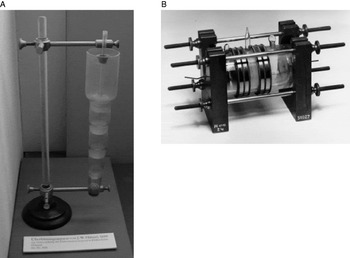
In particular, he could show that Ohm's law would hold for electrolytic conduction as well if secondary effects at the electrodes were considered and, if possible, removed.Footnote 63 Important for such an interpretation was Hittorf's belief that according to Faraday's law and his own measurements only an insignificant electromotive force or electric energy was needed to separate the ions of an electrolyte in solutions;Footnote 64 this contradicted the prevalent belief that different electrolytic substances with different affinities would need different electromotive forces to disassociate their binding. Hittorf followed Faraday, who had shown that electrolytic decomposition took place in the whole substance between the poles: the poles were to be seen as mere boundary surfaces of the electrolytic substance; consequently, the electrolytic solution was just another element of the electric circuit; most importantly, there were no electric fluids accumulating at the poles and no specific attractive or repulsive forces emanating from there.Footnote 65 With his instruments (see Figure 1) Hittorf was able to measure differences of density of the electrolytic substances around the electrodes. These measurements showed that different ions migrated at different rates and were seen much later as supporting the theory of dissolution and free-ion transport in solutions.
Apparatus used by Hittorf in his electrolytic investigations. Deutsches Museum, Munich. Photo: Bernhard Taufertshöfer.

Wilhelm Ostwald later praised the performance and precision of Hittorf's measurements as exemplary and emphasized their long-lasting value. Friedrich Kohlrausch even described them as ‘one of the most laborious experimental investigations that have ever been conducted’.Footnote 66 At the time his claims were issued, though, most colleagues in Germany ignored or attacked them. In his own publications, Hittorf's primary target was the electrolytic theory of the Swedish chemist Jacob Berzelius and his German followers (primarily Gustav Magnus, Gustav Wiedemann and Robert Bunsen).Footnote 67 Furthermore, Hittorf was annoyed with mathematical physicists who offered explanations for processes they obviously did not understand – explanations which, he argued, in most cases contradicted experience. In particular, Hittorf declined the application of molecular models of the kinetic theory of gases to liquids and to the interaction and movement of anions and cations in electrolytic solutions by one of the fathers of this theory, the mathematical physicist Rudolf Clausius.Footnote 68 In Hittorf's understanding, theory based on forces acting at a distance or on the transfer of electric charge between molecules could not explain new empirical results, primarily his own and those coming from Faraday. Hittorf concurred only with certain features of Clausius's theory because it explained the independent motion of ions in solutions and allowed the introduction of Ohm's law to electrolytic conduction: ‘The unnatural scholastic machinery of the dominant theory of two specific electric fluids, which [Clausius] used to explain the details of the electrolytic process’, Hittorf later recalled, ‘I had to oppose.’Footnote 69
Hittorf's major goal was to investigate and understand a process that he felt was not sufficiently understood: ‘the magnificent metamorphosis matter experiences at the electrodes’.Footnote 70 In his attempt to introduce physical concepts to chemistry, Hittorf sought a dynamic understanding of chemical processes, something he believed he could find better in the theories on phlogiston of the eighteenth-century chemist and alchemist Georg Ernst Stahl than in the application of Newtonian physics to chemistry – if Stahl's phlogiston was not understood as a substance but as ‘living force’.Footnote 71 Therefore he particularly criticized Clausius for not mentioning and obviously being unable to distinguish the different chemical properties of matter in its ionic and ordinary states.
When Hittorf summarized his own approach, he emphasized that his claims in most cases relied on the use of very simple instruments and approved measurement procedures, most often consisting in the mere evaporation and weighing of substances. If he himself made mistakes, he claimed, others could find and correct them. The situation was different with theories offered by so-called ‘authorities’: ‘They are highly beneficial if supported by the facts but if they are false, they impede progress oftentimes for centuries.’Footnote 72
The electric current as a tool for transforming and analysing material properties
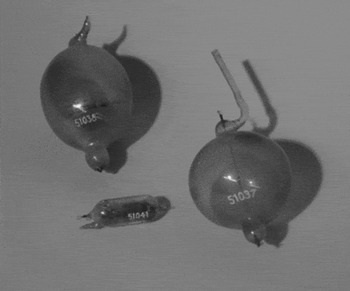
The electric current was the main tool in the exploration of various other substances as well. For example, Hittorf investigated the strange case of ‘electrolytic conduction’ in a modification of copper sulphide and he produced – consciously placing his own research in the tradition of the discoverer of phosphorus, the alchemist Henning Brandt – a new modification of phosphorus (see Figure 2). These experiments seem to have been inspired by Heinrich Geissler, who had used evacuated glass vessels and electric sparks to transmute ‘ordinary’ into red phosphorus in the early 1860s.Footnote 73
Discharge tubes used by Hittorf for his ‘transmutation’ experiments with phosphorus. Deutsches Museum, Munich. Photo: Bernhard Taufertshöfer.

The electric current could be used to manipulate the physical states of materials and create new modifications. At the same time, its use was accompanied by an experimental apparatus and a methodology with which these changes could be monitored and measured with high precision. The use of electric current as a tool, though, was problematic since nobody knew exactly how it operated, but its application made sense because certain laws (for example, Faraday's law, Ohm's law, Joule's law or Kirchhoff's circuit laws) provided a conceptual framework that helped to define and quantify the relationships of various properties such as electromotive force, intensity, resistance and conductivity, amount of heat produced and so on. Ohm's law particularly served as a simple formalism that satisfied practical requirements without referring to theoretical propositions or hypotheses such as electric fluids.Footnote 74
Following Michael Heidelberger, Ohm's law, after it had been extended and clarified by Wheatstone, Kirchhoff and others, can be described as a ‘black box’ which helped to establish the electric circuit as an abstract conception. In this understanding, Ohm's law, with its capacities for conceptual differentiation – after it was supplemented by a growing apparatus of experimental technology and methodology – served as a functional form for the transformation of various fields and objects of research.Footnote 75 In the following years this conception was transferred and applied in the transformation of a growing number of fields of study. For example, in physiological studies the electric current was introduced as a ‘scalpel’ for vivisection and the electric circuit as a means for exploring the ‘living anatomy’ of the human body.Footnote 76
Hittorf's contemporaries praised Ohm's law as an essential tool in electric investigations which unlocked its potential particularly in the rapidly developing telegraphic industry:Footnote 77 ‘It must now be allowed to rank with the law of gravitation and the elementary laws of statical electricity as a law of nature in the strictest sense’.Footnote 78 For Oliver Lodge, Ohm's law was ‘one of the most accurately-known laws there are’.Footnote 79 Although in 1887 the law was still seen as an empirical relation, it could help unveil the obscure relationship between electricity and matter: ‘Undoubtedly, it is one of vast and far-reaching importance: it asserts a connection between electricity and ordinary matter of a definite and simple kind.’Footnote 80 Back in the 1850s an important preliminary work in Hittorf's electrolytic studies was to show the exact validity of Ohm's law in electrolytic conduction and thus the comparability with metallic conductivity – processes that seemed to have not many other features in common.Footnote 81
The electrolytic experiments had rendered Hittorf a skilled experimentalist in investigating the electrical properties of solutions and solids at the boundary between physical and chemical research. When he entered collaboration with Plücker in the early 1860s, he took over the task of preparing the discharge tubes for spectral analysis – evacuating them and filling them with traces of various gases. Soon he not only developed exceptional skills in purifying the substances but also introduced important improvements in vacuum technology. His mastery in preparing high and long-lasting evacuations soon exceeded even Geissler's skills. While the technical and experimental achievements cannot be overestimated, an important outcome at the conceptual level of Plücker and Hittorf's cooperation was the determination that certain ‘elementary substances’ could display different spectra that did not have a single line in common. That one substance can show distinct spectra was a new and puzzling phenomenon and did not concur with the chemists’ search for a one-spectrum-per-substance correlation, which was so important for the identification of the characteristic Gestalt of a specific spectrum and its application in chemical practice.Footnote 82
Plücker and Hittorf interpreted the variation of spectra as clues to different allotropic modifications that emerged under the influence of electric discharge. The modifications, they imagined, were caused by the heating effect of the conduction process, which, according to Joule's law, would be proportional to the product of voltage, current and time.Footnote 83 At this point their method of using discharge tubes to produce spectra proved its superiority to the flame analysis used by most chemical researchers since the variability of the electric current provided an easy way to widely vary the temperature and appearance of the gas:
The electric current, the heating-power of which may be indefinitely increased by increasing its intensity, is alone fitted to produce the peculiar spectra of all elementary bodies … The temperature of the particles of air seized by the weakest electric spark by far surpasses the temperature of the hottest obtainable flame. For no flame shows the spectral lines of air, which are constantly seen in the spark.Footnote 84
In some cases the decomposition of a substance could even be reversed if the power of discharge were decreased.Footnote 85 Eventually the electric current turned out to be a powerful tool not only for enforcing chemical or physical changes but also for doing so in a controlled (and increasingly calculable) manner.
In an early stage of the collaboration, in an attempt to produce the bright light at the negative pole throughout the whole tube to improve their use in spectroscopic analysis, Hittorf had noticed a peculiar electric resistance at the cathode that likely had the same origin as the negative light, or Glimmlicht, as he called it. Although he only returned to studying this effect in 1867, three years after Plücker had abandoned experimental research to complete his geometrical studies, the year 1862 can be seen as the starting point of a research project that absorbed Hittorf for more than twenty years. Hittorf continued a playful exploration of the field but was more and more engaged with a systematic investigation of the electrical properties and the material processes responsible for the strange character of the negative light. Since most of his colleagues believed that the negative light was a secondary effect, and because of their inappropriate equipment, he remained alone in his investigation for a long time.Footnote 86
Why was the resistance at the cathode so important to Hittorf? Primarily its discovery allowed him to continue his studies of material properties and material transformation. In the case of gas discharge, the interaction between electricity and matter in the form of a conduction process even seemed to occur in two distinct ways, probably within the same conductive path, obviously under the same conditions and within the same experimental set-up.Footnote 87 As an ‘interlacing band’, Ohm's law had already served for two forms of conductivity, and Hittorf hoped to show its applicability in gas discharge as well and to use it as a measure against the ‘fragmentary character’ and ‘isolated observation’ that dominated the field.Footnote 88 Hittorf saw good chances to better understand electric conduction itself by means of this approach: ‘it is not impossible that here, comparable to the situation in the studies of heat, gases will show the character of the phenomena most easily’.Footnote 89 The new field offered many additional indicators that made things more complicated, but possibly provided easier access to otherwise invisible processes as well. The luminous effects, for example, could serve as sensitive indicators that showed an experienced observer the slightest variations of the conditions.
Hittorf believed that (under circumstances that had to be explored) gases could conduct electricity in a way comparable to that of metals and electrolytic solutions – in particular he believed that the conduction was continuous and not intermittent. This was not a widely shared assumption; Heinrich Hertz was one of very few researchers who supported Hittorf's approach.Footnote 90 Other researchers denied that the presence of gas played a decisive role in the discharge process at all, some even thought vacuum to be an ideal conductor and gases to be ideal isolators. Most researchers neither accepted gaseous conduction as being an electrodynamic effect nor believed that it was (or possibly could be) continuous.Footnote 91 Faraday had speculated in his diary on the possibility of continuous conduction in gases, particularly within the dark bands or stratifications of the positive light – a speculation he soon abandoned. Williams points to conceptual problems that later haunted Hittorf as well:
There was, in a very real sense, a contradiction here in Faraday's approach. Both static and dynamic factors seemed necessary to explain the action of the striae. He was never really able to resolve this difficulty for he was a prisoner of his own theory. Induction and conduction always went together, he had long argued, but together in succession, not together specially at the same time.Footnote 92
In Hittorf's understanding, experiments showed that the positive and negative light indicated two different modes of propagation of electricity which nonetheless were part of a single conductor. While the negative light seemed to be independent of the positive light, the positive light apparently depended on the presence of the negative light. Following Plücker, Hittorf described the conduction process connected to the positive light as comparable to metallic or electrolytic conduction; the conduction process corresponding to the negative light seemed to be a characteristic feature of the propagation of electricity in gases. For Hittorf it seemed possible that the negative light was caused by the transition from gaseous to metallic conduction that happened at the cathode.Footnote 93 Before he could proceed he had to make sure that the electrical properties close to the cathode and the behaviour of the Glimmlicht were really expressions of the same phenomenon.
To prove the correctness of his propositions, Hittorf sought to apply the whole analytical apparatus of his former electrolytic studies to the new field. Before these practices could be adapted, he had to determine under which circumstances gaseous conduction occurred and to what extent it was comparable to other forms of conduction. There were obvious differences between the electrical properties of gases and those of solids and fluids. Most notably, a very high voltage surge was needed to induce discharge in the beginning. For the operation of the tubes a voltage of several hundred volts was needed. The current itself seemed to generate and define the conditions for its existence.
In his electrolytic studies Hittorf had focused on the electrodes as the place where the specific transformation of different material modifications happened and he hoped to find something similar in gas discharge. The processes at the cathode seemed particularly interesting since they did not show up in other forms of conduction of electricity. But these processes were much more complex, as expected. During the evacuation process small spots of Glimmlicht on the cathode gradually covered the whole surface before the Glimmlicht began to extend into the surrounding space. In addition, Hittorf noticed that the negative light was composed of a luminous film directly on the surface, separated by a dark space from the bright light of the Glimmlicht. When the surface of the cathode was restricted to the tip of the wire at higher evacuations this light extended into the space in a ray-like fashion.Footnote 94
While in his early studies he claimed to have shown that no additional energy was needed to separate the ions in an electrolytic solution, in gas discharge much energy was needed for initializing the conduction process and for generating luminous effects. In extension of (and somehow opposition to) Faraday's theory of conduction, Hittorf believed that conductivity relied on obtaining an extreme state of ‘electric tension’ or polarization. This material state would be maintained if the loss of energy could be compensated by a sufficiently high electromotive force or substituted by a sufficient supply of electric energy.Footnote 95 If this status was achieved and ‘fixed’, the conduction was continuous and not intermittent; if it was not, the molecules could not preserve the polarization state.Footnote 96
Followers of Faraday and Maxwell in England preferred conduction to be intermittent because it was easier to explain the emission of heat and light as resulting from the relaxation process.Footnote 97 In the early 1880s Hittorf seemed to have been working on a mathematical elaboration of his experimental findings and possibly on an extension of Maxwell's theoretical elaboration of Faraday's ideas – obviously with severe consequences for his health. This at least is what he reported to the ministry in 1884: ‘The mathematical work which prohibited the usual exercise damaged my physical health so severely that four years ago I had to ask for leave in order to regain my health.’Footnote 98 How Hittorf's desperate search for answers affected his general constitution becomes apparent from observations reported by a colleague's wife:
More serious was a breakdown that happened in the early 1880s. It was accompanied by a strange apathy toward everything and everybody. For days he would not say a single word, focusing on one and the same train of thought connected to problems in mathematical physics that even overstrained Hittorf's sharp intellect. These problems occupied him all the time, and the book (Maxwell) accompanied him almost day and night. Thus he lost appetite, sleep, and finally his well-balanced mood. Gloomy and silent he would sit in his study reading … We tried to take him for a walk, arranged theatre visits and even managed to invite him and his sister to see a comedy – in most cases his restlessness drove him home ahead of schedule where he again was absorbed by the incomprehensible Maxwell. Hittorf's weight loss was terrifying at this time, and when my husband joined him for a journey through the Harz Mountains his condition would not improve. Secretly he had taken along the Maxwell.Footnote 99
Maxwell's Treatise gave no answers to the problematic relation between electricity and matter in electrolysis and gas discharge that Hittorf had to face in his investigation – particularly the problem of continuous conduction and the relation between the electric field and the micro-structure of matter. What William Thomson said about Maxwell's contribution to the kinetic theory of gases in 1871 did not change with the publication of the Treatise: ‘The deeply penetrating genius of Maxwell brought in viscosity and thermal conductivity, and thus completed the dynamical explanation of all the known properties of gases, except their electric resistance and brittleness to electric force.’Footnote 100 The experimental and theoretical problems Hittorf had to face – particularly if he wanted to merge Faraday's and Maxwell's understanding of conduction based on dielectric polarization with his own understanding of continuous conduction – were defined much later by J.J. Thomson:
The term ‘electric strength of a gas’ would however be misleading if it be found to depend on such things, for example, as the materials of which the electrodes are made, the state of their surface, their shape, size, or distance apart, or on whether the electric field was uniform or variable either with regard to time or space. It has been found that the ‘electric strength’ does depend upon some, perhaps even upon all, of the preceding conditions.Footnote 101
The discharge tubes not only provided an experimental space for the junction of various ‘forces’ and ‘imponderables’, but they also served as increasingly complex interfaces between metallic and gaseous conduction and as a specialized laboratory space for the controlled manipulation of matter in different states with different properties.
The technical and experimental space of discharge tubes
If he wanted to induce and maintain a continuous discharge, Hittorf needed a continuous source of electricity, not a pulsed one provided by the induction machine. He still remembered the critical remarks of one of the referees on his paper co-authored with Plücker:
[Plücker] refers the difference of the two sets of spectra to the difference of temperature of the electric discharge, but in doing so I think he seems to have no very clear conception of the laws by which that temperature is regulated, and to overlook the peculiar character of the induction coil action, and the nature of its spark. The theory of the coil is as yet so imperfect that we cannot tell how a resistance in its circuit affects the quantities of electricity which it discharges; and he seems to ignore the difference between the Leyden discharge and the simple spark. The former is instantaneous, the other not, for its envelope (which you have compared to the Voltaic arc) has a sensible duration. All the spectra of rarefied gas which I have examined with the Revolving mirror have this permanence. How this modifies the heating power of the discharge, it will not be easy to determine.Footnote 102
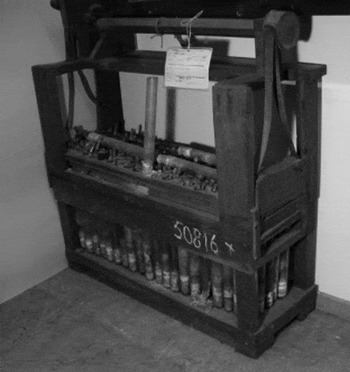
The only comparable continuous source of electricity was a high-voltage battery – a very expensive and time-consuming piece of nineteenth-century ‘big science’.Footnote 103 It took Hittorf several years to achieve a final number of 2,400 elements in a Bunsen battery and a voltage of almost five thousand volts in 1883 (see Figure 3).
Remains of Hittorf's battery in the Deutsches Museum, Munich. Photo by Bernhard Taufertshöfer.

Most parts of Hittorf's battery were handmade, and only lucky incidents such as the provision of industrially produced graphite electrodes for arc lamps helped to accelerate the laborious work.Footnote 104 In addition he needed a technology which allowed him to handle several thousand volts and still comply with the high requirements of precision measurement (switches, resistances, measurement instruments). For example, he developed specific electrolytic resistances that were more suited to his purposes (and skills) and turned out to be more reliable than resistance coils. To decide whether the conduction process was continuous or not Hittorf used capacitors which would discharge or a Siemens telephone which gave the buzzing sound of a mosquito if the conduction were intermittent. These instruments served not only to indicate a continuous conduction of the current but also as indicators for the proper operation of the apparatus.
In the meantime, before he was able to use the battery, he continued to work with the pulsed current. As he remarked, this should suffice to do qualitative experiments and explore the performance of the experimental setup. As long as he believed that gaseous conductivity only occurred at very high temperatures induced by the electric current, it seemed clear that the highest standards of precision could not be achieved anyhow because of the supposedly high temperatures at which every known material stopped behaving like an isolator: ‘Hence in gaseous media we are not able to confine the electric current to a restricted, geometrical path. Therefore we will possibly never reach the precision we easily accomplish in measuring the electric properties of metallic bodies.’Footnote 105
An important condition for the stabilization of the current was the technical control of vacuum conditions over a wide range. The glass bulbs could serve as containers for producing and holding high vacua only after the provision of a sufficiently vacuum-tight fusion between the metallic terminals and the glass wall, and after the source of various substances contaminating the interior of the tubes could be identified. Apart from some innovations that emerged from his chemical expertise – most importantly the introduction of phosphorus pentoxide as a drying agent instead of sulphuric acid, which gave off gases at high vacua – Hittorf's improvements in vacuum technology mostly owed to the application of the spectroscope. The spectroscope made visible the finest cracks in glass walls or the disturbing effects of the materials used by detecting even the faintest quantities of nitrogen or other substances.
During their joint investigation Hittorf regularly informed Plücker about leaking tubes and problems with the changing quality of glass. Occasionally he reported on observations of new effects which mostly turned out to be caused by impurities that had not been considered before, for example tiny splinters of glass.Footnote 106 In May 1863, for a short time Hittorf even believed he had discovered a new chemical element contained in a sample of arsenic. Since the discovery of a new element would have been a major success, Plücker feared strong competition and pushed for immediate publication. Hittorf remained sceptical because arsenic had been investigated by many of the most able chemists of the time and nobody had noticed the new lines; fortunately these chemists did not work with discharge tubes and this seemed a decisive advantage.Footnote 107 In the following letter he announced the ‘discovery of a new chemical element by means of spectrum analysis’.Footnote 108 But the complex chemical analysis and the isolation of the new substance did not yield definite results; shortly afterwards Hittorf had to admit that the four new lines he had noticed did not indicate a new substance but belonged to the mercury spectrum. Although not successful in terms of eternal fame, the weeks of feverish and intensive work turned out to be important for a better understanding of the problems he had to master.
While other researchers were quite content, or had to make do, with the vacua they produced (or they bought at Geissler's), with the spectroscope Hittorf introduced a device into his apparatus that forced him to continue and intensify his search for leakage and gases escaping from the drying agent, electrodes or films of water on the glass surface. Whenever the conditions changed, when he reached higher evacuations, or increased the electrical potential at the terminals, new problems showed up. Suddenly tubes would burst and Hittorf had to test new combinations of glass and wire.Footnote 109 Frequently solutions to problems arising demanded the introduction of new materials or instruments and eventually the recalibration of the whole experimental setup.
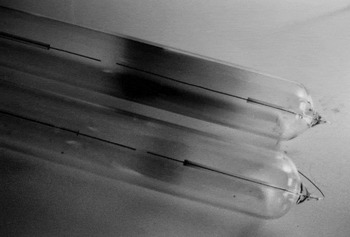
Reconstruction of a pair of tubes with cathodes made of platinum wire of different lengths. A deposit of platinum is visible on the glass wall. Photo by the author.

The electrodes remained another bottleneck of the whole apparatus because the occlusion and emission of gases were very difficult to control. For some experiments, particularly those conducted in very high vacua, he used platinum wires which were partly coated with layers of soft glass before being fused into the glass wall, a method that helped to prevent the occurrence of cracks and leakages even when the cathode was heated up in the discharge process.Footnote 110 However, in these tubes a layer of platinum was deposited on the glass around the cathode (see Figure 4). Alternatively, he worked with aluminium wires that could not be fused directly into the glass wall but instead were inserted into a capillary tube that itself was inserted into a nozzle attached to the tubes’ ends. The wire and the capillary tubes were glued in with sealing wax. This method preserved high vacua for several days before they had to be renewed and at the same time provided the high level of flexibility Hittorf needed in his experiments. As in his electrolytic studies, Hittorf aimed at the construction of an experimental apparatus assembled by as simple and manageable means as possible. Therefore the terminals were plain wires without any plates or other objects attached because the interface between the metallic and the gaseous conductor had to be kept as simple and practical as possible.
In 1864 the Royal Society's referee of Hittorf's and Plücker's joined paper had doubted the quality of Hittorf's vacuum:
Dr. Plücker says that Geisler’s [sic] mercurial Airpump exhausts so completely that the discharge of Ruhmkorff’s small induction machine will not pass through its vacuum. My reason for thinking there is some mistake here is that (besides the presence of … water adhering (which he admits) on the glass) such a vacuum cannot be better than a good Torricellian one in which there is always present enough of mercurial vapour to conduct. Mr. Gassiot found this to be the case till he cools the tube far below the freezing point of mercury. Perhaps in Dr. Plücker's experiments, the condenser of the induction machine may have been disconnected.Footnote 111
To support Hittorf's claim, Plücker sent some tubes to London for inspection.Footnote 112 Hittorf hoped in vain to keep the preparation procedure secret for sufficient time to gain advantage particularly over John Peter Gassiot, whose equipment and financial possibilities considerably exceeded his own.Footnote 113 Unfortunately, Plücker did not show much appreciation of his collaborator's efforts. Already in 1866 he had passed some of Hittorf's secrets to Gassiot.Footnote 114 In 1867 Hittorf travelled to the world fair in Paris where the largest available Ruhmkorff coil, which discharged through 40 centimetres of ordinary air, showed no effect on his resistance tubes although the electrodes were only a millimetre apart.Footnote 115
Before Hittorf was able to publish a written account of their preparation, Geissler produced and sold these tubes as ‘Hittorf's resistance tubes’ and advertised them as containing ‘perfect vacuum’; material evidence of Hittorf's achievements travelled faster than the written word. These tubes were seen by many contemporary scientists as ‘the proof that a vacuum would not conduct electric current’.Footnote 116 As late as 1876, William Crookes in London purchased a ‘light mill’ from Geissler with a discharge tube attached containing, as he claimed, a ‘perfect vacuum’:
the distance between the ends of the platinum wires inside is about a millimetre. A spark which will strike across about an inch in air and any number of feet in an ordinary vacuum tube absolutely refuses to strike across this millimetre of space … Dr. Geissler has got some secret for making these non-conducting which I have not.Footnote 117
Crookes not only adopted some of Geissler's improvements in the construction of his radiometers but also noticed a green fluorescent light he had been unaware of in his own studies. Later on this light was used as indicator to calibrate his vacuum technology: hence a good or very good vacuum was labelled ‘green’ or ‘very green’. Via Geissler's workshop, Hittorf's vacuum exerted a substantial influence on the further development of Crookes's vacuum technology.Footnote 118 Hittorf himself, though, followed Plücker's maxim that an absolute vacuum was a fiction comparable to the mathematical pendulum; such a status could only be approximated but never reached.Footnote 119
Apart from various tricks, the preparation of extremely high evacuations demanded long hours of labour.Footnote 120 There is no evidence that Hittorf delegated this kind of work to other helpers; instead he praised its positive effects as a balance to intellectual work.Footnote 121 When Plücker fell ill after he had switched back to geometrical studies, Hittorf urged him to return to his experimental work: ‘I presume, the new geometry is responsible for your bad health since it enforces a sedentary mode of life. Hopefully, this work will soon be finished and you can return to physics, which comprises physical activities and exercise.’Footnote 122 Hittorf used a Geissler pump in which the tubes were attached to a reservoir. This reservoir was filled with and emptied of mercury by lowering and raising another mercury-filled reservoir. To achieve even higher evacuations Hittorf constructed an apparatus where the tubes were kept in boiling sulphur at 447°C for several hours while the evacuation continued; with other substances even higher temperatures could be achieved. At some point a galvanic current would heat a platinum wire looped around the tube's neck and seal the tube.Footnote 123
The performance of these tubes did not rely solely on the material of the terminals and quality of the vacuum. Another important factor that influenced the resistance at the cathode was the shape and material of glass tubes and terminals. The realization of such a dependency was an important factor in Hittorf's initial decision to focus on the negative light and its strange resistance:
The experiments of recent days have revealed that the insulating properties [of the tubes] depend not only on the degree of rarefaction but also on the shape and size of the tubes … I am forced to return to my studies on the resistance of the negative light that I abandoned and left unfinished 5 years ago.Footnote 124
In his experiments Hittorf used specifically constructed tubes with two or more terminals to observe the relative development of the electric resistance in the positive and the negative light with varying pressure; or he used parallel circuits in which pairs of tubes with only minor variances (different material or surface size of the terminals, shape of glass tubes and so on) were inserted in order to investigate and compare the electrical properties.Footnote 125
Hittorf was able to show that the electric resistance varied with the material, shape and surface area of the cathode. It depended on the pressure and increased if the distance between the surface of the cathode and the glass wall was small. The last feature was used in his famous Umwegröhre or ‘detour-tube’, where the direct discharge between two nearby terminals seemed to be prohibited even at moderate vacua while a bright glow could be seen in an additional, spiral capillary tube which connected the glass space around the two terminals. Obviously the knowledge of the sensitive correlation between the shape of the tubes, the electrodes and the electric properties was important for understanding and manipulating the conditions supporting or prohibiting the discharge process. As a result Hittorf gained a sound understanding of the interdependencies of tube design and electrical properties. Hittorf could show that processes causing the resistance happened in the gaseous atmosphere surrounding the cathode and were dependent on various factors; for some time he even speculated that they were partly caused by counteractive electromotive forces comparable to secondary effects close to the electrodes in electrolysis. On the technical side, these studies resulted in a considerable reduction of resistance at the cathode, for example if tubes with a wide space around the cathode were used.Footnote 126 In addition, these experiments opened up possible ways to obtain continuous and ‘normal’ conduction on the whole distance between the poles. In 1879 Hittorf could even show that between two additional terminals that were placed perpendicular to the direction of discharge in a discharge tube, continuous conduction could be maintained with only few elements of his battery.Footnote 127
In the late 1870s Hittorf more or less completed the second phase of his studies. He was able to vary vacuum, electric current, voltage and some elements of tube design almost continuously and over a wide range. Particularly the technical preparation of vacuum technology helped Hittorf to observe the quasi-continuous, morphological transformation of previously distinct phenomena into each other. Already in 1869 he had celebrated this feature: ‘While the gas passes through all degrees of attenuation the discharge continues. This procedure provides an easy access to the changing luminous patterns of the conduction process.’Footnote 128 Now he had not only optimized his vacuum equipment but could vary the intensity of electric current and voltage in a similar way. On a phenomenological level these specific preparations of his experimental system provided insights into the complexity of the phenomenology he was dealing with; it helped to foster a qualitative and intuitive control of the experimental conditions and provided comprehension of the phenomenological manifold as a whole.
In 1879 Hittorf had announced an important feature of the future programme of his studies:
The measurement of the quantity of heat and the intensity of light which are produced in a portion of gas of constant mass and volume in a time unit by the constant current of a galvanic cell is of fundamental importance for a deeper understanding of the conduction process in gases.Footnote 129
Already in 1865 Plücker and Hittorf had observed the dependence of the appearance or extenuation of single lines of a specific spectrum on the resistance placed in the electric circuit and announced the ‘exact characterisation of the wave lengths’ for a subsequent publication.Footnote 130 In 1879 the research project had reached a status Hittorf had been aiming at: to carry out precise and absolute measurements of those physical quantities that characterized the dynamic properties of gaseous conduction. Among other things, these measurements would have provided data on the amount of energy necessary to induce and maintain the conduction and emission process; possibly they would have helped to understand better the interaction between matter and electrical energy. One of the few examples from this phase of precise and absolute measurements of physical properties with an exemplary character is an instrument which included several additional electrodes which were used as probes for mapping the variation of potential inside the tube.Footnote 131 However, Hittorf's health problems in the early 1880s and the complexity of these measurements seem to have delayed and eventually prohibited what I called in the introduction to this paper the third phase of his research project. Hittorf's last publication on gas discharge in 1884 anticipated a final conclusion that he never presented.
Epilogue: some controversies and misunderstandings
In late 1878 the British chemist, businessman and science journalist William Crookes (1832–1919) gave the first public account of his own investigation of gas discharge phenomena. In Crookes's understanding, the electrodes did not serve as interfaces that mediated between different types of propagation of electricity but as surfaces at which kinetic energy was transferred to particles.Footnote 132 Crookes believed that in highly evacuated tubes gas corpuscles would vertically emanate from heated or electrically stimulated surfaces in a highly ordered state on parallel, non-colliding trajectories. This was a concept Hittorf could not accept. He had witnessed similar theories by the followers of a Weberian electrodynamics in Germany. For example, in 1872 Gustav Wiedemann and Richard Rühlmann had attacked Hittorf's electrodynamic interpretation of gas discharge and his conception of a variable electric resistance located in the space between the two terminals. Instead they favoured an electrostatic understanding: electric charge accumulated at the terminals until it discharged instantaneously through space. In addition they offered another explanation which much more resembled Crookes's understanding: charged molecules were repelled from the electrodes due to electrostatic forces and they transferred the electric charge to other molecules or even crossed the whole space between the electrodes.Footnote 133 Hittorf judged these theories a mere continuation of a conceptual framework which could be dated back to Charles Augustin Coulomb's experiments on the loss of charge in vacuum conducted in the late eighteenth century. He did not see, though, that Crookes was not interested in gaseous conduction but explored cathode rays or ‘radiant matter’ as an independent phenomenon, an expression of a new aggregation state of matter.Footnote 134 Hittorf meticulously explored the phenomenology of cathode rays and anticipated much of what Crookes later presented in his publications as new discoveries, but he was not overly interested in their ray-like character.Footnote 135
Another reason for opposing a Weberian understanding of these processes, not particularly important to Hittorf but important to many other German researchers, was the vehement support of Weber's theories by his self-proclaimed closest follower, devoted enemy of the ‘Berlin physicists’ around Hermann von Helmholtz, and admirer of William Crookes, the occultist and astrophysicist at Leipzig University Friedrich Zöllner.Footnote 136 Zöllner conceived Crookes's experiments on radiant matter as an affirmation of a theory of so called ‘electric rays’ which had been proposed by Wilhelm Weber in the mid-1870s and since then further developed by Zöllner himself.Footnote 137 For these and other reasons Hittorf could not concede to any corpuscular understandings of gas discharge phenomena. Instead, he tended to an electrolytic understanding of the gaseous conduction process.Footnote 138 For example, in order to explore the temperature dependence of electric conduction in gases and the possible role of electrolytes in these processes Hittorf conducted experiments on the propagation of electricity in flames.Footnote 139 In 1878 he had emphasized that only ‘matter and no specific fluids’ should be considered carriers of the conduction process and he added, ‘If I exclude two electrical fluids as carriers of these processes I certainly cannot accept a single fluid or the optical ether to adopt such a role.’Footnote 140 Hittorf published cautious considerations on the electrolytic character of gaseous conduction at the end of his third paper on gaseous discharge in 1879. Empirical evidence argued against such a thesis and he could not find a satisfactory solution to his conceptual problems. From his publications it is not clear how exactly (if at all) Hittorf imagined these processes to take place. Eventually, from a conceptual point of view, Hittorf's research remained an open project. Because he had noticed a mistake in the experimental set-up he withdrew the last paragraph of the publication which further complicated the reception of his theoretical considerations. As a consequence this paragraph was not included in the English translation of his paper and therefore never came to the attention of most of his British colleagues.Footnote 141 Some of his improvements in vacuum technology and instrument design, though, made their way to Britain.
In 1901, in a letter to Wilhelm Ostwald, Hittorf was still complaining about the ‘theory of electrons which has gained a new popularity and found a dedicated advocate in [Walther] Nernst’.Footnote 142 At age seventy-eight, he did not acknowledge, though, that the concept had changed considerably since the old days of electric fluids. Possibly the toll he had paid in his attempts to accept and understand Maxwell's electrodynamics with its emphasis on continuous fields and differential equations was too high for moving back into a mind frame that seemed antiquated.