Eskimo–Aleut languages are spoken across the circumpolar regions from Siberia through Alaska and northern Canada to Greenland. Over the past 100 to 200 years, however, these regions have experienced increasing contact with speakers of other languages, particularly Russian, English, French, and Danish. Depending on the dynamics of this contact, the Eskimo–Aleut languages have faced decline of varying degrees. Several factors have played a role in this decline, including the timing of contact with foreigners, the timing of the development of a writing system and literacy, the timing of the advent of schooling, and the support for the Eskimo–Aleut language within school instruction. In the westernmost regions, Eskimo–Aleut languages have declined significantly such that there are few speakers left among the Eskimo–Aleut population in Siberia, less than 50% in Alaska, and only about 25% in western Canada (Dorais, 1990, 1992). In Labrador, the number of remaining speakers is also very small. In most of eastern Canada and Greenland, however, virtually all Inuit still learn an Eskimo–Aleut language from birth and continue to speak it throughout their life. The language contact situation in Greenland has evolved such that all Greenlanders grow up fluent in Greenlandic, receive instruction in Greenlandic throughout their schooling (including some courses at the University of Greenland), and learn Danish as a second language (L2) at school (Dorais & Sammons, 2002, p. 117). The situation in eastern Canada, however, is still in a state of flux. In this paper, I explore the potential for the future of Inuktitut, the Eskimo–Aleut language spoken in that region. Given the currently pervasive use of English, it is unlikely that the language situation in eastern Canada will develop like that of Greenland. Depending on choices made by speakers and institutions, it could move to a situation of stable bilingualism within the next couple of decades, or equally well to a situation in which Inuktitut gradually or rapidly declines in favor of English and French.
CURRENT LANGUAGE SITUATION
Of the 137,000 speakers of Eskimo–Aleut languages worldwide, some 29,000 are in Canada (Statistics Canada, 2001). Of these, 18,605 are in Nunavut (the Inuit territory established in 1999) and 8,620 are in Nunavik (the Inuit region of northern Quebec). The remaining speakers are in the Northwest Territories (765) and Labrador (550), regions where relatively few Inuit still speak an Eskimo–Aleut language (Statistics Canada, 2001).
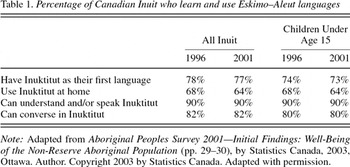
As shown in Table 1, a large percentage of Canadian Inuit (calculated across all four of the regions just mentioned) still learn and use their native language. In fact, this is by far the highest percentage of speakers for any Canadian aboriginal population. It is one of the few aboriginal languages in North America for which a chance of long-term survival is projected (Foster, 1982; Priest, 1985). Numerous studies attest to the fluent acquisition of Inuktitut by preschool Inuit children in Nunavik (e.g., Allen, 1996; Crago & Allen, 1998; Swift, 2004), as well as to the strong Inuktitut abilities of school-aged Inuit children in the early grades (e.g., Allen, Crago, & Pesco, 2006; Crago, Annahatak, Doehring, & Allen, 1991; Wright, Taylor, & Macarthur, 2000). Studies with children in these age ranges in Nunavut show similar results (e.g., Parkinson, 1999).

In the 2001 census, 440 Inuit in Nunavut identified themselves as simultaneous bilinguals, speaking both Inuktitut and either English or French from birth (Statistics Canada, 2001). This constitutes about 2% of the Inuit population. Although similar figures are not available for Nunavik, a similar percentage is likely. Virtually all other Inuit under the age of about 50 years have become bilingual in either English or French through schooling. Schooling began in this region around 1960, so individuals who were born before then typically do not speak a language other than Inuktitut (Dorais & Sammons, 2002). In most communities in this region, school is taught in Inuktitut through the end of Grade 2. From Grade 3 onward, children are instructed in either English or French (according to their family's choice) for the majority of subjects. Instruction in Inuktitut continues for subjects such as physical education, culture, religion, and Inuktitut. In recent years, curricula have been developed for some content subject instruction in Inuktitut. In larger communities such as Kuujjuaq and Iqaluit, instruction is available in both English and French from kindergarten. Some communities also offer full Inuktitut instruction through Grades 3 or 4, depending on availability of qualified teachers.
Exposure to English and French through community interaction is also very common, especially in larger communities (Dorais, 1996; Dorais & Sammons, 2002; Taylor & Wright, 1990). Inuktitut is typically used in domestic situations: in the home, in social situations, and in traditional occupations such as hunting and fishing. English and French are typically used in economically more prestigious situations including specialized work, school, and government posts. These are often situations in which at least one employee is not Inuit. English is typically the lingua franca among speakers of different languages, even though anglophones are the minority population (between 5 and 35%, depending on the community; Dorais & Sammons, 2002). Non-Inuit rarely learn more than a few common words and phrases in Inuktitut, even if they are long-term residents of Inuit communities with Inuit spouses.
Finally, English and French are prevalent in the media (Dorais, 1989, 1996; Taylor & Wright, 1990). The average home has two television sets, and the television is on an average of 3.25 hr per day. Only 35 min of programming per day is available in Inuktitut, so most of the television exposure is in English or French. It is not uncommon for the television to remain on throughout the day in the background. Community radio is also very popular. Programming is often in Inuktitut, although many English songs are played as well as regional news reports in English or in French.
Because of the prevalence and prestige of English and French, there is a danger of language shift from Inuktitut to these majority languages, perhaps leading to eventual loss of Inuktitut. This type of language shift has occurred in western Canada and parts of Alaska within one generation. Surveys of language attitudes in both Nunavik and Nunavut indicate that Inuit place a high value on Inuktitut (Crago, Chen, Genesee, & Allen, 1998; Dorais & Sammons, 2002; Taylor & Wright, 1990). However, it is not clear whether there is enough concrete support for the language for its survival to remain viable.
In the following sections of this paper, I review several published studies on language use and proficiency in simultaneous and sequential Inuktitut–English bilingual children to see whether there are any indications of language shift in these populations. Simultaneous bilinguals are arguably on the front lines in terms of danger of language shift. They learn the majority language along with Inuktitut from birth, so have the longest possible period of exposure to the majority language. Most situations of simultaneous bilingual acquisition that have been reported in the linguistic literature are ones where two languages of equal prestige are being learned (e.g., English–French, Spanish–Catalan, German–French, Chinese–English). These are also typically language pairs where the two languages are relatively similar in grammatical structure. By contrast, the Inuktitut–English/French pair manifests very different levels of prestige between the two languages as well as very different grammatical structure. This could lead to imbalanced acquisition of the two languages, with a trajectory toward eventual higher proficiency in the majority language. Sequential bilinguals, those who acquire the majority language in school, are also subject to strong societal and peer influences toward a preference for the majority language.
I first look at two studies with simultaneous bilinguals that investigate the degree to which Inuktitut–English bilingual children mix their two languages, and the degree to which the grammar of one language influences the other. I then look at three studies of older children who have become exposed to English primarily in school. One study looks at the effect of language of instruction in kindergarten (K) through Grade 2, a second looks at the effect of degree of exposure to the L2, and a third looks at the trajectory of language use from Grade 1 through high school.
STRUCTURE OF INUKTITUT
As mentioned earlier, Inuktitut and English are typologically extremely different. Some of the most important differences are mentioned here.
English has basic subject–verb–object (SVO) word order, which is fairly fixed, and both subject and object are typically obligatory. In contrast, Inuktitut has basic SOV word order as shown in Example 1, which is variable according to discourse purposes. Further, over 60% of subjects and objects are typically omitted in spontaneous speech; Example 1 shows an omitted subject. Examples 1 and 2 are from my fieldwork data.


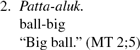
Modifiers such as adjectives, adpositions, possessors, and determiners typically precede nouns in English, whereas they typically follow nouns in Inuktitut, as illustrated in Example 2.
English is morphologically isolating with a small inventory of only eight inflectional morphemes. Inuktitut, conversely, is polysynthetic and agglutinating, with up to 10 morphemes per word, as shown in Example 3.

Over 1,000 verbal and nominal inflections are used in Inuktitut, in addition to more than 400 derivational morphemes.
CODE MIXING
Code mixing is defined here as the use of words or phrases from more than one language within an utterance. Historically, code mixed utterances have been treated as evidence of confusion on the part of the bilingual child (e.g., Lindholm & Padilla, 1978; Redlinger & Park, 1980; Volterra & Taeschner, 1978), and this view is still common among lay people. Substantial research shows that code mixing in adults is linguistically constrained (e.g., di Sciullo, Muysken, & Singh, 1986; MacSwan, 1999; Myers-Scotton, 1993; Poplack, 1980), although opinions differ as to what constraints are followed and whether they differ for languages of different typologies (Muysken, 2000). Research on child code mixing also shows evidence of constraints (Lanza, 1992; Meisel, 1994; Paradis, Nicoladis, & Genesee, 2000). This finding is especially clear once children's speech has some degree of grammatical complexity; before this age it is difficult to determine whether children's mixing is linguistically constrained or merely reflects the input (Deuchar & Quay, 2000).
Virtually all recent research on child code mixing has found mixing to constitute a linguistically healthy bilingual pattern. However, most of this research has been conducted with language pairs that are of equal prestige (e.g., English–French, German–French, English–Spanish, English–Norwegian), and also typically quite similar grammatical structure. It may be that code mixing works differently when the two languages have different levels of prestige. In the Inuktitut–English case, for example, one might expect that code mixed utterances containing English would occur much more frequently than unilingual Inuktitut utterances, because Inuktitut is of relatively lower prestige. One might also expect that code-mixed utterances would be predominantly English with only a few words of Inuktitut mixed in to express culturally significant items. A study of code mixing patterns in Inuktitut–English simultaneous bilingual children would reveal any evidence of a diluting of or a decline in use of Inuktitut. I am only aware of one study of Inuktitut–English code mixing, Allen, Genesee, Fish, and Crago (2002), which is reported here.
This study was conducted with five bilingual Inuktitut–English children, all of whom have two bilingual parents of Inuit heritage, and who lived in large settlements in Nunavik and Nunavut. The children were ages 1;8 to 2;11 at the onset of the study, and were videotaped four to six times at regular intervals over the period of 1 year. The children were observed in their homes engaged in natural conversations with their families and peers.
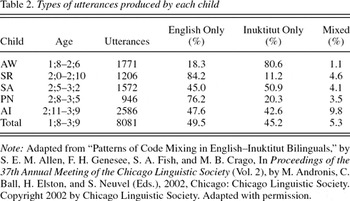
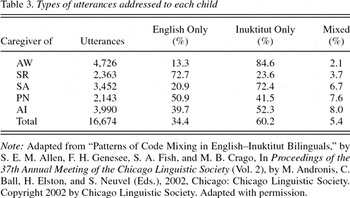
Tables 2 and 3 show the frequency of use of mixing, as well as utterances in each language, in the speech of the children and their caregivers. The rates of mixing are similar across children and adults, and the average rate of mixing for children is similar to that found in other studies of child mixing (e.g., Genesee, Nicoladis, & Paradis, 1995). Children also pattern like their caregivers in the percentage of utterances spoken in each language. However, children overall produce more utterances in English than do their caregivers.


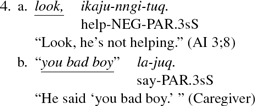
The mixes in the data largely follow four clear patterns (all examples and percentages taken from Allen et al., 2002). Almost a third of the mixes (36.4% for caregivers, 32.7% for children) constitute a tag or quotation in one language, with the remainder of the utterance in the other language, as seen in the examples in Example 4. There is no grammatical relationship between the parts of the utterance in each language. To indicate the difference between the two languages, the English portion of the utterance is underlined in each example.
In the second type of mixing, which accounts for a further half of the mixes (51.5% for caregivers, 48.7% for children), one content word in English (noun, verb, or adjective) is mixed into an utterance otherwise in Inuktitut. Examples of this pattern are shown in Example 5.

Here, the isolated word in English follows the grammar of Inuktitut. It appears in positions in the sentence where Inuktitut but not English words of that class could appear, and takes the appropriate inflectional markings of Inuktitut but not English. This type of mixing is often called insertional mixing (Muysken, 2000) or nonce borrowing (Poplack, Sankoff, & Miller, 1988).
The converse pattern is shown in Example 6, where a content word in Inuktitut appears in an otherwise English utterance. It accounts for a much smaller proportion of the data (2.6% for caregivers, 6.8% for children).
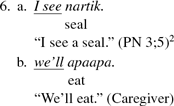
To be completely grammatical in adult English, utterance Example 6a should include the article a immediately before the noun nartik (seal). Because articles are often omitted in monolingual English child language at this age, however, we treat this utterance as grammatical by the rules of child English. In addition, the adult form of the word “seal” is natsiq or nattik; nartik represents this child's idiosyncratic pronunciation of the word.
Here, the relevant word appears in positions in the sentence where English but not Inuktitut words of that class could appear, and takes the appropriate inflectional markings of English but not Inuktitut.
A fourth type of mixing (Example 7) is one in which a full phrase or more of the utterance appears in each language. Again, this accounts for a relatively small proportion of the data (6.0% for caregivers, 7.1% for adults).

In this type of mixing, each phrase follows the grammar of its own language. Further, the point in the utterance where the mixing occurs is one at which the surface word orders of the two languages co-occur. Thus, neither grammar impacts the other. This is often referred to as code switching (Poplack, 1980) or alternational mixing (Muysken, 2000), because there appears to be a complete switch or alternation from one grammatical system to the other.
These four types of mixing account for virtually all of the mixed utterances in the data from both adults (96.5%) and children (95.3%). Only a small number of utterances fall outside these constrained patterns, such as exemplified in Example 8.

These appear not to conform to linguistic constraints. For example, utterance Example 8a cannot be an example of insertional mixing because it would not be grammatical in either language. The verb does not have the appropriate inflections for either English or Inuktitut. Utterance Example 8b also is not grammatical in either language: the possessive is not correctly placed for an Inuktitut utterance (should be tuttiaria-t “pencil-ABS.2Ssg”), and the word order is not correct for an English utterance. These utterances could reflect performance errors because they constitute less than 5% of the total mixed utterances.
We concluded from these data that code mixing in Inuktitut–English bilingual children does not reflect linguistic confusion on the part of the child, but rather adultlike adherence to linguistic constraints that govern mixing. Further, the mixes are sensitive to the typological differences between the two languages. The vast majority of mixes are ones in which there is minimum interaction between the grammar of the two languages: tag or quote mixes, or mixes of single words that are treated as words of the other language. This reflects the child's knowledge that there are few points where the grammars of the two languages are similar enough to permit code switching or alternational mixing of the type illustrated in Example 7, and is evidence that children maintain distinct grammars for their two languages even when using them together in the same sentence.
The mixing also does not reveal any evidence of a diluting of or decline in use of Inuktitut. Children mix in about 5% of utterances overall. This is consistent with the rate of mixing by adult English–Inuktitut bilinguals, as well as the rate of mixing by child bilinguals learning languages of equal prestige such as English and French (e.g., Genesee et al., 1995). The use of mixing is also much less frequent than the use of unilingual Inuktitut utterances, which constitute an average of 45% of these bilingual children's utterances. Further, the data fail to reveal any evidence of weakening Inuktitut in the structures of mixing. Children produce many more utterances mostly in Inuktitut with just one word of English (49% of mixed utterances) than utterances in English with one word in Inuktitut (7% of mixed utterances).
Two aspects of the data warrant further attention as to their implications for language decline. First, the child bilinguals use more English-only utterances than do their caregivers, both as a group (50 vs. 34% of total data) and in each individual child–caregiver pair. Second, children produce more mixed utterances that are predominantly in English (7% of mixed utterances) than do their caregivers (3% of mixed utterances). Both these results indicate that English may be becoming somewhat more prevalent.
CROSS-LINGUISTIC INFLUENCE
Another way in which the two languages of a bilingual could interact is for one language to influence the grammar or pronunciation of unilingual utterances in the other. This phenomenon is referred to as “cross-linguistic influence” in the bilingual acquisition literature, and as “transfer” in the literature on L2 acquisition. In L2 acquisition, the first and stronger language typically influences the second and weaker language such that, for example, learners impose first language (L1) grammatical patterns on the L2. In fluently bilingual children learning two languages of equal prestige, it has been argued that the influence tends to be governed by linguistic rather than proficiency constraints; for example, the structure must involve both syntax and pragmatics (Hulk & Müller, 2000) or an infrequent structure in one language must be strongly reinforced by a competing structure in the other (Döpke, 2000). However, in the case of Inuktitut–English bilinguals who are learning languages of different prestige, it may well be the case that the grammatical rules of the more prestigious language would prevail.
Subject realization is one aspect of language that tends to differ markedly across languages and thus is ripe for cross-linguistic influence. Many languages such as Spanish, Italian, Japanese, and Chinese permit and even require omission of subjects whose identity is already evident from verbal inflection or from the discourse. Other languages, such as English, typically require the subject to be overtly expressed except in imperatives and certain other highly constrained constructions. At least four studies have been reported to date on cross-linguistic influence in subject realization in child simultaneous bilinguals: Catalan–English (Juan-Garau & Pérez-Vidal, 2000), Italian–German (Cantone & Schmitz, 2001), Italian–English (Serratrice, Sorace, & Paoli, 2004), and Spanish–English (Paradis & Navarro, 2003). Note that all these pairs contain two languages of roughly equal prestige. None of the former three studies found evidence of cross-linguistic influence in the relevant age range. Although Paradis and Navarro (2003) did find such influence (the child's Spanish contained more overtly expressed subjects than was typical in the speech of monolinguals), they attributed it to the caregiver speech that the child was exposed to (her nonnative mother also used a very high rate of subjects in her Spanish) rather than to cross-linguistic influence.
The overall picture, then, is that cross-linguistic influence is not found in the domain of subject realization. However, perhaps this would be different if the child were learning two languages of differing prestige. Then perhaps the grammar of the more prestigious would be salient, and the child would tend to follow that grammar to yield different output than that of similar-aged monolingual children. One study of cross-linguistic influence in subject realization in English–Inuktitut bilinguals is reported in the literature (Zwanziger, Allen, & Genesee, 2005). The findings of this study are summarized in the following paragraphs.
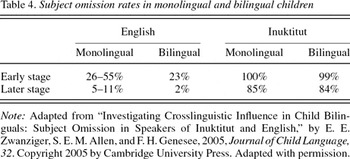
Subjects are typically omitted in Inuktitut; they are only present when specific information is needed to either identify the referent or disambiguate it from other potential referents. Monolingual children up to about age 2;0 omit virtually all subjects (Crago & Allen, 1998), and children from this age on omit subjects in about 85% of utterances with verbs (Allen & Schröder, 2003). In English, in contrast, subjects in main clauses are typically obligatory except in imperatives. English-speaking children typically omit subjects more often than adults in the early stages of language learning; reports in the literature range from 26 to 55% of subjects omitted before the age of 2;6 (Bloom, 1990; Valian, 1991; Wang, Lillo-Martin, Best, & Levitt, 1992). After this age, omissions decrease to an adult level of between 5 and 11%. An Inuktitut–English bilingual child who is experiencing the influence of the more prestigious language (English) on the less prestigious one (Inuktitut) would likely produce more subjects than is typical in Inuktitut. If that child experiences no influence, however, the omission rate will be consistent with that of monolinguals in each language.
Zwanziger et al. (2005) explored this question with six English–Inuktitut bilingual children. Five were in families with two bilingual parents of Inuit heritage, and lived in large settlements in Nunavut and Nunavik (these are the same children that were studied in Allen et al., 2002). The sixth had an English-speaking father and a bilingual mother, and lived in a small settlement in Nunavik. All children were between 1;8 and 2;11 at the onset of the study, and were videotaped four to six times at regular intervals over a 1-year period in naturalistic situations in their homes. The results from all children averaged together are shown in Table 4.

These data show no evidence for cross-linguistic influence in subject realization. The bilingual children follow the same developmental patterns as do monolinguals in each of their languages. In this domain, at least, there is no support for the idea that the children's Inuktitut is declining by being influenced by English grammar. Rather, these bilingual children appear to possess nativelike knowledge of the different target patterns in each of their two languages.
FROM PRESCHOOL SIMULTANEOUS BILINGUALS TO SCHOOL-AGED BILINGUALS
These two studies taken together suggest that preschool bilingual children learning English and Inuktitut together in the home are fully proficient in both languages, at least for the structures investigated. Although there is some indication that these bilingual children use more English than their caregivers do, nonetheless, there is no indication that English is completely replacing Inuktititut at this age, or that Inuktitut abilities are being diluted by English.
What happens once children enter school where they are exposed to English many hours each day in a high prestige context? Does this somehow alter the balance so that English takes over? The school policy in Nunavik is officially one of additive bilingualism: teaching another language in addition to the first one, rather than at the expense of the first one. School board policy is “to develop a curriculum that embraces and preserves native traditions, culture, and language, and prepares students for active participation in the modern world” (Kativik School Board, 1985). However, many parents informally report a progressive decline in their children's Inuktitut once the children begin to be educated in their L2 at school. In interviews, adults report that children are losing interest in Inuktitut language and culture, and that they are losing L1 proficiency as a result of L2 schooling (Kativik School Board, 1998; Nunavik Educational Task Force, 1992; Spada & Lightbown, 2002; Taylor & Wright, 1990). Several studies have begun to investigate these and similar reports more systematically. I review three of them here.
EFFECT OF EARLY LANGUAGE OF INSTRUCTION
As stated earlier, children in eastern Canadian Inuit communities are typically educated in Inuktitut in kindergarten through Grade 2. In larger communities, however, instruction is available in both English and French. Does receiving instruction in the majority language at school have any effect on the Inuktitut of children who are monolingual native speakers of Inuktitut? Wright, Taylor, and Macarthur (2000) investigated this question in one community in Nunavik.
The study included all children in that community who entered kindergarten over a 4-year period, and followed each child through their first 3 years of school. Participants were either of Inuit parentage and native speakers of Inuktitut (n=63), of mixed Inuit and non-Inuit parentage and native speakers of English (n=25), or of non-Inuit parentage and native speakers of French (n=8). Crucially, a portion of the participants in each group received school instruction in each of Inuktitut, English, and French.
Between 16 and 20 tests of language ability in each of the three community languages (Inuktitut, English, French) were administered to each participant at the beginning and end of each academic year. Results on these tests were averaged to yield one measure of general language proficiency. Further, results on particular tests were averaged to yield separate measures of conversational and academic language proficiency. Following Cummins (1989), the authors define conversational proficiency as “the type or level of proficiency required to carry on contextualized day-to-day verbal interactions with other native speakers,” typically ones that “require relatively simple, repetitive and automatic language processing” and “in which the situation or context provides much of the meaning” (Wright et al., 2000, p. 66). This was assessed by tests of vocabulary comprehension, production of simple context-embedded vocabulary, sentence comprehension, concrete general knowledge questions, and naming as many items as possible in a given category (e.g., food, animals). Academic language proficiency, in contrast, “allows for communication in decontextualized settings that require manipulation of abstract forms of the language,” including the ability “to use that language to analyze [one's] own thoughts and to use the language in cognitive problem-solving” (Wright et al., 2000, p. 66). This was assessed by tests of production of difficult vocabulary items, story comprehension questions relying on inference from the story, general knowledge questions relying on inference or abstract linguistic skills, sentence completion tasks, letter identification, sight word reading, and sentence reading.
I report here only the results for Inuit children who were raised in homes with only Inuit parents and were native speakers of Inuktitut. These participants were divided into three groups: those who received kindergarten to Grade 2 instruction in Inuktitut, in English, and in French. The researchers asked whether the language of instruction affected the children's general, conversational, and academic proficiency in Inuktitut.
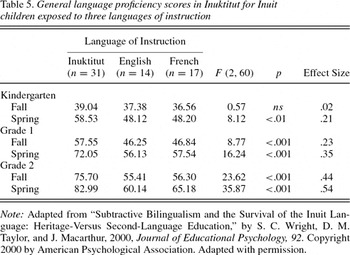
Table 5 shows the results for general language proficiency for each of the three language of instruction groups. Data were analyzed using a multivariate analysis of variance, as well univariate tests and effect size analyses for each test occasion.

At the first time of testing, there is no significant difference in Inuktitut proficiency between the three groups. However, from the end of kindergarten on, there is a significant difference between the children instructed in Inuktitut compared to the children instructed in English and French. There is no difference at any age between the latter two groups. These data clearly show that Inuit children in L2 instruction experience disruptions in the development of their L1 after only 1 year of schooling, with the magnitude of the effect increasing with each subsequent year. The results are similar for both conversational and academic language proficiency as assessed individually, although the differences between the groups are not as large for conversational proficiency as for general and academic proficiency.
Note that this disruption in native language proficiency is not simply the effect of being instructed in an L2, whatever that language is. The same set of tests in English was administered to two groups of English native-speaking children in the community, one which received kindergarten through Grade 2 instruction in English and the other in French. The English native speakers receiving L2 (French) instruction did not show the same subtractive effect in their native language proficiency as did the Inuktitut native speakers receiving L2 instruction. This suggests that the effect is specific to minority language students being instructed in a majority language with relatively higher prestige.
These results leave one to wonder what happens to Inuktitut proficiency once all Inuit children receive L2 instruction starting in Grade 3.
EFFECT OF YEARS OF EXPOSURE
As mentioned earlier, many Inuit parents have expressed the fear that their children's Inuktitut begins to decline once they begin L2 instruction in Grade 3. People state that the Inuktitut of children in Grade 8, after 5 years of school exposure to the L2, is worse than their Inuktitut in Grade 3, in their first year of school exposure. Further, parents fear that the Inuktitut of children living in large communities is worse than the Inuktitut of those living in smaller communities. This is attributed to the greater degree of exposure to the L2 in larger communities.
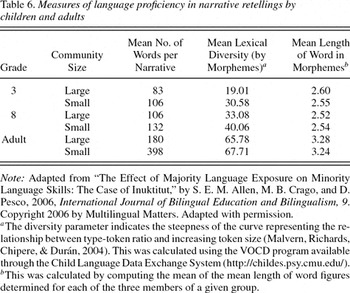
To investigate these observations, Allen et al. (2006) studied the Inuktitut linguistic ability of children in Grades 3 and 8, as well as adults, in both large (population about 1,000) and small (population about 250) communities in Nunavik. All children in the relevant grades participated in the study, as did several adults. Three participants from each grade/age group from each of large and small communities were randomly selected for intensive analysis, for a total of 18 participants.
Participants narrated the Frog Story (Mayer, 1969), a story about a boy who searches for his lost pet frog with his dog and eventually finds the frog after several misadventures. The examples below show typical narrations from each of the groups of the second significant event in the story, the discovery of the disappearance of the frog.

The narratives were assessed for several aspects of linguistic ability: fluency (number of words per narrative), lexical diversity (number of different morphemes per narrative), grammatical complexity (mean length of word in morphemes), grammatical difficulties (e.g., transitivity marking, case, number), and narrative structure (e.g., time setting, descriptive detail).
As shown in Table 6, only one of these measures, mean length of word in morphemes, suggests that language does not develop between Grades 3 and 8. In contrast, several measures suggest that the Inuktitut proficiency of children living in small communities is better than that of same-aged children living in large communities. The number of words per narrative and the lexical diversity are both greater for same-aged groups in small communities, whereas the number of grammatical errors produced is smaller.

These findings are certainly suggestive of first language stagnation as a result of either school or community exposure to an L2. However, a larger study with more participants and more tests would be much more conclusive.
LANGUAGE USE IN THE BAFFIN REGION
The two studies just summarized assessed language health by looking at proficiency in production and comprehension of the language. Another method is to look at how frequently the language is used in interactions in various contexts in the life of speakers. Diminishing use of the minority language (Inuktitut) in the face of increasing use of the majority language (predominantly English) can foreshadow difficulty for the health of the minority language.
Dorais and Sammons (2002) undertook an extensive study of language use in the Baffin region of Nunavut over a 5-year period from 1994 through 1998. Three communities were involved in the study: Iqaluit (4,200 inhabitants including 61.5% Inuit), Igloolik (1,174 inhabitants including 92% Inuit), and Kimmirut (397 inhabitants including 89% Inuit; Dorais & Sammons, 2002, p. 5). Inuit and non-Inuit adults and children were interviewed about their language use patterns at home, at school, in the work place, and in the community. Observations of language use were also conducted at home, school, and work. I report here on language use of the Inuit adults and children in interactions with family and friends.
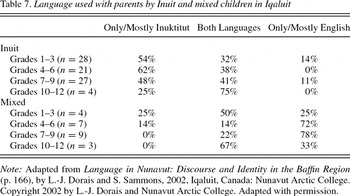
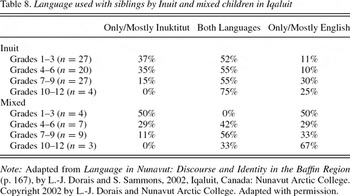
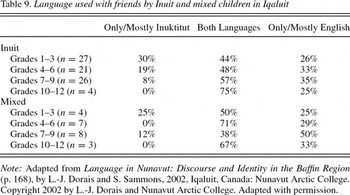
Researchers interviewed 166 Inuit children between Grades 1 and 12 in the three communities, asking them which languages they typically used with their parents, siblings, and friends. Tables 7 through 9 show responses for Inuit children in the largest community, Iqaluit. Data are separated by whether the children are in homes with solely Inuit parents (where predominantly Inuktitut would be expected) or with one Inuit parent and one non-Inuit parent (where more English would be expected).


All the tables reveal the same general trends. The use of only or mostly Inuktitut is most prevalent among the youngest group, and decreases with age. Further, only or mostly Inuktitut is spoken more with parents than with siblings, and more with siblings than with friends; this pattern persists at all ages. In the Grade 10–12 range, only one child out of the seven interviewed speaks only or mostly Inuktitut with his/her parents, and none speak only or mostly Inuktitut with siblings or friends.
Few children with only Inuit parents in any age group speak only or mostly English to their parents (only 14% in Grades 1–3, 11% in Grades 7–9, and 0% for the other two groups). The use of only or mostly English is slightly more common with siblings, increasing from around 10% in Grades 1–6 to around 30% in Grades 7–12. Use of only or mostly English with friends remains relatively constant across ages at between 25 and 35%. Children with mixed parentage understandably speak only or mostly English more frequently with their parents and siblings: English is typically the language used between mother and father in these homes, although the Inuk parent often uses predominantly Inuktitut when speaking to the children. The amount of only or mostly English used with friends is not appreciably different from the amount of English used by children of only Inuit parentage with their friends.
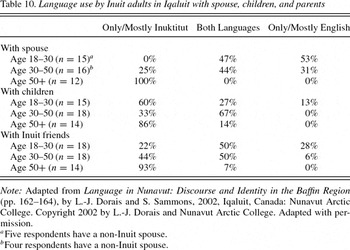
This pattern is paralleled by data from adults, shown in Table 10, many of whom report in interviews speaking only or mostly Inuktitut with their children in preschool and early grades, and gradually using more English with the children as the children begin learning English in school (Dorais & Sammons, 2002, pp. 18–23). Most parents say that they choose to speak Inuktitut with their younger children to give them a solid foundation in the language and in their Inuit identity. For some parents, their goal in moving more to English as their children get older is to provide more practice in English so that their children's English abilities will improve. Others find that their children are no longer able to understand everything they say in Inuktitut, so they switch to English to be understood. For others, the decision does not appear to be a conscious one. Note that most Inuit over the age of 50 are monolingual in Inuktitut because they were never exposed to schooling in an L2. It is not clear what language choices the younger adults of today will make as they age.

Results from the smaller communities, Igloolik and Kimmirut, are overall very similar with regard to the trends described earlier for use of only/mostly Inuktitut versus use of both Inuktitut and English (Dorais & Sammons, 2002, pp. 162–168). However, only a very small number of respondents in each community reported using only or mostly English.
At work, respondents under age 50 in all three communities predominantly reported using both langauges. Many people reported using Inuktitut with Inuit coworkers and customers, and English with non-Inuit coworkers and customers. An observational study in nine workplaces in Iqaluit found that English was used in about 60% of conversational turns overall, Inuktitut in about 25%, and the two languages were mixed in a further 10% of turns (Dorais & Sammons, 2002, p. 53).
It is clear from these data that the use of Inuktitut as the only language of communication decreases gradually with age, especially outside the home. However, the results do not show that Inuktitut is being abandoned in favor of English. Rather, about half the children in every age and parentage group, as well as the adults under age 50, are using both English and Inuktitut in their interactions with all their interlocutors. This is not unexpected for fluent bilinguals: it may simply be a sign of healthy stable bilingualism rather than a warning sign of language loss. These results unfortunately reveal nothing about the level of proficiency in Inuktitut that these speakers possess, so it is not clear whether the richness and complexity of Inuktitut is being maintained despite increasing use of English. However, the results do indicate that Inuktitut continues to be used as a primary language or colanguage of communication on a daily basis by most of the adults and children interviewed.
CONCLUSION
Having looked at data from various research studies that examine language ability and language use in Inuktitut–English bilinguals in eastern Canada, we are now in a position to draw some conclusions about the potential future of Inuktitut in this region. Overall, we see that preschoolers who are both Inuktitut monolingual and Inuktitut–English bilingual attain a very strong command of Inuktitut in their first 4 years. Exposure to English through the media, community interactions, and schooling clearly leads to greater use of that language over time. The Wright et al. (2000) and Allen et al. (2006) studies show that this exposure typically leads to some stagnation of conversational and academic language proficiency in Inuktitut, at least in the domains tested. The Baffin language use study (Dorais & Sammons, 2002) suggests that at least the largest settlement in this region, and to some extent also smaller settlements, seems to be moving to a situation of stable bilingualism where both languages are used both inside and outside the home. Although the use of Inuktitut as a sole language of communication declines with age, Inuktitut is not typically being replaced by English as a sole language, but rather by a balanced use of both languages depending on the interlocutor and the situation. However, Dorais and Sammons (2002) did not look at any measures of language ability. It may well be that speakers continue to use Inuktitut, but with decreased fluency, vocabulary, or complexity compared to monolingual peers (e.g., maintaining conversational language proficiency but gradually losing academic language proficiency). Wright et al.'s (2000) study cautions strongly about that possibility. The experience of Greenland indicates that extending schooling in Inuktitut through Grade 12 would be one effective way to combat such a decrease.
Overall, we conclude that many indicators from the bilingual groups studied suggest that stable Inuktitut–English bilingualism is possible in Nunavut and Nunavik if supportive choices are made in both the home and school environments.
I thank all of the Inuit who have shaped my understanding of the language situation in Nunavik and Nunavut, as well as my fellow researchers in this area including those whose work is mentioned here. Special thanks to Louis-Jacques Dorais and Fred Genesee, who read and commented on a previous version of this article. Virtually all the work discussed here has been funded by one or both of the Kativik School Board and the Social Sciences and Humanities Research Council of Canada. I am most grateful for their continued support of these important questions concerning language survival. An earlier version of this article was presented at the Language Acquisition and Bilingualism Conference in Toronto, Ontario, in May 2006.