Introduction
In 2017, about one million (992,289) embryos globally were produced in vitro, this is a 48.9% increase compared with 2016 (Viana, Reference Viana2018). However, embryos produced in vitro were more likely to be transferred fresh (66.1%) than those embryos produced in vivo (39.9%; Viana, Reference Viana2018), and likely to result from the lower cryotolerance of in vitro produced embryos (IVEP). To improve commercial success, understanding the basic processes of embryo development is essential. Hence, many studies have examined some of these basic processes such as researching embryo metabolism and development under different conditions (Tesfaye et al., Reference Tesfaye, Kadanga, Rings, Bauch, Jennen, Nganvongpanit, Holker, Tholen, Ponsuksili, Wimmers, Montag, Gilles, Kirfel, Herzog and Schellander2006; Rocha-Frigoni et al., Reference Rocha-Frigoni, Leão, Nogueira, Accorsi and Mingoti2013; Zolini et al., Reference Zolini, Carrascal-Triana, Ruiz de King, Hansen, Alves Torres and Block2019).
Intracellular lipid accumulation has been postulated to be an important factor influencing IVEP cryotolerance. l-Carnitine, a small water-soluble molecule and cofactor of β-oxidation, is crucial for the translocation of fatty acids into the mitochondria, which are subsequently metabolized to acetyl-CoA through β-oxidation and potentially produce ATP through oxidative phosphorylation (Sutton-McDowall et al., Reference Sutton-McDowall, Feil, Robker, Thompson and Dunning2012). l-Carnitine also has an antioxidant activity that protects cells from DNA damage (Abdelrazik et al., Reference Abdelrazik, Sharma, Mahfouz and Agarwal2009). Several beneficial effects of l-carnitine supplementation to culture medium have been reported previously such as improved embryo development (Sutton-McDowall et al., Reference Sutton-McDowall, Feil, Robker, Thompson and Dunning2012), lipid metabolism and cryotolerance of bovine embryos (Takahashi et al., Reference Takahashi, Inaba, Somfai, Kaneda, Geshi, Nagai and Manabe2013).
In vitro conditions cannot mimic in vivo conditions, and this can lead to increased levels of reactive oxygen species (ROS) or reactive nitrogen species (RNS; Agarwal et al., Reference Agarwal, Said, Bedaiwy, Banerjee and Alvarez2006), particularly when the culture is conducted under high atmospheric oxygen tension (20%), which is higher than an in vivo environment (5–7%). ROS and RNS are free radicals generated as sub-products of oxygen consumption by the electron transport chain during cellular respiration in the mitochondria (Liu et al., Reference Liu, Fiskum and Schubert2002). However, ROS are necessary for follicles to establish pregnancy (Pasqualotto et al., Reference Pasqualotto, Agarwal, Sharma, Izzo, Pinotti, Joshi and Rose2004), as potential markers in patients for predicting the success of in vitro fertilization (IVF; Attaran et al., Reference Attaran, Pasqualotto, Falcone, Goldberg, Miller, Agarwal and Sharma2000) and during the in vitro maturation of oocytes (Morado et al., Reference Morado, Cetica, Beconi and Dalvit2009). Additionally, RNS are necessary for the development of large antral follicles (Zheng et al., Reference Zheng, Sulieman, Li, Wei, Xu and Shi2015; Dubey et al., Reference Dubey, Tripathi, Singh, Saikumar, Nath, Pratheesh, Gade and Sharma2012), to stimulate meiotic maturation in oocytes (Bu et al., Reference Bu, Xia, Tao, Lei and Zhou2003; Viana et al., Reference Viana, Caldas-Bussiere, Matta, Faes, de Carvalho and Quirino2007), in the ovulatory process (Jablonka-Shariff and Olson, Reference Jablonka-Shariff and Olson1998), in early folliculogenesis up to the maturation step (Pires et al., Reference Pires, Santos, Adona and Natori2009) and in preimplantation embryonic development (Tranguch et al., Reference Tranguch, Steuerwald and Huet-Hudson2003; Tesfaye et al., Reference Tesfaye, Kadanga, Rings, Bauch, Jennen, Nganvongpanit, Holker, Tholen, Ponsuksili, Wimmers, Montag, Gilles, Kirfel, Herzog and Schellander2006). Furthermore, Inoue et al. (Reference Inoue, Sato, Park, Nishikawa, Kasahara, Miyoshi, Ochi and Utsumi2000) determined that a cross-talk of ROS and RNS can regulate circulation, energy metabolism, reproduction, embryonic development and remodelling of tissues through apoptotic mechanisms and act as an important defence system against pathogens. Yet, excessive amounts of ROS and RNS can promote DNA and RNA damage as well as promote several processes that can impair embryo development (Finkel and Holbrook, Reference Finkel and Holbrook2000).
Nitric oxide is an important representative of the RNS group and is produced from l-arginine by action of nitric oxide synthase (NOS) enzyme, which is present in three isoforms: neural (nNOS), endothelial (eNOS) and inducible (iNOS; Tesfaye et al., Reference Tesfaye, Kadanga, Rings, Bauch, Jennen, Nganvongpanit, Holker, Tholen, Ponsuksili, Wimmers, Montag, Gilles, Kirfel, Herzog and Schellander2006). All NOS isoforms have been observed in bovine oocytes and embryos (Tesfaye et al., Reference Tesfaye, Kadanga, Rings, Bauch, Jennen, Nganvongpanit, Holker, Tholen, Ponsuksili, Wimmers, Montag, Gilles, Kirfel, Herzog and Schellander2006). Additionally, Matta et al. (Reference Matta, Caldas-Bussiere, Viana, Faes, Paes de Carvalho, Dias and Quirino2009) showed that inhibition of NO derived from iNOS during maturation affects the in vitro maturation of bovine COC, harming meiosis development and cleavage and blastocyst development. To prevent oxidative/nitrosative stress, culture conditions under low and high oxygen tensions have been studied, however these results tended to contradict each other (Takahashi et al., Reference Takahashi, Keicho, Takahashi, Ogawa, Schulte and Okano2000; Mingoti et al., Reference Mingoti, Caiado Castro, Méo, Barretto and Garcia2009; Rocha-Frigoni et al., Reference Rocha-Frigoni, Leão, Nogueira, Accorsi and Mingoti2013). Therefore, further research into this area is necessary. The aim of this study was to evaluate the production of bovine embryos in vitro when supplemented with 3.03 mM l-carnitine for 24 h beginning on d 5 under two different oxygen tensions (20% or 5%) and the relationship of NO in the IVC medium with embryo development in vitro.
Materials and methods
Chemicals and medium
Unless otherwise mentioned, the reagents used in this experiment were purchased from Sigma (St. Louis, MO, USA).
Oocyte recovery
Bovine ovaries (n = 493) were collected from a local abattoir and immediately transported to the laboratory in 0.9% (w/v) saline solution supplemented with penicillin G (100 IU/ml) and streptomycin sulfate (100 μg/ml) at 33−35°C within 1 h. In the laboratory, 2–8-mm follicles were aspirated with syringes and needles (40 × 12). Follicular fluid was kept in a water bath (37ºC) until sedimentation of contents and pellet formation. Pellet contents were screened in a medium of Dulbecco’s phosphate-buffered saline (DPBS) containing 10% FCS. The COC were then selected for in vitro maturation (IVM) according to the number of cumulus cell layers and cytoplasm homogeneity (Stojkovic et al., Reference Stojkovic, Machado, Stojkovic, Zakhartchenko, Hutzler, Gonçalves and Wolf2001).
In vitro maturation
Selected COC (n = 837) were washed three times in Tissue Culture Medium 199 (TCM-199; Gibco, Grand Island, NY, USA) supplemented with 10% FCS (Gibco) that had been previously equilibrated for at least 1 h at 38.5°C under 5% CO2 in humidified air, then transferred to droplets of IVM medium containing TCM-199 plus 10% FCS, 0.011 g/ml sodium pyruvate, 1 μg/μl FSH, 5 μg/μl luteinizing hormone and 100 IU/ml penicillin/100 μg/ml streptomycin. Groups of 25 COCs were cultured in 100 μl IVM medium in Petri dishes covered with mineral oil at 38.5°C, 5% CO2 in air for 24 h.
In vitro fertilization
At the end of the maturation period, groups of 25 oocytes were transferred to 100-μl drops of Fert-Talp supplemented with 5 mg/ml BSA, 0.2 mM pyruvate, 30 μg/ml heparin, 18 μM penicillamine, 10 μM hypotaurine, 1.8 μM epinephrine, 100 μg/ml streptomycin sulfate and 100 IU/ml penicillin and covered with mineral oil. The oocytes were submitted to IVF with frozen semen from a single Nelore bull match with proven fertility. Thawed sperm were washed in a discontinuous 45/90% Percoll gradient (Parrish et al., Reference Parrish, Krogenaes and Susko-Parrish1995), and the concentration was adjusted to 2 × 10⁶ sperm/ml. Sperm and COC were co-incubated under the same conditions as IVM for 18–22 h. Fertilization day was set to d 0.
In vitro culture
Presumptive zygotes were stripped of cumulus cells and spermatozoa by gentle pipetting. After washing, a maximum of 25 presumptive zygotes were put into 100 μl SOF medium under mineral oil and randomly distributed in systems with either high O2 (5% CO2 and atmosphere O2 tension) or low O2 (5% CO2, 5% O2 and 90% N2). For both systems, the culture medium was SOFaa plus BSA, sodium pyruvate, penicillin/streptomycin, and supplemented with 5% FCS. At d 5, embryos were randomly assigned to one of four treatment groups: high O2 tension (High-Cont), high O2 tension + l-carnitine (High-Lcar), low O2 tension (Low-Cont) or low O2 tension + l-carnitine (Low-Lcar). The High-Lcar and Low-Lcar treatments had 3.03 mM l-carnitine added for 24 h from d 5 to d 6. After this period, all groups were transferred to fresh SOF medium and cultured until d 9.
At 72 h post-fertilization (d 3) the cleavage rate was evaluated. The rate of blastocysts and their morphological classification (Robertson and Nelson, Reference Robertson, Nelson, Stringfellow and Seidel1998) were performed 7 days after IVF (d 7) under stereomicroscope. Hatching rate was calculated on d 9. As some embryos were removed on d 7 for staining, the hatching rate was calculated considering the embryos remained in IVC. Five replicates were performed with an average of 25 COC per treatment.
Measurement of NO concentration
Determination of NO release in the culture medium was based on the method of Ding et al. (Reference Ding, Nathan and Stuehr1988). Here, 200 µl were removed from the culture medium on d 5, d 6 and d 9 after IVF and stored at −20°C until analysis. Then, 50-µl aliquots of culture medium were dispensed into a 96-well microplate, in which an equal amount of Griess reagent was added. Griess reagent is composed of 1% N-naphthylethylene diamine (NEED) in distilled water and 1% sulfanylamide (1% in phosphoric acid solution) solution. The mixture was incubated at room temperature for 10 min and optical density was determined by an ELISA reader at 540 nm. Reading values were compared with the NaNO2 standard curve (1.2–160 µM). Results were expressed in µM of NO2–. Measurement of inorganic NO2– is used for indirect quantification of NO production (Ricart-Jane et al., Reference Ricart-Jane, Llobera and Lopez-Tejero2002)
Measurement of lipid content in blastocysts
Blastocysts on d 7 (n = 70) post-insemination were randomly selected during experimental replications and stained with Nile Red (Molecular Probes, Eugene, OR, USA), a fluorescent dye for intracellular lipid droplets, as previously described by Sudano et al. (Reference Sudano, Rascado, Tata, Belaz, Santos, Valente, Mesquita, Ferreira, Araújo, Eberlin and Landim-Alvarenga2016). The embryos (13–20 per group) were washed in a solution of 0.1% (wt/vol) polyvinylpyrrolidone in phosphate-buffered saline solution (PVP–PBS) and fixed in 4% (vol/vol) formaldehyde in PVP–PBS solution for 1 h. A stock solution was prepared by dissolving Nile Red in dimethyl sulphoxide (DMSO) at a concentration of 1 mg/ml and stored at −20°C. Embryos were stained overnight with a working solution of 15 mg/ml of Nile Red in PVP–PBS solution and stored in a dark refrigerator. Stained structures were washed again in PVP–PBS, mounted on coverslips and examined under a fluorescence Zeiss Axio microscope at ×40 magnification. Fluorescence intensity (FI) was quantified using ImageJ 1.47t software (v.1.60_65, Wayne Rasband; National Institutes of Health, Washington DC, USA).
Statistical analysis
Data on cleavage rate, blastocyst production and embryonic development were submitted to analysis of variance in a 2 × 2 factorial arrangement (two treatments and two oxygen tensions). The statistical program used was Sisvar 5.6 and we considered a P-value < 0.05 to be statistically significant.
To process NO data, a completely randomized design was used. Because of the change of medium on d 6, we analyzed NO concentration among groups each day individually, using Anova Glimmix (SAS University). In the case of a statistically difference at 90%, the Tukey multiple comparison test was used.
Results
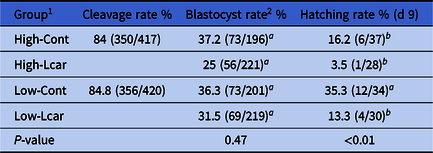
The cleavage rate of zygotes did not differ (P > 0.05) when cultivated under high (84%) or low oxygen tension (84.8%). Treatment showed no effect on the blastocyst rate (Table 1; P = 0.47), however, the hatching rate was higher for Low-Cont compared with the other treatments (P < 0.01, Table 1).
In vitro production of bovine embryos cultivated at high (20%) and low (5%) O2 tension either with or without the addition of 3.03 mM l-carnitine for 24 h during IVC

a,b Different letters within columns represent significant differences (P < 0.05).
1 High-Cont: O2 high tension without l-carnitine; High-Lcar: O2 high tension + l-carnitine; Low-Cont: O2 low tension without l-carnitine; Low-Lcar: O2 low tension + l-carnitine.
2 Blastocyst production rates were estimated considering the total number of oocytes in each maturation drop (IVF: d 0).
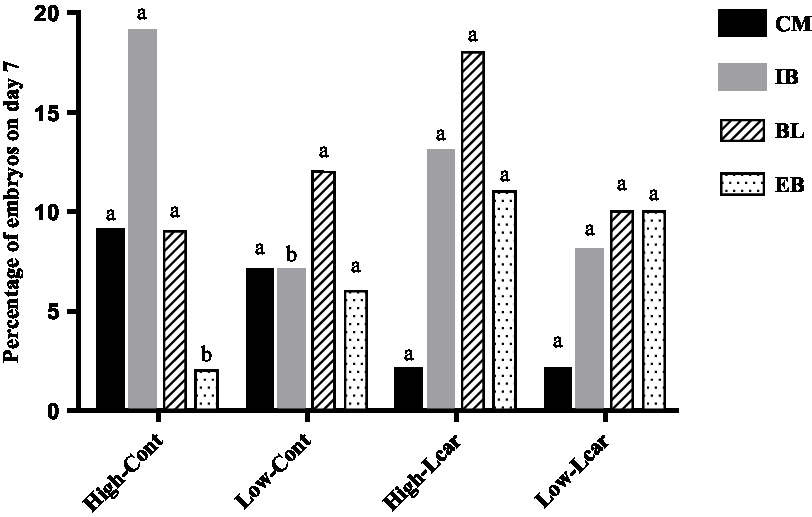
Embryos observed on d 7 were classified according to their developmental stage to verify if the cultivation conditions to which the probable zygotes were submitted interfered in their development kinetics (Fig. 1). Neither low O2 tension nor l-carnitine affected cultivation (P > 0.05), however High-Lcar generated a higher percentage of embryos in early stages of development (morula and initial blastocyst) compared with the other studied culture conditions (P < 0.05) and only around 2% of the blastocysts were expanded (Expanded Blastocysts: High-Cont: 1.6%; High-Lcar: 10.8%; Low-Cont: 6.2% and Low-L-car. 9.6%).
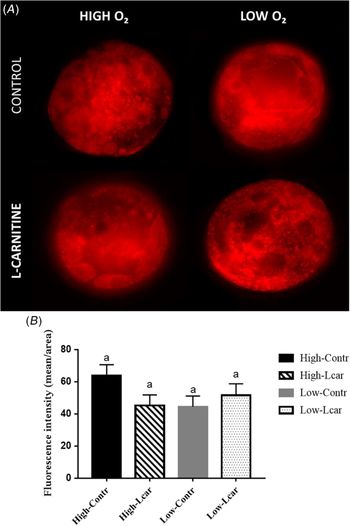
We did not observe any differences in the lipid content of d 7 blastocysts among groups after Nile Red staining (Fig. 2).
Developmental stage of bovine embryos cultured for 7 days in medium under high (20%) or low (5%) O2 tension supplemented or not with 3.03 mM l-carnitine. Bl: blastocyst; CM: compact morula; EB: expanded blastocyst; IB: initial blastocyst. Different letters (a, b) above the bars indicate differences between treatments for each embryo developmental stage (P < 0.05).

(A) Representative images of cytoplasmic lipid droplets labelled with Nile Red on blastocysts cultured in low or high O2, supplemented with l-carnitine. (B) Lipid content in blastocysts (d 7) expressed by mean fluorescence intensity per area [least-squares mean ± standard error of the mean (SEM)]. Values with letters in common do not differ significantly (P > 0.05; n = 13–20 per group).

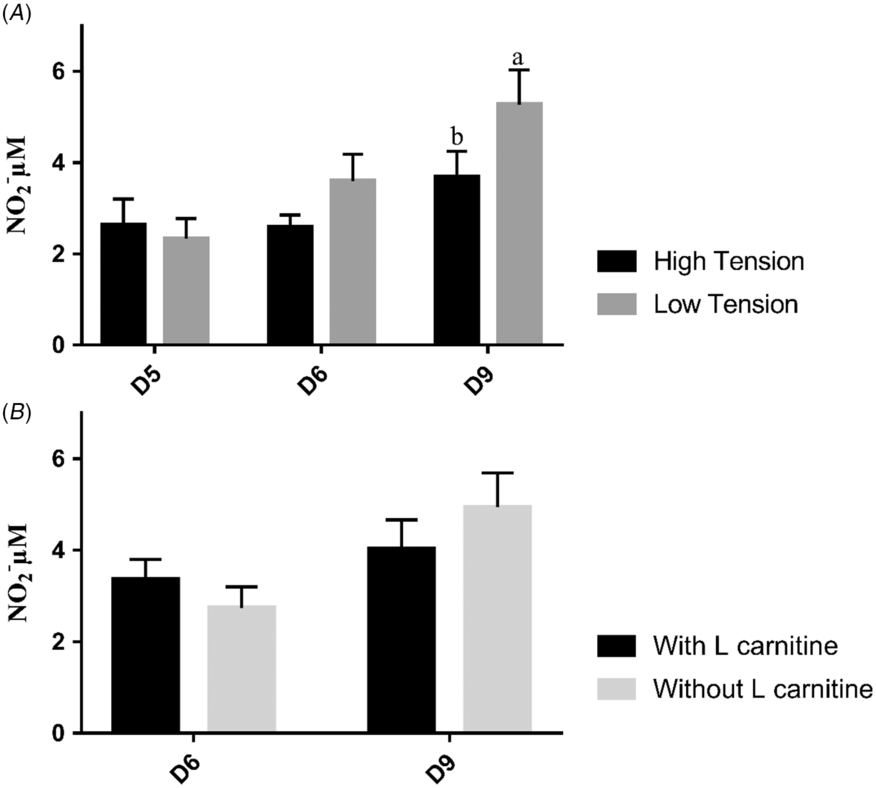
No interaction NO2– concentration (μM) was observed between treatment and O2 tension. Figure 3 shows the NO2– concentration present in the in vitro embryo culture medium on d 5, d 6 and d 9 in high tension and low O2 tension and with or without l-carnitine on d 6 and d 9. NO2– concentration was higher on d 9 under low O2 tension (P < 0.10).
NO2–concentration (μM). No interaction was observed between treatment and O2 tension. NO2–concentration present in the in vitro embryo culture medium on d 5, d 6 and d 9 in high or low O2 tension (A) and with or without l-carnitine (B) on d 6 and d 9. NO2– concentration is higher on d 9 under low O2 tension (P < 0.10).

Discussion
More recently, Sudano and colleagues (Reference Sudano, Rascado, Tata, Belaz, Santos, Valente, Mesquita, Ferreira, Araújo, Eberlin and Landim-Alvarenga2016) have shown that cytoplasm lipid content in embryos grown in vitro was highest at the morula stage and lowest at the blastocyst stage. Therefore, we added 3.03 mM l-carnitine on d 5 when most embryos develop into the morula stage. However, this treatment was removed on d 6 to decrease the risk of further lowering the amount of lipids in blastocysts.
Additionally, we evaluated IVC incubation with and without l-carnitine under high or low oxygen tension. We hypothesized that IVC supplemented with l-carnitine for 24 h in low oxygen tension should produce more and better quality blastocysts and that the NO concentrations in IVC medium would be involved in this process.
Controversies regarding the production and quality of embryos produced in vitro in low (Takahashi et al., Reference Takahashi, Keicho, Takahashi, Ogawa, Schulte and Okano2000; Guerin et al., Reference Guerin, El Mouatassim and Menezo2001; Kitagawa et al., Reference Kitagawa, Suzuki, Yoneda and Watanabe2004) and high O2 tensions (Corrêa et al. Reference Corrêa, Rumpf, Mundim, Franco and Dode2008; Mingoti et al., Reference Mingoti, Caiado Castro, Méo, Barretto and Garcia2009) have been observed. Because low oxygen tension implies additional cost associated with reducing the oxygen concentration, using atmospheric oxygen tension as a permanent IVEP condition would reduce embryo production costs. In the present study, the blastocyst rate was similar in all studied conditions, however the highest rate of hatching was observed when IVC was performed at low O2 tension and in the absence of l-carnitine, which suggests that this condition produces better quality embryos. Moreover, low O2 tension has been shown to improve quality and invasion ability of mice blastocysts, potentially improving the implantation rate (Ma et al., Reference Ma, Chen and Tzeng2017; Bagheri et al., Reference Bagheri, Kazemi, Sarmadi, Shamsara, Hashemi, Joupari and Dashtizad2018). We also observed that when IVC was performed at a high O2 tension in the absence of l-carnitine the embryo development was slower, so that at d 7 a significantly lower amount of expanded blastocysts was observed. Embryos transferred at the morula and initial blastocyst stages have been shown to have lower pregnancy rates than those transferred at the blastocyst, expanded and hatched blastocyst stages (Zolini et al., Reference Zolini, Carrascal-Triana, Ruiz de King, Hansen, Alves Torres and Block2019), and allows us to associate culture at high O2 tension with the production of lower quality embryos.
A reduction in lipid content after culture with l-carnitine was observed by Takahashi et al. (Reference Takahashi, Inaba, Somfai, Kaneda, Geshi, Nagai and Manabe2013) but not by Held-Hoelker et al. (Reference Held-Hoelker, Klein, Rings, Salilew-Wondim, Saeed-Zidane, Neuhoff, Tesfaye, Schellander and Hoelker2017), probably because of differences in IVP conditions. Additionally, the improvement of blastocyst rate in l-carnitine-supplemented IVC medium is controversial and may be related to O2 tension, as embryos cultured at high O2 tensions showed an improvement in blastocyst rate (Takahashi et al., Reference Takahashi, Inaba, Somfai, Kaneda, Geshi, Nagai and Manabe2013; Ghanem et al., Reference Ghanem, Ha, Fakruzzaman, Bang, Lee and Kong2014) but not when cultured at low O2 tensions (Held-Hoelker et al., Reference Held-Hoelker, Klein, Rings, Salilew-Wondim, Saeed-Zidane, Neuhoff, Tesfaye, Schellander and Hoelker2017; Zolini et al., Reference Zolini, Carrascal-Triana, Ruiz de King, Hansen, Alves Torres and Block2019). In the present study we could not see any benefit of l-carnitine addition on IVC, neither in lipid content reduction nor improvement of blastocyst and hatching rates. Most studies have used l-carnitine for at least 3 days (Ghanem et al., Reference Ghanem, Ha, Fakruzzaman, Bang, Lee and Kong2014; Held-Hoelker et al., Reference Held-Hoelker, Klein, Rings, Salilew-Wondim, Saeed-Zidane, Neuhoff, Tesfaye, Schellander and Hoelker2017; Zolini et al., Reference Zolini, Carrascal-Triana, Ruiz de King, Hansen, Alves Torres and Block2019; Dias et al., Reference Dias, Leme, Sprícigo, Pivato and Dode2020) and, as such, we believe that the supplementation of IVC medium for just 24 h may not have been enough time to induce the expected results. Regardless, the role of l-carnitine and lipid content in embryo development needs to be better understood because supplementation resulted in better re-expansion rates after vitrification/warming (Held-Hoelker et al., Reference Held-Hoelker, Klein, Rings, Salilew-Wondim, Saeed-Zidane, Neuhoff, Tesfaye, Schellander and Hoelker2017; Zolini et al., Reference Zolini, Carrascal-Triana, Ruiz de King, Hansen, Alves Torres and Block2019), but did not improve the pregnancy rate of vitrified/warmed embryos (Zolini et al., Reference Zolini, Carrascal-Triana, Ruiz de King, Hansen, Alves Torres and Block2019). In addition, when supplemented during the whole IVC, however, lipid content was reduced, and embryo production and development, after thawing slow freezing embryos, were reduced (Dias et al., Reference Dias, Leme, Sprícigo, Pivato and Dode2020).
Surprisingly, the embryos showing the highest cryotolerance were not those containing the lowest amounts of lipids, even after culture in the presence of l-carnitine (Held-Hoelker et al., Reference Held-Hoelker, Klein, Rings, Salilew-Wondim, Saeed-Zidane, Neuhoff, Tesfaye, Schellander and Hoelker2017).
l-Carnitine is also known as a potent antioxidant. Jiang et al. (Reference Jiang, Li, Zhao, Gao, Jin, Yan and Xu2020) showed that l-carnitine supplementation during the whole IVC can improve embryo development by reducing oxidative stress. In the present study l-carnitine was present in the IVC medium for 24 h, this time was probably not sufficient to protect against ROS, therefore no improvement was observed.
Nitric oxide is required for normal preimplantation embryo development but it must be produced within a limited range of concentrations (Tranguch et al., Reference Tranguch, Steuerwald and Huet-Hudson2003; Tesfaye et al., Reference Tesfaye, Kadanga, Rings, Bauch, Jennen, Nganvongpanit, Holker, Tholen, Ponsuksili, Wimmers, Montag, Gilles, Kirfel, Herzog and Schellander2006). Therefore, in this study, we evaluated if NO concentration in IVC medium could be related to embryo development in vitro when supplemented with an antioxidant (l-carnitine) at different oxygen tensions (20% or 5%). Nitric oxide and ROS can be generated by distinct enzymes or by the same enzyme through alternate reduction and oxidation processes. Enzymatic uncoupling, changes in oxygen tension, and the concentration of coenzymes and reductants can modulate NO/ROS production from these oxidoreductases and determine the redox balance in health and disease (reviewed by Tejero et al., Reference Tejero, Shiva and Gladwin2019). It is known that lowering the oxygen tensions increases the biological activities of NO (reviewed by Inoue et al., Reference Inoue, Sato, Nishikawa, Park, Kira, Imada and Utsumi2003) and that NO protects many cell types against ROS toxicity, probably through the Nrf2/Srx pathway (Abbas et al., Reference Abbas, Breton, Planson, Bouton, Bignon, Seguin, Riquier, Toledano and Drapier2011). The addition of a NO inhibitor [10 mM N ω-nitro-l-arginine methyl ester (l-NAME)] during IVC impaired bovine blastocyst production (Tesfaye et al., Reference Tesfaye, Kadanga, Rings, Bauch, Jennen, Nganvongpanit, Holker, Tholen, Ponsuksili, Wimmers, Montag, Gilles, Kirfel, Herzog and Schellander2006), highlighting the importance of this substrate during bovine embryogenesis. In the present study NO was measured in the IVC medium on d 5 (before l-carnitine addition), d 6 (after l-carnitine removal) and d 9 (last day of IVC) and we could see that the amount of NO was greater 9 d post-insemination just in the group in which zygotes were cultured under low O2 tension. A significantly higher hatching rate on d 9 was observed when zygotes were cultured under low tension and without l-carnitine, therefore we hypothesized that the NO biologically activity, induced by low O2 tension during IVC, is related to a better development pattern in embryos.
In conclusion, the addition of 3.03 mM l-carnitine between d 5 and d 6 of IVC was not efficient in reducing cytoplasmic lipid content of bovine embryos, independent of incubation oxygen tension. Additionally, IVC at low oxygen tension without l-carnitine promoted better conditions for embryo development. Under low O2 tension, independent of l-carnitine supplementation, a higher, but beneficial, concentration of nitric oxide in IVC medium was observed on day 9.
Acknowledgements
The authors thank Slaughterhouse Buriti – Aquidauana/MS for providing ovaries.
Financial Support
This study was funded by the Coordination of Improvement of Higher Education Personnel – Brazil (CAPES – 88881.068117/2014-01) and PhD students received Grant from the same institution (CAPES – 001).
Conflict of Interest
The authors declare that there is no conflict of interest that can be perceived as prejudicing the impartiality of the research reported.
Ethical Standards
Not applicable.