Introduction
The limitations of unitary, top-down leadership theories are well recognised (Greene, Reference Greene1975; Dachler, Reference Dachler1984) and much scholarship has moved from leader centric, to more collective leadership models, which are concerned more with shared influence and the combined leadership behaviours of groups (Ahn, Adamson, & Dornbusch, Reference Ahn, Adamson and Dornbusch2004; Dalakoura, Reference Dalakoura2010).
Shared, distributed, and collective leadership are long-standing constructs and have been used interchangeably (Pearce & Conger, Reference Pearce and Conger2003; Fitzsimons, James, & Denyer, Reference Fitzsimons, James and Denyer2011). But they do have nuanced differences, reflecting their evolution from different fields, and the level at which leadership is shared. For instance, shared leadership is often described as a team-level construct, but it likely also works at the organisational-level, where efforts are coordinated both within and between teams and units (Carson, Tesluk, & Marrone, Reference Carson, Tesluk and Marrone2007). Another nuance of shared, compared to distributed, leadership is that it is coordinated through the behavioural components of ‘accountability, partnership, equity, and ownership’ (Jackson, Reference Jackson2000: 168). This signals a distinction from some discussions of distributed leadership, where the latter is not necessarily always coordinated or relational. Distributed leadership can instead be an aggregation of individual efforts that may or may not align with those shared by the collective (Gronn, Reference Gronn2002; Harris, Reference Harris2009). Shared leadership is studied here as it describes shared influence aligned to common, organisational goals and has become probably the most established definition from this field (Bolden, Reference Bolden2011). It has been described as, ‘a dynamic, interactive influence process among individuals in groups for which the objective is to lead one another to the achievement of group or organisational goals’ (Pearce & Conger, Reference Pearce and Conger2003: 1).
In contrast to vertical leadership, shared leadership concerns leadership as a ‘team sport’ where individuals with the knowledge or skills to effectively contribute to the leadership of a situation can do so (Pearce & Conger, Reference Pearce and Conger2003). It overlaps with related constructs such as teamwork, team empowerment, cooperation, team cognition, visionary leadership, emergent leadership, and transformational and empowering leadership styles. Although these all concern movements away from control of others through a formal hierarchy, and toward the use of softer approaches instead, shared leadership differs from these approaches in several ways. First, unlike teamwork, empowerment, cognition, and so on, it still recognises the role of an individual leader in a project. Second, unlike emergent, transformational, and empowering leadership, it explicitly recognises that workers can alternate between being leader and follower across different projects. Shared leadership does emphasise, however, decentralised decision-making, mutual influence, and voice and is particularly effective when it emphasises these factors (Wang, Waldman, & Zhang, Reference Wang, Waldman and Zhang2014).
It has other benefits too. It can empower individuals and workforces and enhance team effectiveness, especially when jobs are complex (Perry, Pearce, & Sims, Reference Perry, Pearce and Sims1999; Wang, Waldman, & Zhang, Reference Wang, Waldman and Zhang2014). It is particularly effective where commitment, creativity, and innovation are essential, and the work requires interdependence and collaboration (Pearce, Manz, & Sims, Reference Pearce, Manz and Sims2009). For knowledge workers often operate in such contexts, participation in leadership has been linked to enhanced autonomy, influence, and meaningfulness (Carson, Tesluk, & Marrone, Reference Carson, Tesluk and Marrone2007). Shared leadership offers both motivational and cognitive pathways for effectiveness. When integration of multiple knowledge domains and capabilities are needed, sharing leadership can work better than counting on the bounded rationality of a single leader.
In public-sector environments, the suitability of traditional centralised command and control leadership is increasingly questioned (Howieson & Hodges, Reference Howieson and Hodges2014). More complex and dynamic demands on public organisations, and the accordant need for innovation, problem-solving, collaboration, and service delivery, all require a more decentralised, adaptive and networked approach. Consequently, many public-sector studies have called for more attention to shared leadership to help address these issues, but little is known how to ‘do’ it in bureaucracies which often have competing goals and stakeholders (Crosby & Bryson, Reference Crosby and Bryson2005; Denhardt & Denhardt, Reference Denhardt and Denhardt2007; Currie, Grubnic, & Hodges, Reference Currie, Grubnic and Hodges2011; Howieson & Hodges, Reference Howieson and Hodges2014; Ospina, Reference Ospina2017).
Public agencies need to manage multiple tensions, such as between diverse stakeholders that need to be ‘kept happy’, with political approval ensured, and effectiveness retained (Head & Alford, Reference Head and Alford2015). The demands of these tensions have led to calls for shared leadership in public agencies, as these tensions are unlikely to be well resolved in the command and control and individual leadership models that have traditionally characterised public organisations (O’Flynn, Reference O’Flynn2007; Benington & Moore, Reference Benington and Moore2010; Howieson & Hodges, Reference Howieson and Hodges2014). In the public sector, job complexity creates a demand for shared leadership, but traditions of hierarchical management and accountability might make it hard to implement at the organisational level.
As public sectors increasingly seek to manage adaptively across diverse agencies, networks, and stakeholders, knowing how to change leadership beliefs and styles is an increasing challenge (Head & Alford, Reference Head and Alford2015; Plimmer, Bryson, & Teo, Reference Plimmer, Bryson and Teo2017). This paper addresses two gaps in current knowledge, both of which concern the dynamics of shifting from a hierarchically led organisation, to one that embraces shared leadership. The first is how shared leadership is developed, particularly when employees have not previously identified or acted as leaders (Pearce, Reference Pearce2004). The development of a leader identity from an emergent leader’s perspective is relatively unknown and warrants further research attention (Houghton, Neck, & Manz, Reference Houghton, Neck and Manz2003). How these identities might change organisations is not adequately understood.
Most shared leadership research is at the team level, and little is known about whether it shapes organisations beyond the team or dyad level, to compile new organisational-level properties that are more than the aggregated individual-level parts (Dinh, Lord, Gardner, Meuser, Liden, & Hu, Reference Dinh, Lord, Gardner, Meuser, Liden and Hu2014; Nicolaides et al., Reference Nicolaides, LaPort, Chen, Tomassetti, Weis, Zaccaro and Cortina2014; Wang, Waldman, & Zhang, Reference Wang, Waldman and Zhang2014; D’Innocenzo, Mathieu, & Kukenberger, Reference D’Innocenzo, Mathieu and Kukenberger2016). At the team level, we know that conditions such as voice, mutual understanding, sufficient resources, encouragement, and support are important for shared leadership development (Pearce, Reference Pearce2004; Carson, Tesluk, & Marrone, Reference Carson, Tesluk and Marrone2007), but it is not clear how the development process occurs beyond teams. Whilst shared leadership depends on vertical leadership (Carson, Tesluk, & Marrone, Reference Carson, Tesluk and Marrone2007), it also exists in inherent tension, or paradox, with vertical leadership particularly when that style is strong, and well mandated, as in public-sector organisations. The second research gap is therefore a better understanding of how leadership operates at the organisational, rather than just the team level, particularly in public-sector organisations.
In sum, this study explores how shared leadership can be developed and, following that, its impact on a public-sector organisation. This study is of a public-sector research institute. It uses 33 interviews triangulated against observations and documents.
Leadership
The limitations of unitary, top-down leadership theories are long known (Greene, Reference Greene1975; Dachler, Reference Dachler1984), and much scholarship has moved from developing individual leaders, to leadership models, which more concern the collective leadership behaviours of groups (Ahn, Adamson, & Dornbusch, Reference Ahn, Adamson and Dornbusch2004; Dalakoura, Reference Dalakoura2010). Now that many organisational decisions rely on sharing knowledge, feedback, and understanding between diverse technical workers and organisational leaders across contexts, the effectiveness of concentrating leadership competencies within a single person seems limited (Galli & Müller-Stewens, Reference Galli and Müller-Stewens2012).
Such leadership, however, is likely to require skill and knowledge both individually and collectively (Ramthun & Matkin, Reference Ramthun and Matkin2012). While individual leaders can create the context for knowledge sharing, the sharing of leadership itself is often needed to enact it effectively (Solansky, Reference Solansky2008). The need for a shared approach to leadership is present in other areas of organisational capability too. Jing (Reference Jing2018), for instance, found that organic/distributed leadership was associated with significantly higher performance (financial performance and employee/customer satisfaction) than traditional forms such as transactional leadership. Such leadership, however, is likely to require new individual and collective capabilities that are also likely to complement, rather than replace, the traditional, individual approaches to leading that are common in public-sector studies (Ospina, Reference Ospina2017).
Leadership development
Leadership development is still underresearched compared to leadership studies generally (Galli & Müller-Stewens, Reference Galli and Müller-Stewens2012; Chami-Malaeb & Garavan, Reference Chami-Malaeb and Garavan2013). For instance, a quick Google Scholar search of research in 2017 found 13,900 titles with the word ‘leadership’, but only 584 articles with the phrase ‘leadership development’. This is surprising, as collective development of new knowledge, skills, and abilities has strong theoretical linkages to organisational outcomes, particularly in complex environments (Khoreva, Reference Khoreva2016).
Brungardt (Reference Brungardt1997: 83) defined the development of leaders broadly as ‘every form of growth or stage of development in the life cycle that promotes, encourages, and assists the expansion of knowledge and expertise required to optimise one’s leadership potential and performance’. Since then, leadership development has emphasised the collective capabilities of multiple individuals and groups rather than just individual leaders. It also concerns the collective interactions between leaders as well as the dyadic relations of leaders and followers (Day, Fleenor, Atwater, Sturm, & McKee, Reference Day, Fleenor, Atwater, Sturm and McKee2014). Development of these collective capabilities still likely follows similar processes of learning and exploration (Kempster, Reference Kempster2006), but few studies show how leadership development interventions impact on the workplace. The workplace conditions for shared leadership’s success, and how it can be explicitly developed, therefore matter.
Conditions for leadership development
Paradoxically, formal implementation of shared leadership requires vertical leader(s) to establish appropriate conditions and encourage followers to embrace the new direction (Fletcher & Kaufer, Reference Fletcher and Kaufer2003). Formal leaders can provide resources, help team members better understand others’ skills, capabilities, and motivations, and inspire followers to lead informally (Hoch & Kozlowski, Reference Hoch and Kozlowski2014). Encouragement and support can help build collective efficacy while worker voice encourages the exchange and ownership of ideas (Burke, Fiore, & Salas, Reference Burke, Fiore and Salas2003; Carson, Tesluk, & Marrone, Reference Carson, Tesluk and Marrone2007).
Formal leaders also act as role models for shared leadership. Encouraging others to act similarly and share influence, as well as shaping collective purpose to unite a group, build trust, integrate ideas, and support contributions (Binci, Cerruti, & Braganza, Reference Binci, Cerruti and Braganza2016). While these conditions for shared leadership are likely necessary, they alone are not necessarily sufficient, particularly in an environment that in the past has relied on vertical leadership.
There are, however, inherent tensions between shared and vertical leadership, and a risk of dysfunction and chaos. Whilst a group can develop a shared purpose, it may be ineffective if it contradicts organisational goals (Cox, Pearce, & Perry, Reference Cox, Pearce and Perry2003). Goals may be unclear or even contested (Ospina, Reference Ospina2017). In public-sector organisations shared purpose could lead to conflict where the purpose is tied to public value, which is typically defined by external stakeholders rather than vertical leaders or their employees. These competing goals and stakeholders can be seen as a paradoxical management challenge. The ability to manage paradoxes, defined as ‘contradictory, yet integrated elements that exist simultaneously and persist over time’, is likely to be an issue in shifting a complex hierarchical government organisation to shared leadership (Smith & Lewis, Reference Smith and Lewis2011: 382).
Developing shared leadership
Once necessary conditions have been met, Day and Harrison’s (Reference Day and Harrison2007) approach to developing leadership identities is a logically applicable framework for its development. As shared leadership includes multiple individuals’ playing the role of leader, relating with interactional influence, and also coordinating to achieve group goals, this fits with the notion of developing individual, relational, and collective leader identities. Shared leadership requires individuals taking turns as leaders, having the skills to relate, and considering the wider group (collective) within and between teams in an organisation. This ‘layers of identity’ approach seems likely to be more enduring than teaching narrow skills or competencies. An identity approach to shared leadership likely carries with it the motivation to apply new skills and also the schema to adapt behaviour to a diverse range of situations (Day & Harrison, Reference Day and Harrison2007).
At the individual level, identity is developed via underlying components, such as self-efficacy and self-awareness. Self-efficacy can reduce reliance on vertical leaders and help establish an identity as a leader (Bligh, Pearce, & Kohles, Reference Bligh, Pearce and Kohles2006). It also raises personal standards and competence and in turn helps motivate others to lead (Van Knippenberg & Hogg, Reference Van Knippenberg and Hogg2003). Establishing this initial level of ‘oneself as a leader’ is important for shared leadership, particularly for those who have not had the opportunity to experience this before. Self-awareness and self-regulation allow individuals to transfer between leader and follower roles, resulting in shared influence (Jackson, Reference Jackson2000). Self-evaluation, 360° feedback and coaching or mentoring all can help develop this self-awareness (Galli & Müller-Stewens, Reference Galli and Müller-Stewens2012).
Relational identities can also be built through teamwork skills and learning about others’ perspectives. These help gain commitment, trust, and respect from followers and stakeholders (Van Knippenberg & Hogg, Reference Van Knippenberg and Hogg2003; Pearce, Reference Pearce2004). Encouraging individuals to think of themselves in relation to others increases social awareness and enables leadership to be shared.
Collaborative, or group learning, can develop both interpersonal skills and social capital via techniques such as ‘action learning’ (Galli & Müller-Stewens, Reference Galli and Müller-Stewens2012). These group experiences allow individuals to test and strengthen individual leader identities, take on different roles, and craft their jobs to align with their own interests (Van Knippenberg & Hogg, Reference Van Knippenberg and Hogg2003; DeRue & Ashford, Reference DeRue and Ashford2010). In this dynamic view of leadership, people fluctuate between being followers or leaders (Raelin, Reference Raelin2006). This relational aspect is particularly important, as others must ‘buy in’ to one’s view of themselves as a leader – otherwise efforts to lead others would be ineffective.
As emergent leaders gain confidence and exercise voice, they may then be driven by collective goals and values (Van Knippenberg & Hogg, Reference Van Knippenberg and Hogg2003). The ability to critically reflect (developed at the individual and relational level) enables leaders to think about who the group is, what they represent, and how to lead together rather than as individuals (Day & Harrison, Reference Day and Harrison2007). Cross-functional learning groups facilitate collaboration and a shared understanding (Galli & Müller-Stewens, Reference Galli and Müller-Stewens2012).
Individual, relational, and collective identities can act as both conditions for, and outcomes of, various stages of the shared leadership development process. In this way, these identities are dynamic and present throughout the development process and can be activated by both personal motives and contexts. Vignoles, Regalia, Manzi, Golledge, and Scabini (Reference Vignoles, Regalia, Manzi, Golledge and Scabini2006) explain the role of identity motives in creating the dynamism we perceive as evident in the identity development process. These motives are ‘defined as pressures towards certain identity states and away from others’, guiding the process of identity coconstruction (Vignoles, Regalia, Manzi, Golledge, & Scabini, Reference Vignoles, Regalia, Manzi, Golledge and Scabini2006: 309). Brickson (Reference Brickson2000) likewise presents the view that identification processes are dynamic and that individuals with developed multilevel identities may have different identities activated in different contexts. These shifts in identity states help explain the role fluctuations between leader and follower. Although some argue that once developed, leader identities become static and fixed (Komives, Owen, Longerbeam, Mainella, & Osteen, Reference Komives, Owen, Longerbeam, Mainella and Osteen2005), others argue that leadership identities are individual, relational, collective, and state like and are ‘socially constructed and inherently related’ (DeRue & Ashford, Reference DeRue and Ashford2010: 628). There is a lack of research on the processes of identity construction and cognitions residing in one’s self-concept (Komives et al., Reference Komives, Owen, Longerbeam, Mainella and Osteen2005; DeRue, Ashford, & Cotton, Reference DeRue, Ashford and Cotton2009).
This multilayered view of personal, relational, and collective leader identities means that different contexts can activate identity at one level, which can reinforce or undermine identity at another (Vignoles et al., Reference Vignoles, Regalia, Manzi, Golledge and Scabini2006). Leadership problems can therefore be viewed as tensions between identity levels – a socially aware leader lacking confidence, the leader focused on the collective who lacks follower (relational) support, or the leader who only operates within the confines of their group, perhaps to the detriment of the collective. Effective shared leadership likely involves the ability to turn on and off leader identities, such as between being a leader and a follower (Perry, Hondeghem, & Wise, Reference Perry, Hondeghem and Wise2010). A multilevel identity-based approach is particularly apt for developing shared leadership in public servants who comprise the participants in this study, as in western societies public servants are commonly motivated to contribute to society (Perry, Hondeghem, & Wise, Reference Perry, Hondeghem and Wise2010). The pro-social relational and collective aspects of leadership identity would correspond well with this public service motivation and possibly compile new organisational capabilities. A multilevel identity-based approach is appropriate for developing shared leadership as it includes the relational and collective aspects necessary for successful deployment of shared leadership across the public sector (Ingraham & Getha-Taylor, Reference Ingraham and Getha-Taylor2004).
Research questions
Thus, this case study aims to explore the following research questions:
∙ How is shared leadership developed?
∙ How can shared leadership change an organisation, particularly within the public sector?
Method
Organisational setting
Resorg, a government research and development organisation, was mandated to undertake research for the public good, whilst remaining financially viable. Its employees, predominantly scientists, performed nonroutine and uncertain work that benefited from creativity and collaboration. This context was well suited to shared leadership, which emphasises interpersonal skills such as consulting and sharing sensitive information. These skills are not well considered in traditional leadership constructs such as transformational leadership and so may not engender the needed distributive, procedural, and interactional justice that helps creative performance (Gupta & Singh, Reference Gupta and Singh2015). In recent years, Resorg’s business strategy had unsuccessfully focused on creating commercial ‘spin-offs’, which were now losing market relevance and money. Stakeholders had criticised this strategy for only benefiting Resorg’s own standing, rather than that of the public and of neglecting local businesses’ needing scientific support. Following economic and financial concerns, the government required Resorg to be more focused on the research and development needs of local businesses and to partner and coproduce commercial research with industry. The government subsequently altered public funding requirements (two thirds of Resorg’s revenue), giving preference to projects tied to industry and therefore encouraging the realignment of the organisations’ goals to deliver public value.
With these significant changes, Resorg lost many previously secure contracts. Leadership was bureaucratic and hierarchical. Scientific disciplines were in silos, and business development staff were siloed from scientists. After running its first engagement survey, 50% of staff reported as disengaged. A new CEO, tasked with building closer ties with industry, recognised that while the organisations had many capable scientific leaders, they were lacking the business leadership capabilities required to enact the new strategy and form collaborative teams across the organisation. A leadership development programme (LDP) was introduced to equip staff with the shared leadership skills needed to overcome silos and to execute the new strategy.
When this research began, Resorg employed 340 staff and had operated the LDP for 6 years. Around one third of the staff had taken part in the LDP – indicating only a gradual rollout of 24 participants going through one course per year due to cost.
Program description
The LDP was built on the CEO’s view of shared leadership as an ‘activity, action or a principle that operates at all times, at all levels through the organisation’. The programme’s open participation policy reflected this view. Whilst the programme was targeted to scientists, all staff could participate either by volunteering or upon a manager’s recommendation. The programme comprised three interrelated components: a personal assessment performed by an organisational psychologist, a 3.5-day personal development centre and a customised 5-day academic programme to develop leadership capabilities. Participants took part in all three components over a year and upon graduating they joined a growing cohort of ‘LDP alumni’. Following this, additional development courses, mentoring from senior staff, secondments, strategy discussions, and seminars were available for all staff.
Part one: Personal assessment
At the beginning of the LDP, participants went through two psychometric tests to identify personality type and personal style, respectively – the Jung Type Indicator and the Fifteen-Factor Questionnaire (Psytech International, 2002). Results were then discussed with a psychologist and explored in a 90-min workshop.
Part two: Development centre
For 3.5 days participants stayed at a residential location, along with a coach and four trained observers from the organisation. The development centre aimed to develop personal awareness, social awareness, and knowledge in topics such as communication, teamwork, coaching, and development. Learning took place via collaborative action learning exercises tailored to the context of a research and development organisation. Each exercise was designed to draw on different personality types and knowledge bases and highlight how they influence group behaviour. Group feedback and discussion concluded each activity. Participants also received a personalised behavioural report from observers (senior members of the organisation or LDP alumni) which was discussed one-on-one with the coach at the end of the development centre. The CEO and senior executives attended an afternoon session and a dinner to discuss shared leadership and strategy.
Part three: Academic programme
The 5-day academic programme sought to provide frameworks and tools for organisational leadership skills. The CEO and senior executives attended the day 1 programme as well as a social function to further engage with participants. The topics, related to leading and sharing influence (such as organisational leadership, identity and values, strategy, and project management), covered by the academic programme were operationalised through lectures, group discussions, case studies, and practical examples.
The central exercise was the Dragon’s Den. On the first day, the CEO discussed a current organisational challenge with participants who then developed a project proposal (in groups of three to four) to address this challenge. Over the week, participants applied classroom concepts to develop a final proposal that they presented to a panel of ‘dragons’ on the final day. The winning team was then provided with the necessary resources and support from senior management to implement their ideas back in the organisation.
Data sources
Data sources were organisational documents, observations, and interviews of Resorg staff.
One-on-one, semi-structured, in-depth interviews comprise the majority of data. To avoid bias, questions were explicitly open-ended and covered experiences and perceptions of the LDP and any perceived changes in the self, others, and organisation following the programme. A series of prompts corresponded to Kirkpatrick’s (Reference Kirkpatrick1975) levels of personal reactions, learning, behaviours, and results. Observations took place during the academic component of the LDP, using a schedule based on personal reactions to the learning experience (including levels of enjoyment, practicality and relevance, level of participation, and programme design features; Kirkpatrick, Reference Kirkpatrick1975). Documents such as engagement surveys, and financial reports, helped triangulate results.
Interview selection
Two groups of interviewees were chosen for this study: participants of the LDP (n = 22) hereafter referred to as participants and those who had not participated in the LDP (n = 11) or nonparticipants. This second group provided an ‘outsider’s’ view of the programme’s effects. Semi-structured interviews took place on-site and ranged from 0.5 to 1.5 hr. Questions covered LDP experiences; any changes in attitudes, behaviour, and cognitions about work and the organisation; and factors that motivated or hindered change.
Interview sampling was in three stages. The first round (N = 13) was in response to a call for volunteers. In these initial interviews, interviewees indicated that there were three different personal outcomes of the LDP: (1) participants who changed their jobs or outlook following the programme, (2) participants who showed minor changes, and (3) participants who were cynical of the programme. Subsequently, a key informant suggested individuals that fell into the above groups. Snowball sampling in these categories was also used.
Participant description
Most interviewees were male and of European descent. A majority were aged over 40, although they ranged in age from the 20–29 to the 60–69 age brackets. Most had worked in the organisation for over 6 years when the programme began, with the majority of participants having been employed between 6 and 10 years (N = 8). They worked in a range of roles and levels throughout the organisation, with 75% of them employed as scientists or engineers. This matched the organisation’s composition. The following descriptors are used to categorise quotes from participants in certain demographics:
P or NP – participant or nonparticipant in the LDP
S or NS – science function or nonscience function. Change in functions is reflected as S-NS (e.g., scientific function to nonscientific function).
T – tenure: (1–5) 1–5 years, (6–10) 6–10 years, (11–15) 11–15 years, (16–20) 16–20 years, and (20) more than 20 years.
Data coding and analysis
The data were coded using NVivo10. For the analysis, a priori codes were first defined by the theoretical foundations of the research questions. This involved identifying processes of leadership development, individual, relational, and collective identity development and the associated organisational effects (Day & Harrison, Reference Day and Harrison2007).
Emergent codes were developed when the data could not be coded using the preidentified themes mentioned above, or if a particular code became too broad and needed to be reorganised into subcodes (Brooks, McCluskey, Turley, & King, Reference Brooks, McCluskey, Turley and King2015). This stage of code development was organic, in that it was not guided by a preestablished coding frame (Braun & Clarke, Reference Braun and Clarke2006). A template was developed, and then modified, through joint analysis combining both a priori and emergent codes (Brooks et al., Reference Brooks, McCluskey, Turley and King2015).
Interconnections between the major codes were then identified (Miles & Huberman, Reference Miles and Huberman1994). The template was refined in discussions between the authors (Gioia, Corley, & Hamilton, Reference Gioia, Corley and Hamilton2013). Different statements were contrasted to identify themes of overarching tensions or paradoxes in the data. This process identified higher order themes that were not immediately apparent at the interview stage.
Four steps were taken to ensure coding validity. First, separation between participants and the researcher was maintained. Second, member checking was used to clarify or confirm interpretations of causal linkages. Following initial analysis of the complete data set, an external coding audit was performed by an individual who does not belong to this study. Differences in interpretations and thematic categories were discussed to resolve inconsistencies in coding (Miles & Huberman, Reference Miles and Huberman1994). The fourth step was triangulation between observation notes, documents, and interviews.
Results
Results are presented in two stages. The first covers leadership development including the causal pathways from programme features to changed behaviours. The second stage discusses paradoxes and tensions between shared and traditional hierarchical leadership, which were not immediately apparent and emerged through more exploratory analysis.
Research question – How is shared leadership developed?
Post LDP context
Development of shared leadership
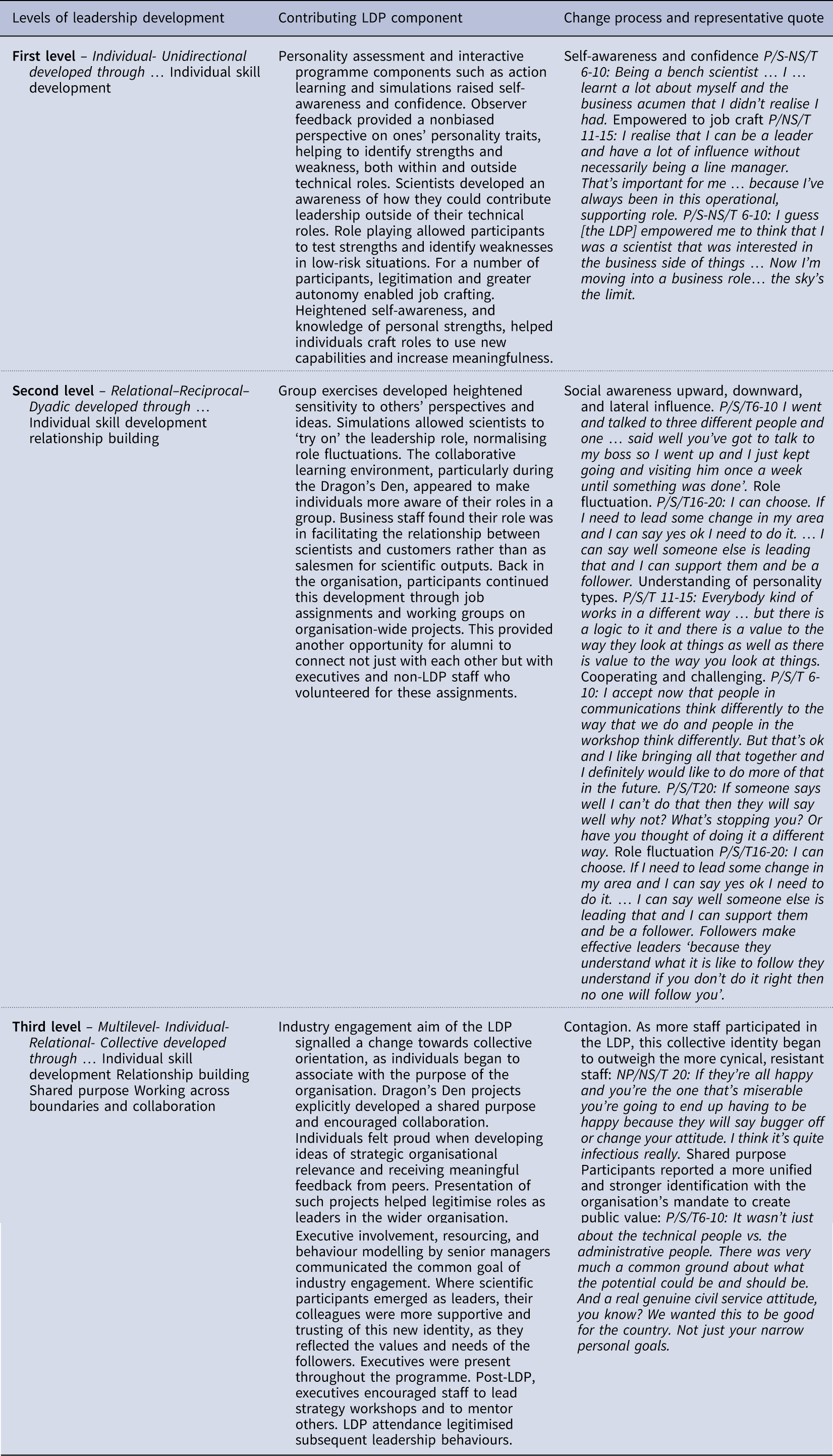
Nonparticipants described how interactions with LDP alumni became more ‘positive’, ‘more respectful’, and that managers were ‘less dictatorial’. Most nonparticipants felt that the LDP alumni reflected the organisation’s new goal and viewed them as effective leaders. Participants reported that they developed a number of necessary personal resources to lead, with each stage reinforcing the next (individual to relational to collective; see Table 1). The shared leadership approach resonated with scientists who were typically ‘driven by thinking and implementing and being challenged’ and who valued the opportunity to ‘enrich the organisation from the ground up’.
Individual, relational, and collective identity development from the LDP

Note: Function that is marked S-NS refers to participants who were in scientific roles prior to the LDP and had transferred to a nonscientific role after the LDP. T1–5, 6–10, 11–15, 15–20, and 20 refer to tenure.
LDP = leadership development programme; NS/S = nonscientific or scientific function; P/NP = participant or nonparticipant.
Triangulation against documents provides some confirmation of these study findings. The most recent engagement survey showed increased engagement with the organisation’s purpose, and a 27% decrease in the number of disengaged staff from the earliest survey 5 years before. Support for the organisation’s leadership had increased by 38.8% alongside an 8.7% increase in ratings for learning and development. Financial data had also improved, in particular from new, diverse funding sources, rather than the large government contracts which Resorg had relied on when using only vertical leadership.
This positive growth story is, however, tempered in the subsequent results that discuss organisational dynamics. Whilst the LDP facilitated a shift from individual to collective goals, tensions arose between the traditional power of hierarchy and shared leadership. There were also tensions between job crafting and task performance. Finally, there was a paradox of attitude between cynicism and evangelism.
These tensions emerged from interviewee descriptions of attempts to transfer shared leadership to the workplace and the complications that arose in doing so. These tensions were between shared leadership and the requirements of organisational hierarchies.
Paradox of power
Vertical hierarchy versus dispersed networks of influence
Although shared leadership (and thus distributed power) was encouraged, informal leaders still found that a lack of positional power limited effective influence. Nonparticipation in the LDP by some senior staff decreased morale in younger scientists:
NS/P/T11-15: All the grumpy old men, quite senior guys just point blank refused. And that’s quite frustrating for the people that report to them that…come back all hopeful that they can do this …and life’s going to change and it doesn’t.
To others, the LDP alumni provided a ‘bypass’ around traditional, bureaucratic chains of command and bad managers.
S/P/T11-15:… forming networks across the company …and not always channeling things through your boss …quite often you get bottlenecks with bad managers …[if] you’re always doing things through the chain of command, that hasn’t really worked very well.
An unexpected discrepancy arose in interviewees’ descriptions of the extent to which leadership was indeed collectively shared versus whether it really consisted more of individual self-appointed leaders operating with little real power. Whilst the LDP provided networks throughout the organisation of ‘like-minded’ leaders, the ability to maintain these networks was often limited by the extensive size of the group, technical specialisation, lack of authority and physical distance between operating sites. A lack of ongoing opportunities to share leadership also played a role.
P/S-NS/T6-11: I think that as soon as you walk out the door and you’ve done the Dragon’s Den, if you’re not part of an ongoing project it all dies again.
Shared leadership was sometimes depicted as the actions of individuals, without strong links between each other, or their projects. This is seen in the following from a scientist
NS/P/T11-15: I see [the LDP] as a game changer and what its done for the organisation but I think its done that through the impact on the individual, not on the cohort per se.
Paradox of goals
Task performance versus job crafting
Whilst job crafting and the added public value of industry engagement resulted in more meaningful work for some participants, others found it unproductive, diverting efforts away from traditional role expectations and requirements. Moreover, both participants and nonparticipants reported that engaging with industry distracted from research and science objectives and ‘[blurred] the line between researcher and the person who does engagement’. Colleagues engaging outside of their traditional role expectations were sometimes challenged:
NP/S/T20: A lot of people want to stop working at the bench and start working in business development, well I say … I have the money for the bench scientists. I actually suggest that you stay at the fucking bench, [and] make some more compounds ….
NP/S/T1-5: That [manager] became too involved in other stuff … you know with all good intention but he inadvertently took a huge workload upon himself, that person became basically um, a last port of call in the case of whatever…there could be a negative effect because of not knowing what was going on.
Fatigue and revitalisation
Although many found new roles invigorating, extra-role behaviours could also be exhausting when trying to balance the demands of daily work with the extra tasks arising from the LDP. Examples below portray this contrasting effect:
P/S/T6-10: With the Dragon’s Den … another guy who was also on my team he got another project lumped on top of him from the dragons den and his science productivity just went to zero. So that’s why he said he really wanted to get back into science.
P/S/T6-10 … it’s given me a lot of energy to do the ordinary things. Not just the ordinary things, there was a challenge in terms of going from this big global company promotion thing to the nitty gritty of what I did … but it didn’t make the details less [fun]…I probably did them better if anything.
Paradox of attitude
LDP cynicism versus evangelism
Some scientists felt ‘discarded’, as it ‘wasn’t about what they could do in the lab anymore’. Others viewed the LDP as a waste of time and money and a superficial attempt to improve employee engagement. One participant described how colleagues ‘like to make fun of the LDP which brought you back down’.
Most, however, thought that the organisation needed to ‘adjust and change’. Over time, this cynicism diminished, particularly as the number of alumni grew to comprise one third of the workforce. LDP alumni were described as ‘evangelists’ and the ‘fresh identity of the organisation’. One scientist metaphorically described the LDPs impact on cynicism:
P/S/T6-10: In an organisation like this, it’s de-energised by cynicism and skepticism. [Cynicism is] a cancer in the place. And if [the LDP] is cytotoxic then I think it’s the sort of thing the organisation should do.
Nonparticipant also reflected this sentiment:
NP/S/T20 I think everyone who’s been to this course has got value from it and I’ve seen that value, and their colleagues have seen that value. I think in some cases, the company has seen that value expressed very clearly
NP/NS/T20: Often they would come and moan at me… the ones that didn’t like [the LDP], they left. I can tell you now they left.
Discussion
This study explores how multilevel identity development enabled shared leadership and how this in turn helped an organisation better deal with rising demands and conflicting objectives. The study revealed that multilevel identities – individual, relational, and collective – emerged as staff developed and became involved in shared leadership activities. It also revealed how strengthened leadership identities promoted further involvement and engagement in shared leadership processes, in mutually reinforcing manners. Our interview and observational data confirm that shared leadership and many of its purported effects were found throughout the organisation, albeit in varying forms.
These changes within individuals, and the organisation, can be interpreted using Dinh, Lord, Gardner, Meuser, Liden, and Hu’s (Reference Dinh, Lord, Gardner, Meuser, Liden and Hu2014) framework for global, compositional, and compilational forms of emergent leadership-relevant processes. In sum, global processes are ‘static, level specific’ and ‘do not apply to lower levels’, such as size and demographic diversity (Dinh et al., Reference Dinh, Lord, Gardner, Meuser, Liden and Hu2014: 43). In this case, the context is of a government-owned research organisation, with a tradition of hierarchical management and dependence on state funding, that is then required to attract and work better with private funders. These global unit-level properties set the scene for the LDP, the emergence of shared leadership, and the tensions with hierarchical management and the ‘old school’ scientists.
Compositional properties concern the aggregation of individual-level components, without changing their fundamental properties (Dinh et al., Reference Dinh, Lord, Gardner, Meuser, Liden and Hu2014). In this case, the development of individual and relational identities aggregated to allow new skills and capabilities at scale in the organisation, such as job crafting, self-confidence, social awareness, cooperating, and challenging. A further set of processes are compilational, which concerns a fundamental change in organisational qualities as aggregation occurs. In this case, the stronger shared purpose, contagion and legitimation of upward and horizontal influence were part of changes in organisational capability. These processes scaffolded from the more individual and relational levels of change, such as enhanced confidence and social awareness, and the ability to shift from being a follower to a leader and back.
The introduction of shared leadership also led to tensions between hierarchy and dispersed networks of influence, between public value and revenue, and between task performance versus job crafting, and fatigue and cynicism versus revitalisation and evangelism. In some cases, these tensions represent conflicts between global processes (existing vertical hierarchy) and compositional processes (dispersed networks of influence) and between compositional processes such as cynicism and the compilational processes of evangelism and positive contagion.
Global properties and processes: The public context
A global feature of public organisations is that while individual public leaders might have their own view of public value and goals, for legitimacy others must agree with them, particularly in the face of new strategic choices (Moore, Reference Moore1995). This research shows that shared leadership can help alleviate goal conflicts and help an organisation reach a shared view of public value and goals, and better engage with stakeholders, particularly if leaders are able to develop a collective identity (a compilational process). The sustained support from the CEO and the tailoring of LDP exercises to the organisation’s objectives was likely critical to the introduction of shared leadership, the growth of collective identity, and hence the means to manage goal conflicts and paradoxes. Problems still arose where the individual, or team, purpose conflicted with that of public value. The industry engagement objective, an example of public value, was a common unifying theme in the face of varying skillsets and knowledge between administrative and technical staff. Shared leadership can be complex, but still effective, in organisations with multiple individual and collective goals.
Arguably shared leadership is contingent on strong hierarchical leadership, but this should not be confused with strong structure or bureaucracy which sends conflicting messages to those attempting to share leadership. The view of participants, and the CEO, was that shared leadership was essential for the new industry engagement strategy to work. While some participants felt discarded under the new strategy, and felt the LDP was a waste of time, others felt invigorated by the LDP and the new strategy provided a format and purpose to enact shared leadership. The adoption of shared leadership was likely successful because it matched a strategic response to a crises and accordant changed job expectations. Otherwise it may have failed, as organisational change efforts often do (Kee & Newcomer, Reference Kee and Newcomer2008).
In theory, hierarchy provides a chain of command that make public service agencies accountable. In the present case, however, the initial vertical leadership was seen to have failed in both financial terms and creating public value. Although public-sector leadership studies often emphasise their unique context, this study shows that leadership theories developed in other contexts can apply to government (Vogel & Masal, Reference Vogel and Masal2015). Conflict between task performance and job crafting are also likely to occur in private-sector organisations, but in government they have added problems as it mirrors wider debates about the role of public-sector leaders’ discretion and administrative bureaucracy. Such debates are normally confined to public-sector executives, not line staff or those adopting a leadership role for a project (Ospina, Reference Ospina2017).
Tensions between vertical or bureaucratic leadership, and shared or distributed leadership, are also likely to apply to private organisations but are particularly intense in democratically accountable public organisations. At one level, it may be an unresolvable confrontation requiring much theorising (Ospina, Reference Ospina2017). But at another level, vertical leaders that can correctly enable shared leadership may be just a new executive competency needing better skills. Role modelling, provision of support and resources, and high involvement in shared leadership development seem important here to enable compositional and compilational processes. Accepting these paradoxes, differentiating the value of each polarity, and then integrating them with trust and good systems seem likely to help (Smith, Besharov, Wessels, & Chertok, Reference Smith, Besharov, Wessels and Chertok2012).
Public sectors are already investing heavily in individual leader development (Rigg, Reference Rigg2006). Contrastingly, this research shows that leadership development of multiple individuals, rather than the exclusive development of individual ‘stars’ may prove more effective. This is likely to result in leadership that is shared and more appropriate for the current public-sector environment with its increasing need to share responsibility, problem-solve collectively, and use complementary capabilities (Denhardt & Denhardt, Reference Denhardt and Denhardt2007; Currie, Grubnic, & Hodges, Reference Currie, Grubnic and Hodges2011; Howieson & Hodges, Reference Howieson and Hodges2014). This research found that although there are tensions and paradoxes with vertical leadership, they are not insurmountable, and that the results are effective overall.
Compositional properties and processes: Leadership development
Psychometric testing, with feedback, plus simulations, and group exercises appeared to help develop individual and relational identities, and so helped most directly with compositional processes. The Dragon’s Den and involvement of executives were two other components of the programme that helped compose individual and relational skills and identity that in turn helped develop a common collective identity. These identities and skills for shared leadership were shown to be effectively ‘transferred’ to the workplace, particularly through ongoing projects or the combined efforts of many individuals
The weaving together of individual, relational, and collective identities became mutually reinforcing (Day & Harrison, Reference Day and Harrison2007). In Day and Harrison’s model, individual identities reflect confidence and self-efficacy. For instance, those described as followers may have little desire to lead, perhaps due to the fear of failure (Pearce, Reference Pearce2004). In this study, psychometric testing improved self-confidence and awareness, and this in turn enabled participants to try on new roles and recraft their jobs accordingly. However, such change also created tensions with task performance and could cause both fatigue and revitalisation.
Relational identities, on the other hand, concern what happens between the individual and others, including both leaders and followers (Day & Harrison, Reference Day and Harrison2007). In this study, group exercises and simulations developed social awareness, leading to new forms of upward, downward, and lateral relationships and influence, and in doing so, to both cooperate with, and challenge, colleagues more. This created tension between ‘cynics’ and ‘evangelists’ of the LDP – particularly when criticism of new ideas impeded group formation and development. In this study, the tension between ‘cynics’ and ‘evangelists’ overlapped and was confounded with tension between those having a professional identity (scientist), and those that (also) identified strongly with the organisation.
Compilational properties and processes
Contagion and shared purpose seem to have reinforced a strengthened collective and organisational identity and be a compilation of both global processes (public-sector science values) and compositional processes, such as cooperating and social awareness. So too did having a critical mass of leaders. It is likely that shared leadership is particularly effective at this compositional level due to leader prototypicality (Van Knippenberg, Reference Van Knippenberg2011). In considering collective identity, tensions arising from cynicism versus evangelism, and dispersed horizontal networks of influence versus hierarchy seem particularly salient.
Redefining shared leadership
Whilst shared leadership is commonly defined, measured, and operationalised as an interdependent, relational phenomenon in which a group is collectively led towards a common goal (Seers, Keller, & Wilkerson, Reference Seers, Keller and Wilkerson2003; Ensley, Hmieleski, & Pearce, Reference Ensley, Hmieleski and Pearce2006; Carson, Tesluk, & Marrone, Reference Carson, Tesluk and Marrone2007), our research shows that tensions with existing vertical leadership processes and practices likely make this difficult at the organisational level. In this case, difficulty in maintaining dispersed networks meant that true shared leadership was only maintained through participation in projects and job assignments, and individual leader influence was prevalent. Thus, within organisations it appears that variants of shared leadership exist from collective influence to aggregated individual leadership efforts, as has been suggested by proponents of distributed leadership (Gronn, Reference Gronn2002). Possibly, shared leadership is most effective at the team level and requires additional support and intervention from vertical leaders to be maintained at the organisational level.
In addition, shared leadership may also risk pressuring public servants to do, or be, more without added resources. This reflects a shift in the wider field of positive organisational behaviour with researchers highlighting negative outcomes of organisational citizenship behaviours performed at the expense of individual role performance. Findings about fatigue and overwork suggest that, from a critical perspective, shared leadership is a form of job intensification, with little tangible reward for workers and worthy of cynicism (Bolino, Klotz, Turnley, & Harvey, Reference Bolino, Klotz, Turnley and Harvey2013).
Nevertheless, practical implications are that shared leadership is possible, applicable in public administration, and can be beneficial. Once demonstrated to be of value, the model and value embedded in shared leadership can be extended to other parts of the organisation. As well as needing development, it also requires the support of skilled executives to champion it (Day & Harrison, Reference Day and Harrison2007). There are likely to be transition problems, including risks around neglect of core tasks and cynicism. Rather than selecting small groups of high performers for development, cohorts of leaders, from various levels within the organisation, can help create the critical mass necessary for change.
Limitations
This paper’s findings do not necessarily apply to all public-sector work, or outside the public sector, or where work is less complex. The sample size and sampling of interviews may have led to bias through the snowball and informant methods. However, as explicit attempts were made to get diverse views, and results were triangulated against observations and documents, we see this potential weakness as limited. Further research could explore how to continually manage the paradoxes of shared leadership.
Concluding comments
In conclusion, this paper examined the development of an effective and shared leadership capability in a leading public-sector organisation. It found that shared leadership, once introduced, can be extended in scale and scope and enhance public value. It does, however, require active legitimisation from hierarchical leaders and has inherent paradoxes that need to be managed.
About the authors
Katie Zeier has a Masters in Human Resources and Industrial Relations at Victoria University of Wellington. She now works on matters related to scientific training at the European Molecular Biology Laboratory in Heidelberg, Germany.
Geoff Plimmer works with the School of Management, Victoria University of Wellington. His research interests include leadership, performance management, public administration and organisational capability.
Esme Franken is a PhD candidate in the School of Management at Victoria University of Wellington. She researches the relationships between leadership behaviours, and employee development and resilience in organisations.