I. INTRODUCTION
Human body functions rely on the presence of metals including heavy metals. Many metabolic processes, cell functions, and chemical transport mechanisms involve complex formation between metals in form of cations or as oxyanions and biochemical substrates. Examples are the iron–hemoglobin complex for oxygen transport in blood, zinc being a co-factor for many enzymes, and cobalt being part of vitamin B12 (Seiler et al., Reference Seiler, Sigel and Sigel1994; World Health Organization FAO, 2002). Only very few metals display outright toxicity with mercury, cadmium and lead being the most known and notorious ones (Nordberg et al., Reference Nordberg, Fowler, Nordberg and Friberg2007). Some metals are toxic in one oxidation state, but not in another. Examples are chromium and arsenic, where the tri-valent chromium is an essential element and hexavalent chromium considered as carcinogenic. In case of arsenic this situation is opposite, with tri-valent arsenic being toxic and penta-valent being essential (Seiler et al., Reference Seiler, Sigel and Sigel1994; Nordberg et al., Reference Nordberg, Fowler, Nordberg and Friberg2007). Toxicity of these metals is related to their closeness in charge or size to common essential elements, which makes it possible for them to be transported into a cell or being bound to a substrate and disrupt cellular or metabolic pathways. However, many essential heavy metals can also become toxic, when a certain concentration is exceeded in the biological system. Hence, it is important to measure and monitor heavy metal concentrations in the human body system to assess health risks. Analysis of body fluids provides a measure of current exposure, whereas analysis of tissues and bones gives a cumulative measure of metal burden (Erie et al., Reference Erie, Butz, Good, Erie, Burritt and Cameron2005). The most common methods to measure heavy metals in biological samples are inductively coupled plasma mass spectrometry (ICP-MS) and atomic absorption spectrometry (AAS) (Erie et al., Reference Erie, Butz, Good, Erie, Burritt and Cameron2005; Guidotti et al., Reference Guidotti, McNamara and Moses2008; Praamsma et al., Reference Praamsma, Arnason and Parsons2011). Unfortunately, both methods suffer from major matrix effects for the direct analysis of biological samples and the material has to be digested in a lengthy procedure. In contrast, total reflection X-ray fluorescence (TXRF) does not suffer from these matrix effects because of its lack of sensitivity for light elements and as long as the sample is small and can be dried as a homogenous residue. Studies investigating various elements in human body fluids and tissues showed excellent results (Von Bohlen et al., Reference Von Bohlen, Klockenkaemper, Toelg and Wiecken1988; Marco et al., Reference Marco, Greaves and Alvarado1999; Hernandez-Caraballo and Marco-Parra, Reference Hernandez-Caraballo and Marco-Parra2003; Varga et al., Reference Varga, Szebeni, Szoboszlai and Kovacs2005; Stosnach and Mages, Reference Stosnach and Mages2009).
Surprisingly little is known about the presence and concentration of heavy metals in ocular tissue and how it influences vision and acuity. One early study carried out by Zeimer et al. (Reference Zeimer, Weinreb, Loewinger, Kalman and Belkin1974) using X-ray fluorescence spectrometry and cat-eyes related eye injury to metal objects and in a more recent study Erie et al. (Reference Erie, Butz, Good, Erie, Burritt and Cameron2005) analyzed different eye tissues obtained from autopsy to determine ocular metal concentrations via ICP-MS. To our knowledge no study has investigated the concentrations of heavy metals in ocular tissue of living patients having major vision impairments. In an effort to obtain more insight into this subject lens and aqueous humor were collected from patients undergoing routine cataract surgery. Patients were asked to fill out a short questionnaire regarding their basic physical data and lifestyle habits. The questionnaire data were used to investigate relationships between presence and concentration of heavy metals and demographic information. The analysis of the samples was carried out by TXRF using only minimal sample preparation.
II. EXPERIMENTAL
A. Sample collection and preparation
Aliquots of aqueous humor were collected before cataract surgery of the specific eye using a microliter pipette. The amount collected varied between 50 and 200 µl and was deposited into a clear 1.5 ml reaction tube. Homogenized lens fragments were obtained during the phacoemulsification procedure of routine cataract surgery. For this a small incision was made into the lens, while the eye was flushed with balanced salt solution (BSS) and the lens washed out with this solution. The resulting slurry was collected into a clear 15 ml plastic tube. The BSS used for flushing the eye was retained as blank from each individual patient. Only samples with enough material for analysis of both media were considered resulting in a total number of 14 patients. If not enough material of one medium type was available or missing, the data for this patient were disregarded.
Each patient was asked to fill in a questionnaire regarding basic physical data (gender, age, height, and weight) and selected lifestyle habits (smoking, use of cosmetics, and drinking water source) before surgery.
Samples were kept frozen at −80 °C until analysis to prevent decomposition. Sample preparation for both types of media consisted of a 1:1 dilution with ultrapure water including gallium as internal standard for quantification. Ten microliters of the resulting sample solution was pipetted onto a cleaned and previously checked quartz reflector and dried at 60 °C on a hot plate. No ring formation was observed upon drying after the 1:1 dilution.
Serum samples were also available for all patients, but because of the various degrees of hemolysis were not considered.
B. Analysis
The analysis was carried out using a S2 PicoFox® total reflection X-ray spectrometer (Bruker Nano, Berlin, Germany) with power settings of 600 µA and 50 kV. Energy calibration of the instrument was done daily using a strontium standard. Analysis time was 2000 s and three aliquots of each sample were analyzed to obtain sufficient statistical value.
III. RESULTS AND DISCUSSION
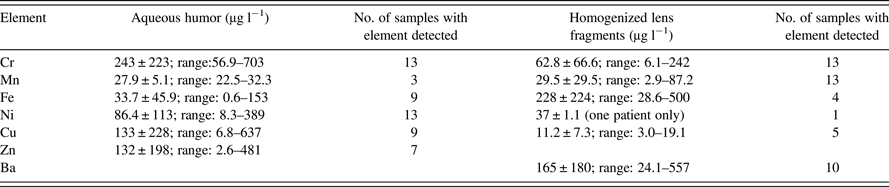
From the 14 patients enrolled in this study, six were male and eight were female. The average age was 68 and the age ranged from 50 to 84 years. Body mass index (BMI) was calculated for each patient with the average BMI being 30.4. According to the table published by the National Institutes of Health (National Heart, Lung and Blood Institute, 2013), no patient was underweight (BMI < 18.5), two patients were normal weight (BMI 18.5–24.9), four patients were overweight (BMI 25–29.9), and eight patients were considered obese (BMI > 30) with one of them heavily obese (BMI > 40). Only one patient smoked cigar, but seven had smoked at some time in their life. Most, but not all patients used tap water as their main drinking water source and had metallic parts in their body either as dental objects or rods and screws as result of surgery. Table I lists the average concentrations of metals found in both aqueous humor and lens along with standard deviations and ranges for all patients combined. All data are blank corrected. In a separate column, the number of samples is listed for each medium where the specific metal was found. Most heavy metals were present in both types of samples, with Ni only in aqueous humor and Ba only in lens. The concentration range was large for all elements and the standard variations as well. Only Mn in aqueous humor and Cu in lens had smaller standard deviations. Zinc was found in homogenized lens fragments of only one patient accounting for the low standard deviation and lack of range. The large standard deviations and ranges are not surprising considering the diversity of patients observed.
Elemental concentrations, standard deviations, range for aqueous humor and lens, and number of samples where an element was detected for the 14 patients enrolled in the study.

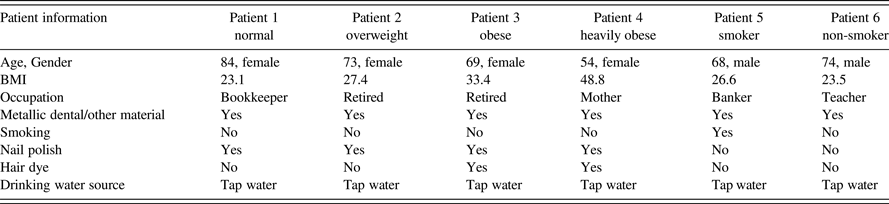
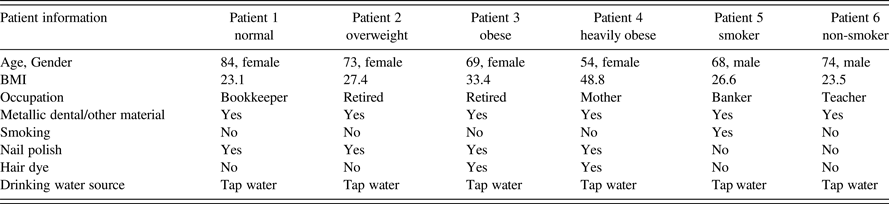
In an effort to investigate whether weight or smoking had an effect on elemental presence and concentrations in ocular tissue, BMIs were calculated for each patient and one patient from each BMI group was selected. Also the smoker was compared to a non-smoker. Criteria for the BMI comparison group were gender, main drinking water source, and presence of metallic objects in the body. Other parameters, such as age and the use of hair dye were more difficult to match because of the small number of samples. Since the heavily obese patient was female, only female patients in the other BMI groups were selected to avoid gender bias. The smoking patient was male and the control patient selected was closely matched not only in gender, but also in age, BMI, main drinking water source, and presence of metallic objects. Table II shows patient information derived from the questionnaire provided for the six selected patients and Table III lists the heavy metal concentrations determined by TXRF for those patients. All metal concentrations are blank corrected and are the average of three measurements. The first four patients (1–4; all females) correspond to each BMI group and of the last two (5, 6; both males), one was a smoker and one a non-smoker.
Basic physical and lifestyle data for six patients extracted from the questionnaire.
Metal concentrations detected for aqueous humor and homogenized lens fragments of the six patients selected. LOD: limit of detection, determined for these biological samples.
AH, aqueous humor; L, homogenized lens fragments.
Whereas the results do not show clear trends as the sample size is very small, they do provide initial information about metal concentrations in aqueous humor and lens of patients undergoing cataract surgery. Most elements showed substantial variations from patient to patient for each medium. Interestingly it appears that the number of heavy metals detected and their concentrations increase with increasing BMI. For instance, manganese was found in aqueous humor of the obese and heavily obese patient, whereas it was below detection limit for the lower BMI groups. The heaviest patient also showed a much higher copper concentration. Both copper and manganese are essential elements taken up by the diet and are involved in a number of enzymatic processes including synthesis and degradation of proteins (Nordberg et al., Reference Nordberg, Fowler, Nordberg and Friberg2007). Excess manganese and copper are excreted via the digestive tract with copper also excreted in sweat and through hairs. However, little is known whether these elements or other excess heavy metals can be deposited in the ocular tissue. Therefore, the results suggest that a more focused study should be carried out taking the influence of weight and age on heavy metal concentrations in ocular tissue into account.
In case of the smoker and the non-smoker comparison, it is noticeable that copper and zinc concentrations in aqueous humor are substantially higher for the smoker. In fact, the concentrations were the highest found for this medium over all patients analyzed. Also further studies are warranted to corroborate this finding.
In summary, certain trends appear to be present with regard to heavy metal concentrations in ocular tissues, but a large set of data has to be collected to investigate those trends more closely and define relationships in connection to obesity, age, and smoking.