

The objective of this article is to analyse the origin, operation and outcomes of Kemmerer's mission in Mexico. The famous US financial advisor for foreign governments, known as the ‘money doctor’, visited Mexico for six weeks, from the middle of July to the end of August of 1917. The constitutional President of Mexico, Venustiano Carranza, invited him to draw up a new central bank plan and to design a new monetary law respectful of the gold standard. According to the Mexican government these two reforms might put the national economy ‘on its feet again’ after seven years of political turmoil and economic devastation, following the revolution that had overthrown Porfirio Diaz's dictatorship.Footnote 1
Kemmerer's job for the Mexican government was to be the first of a series of missions in Latin America. During the 1920s, many Andean governments hired the money doctor to modernize their economy whilst improving their access to foreign loans. Indeed, these goals were strongly intertwined. The core economics ideas and institutions that Kemmerer brought to the host countries (i.e. a new central bank, the gold standard and an efficient fiscal system) usually attracted new foreign capital (Drake Reference Drake1989; Eichengreen Reference Eichengreen and Drake1994; Flandreau Reference Flandreau and Flandreau2003). At least, this was true for the Andean countries that Kemmerer visited in the 1920s.
However, his Mexican mission of 1917 did not go down the same route. In fact, the amount of new American capital received by Mexico during the Roaring Twenties was minimal (Lewis Reference Lewis1938, pp. 626–7). The failure to reassure potential foreign lenders led some scholars to define Kemmerer's mission in Mexico as an ‘unsuccessful’ attempt (Drake Reference Drake1989, p.9; Eichengreen Reference Eichengreen and Drake1994, p. 121; Turrent Reference Turrent and de México2010).
But was his mission a failure? The economic historian Paul Drake stressed that the ‘most basic function of money doctors’ has been ‘to bring new economic knowledge and techniques to the host countries’ (Drake Reference Drake and Drake1994, p. xviii): thus, did Kemmerer introduce some new and more efficient economic practices and institutions in Mexico?
To tone down the idea that Kemmerer's mission in Mexico was a total fiasco, this article provides the first analysis of the origins, the purpose and the outcomes of this mission. Detailing the impact of Kemmerer's laws on the Mexican economy goes beyond the aim of this work. Although I use some quantitative data to examine Mexico's economic performance during the 1920s, mine is primarily a historical narrative. Drawing on unpublished materials from the Edwin Kemmerer Papers, the Federal Reserve Bank Archive, the Archive and Bank of Mexico and other private and public archives, in this article I critically evaluate Kemmerer's sponsored economic reforms at four different stages: study, approval, installation and implementation. Comparing Kemmerer's original plans with the actual reforms carried out by the government in the following years, I argue that his mission in Mexico followed the same path and produced similar institutional outputs as his later missions in the Andean countries.
Indeed, despite some delays, Mexico approved and installed all the reforms suggested by Kemmerer. Although a thoroughly comparative analysis of previous missions by Kemmerer in the Andes with the Mexican one is not carried out, a general overlook highlights that while the implementation of the first ‘faltered because local politics and economic powers reshaped, distorted and subverted Kemmerer's reforms’ (Drake Reference Drake1989, p. 254), in Mexico the mission experienced some problems in getting its laws properly enacted. Overall, I claim that whilst Kemmerer's reforms produced some results in the short term, many of his recommendations failed to produce the expected outcomes. I advocate the view that the main obstacle Kemmerer faced in Mexico was the financial devastation and political instability caused by the Mexican Revolution.
The article is structured as follows. The first section reviews the Mexican economic and financial situation before Kemmerer's mission and the motives that induced Carranza to hire him. The central corpus of the article focuses on the studies, adoption and implementation of respectively the monetary reform (Section ii), the banking reform (Section iii) and the fiscal reform (Section iv). By comparing Kemmerer's idea with the actual outcomes, I underline the problems encountered by Mexico during the implementation of each reform. The article concludes with a brief discussion of the results of Kemmerer's sponsored advice until the end of 1931, when the consequences of the global depression obliged a reluctant government to discard the money doctor's orthodoxy.
I
In a missive of 23 July 1917, Kemmerer informed his Princeton colleague Frank Fetter of his six weeks’ academic leave to travel to Mexico City: he was to serve there as a monetary advisor to the Mexican government, since ‘the currency situation in Mexico is now in a rather bad tangle’.Footnote 2 Indeed, the monetary and the banking systems were among the first and probably the main casualties of the armed uprising that had begun in late 1910. The civil war between Venustiano Carranza (the First Chief of the revolutionary group called the Constitutional Army) and the dictatorship government of Victoriano Huerta had jeopardized the national financial system's stability since the middle of 1913. Huerta officially suspended the gold standard in November 1913 and deferred the service on the US$600 m external debt in 1914 (Turlington Reference Turlington1930). Nevertheless, since the middle of that year, his government had borrowed almost MX$50 m from the national banks of issue, allowing the latter to put additional paper currency into circulation to provide the amount borrowed.
While the territories controlled by Huerta were ‘in the abyss of irredeemable paper money’; the portion of the country administrated by Carranza was experiencing an even worse financial situation.Footnote 3 Whereas Huerta's government could count on financial aid provided by national banks, Constitutionalists had to finance their warfare by themselves. Thus, Carranza was obliged to authorize several issues of paper money to recruit troops and buy weapons. The currency situation spiralled out of control when the Constitutionalist group split into two opposing sides. From the end of 1914 until the middle of 1916, each revolutionary faction declared its currency to be the only legal tender, by voiding any other monetary issues and putting an enormous amount of highly depreciated paper money into circulation.Footnote 4
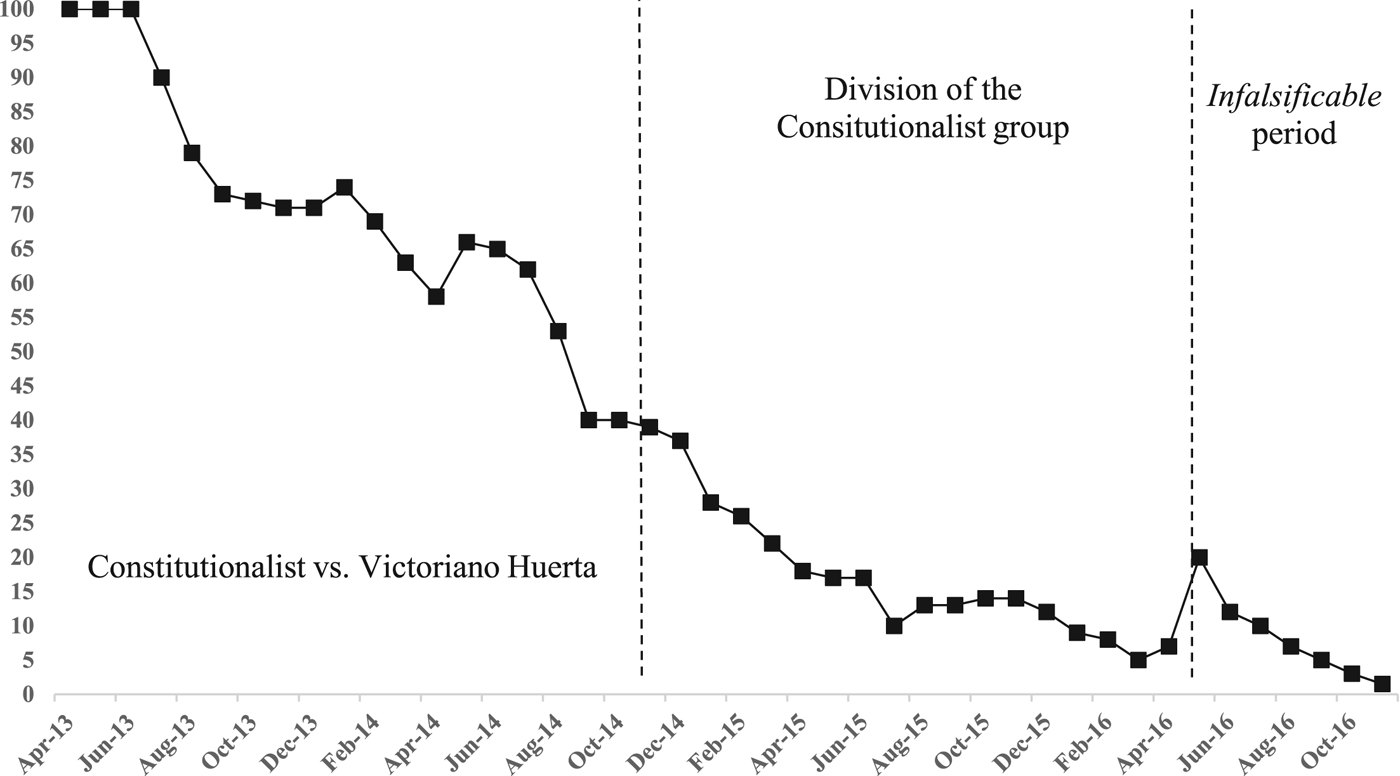
Carranza endorsed a project of monetary unification after regaining military control of Mexico City. Issued on 5 May 1916, the new paper currency called Infalsificable (uncounterfeitable paper money) was promoted by official propaganda as the definitive solution to the country's monetary problems. The government guaranteed the value of Infalsificable currency to be 20 cents’ worth of gold for each peso. However, only five months into the reform, this new currency had depreciated to such an extent that it was no longer usable (see Figure 1). The depreciation of the paper money went hand in hand with the spread of a hyperinflation that jeopardized Carranza's project of state-building (Kemmerer Reference Kemmerer1940).
Constitutionalist paper currency, April 1913 – December 1916 (100 = 1 Mexican gold peso)

To keep general protests at bay, the government found it advisable to pay its employees in metallic money and tried to switch from paper to a metallic-based monetary system, ordering the Mexican mint to coin metallic currency as quickly as possible. Despite the efforts of the Mint, the amount of metallic currency coined until May 1917 was less than MX$20 m, a completely inadequate sum for the needs of the country.Footnote 5 Desperate to find metallic coins, Carranza expropriated more than MX$54 m in gold and silver from the banks of issue's reserves.Footnote 6 Having been caught between ‘the Scylla of the revolution, on the one hand, and the Charybdis of a hostile government, on the other’ (McCaleb Reference McCaleb1920, p. 257), by the beginning of 1917 the great majority of the 26 banks of emission working in the republic before the start of the revolution were in bankruptcy.
Struggling to rebuild the financial system of the country, in May 1917 Carranza created the Financial and Administrative Reorganization Commission (FAC). Formed by four Mexican officials (Mexican Secretary and Sub-Secretary of the Treasury, Luis Cabrera and Rafael Nieto; Secretary of Commerce Alberto Pani; and Secretary of Communications Manuel Rodriguez Gutierrez) and two US economic advisors (Thomas Lill and Henry Bruere), the Commission was instructed to draft a project of economic reconstruction that would help restore the government's reliability both internationally and domestically. While Bruere and Lill were focusing on ‘paving the way for conferences between responsible bankers in the United States and representatives of Mexican government’ (Lill Reference Lill1919, p. 1), the technical details of the country's economic reconstruction were delegated to two other advisors: Edwin Walter Kemmerer and Henry Chandler. The first, known in Mexican financial circles for his writings on the Mexican monetary system during the Porfirian period, would study the currency and banking problems, and the second was to oversee the taxation reorganization.
Two main reasons justified the hiring of foreign advisors by the middle of 1917. Firstly, as President of the Mexican Republic, Carranza had a duty to sustain the legitimation process of the revolutionary government, and he identified the US specialists as the main facilitators. At this time, Mexican society considered Carranza to be a thief, the main agent of an ‘infamous government’, which had violated property rights and flooded the country with useless paper money.Footnote 7 Additionally, the presence of foreign economists was of the utmost importance in addressing the lack of Mexican financial experts within the Carranza administration team. Alberto Pani, Rafael Nieto and Luis Cabrera had different backgrounds, but they were all politicians, forced to accept economic and financial roles only to show ‘political loyalty’ to Carranza.Footnote 8 Luis Cabrera himself confessed the need for foreign expertise to update Mexican officials’ knowledge of modern economic theories. ‘Who are the Mexicans who know about finance?’ he asked during a congressional debate session. ‘We have Mexicans who know in depth how to solve our financial problems, but their names are José Yves Limantour, Pablo Macedo and Joaquin Casasús, Mexican citizens but against the revolution.’Footnote 9 Thus, the technical advice of Kemmerer and Chandler made it possible for the government to fill this gap and provide a solid base for the entire process of financial reconstruction.
Given these premises, Kemmerer's role in Mexican economic reorganization displayed some differences from his future missions. Firstly, in Colombia, Chile, Ecuador, Bolivia and Peru, Kemmerer would always serve as chair of the mission, whilst in Mexico he was just an economic advisor working under the direction of the FAC. Moreover, the majority of the Andean countries that Kemmerer visited had already laid the groundwork for monetary reform and a central bank (Drake Reference Drake1989). As seen, when he arrived in Mexico in July 1917, the country's financial situation was still desperate and Kemmerer had to rebuild the currency and the banking institutions from the ground up. The members of the FAC clearly established their priorities. ‘Primarily’, they informed Kemmerer, ‘you give your attention to the currency problem.’Footnote 10 Thus, having solved the monetary problem, Kemmerer could finally focus his attention on banking system reform, and offer a scientific foundation for the creation of a central bank.
II
Kemmerer arrived in Mexico by the middle of July 1917 and he quickly noticed the devastating consequences of the military insurgency on the national monetary system. ‘One of the results of the past five years of warfare in the Republic of Mexico’, Kemmerer wrote in his private notes, ‘has been the complete destruction of the paper currency system.’Footnote 11 Indeed, as described, by July 1917 the country was operating on a pure metallic currency basis, and no paper money was circulating.
The Mexican government explicitly invited the money doctor to prepare the adoption of a gold standard monetary plan that respected the 1905 monetary law on parity with the US dollar (i.e. with the peso equalling 49.85 US cents). A full gold standard adoption was a long-term goal, which could be fully accomplished after a complete economic stabilization, or at least a reorganization of the banking system. Because the implementation of banking reform took time, Kemmerer had to quickly solve another, more pressing problem. By the middle of March 1916, the price of silver in New York rose above the bullion par of the one-peso silver coin (Peso Fuerte); and since June 1917, one month before Kemmerer arrived in Mexico, it had risen above the bullion par of silver fractional money (Kemmerer Reference Kemmerer1917, p. 8). Although it drove all the Mexican silver fractional coins out of circulation, the increasing silver price offered a quick way to readopt a pure gold standard. As Kemmerer pointed out in his first monetary plan sketch, which was ready by 24 September 1917, the Mexican government had to quickly recoin all the existing silver pesos, and reduce their pure silver content. ‘The high price of silver’, the money doctor said, ‘is Mexico's opportunity to recoin silver with a good excuse’, and to secure large seigniorage profits, which would be large enough to form the greatest part of an adequate gold standard reserve.Footnote 12
To enact this plan, Mexico was required to sell its silver in exchange for gold in New York. However, at the beginning of September 1917, Woodrow Wilson ordered a general embargo on exporting US gold (Rosenberg Reference Rosenberg1975). Thus, deprived of the possibility of exchanging silver for gold, the currency plan was holed below the waterline. According to Alfredo Caturegli, the Mexican financial agent in New York, the effects of the gold ban could have triggered ‘disastrous consequences for the monetary future of Mexico’.Footnote 13 Luckily, Mexico could count on Kemmerer's unconditional help. By 25 September, he travelled to New York to organize several conferences with members of the Federal Reserve System, and with officers of the Government Gold Embargo Board, to campaign for the Mexican cause.Footnote 14 Thanks to his ‘pressures’, on 5 October 1917 the Federal Reserve granted special permits to export US gold to Mexico.Footnote 15
Having overcome the gold embargo, on 17 October, 1917 Kemmerer finally delivered his monetary reform plan to the Mexican government. As introduced in the tentative plan, the Mexican mint had to recoin all the existing silver coins and reduce their pure silver content. Kemmerer sponsored the coinage of a new peso fuerte with a pure silver content of 15 grams. The plan stated that in case of an unexpected rise in the price of silver during the period of preparation for the recoinage, the government ‘should reduce the coins’ fineness sufficiently to give the necessary protection to them’ (Kemmerer Reference Kemmerer1917, p. 45). Following the declaration of the free coinage of gold, the government had to build a proper machinery to sustain the new exchange parity. In particular, according to Kemmerer, once the coinage of fiduciary coins was restricted, an adequate gold reserve should be mandatory in order to ensure the parity of fiduciary coins with the gold unit of the value of 75 centigrams of pure gold.
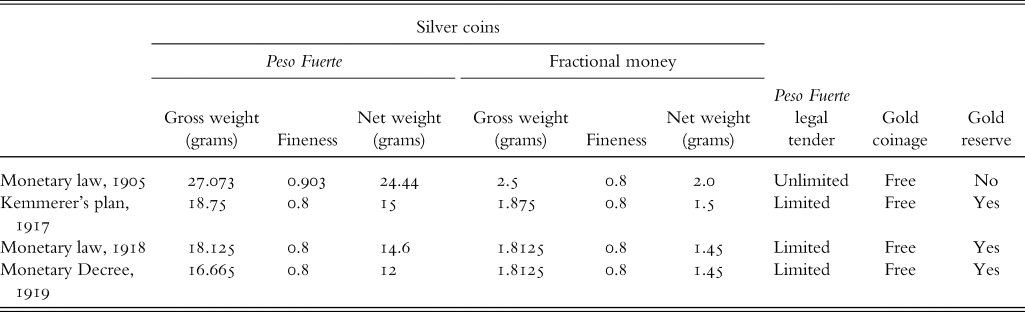
On 13 November 1918, when the Mexican mint was ready to issue the new metallic coins, Carranza finally enacted the new official monetary laws. Even though the pure silver content of the peso coins further decreased in 1919 due to another increase in the silver price, the monetary reform faithfully respected Kemmerer's prescriptions (see Table 1).
Kemmerer's monetary plan and Mexico monetary laws

Source: Author's own elaboration.
The gold reserve was of paramount importance in creating a proper apparatus for maintaining the parity between silver and gold, as well as defending the peso's exchange value. Kemmerer was convinced that the process of recoinage itself would yield a substantial seigniorage profit for building up the gold reserve. He knew that ‘to be on the safe side’, the government would have asked for a foreign loan of US$5 m, and later deposited part of the reserve in banks located in foreign financial centres (Kemmerer Reference Kemmerer1917, p. 51). However, due to the problems in US–Mexican relations, this option was impossible by the end of 1917. According to Kemmerer, this would not be a great problem. Indeed, when he left Mexico at the end of July 1917, gold coins accounted for the entire monetary circulation. A few months later, in a letter to Henry Bruere, Kemmerer wrote that ‘under present conditions, with fractional silver coins having a value as bullion ten per cent above their gold par’, there was ‘little danger of silver coins’ depreciation, even though there is no gold fund in existence for their redemption’.Footnote 16 He was aware that future improvements would involve the government limiting the coinage of fiduciary silver coins within the bounds of trade needs. Nevertheless, at the time of the monetary reform's launch, a gold reserve of 30 per cent should have been more than enough to deal with the absorption through redemption of any silver coinage in circulation.Footnote 17 Hence, Mexico would have ample time to build up a proper gold reserve in the future.
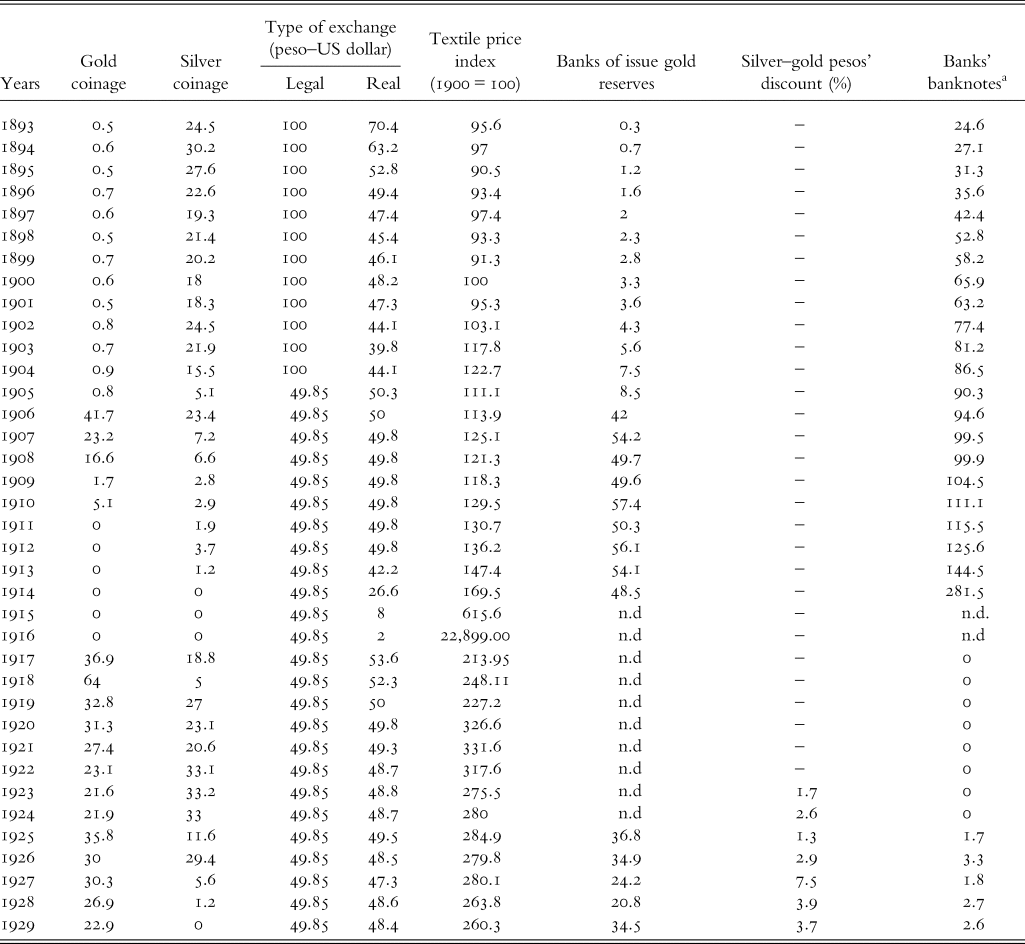
The result of the monetary reform was satisfactory, at least in the short term. Indeed, contemporaries saw the gold standard adoption as a sort of miracle created by the revolutionary government. According to local newspapers, Carranza and his government were able to consolidate and successfully adopt the best monetary system in the world, despite all the economic and political complications.Footnote 18 Surprisingly, some members of the old anti-revolutionary Porfirian elite also welcomed the gold standard adoption. For instance, Enrique Martínez Sobral revealed his surprise in a letter to his friend and confidant, José Yves Limantour, the former Secretary of the Treasury. ‘The Mexican type of exchange has come back to the good old days’, he wrote; and the gold standard adoption could be said to be almost complete, thanks to ‘the huge amount of gold now in circulation’.Footnote 19 The astonishment of public opinion was easy to understand after so many years of monetary disorder and hyperinflation. As Table 4 summarizes, while the Mexican mint coined only gold currency until November 1918, thanks to the approval of the monetary law, silver coins were issued too, helping to reduce the monetary stringency. By the beginning of 1921, even the influential newspaper The Bankers Magazine stated that Mexico was ‘on a solid gold basis’, due to the predominance of gold coins in circulation and in the Treasury gold fund reserve.Footnote 20
Nevertheless, Kemmerer's monetary plan was only a first step towards restoring some sort of monetary normality. The large percentage of gold coins in active circulation in Mexico worried the money doctor. As he confessed to Henry Bruere, ‘all the modern tendencies and the best monetary scientific opinion suggest that depending upon a large circulation of gold coin is extremely expensive and dangerous for a country’.Footnote 21 First, the gold coins in circulation threatened any future issues of banknotes. Second, in times of emergency, ‘when exchange rates turn against the country and economic conditions demand the prompt payment of gold export’, people generally tend to hoard the gold, thus precluding any chance of quickly gathering gold coins.Footnote 22 Indeed, according to Kemmerer's gold standard plan, in the near future, gold coins had to be replaced with central bank's convertible paper money. To reach this final goal, banking reform was crucial.
III
During the two months he spent in Mexico City, Kemmerer concentrated his work almost exclusively on the currency reorganization. As briefly mentioned before, the revolution had forced the old banks of issue out of existence: their assets were wiped out and their reserves taken over by the government, until the banks eventually declared themselves insolvent (McCaleb 1920; Maurer Reference Maurer2002; Bett Reference Bett1956). Out of the 26 banks of issue working before the revolution, at the beginning of 1918, ‘20 were bankrupt, and the surviving six were on the brink of collapse’.Footnote 23
Article 28 of the Mexican Constitution, approved on February 1917, sanctioned the state monopoly over the paper money issue. However, this functioned more as a declaration of intent rather than a real project for the establishment of a single bank of issue. ‘The banking problem in Mexico’, Kemmerer correctly reported in November 1917, ‘was merely a case of thinking out loud, in which the irritant was the reading of some soulish plans suggested for the banking reorganization in Mexico by men in high places.’Footnote 24 According to the money doctor, only Cabrera, Nieto and Alberto Pani genuinely favoured a scientific and technical reconstruction of the national banking system.Footnote 25 Indeed, they assigned Kemmerer a project that aimed for the ‘liquidation of the existing banks, their ultimate reorganization and the project for a new central bank of issue’.Footnote 26
In November 1917 Kemmerer started to develop a banking plan. Although the old banks of emission had been ‘basically destroyed’, he recommended that the government should push them to redeem, with some discount, all their outstanding notes, paying them in legal tender metallic money at sight, in order to ‘maintain the prestige of paper money’.Footnote 27 In the meantime, the Secretary of the Treasury would have compensated the net losses, which each bank of issue had suffered during the revolution.Footnote 28 Once the old banks of issue were liquidated, it would then be necessary to promote the creation of new commercial, deposit, mortgage and industrial banks. This would eventually lead to establishing the new central bank, the Bank of Mexico. According to Kemmerer's plan, the central bank would be the only institution allowed to issue paper money and to carry out the function of lender of last resort in case of emergency. To foster internal credit and smooth the circulation of banknotes, Kemmerer suggested creating several branches of the central bank, scattered throughout the republic.Footnote 29 Given that the money doctor underlined the importance of the central bank's independence, he proposed a mixed ownership, as the associate banks, private stockholders and the government must contribute to its capital. Regarding the issue of the central bank's board of directors, Kemmerer planned a board of ten directors, elected either by the stockholding banks or by individual stockholders, and appointed by the Mexican government. To strengthen the central bank's independence, Kemmerer stated that the total amount of loans that the bank could grant to the government could not exceed 10 per cent of its capital.Footnote 30
The money doctor also proposed other technical solutions. After conducting a historical analysis of ‘the reserve policy of all the great central banks of the world’, and having taken into consideration Mexicans’ ‘lack of confidence in all banks and in all form of bank credit’, he evaluated as ‘not excessive’ the establishment of a reserve requirement of 50 per cent against circulating notes and deposits.Footnote 31 As he was to do for the Andean countries he visited during the 1920s, Kemmerer considered the indigenous economic and financial conditions. In the case of Mexico, he suggested that, due to the problems the Carranza government had experienced with the old banks of issue, the future central bank law had to establish the freedom of association. Moreover, in order to compensate for the complete lack of internal credit, the new central institution should be allowed to deal directly with the public.Footnote 32
In November 1918 Alberto Pani and Rafael Nieto offered Carranza a new law for the regulation of banks and institutions of credit that strictly followed the advice of Kemmerer. The new General Law for Credit Institutions, submitted to the Mexican congress at the beginning of 1919, provided for a central bank of issue and the creation of new mortgage, deposit and commercial banks (McCaleb Reference McCaleb1920). While the implementation of the monetary reform was quick, the process of reforming national credit institutions took time. Any initiative by Carranza was halted by the government's financial trouble, its lack of credibility and the increasing political instability (Maurer Reference Maurer2002). By the end of 1922, the old banks of issue which had survived the revolution were still making strenuous efforts to collect outstanding loans, and collected their old bills at 18 to 54 per cent of face value.Footnote 33 Their only business consisted almost entirely of foreign exchange transactions and, as a New York banker reported to Kemmerer in 1920, ‘even in this line of business they have to meet the competition of street brokers’.Footnote 34
Only in December 1924 did Alberto Pani, recently promoted to Secretary of Finance, endorse a new general law for credit institutions and banking establishments. Following Kemmerer's advice, this law laid down provisions under which the banks should be organized into mortgage banks, promotion banks, agricultural banks, industrial banks, banks of deposit, and trust companies. Once the whole banking sector had been regulated, on 1 September 1925 the Banco de Mexico (Banxico) began its operations. Written by the first central bank's President, Manuel Gomez Morin, Banxico's law resembled Kemmerer's advice (Table 2). Even if Gomez Morin never explicitly quoted the Princeton professor, he acknowledged the strong influence that the ‘central bank's early theorist’ had on its final draft.Footnote 35 According to the Organic Law, Banxico had the right to issue banknotes redeemable in gold on demand and it regulated, within the republic, monetary circulation, foreign exchange and interest rates. Conditions for issuing notes were very stringent. Indeed, notes could be issued only in exchange for national or foreign gold coins; in exchange for foreign drafts ‘of first order payable at sight in gold’; and in exchange for ingots of gold at the rate of 75 centigrams of gold.Footnote 36 Lastly, banknotes could be issued in rediscounts which Banxico might make with the associate banks, to be issued on paper and payable in gold.
Kemmerer's central bank plan (Reference Kemmerer1917) and Banxico law (1925)

Source: Author's own elaboration.
In September 1925, some US bankers praised Banxico's organization: ‘the central bank law’, they wrote to Gomez Morin, was in line with ‘gold standard orthodoxy’, and it took account of the ‘tremendous importance of being cautious and conservative’.Footnote 37 In 1933, the Board of Directors of the powerful Bank of England stated that the Mexican central bank's organic law ‘totally followed Kemmerer's lines’.Footnote 38 Members of the Federal Reserve Bank of New York shared a similar opinion: ‘The Bank of Mexico’, they stated in 1930, ‘is under the gold exchange standard rules’, as were the other Latin American central banks that had been ‘founded by Kemmerer’.Footnote 39 Indeed, some of the most characteristic features of ‘Kemmererized’ central banks were present in Banxico's organization. For instance, as in the cases of Colombia and Chile, Kemmerer had granted the bank the right to engage in direct loan and discount transactions with the public (Carrasco Reference Carrasco2009). Furthermore, the new legislation established a 50 per cent gold reserve requirement for circulating notes. Lastly, Banxico was required to establish its headquarters in Mexico City, while 26 branches were opened, spread throughout the country's states.
As in the Andean countries, in Mexico local politicians distorted and personalized some of Kemmerer's recommendations. According to the original proposal of 1917, the work of Banxico should have been insulated from governmental pressures. However, considering the Mexican economic and political situation of 1925, this was simply unfeasible. According to the Mexican government, the central bank must be a state bank, and the principal national source of credit, rather than simply an apolitical and technocratic bank. Indeed, on 1 September 1925, when the bank started its operations, the government subscribed 51 per cent of Banxico's capital, and appointed five out of nine members of the bank's board of directors. In sum, as US financial experts Sterrett and Davis correctly pointed out in 1928, the Bank of Mexico ‘would seem to be much more under the control of the Government … than is common in central banks in other countries’ (Sterrett and Davis Reference Sterrett and Davis1928, p. 127).
IV
After he had delivered his monetary and banking projects, Kemmerer's mission was officially over. Nevertheless, his service to the Mexican government was far from complete. By the middle of 1917, Lill and Bruere had already been working on retooling government finance, as the Carranza government's budget was still in a bad tangle.Footnote 40 The first step in the process of reorganizing and tightening the national budgeting was the creation of a national comptroller within the new Department of Finance, who would supervise the progress of economic planning as well as controlling government expenditures.Footnote 41 The two US advisors also tried to persuade Carranza of the urgency of reducing expenditures by a system of monthly allotments, whereby the Treasury Department was required to submit a programme of expenditures each month for executive review.Footnote 42 Mexicans warmly welcomed these recommendations. In January 1918, the congress approved the creation of a Department of Control and a national comptroller, who held jurisdiction over all the nation's accounts. By 25 July 1919, Thomas Lill, who for over a year had supervised the ‘daily analysis of the cash receipts and disbursement of the revolutionary government’, proudly stated that his recommendations were fully adopted.Footnote 43 Indeed, as he reported directly to Woodrow Wilson, ‘I have been in this work for seventeen years and in no other engagement that I have been on, I had such a large number of my recommendations carried out.’Footnote 44
Despite all its efforts in diligently following Lill's recommendations, the Mexican government failed to attain a sound financial system. First, as Lill underlined, a substantial reduction of expenditures ‘cannot be expected until law and order have been re-established in Mexico’ (Lill Reference Lill1919, p. 9). Second and more important, only an increase of income through a complete revision of the entire revenue system could put Mexican financial reconstruction on a solid footing. To achieve this goal, Carranza hired Henry Alfred Chandler, a professor of economics at Columbia University and a member of the New York State Joint Legislative Committee on Taxation. The members of the Financial Commission considered Chandler's report unsatisfactory. In truth, Chandler's criticisms were well founded. The revenue system of Mexico's old regime had been regressive, inefficient and unequal. Indeed, the country depended mainly upon indirect taxes, and suffered from a multiplicity and a variety of taxes across federal states’ local and municipal governments (Chandler Reference Chandler1918). As Chandler suggested, Mexicans would have to simplify the taxation scheme and introduce direct taxes such as income tax. Although everyone agreed with Chandler's description of the old revenue system's weaknesses, there was still the problem of how to accomplish all these reforms in the short term. Mexico was facing an emergency that required some radical and unorthodox solutions. Thus, Chandler's ideas of relying on direct taxes were, at the very least, naïve. Mexican officials described Chandler's report as ‘unrealizable’, while Lill and Bruere thought it was full of ‘generalizations that appear to be sound as far as they go, but definitely too incomplete’.Footnote 45 Kemmerer made similar criticisms: ‘Chandler's report’, he stated, ‘is only a rough draft based upon incomplete information, and it is presented at this time only because of the urgent need for as much light as possible.’Footnote 46 Although the Mexican government hired Kemmerer just to draw up a new monetary and banking law, he quickly transformed himself into the real director of the Mexican mission. Indeed, after Chandler's plan was discharged, Kemmerer was asked to counteract someone else's less than diligent attitude. While reviewing what Chandler had done so far, he realized that the government needed an ‘Emergency Revenue Plan’ that could alleviate the economic constraints in the short term. In Kemmerer's opinion, the Mexican government should establish some new revenues from mining and petroleum production, and increase taxation on their exports. These two industries, mainly controlled by US owners, were flourishing thanks to a post-World War I price boom. Kemmerer's advice was, in truth, not original. Since 1911, when the first revolutionary president, Francisco Madero (1911–13), took control of the country, the Mexican government had raised taxes on oil (Haber, Maurer and Razo Reference Haber, Maurer and Razo2003b). However, it is interesting to underline the fact that, like the future banana tax in Colombia and the copper tax in Chile, in Mexico Kemmerer also suggested increasing the revenues derived from foreign individuals and foreign capital employed in the country.Footnote 47 Nevertheless, there were some worthwhile aspects of Chandler's original draft. For example, an income tax was a clever idea to modernize the Mexican financial system; although in Mexico, ‘only businessmen and some professionals have large incomes’, and ‘these are classes of persons whose incomes have been found very difficult to reach in other countries also’.Footnote 48 Hence, a previous period of study was mandatory to successfully establish the income tax.
Because Kemmerer was busy drafting the banking reform law, he decided to delegate the fiscal system's reorganization to Arthur Young, a ‘very capable young man’, as well as his former student at Princeton.Footnote 49 In November 1917, Kemmerer convinced the members of the FAC to hire Young for a period of six months, to stay ‘on the ground in Mexico during the period of taxation reform’.Footnote 50 Young's task was to promote the simplification of the entire revenue system, segregating the taxes belonging to the federal and municipal governments, and to study the financial situation of the most important municipality in the entire country, Mexico City. His mentor, as well as the Mexican government, cheered Young's report, submitted in April 1918. The ‘Finances of the Federal District of Mexico’ called for the simplification, extension and better collection of taxes. Young suggested creating a Tax Commission to supervise the administration of taxes, which was the most important tool for modernizing and centralizing the revenue system.Footnote 51 As in the case of the Controller's Department, Mexicans quickly endorsed Young's recommendations, and by 1918 a Tax Commission was created to control Mexico City's finances.
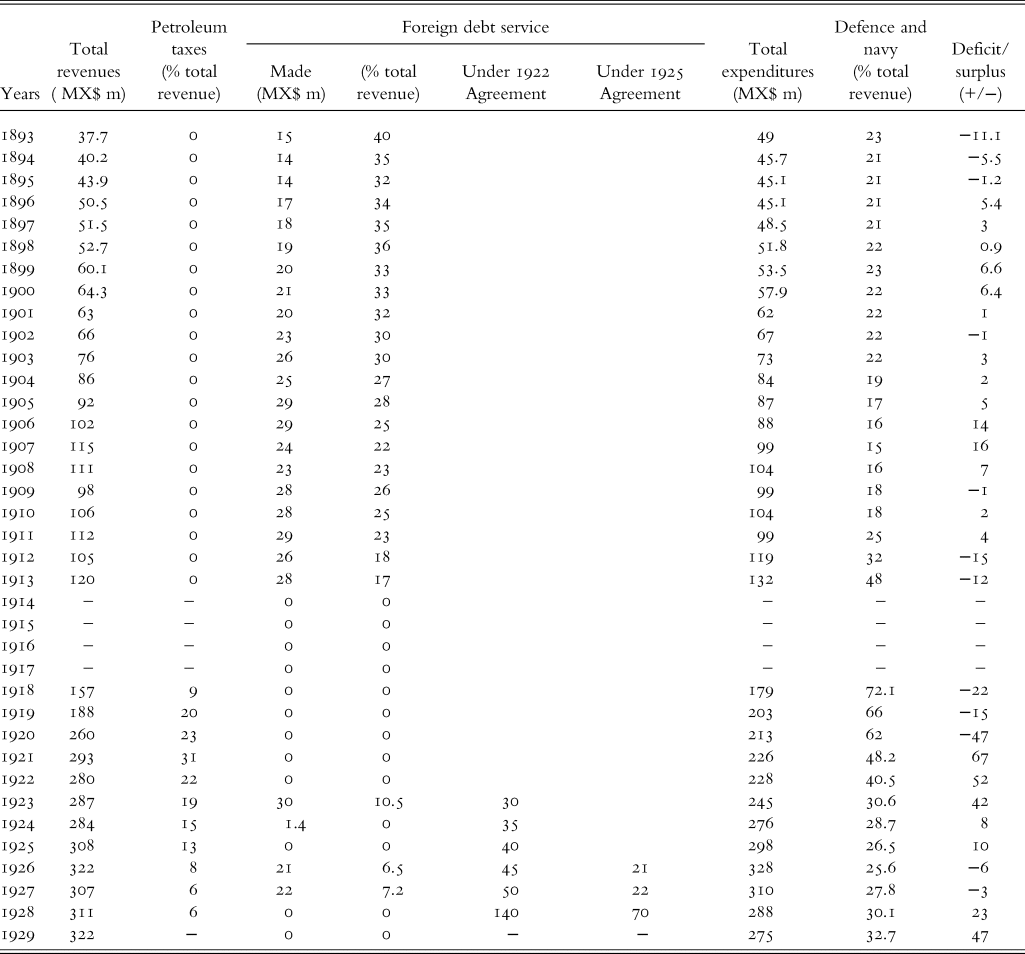
Nevertheless, political instability hindered Young and Kemmerer's recommendations for more productive and progressive taxes. Military revolts and a series of political uprisings obliged the government to make heavy military expenditures that jeopardized the entire budget process (Haber, Razo and Maurer Reference Haber, Maurer and Razo2003a). The emergency plan suggested by Kemmerer lasted longer than expected. Indeed, the production and the export taxes on petroleum, first imposed in the second half of 1920, formed the country's largest single source of revenue until 1925 (Haber, Razo and Maurer Reference Bett2003b). Even though, as Table 3 summarizes, the official accounts presented by the Mexican government showed that revenues exceeded expenditures prior to 1925, there are several reasons to question these records. Proof of this inaccuracy lies in Alberto Pani's critical remarks. When he became Secretary of the Treasury in September 1923, he pointed out that, instead of having the ample funds that the accounts seemed to indicate, the country was facing a deficit on its current account of roughly MX$60 m.Footnote 52
Mexican macroeconomic resumé, 1893–1929

Sources: Data on total revenue, total expenditure, foreign debt service and defence expenditures are from MSHyCP (various issues). Data on petroleum taxes are from Haber, Maurer and Razo (Reference Haber, Maurer and Razo2003b, p. 17). The estimates for foreign debt service under 1922 and 1925 agreements are from Galvarriato and Musacchio (Reference Galvarriato and Musacchio1997, p. 28).
A proper installation of the new tax planned in 1918 was enacted only in 1925, seven years after the financial mission left the country. As for the reform of the central bank, Alberto Pani was the main actor in this change. His fiscal programme resembled Kemmerer and Chandler's fiscal plans. After denouncing the inequity, inefficiencies and regressive character of Mexico's revenue system, he initiated a tax reform with the following major objectives: the rational division of the field of taxation between the federal state and local government; the elimination of irregular and absurd taxes; and the establishment of an income tax (Aboites Reference Aboites2003). Ironically, the income tax, which had been strongly recommended by US technocrat advisors and criticized by Mexican entrepreneurs, was eventually transformed by Pani's propaganda into being the true and only ‘revolutionary tax’. As the newly elected Mexican president, Plutarco Elias Calles proudly declared that the income tax was a tax of ‘high redeeming function’ that would place ‘the burdens that have gravitated more heavily on the poor, on the strong backs of the rich’ (MSHyCP 1925, p. 8).
V
Though the gold standard law was approved in 1918, the Mexican government established a central bank and endorsed a fiscal reform only in 1925. In the same year, Mexico also resumed service of its international debt (Turlington Reference Turlington1930). Alberto Pani pompously declared that the process of financial reconstruction was definitely over and ‘Mexico now stands at the threshold of a new era of prosperity’.Footnote 53 Pani's overconfidence was short-lived. Indeed, at the end of 1927, when Luis Montes de Oca replaced him as Secretary of the Treasury, national public revenues were shrinking once more and the government suspended debt payments again in 1928. In light of this, what was the ultimate legacy of Kemmerer's mission in Mexico? Was he indeed able to ‘put Mexico on its feet again’?
On the eve of the Great Depression, Mexico exhibited the main institutional characteristics of ‘Kemmererized’ countries: a central bank, the gold standard, and a centralized and progressive tax system. Nevertheless, as in the case of countries like Chile, Ecuador, Colombia and Bolivia, things did not go as expected. As for the fiscal reform, the automatic budgetary system promoted by Lill and Young proved unsuitable for a country like Mexico, which was hindered by political instability and volatile foreign trade. Furthermore, the financial advisors’ recommendations for a more technical and progressive tax system encountered numerous domestic obstacles. The income tax, for example, clashed with the interest of industrialists and merchants; and despite growing in importance in the years ahead, by 1935 it amounted to only the 12 per cent of total revenues (Aboites Reference Aboites2003).
The implementation of the central bank and monetary reform followed a different and still intricate path. The first of Kemmerer's plans endorsed by the Mexican government was the adoption of the gold standard in 1918. However, defining the essence of the Mexican monetary system during the 1920s is not an easy task. According to Kemmerer, after his mission, ‘Mexico continued to maintain the gold standard, with slight interruption, until the summer of 1931’ (Kemmerer Reference Kemmerer1940, p. 135). Alberto Pani went even further, declaring in 1925 that Mexican adoption and implementation of a ‘pure gold standard’ was an achievement that ‘has not been obtained even by some of the richest and most powerful countries in Europe’.Footnote 54 Other international observers were, correctly, more cautious. Sterrett and Davis, for example, noted in 1927 that ‘although free coinage of gold is maintained, the country has not had a gold standard in the full sense of term’ (Sterrett and Davis Reference Sterrett and Davis1928, p.24). Indeed, as Table 4 summarizes, from 1922, silver pesos were coined in large quantities, with a view to realizing seigniorage profits that would accumulate funds for the establishment of the Bank of Mexico. Thus, from 1923 until the monetary reform of 1931, silver pesos were discounted in relation to gold.
Mexican monetary and banking resume 1893–1929 (MX$ m)

aData from 1893 to 1917 take into account all the Mexican banks of issue. From 1925 the central bank had the monopoly on issue.
Sources: For gold and silver coinage, see MSHyCP (various issues). Textile price index is from Galvarriato and Musacchio (Reference Galvarriato and Musacchio1998, p. 25). Gold reserve and banknotes data (1893–1917) are from El Economista Mexicano (various issues) and for the period 1925–9 data from Banxico Annual Reports have been used. Data on type of exchange (1893–1925) are from El Economista Mexicano (various issues), while for the period 1925–9 data are from Banxico Annual Reports.
The main characteristic of Mexico's monetary system during the 1920s was the predominance of metallic currency over paper money. Indeed, Mexicans’ preference for hard money was one of the greatest weaknesses of the central bank. As Table 4 summarizes, although Banxico's paper money was more than covered by a gold reserve, the government's efforts to induce people to use banknotes were unsuccessful. The reason for this debacle was the complete lack of public confidence in paper money: the memory of revolutionary hyperinflation was still very vivid in Mexican society during the 1920s (Sherwell Reference Sherwell1929). Moreover, government influence in central bank affairs hindered public confidence in its management. The lack of trust around the central bank had a strong impact on its progress. Since the only channel through which Banxico could augment the currency supply was the rediscount with associate banks, the fact that by 1929 only five banks had decided to become associates had a strong impact on the central bank's role as monetary director of the country.
Nevertheless, Banxico accomplished some of its tasks. The central bank played a primary role in encouraging the national credit market. Manuel Gómez Morín stated that it was only thanks to the central bank that the Mexican monetary system had ‘returned to a technical management’, forgetting the ‘previous excesses’.Footnote 55Alberto Mascareñas, Banxico's managing director, proudly emphasized this in his correspondence with the deputy governor of the Federal Reserve Bank of New York. ‘The business community in Mexico’, he stated in 1928, ‘has to thank the Bank of Mexico for cheapening money to a point where, at present, even a merchant or a manufacturer may obtain funds to finance his ordinary operations’.Footnote 56 Indeed, while the normal interest rate across the republic in 1924 was between ‘18 percent and 24 percent annually’, after the creation of the central bank it fluctuated between 7 per cent for inter-bank loans and 10 per cent for regular loans. Moreover, despite political instability and the heavy withdrawals of liquid capital from Mexico, the bank made strong efforts to regulate and stabilize the Mexican exchange and reduce silver pesos’ discount against gold. Indeed, before the crisis of 1929, the gold pesos moved within the gold exchange points, or just below the gold export point.
The most important legacy of Kemmerer's mission was his influence on the ideological foundation of the new financial and economic elite of revolutionary Mexico. Alberto Pani (Secretary of Finance from 1923 to 1927 and 1931 to 1933) and Luis Montes de Oca (from 1927 until 1931) both adhered to the Western orthodox economic ideas brought into Latin America by Kemmerer. During the economic downturn of 1931, the Mexican government again turned to him for new advice. Although Kemmerer could not help in person, his legacy lives on in the monetary and banking law approved by the Mexican government in July 1931. As members of the Federal Reserve Bank of New York noted in November 1931, the aforementioned Mexican monetary law, was ‘the first step in the Mexican government's plan to evolve a stable currency system in the country, with the establishment of the gold exchange standard as the ultimate objective’.Footnote 57 This goal was never attained because of the worsening depression in 1931–2. Despite the tremendous consequences of the Great Depression, Mexican monetary authorities were very reluctant to leave the gold standard ideology. Kemmerer's legacy has proved hard to erase.