Implications
Limited information is available on the possible advantages of increasing diet fermentability on performance and health criteria of heat-stressed dairy cows. This study indicates increasing diet fermentability may increase milk protein production and improve heath criteria and nitrogen metabolism of heat-stressed dairy cows. However, the recommendation should be considered with caution because this effect may be negated at high levels of diet fermentability.
Introduction
Ambient heat stress is a very important challenge for animal production in most parts of the world (Baumgard and Rhoads, Reference Baumgard and Rhoads2012; Renaudeau et al., Reference Renaudeau, Collin, Yahav, De Basilio, Gourdine and Collier2012). With a projected increase in global average surface temperatures by 2100 between 1.88°C and 4.08°C (Renaudeau et al., Reference Renaudeau, Collin, Yahav, De Basilio, Gourdine and Collier2012), the effect of heat stress on future animal production is a growing concern. The continued success of dairy cow husbandry is dependent on strategies that will enable acclimation to heat stress.
Heat stress can affect the dairy cow in many ways. Intake, immune responses and reproductive efficiency are decreased (West, Reference West1999, Reference West2003; Carroll et al., Reference Carroll, Burdick, Chase, Coleman and Spiers2012; Renaudeau et al., Reference Renaudeau, Collin, Yahav, De Basilio, Gourdine and Collier2012), and milk production appears to be particularly sensitive to thermal stress as decreased yields of up to 35% to 40% are not unusual (West, Reference West2003). Although the decline in milk yield during heat stress is mainly due to depression in feed intake (West, Reference West2003), a study by Baumgard and Rhoads (Reference Baumgard and Rhoads2012) indicated that mechanisms of haemostasis and partitioning of nutrients independent of feed intake were also involved. These mechanisms rely on nutrient metabolism (i.e. fat, protein and carbohydrate) and hormonal regulation (Baumgard and Rhoads, Reference Baumgard and Rhoads2012). Some examples are decreased adipose tissue mobilisation, decreased levels of non-esterified fatty acids (NEFA) and glucose in blood (Baumgard et al., Reference Baumgard, Wheelock, Sanders, Moore, Green, Waldron and Rhoads2011; Renaudeau et al., Reference Renaudeau, Collin, Yahav, De Basilio, Gourdine and Collier2012), increased muscle catabolism of amino acids (Wheelock et al., Reference Wheelock, Rhoads, VanBaale, Sanders and Baumgard2010), and glucose sparing by the mammary gland (Baumgard and Rhoads, Reference Baumgard and Rhoads2012). As a result, strategies for improving performance of dairy cows subjected to heat stress need to focus on induced responses.
It has been reported that increasing diet fermentability can increase the efficiency of rumen fermentation by producing greater propionate and lesser acetate and butyrate concentrations, leading to less enteric methane energy and heat losses (Knapp et al., Reference Knapp, Laur, Vadas, Weiss and Tricarico2014; Krause et al., Reference Krause, Combs and Beauchemin2002). Also, propionate is the major precursor of glucose production in the liver and increasing synthesis of propionate can promote endogenous production of glucose and spare internal catabolism of body reserves (Bell, Reference Bell1995). Moreover, it has been reported that increasing diet fermentability increases microbial protein synthesis in the rumen (Oba and Allen, Reference Oba and Allen2003) reducing the need for supplementary undegradable feed protein sources. Increased microbial protein production could decrease ammonia-N (NH3-N) concentration in the rumen, decrease plasma urea nitrogen (Oba and Allen, Reference Oba and Allen2003), and reduce nitrogen excretion urea. Increasing diet fermentability may, therefore, offer a means of alleviating the effects of heat stress on dairy cow performance. However, excessive diet fermentability can further exacerbate rumen acidosis, a condition that is prevalent in heat-stressed cows (Kadzere et al., Reference Kadzere, Murphy, Silznikove and Maltz2002; West, Reference West2003; Nasrollahi and Khorvash, Reference Nasrollahi and Khorvash2014).
To our knowledge, there is no study that has examined the effect of increasing diet fermentability on performance of heat-stressed dairy cows. Therefore, the objective of this study was to evaluate the effect of increasing diet fermentability on intake, total tract digestibility, rumen fermentation, blood metabolites, and milk production and efficiency of heat-stressed dairy cows. We hypothesised that moderate increases in diet fermentability would shift the rumen fermentation towards propiogenesis resulting in improved health and productivity of heat-stressed dairy cow.
Materials and methods
The experiment was a collaboration between the Department of Animal Science, University of Tehran (Karaj, Iran) and the Lavark Research Station of the Department of Animal Science, Isfahan University of Technology (Isfahan, Iran). Animals were cared for according to the guidelines of the Iranian Council of Animal Care (1995) and the experiment was approved by the Institutional Animal Care Committee for Animals Used in Research.
Animals, experimental design and treatments
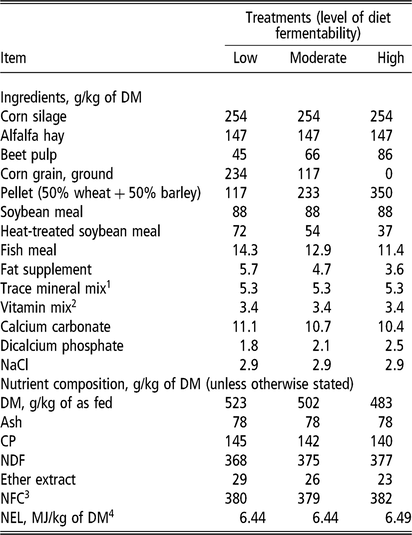
Nine multiparous lactating Holstein dairy cows (650 ± 56 kg BW; mean ± SD) averaging 102 ± 13 days in milk and producing 54 ± 6 kg/day of milk were used and randomly allocated to a replicated 3 × 3 Latin square design with 21-day periods. Each period consisted of 14 day of adaptation followed by 7 day of data collection. Cows were housed in individual stalls (3 m × 3 m) within an aluminium roofing facility with open sides and clean wood shavings and sand were used for bedding and refreshed daily. The dietary treatments were three levels of diet fermentability achieved by altering the ratio of ground corn:pellets containing 50% ground wheat and 50% ground barley (DM basis): (1) 66.6:33.3 pellets (low), (2) 33.3:66.6 pellets (moderate) and (3) 0:100 pellets (high). Together the corn and pellets comprised 35% of dietary DM. Diets were formulated to meet or exceed the Cornell Net Carbohydrate and Protein System (CNCPS, version 5.0; Fox et al., Reference Fox, Tylutki, Czymmek, Rasmussen and Durbal2000) nutrient allowance for a lactating dairy cow weighing 650 kg and producing 53 kg/day of milk with 2.9% milk true protein and 3.0% milk fat (Table 1). Feed was supplied twice daily at 1000 and 1800 h in amounts that allowed 5% to 10% refusals. Diets were manually mixed and weighed into each cow’s feed trough, and refusals were manually removed daily and weighed.
Composition and nutrient content of dairy cows diets

1 Contained 800 mg/kg of Fe, 3000 mg/kg of Cu, 10 000 mg/kg of Mn, 120 mg/kg of Co, 16 000 mg/kg of Zn, 80 mg/kg of Se, 150 mg/ kg of I and 2000 mg/kg monensin.
2 Contained 1300 kIU/kg of vitamin A, 360 kIU/kg of vitamin D and 12 kIU/kg of vitamin E.
3 NFC = nonfibre carbohydrate calculated by difference 100 − (% NDF + % CP + % fat + % ash).
4 NEL = Net energy for lactation based on tabular values (Cornell Net Carbohydrate and Protein System; Fox et al., Reference Fox, Tylutki, Czymmek, Rasmussen and Durbal2000).
Environmental measurements and calculation of temperature–humidity index
The study was conducted from 27 May 2015 to 28 August 2015. Ambient temperature ( T db , °C) and relative humidity (RH, %) were measured using a temperature and humidity data-logger (model ST-172; Fotronic Co., Melrose, MA, USA) at 30-min intervals over 24 h for two consecutive (days 19 to 20) days of each sampling period to calculate the temperature–humidity index (THI):
THI = (1.8 × T db + 32) – [(0.55 – 0.0055 × RH) × (1.8 × T db – 26.8)] (NRC, 1971).
Intake, digestibility, analyses and in situ rumen fermentability of grains
The total mixed ration amounts offered and refused were measured daily for each cow during days 15 to 20 of each period and daily dry matter intake (DMI) for each cow was calculated. Representative samples of treatment total mixed rations (pooled by diet within period), and individual refusals (pooled by cow within period) were taken during days 15 to 20 of each period. Also, samples of faeces were taken from each cow before the morning feeding on three consecutive days of each period (days 18 to 20). All samples were immediately frozen at −10°C until analysed.
After thawing, the DM concentration of diets, refusals and faeces samples was determined by drying at 60°C in a forced-air oven for 72 h. All samples were ground using a Wiley mill through a 1-mm screen (Retsch GmbH 5657 HAAN, Germany) and analysed for CP using the Kjeldahl method (Kjeltec 1030 Auto Analyzer, Tecator, Höganäs, Sweden; AOAC, 2002, method 955.04), ether extract using diethyl ether (EE; AOAC, 2002, method 920.39), ash determined at 620°C for 8 h (AOAC, 2002; method 942.05), and NDF using heat stable α-amylase (100 μl/0.5 g of sample, Van Soest et al., Reference Van Soest, Robertson and Lewis1991). Non-fibre carbohydrate (NFC) was calculated as 100 − [CP + NDF + EE + ash]. Refusals from individual cows were used to calculate nutrient intakes. Samples of faeces taken from each cow before the morning feeding on three consecutive days of each period were pooled and analysed for acid-insoluble ash (AIA) as an internal marker to calculate apparent digestibility using the 2 N HCl procedure of Van Keulen and Young (Reference Van Keulen and Young1977).
Ruminal fermentability of DM of the grains was determined in a separate experiment using two rumen-cannulated non-lactating Holstein dairy cows according to Bender et al. (Reference Bender, Cook and Combs2016). The cows were fed ad libitum a high forage ration. Sample size to surface area ratio of the polyester bags (pore size of 25 μm) was 10 mg/cm2 and three incubation times (2, 4 and 6 h) were used for each sample.
Rumen sampling and analysis
On day 21 of each period, 4 h after the morning feeding ruminal fluid (about 3 ml) from the ventral sac was sampled via rumenocentesis (Nordlund and Garrett, Reference Nordlund and Garrett1994). The pH of the ruminal fluid was immediately determined using a portable digital pH meter (HI 8318; Hanna Instruments, Cluj-Napoca, Romania)
For measuring volatile fatty acids (VFA) and NH3-N, ruminal fluid samples were taken on day 20 of each period 4 h after the morning feeding, using a stomach probe. The first 100 ml of fluid were discarded and 50 ml of the subsequent sample was retained. Ruminal fluid was strained through one layer of cheesecloth, and then 4 ml of strained fluid were acidified with 1 ml of 25% meta-phosphoric acid and stored at −10°C until VFA analyses. Ruminal fluid samples were analysed for VFA by gas chromatography (Philips, PU 4410, USA) according to the procedures described by Ottenstein and Bartley (Reference Ottenstein and Bartley1971). Ruminal NH3−N concentration was determined by the colorimetric phenol-hypochlorite method of Broderick and Kang (Reference Broderick and Kang1980).
Blood sampling and analyses
On day 18 of each period, blood samples (7 ml) were collected before the morning feeding via the coccygeal vein using an evacuated tube without anticoagulant and a heparinised evacuated tube. All the blood samples were placed on ice immediately after collection and 0.5 to 1 h later were centrifuged at 3,000 × g for 15 min. Serum and plasma samples were separated and stored in plastic tubes frozen at −10°C until analysis. The concentrations of serum glucose, cholesterol, blood urea-N (BUN), high-density lipoprotein (HDL) cholesterol, triglyceride (TG), total protein, albumin, creatinine, aspartate aminotransferase (AST) and alkaline phosphatase (ALP) were measured by an autoanalyser (Abbott Alycon 300, USA) using commercial kits (Pars Azmoon Co., Tehran, Iran) according to the manufacturer’s instructions (Nasrollahi et al., Reference Nasrollahi, Ghorbani, Zali and Kahyani2017). The analyser was calibrated and controls assayed daily according to the manufacturer’s instructions to ensure acceptable assay performance. Serum beta-hydroxy butyric acid (BHBA) and nonesterified fatty acid (NEFA), and total antioxidant capacity (TAC) were determined by commercial colorimetric kits (Randox Laboratories Ltd., Ardmore, UK) using the same autoanalyser. The concentration of serum malondialdehyde (MDA) was determined by thiobarbituric acid reacting substances method, in which the absorbance of a coloured complex that is formed from the reaction of MDA with 2-thiobarbituric acid in acid environment is measured at 532 nm (Wullepit et al., Reference Wullepit, Hostens, Ginneberge, Fievez, Opsomer, Fremaut and DeSmet2012). Globulin concentrations were calculated by subtracting albumin concentrations from total protein. Plasma concentration of serum amyloid A (SAA) was determined using an ELISA bovine kit (Shanghai Crystal Day Biotech Co., China) according to manufacturer’s instructions (Nasrollahi et al., Reference Nasrollahi, Ghorbani, Zali and Kahyani2017).
Milk yield and components, body weight and body condition score, and rectal temperature
Cows were milked three times daily at 0100, 0900, and 1700 h in a herringbone milking parlour. Milk yield was recorded during days 15 to 20 of the study, while milk samples were collected from each milking during days 15 to 18 of the study. Milk samples were preserved with potassium dichromate and stored at 4°C until further analysis for fat, true protein, lactose, and solid not fat content (Fossomatic 5000, Foss Electric, Hillerød, Denmark; Nasrollahi et al., Reference Nasrollahi, Ghorbani, Zali and Kahyani2017). Milk yield was corrected for milk components as 3.5% fat corrected milk (FCM = 0.432 milk yield + 13.23 fat yield; Gaines, Reference Gaines1928) and energy corrected milk (ECM = 0.3246 milk yield + 12.96 fat yield + 7.04 protein yield; Jenkins et al., Reference Jenkins, Bertrand and Bridges1998).
Cows were weighed at the beginning (d1) and the end (days 19 and 20) of each period and body condition score (BCS) was determined using a 5-scale method where 1 = emaciated and 5 = obese (Ferguson et al., Reference Ferguson, Galligan and Thomsen1994).
On day 19 of each period, rectal temperature was measured at about 1500 h using a clinical veterinary thermometer inserted in the rectum.
Statistical analyses
Data were analysed using the mixed-model procedure of SAS (Proc Mixed; SAS Institute, 2002) to account for effects of square, cow within square and treatment. The treatment, square and period were considered as fixed effects; cow within square was considered a random effect. Estimation method was REML and the degrees of freedom method was Kenward–Rogers. Polynomial orthogonal contrasts were used to test the linear and quadratic effects. Additionally, the differences among the treatments were evaluated using a multiple comparison test following the Tukey–Kramer method. Statistical significance of main effects was declared at P ≤ 0.05, and tendencies were discussed at 0.05 ≤ P ≤ 0.10.
Results
Ambient heat stress occurrence
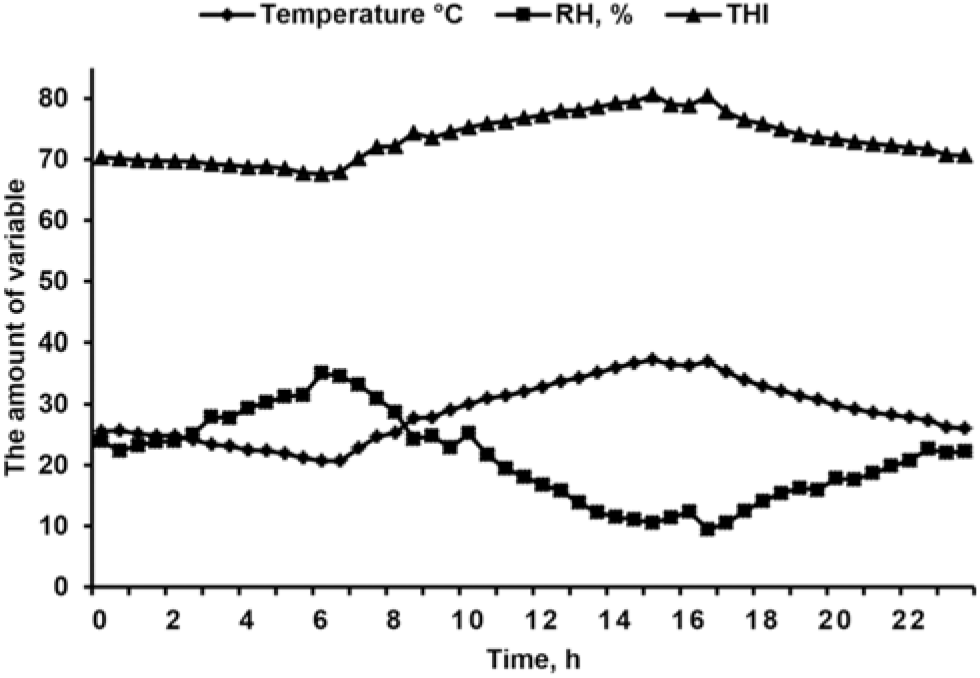
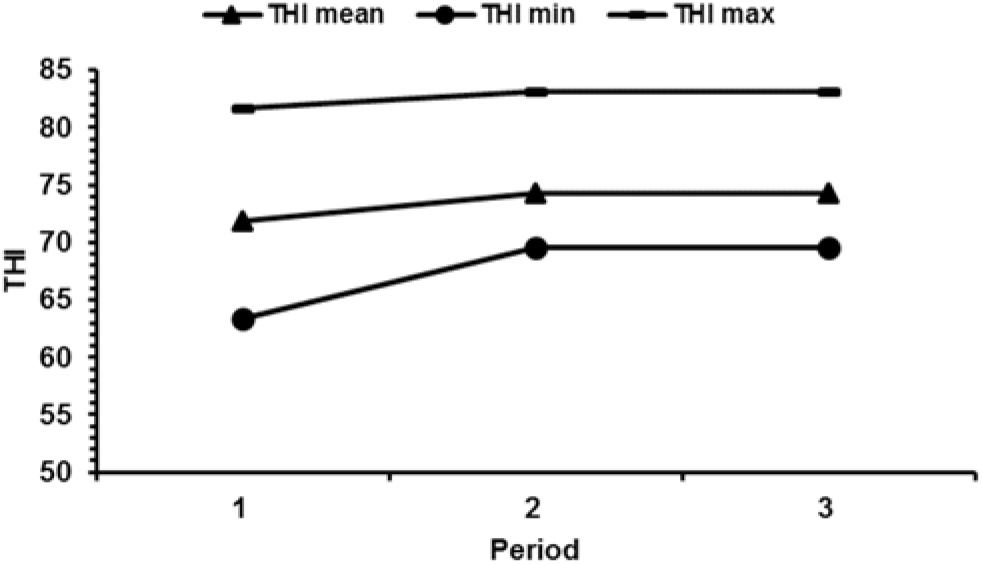
Averaged over the experiment, the THI exceeded 68 at almost all times of the day (Figure 1). In fact, the cows experienced 22.5 h/day of ambient THI > 68, 18 h/day of THI > 70, and 14.5 h/day of THI > 72. The THI was consistent among the three experimental periods, with average daily THI > 72 in all periods (Figure 2), maximum THI of 82, 83 and 83 for Periods 1, 2, and 3, respectively, and minimum THI of 63, 70, and 70 for the same three periods.
Average daily change in temperature, relative humidity (RH) and temperature–humidity index (THI) during the experiment on dairy cows.

Mean, minimum and maximum temperature–humidity index (THI) during different periods of the experiment on dairy cows. The study was conducted from 27 May 2015 to 28 August 2015.

Nutrient intake, digestibility and grain fermentability
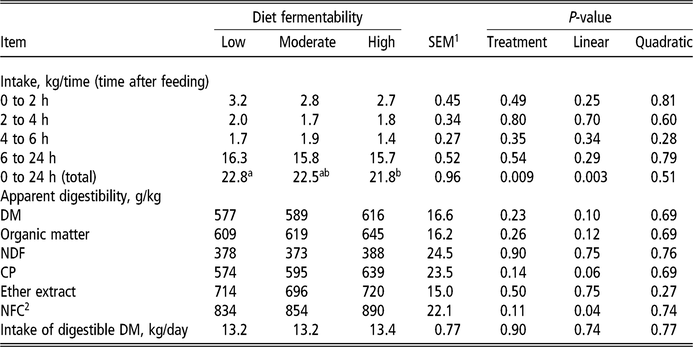
Daily DMI decreased linearly with increasing diet fermentability (P ≤ 0.01; Table 2). The amount of daily intake was 22.8, 22.5 and 21.8 kg/day for low-, moderate- and high-diet fermentability. However, the DMI at different times after morning feeding was not affected by diet fermentability. Moreover, the intake of digestible DM was not affected by dietary treatment.
Nutrient intake and total tract digestibility for dairy cows fed diets differing in fermentability under condition of heat stress (n = 9 cows)

a,b Means at the same row with different superscripts differed at P ≤ 0.05.
1 Largest SEM published in table.
2 NFC = nonfibre carbohydrate.
The digestibility of DM tended (P = 0.10) to increase linearly, while digestibility of NFC increased linearly (83%, 85% and 89% for high, moderate and low, respectively; P ≤ 0.05) with increasing diet fermentability. Also, the digestibility of CP tended (P = 0.06) to increase linearly with increasing diet fermentability, while the digestibilities of NDF and EE were not affected.
The fermentability of the pellet was greater than corn at the three times of incubation. The fermentability of pellet at incubation times of 2, 4 and 6 h was 48.5%, 54.4% and 55.6%, respectively, whereas the value for corn was 44.1%, 48.9% and 51.3%, respectively.
Rumen pH and fermentation profile
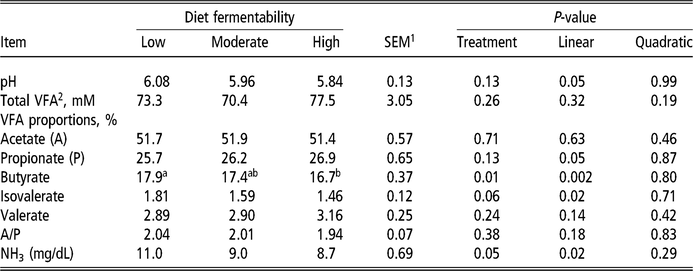
Ruminal pH decreased linearly from 6.08, to 5.96 and 5.86 for low-, moderate- and high-diet fermentability (P ≤ 0.05; Table 3). The proportion of propionate linearly increased with increasing diet fermentability (P ≤ 0.05), whereas the proportions of butyrate (P ≤ 0.01) and isovalerate (P ≤ 0.05) decreased. Total VFA concentration and the proportion of acetate, valerate and the ratio of acetate to valerate were not affected by the treatments. The concentration of NH3-N in the rumen fluid linearly decreased with increasing diet fermentability (P ≤ 0.05).
Ruminal fluid pH, VFA profile, and NH3 concentration for dairy cows fed diets differing in fermentability under conditions of heat stress (n = 9 cows)

a,b Means at the same row with different superscripts differed at P ≤ 0.05.
1 Largest SEM published in table.
2 VFA = volatile fatty acids.
Blood metabolites and inflammatory markers
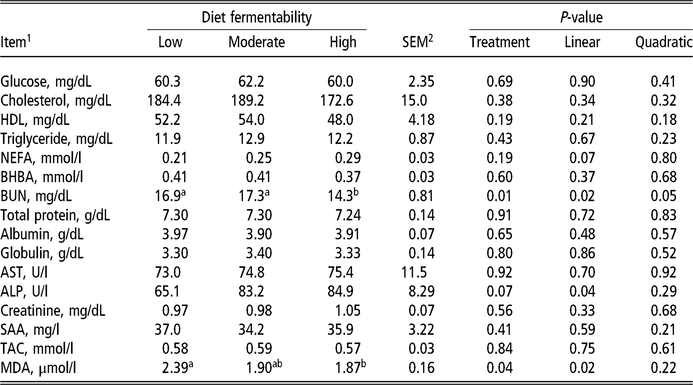
The concentration of BUN decreased linearly with increasing level of diet fermentability (Table 4; P ≤ 0.05). Activity of ALP increased linearly (P ≤ 0.05), concentration of NEFA tended (P = 0.07) to increase linearly, while concentration of MDA in the blood linearly decreased (P ≤ 0.05) with diet fermentability. In contrast, the concentrations of glucose, cholesterol, HDL, BHBA, total protein, albumin, globulins and creatinine were not affected by the treatments. The concentration of the inflammatory marker SAA and total antioxidant concentration in the blood were also not affected by the treatments.
Blood metabolites and inflammatory markers in dairy cows fed diets differing in fermentability under condition of heat stress (n = 9 cows)

a,b Means at the same row with different superscripts differed at P ≤ 0.05.
1 HDL = high-density lipoprotein; NEFA = non-esterified fatty acids; BHBA = beta-hydroxy butyric acid; BUN = blood urea nitrogen; AST = aspartate aminotransferase; ALP = alkaline phosphatase; SAA = serum amyloid A; TAC = total antioxidant capacity; MDA = malondialdehyde.
2 Largest SEM published in table.
Milk yield and milk composition, feed efficiency and body reserve change
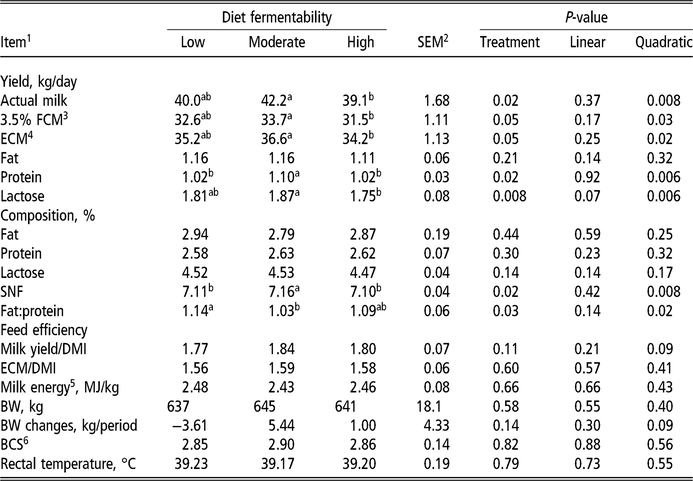
The production of milk, FCM and ECM were quadratically affected by increasing diet fermentability with cows fed the diet with highest fermentability producing less than the cows fed the other two diets (P ≤ 0.05; Table 5). Production of protein and lactose also responded quadratically to diet fermentability (P ≤ 0.05), with greater production of protein for cows fed the moderate diet compared with the other two diets, and greater lactose for cows fed the moderate diet compared with cows fed the high fermentability diet. The percentages of fat, protein and lactose were not affected by diet fermentability. The percentage of SNF was quadratically (P ≤ 0.01) affected by diet fermentability with greater SNF for the moderate diet, while these cows also had lower fat:protein than cows fed the low fermentability diet (P ≤ 0.05).
Milk production and composition, feed efficiency, and body reserve change for dairy cows fed diets differing in fermentability under condition of heat stress (n = 9 cows)

a,b Means at the same row with different superscripts differed at P ≤ 0.05.
1 FCM = fat-corrected milk; ECM = energy-corrected milk; SNF = solids-not-fat; DMI = dry matter intake; BW = body weight; BCS = body condition score.
2 Largest SEM published in table.
3 3.5% FCM = 0.432 milk yield + 13.23 fat yield (Gaines, Reference Gaines1928).
4 ECM = 0.3246 milk yield + 12.96 fat yield + 7.04 protein yield (Jenkins et al., Reference Jenkins, Bertrand and Bridges1998).
5 Milk energy = 4.184 × [(0.0929 × fat %) + (0.0547 × protein) + (% 0.0395 × lactose %)] (NRC, 2001).
6 Body condition score was determined using 5-scale method where 1 = emaciated and 5 = obese (Ferguson et al., Reference Ferguson, Galligan and Thomsen1994).
There was no effect of treatment (P > 0.10) on efficiency of milk or ECM production, body weight or BCS of cows (Table 5). Also, rectal temperature (mean, 39.2°C) was not affected by treatment.
Discussion
The study was conducted during a period of mild-to-moderate heat stress using the criterion of average daily THI ≥ 72 as proposed by Renaudeau et al. (Reference Renaudeau, Collin, Yahav, De Basilio, Gourdine and Collier2012). The elevated rectal temperature (39.2°C) of the cows compared with the baseline value of 38.5°C (Dikmen and Hansen, Reference Dikmen and Hansen2009) can be considered another indication of heat stress (Kadzere et al., Reference Kadzere, Murphy, Silznikove and Maltz2002; Cheng et al., Reference Cheng, Zheng, Sun, Li, Wang and Zhang2016). There may have been some undetected variability in heat stress conditions incurred during the study that went undetected because THI was only measured on two continuative days during each period. However, the heat generally persisted throughout the study, typical of summer conditions in this location of Iran.
The greater fermentability of ground wheat and barley than ground corn is in agreement with previous studies that have shown a faster rate of ruminal digestion of ground wheat followed by ground barley, compared with ground corn (Lanzas et al., Reference Lanzas, Fox and Pell2007). Also, the observed linear decrease in ruminal pH with increasing diet fermentability confirms that the intended increase in diet fermentability was achieved.
The inverse relationship between diet fermentability and feed intake was expected, as diets containing wheat and barley often promote less DMI than diets containing corn (Lanzas et al., Reference Lanzas, Fox and Pell2007). The decrease in feed intake due to increasing diet fermentability is in agreement with the observed linear decrease in ruminal pH and linear increase in propionate concentration. Therefore, our hypothesis that moderate increases in diet fermentability would shift the rumen fermentation towards propiogenesis was accepted. Propionate concentration in ruminal fluid is considered the main factor affecting DMI in mid-lactation dairy cows (Allen et al., Reference Allen, Bradford and Oba2009). Relative to other VFA, the production of propionate is associated with less energy lost as enteric methane (Knapp et al., Reference Knapp, Laur, Vadas, Weiss and Tricarico2014), which can increase metabolisable energy intake. Moreover, propionate is a precursor of hepatic glucose production through gluconeogenesis (Bell, Reference Bell1995). Use of propionate by hepatocytes may spare amino acids and other endogenous catalytic process and improve whole body energy balance (Bell, Reference Bell1995; Baumgard and Rhoads, Reference Baumgard and Rhoads2012). As such, increasing propionate proportion in the rumen as a result of increased diet fermentability could be beneficial for dairy cows under heat stress. However, highly fermentable diets may depress ruminal pH, as observed in the present study, an effect that may offset positive effects on animal performance.
Enhanced digestibility of NFC with increased diet fermentability was consistent with the change in grain source and the slight decrease in DMI, which is known to be inversely related to digestibility. The small increase in nutrient digestibility offset the decline in feed intake, as total intake of digestible DM did not differ among the treatments.
We anticipated that milk production would increase linearly with increasing diet fermentability due to increased rumen availability of NFC and increased propionate concentrations in the rumen. However, our data on milk, 3.5% FCM, and ECM production revealed a quadratic response with similar yield for low and medium diets, and reduced yield for the high diet. Therefore, our hypothesis that a shift in rumen fermentation towards propiogenesis would increase the productivity of heat-stressed dairy cows was rejected. It is possible that the cows fed the diet with highest fermentability experienced subacute rumen acidosis, as evidenced by this group having the lowest rumianl pH. However, it must be cautioned that, because of the use of ruminocentesis, pH was only measured once per period in this study although pH is known to fluctuate widely over the 24-h cycle. Acidosis can intensify the effects of heat stress (Kadzere et al., Reference Kadzere, Murphy, Silznikove and Maltz2002; West, Reference West2003); thus, it is possible that increased acidosis may have caused lower milk production in the cows fed the diet with highest fermentability. Overton et al. (Reference Overton, Cameron, Elliott, Clark and Nelson1995) reported that at a high level of replacement of corn with barley grain, milk production would be suppressed due to decreasing DMI. However, Nasrollahi et al. (Reference Nasrollahi and Khorvash2014) reported that feeding barley grain at 40% diet DM compared with a diet containing a similar amount of grain consisting of equal proportions of barley and corn decreased DMI without affecting milk production. The discrepancy between the current study and that of Nasrollahi et al. (Reference Nasrollahi and Khorvash2014) may be due to the heat stress condition in current study. Indeed, previous studies indicated that increasing glucose availability via administration of betaine (Hall et al., Reference Hall, Dunshea, Allen, Rungruang, Collier, Long and Collier2016) or monensin (Baumgard et al., Reference Baumgard, Wheelock, Sanders, Moore, Green, Waldron and Rhoads2011) did not guarantee an improvement in milk production of heat-stressed dairy cows. For heat-stressed dairy cows, processes other than milk synthesis can be a priority for glucose use (Baumgard et al., Reference Baumgard, Wheelock, Sanders, Moore, Green, Waldron and Rhoads2011).
The observed decrease in ruminal NH3-N concentration with increasing diet fermentability might indicate that it was used more efficiently for microbial protein synthesis (Oba and Allen, Reference Oba and Allen2003). Rumen degradable OM is a key limiting factor of microbial synthesis and thus increasing diet fermentability can promote microbial protein synthesis (Oba and Allen, Reference Oba and Allen2003). Decreased ruminal NH3-N concentration can be considered beneficial for the heat-stressed cow (Shwartz et al., Reference Shwartz, Rhoads, VanBaale, Rhoads and Baumgard2009), because the heat and energy needed for handling NH3-N absorbed and excreted as urea in the urine might be spared. Because heat-stressed dairy cows are highly dependent upon glucose and amino acids as fuel, greater amino acid supply through more rumen synthesis of protein could diminish body reserve catabolism and provide more mammary supply of amino acids (Baumgard and Rhoads, Reference Baumgard and Rhoads2012). It is possible that reduced muscle catabolism of amino acids occurred, which in turn decreased urea concentration of blood (Shwartz et al., Reference Shwartz, Rhoads, VanBaale, Rhoads and Baumgard2009). Results of blood urea concentration and body reserve change are in agreement with this speculation.
Despite lack of treatment effects on the concentration of SAA, mean concentration of this inflammatory marker (35.5 mg/l) was well above the level previously suggested as an indication of inflammation and metabolic stress (i.e. > 25 mg/l; Bionaz et al., Reference Bionaz, Trevisi, Calamari, Librandi, Ferrari and Bertoni2007). The elevated concentration of SAA in our study may have resulted from the heat stress conditions experienced by the cows. It has been demonstrated that under physiological stress such as heat stress, the barrier function of tight junctions in the mucosa of the gastrointestinal tract can be affected, thereby increasing permeability and uptake of lipopolysaccharide (Gareau et al., Reference Gareau, Silva and Perdue2008). This histological change can allow translocation of bacteria and LPS through the ruminal epithelium and intestinal mucosa into the blood stream and consequently to the liver, where a more systemic inflammatory response may occur (Plaizier et al., Reference Plaizier, Khafipour, Li, Gozho and Krause2012).
The decrease in MDA with increasing diet fermentability observed in the current study might indicate less oxidative stress (Belhadj Slimen et al., Reference Belhadj Slimen, Najar, Ghram and Abdrrabba2016) possibly mediated through the reduction in nutrient intake, changes in endproducts of rumen fermentation, and metabolism. These results support our hypothesis that moderate increases in diet fermentability improve health of heat-stressed dairy cows. Increased activity of ALP with increasing diet fermentability can also be related to increasing hepatic activity for processing propionate produced in rumen (Bobe et al., Reference Bobe, Young and Beitz2004). Because both decreasing MDA and increasing ALP have been reported as an indicator of reduced heat stress (Cheng et al., Reference Cheng, Zheng, Sun, Li, Wang and Zhang2016), we speculate that diet fermentability may be a way of alleviation of heat stress. Further studies with a control treatment without heat stress are warranted for evaluating this hypothesis.
Conclusion
Increasing diet fermentability under conditions of heat stress decreased nutrient intake but increased nutrient digestibility such that digestible nutrient intake of lactating cows was not affected by treatment. Increasing diet fermentability increased propionate proportion and decreased butyrate proportion in rumen fluid. Concentrations of NH3-N in rumen fluid and urea in blood decreased and milk protein production increased linearly indicating improved N utilisation. Blood concentrations of increased ALP and MDA concentration decreased indicated increasing diet fermentability improved oxidative stress. The production of milk and FCM were similar for diets of low and medium fermentability, but they decreased with a further increased in fermentability likely due to increased rumen acidosis. Overall, a modest increase in diet fermentability may lessen oxidative stress, improve protein production and nitrogen metabolism of heat-stressed dairy cows, but a further increase in diet fermentability may decrease milk yield.
Acknowledgements
The authors thank many students from the IUT (Isfahan, Iran), especially A. Kahyani, for their help in conducting this experiment. Appreciation is extended to staff at the Lavark farm and the research unit (IUT, Isfahan, Iran) for their technical assistance. This work was supported by the Iran National Science Foundation (Tehran, Iran) [grant number 93011381].
Declaration of interest
None.
Ethics committee
Animals were cared for according to the guidelines of the Iranian Council of Animal Care (1995) and the experiment was approved by the Institutional Animal Care Committee for Animals Used in Research.
Software and data repository resources
None of the data were deposited in an official repository.