INTRODUCTION
Palliative care is defined as interdisciplinary care for patients with a life-threatening illness. This includes prevention and relief of suffering by early identification and thorough assessment and treatment of pain and other symptoms—physical, psychosocial, and spiritual. The key factors in development of the best palliative care is academic education and training for skilled practitioners to promote leadership and research (Sigurdardottir et al., Reference Sigurdardottir, Haugen and van der Rijt2010).
Palliative medicine has recently been recognized as a specialty in Canada, the United Kingdom, the United States, and France, among others. Over the next few years, this relatively new specialty will require significant investment from healthcare institutions to enable creation of a strong curriculum for education that will address both clinical knowledge and research.
Palliative care research faces several specific challenges: a heterogeneous and frail population requiring appropriate design (Wohleber et al., Reference Wohleber, McKitrick and Davis2012; Kaasa & de Conno, Reference Kaasa and de Conno2001; Seymour, Reference Seymour2012); specific and complex outcomes (e.g., improvement of quality of life, family support) (Payne & Turner, Reference Payne and Turner2008); and a lack of infrastructure and administrative resources (Bruera et al., Reference Bruera, Billings and Lupu2010). Although the availability of palliative care services is growing rapidly (Hui et al., Reference Hui, Elsayem and de la Cruz2010), there is still much to do to better support clinicians who are starting research programs (Bruera et al., Reference Bruera, Billings and Lupu2010; Sigurdardottir et al., Reference Sigurdardottir, Haugen and van der Rijt2010; Reference Sigurdardottir, Haugen and Bausewein2012). An increase in palliative care research at the international level has been observed, reflected by the increasing number of scientific publications over the previous 15 years (Payne & Turner, Reference Payne and Turner2008; Hui et al., Reference Hui, Parsons and Damani2011). But among the several barriers identified in the literature, insufficient knowledge and expertise, methodological issues, and lack of research training programs have been reported most often (Bruera et al., Reference Bruera, Billings and Lupu2010; Sigurdardottir et al., Reference Sigurdardottir, Haugen and van der Rijt2010; Reference Sigurdardottir, Haugen and Bausewein2012; Kaasa & Dale, Reference Kaasa and Dale2005). In France, as we have previously reported (Rhondali et al., Reference Rhondali, Berthiller and Hui2013), the growth in the number of publications has not been comparable, with only 9 (2%) of the 477 European publications identified by Hui and colleagues (Reference Hui, Parsons and Damani2011), suggesting greater barriers.
Thus, we have hypothesized that palliative care research development must also be supported by the development of teaching methods for all those involved in this discipline. In the field of palliative care, it is recommended that the education system involve the use of a variety of teaching methods (Elsner et al., Reference Elsner, Centeno and de Conno2009; Filbet et al., Reference Filbet, Centeno and de Conno2007). As most healthcare professionals will be involved in research without having received training for research teaching, methods should be adapted to this specific population. Conventional teaching methods (e.g., lectures) are not suited to acquisition of knowledge and skills among adults. It is often recommended to employ other more appropriate teaching methods such as roleplay, group work, and target acquisition (Davies & Farmer, Reference Davies and Farmer1992; Kuipers & Clemens, Reference Kuipers and Clemens1998; Rosnow, Reference Rosnow1990; Simpson, Reference Simpson1985; Strohmetz & Skleder, Reference Strohmetz and Skleder1992; Wise, Reference Wise1980).
The objective of our paper was to describe in detail an educational research method for healthcare professionals working in palliative care and to report the results of a survey conducted within a three-year sample of students.
METHODS
The Educational Research Method
The format of our course was a multidisciplinary working group (physicians, nurses, and psychologists) that took place over a single session during a full day (eight hours) at Université Lyon 1. The number of participants was large enough to allow for a dynamic within the group, but not too great, thus ensuring that everyone could participate (usually 6–10). Participants were asked to prepare for the course by choosing their research topic and doing a preliminary literature search. The topic was required to be relevant to palliative care patients (psychosocial, biomedical, etc.).
The course was divided into two main sections:
• elaborating participants' hypothesis and writing the main objective in a single sentence;
• discussing and choosing the best design according to the main objective.
PART ONE
We always started a course with an example (30 minutes): a student from a previous course that had successfully conducted a research project and took it from idea to publication. The aim here was to describe the key points involved in publishing a research work (clear objective, literature review to justify the importance of the work, ethical requirement, methods section clearly detailed, appropriate data analysis [avoiding data “torturing”], writing, and the publication process). During this presentation, the student was asked to highlight the main barriers or difficulties to avoid and also to provide a timetable for all the steps.
All the students were then invited individually to formulate their research question succinctly and accurately (10 minutes). Each was then asked to submit his/her hypothesis or question to the whole group. The other participants had to answer three questions:
• Do they understand?
• Do they think this is clinically relevant?
• Do they think this is original?
The student presenting his/her proposal was in the room during the comments and feedback from other participants but was not allowed to respond until the end of the discussion (after 5–10 minutes). We found it necessary to leave time for the group to have as full a discussion as possible about the background of the research rather than allow a student to respond directly to each comment, which might inhibit further comments from the group. Then, if necessary, the student was invited to clarify his initial proposal based on the group's comments (5 minutes). The initial hypothesis or question usually included several specific questions (e.g., pain management in elderly with cognitive failure, healthcare professional barriers to manage pain in this population) and/or more general ones (e.g., pain management in elderly). The critics from the group could then highlight several issues and encourage the student to focus on one of them.
There was no teacher for the course but a facilitator/moderator, who helped the group conduct genuinely critical yet respectful discussions. When we first started this work, there was a lack of communication between moderator and students, most of whom seemed disinclined to speak, and so we allowed students to critique each other. In addition, many were upset when criticism came from an individual student, but allowing peer critiquing led to a significant enhancement of group dynamics.
All the moderators involved in the course were palliative care physicians or nurses actively involved in palliative care research (WR, FV, SD, and MF).
PART TWO
Study Design
The students had 10 minutes to think up a design that would allow them to answer their research question (positive or negative). Again, each student was invited to present the selected design to the group. The other participants were required to answer three questions:
• Does the design allow us to respond to the question?
• Is it feasible?
• Does this design meet ethical requirements?
Students were present during comments and feedback from other participants but were not allowed to respond until the end of the discussion (after 5–10 minutes). The moderator supervised discussion of proposals.
The moderators then joined the group for a five-minute discussion to summarize the group's conclusions about the design. If requested, they could contribute specific theoretical information on research design, but we wanted to avoid any information not relevant to the initial project. This method of learning in response to a specific question allowed students to better understand and acquire theoretical content.
Finally, we suggested that they create a timetable (30 minutes), which was constructed retroactively (starting from submission and ending at the beginning of protocol writing). This allowed many students to adjust their project and outcomes to ensure that they were realistic in terms of resources. Taking time to do this was important because students had reported to us that many projects failed because of time constraints.
At the end of the day, each student received feedback from a methodologist familiar with palliative care research but not involved in the work of the group. A final discussion then occurred to discuss any other specific issues.
Composition of the Group
This was a multidisciplinary group, open to all healthcare professionals involved in palliative care who had a strong interest in research. All course participants were physicians, nurses, or psychologists. This multidisciplinary approach was not an obstacle, but rather an asset, and offered input from professionals with different points of view on palliative medicine. The educational process was clearly participatory with very limited theoretical contribution. All the required theoretical supports were established prior to the course.
Participants
A 20-question e-survey was designed and distributed to each student enrolled in the course over the past three years (n = 119). Students included physicians, nurses, and psychologists from all over France who were taking palliative care courses, both as part of undergraduate (UME) or graduate medical education (GME). To validate their diplomas, participants had to have conducted a research project during the past year and to have written a report on their work.
Survey
We sent the questionnaire to all participants using the Survey Monkey website (www.surveymonkey.com). Invitations to participate were emailed in January of 2013 via this website. We also sent two reminders (two weeks and one month after the initial mailing). We collected age, gender, and professional data for the participants and information on whether they had taken the course (UME or GME).
The 20-question survey was constructed by two of our authors (WR, MF) using existing questionnaires created to investigate the perception of medical students about near-peer learning and teaching and to identify relevant teacher roles (Bulte et al., Reference Bulte, Betts and Garner2007). We used questions 2–13 and 18—four were employed to rate satisfaction with the course on a 10-point Likert scale and three to assess the status of their research project (i.e., whether they able to start or complete the project, or to submit the final report). The full questionnaire is duplicated below in the Appendix. We added a waiver from our institutional review board regarding the study, as we did not collect sensitive data.
RESULTS
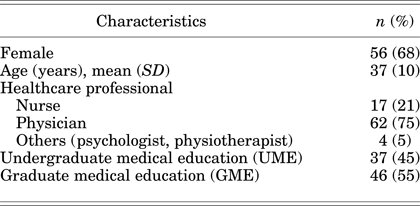
Some 83 of the 119 (70%) students responded, including 56 (68%) women; the median age was 37. The majority of our sample were physicians (n = 62, 75%), followed by nurses (n = 17, 21%). Most participants were taking this class as part of GME (n = 46, 55%). All participant characteristics are summarized in Table 1.
Participant characteristics (N = 83)

SD, standard deviation.
During the class, students assessed the role of the teacher as information provider (n = 51, 61%), role model (n = 36, 43%), and facilitator (n = 33, 40%), and considered all of these roles as suitable, with a score of 3.9–4.7 out of 5 (0 = completely disagree, 5 = completely agree). The two most important strengths reported by the participants were teacher expertise (n = 41, 66%) in the field of palliative care research (e.g., knowing the literature, knowledge of specific design relevant to a palliative care population), and the fact that all the theoretical content matched students' objectives and their personalized goals (n = 24, 39%). The two main weaknesses pointed out by participants were the shortness of the course (n = 30, 54%) and the large number of participants, which further reduced the time available for each student (n = 18, 32%).
Finally, 51 (77%) participants were able to start their research project following the class, after obtaining institutional approval. However, none of them were able to obtain funding to conduct their research. Twenty-seven (41%) participants were able to complete their research, and 8 (12%) submitted their research to a journal or a conference.
DISCUSSION
Our results suggest that newer teaching methods such as roleplay, group work, and target acquisition are feasible and effective in a palliative research curriculum and instruction, as opposed to the more commonly used traditional methods of lecture presentations employed in most research curricula (Hebert et al., Reference Hebert, Levine and Smith2003; Hauer & Quill, Reference Hauer and Quill2011; Macauley & Billings, Reference Macauley and Billings2011). Participants reported high satisfaction with both teacher roles, and the summative evaluation of the curriculum was positive. Most participants were able to begin projects. The eight participants that were able to publish were all mentored by trained researchers throughout this educational activity.
Our study subjects included nurses, physicians, and other healthcare professionals. The group also included both undergraduate and graduate healthcare professionals. It is not known if our results are applicable to more homogenous groups. We evaluated the curricular components of the teaching methods (i.e., small groups and role models/mentors) as well as learner satisfaction; however, we did not test attitudes toward research, specific knowledge, or skills. The research project status response was also a subjective response by participants, and objective data to verify starting a project, completing a project, or manuscript submission or conference presentation were not collected.
Our results confirm that more interactive and non-lecture-style instruction can be beneficial to a research curriculum intended for a broad multidisciplinary group of learners (Seehusen & Weaver, Reference Seehusen and Weaver2009; Macauley & Billings, Reference Macauley and Billings2011; Jaques, Reference Jaques2003). Our findings will allow us to take the next step in rigorously evaluating the role of newer teaching methods in medical education and its outcomes. Our data are consistent with adult learning theories, which suggest that interactivity with newer teaching methods may result in higher learner satisfaction and improved learning outcomes (Jones, Reference Jones2007; Allery, Reference Allery2012).
In the present study, we have demonstrated for the first time that non-lecture instruction is feasible and rated highly by a multidisciplinary group of learners across many education levels. Another major strength of the study was the heterogeneity of the learners and the research mentorship provided. With the current lack of research education curricula, limited resources for academic institutions, and increased interest in inter-professional education (Barnsteiner et al., Reference Barnsteiner, Disch and Hall2007; Mitchell et al., Reference Mitchell, Belza and Schaad2006; Reeves et al., Reference Reeves, Zwarenstein and Goldman2008), our findings support the premise of an interactive and inter-professional research curriculum with an emphasis on submitting a research project or presenting at a conference as objective data on the effectiveness of the curriculum. The small number of participants and the limited time available are two important limitations that require additional studies to confirm the objective outputs of educational interventions, including research outputs.
POTENTIAL CONFLICT OF INTEREST
The authors state that there are no conflicts of interest.
Appendix. Twenty-Question Survey
1. E-Mail ____________________
2. Gender
□ Male
□ Female
3. Year of birth ________
4. In which city do you work?
____________________
5. Were you taking this course as part of:
□ UME
□ GME
6. Which teacher roles did the teacher provide? (Check all that apply)
□ Information provider (lecturer, skills trainer)
□ Role model (demonstrator of behavior as a teacher, scientist, clinician, etc.)
□ Facilitator (mentor, small group tutor or moderator)
□ Assessor (evaluator of students or their work)
□ Planner (curriculum planner, making schedules, designing education)
□ Resource developer (writer of study guide, writer of study texts)
7. Which roles do you consider suitable for a teacher?

8. Please list what you consider to be the three greatest strengths and weaknesses for this teaching method:
Strengths Weaknesses
9. To what extent did the tutorial classes meet your expectations?
0 1 2 3 4 5 6 7 8 9 10
(not at all) (absolutely)
10. How would you describe the required workload for the course?
0 1 2 3 4 5 6 7 8 9 10
(too little) (too much)
11. Did you find that the teacher was motivating?
0 1 2 3 4 5 6 7 8 9 10
(not at all motivating) (extremely motivating)
12. Overall, how satisfied were you with this class?
0 1 2 3 4 5 6 7 8 9 10
(extremely dissatisfied) (extremely satisfied)
13. Did you manage to start your research project?
□ Yes
□ No
14. Did you manage to finish your research project?
□ Yes
□ No
15. Did you manage to publish your research (submitted to or accepted in a journal or a conference)?
□ Yes
□ No
16. Do you have any suggestions or general comments about the way that the teacher led the tutorial class?
17. Do you have any other suggestions or comments about the tutorial class?
Thank you for completing this and sharing your comments.