INTRODUCTION
Maize (Zea mays L.) is a major staple food in the savanna agro-ecology of West and Central Africa (WCA). Availability of extra-early maturing varieties (80–85 days to maturity) has allowed maize to expand into the drier savanna of WCA, replacing traditional cereal crops such as Sorghum bicolour (L.) Moench and Pennisteum glaucum (L.) R. Br., thus filling the hunger gap in July when food reserves are depleted after the long dry period. Notwithstanding the latent role of extra-early maize in the savanna of WCA, grain yield is greatly constrained by the parasitic weed Striga hermonthica (Del.) Benth. The levels of infestation are often so high that maize can suffer total yield loss and farmers usually abandon severely infested fields. The parasite is estimated to severely infest 40 million ha of cereal crops, while another 70 million ha have moderate levels of infestation (Lagoke et al. Reference Lagoke, Parkinson, Agunbiade and Kim1991). Yield losses may range from 10 to 100% depending on the genotype grown, climatic conditions, soil fertility status and levels of infestation (Lagoke Reference Lagoke and Lagoke1998; Kroschel Reference Kroschel, Kroschel, Mercher-Quarshie and Sauerborn1999). Effective control of Striga is extremely difficult, because the parasite produces millions of tiny seeds that can remain viable in the soil for up to 20 years (Bebawi et al. Reference Bebawi, Eplee, Harris and Norris1984). Use of host plant resistance or tolerance is considered the most economically feasible and sustainable approach for reducing the effects of the parasitic weed (DeVries Reference Devries, Haussmann, Hess, Koyama, Grivet, Rattunde and Geiger2000; Badu-Apraku et al. Reference Badu-Apraku, Fakorede, Menkir, Kamara, Akanvou and Chabi2004). Through the collaborative effort between the International Institute of Tropical Agriculture (IITA) and the West and Central Africa Collaborative Maize Research Network (WECAMAN) over 200 advanced extra-early maturing Striga-resistant or tolerant inbred lines of various grain types and colours have been developed. Hybrid development is a promising avenue for enhancing maize yield potential in the WCA sub-region. One of the goals of developing inbred lines in the extra-early maturity group is to develop hybrids that would be ultimately produced by commercial seed companies in WCA. Presently, there are no commercial extra-early maturing hybrids despite the availability of numerous extra-early inbreds in the IITA maize programme. There is an increasing demand for hybrid seed and this is driving the emergence of several seed companies in the sub-region. These companies depend on public breeding programmes for their supply of germplasm. There is, therefore, an urgent need for the identification of diverse parental combinations for commercial hybrid production by seed companies.
Information on the genetic diversity and heterosis of inbred lines is of great interest to maize breeders because it facilitates the identification of inbreds that would produce crosses exhibiting high levels of heterosis. The information makes it possible to develop productive hybrids without testing all possible hybrid combinations among the potential parents available in a hybrid programme. The positive relationship between midparent heterosis (MPH) of F1 grain yield and parental genetic divergence has been reported by Moll et al. (Reference Moll, Lonnquist, Velez Fortuno and Johnson1965) and Paterniani & Lonnquist (Reference Paterniani and Lonnquist1963). The relationship between genetic distance (GD) and hybrid performance has been studied in maize using molecular markers (Lee et al. Reference Lee, Godshalk, Lamkey and Woodman1989; Godshalk et al. Reference Godshalk, Lee and Lamkey1990; Smith et al. Reference Smith, Smith, Bowen, Tenborg and Wall1990; Betran et al. Reference Betran, Beck, Banziger and Edmeades2003a; Makumbi et al. Reference Makumbi, Betrán, Bänziger and Ribaut2011). In a situation where heterotic groups are not well established, marker-based GD estimates could be invaluable in avoiding the production and testing of crosses between related lines and crosses with low MH could be discarded based on the prediction (Melchinger Reference Melchinger, Coors and Pandey1999). However, the heterotic patterns and the extent of diversity in the Striga-resistant extra-early inbreds in the IITA's maize breeding programme have not been studied adequately.
Multi-environmental trials (METs) in WCA usually show significant genotype×environment interaction (G×E) due to the differential response of cultivars to varied growing conditions (Badu-Apraku et al. Reference Badu-Apraku, Fontem Lum, Fakorede, Menkir, Chabi, Thé, Abdulai, Jacob and Agbaje2008, Reference Badu-Apraku, Fakorede, Lum and Akinwale2009). METs are therefore conducted routinely by the IITA Maize Programme in Nigeria to identify genotypes with stable high yields. The information obtained from such trials is invaluable to the national maize programmes with similar growing conditions in the sub-region. It allows them to identify and select high-yielding cultivars with specific or broad adaptation to their conditions for further testing on-farm and for release to farmers in their countries. In addition, the information helps national scientists to identify appropriate germplasm with specific stress tolerance, desirable agronomic traits and end-use quality attributes for use in national breeding programmes (Badu-Apraku et al. Reference Badu-Apraku, Fakorede, Lum and Akinwale2009).
The objectives of the present study were to (i) identify the most productive and stable hybrids under Striga infestation and Striga-free environments, (ii) assess the extent of heterosis in hybrids involving one or two resistant parents under artificial S. hermonthica infestation and (iii) determine the effect of genetic diversity of the extra-early inbreds on hybrid performance.
MATERIALS AND METHODS
Genetic materials, field evaluation and molecular analysis
Genetic materials
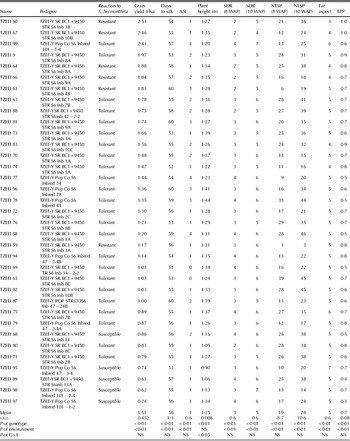
Forty-two extra-early yellow-endosperm fixed inbred lines developed from two broad-based populations resistant to Striga and maize streak virus at IITA were used in the present study (Table 1). The inbred lines were derived from the broad-based population TZEE-Y Pop STR C0 and the cross TZEF-Y SR BC1×9450 STR. The details of the method adopted for the development of the inbred lines have been described in detail by Badu-Apraku et al. (Reference Badu-Apraku, Menkir, Fakorede, Fontem Lum and Obeng-Antwi2006). The lines were developed by the pedigree method with the evaluation of topcross performance at the S3 stage under Striga infestation in Côte d'Ivoire during the rainy season of 1997 at Ferkessedougou (9°3′N, 5°10′W, 325 m asl, mean annual rainfall of 1400 mm) and Striga-free conditions at Sinematialli (9°37′N, 3°04′W, 305 m asl, mean annual rainfall of 1200 mm). At the S4 stage, 250–300 lines derived from each population were crossed to the corresponding base population as the tester for general combining ability (GCA) for the lines derived from it (Hallauer & Miranda Reference Hallauer and Miranda1988). Using the yield performance of the lines per se, their combining abilities for grain yield, Striga damage rating, Striga emergence count, ear number and other desirable agronomic characters across the two locations as criteria, 90–100 S4 lines were selected and advanced to S8.
Grain yield and other agronomic traits of extra-early yellow maize inbred lines evaluated under artificial Striga infestation at Abuja and Mokwa in 2011 and used in the genetic diversity study

ASI, anthesis–silking interval; SDR, Striga damage rating; WAP, weeks after planting; NESP, number of emerged Striga plants; EPP, ears per plant.
Field evaluation
Evaluation of extra-early inbreds for Striga resistance/tolerance
An evaluation trial involving 90 extra-early white- and yellow-endosperm inbreds, including 42 advanced extra-early yellow-endosperm inbred lines (S6–S8), derived from the two broad-based Striga and maize streak virus-resistant populations, TZEE-Y Pop STR C0 and the cross TZEF-Y SR BC1×9450 STR, were conducted at Abuja (9°16′N, 7°20′E, 300 m asl, 1500 mm annual rainfall) and Mokwa (9°18′N, 5°4′E, 457 m asl, 1100 mm annual rainfall) from June to October, 2011; both sites are in the Southern Guinea Savanna (SGS) agro-ecological zone of Nigeria, where Striga is endemic. The extra-early inbreds were evaluated for high and stable grain yield, and desirable agronomic traits, using 10×9 incomplete block design. Each plot consisted of one row, 4 m long, with 0·40 m spacing between plants within the row. The plots were spaced 0·75 m apart. The performance of the inbreds was compared under artificial Striga infestation. One week before the hybrids were planted at Mokwa and Abuja, the fields were injected with ethylene gas to stimulate suicidal germination of existing Striga seeds in the soil at both sites. Thereafter, artificial Striga infestation using the field screening method developed by the IITA Maize breeding programme was carried out to ensure uniform Striga infestation (Kim Reference Kim and Kim1991; Kim & Winslow Reference Kim, Winslow, Ransom, Musselman, Worsham and Parker1991). Striga seeds used for artificial infestations were routinely collected from sorghum (Sorghum bicolor (L.) Moench) and not from maize fields because maize plants often collapse under Striga infestation and Striga seed production becomes affected owing to the inability of maize plants to support the parasite at the later reproductive stage. This is because maize is a crop recently introduced to the savanna zone. Fortunately, S. hermonthica parasitizes both maize and sorghum in the savanna of WCA and maize-adapted strains of S. hermonthica have probably not yet evolved (Kim Reference Kim and Kim1991). The S. hermonthica seeds used for the infestation were therefore collected from fields of sorghum at the end of the previous growing season and mixed with finely sieved sand in the ratio of 1:99 by weight and 5000 germinable seeds were placed in each planting hole of the Striga-infested plots. Three seeds of the inbreds were also planted in each infested hole. The maize plants were thinned to two per hill at 2 weeks after emergence to give a population density of 66000 plants per hectare. For the Striga-infested trials at Abuja and Mokwa, fertilizer was applied twice to give a total rate of 30 kg/ha each of N, P2O5 and K2O using 15-15-15 N.P.K. The first application was at 2 weeks after planting (WAP), followed by the second dose at 5 WAP. A mixture of GrammoxoneR (Paraquat) and PrimextraR was sprayed at 2 days after planting (DAP) to control weeds at both locations. Subsequently, weeds other than Striga plants were controlled manually at both locations.
Generation and evaluation of single-cross hybrids
Thirty-nine yellow-grained extra-early inbred lines from the IITA Maize Improvement Programme were crossed to three extra-early testers (TZEEI 63, TZEEI 79 and TZEEI 95) of the known heterotic groups, which were also intermated to generate a total of 120 F1 hybrids. The 120 hybrids, along with 2008 SYN EE-Y DT STR (an open-pollinated variety (OPV) used as a Striga- and drought-tolerant control), were each evaluated under Striga infestation and Striga-free conditions at the two locations in Nigeria mentioned previously (Mokwa and Abuja) during the 2010 and 2011 growing seasons (May–October). It would have been ideal to include an extra-early yellow hybrid as the control; however, at the time when the study was conducted, there were no extra-early maturing Striga-resistant hybrids available in the IITA Maize Improvement Programme. Evaluation under Striga infestation was carried out at Abuja and Mokwa from June to October 2010 and 2011 and the single-cross hybrids were evaluated under Striga-free conditions at Ikenne (6o87′N, 3o7′E, 60 m asl, 1500 mm annual rainfall) and Mokwa in 2010 and 2011. Each field trial was laid out as 11×11 simple lattice design with two replications. Row and hill spacing were 0·75 and 0·40 m, respectively, with two plants per hill. Plots consisted of single rows, each 4 m long with 0·40 m within rows and 0·75 m between plots. Artificial Striga infestation, fertilizer application and other field management practices for the Striga-infested trial were the same as reported earlier for the inbred evaluation trial. Fertilizer was applied to the Striga-free plots at Ikenne and Mokwa at the rate of 60 kg N/ha, 60 kg P2O5/ha and 60 kg K2O/ha at 2 WAP. Urea at the rate of 60 kg N/ha was top-dressed at 5 WAP. Apart from ethylene injection and artificial Striga infestation, weed control and other management practices were the same for both Striga-infested and Striga-free experiments.
Collection of agronomic data
In all experiments, days to silking (DS) and days to anthesis (DA) were recorded as the number of days from planting to when 0·50 of the plants in a plot had emerged silks and when 0·50 of the plants had shed pollen. Anthesis–silking interval (ASI) was calculated as the difference between days to 0·50 silking and 0·50 anthesis. Plant height was measured on five plants per plot from the base of the plant to the height of the first tassel branch and ear height as the distance from the base of the plant to the node bearing the upper ear. Number of ears per plant (EPP) was obtained by dividing the total number of ears per plot by the number of plants harvested. Plant aspect was scored on a scale of 1–5, where 1=excellent and 5=poor. Husk cover was also rated on a scale of 1–5, where 1=husks tightly arranged and extended beyond the ear tip and 5=ear tips loose with kernels exposed. The observations made on the Striga-infested experiments were the same as those of the Striga-free conditions. Additional data collected on Striga-infested plots were the number of emerged Striga plants and host-plant damage at 8 and 10 WAP. Striga damage was scored on plot basis on a scale of 1–9, where 1=no damage, indicating normal plant growth and high tolerance, and 9=collapse or death of maize plants, i.e. highly susceptible (Kim Reference Kim and Kim1991). Striga count data were subjected to logarithm (y+1) transformation before analysis. Number of stalk-lodged (broken at or below the highest ear node) and root-lodged plants were counted at physiological maturity and converted to percentages. Ear aspect was scored on a scale of 1–5, where 1=clean, uniform, large and well-filled ears, and 5=ears with undesirable features. Also, field weight of the cobs, grain moisture content and grain yield were recorded. Grain moisture was taken from a random sample of five ears per plot. Grain yield was calculated based on 80% shelling percentage and adjusted to 15% moisture. Grain yield was computed using the following formula:
 $$\eqalign{{\rm Grain \ yield\;(kg/ha)} \ = \ & ({\rm Field\;weight\;(kg)}/{\rm area\;(m}^2 {\rm )} \cr & \times \left( {(100 - {\rm moisture})/{\rm 85}} \right) \cr & \times ({\rm 1}0\,000 \times 0 {\cdot} {\rm 8}0)} $$
Molecular analysis
Simple sequence repeat (SSR) assays
Twenty-two yellow-grained extra-early inbred lines were selected from the panel of 43 extra-early yellow-endosperm inbreds of the IITA Maize Programme based on their resistance to S. hermonthica and/or drought tolerance (Table 1) for the genetic diversity assessment study. The 22 inbred lines were grown in the IITA screen house in Ibadan (Table 1). Young leaves were harvested at V6 stage from 15 to 20 seedlings of each inbred line 10 DAP and stored at −80 °C. Genomic DNA extraction was carried out using the miniprep extraction protocol of Dellaporta et al. (Reference Dellaporta, Wood and Hicks1983). The purified DNA was quantified on a nanodrop spectrophotometer. Sixty mapped SSR markers were randomly selected from the Maize GDB database (www.maizegdb.org), with six markers per chromosome and three markers per chromosome arm. The 60 primer pairs were tested on four selected inbreds to identify the polymorphic ones. Only the polymorphic markers were used for the genotyping of the 22 inbred lines. The SSR analyses were conducted according to Vroh Bi et al. (Reference Vroh Bi, Mcmullen, Sanchez-Villeda, Schroeder, Gardiner, Polacco, Soderlund, Wing, Fang and Coe2006). In brief, each polymerase chain reaction (PCR) with SSR primers was set up in a final reaction volume of 10 μl containing 1 unit Taq DNA polymerase (Promega, USA), 2 mm MgCl2, 0·2 mm each dNTPs and 0·5 μ m each of reverse and forward primer. The PCRs were performed on a PTC-200 thermocycler (MJ Research, USA) programmed for an initial denaturation of 4 min at 94 °C, a touchdown program of 10 cycles from 60 to 51 °C with a −1 °C increment per cycle, followed by 30 cycles (1 min denaturation at 94 °C, 51 °C for 45 s and 72 °C for 1 min 30 s) and a final extension of 5 min at 72 °C. The PCR products were resolved in 2·5% superfine resolution agarose gels (Amresco, Solon, OH, USA) for detection of polymorphism. The polymorphic bands with strong intensity were scored manually as either present (1) or absent (0) for all the parental inbred lines.
Statistical analysis
Analysis of variance (ANOVA) was first carried out for each environment. Thereafter, combined ANOVA across environments (locations×year) was performed across each of the Striga-infested and Striga-free conditions with PROC GLM in SAS (SAS Institute 2001) to determine if G×E interaction was significant. Environment, replication within environment and incomplete block within replication-by-environment were defined as random effects; genotypes were defined as fixed effects and their adjusted means and standard error (s.e.) were estimated.
To identify productive single-cross hybrids for commercial production under Striga, a selection index was computed using standardized data for selected variables. The best 15 and the worst 10 single-cross hybrids under Striga infestation were selected using a base index that integrates grain yield, Striga emergence counts, Striga damage syndrome rating and EPP measured under infested conditions (Menkir & Kling Reference Menkir and Kling2007; Badu-Apraku et al. Reference Badu-Apraku, Oyekunle, Akinwale and Fontem Lum2011). The means of the selected traits were expressed in standard deviation units and the base index scores computed as follows:
 $$\eqalign{I \ = \ & [({\rm 2} \times {\rm YLI}) + {\rm EPP} - ({\rm SDR8} + {\rm SDR1}0) \cr & - 0 {\cdot} {\rm 5}\;{\rm (ESP8} + {\rm ESP1}0{\rm )],}} $$
where YLI was the grain yield in Striga-infested plots, EPP was the number of ears per plant in the Striga-infested plots, SDR8 and SDR10 were Striga damage rating at 8 and 10 WAP, and ESP8 and ESP10 were the number of emerged Striga plants at 8 and 10 WAP.
Subsequently, the yield data were subjected to genotype main effect plus genotype×environment interaction (GGE) biplot analysis to evaluate the G×E interactions of each experiment (Yan et al. Reference Yan, Hunt, Sheng and Szlavnics2000; Yan Reference Yan2001). The GGE biplot was used to obtain information on the hybrids that were suitable for stress and non-stress environments, and to investigate the stability of hybrids in the various environments. The analyses were done using the GGE biplot windows application that fully automates biplot analysis (Yan Reference Yan2001). The GGE biplot model equation is:
 $$Y_{ij} - Y_j = \lambda _1 \xi _{i1} \eta _{\,j1} + \lambda _2 \xi _{\,j2} \eta _{\,j2} + \Sigma _{ij} $$
where Y ij is the average yield of genotype i in environment j, Y j is the average yield across all genotypes in environment j, λ 1 and λ 2 are the singular values for principal component (PC)1 and PC2, ξ i1 and ξ j2 are the PC1 and PC2 scores for genotype i, η j1 and η j2 are the PC1 and PC2 scores for environment j and Σij is the residual of the model associated with the genotype i in environment j. The data were not transformed (Transform=0), not standardized (Scale=0) and were environment-centred (Centring=2).
A dendrogram was constructed based on modified Roger's genetic distances (MRD2), calculated between pairs of inbred lines using the method developed by Nei & Li (Reference Nei and Li1979)
 $${\rm GD} = (1 - 2N_{ij} )/(N_i + N_j )$$
where GD is the genetic distance, N ij is the number of bands common to lines i and j, and N i and N j are the total number of bands for lines i and j, respectively.
Midparent heterosis (MPH) and high-parent heterosis (HPH) were calculated using the adjusted means of the hybrids and inbred lines. MPH for individual crosses was calculated as
 $${\rm MPH} \ = \displaystyle\ {{({\rm F}_1 - {\rm MP}) \times 100} \over {{\rm MP}}}$$
where F1 is the mean of the hybrid performance and MP=(P1+P2)/2 in which P1and P2 are the means of the inbred parents, respectively. HPH for individual crosses was calculated as
 $${\rm HPH} \ = \displaystyle\ {{({\rm F}_1 - {\rm HP}) \times 100} \over {{\rm HP}}}$$
where HP is the better parent.
Correlation analysis was computed between the GD estimates of pairs of parental lines and the traits means of the corresponding F1 hybrids observed under Striga-infested and Striga-free environments. Also, GD between pairs of parental lines was correlated with F1 hybrid grain yield, MP, HP, MPH and HPH. The correlation analysis was carried out using the SAS package, version 9.2 (SAS 2001). Simple linear regression was computed to determine the relationship between F1 hybrid grain yield and GD and between grain yield of inbred line and F1 hybrid grain yield.
RESULTS
Performance of extra-early yellow maize inbred line under Striga infestation
Combined ANOVA across two environments showed significant genotype (G) and environment (E) mean squares for grain yield, DS, ASI, plant height, ear aspect, EPP, Striga damage rating at 8 and 10 WAP, and emerged Striga plant at 8 and 10 WAP except for plant height, which was not significant at the two environments (Table 1). In contrast, G×E mean squares were not significant for grain yield and most other traits except for plant height. The grain yield of inbred lines ranged from 627 kg/ha for TZEEI 89 to 2·46 t/ha for TZEEI 67. Mean grain yield of the inbred was 1·51 t/ha under Striga-infested conditions. The Striga-resistant inbred lines were characterized by higher grain yield, increased plant height, lower ear aspect, higher EPP and lower Striga damage rating at 10 WAP (Table 1). In contrast, the susceptible inbred lines were generally characterized by lower grain yield, shorter plant height, poor ear aspect, smaller EPP and higher Striga damage rating. The susceptible inbreds, TZEEI 98 and TZEEI 95, had fewer numbers of emerged Striga plants at 8 and 10 WAP than the resistant inbreds such as TZEEI 60 and TZEEI 64, and the tolerant inbreds such as TZEEI 78 and TZEEI 58. Similarly, the susceptible inbreds were comparable to many Striga-resistant and tolerant inbreds in terms of the ASI.
ANOVA and performance of single-cross hybrids and OPV controls in Striga-infested and Striga-free environments
For the ANOVA combined across two locations (Mokwa and Abuja) under artificial Striga infestation in 2010 and 2011 for the single-cross hybrids and OPV controls, the two main effects, viz. genotype (G) and site (S), and their interaction (G×S) were significant for grain yield, DS, ASI, plant height, EPP, ear aspect and Striga damage rating at 8 and 10 WAP, whereas only the two main effects were significant for DA and number of emerged Striga plants at 8 and 10 WAP (data not shown). In contrast, the mean squares for genotype, site and G×S were significant for all traits except genotype and G×S for root lodging under Striga-free conditions.
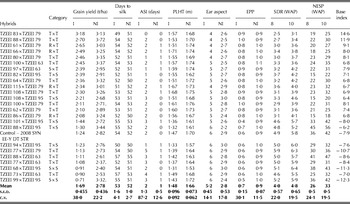
Table 2 shows the means, s.e. and coefficient of variation (C.V.) for measured traits of inbred lines evaluated under artificial Striga infestation and Striga-free conditions. Under Striga infestation, the mean grain yield of the genotypes ranged from 711 kg/ha for TZEEI 99×TZEEI 95 to 3·18 t/ha for TZEEI 83×TZEEI 79 with a mean of 1·69 t/ha, while under Striga-free conditions it ranged from 1·19 t/ha for TZEEI 75×TZEEI 63 to 3·94 t/ha for TZEEI 67×TZEEI 63 (data not shown) with a mean of 2·78 t/ha. Mean yield under artificial Striga infestation was 61% of the yield under Striga-free conditions.
Grain yield and other agronomic traits of a selection of hybrids (best 15 and worst 10 based on base index) and an open pollinated extra-early control variety evaluated under artificial Striga infestation (I) at Mokwa and Abuja and under Striga-free conditions (NI) at Ikenne and Mokwa in 2010 and 2011

ASI, anthesis–silking interval; PLHT, plant height; EPP, ears per plant; SDR, Striga damage rating; WAP, weeks after planting; NESP, number of emerged Striga plants.
There were no significant differences in grain yield among the top highest yielding hybrids under Striga infestation (Table 2). The highest yielding Striga-resistant hybrid under Striga infestation, TZEEI 83×TZEEI 79, out-yielded the Striga-resistant OPV control by 1·94 t/ha.
Under Striga-free conditions, TZEEI 75×TZEEI 63 was the top yielding hybrid and out-yielded the OPV control by 40% (data not shown). The reduction in grain yield of the hybrids under artificial Striga infestation was accompanied by increased DS, ASI, bareness and poor ear aspect (Table 2). The 12 highest-yielding R×T, T×T and T×S cross hybrids in the present study had significantly higher grain yields under Striga infestation, lower Striga damage ratings, fewer number of emerged Striga plants, greater EPP and better ear aspect compared with the tolerant OPV control (2008 Syn EE-Y DT STR) and the S×S hybrids. However, there were no significant differences in grain yield and other measured traits of 2008 Syn EE-Y DT STR and hybrids involving T×S (TZEEI 94×TZEEI 95, TZEEI 101×TZEEI 95 and TZEEI 88×TZEEI 95), T×T (TZEEI 77×TZEEI 79, TZEEI 88×TZEEI 63, TZEEI 77×TZEEI 63 and TZEEI 73×TZEEI 63) and the S×S (TZEEI 68×TZEEI 95 and TZEEI 99×TZEEI 95). However, under Striga-free conditions, no significant differences were detected in grain yield and other traits among the 12 highest-yielding hybrids involving R×T, T×T, as well as the hybrid involving the two Striga-susceptible inbreds (TZEEI 99×TZEEI 95). In general, the mean grain yield and agronomic performance of R×T and T×T cross hybrids were superior to that of S×T and S×S cross hybrids when Striga-infested, but not in the absence of the parasite.
GGE biplot analysis of grain yield under Striga-infested and Striga-free conditions
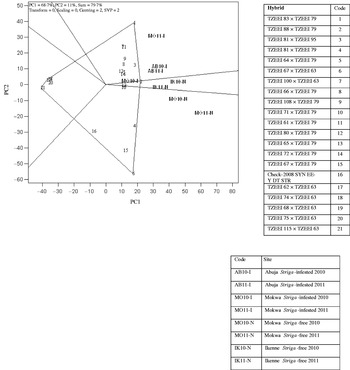
The highly significant G+G× S interaction for grain yield and most measured traits of the single-cross hybrids and OPV controls under the Striga-infested and Striga-free conditions justified the use of the GGE biplot to decompose the GSI and to examine the yield performance and stability of the extra-early hybrids across test sites. The GGE biplot for grain yield of 20 (15 best and 5 worst) extra-early maturing maize hybrids including the OPV control evaluated under two research conditions in three locations for 2 years is shown in Fig. 1. In the polygon view (Fig. 1), the vertex hybrid in each sector represents the highest-yielding hybrid in the location that falls within that sector. TZEEI 83×TZEEI 79 (Entry 1) was the highest-yielding hybrid under Striga infestation at Mokwa and Abuja in 2010 and 2011, TZEEI 88×TZEEI 79 (Entry 2) was highest-yielding at Ikenne in 2010/11, whereas TZEEI 67×TZEEI 63 (Entry 6) was the highest-yielding hybrid at Mokwa in 2010/11 under Striga-free conditions. Although Entries 18, 19 and 21 were the vertex hybrids in some sectors, the sectors were not matched with the locations used. Consequently, these hybrids were the lowest-yielding in the three locations used in 2010/11. Hybrids within the polygon, particularly those located close to the biplot origin, were less responsive than the vertex hybrids.
A ‘which won where’ GGE biplot of grain yield of 20 extra-early maturing maize hybrids evaluated at three locations; two under Striga-infested (Abuja and Mokwa) and two under Striga-free conditions (Ikenne and Mokwa) in 2010 and 2011.

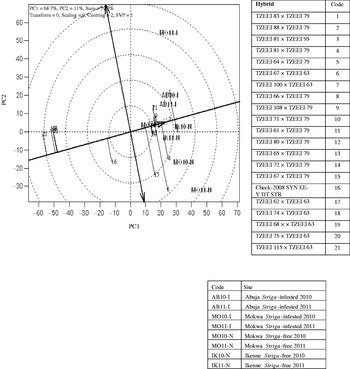
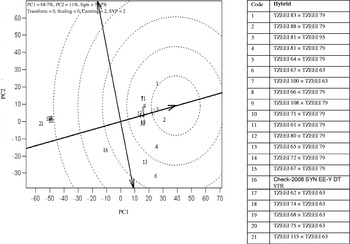
In the GGE biplot presented in Fig. 2, the single-arrowed line that passes through the biplot origin and the average environment is referred to as the average-environment coordination (AEC) abscissa and points to a higher mean yield across environments. The double arrowed line is the AEC ordinate; it points to greater variability (poorer stability) in either direction. The greater the absolute length of the projection of a hybrid, the less stable it is. Thus, TZEEI 81×TZEEI 95 (Entry 3) was the most stable hybrid followed by Entries 2, 9, 8 and 10, while Entry 6 was the least stable. The four hybrids had TZEEI 79 in their parentage. The yield of entries 18, 19, 20 and 21 were below the overall mean grain yield of the hybrids.
The entry/tester GGE biplot based on grain yield of 20 extra-early maturing maize hybrids evaluated under Striga-infested conditions at Mokwa and Abuja in 2010.

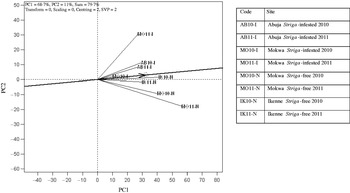
The GGE biplot was also used to study the relationship among the test environments. In the biplot view (Fig. 3), the straight line from the origin to the coordinates where an environment falls is called the research environment vector, whereas the straight line with a single arrow which passes through the origin and the average environment represents the average environment axis (AEA). The length of the vector describes its discriminating power, whereas the angle between an environment and AEA measures its representativeness. According to Yan et al. (Reference Yan, Fregeau-Reid, Pageau, Martin, Mitchell- Fetch, Etienne, Rowsell, Scott, Price, De Haan, Cummiskey, Lajeunesse, Durand and Sparry2010), the shorter environmental vectors indicate that the specific environments were not strongly correlated with environments with longer vectors and that they were probably not strongly correlated with one another either. Thus, MO11-N and MO11-I had relatively long vectors and were more powerful in discriminating among the hybrids whereas IK11-N and IK10-N environments had small angles with AEA, thus they were the most representative of the test environments. An ideal hybrid is one that has the largest vector of all the hybrids (most discriminating) and has a zero projection on the ATC ordinate (most representative of the hybrids). Based on this, TZEEI 88×TZEEI 79 (Entry 2) and TZEEI 81×TZEEI 95 (Entry 3) were identified as the ideal hybrids across the research environments (Fig. 4).
The discriminating power and representativeness view of GGE biplot based on G×E yield of 21 extra-early hybrids evaluated at three locations in 2010/11.

The biplot view showing the ranking of the 21 extra-early maturing hybrids based on their discriminating ability and representativeness across all research environments.

Relationship between genetic diversity of parental lines and performance of their F1 hybrids and heterosis
There were no significant correlations between GD estimates of the parental lines and hybrid means for grain yields (r=0·06), DS (r=−0·03), ASI (r=0·08), plant height (r=0·08), ear aspect (r=−0·08), EPP (r=0·07), Striga damage rating at 8 WAP (r=−0·05) and 10 WAP (r=−0·01), emerged Striga count at 8 WAP (r=0·05) and 10 WAP (r=0·03) under Striga infestation. Similarly, correlations between GD estimates of the parental lines and hybrid means were not significant for grain yields (r=0·05), days to silk (r=−0·12), plant height (r=0·18), plant aspect (r=−0·07), ear aspect (r=−0·09) and ear per plant (r=−0·01), but was significant for ASI (r=−0·26) under optimum growing conditions (Table not shown).
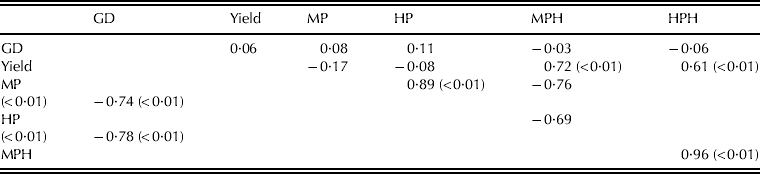
The relationship between per se performance of the inbred parents and their F1 hybrid performance was studied by running a linear correlation between midparent and hybrid performance under Striga infestation. Grain yield of inbreds under Striga infestation was not significantly correlated with that of F1 hybrid grain yield (Table 3). Similarly, there was no significant difference between GD estimates of the parental lines and MP, HP, MPH and HPH under Striga infestation. However, MP was significantly correlated with HP, MPH and HPH. Furthermore, a significant correlation was observed between grain yield and MPH (r=0·72, P<0·001) and grain yield and HPH (r=0·61, P<0·01) (Table 3).
Correlation of GD and heterosis of F1 hybrids under Striga infestation (P values in parentheses where appropriate)
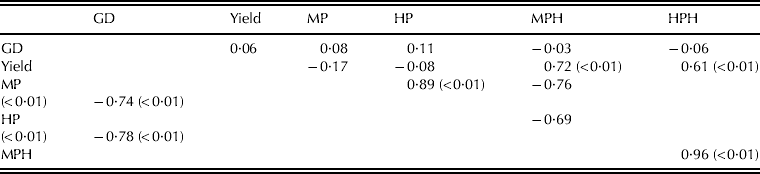
GD, genetic distance; MP, mid-parent; HP, high-parent; MPH, mid-parent heterosis; HPH, high-parent heterosis.
The rankings of inbred lines were found to be associated with those of F1 hybrid under Striga infestation. However, the variation in grain yield of F1 hybrid under Striga infestation captured 3·3% of the total variation in grain yield of inbred lines under the same conditions (data not shown). Similarly, the variation in GD explained 0·4% of the total variation in grain yield of F1 hybrids under Striga infestation (data not shown).
Genetic diversity and polymorphism detected among extra-early maize inbred parents
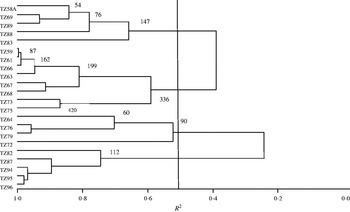
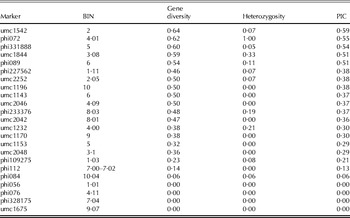
Out of 60 SSR primer pairs analysed, 23 were polymorphic among the 22 inbreds studied (Table 4). The markers were dispersed throughout the maize genome. The SSR marker analysis showed wide genetic diversity ranging from 0·06 for the cross TZEEI 96×TZEEI 95 to 0·80 for the cross TZEEI 72×TZEEI 95. The results of the analysis showed that markers umc1542, phi072, phi331888, umc1844 and phi089 on chromosomes 2, 4, 5, 3 and 6, respectively, had high polymorphism information content (PIC>0·50) among the markers used for genotyping the 22 extra-early maize inbreds (Table 4). Gene diversity among the inbreds was lowest (0·00001) for markers phi056, phi076, phi328175 and umc1675 and highest (0·64) for umc1542. The primer pairs generated a total of 64 polymorphic fragments. The number of alleles per locus ranged from 2 to 5, with an average of 2·45. A dendrogram, constructed on the basis of GDs, revealed four groups: TZEEI 58A, TZEEI 69, TZEEI 89, TZEEI 88 and TZEEI 83 constituted the first group, TZEEI 59, TZEEI 61, TZEEI 66, TZEEI 63, TZEEI 67, TZEEI 68, TZEEI 73 and TZEEI 75 formed the second group, TZEEI 64, TZEEI 76, TZEEI 79 and TZEEI 72 made up the third group, while TZEEI 82, TZEEI 87, TZEEI 94, TZEEI 95 and TZEEI 96 formed the fourth group (Fig. 5). Groups 3 and 4 comprised Striga-resistant and tolerant inbred lines, whereas groups 1 and 2 consisted of Striga-resistant, tolerant and susceptible inbreds, thus indicating that the groupings were based on the pedigree of the inbreds rather than their reaction to S. hermonthica.
Dendrogram of 22 extra-early yellow maize inbred lines constructed from Roger's modified distance using SSR markers.

Gene diversity, heterozygosity and polymorphic information content (PIC) of the SSR markers used

DISCUSSION
The significant mean squares observed for genotypes for all traits under Striga infestation and for 10 of the 11 measured traits under Striga-free conditions indicate that there is a large genetic variation among the genotypes to allow good progress from selection under the two research conditions. The highly significant site mean square under Striga-infested and Striga-free conditions suggested that the test sites were highly variable, and for these traits testing in more than one site is necessary. These results are in agreement with the finding of Badu-Apraku et al. (Reference Badu-Apraku, Fakorede and Fontem Lum2007), who reported that the evaluation environments in WCA for selected IITA lowland early maturing varieties and inbred lines under Striga-infested and Striga-free conditions were highly variable. A similar finding was also reported for the late- and intermediate-maturing lowland white inbreds under drought and well-watered conditions (Menkir et al. Reference Menkir, Badu-Apraku, Thé and Adepoju2003). Under Striga infestation, the hybrids differed in their response patterns at the two sites for 2 years. This was evidenced by the significant GSI obtained for grain yield and host plants Striga damage. Several authors (Badu-Apraku et al. Reference Badu-Apraku, Fakorede and Fontem Lum2007; Yallou et al. Reference Yallou, Menkir, Adetimirin and Kling2009; Menkir et al. Reference Menkir, Adetimirin, Yallou and Gedil2010) have reported significant G×E interaction under S. hermonthica infestation in WCA. A possible source of the G×S in the present study is difference in the strain of S. hermonthica at the two test locations.
Empirical estimates of maize yield reduction under artificial Striga infestation in WCA have been variable: 42% (Badu-Apraku et al. Reference Badu-Apraku, Fakorede, Menkir, Kamara, Akanvou and Chabi2004), 53·7% (Adetimirin et al. Reference Adetimirin, Aken'ova and Kim2000), 68% (Kim et al. Reference Kim, Adetimirin, The and Dossou2002) and 80% (Stewart et al. Reference Stewart, Press, Graves, Nour, Wylde and Kim1991). The mean yield reduction obtained under Striga infestation in the present study was 39%. Possible factors responsible for these differences include differences in the level of Striga infestation, soil fertility, level of resistance/tolerance of the maize genotypes studied and environmental conditions, including moisture regime. In the present study, the reduction in grain yield of hybrids under Striga infestation was accompanied by increased days to 0·50 silking, ASI, barrenness, poor ear aspect, increased Striga damage and number of emerged Striga plants.
Using the base index, TZEEI 83×TZEEI 79 was identified as the highest-yielding hybrid under Striga infestation. TZEEI 83×TZEEI 79 out-yielded the best Striga-resistant OPV control, 2008 Syn EE-Y DT STR, by 157%. The low levels of yield reduction and lower Striga damage and DS observed for the top-yielding hybrids under Striga infestation, compared with the OPV control clearly indicated the presence of Striga-resistant genes in the extra-early maturing inbred parents from which the hybrids were derived.
In Striga research, resistance is demonstrated by the ability of the host plant's roots to stimulate the germination of Striga seeds but prevent the attachment of the parasite to the roots of the host plant, or to kill the attached parasite. When Striga-infested, the resistant genotype supports significantly fewer Striga plants and produces a higher yield than a susceptible genotype. In contrast, a Striga-tolerant genotype germinates and supports as many Striga plants as the susceptible genotype, but produces more grain and stover, and shows fewer damage symptoms (Kim Reference Kim1994). The significantly higher grain yield, reduced Striga damage, number of emerged Striga plants, higher EPP and better ear aspect of the R×T and T×T cross hybrids compared with the T×S hybrids under S. hermonthica infestation indicated that inbred combinations of Striga resistant×tolerant and tolerant×tolerant expressed more tolerance/resistance. This result appears consistent with the findings of Kim (Reference Kim and Kim1991) and Badu-Apraku et al. (Reference Badu-Apraku, Oyekunle, Akinwale and Fontem Lum2011), who reported that the highest level of tolerance based on Striga damage rating was achieved in crosses involving two resistant inbred parents. It is striking that the crosses involving two Striga tolerant inbreds, such as TZEEI 77×TZEEI 79, TZEEI 88×TZEEI 63 and TZEEI 77×TZEEI 63 and TZEEI 73×TZEEI 63, were classified as susceptible hybrids by the base index. This could be due to the fact that the parental inbreds involved in these hybrids were sister lines and therefore could not exhibit heterosis in their respective crosses.
In the present study, the susceptible inbreds TZEEI 98 and TZEEI 95 had fewer numbers of emerged Striga plants at 8 and 10 WAP than the resistant inbreds such as TZEEI 60 and TZEEI 64 and the tolerant inbreds such as TZEEI 78 and TZEEI 58, but had more severe Striga damage resulting in poor grain yield of the susceptible inbreds. Low Striga emergence counts, often recorded on susceptible maize plants, are presumably due to the inability of the host to support underground parasitic seedlings to emergence or poor adaptation to the growing environment. Reduction in parasite emergence counts of susceptible genotypes has also been reported by Kim & Adetimirin (Reference Kim, Adetimirin, Jewell, Waddington, Ransom and Pixley1995), Badu-Apraku et al. (Reference Badu-Apraku, Fakorede and Fontem Lum2007) and Badu-Apraku & Akinwale (Reference Badu-Apraku and Akinwale2011). TZEEI 63, TZEEI 81 and TZEEI 99 had high grain yield, but moderately high Striga damage at 10 WAP and supported large numbers of emerged Striga plants at 10 WAP and it may be concluded that they possessed Striga-tolerant genes.
Secondary traits are invaluable in selection for improved grain yield under Striga infestation. The similarity in the ASI of resistant/tolerant and susceptible inbreds under Striga infestation and Striga-free conditions in the present study suggested that grain yield did not have any significant correlation with ASI of the extra-early inbreds under Striga infestation. Earlier studies have reported a lack of significant correlation between ASI and grain yield of early maturing cultivars under Striga infestation (Badu-Apraku et al. Reference Badu-Apraku, Fakorede, Menkir, Kamara, Akanvou and Chabi2004; Badu-Apraku Reference Badu-Apraku2010). This result justified the exclusion of ASI in the base index used for selecting improved grain yield and Striga-resistant/tolerant genotypes under Striga infestation.
Striga infestation is erratic, with the incidence and severity largely influenced by weather, and is, to a large extent, unpredictable (Badu-Apraku et al. Reference Badu-Apraku, Fontem Lum, Fakorede, Menkir, Chabi, Thé, Abdulai, Jacob and Agbaje2008). The best genotypes are, therefore, those with superior performance under Striga-infested and Striga-free environments. The 10 out of the 15 R×T and T×T hybrids that showed superior performance under both research environments (Table 2) may be considered the best hybrids in the present study. The outstanding performance of these hybrids under Striga infestation and the lack of significant differences in grain yield and other traits between these hybrids and the best susceptible hybrid (TZEEI 99×TZEEI 95) under Striga-free conditions are clear indications that the available hybrids in the IITA Maize Improvement Programme possess the potential to perform well under Striga-infested as well as under Striga-free conditions.
The GGE biplot identified TZEEI 88×TZEEI 79 and TZEEI 81×TZEEI 95 as the ideal hybrids across environments for the two research conditions used in the present study. Based on the discriminating ability and representativeness of the research environments used, Mokwa was identified as the location that has the ability to discriminate well among the extra-early maturing hybrids. The outstanding performance of many hybrids compared with the OPV control in the present study is a clear indication of the considerable progress that has been made in breeding extra-early materials for high-yield under Striga infestation. The outstanding hybrids are candidates for on-farm trials and release to farmers in the sub-region to ensure food security.
Molecular analysis of the inbreds revealed wide genetic diversity. The inbreds were developed from two broad-based populations: TZEF-Y SR BC1×9450 STR and TZEE-Y Pop C0. There was a wider genetic diversity among the TZEF-Y SR BC1×9450 STR derived inbreds as they were classified into four groups, compared with the TZEE-Y Pop C0 derived inbreds that were all clustered into one group, except TZEEI 79. The results also revealed that SSR marker-based groupings were consistent with the pedigree of the inbreds but not with their reaction to S. hermonthica. This finding appears consistent with the results of Makumbi et al. (Reference Makumbi, Betrán, Bänziger and Ribaut2011) who reported that clustering based on GD grouped lines according to the pedigree. Similarly, Menkir et al. (Reference Menkir, Adetimirin, Yallou and Gedil2010) used amplified fragment length polymorphism (AFLP) markers to group inbred lines in accordance with their source germplasm, but not on the basis of their reaction to S. hermonthica.
Inbred line information indicative of hybrid performance is desirable to reduce the costs associated with hybrid evaluation. The correlation between the SSR-based GD estimates of the parental lines and the means of F1 hybrids under Striga infestation and optimum growing conditions were not significant for grain yield and other measured traits. These results are in agreement with the findings of Ajmone-Marsan et al. (Reference Ajmone-Marsan, Castiglioni, Fusari, Kuiper and Motto1998), Pejic et al. (Reference Pejic, Ajmone-Marsoan, Morgante, Kozumplick, Castiglioni, Taramino and Motto1998), Senior et al. (Reference Senior, Murphy, Goodman and Stuber1998), Lübberstedt et al. (Reference Lübberstedt, Melchinger, DUβLE, Vuylsteke and Kuiper2000), Lu & Bernardo (Reference Lu and Bernardo2001), Enoki et al. (Reference Enoki, Sato and Koinuma2002), Shieh & Thseng (Reference Shieh and Thseng2006), Benchimol et al. (Reference Benchimol, De Souza, Garcia, Kono, Mangolin, Barbosa, Coelho and De Souza2008) and Menkir et al. (Reference Menkir, Adetimirin, Yallou and Gedil2010). Bernardo (Reference Bernardo1992) attributed the poor relationship between GD and F1 hybrid performance to the absence of linkage between genes controlling the trait and markers used to estimate GD, inadequate genome coverage and different levels of dominance among hybrids. Moll et al. (Reference Moll, Lonnquist, Velez Fortuno and Johnson1965) suggested that poor correlation between GD and F1 hybrid could be due to the presence of epistasis.
The absence of correlation between inbred line and hybrid performance indicated that the per se performance of inbred lines cannot be used to predict the performance of inbred lines in hybrid combinations under either stressed or non-stressed conditions. These results further imply that hybrid vigour is not expected between any inbreds from different groups identified using SSR markers and this may be due to the confounding effects of the complex environmental factors and Striga parasitism. These results are consistent with the findings of Lafitte & Edmeades (Reference Lafitte and Edmeades1995), who reported no significant correlation between S2 line grain yield and top-cross grain yield under low N. In contrast, the present results do not appear to agree with the findings of B. Badu-Apraku et al. (unpublished results), who showed that the grain yield performance of extra-early inbreds under drought stress had a significant correlation with F1 hybrid yield under drought, whereas mid-parent values for DS and ASI under drought stress were significantly correlated with F1 hybrid yield under well-watered environments. Inbred performance under well-watered environments, however, had non-significant correlation with hybrid yield performance under well-watered or drought stress environments. Similarly, Betran et al. (Reference Betran, Banziger, Beck, Edmeades, Banziger, Mickelson and Peña-Valdivia1997, Reference Betran, Ribaut, Beck and Gonzalez De Leon2003b) reported significant correlations between inbred line and hybrid grain yield under drought stress and optimum conditions. The low correlation observed in the present study could be due to the high degree of inbreeding, as suggested by Betran et al. (Reference Betran, Ribaut, Beck and Gonzalez De Leon2003b). The inbred lines used in the present study are fixed (S6–S8 generations) and this may explain the low correlation observed. The lack of any definitive correlation between yields of parent inbred lines and their crosses indicated that selection for combining ability should be based on the performance of the lines in crosses rather than on the performance of inbred lines (Hallauer & Miranda Reference Hallauer and Miranda1988). The low correlations observed in the present study therefore emphasized the need to evaluate hybrids under stresses to identify superior hybrids for contrasting environments.
This study was part of the MSc research of the first author carried out with a scholarship of the Alliance for a Green Revolution in Africa (AGRA) and a grant from the Drought Tolerant Maize for Africa (DTMA), in collaboration with the International Institute of Tropical Agriculture (IITA), Ibadan. The authors are grateful to all the staff of the IITA Maize Programme in Ibadan for technical assistance.