


Introduction
Case study outline
This case study includes the following sections: a literature review of the relevant research, followed by case introduction, case formulation and course of therapy sections. The process and outcomes of treatment are outlined, including the client’s views on the most helpful ingredients of therapy. This is followed by a discussion of the clinical implications and recommendations for practice and development.
Literature review – theoretical and research basis for therapy
According to the DSM-5 [American Psychiatric Association (APA), 2013], depression, in particular major depressive disorder (MDD), is diagnosed from experiencing most of the day, nearly every day, five or more defined criteria including low mood/irritability, lack of interest/motivation, poor sleep, poor concentration, poor appetite, feelings of worthlessness and suicidal ideation. MDD exists on a continuum and these symptoms can occur for different durations, frequencies and intensity ranging from acute to persistent (Juruena, Reference Juruena2013). Acute MDD can often present as mild, moderate or severe and can last for several months. Persistent MDD can range from subthreshold to severe and can last for several years. This can result in an impact on home, work and relationships. Persistent MDD can leave clients feeling demoralised and hopeless, leading to functional impairment, a sense of learned-helplessness and pessimistic beliefs over change. There can also be elements of clients starting to identify with the depression as organic and a part of who they are. The clients engage in all-or-nothing, self-critical thinking patterns and get caught up in a depressive interlock of negative schematic information processing, which clinically presents as repetitive negative-thinking and rumination (Beck et al., Reference Beck, Rush, Shaw and Emery1979; Teasdale, Reference Teasdale1999). Clients get caught up in a cycle of dysphoric rather than euphoric recall, where they remember more sad memories rather than happy ones. These clients are often adamant that nothing will change, which can hinder engagement and treatment (Fennell et al., Reference Fennell, Westbrook, Bennett-Levy, Bennett-Levy, Butler, Fennell, Hackman, Mueller and Westbrook2004; Juruena, Reference Juruena2013). Therefore, depression has a significant impact at an individual level.
Depression is also highly prevalent socially and according to the World Health Organization (WHO, 2018), it affects nearly 300 million people globally. In the UK, depression affects about one in four people, with waiting lists in primary care remaining high. In fact, evidence shows that the healthcare costs of persistent MDD are higher than most other client groups (Fostick et al., Reference Fostick, Silberman, Beckman, Spivak and Amital2010). Therefore depression has both an individual and social impact, which lends support for the need to prioritise its treatment.
Purpose of this study – why use in-session BEs in persistent MDD treatment?
Treating depression is a priority in UK primary care services. The main current psychological treatment option is cognitive behavioural therapy (CBT) delivered in one-to-one or group formats [National Institute for Health and Care Excellence (NICE) 2018]. These interventions have been shown to be effective in the treatment of MDD. However, treatment resistance and persistence are also common, which necessitates the need to continually develop the application of CBT. To date, research evidence shows that the best treatment is a combination of anti-depressants with CBT (NICE, 2018). However, it is also important to tailor the ingredients of CBT in order to maximise client outcomes. In line with this, the National Institute for Health and Care Excellence (NICE, 2018) guidelines recommend tailoring care and treatment based on the severity of a person’s depression in order to maximise the client’s chances of emotional and cognitive change.
The main emphasised ingredients of CBT include activity scheduling and cognitive restructuring. Behavioural experiments (BEs) are another major ingredient of CBT that has been shown to be effective. The Oxford Guide to Behavioural Experiments suggests that BEs are one of the most effective methods for change in cognitive therapy (Bennett-Levy et al., Reference Bennett-Levy, Westbrook, Fennell, Cooper, Rouf, Hackmann, Bennett-Levy, Butler, Fennell, Hackman, Mueller and Westbrook2004; Fennell et al., Reference Fennell, Westbrook, Bennett-Levy, Bennett-Levy, Butler, Fennell, Hackman, Mueller and Westbrook2004). These BEs are formulation-driven and designed to help the client derive balanced perspectives by experientially testing out their predictions. These BEs can be applied in-session or between-sessions. In-session BEs are a particular ingredient of CBT that remain under-utilised in depression compared with anxiety disorders (e.g. McMillan and Lee, Reference McMillan and Lee2010). Working with persistent depression can often leave therapists feeling frustrated. However, the work of Beck and Weishaar (Reference Beck, Weishaar, Corsini and Wedding2005) and Padesky (Reference Padesky2015) demonstrate how to use creative in-session BEs to engage demoralised clients. The current study capitalised on their evidence to engage a client presenting with persistent MDD symptoms.
This case study describes the creative use of BEs to engage and treat a client presenting with persistent MDD and hopelessness. It outlines the early use of an off-the-cuff in-session BE to provide a quick-win in order to engage the client towards further intervention. It also discusses the repeated use of collaboratively planned between-sessions BEs to consolidate experiential learning and mastery.
Case introduction
The case
The client was a 52-year old white British male referred by his GP and presenting with persistent MDD. He was unemployed on sick benefits following physical health problems 5 years earlier, which rendered him unable to work in the conservation industry. This was complicated by the loss of his father at around the same time. He was prescribed 20 mg of Citalopram over several years. Previous attempts at therapy proved unsuccessful and he dropped out twice, with this being his third episode. The client had presented to the service over the past 2 years. In his first episode around 2 years earlier, he attended four sessions and dropped out. In his second episode about a year earlier, he attended one session and dropped out. His symptoms persisted throughout these episodes. He attended the current third episode assessment as he had been re-referred by his GP.
Presenting problem
At assessment, the client’s description of his main problem was consistent with MDD. He reported feeling constantly sad, tired and unmotivated, spending most of his days home alone in bed. He also reported hopelessness and presented with mild suicidal ideation. His presenting problem was diagnosed as persistent as his symptoms were recurrent and the current episode continued over a period of 2 years. During assessment, the client appeared introverted and hopeless and reported that ‘the engine will never restart’.
Measures
Client symptoms were measured at assessment and treatment as follows: depression symptoms were assessed using the Patient Health Questionnaire-9 (PHQ-9) scale, a reliable and valid diagnostic measure of depression (Kroenke et al., Reference Kroenke, Spitzer and Williams2001). Anxiety symptoms were assessed using the Generalized Anxiety Disorder Assessment-7 (GAD-7) scale, a valid and efficient tool for GAD (Spitzer et al., Reference Spitzer, Kroenke, Williams and Lowe2006). The functional impairment impact of distress symptoms on the client was assessed using the Work and Social Adjustment Scale (WSAS), a reliable and valid tool (Mundt et al., Reference Mundt, Marks, Shear and Greist2002). Qualitative information about the therapy process was gathered using a patient experience questionnaire where the client reported what aspects of therapy were most helpful.
Assessment
A CBT assessment was conducted with the client in order to develop a shared understanding of how his cognitions, affect and behaviours interacted to maintain his problems. The client’s hopelessness and suicidal ideation were also explored to ensure his safety and motivation for therapy. The developmental predisposing factors were also explored. The assessment included suitability for CBT including recognition of unhelpful cognitive and behavioural precipitating factors, some level of optimism and ability to engage in therapy. The client expressed pessimism that therapy would help him. In line with the NICE (2018) guidelines, the therapist applied a sensitive and empathic stance and ensured to instil hope. At assessment, the client scored moderate on the PHQ-9 and GAD-7. He also met the diagnostic criteria for MDD in line with the DSM-5 (APA, 2013). The clients consented to his data being used in this study. The client’s goal was ‘to restart the engine to at least get out of bed and engage with meaningful life’.
Case formulation
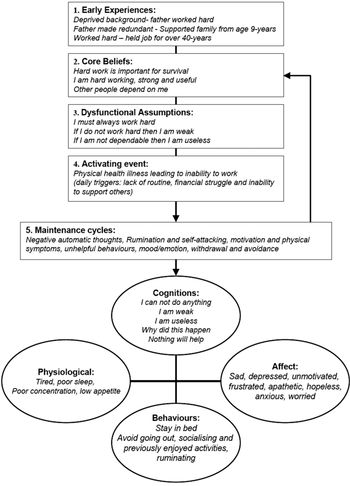
The client’s problem was formulated with Beck’s longitudinal formulation (Beck et al., Reference Beck, Rush, Shaw and Emery1979; Moorey, Reference Moorey2010). This consisted of five parts: early experiences, core beliefs about himself, the world and the future, dysfunctional assumptions, activating event(s) and maintenance factors. The client’s early experiences consisted of him growing up in a socio-economically deprived family where his father worked hard. Upon his father being made redundant, he reported having to take charge to support his mother from age 9 years. The client reported core beliefs around hard work, his sense of weakness and usefulness. He reported developing dysfunctional assumptions around needing to work hard to prove that he was not weak or useless. Illness and not being able to work violated the client’s assumptions and core beliefs. This was then maintained day-to-day by negative automatic thoughts and unhelpful behaviours. For example, he stopped reading, creating computer graphics, photography, paying bills, going out, socialising and gradually spent most of his time in bed. In line with the Beck cognitive triad, he developed negative views about himself: ‘this is who I am’, the world: ‘other people do not understand’ and the future: ‘nothing will help’. In line with the above formulation, the client was caught up in a depressive-interlock characterised by helplessness and rumination about self, the world, the future and his depression. His interlocked schema was that the depression was intrinsic and permanent. The case formulation is illustrated in Fig. 1.
Case formulation of the client’s depression [adapted from Beck et al. (Reference Beck, Rush, Shaw and Emery1979) and Moorey (Reference Moorey2010)].

Course of therapy
Treatment plan
The initial phase of therapy consisted of assessment and engagement. Therapy was conducted by an accredited CBT therapist supervised by two accredited senior CBT therapists. This involved normalising, psychoeducation, Socratic questioning and guided discovery. The client exhibited dysphoric recall and reported remembering more times when he was depressed than not and that he was unable to do anything. At the start of therapy, the client held the belief: ‘the engine will never restart’. He believed that he would not be able to do anything as he was ‘broken’. The therapist normalised his cognitions which aligned with his sense of hoplessness linked to his cognitive triad. The use of Socratic questioning helped the client uncover that he had done something by coming to the session. From this, the client was able to see two alternatives: Theory A: he was unable to do anything or Theory B: his depression symptoms were causing apathy. The client was open to testing out Theory B for treatment and was offered 12 sessions of CBT. Sessions were conducted over a period of 15 weeks as outlined below:
Session 1: Assessment and engagement (weeks 1–4)
Session 2: Psychoeducation and socialisation to the CBT model (week 5)
Session 3–5: In-session BEs – belief testing to reignite euphoric recall and enhance engagement (weeks 6–8)
Session 6–9: Between-sessions BEs – belief testing to enhance real-life experiential learning (weeks 9–12)
Session 10–11: Cognitive shift assessment – cognitive-restructuring, Socratic dialogue and guided discovery (weeks 13–14)
Session 12: Therapy blueprint – maintaining progress (week 15)
3-month follow-up: long-term effects of treatment
Behavioural experiments
At the start of therapy, the client’s belief-rating in Theory A was 95%, and 5% in Theory B. To test Theory B, a between-sessions BE was collaboratively planned between therapist and client; test belief – ‘If I pick up a book, I will not be able to recall anything and I will beat myself up which will make me feel worse’ (95%); alternative – ‘I may recall one or two things, which will be a start’ (5%). After 4 weeks following the pre-therapy assessment, the client’s scores remained high. His levels of engagement also remained low, which necessitated a BE collaboratively agreed with the client. The rationale behind initiating a BE rather than traditional structured activity scheduling was to engage the client given his high levels of hopelessness and apathy. The planned BE was to pick a book of his choice from his shelf and complete an overview of the first three chapters after which the client would bring the book to the next session for feedback. The client attended the session with the book. However, he reported that he did not complete the homework. As this was set as a no-lose experiment, it was used as a baseline for learning. The client reported that he was not as disappointed in himself because he had at least picked up the book and brought it to the session, already demonstrating a shift from rigid all-or-nothing, self-critical thinking to more cognitive flexibility. However, the client was still hopeless around trying a further BE. This necessitated an off-the-cuff in-session BE. The rationale for this unplanned BE was to seize in-the-moment windows of opportunity to engage the client given his high levels of despondency. The therapist capitalised on this and applied professional curiosity and collaboration to implement an off-the-cuff in-session BE to test out the client’s original belief: ‘If I pick up a book, I will not be able to recall anything and I will beat myself up which will make me feel worse’ (95%). The therapist invited the client to complete the original homework task in-session. The client gave a chapter-by-chapter overview of the book with the therapist Socratically and curiously aiding guided discovery. Surprisingly, the client was able to recall and narrate the book gradually shifting into a state of euphoric recall and eagerness. The client realised that contrary to his belief, he was able to recall most of the material and reported that he ‘actually enjoyed it’. The client re-rated his beliefs as follows: ‘If I pick up a book, I will not be able to recall anything and I will beat myself up which will make me feel worse’ (50%); alternative – ‘… I may recall one or two things, which will be a start’ (50%). This cognitive shift marked a turning point for client engagement and treatment. The in-session mastery provided positive reinforcement for self-efficacy and between-sessions mastery. As a result, the client was open to further between-sessions BEs.
Following the off-the-cuff in-session BE, the client still held some conviction in his original belief. He was convinced that it would hold more truth outside the session. Therefore, a between-sessions BE to test out the belief was planned: ‘If I pick up a book, I will not be able to recall anything and I will beat myself up which will make me feel worse’ (50%); alternative – ‘… I may recall one or two things, which will be a start’ (50%). The client was able to complete the BE and flowed into completing reading the whole book. Following this BE, the client re-rated his beliefs at 30 vs 70%, respectively. However, he still had some conviction in his original belief and argued that he would not be able to do other things. His new original belief was: ‘If I do anything else, I will not enjoy it and I will beat myself up again’ (50%). The alternative belief was: ‘… I may enjoy it’ (50%). The planned BE was to re-organise his landscape photograph album, which he completed. Following this BE, the client re-rated his beliefs at 20 vs 80%, respectively. Following the same theme, further BEs were planned around his other activities.
Outcome
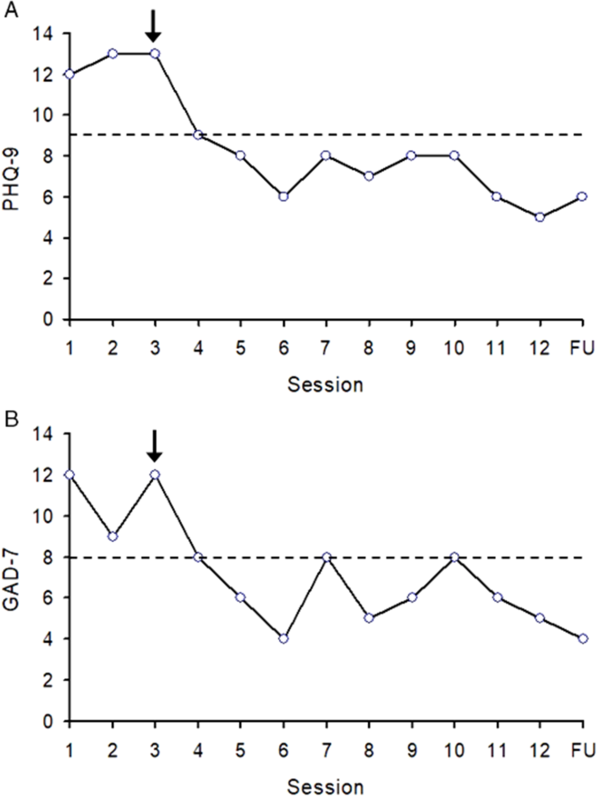
At the pre-therapy assessment, the client presented with moderate symptoms of depression as measured on the PHQ-9 and his self-reported assessment. These scores had remained within this range for over 2 years as indicated by the client’s own explanatory model and his previous episodes (data not included). In the current episode, the treatment plan aimed to instil hope and engage the client towards intervention. At the start of treatment, the client had high levels of hopelessness but presented a window of opportunity for a BE, which was capitalised on by the therapist. This initial off-the-cuff in-session BE yielded cognitive shift and self-efficacy. It also provided a quick-win which was reinforced by further follow-on BEs. This shift correlated with the client’s scores on the PHQ-9 and GAD-7 as shown in Fig. 2.
Client session-by-session PHQ-9 (A) and GAD-7 (B) outcomes. Session 1 indicates the pre-therapy assessment scores. As indicated by the arrow, session 3 is the point where the initial off-the-cuff in-session BE was implemented and is clearly shown to have effected a marked improvement in scores. There were 3 weeks of pre-therapy engagement between sessions 1 and 2 where the client’s scores remained high. Sessions 6–9 indicate points where further BEs were implemented and show continued improvement. The graph also shows that improvement was maintained at 3-month follow-up. The dashed line indicates the clinical cut-off scores.

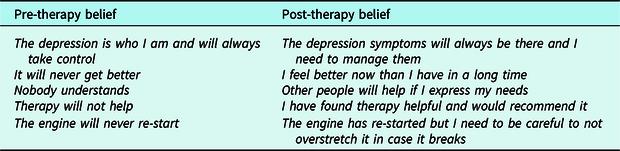
By session 6, the client had completed reading two books. He reported that: ‘the engine has re-started’. Following this, the client compiled a list of other activities. By session 10, he had made arrangements for a bill payment plan, started going out to do his photography, fixed his computer to download his graphics, visited one friend and had also recommended therapy. He was also planning to do some voluntary work. The BEs provided cognitive shift as a result of experiential learning. Altered beliefs were that the client reported learning that his depression was a set of fluctuating symptoms rather than a fixed problem inherent to him. This provided a bandwidth for him to re-engage with meaningful life in line with his goals. The client’s cognitive shift is summarised in Table 1.
Summary of cognitive shift post-therapy vs pre-therapy

At the end of therapy, the client reported qualitative improvement in his depression symptoms and morale. This was maintained at 3-month follow-up, where he reported that he was ‘still fixing the catalogue of mess created by the depression over the years but being mindful to not do too much in case it gets messy again’. This self-reported improvement in function was in line with his WSAS functional impairment scores which dropped from a total impact score of 30 to 7. The client no longer met the diagnostic criteria for depression and had also maintained reliable recovery on the PHQ-9 and GAD-7 (Fig. 2).
Client-reported qualitative outcome
Qualitatively, the client reported that: ‘I feel better than I have in a long time’. He also reported the following: (1) the initial off-the-cuff in-session BE was the most helpful aspect of treatment; (2) this stage ‘kick-started the engine’ and made him realise that he could do things again; (3) the subsequent BEs gradually increased his self-belief to take on harder tasks; and (4) problem clarification and the therapeutic relationship were also helpful.
Discussion
The current case study demonstrates the effectiveness of in-session BEs in the engagement and treatment of a client presenting with persistent MDD. This treatment protocol achieved the following matrices: instillations of hope, engagement of a despondent client and re-establishment of client mastery, self-efficacy and empowerment to reconnect with meaningful change. The study used Beck’s longitudinal formulation and employed BEs from the outset. This is in line with research suggesting that early use of BEs and capitalising on the client’s own windows of opportunity aids discovery and hypothesis testing and can be helpful in elaborating the formulation and engaging the client (Rouf et al., Reference Rouf, Fennell, Westbrook, Cooper, Bennett-Levy, Bennett-Levy, Butler, Fennell, Hackman, Mueller and Westbrook2004). An initial between-sessions BE proved less effective. Professional curiosity and creativity were used to implement the initial off-the-cuff in-session BE. This approach proved effective as it moved the client from a state of apathy towards further intervention. It also marked a turning point in therapy as it instilled hope and a foundation for self-efficacy and mastery. According to Rouf et al. (Reference Rouf, Fennell, Westbrook, Cooper, Bennett-Levy, Bennett-Levy, Butler, Fennell, Hackman, Mueller and Westbrook2004), therapists must not be afraid to incorporate BEs at any stage of the CBT process including assessment, intervention, ending and consolidation. They also need to be mindful and not assume that all BEs need to be carefully planned. On the contrary, they emphasise that off-the-cuff BEs taking advantage of the moment-by-moment processes of what happens in the therapy room are often highly effective. As demonstrated in the current case it was necessary not to plan the initial in-session BE as the client had high levels of apathy and hopelessness but presented an in-the-moment therapeutic opportunity of openness which was seized by the therapist. The client believed that he could not overcome his apathy. The use of an off-the-cuff in-session BE early on got him out of this mindset quickly.
The conventional CBT approach to treating depression is the early use of activity scheduling, followed by cognitive intervention. However, in the current case, this approach was unfavourable as the client had high levels of apathy and hopelessness and was not motivated to engage in planned and structured activity scheduling. Based on this, BEs presented as the timely path of least resistance especially given that the client presented windows of opportunity. The off-the-cuff in-session BE provided a quick-win where the client was able to reignite his euphoric recall leading to engagement and motivation for therapy. As illustrated by Fennell et al. (Reference Fennell, Westbrook, Bennett-Levy, Bennett-Levy, Butler, Fennell, Hackman, Mueller and Westbrook2004), BEs are most effective when used early on in therapy as this is where fundamental change occurs for most clients. In the current study, the early use of in-session BEs provided new experiential learning and cognitive shift, which provided positive reinforcement for self-efficacy, between-sessions mastery and meaningful change. Repeated BEs consolidated the learning and created the foundations for relapse prevention. Whether planned or not, BEs still need to be carefully and appropriately implemented in order to ensure maximum benefit and safety of the client. Therefore, caution needs to be taken in setting BEs and deciding when to plan and when not to plan as weak experiments could worsen the client’s symptoms (Padesky, Reference Padesky, Bennett-Levy, Butler, Fennell, Hackman, Mueller and Westbrook2004).
Limitations
The current case study demonstrates the effectiveness of BEs in the treatment of MDD in this case. However, it did not ascertain other contributing factors. For example, the therapeutic relationship has been shown to be linked with successful outcomes in psychological therapy. In the current case study, the client qualitatively reported finding this ingredient helpful. However, this study did not quantify its contribution. Furthermore, as with all case studies, cause–effect or generalisability cannot be statistically quantified from this single-case study. Nevertheless, despite these limitations, this case study demonstrates the effective use of BEs in engagement and treatment of persistent MDD and adds to the evidence base on this topic.
Clinical implications of the case
The aim of this case study is to encourage therapists to return to the roots of Beck’s cognitive model and incorporate in-session BEs in the treatment of persistent MDD. Both quantitative and qualitative outcomes of this study indicate that:
Behavioural experiments were effective in the treatment of persistent MDD.
In-session BEs were key ingredients in engaging the client towards treatment.
The off-the-cuff in-session BEs provided quick-wins and helped with instillation of hope for change and provided a foundation for self-efficacy and mastery.
Repeated BEs consolidated experiential learning and provided a foundation for meaningful change and relapse prevention.
Recommendations for practice and development
Although this study describes a standard intervention, it raises awareness of a topic that needs further attention when working with persistent MDD. It has potential merits for trainees and early career therapists to reflect on, as well as experienced therapists to use as a therapeutic tool when working with persistent MDD. Based on the current case study, recommendations on how practitioners might use BEs in the treatment of persistent MDD are as follows:
Drawing on BEs may help engagement and treatment in persistent MDD.
Therapists must not be afraid to use in-session BEs at the earliest opportunity to engage clients with persistent MDD and hopelessness.
Therapists must be curious, creative and confident to decide when to plan or when it is necessary not to plan BEs.
Therapists must apply scientific curiosity to refine and repeat BEs in order to consolidate experiential learning.
Acknowledgements
The authors would like to acknowledge the support and encouragement of Daniela Antonie (Service Clinical Lead) and Eiza Griffin (Deputy Clinical Lead) at Newham Talking Therapies. Thanks also goes to the client for his consent.
Financial support
This research received no specific grant from any funding agency, commercial or not-for-profit sectors.
Conflicts of interest
There are no known conflicts of interest.
Ethical statement
The authors have abided by the Ethical Principles of Psychologists and Code of Conduct as set out by the APA. In line with this, ethical approval was sought from the East London Foundation Trust board of Ethics committee (GECSE). Client consent and data management were conducted in line with their recommendations.
Key practice points
(1) Demonstrates the effective use of in-session BEs to engage and treat persistent MDD.
(2) Emphasis on early use of off-the-cuff in-session BEs to instil hope and engage the client towards further intervention.
(3) Repeated use of BEs consolidates shifts in belief, mastery and experiential learning.



Comments
No Comments have been published for this article.