[Crystal Structure solutions (powders and single crystals); Theory & Practice]
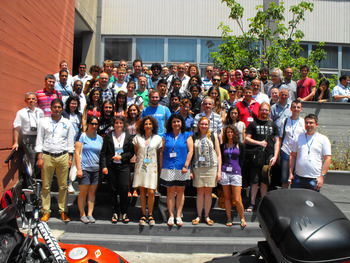
About 92 participants from 23 countries/4 continents gathered at the Department of Earth and Environmental Sciences of the University Aldo Moro of Bari, in the Apulia region located in Southern Italy (see Figure 1). About half came from Italy and Germany alone. Their primary motivation was to learn about the latest updates and new features pertaining to two hugely popular crystallographic software packages EXPO and SIR, developed at the Institute of Crystallography [IC-CNR] of Bari by Professor Carmelo Giacovazzo and the two teams he had set up for this task. Most of the attendance came from Academia, but not exclusively so.
(Colour online) Group photo of the EXPO Workshop held at the Dipartimento di Scienze della Terra e Geoambientali of the University of Bari [Courtesy of the Institute of Crystallography, IC-CNR, Bari]. Two of the workshop Instructors stand in the front row: Anna Moliterni & Rosanna Rizzi (3rd & 4th left).

This very successful meeting is the latest in a long series started more than 25 years ago. It follows an earlier one, PHARE 2009, organized by the same teams and geared towards similar goals, held 5 years ago in Martina Franca, also in the Apulia region and about 50 miles south of Bari.
Most of the participants were rather fluent with one former version of at least one of the two programs, EXPO (for Powders) and SIR (for Single Crystals). A majority of them [77/92] attended both workshops in a row. The EXPO workshop was held first, June 10–11 and gathered 89 attendees and 5 instructors from IC-CNR, followed by the SIR workshop, which claimed 80 participants directed by 7 instructors.
Both the EXPO & SIR workshops shared the following unique features:
(1) Theory in the mornings, by lecturers directly involved in the development of the Theory and Software; (2) Practice on the computer in the afternoons (3–4 h). The attendance was then split into smaller groups (of about 20 people each) under the guidance of one instructor; (3) accessibility to the latest version of the software pertaining to the workshop and last but not least; (4) the chance to interact informally with the instructors for the full duration of the workshop; (5) ample time to discuss one's own specific science problems and difficulties in using the supplied software; and (6) the chance to learn how to use both EXPO and SIR in non-default mode.
A fully attended social dinner was organized on the night following the end of the EXPO workshop on June 11th, in the scenic city of Trani by the sea, 30 miles away from Bari. During one of the lunch breaks, a few of the attendees were fortunate to visit the Powder Diffraction Group in their laboratory at the IC-CNR, a few hundred yards away from the main campus, and where they were guided by the EXPO team members Angela Altomare, Corrado Cuocci, Anna Moliterni, and Rosanna Rizzi.
Turning now to the technical & scientific part of this report, the EXPO workshop started head on after a warm welcome from Professor Pierfrancesco Dellino, Head of the Department of Earth and Geoenvironmental Sciences hosting the meeting, and a few words of introduction from Dr. Michele Saviano, who presented the IC-CNR, of which he is the current Director.
The first lecturer was Professor Carmelo Giacovazzo, one of the founding fathers of Direct Methods in Crystallography, and on which both EXPO and SIR are mostly based. His lecture brought him from a bird's eye view of the Phase Problem to the new features of SIR 2014, also used by EXPO: Patterson Deconvolution Techniques and the VLD (Vive La Difference = Improved Difference Fourier) approach. Indexing was discussed next by Anna Moliterni, with an emphasis on difficult cases and associated non-default ways to run EXPO. Professor Giacovazzo went then back to the floor to discuss better ways to assess the space group by advocating the use of the Control Peak List and a related new algorithm introduced in EXPO2014. Angela Altomare followed by describing EXPO2014's improved way of extracting intensities from powder patterns using the Le Bail procedure in a modified way. Rosanna Rizzi ended this first theoretical session by describing the principal steps performed by EXPO2014 during the phasing process via Direct Methods and by introducing the newly developed ALLTRIALS strategy in EXPO2014 to improve the efficiency of Direct Methods. The afternoon comprised a first Vendor's Communication by Dr. Akihiro Himeda from Rigaku, describing the PDXL software, an integrated Powder Diffraction Software distributed by Rigaku, and which includes the EXPO package. This first working day was then concluded by an exhaustive practical presentation describing the default run of EXPO2014 given by Aurelia Falcicchio, and then followed by the first of the two hands-on sessions devoted to EXPO 2014. The efficiency of the latter was maximized due the splitting of the attendees into four small groups and also thanks to a clear and an efficiently prepared written hand-out.
On the second day of the EXPO workshop, Angela Altomare started off by discussing Model Optimization and introducing three improved procedures [wLSQ, RBM, COVMAP] used together with a new one [RAMM], which provides an efficient alternative to Direct Methods. These acronyms stand for weighted Least-SQuares, Resolution Bias Modification, COVariance MAP, and RAndom Model based Method, respectively. The next presentation was delivered by Anna Moliterni, who focused on proceeding with a Rietveld refinement within EXPO14 once a suitable preliminary crystallographic model has been found, and who emphasized how restraints are now automatically set by the program and ready to be used if need be. In a third lecture, Rosanna Rizzi compared quite a few known direct-space approaches [Monte-Carlo, Parallel Tempering, Genetic Algorithms, …] with a new one developed and advocated by the Bari group: the Hybrid Big Bang Big Crunch strategy. Corrado Cuocci then stepped in to discuss practice using specific examples of Direct Space Approaches using EXPO2014. The last talk of this workshop was provided by a vendor representative, Dubravka Sisak from DECTRIS, who advocated the use of the new series of array detectors EIGER and PILATUS3 for X-ray diffraction experiments, which make use of the Hybrid Photon Counting technology with specific models for Synchrotron [S,X] use and Laboratories [R]. After lunch, another intensive 3 hr-long hands-on session took place, during which the attendance was once again split into four smaller groups, each of them being supervised by its own tutor.
Unlike the first, the second workshop, devoted to Single-Crystal Techniques as implemented in the latest SIR14 package, was geared towards the seasoned user.
In spite of this different slant, the second half of the Bari meeting was nearly as well attended as the first, and as successful. Let us first mention that the former Il Milione Bari crystallographic software, devoted to macromolecular compounds and proteins is no longer maintained and that the current SIR14 package covers the whole range from small molecule to protein crystals. The layout of the SIR workshop was the same as the EXPO one: lectures in the mornings, hands-on for smaller groups in the afternoon, and last but not least software and PDF files of the talks usefully complemented by an effective tutorial [Slides in a PDF format] which were generously distributed on a USB pen drive.
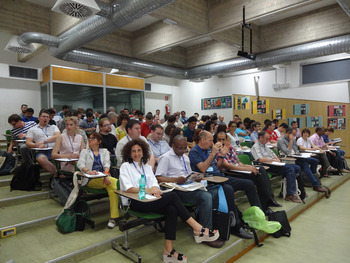
The introduction and main lecture was given by Professor Carmelo Giacovazzo, who presented the theoretical bases underlying the latest ab initio phasing strategies as implemented in SIR2014 (see Figure 2). This presentation may be compactly summarized by the following four acronyms, MDM, SDM, VLD, EDM [Modern & Standard Direct Methods, Electron-Density Modification] and a new procedure: RELAX. The latter allows for the automatic positioning of the structural model found by Direct Methods [P10 formula, negative quartets, … ] to the correct origin in the unit cell. Most appropriately, the next lecture given by Gianluca Cascarano was very practical, emphasizing the ease of use of the SIR2014 package, and in which case should each one of the previously described algorithms be used: MDM for small and medium systems (size is measured by the number of non-H atoms in the asymmetric unit), SDM for electron diffraction and Patterson Methods for Proteins. The third lecture, jointly presented by Maria Cristina Burla and Giampiero Polidori, gave more insight on the various algorithms mentioned above, showing multiple graphical outputs for each single one of them as well as ranking their respective efficiencies and success rates when used on the same bank of test structures of various sizes.
(Colour online) Everfilled Main Hall where the main lectures were held during both the EXPO and SIR workshops. Professor Carmelo Giacovazzo (front row, 3rd left) is involved in a handwaving argument. [Courtesy of the Institute of Crystallography, IC-CNR, Bari].

The last two morning lectures were given by Rocco Caliandro and Benedetta Carrozzini, who gave more information on the new implementation of the Patterson deconvolution algorithm for proteins and direct methods for small/medium systems respectively. In either case, the rationale and the efficiency of each approach were illustrated by a fistful of sketch diagrams and a great many 3D graphical output(s).
On the second day of the SIR workshop, the remaining morning lectures focused successfully on the following topics: Electron Diffraction (Gianluca Cascarano), Solving Structures using Simulated Annealing (Corrado Cuocci), and subsequently two more lectures pertaining to Macromolecular systems presented by Benedetta Carrozzini [Direct Space Refinement Process], and by Annamaria Mazzone [Molecular Replacement]. An ultimate Vendor's talk given by Dubravka Sisak (from DECTRIS) advocated again the use of the EIGER and PILATUS array detectors for X-ray diffraction experiments, this time carried out on single-crystal samples.
PHARE 2009, SIR/EXPO 2014…, we are eagerly looking forward to the next event!
ACKNOWLEDGEMENTS
Help from Dr. R. Rizzi and Dr. G. Cascarano [CNR Bari] is gratefully acknowledged.