Implications
New feeding strategies for dairy cows involving higher amounts of n-3 fatty acids are introduced to increase the proportion of unsaturated fatty acids in milk. As n-3 fatty acids are substrate for less potent proinflammatory mediators, feeding higher amounts of n-3 fatty acids could change the immune response of dairy cows. This study showed that cellular immunity of dairy cows was affected by n-3 dietary fatty acids and that oxidative stress is one of the factors that contribute to reduced cellular immunity induced by dietary n-3 fatty acids during the periparturient period.
Introduction
Linseed as a source of n-3 fatty acids has been widely used as it is well known that linseed is rich in α-linolenic acid (Scholljegerdes et al., Reference Scholljegerdes, Lekatz and Vonnahme2014). Apart from milk composition, n-3 fatty acids can influence immune response and reduce symptoms of chronic inflammatory diseases.
Key inflammatory mediators are the n-6 eicosanoids, prostaglandin E2 and leukotriene B4 (LTB4), which are derived from n-6 arachidonic acid (AA). The key enzyme in leukotriene biosynthesis is 5-lipooxygenase, which catalyses the formation of leukotriene A4 (LTA4) from AA in a two-step reaction. LTA4 can be further metabolised into LTB4, a reaction catalysed by LTA4 hydrolase (Runarsson et al., Reference Runarsson, Liu, Mahshid, Feltenmark, Pettersson, Klein, Björkholm and Claesson2005). LTB4 is a potent inflammatory mediator that exerts its biological effects primary on leukocytes. Reports indicate that LTB4 enhances activation, proliferation and antibody production in B lymphocytes and stimulates various T-cell functions. The actions of LTB4 on leukocytes are mainly mediated by BLT1, a high-affinity G-protein coupled LTB4 receptor expressed on neutrophils and monocytes. BLT1 is also expressed on activated T lymphocytes, both CD8+ and CD4+ cells (Goodarzi et al., Reference Goodarzi, Goodarzi, Tager, Luster and Andrian2003). AA is derived from n-6 linoleic acid found in soy, corn and sunflower. EPA derived from α-linolenic is a source of n-3 eicosanoids, prostaglandin E3 and leukotriene B5, which are less potent proinflammatory mediators.
During the transition from pregnancy to lactation dairy cows undergo substantial metabolic and physiological adaptation (Sordillo and Aitken, Reference Sordillo and Aitken2009). The considerable increase in oxygen requirements during the period of increased metabolic demands results in increased production of reactive oxygen species (ROS). An imbalance between increased ROS production and the availability of antioxidant defences needed to reduce ROS accumulation may expose cows to increased oxidative stress. The biochemical outcome of free radical transformation is an increase in lipid peroxidation outcome in particular of malondialdehyde (MDA). ROS production during oxygen metabolism has necessitated the development of antioxidant defences that can effectively trap reactive intermediates before causing oxidation to macromolecules or to reduce biomolecules that already have been oxidised (Sordillo and Aitken, Reference Sordillo and Aitken2009). Among the most efficient antioxidants are enzymes that can directly catalyse the reduction of ROS such as superoxide dismutase (SOD) and glutathione peroxidase (GPx), a selenoenzyme most often associated with antioxidant function in cattle (Jefferies et al., Reference Jefferies, Coster, Khalil, Bot, McCauley and Hall2003).
Extensive research with dietary n-3 fatty acid sources has focused on changing milk fatty acid composition (Shingfield et al., Reference Shingfield, Reynolds, Lupoli, Toivonen, Yurawecz, Delmonte, Griinari, Grandison and Beever2005; Lejonkleva et al., Reference Lejonkleva, Storma, Larsena, Mortensena and Weisbjerg2013; Nudda et al., Reference Nudda, Battaconea, Atzoria, Dimauroa, Rassua, Nicolussia, Bonellia and Pulina2013; Gallardo et al., Reference Gallardo, Gómez-Cortés, Mantecón, Juárez, Manso and de la Fuente2014), disregarding the effect of n-3 fatty acids on the immune system or oxidative stress in dairy cows. The aim of this research was to determine the influence of dietary replacement of n-6 with n-3 polyunsaturated fatty acids (PUFA) on cellular immunity and oxidative stress in the transition period of dairy cows.
Material and methods
Experimental design and diets
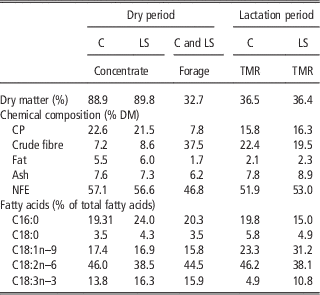
The experiment was conducted on 20 dairy Holstein cows, BW of ~635 kg, at the age of 3 years, during the second pregnancy, from 3±1 weeks before parturition until the 6th week of lactation. The cows were randomly allocated into two groups of 10 cows in separated pens, under identical environmental conditions. In this experimental design a part of dietary n-6 fatty acids were replaced with n-3 fatty acids keeping the diets iso-energetic and iso-nitrogenous. During the dry period cows were fed with forage (grass silage 6 kg, wheat straw 6 kg, wet beet pulp 5 kg/cow per day) and 2 kg of concentrates/cow per day. Concentrate for the control (C) group contained ground corn, sunflower, rapeseed, mineral premix and soybean meal, which was replaced in the experimental (LS) group with 10.2% ground linseed. During lactation cows received total mix ration containing corn silage 24 kg, grass silage 10 kg, grass hay 1 kg, wet beet pulp 10 kg, concentrate 11 kg/cow per day. Concentrate for the C group contained ground corn, sunflower, barley, mineral premix and toasted soy, which was replaced with 19% ground linseed in the LS group. The cows were fed once a day. Chemical and fatty acid composition of the diets according to the study design are shown in Table 1. Experimental and animal management procedures were conducted in accordance with the ‘Directive for the Protection of Vertebrate Animals used for Experimental and other Purposes’ (86/609/EEC).
Chemical and fatty acid composition of the experimental diets containing no linseed and linseed

C=control group; LS=linseed group; NFE=nitrogen-free extract, consisting of carbohydrates, sugars, starches and hemicelluloses.
Chemical analyses of diets
Feed samples were analysed for dry matter (24 h at 103°C), N content by the Kjeldahl method (6.25 multiplication factor was used to calculate CP), crude fibre by Ceramic fibre filter method (Buchi, Flawil, Switzerland) and fat by Soxhlet (Association of Official Analytical Chemists, 1995).
Blood sample collection and analytical procedure
2 h before each blood sampling all cows were injected subcutaneously with 2 mg of ovalbumin grade V in incomplete Freund’s adjuvant (Sigma-Aldrich®, USA). At the same time of the day, on days −10, 1, 21 and 42 relative to parturition the blood samples of 10 cows from each group were taken from the coccygeal vein into tubes with heparin and K3EDTA anticoagulant (Becton Dickinson, Plymouth, England, UK). The number of white blood cells (WBC) was determined using the haematological analyser 100 PochVef (Sismex, Kobe, Japan). Blood smears were made by hand using May-Grünwald Giemsis stains and blood constituents were differentiated using light microscope Olympus BX 51 (Olympus Optical co., Tokyo, Japan).
Lymphocyte subpopulations in the blood were determined using the flow cytometer EPICS-XL (Beckman Coulter, Brea, CA, USA). Blood from K3EDTA tubes was diluted in phosphate buffered saline (PBS) so that the number of leukocytes would be between 5.0 and 9.7×10⁹/l. In each sample 50 µl of monoclonal antibodies (Southern Biotechnology Associates Inc., Birmingham, AL, USA) against bovine CD4+, CD8+ and CD45+ surface markers was added. Antibodies were fluorescently labelled. Room temperature incubation lasted for 20 min. Samples were washed with 1 ml PBS and centrifuged at 1200×g for 5 min. Supernatant was discharged and 0.5 ml of lysis fluid (ammonium chloride) was added. After 10 min in the dark samples were washed with 1 ml PBS and centrifuged at 1200×g for 5 min. Supernatant was discharged and samples were diluted with 1 ml PBS and analysed.
Phagocytosis ability (PHA) of peripheral blood polymorphonuclear cells was measured using following procedure: peripheral blood polymorphonuclear cells were isolated from the whole blood according to the method described by Pantazis and Kniker (Reference Pantazis and Kniker1979) with some modifications. Briefly, blood was centrifuged, leukocytes separated and washed three times in minimal essential medium (MEM). The number of leukocytes was arranged to 1×10⁶/ml. Suspension was separated to plates and incubated for 30 min at 37°C in 5% CO2 atmosphere. Supernatant was discharged and plates washed with MEM to remove all unattached cells. Suspension 0.25 ml with 40×106/ml of Saccharomyces cerevisiae was placed in plates and incubated for 30 min. Plates were washed and cells were coloured with 0.05% acridine orange (Sigma, St. Louis, MO, USA) in MEM for 1 min. Plates were washed and observed using an UV light microscope. The results of phagocytosis are displayed as a PHA, phagocytosis index (PHI) and microbicidity (PHM):
 $${\rm Phagocytosis}\,{\rm ability}={{{\rm Number}\,{\rm of}\,{\rm phagocitised}\,{\rm neutrophils}} \over {{\rm Total}\,{\rm number}\,{\rm of}\,{\rm neutrophils}}}\,{\times}\,100$$
 $$\eqalignno{{\rm Phagocytosis}\,{\rm index} =&{\rm Mean}\,{\rm number}\,{\rm of}\,{\rm phagocyted}\,\cr & { Saccharomyces}{\,cerevisiae\, \rm per}\,{\rm one}\,{\rm neutrophil}$$
 $${\rm Microbicidity}={{{\rm Number}\,{\rm of}\,{\rm killed}\,{Saccharomyces\,cerevisiae}{\rm }} \over {{\rm Total}\,{\rm number}\,{\rm of}\,Saccharomyces\,cerevisiae{\rm }}}\,{\times}\,100$$
PHA and PHI shows the capability of neutrophils to engulf pathogens and PHM shows the capability of neutrophils to kill them a few minutes later. All three are good indicators of cell immunity, as phagocytosis is one of the most important defence mechanism against bacterial infection.
Analysis of oxidative status was determined by SOD and GPx activities in serum by the kinetic method using a commercial kit RANSEL (Randox Laboratories, Crumlin, UK) on a SABA automated analyser (AMS, Bergamo, Italy). Activity of SOD was expressed in U/ml and GPx activity in U/l of serum. Concentration of glutathione (GSH) was determined using the method of Buetler et al. (Reference Buetler, Duron and Mikus1963) and was expressed in mmol/l. Concentration of total MDA in plasma was determined by HPLC (Grotto et al., Reference Grotto, Santa Maria, Boeira, Valentini, Charäo, Moro, Nascimento, Pomblum and Garcia2007) on TSP-130 system (Thermo Separation Products Inc., Thermo Fisher Scientific Inc., Waltham, MA, USA).
Statistical analysis
A GLM procedure was used to generate LSD repeated measures ANOVA (STATISTICA version 12; StatSoft Inc., Tulsa, OK, USA). The GLM model included fixed effects of the day (relative to calving) and group to determine any significant differences between blood constituent’s ratio, lymphocyte subsets (CD45+, CD4+ and CD8+), phagocytosis (PHA, PHI and PHM) and parameters of oxidative status (SOD, GSH, GPx and MDA) at each time point and between days. The significance was accepted at P<0.05.
Results
Blood constituents
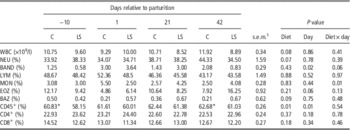
In relation to the effect of dietary linseed on total WBC count we have found trend towards lower (P=0.08) total WBC count in the LS group (Table 2). The relative proportion of neutrophils was also lower in LS group compared with the C (P=0.07). There was a trend towards lower (P=0.07) relative proportion of neutrophils in the LS group compared with the C group. The share of lymphocytes was higher in the LS group during the whole experimental period except on day 1 after parturition, but without significance (Table 2).
Blood constituent’s proportion and difference in proportions of lymphocyte subpopulations of Holstein cows fed diets containing no linseed and linseed

C=control group; LS=linseed group; WBC=white blood cells; NEU=neutrophils; BAND=band neutrophils; LYM=lymphocytes; MON=monocytes; EOZ=eosinophils.
1 Pooled s.e.m.
*Values on a given day differ significantly at P<0.05.
Changes in the recruitment of circulating immune cell subsets were determined by the cytometric analysis of CD45+, CD4+ and CD8+ subsets in peripheral blood of dairy cows according to the experimental design (Table 2). The lower proportion of CD45+ was recorded in the LS group compared with the C group during the entire experimental period. The proportion of CD45+ was affected both by dietary treatment and days relative to parturition, but without interaction. At the begging of the experimental period (−10, 1) proportion of the CD4+ was higher in LS group in relation to the C (P>0.05). Contrary, there was a trend of lower proportion of CD8+ in LS group during the same experimental period.
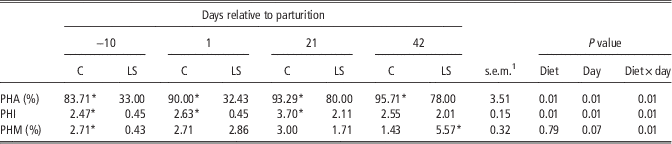
PHA of the peripheral blood polymorphonuclear cells was significantly lower (P<0.05) in the LS group during the whole experiment, especially on prepartum day −10 and day 1 of lactation (Table 3). The PHI of the peripheral blood polymorphonuclear cells was lower (P<0.05) in the LS group every day except day 42 of the experiment. Neutrophil microbicidity was lower (P<0.05) in LS group on day −10 relative to calving and was higher (P<0.05) on the 42nd day of lactation.
In vitro phagocytosis ability, phagocytosis index and microbicidity of neutrophils of Holstein cows fed diets containing no linseed and linseed

C=control group; LS=linseed group; PHA=phagocytosis ability; PHI=phagocytosis index; PHM=microbicidity.
1 Pooled s.e.m.
*Values on a given day differ significantly at P<0.05.
Markers of oxidative status
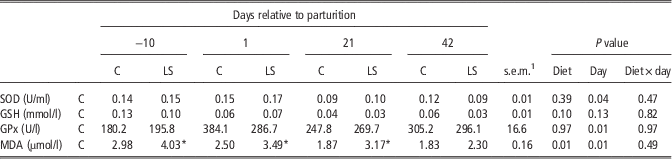
To control the experimental diet influence on antioxidative protection and oxidative stress, activities of two enzymes and concentration of a substrate and one product were measured (Table 4). GSH concentration was not influenced (P>0.05) either by dietary treatment or the days relative to parturition. Concentration of MDA was significantly higher (P<0.05) in cows from the LS group compared with C group on day −10, 1 and 21 relative to parturition. In both groups, MDA concentration significantly decreased (P<0.05) during the experimental period. SOD activity in both groups was higher in the prepartum period, reaching top values on day 1 after parturition but was not influenced by diet. GPx activity was not influenced by dietary treatment (P>0.05); the highest activity was on the 1st day after parturition in both groups and significantly changed (P<0.05) relative to parturition.
Markers of lipid peroxidation and antioxidant status in the serum of Holstein cows fed diets containing no linseed and linseed

C=control group; LS=linseed group; SOD=superoxide dismutase; GSH=glutathione; GPx=glutathione peroxidase; MDA=malondialdehyde.
1 Pooled s.e.m.
*Values on a given day differ significantly at P<0.05.
Discussion
The present study was designed to investigate the influence of a diet enriched with n-3 fatty acids on cellular immunity and oxidative status in the transition period of dairy cows. The results obtained are composed of cellular immunity and oxidative status of the transition period dairy cows.
Cellular immunity
Polymorphonuclear leukocytes are important in immune responses and there are many studies regarding the effects of different fatty acids on their response. Most of the research on PHA was done on phagocyte cells incubated with a large amount of PUFA in vitro. These conditions can never be achieved in vivo. In such an environment the results of Calder et al. (Reference Calder, Bond, Harvey, Gordon and Newsholme1990) showed positive effects of PUFA to PHA of macrophages, compared with the incubation with saturated fatty acid. Incorporation of unsaturated fatty acid in phagocyte cell membrane promotes PHA by increasing fluidity of the membrane. Ordóňez et al. (Reference Ordóňez, Pescador, Gorodezky and Saltijeral2008) compared PHA and PHI of neutrophils from milk and blood using Staphylococcus aureus; those results are similar to the one in our C group. PHA and PHI were significantly lower (P<0.05) in the LS group which is not in relation with Silvestre et al. (Reference Silvestre, Carvalho, Crawford, Santos, Staples, Jenkins and Thatcher2011). They used S. aureus and Escherichia coli to determine PHA of dairy cow neutrophils according to a different dietary fatty acid composition and found that dietary treatment did not influence PHA whereas bacteria species did. Present study results suggest that cellular immunity of dairy cows was affected by dietary fatty acids. PHA and PHI of the LS group was reduced compared with the C group during the whole experimental period. The most severe decrease in PHA was during the prepartum period. The reason for lower PHA and PHI of the LS group of cows could be found in fact that n-3 fatty acids reduce levels of the proinflammatory LTB4. LTB4 is synthesised by the action of 5-lipoxygenase and LTA4 hydrolase, from AA (Peters-Golden and Henderson, Reference Peters-Golden and Henderson2007). EPA, the n-3 fatty acid derived from α-linolenic acid competitively inhibits AA metabolism via those enzymatic pathways, thus, suppressing the production of LTB4. LTB4 is a potent neutrophil chemoattractant and a key player in the initiation of inflammation. LTB4 acts as a signal-relay molecule for neutrophils migrating towards formyl peptides released from bacteria. During the entire experimental period the proportion of CD45+ cells was significantly lower in LS groups compared with the C group. Despite that the proportion of CD8+ cells was not significantly lower, there was a trend of decreasing proportion in LS group at −10 and 1 day, as well as trend of the increasing proportion of CD4+ cells at the same days, which is in relation with Stankova et al. (Reference Stankova, Gagnon and Rola-Pleszczynski1992). LTB4 is a very potent chemotactic compound for activated T lymphocytes, and BLT1 – receptor-deficient mice have an impaired trafficking of activated CD8+ cells and CD4+ cells (Tager et al., Reference Tager, Bromley and Medoff2003). Treatment of CD8+ T cells with LTB4 increases the proliferation rate, and IL-2β expression. CD4+ T cells respond to LTB4 by increased IL-2 production (Stankova et al., Reference Stankova, Gagnon and Rola-Pleszczynski1992). In the present study the proliferation rate of CD8+ cell might have been impaired by n-3 fatty acids reducing the synthesis of LTB4. LTB4 supports proliferation of CD8+ but not CD4+, which is similar with our results where we determined trend towards lower CD8+ and higher CD4+ T cell proportion in the LS group. Although not significant this trend shows that diet has not only influenced phagocytic ability of neutrophils but also circulating immune cell subsets.
Oxidative status
Oxidative stress can be monitored with several markers such as concentration of MDA – lipid peroxidation products, amount of ROS, antioxidant capacity, biological antioxidant potential, intracellular glutathione content, protein carbonyl content, as well as activity of antioxidant enzymes glutathione reductase, SOD and GPx (Kataria et al., Reference Kataria, Kataria, Maan and Gahlot2010). An increased level of oxidative stress, expressed as the proportion between the amount of ROS and biological antioxidant potential in plasma of dairy cows, during the first 2 weeks of lactation has been found by Pedernera et al. (Reference Pedernera, Celi, Garcia, Salvin, Barchia and Fulkerson2010). Increased oxidative stress has been reported for dairy cows in late pregnancy, parturition and initiation of lactation. Peripartum and early lactation are critical periods where considerable physiological changes challenge homoeostasis, leading to oxidative stress (Kataria et al., Reference Kataria, Kataria, Maan and Gahlot2010). Our results support that statement because SOD and GPx activities increased 1 day after parturition. Otherwise, their activities were not influenced by dietary treatment which means that feeding additional n-3 fatty acids did not have a detrimental effect on antioxidant defence. The entire antioxidant system seems to be under homoeostatic control so when the risk of oxidative damage increases, endogenous antioxidant protection increases too. A rise in GPx and SOD activity and a fall of GSH concentration could indicate a peak of oxidative stress at the time of parturition in our investigation. Stefanon et al. (Reference Stefanon, Sgorlon and Gabai2005) showed a similar finding. Albumin is exclusively synthesised by the liver, and it is the main source of plasma GSH. Glutathione is mainly synthesised de novo within the liver. The reduction of liver function that is usually observed in the early postpartum period might explain lower plasma GSH levels. In addition, GSH is important in the degradation of ROS by being oxidised to GSSH via the GPx catalysing activity. In that matter the concentration of GSH is reduced in times of oxidative stress as observed in our research during the transition period.
Pregnant cows 1 week before and 1 week after calving had an increased level of MDA in plasma and increased total antioxidant status in the serum (Castillo et al., Reference Castillo, Hernandez, Bravo, Lopez, Pereira and Benedito2005). Our results show that dietary treatment increased MDA concentration during the entire experimental period. These results are in agreement with the known fact that C18:3 is more prone to lipid peroxidation compared with the C18:2. Concentration of MDA gradually decreased during the experimental period in both groups which shows that lipid peroxidation is most pronounced during the periparturient period and gradually decreased afterwards. This is in accordance with the results of Castillo et al. (Reference Castillo, Hernández, Valverde, Pereira, Sotillo, López and Benedito2006) who measured MDA levels during weeks after calving. They concluded that in the first weeks after calving high levels of free radicals cause lipid peroxidation, and that the effect is related to intensity of metabolic changes under endocrine regulation, and that the lipid peroxidation increase is maintained for a short period of time. Results in this research show that the highest concentration of MDA appears on the days before calving suggesting that lipid peroxidation reaches its peak before compensatory mechanism of antioxidants (SOD and GPx) can put it under homeostatic control. The results obtained in this study demonstrated that a dietary treatment with n-3 fatty acids does not change activities of antioxidative enzymes, but does increase marker of lipid peroxidation (MDA), while parturition increases the markers of oxidative status (SOD and GPx). The immune suppression was most pronounced during periparturient period determined by lower PHA, PHI, PHM, and trend towards lower CD8+ in LS group, but was mitigated later on. In that matter we can conclude that not only dietary n-3 fatty acids but also oxidative stress, which reached peak at time of parturition, contributed to the reduced cellular immunity during the periparturient period.