


Power and effectiveness are fundamental to the study of politics. Central to that study are questions about how politicians obtain power and what types of power make them effective. In legislative settings, there are at least two broad types of power: “personal power” and “situational power.”1
See Lukes (1974) for some other types of power.
Recently, scholars have studied the personal power of various delegates at the Constitutional Convention. In particular, Rakove (1996, 92) alluded to Roger Sherman's ability to counter James Madison. Robertson (2005) presented a more detailed description of the ways in which Sherman was particularly effective at derailing Madison's agenda. According to Robertson, “Sherman skillfully used rhetoric, timing, and compromise to manipulate the design agenda and alternatives…He staked out positions diametrically opposed to Madison, and then expressed a readiness to compromise on a middle ground” (Robertson 2005, 234–35). According to these scholars, Sherman's intrinsic abilities and political savvy helped him affect the final form of the Constitution.
We offer an alternative explanation for Sherman's effectiveness—which is a specific type of situational power. Using empirical estimates of ideal points, we claim that Sherman was a pivotal voter in his delegation and that his state (Connecticut) was pivotal on many issues at the Convention. A delegate is pivotal, in our use of the term, if he can change the assembly's choice by changing his vote.2
Note that our definition of “pivotal” differs from Robertson's usage of the term. We use it as it is applied in the spatial voting literature, where pivotal voters can change their votes but do not change their preferences (Mueller 2003). Robertson (2005) uses the term to convey being instrumental in a broader sense.
At the Convention, delegates voted in state blocks. Each state's vote was determined by a majority of its delegates and a simple majority of the states determined whether a proposal passed (Farrand 1936–66, 1, 7–10). There are two requirements for a delegate to be pivotal in this context. First, he must be in a position to change his vote in a way that will change his state's vote; and second, the change in his state's vote must alter the outcome of a vote. To demonstrate that the Convention's voting rule affected Sherman's pivotalness, we further argue that if the votes would have been tallied by delegates individually, then Sherman would have been less pivotal. This suggests that Sherman's effectiveness might have been the result of the voting rule used at the Convention, as well as by his ideological position relative to others.
Before we proceed, it is important to note that personal power and situational power are not mutually exclusive. In general, a legislator can exercise various types of personal power and various types of situational power at the same time. This implies that we cannot deny one type of power by demonstrating the other. Keeping this caveat in mind, we provide some evidence that Sherman's overall effectiveness at the Convention is more consistent with his situational power than with his personal power. However, it is still possible that Sherman's personal power better explains his effectiveness on any individual vote.
CONNECTICUT AS A PIVOTAL STATE
Part of the reason that Sherman was effective may have been that his state, Connecticut, was pivotal on many votes. This can be shown by estimating ideal points for the twelve states that attended the Convention. For this purpose we use Poole's (2000) optimal classification routine.3
The software used in these estimates is available at http://pooleandrosenthal.com/Optimal_Classification.htm.
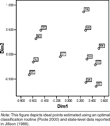
Optimal classification estimates for the 569 state-level roll call votes at the Convention are displayed in Figure 1 (see Jillson 1988, 215–20, for the data).4
As a referee has pointed out, the proposals which create the set of roll-call votes used in the estimation procedure may have been opportunistically crafted by skilled individuals. This does not affect optimal classification estimation, as long as voting is sincere. Furthermore, because we use all state roll-call votes to estimate our optimal classification scores, there is no concern about the representativeness of our sample.
Eigenvalues of the double-centered agreement score matrix were as follows: for one dimension (0.3220), for two dimensions (0.1925), for three dimensions (0.1570), for four dimensions (0.0926). The correlation between ideal point estimates in any two of three dimensions is no greater than .031. It is possible, however, that the appropriate number of dimensions is greater than two. If three dimensions are estimated, then the dimensions in Figure 1 are roughly reproduced and a third dimension is added which roughly represents a north–south divide. Connecticut is at the median of the second dimension and near the median in the first and third dimensions. Because our two dimensional graph depicts roughly the same story as our three- (or four)-dimensional estimates, we focused on two dimensions for visual simplicity.

States at the Constitutional Convention
The two dimensions in Figure 1 are empirically derived. Hence, they are linear transformations, or near linear transformations, of a wide variety of issues. Although it is merely speculative, the distribution of states across the first dimension appears to correlate with the coalitions formed over issues of representation (Jillson 1988; Robertson 2005),6
New Hampshire arrived after the apportionment issue was settled (Rossiter 1966, 196).
Rhode Island never attended the Convention, hence, it is not included in Figure 1. Moreover, delegates from New York and New Hampshire never attended at the same time. To account for the differing attendance of these two states, we divide the Convention into three periods: May 30 to July 10 (when New York attends, but New Hampshire does not), July 11 to July 22, (when neither state attends),7
New Hampshire does cast one vote, however, on July 20.
During the first period (May 30–July 10), Pennsylvania is the median state in the first dimension and Connecticut is the median state in the second dimension. During the second period (July 11–July 22), both Pennsylvania and Virginia are the median states in the first dimension (an even number of states imply at least two states at the median), and Connecticut and Maryland are the median states in the second dimension. During the third period, Virginia is the median in the first dimension and Connecticut is the median in the second dimension.
Without knowing the location of the status quo and the proposal for any particular vote, we cannot determine pivotalness based on medians. Instead, we calculate Shapley–Owen values (Owen and Shapley 1989) for the states using the ideal points estimated in Figure 1.8
With 569 roll-call votes, there is a maximum of 162,166 classification regions in Figure 1 (Poole 2000, 213). On average, the classification regions are small enough to meaningfully apply a power index. Shapley–Owen values were calculated using the estimated ideal points in Figure 1 and software developed by Godfrey and Matkovsky (2004).
Calculating Shapley–Owen values for the states, we found that Connecticut had the largest Shapley–Owen value during each of the three periods. During the first period, the three largest Shapley–Owen values were Connecticut (.40), Georgia (.17), and Pennsylvania (.13). During the second period, the three largest were Connecticut (.30), Virginia (.27), and South Carolina (.17). During the third period, the three largest were Connecticut (.33), Virginia (.23), and New Hampshire (.17). Connecticut's vote was not pivotal on every single issue, but the power index in each period suggests that it was more likely to be critical to the final vote tally than any other state a priori. This implies that, everything else equal, the delegates from Connecticut had greater influence on the Constitution than delegates from states like New Jersey, which were rarely in a position to affect the outcome of a vote.
A PIVOTAL DELEGATE FROM CONNECTICUT
Not only was Connecticut likely to be pivotal, as suggested in the previous section, but also it appears that Sherman was the most pivotal delegate from his state. Delegate level votes were not recorded at the Convention. However, McDonald (1958) inferred sixteen delegate level votes using delegate positions in speeches and manuscripts. He then compared these positions to attendance records and state votes recorded in the journal to fill in missing values. His data have been used extensively by McGuire (1988, 2003) and McGuire and Ohsfeldt (1986). Using the same process as McDonald, we were able to infer an additional sixteen votes for the three Connecticut delegates. For example, Ellsworth is coded as voting yea on vote 249 because he made the motion. Johnson and Sherman are coded as nay on vote 249 because Connecticut voted nay and a majority of each delegation determined the vote of their state. Combined, these 32 votes spanned all 5 months of the Convention but focused primarily on cases where all three delegates were in attendance (June 2–August 23). The votes represent a wide range of issues from the apportionment of the legislature and election of the President to the powers of issuing currency and the importation of slaves. We then used these 32 votes to create optimal classification estimates for the Connecticut delegation.9
The votes used to create the spatial mapping for the Connecticut delegates include the 16 votes listed in McGuire (2003, 86–9) and 16 additional votes. McGuire's delegate level votes are McDonald's (1958) with additional imputations made by McGuire and Ohsfeldt (1986). The additional votes came from Farrand (1966, 1: 50 [vote 5]; 54 [vote 8]; 201 [vote 39]; 201–2 [vote 40]; 407–8 [unnumbered vote to alter the committee report so that members of the second branch were popularly elected]; 510 [vote 110]; 581 [vote 132]; 588 [vote 136]; 596 [vote 146]; 597 [vote 147]; 219 [vote 249]; 2: 223 [vote 253]; 319 [vote 313]; 404 [vote 361]; 415 [vote 367]; 416 [vote 368].
Eigenvalues of the double-centered agreement score matrix were 0.519 for one dimension and less than 5×10⁻⁵ for two dimensions.
After August 23, when Ellsworth left the Convention, Sherman and Johnson were the only delegates remaining from Connecticut. By definition, both delegates were equally pivotal in determining Connecticut's vote during this period. Prior to August 23, Sherman was the median voter in our single-dimensional estimates. This is true whether ideal points are estimated from all 32 recovered votes or from only the 21 votes which took place through August 23. Although it is always possible that recovering additional votes might produce different conclusions, the available evidence suggests that Sherman was the most pivotal delegate from his state.
Our analysis suggests that Sherman was in a better position to affect the outcome of the Convention than other delegates due to his ideological position. His state was critical to the outcome on many issues. When all three Connecticut delegates were present, Sherman fell between the positions of his two co-delegates, making his vote frequently critical. When only one other Connecticut delegate attended, Sherman (and Johnson) could always alter his state's vote. Hence, part of Sherman's effectiveness at the Convention might stem from his spatial position relative to others and the rule requiring delegates to vote in state blocks.
NONPIVOTAL AMONG DELEGATES ALONE
Sherman's ability to influence the content of the Constitution may have resulted in part from the voting rules themselves. If the Convention rules had differed, such that passage of a proposal required a simple majority of all delegates voting individually (as done in the modern-day House), then Sherman might have been less pivotal. This is revealed by creating optimal classification estimates for 53 of the 55 delegates at the Convention,11
Fifty-five delegates attended the Convention, but William Houston (NJ) and George Wythe (VA) left during the second week. Hence, they were not coded by McDonald (1958) or McGuire (2003), nor were they used in this analysis.
Votes for the Connecticut delegates were relatively easy to infer because Connecticut had only three delegates. Inferring votes for 53 delegates is considerably more difficult because some of the delegations had as many as 8 members and questions where almost all delegates spoke or wrote an opinion on the same issue are difficult to find.
Under the assumption of a single dimension, one of two orderings are created—depending on the restriction. Either C. C. Pinckney (SC), Rutledge (SC), and Butler (SC) are at the median (they have the same estimated ideal point), or Spaight (NC), Davie (NC), and Pierce (GA) are at the median (they have same estimated ideal point). This is true for all three periods of attendance. Sherman is in 45th position in the first series of estimates, and in the 10th position in the second series. In either case, there are at least 14 delegates between Sherman and the median voter. In other words, Sherman would be far from pivotal in the single-dimensional case.
With only 16 votes for each delegate, two-dimensional estimates are very imprecise, and delegate restrictions have noticeable effects on the spatial mappings. Nevertheless, Sherman is not a centrist in two dimensions. Investigating more than 35 combinations of restrictions, we found that there were no fewer than 8 delegates between Sherman and the median in the first dimension and no fewer than 14 delegates between Sherman and the median in the second dimension—across all three periods of attendance. Typically, Sherman was estimated to be more extreme. In the case where Sherman was the most centrist, 12 other delegates had greater Shapley–Owen values than Sherman—the top 5 of which were from the South (Pierce, Spaight, Baldwin, C. C. Pinckney, and Rutledge). Combined with the single-dimensional results, this suggests that Sherman was unlikely to have been pivotal if votes were tallied by individuals.
If the votes were tallied individually, rather than by state, then Sherman might have been less effective. Under this counterfactual, Southern delegates would have been in the most pivotal positions, and the Constitution might have been a very different document. With slavery and the regulation of international trade at stake, the method of tallying votes might have had a significant effect on the nation's political development. However, given the limited data, we again stress that the results in this section are merely suggestive.
A COMPARISON OF THE PERSONAL POWER AND SPATIAL PIVOT ARGUMENTS
Although Rakove (1996) and Robertson (2005) claimed that Sherman's effectiveness was due to various types of personal power, our analysis suggests that Sherman's spatial position, and the spatial position of his state, could also explain his overall effectiveness. Because both arguments can explain the same phenomena, and one argument need not preclude the other, it may be difficult to assess their relative contributions. Nevertheless, in this section, we try to do just that. We highlight two pieces of evidence that shed some light on the relative merits of the personal power and pivotal voter arguments.
Personal power can be exercised in many forms. One form is the ability to propose motions that pass. Success rates on motions capture the ability to forward an agenda or to counter another delegate by alternative phrasing—as Robertson claimed was the intent of Sherman. Some of the most capable delegates in this regard were Edmund Randolph, James Wilson, Gouverneur Morris, and Elbridge Gerry. Each of these delegates made more than 20 motions at the Convention and passed their motions at above-average rates (see Table 1).13
This claim is based on the 569 numbered roll-call votes at the Convention and the motions recorded by Madison, Yates, or King (Farrand 1966, Vols. 1–2). Although this is the bulk of the votes at the Convention other motions certainly exist.
There are several reasons why success rates might not indicate the instrumental efficacy of a particular member. For example, delegates might gain utility from creating successful motions (without regard to the policy implications of those motions). If roughly half of the delegates behaved this way and Sherman proposed motions for policy-oriented reasons, then Sherman might be much more successful at motioning for policy purposes than his co-delegates. That would not change the conclusion that he had below-average skills in motioning. It would only alter the interpretation of these skills.

Alternatively, personal power may manifest itself through a delegate's ability to block proposals made by other delegates. According to Robertson (2005) and Rakove (1996), Sherman was particularly good at obstructing Madison. This type of personal power is more difficult to evaluate because no one motions an opposition. Delegates can take stances in opposition, but the causal connection between one delegate stating a position and another delegate changing his vote is always tenuous—particularly for a small number of cases. There are times when a delegate might have vocalized his opposition to an issue followed by another delegate changing his stance on the issue. Such observations are consistent with a story of personal power, but other explanations are still plausible. For example, the new stance could be due to subtle changes in the phrasing of the question, fatigue, or a variety of other factors.
To more directly assess the affect of Sherman's personal power and his pivotalness on his overall effectiveness, we need to find a situation where their predictions differ. In a biography of Sherman, Collier (1971, 316) seems to claim that Sherman was less influential in the First Federal House than he was at the Federal Convention. This is interesting because the method of tallying votes differed between the two bodies (as noted previously, votes were tallied by individuals in the House; they were tallied by states at the Convention) and because the House contained different personages than the Convention. These differences could affect Sherman's pivotalness, but they should not reduce the effectiveness of his intrinsic qualities. If personal power is about Sherman's intrinsic qualities in and of themselves, not about his qualities relative to others, then there should be no change in Sherman's personal power between the two bodies. If personal power is about Sherman's intrinsic qualities relative to others, and these qualities correlate with political experience, then we should expect Sherman to have greater personal power in the House than at the Convention. The House contained a smaller percentage of experienced statesmen than the Convention; hence we would expect Sherman to have greater personal power relative to others there. However, both claims about personal power contradict Collier's observation that Sherman was less influential in the House.
The pivotal voter argument does a better job of explaining Collier's observation. If the pivotal voter argument is correct, Sherman should be more influential where he was more pivotal. Using Lewis and Poole's two-dimensional W-NOMINATE scores for the First Federal House,15
we calculated Sherman's Shapley–Owen value in two dimensional space as less than 5×10⁻⁴. This Shapley–Owen value is smaller than the values of 25 of the other 65 representatives, suggesting that Sherman was less pivotal in the House than he was at the Convention. Perhaps Sherman was less effective in the House because, on average, he was in a worse position to affect the outcome. Without maintaining a favorable position relative to others under the established voting rules, someone who was effective in one setting was less effective in another.CONCLUSION
Coming from a different methodological position than ours, Robertson (2005) and Rakove (1996) correctly point out that Sherman was an effective delegate that historians have traditionally overlooked. Robertson characterizes Sherman as the leader of Madison's opponents at the Convention. We suggest that Sherman can also be characterized as a pivotal delegate from a pivotal state, whose influence at the Convention was partly the result of the voting scheme and partly his position relative to others. This helps to explain why this lesser known statesman was more influential than many of his more prestigious counterparts. As a pivotal voter from a pivotal state, Sherman was likely to see his ideas enacted more often than his peers.
APPENDIX
Optimal classification requires four assumptions: (1) a Euclidean choice space; (2) individuals making choices as if they have symmetric, single peaked preferences; (3) individuals voting sincerely, and (4) the ideal point of each individual maintaining a single location throughout the estimation. The first two are relatively uncontroversial. Hence, we discuss the relevance of only the third and fourth assumptions in a nontechnical fashion. For a more detailed discussion of these and other ideal point estimation techniques see Poole (2005) and Bailey (2001).
Consider the third assumption. If delegates consistently traded votes or voted against their preferences to obtain more preferred alternatives in later rounds, then our ideal point estimates might be misplaced. Nevertheless, there are several reasons to believe that strategic voting was not as much of a concern at the Constitutional Convention as it is in other legislative settings. First, the Convention adopted a rule of secrecy, which required that “nothing spoken in the House be printed, or otherwise published, or communicated without leave” (Farrand 1966, 1: 15). Secrecy removed the incentive to stake positions for public consumption, which is one reason that representatives vote strategically in contemporary settings (Londregan 1999). Second, the Convention passed a rule that allowed a majority to revisit any “matter which had been determined by a majority” (Farrand, 1: 16). The ability to revisit clauses made the agenda and the ultimate form of the document less predictable. A delegate would be less capable of voting strategically in this context because he would be less capable of predicting the effects of his actions (Londregan 1999). Third, early Americans valued impartiality (Wood 1992), or at least the appearance of impartiality. If they voted strategically in a way that was grossly apparent to the other delegates, the quality of their character might be impeached. This was particularly costly in 1787, when reputations were critical for information, business, and maintaining the public trust. Although strategic voting probably occurred on various occasions, these factors give us reason to believe that strategic voting was not as systematic at the Convention as it is in other legislative settings such as Congress or the internal workings of U.S. courts—cases where spatial estimates requiring this assumption have been frequently applied (Carson and Roberts 2005; Jenkins and Sala 1998; Songer and Ginn 2002).
The fourth assumption about the stability of a delegate's ideal point can be justified on the grounds that the personal interests of delegates and their state's interests did not change during the course of the Convention. For example, a delegate owned roughly the same assets and had the same constituency throughout the Convention. If a delegate wanted to protect his ability to purchase slaves or thought apportioning the House based on population would give his state a greater voice, then he would probably want to protect these interests at the end of the Convention as much as he did at the beginning. This does not mean that the delegate would always vote the same way on a particular clause. A delegate may expect different consequences from a given clause depending on the current status quo (see, e.g., Gouvernor Morris' statement, Farrand 1966, 2: 25). For example, a delegate from a small state might vote against clauses that strengthen the national government if the federal legislature was apportioned on population but vote in favor of the same clauses if one of the chambers were apportioned equally among the states. Changing votes on a given clause can also reflect compromises or subtle changes in the wording of proposals, without implying that a delegate's preferences had changed.
The issue is captured by Poole's (2005) distinction between basic space and issue space. Studying almost all members of the 80th to the 107th Congresses, Poole concludes that “based upon the roll call voting record, once elected to Congress, members adopt a consistent ideological position and maintain it over time” (Poole 2003, 2). In other words, the preferences of Congressional members remain very stable. What changes is the mapping of the basic space into the issue space. Poole and Rosenthal (1997), Grofman, Griffin, and Berry (1995), and Lott (1987) also find stable preferences in Congress. Since Poole's argument applied to cases over a 54 year span, where popular tastes and constituencies changed, it is reasonable to believe that delegate preferences were relatively stable across the course of the Constitutional Convention, which lasted only four months.
Funding for some of the data gathered in this research was supported by the National Science Foundation, SES-0418254. We thank Jamie Carson and John Dinan for useful comments and David Robertson and three anonymous referees for useful feedback. We also thank Robi Regan for help gathering data.




Comments
No Comments have been published for this article.