1. Introduction
In his relentless pursuit of industrial renewal and the creation of high-paying blue-collar jobs, Donald Trump has dented the liberal economic order promoted by the United States since the Second World War. Shortly after taking office, he ordered additional tariffs not seen since the 1930s.Footnote 1 China’s swift retaliation led to a staggering protectionist escalation and the reciprocal imposition of triple-digit tariffs.
Under pressure from the financial markets, the President suspended the application of numerous surtaxes (the ‘reciprocal tariffs’) differentiated by country (from 11% to 49%) for 90 days as of 9 April. A similar truce was agreed with China on May 12. During the reprieve, the US will, as a general rule, apply a baseline additional tariff of 10% on all imports (30% on Chinese goodsFootnote 2: 20% fentanyl-related tariff + 10% baseline tariff). This respite allows time for negotiations.
Furthermore, an extra fentanyl-related tariff of 25% has been imposed on all goods from Canada and Mexico that do not comply with the rules of origin of the United States–Mexico–Canada Free Trade Agreement (hereinafter USMCA non-compliant).
The measures were introduced without any regard for international law, particularly WTO agreements.Footnote 3 The US administration is currently adjusting its policy at short notice. Assumptions made at the time of writing (2 June) may therefore lose all relevance in the not-too-distant future.
The uncertainties in US trade policy had been further exacerbated by the 28 May ruling of the US Court of International Trade (CIT) ordering the repeal of the aforementioned tariffs within ten days.Footnote 4 The court ruled that the 1977 International Emergency Economic Powers Act (IEEPA) invoked by the President could not justify the imposition of these measures, which in this instance were the responsibility of the US Congress.
The Trump administration immediately filed an appeal with the US Court of Appeals for the Federal Circuit, which agreed to suspend the CIT’s decision for the time needed to examine the parties’ arguments.Footnote 5 If the plaintiffs are successful (the Supreme Court could have the final say), most of the surcharges imposed by President Trump would be cancelled. In that case, the administration will certainly seek to back up its policy by means of other available options.
That said, a series of sector-specific customs duties (25% on automobiles and their parts and 50% on aluminium and on steel), remain in force and others are looming (e.g. semi-conductors, pharmaceuticals, trucks and their parts).Footnote 6 These measures are not affected by the ruling of the CIT as they fall under another legal basis: section 232 of the Trade Expansion Act.
Against a backdrop of legal conflict, internal resistance, and international tensions, any prediction as to the regime that will apply in a few months’ time is highly risky. We would venture to suggest that a return to the former status quo – where average US tariffs on industrial goods neared 2% – seems out of the question. Depending on the products, a more or less pronounced degree of protection will remain. Without a marked reduction in the rates initially announced, all trading partners will suffer from a protectionist outburst. Starting with the United States, where the Fed is forecasting higher inflation, slower growth, and rising unemployment.
According to the White House, the new tariffs will incentivize companies to (re)locate their factories in the USA and (re)hire numerous workers to revitalize regions left behind by globalization. While the end is undeniably laudable, the appropriateness of the means is a point of contention. To better understand the impact of such a policy, it is useful to look at the potential effects of tariffs on a sector representative of modern production methods: the automotive industry.
2. A Case in Point: The Automotive Industry
2.1 A Convoluted Protectionist Regime
On 26 March, President Trump announced the imposition of a 25% surcharge on passenger vehicles and light trucks as well as on some of their essential parts, such as engines and engine parts, transmissions and powertrain parts, and electrical components.Footnote 7 The surcharge took effect on 3 April for finished vehicles, and on 3 May for parts and components. The following is a description of the new system, which stands out for its extreme complexity.
1. Apart from the exceptions set out hereunder, duties are in addition to other levies (e.g., most-favored-nation/MFN tariffs). For instance, the United States currently imposes an MFN tariff of 2.5% on passenger vehicles and 25% on light trucks. With the additional 25% tariff, the total rate will amount to 27.5% for passenger vehicles and 50% for light trucks originating in countries that did not conclude comprehensive free trade agreementsFootnote 8 with the US (e.g. EU member states). Usual MFN duties for automobile parts are relatively low from 0 to a minimum percent depending on the product.
2. For vehicles and parts imported under a comprehensive free trade agreement, the additional tariff will in most cases amount to 25%.
3. When an imported product is subject to additional tariffs on finished vehicles or parts, it is not subject to the additional tariffs on steel or aluminium nor the baseline 10% tariff.
4. Finished vehicles from Canada and Mexico that comply with the rules of origin of the USMCA (hereinafter USMCA-compliant) will receive preferential treatment and pay a maximum customs duty of less than 25%. Indeed, the US content of eligible automobiles will remain exempt.Footnote 9 The US Department of Commerce estimates that the percentage of US content in the typical USMCA vehicle is equal to 40%Footnote 10 of the car’s value, although the actual percentage varies considerably from model to model. Theoretically, the average tariff on vehicles from Mexico and Canada (around 36% of the value of US imports) could approximate 15%.
5. USMCA non-compliant vehicles and spare parts imported from Canada and Mexico are not subject to the 25% fentanyl-related tariff.
6. The sum of the tariffs imposed by the Biden and Trump administration on Chinese electric cars will reach a quasi-prohibitive level, given that President Biden had already raised the US tariff on such vehicles to 100% in 2024.Footnote 11
7. Imported USMCA-compliant parts will be exempted until the Commerce Department establishes a process to apply the tariff exclusively to the value of the non-US content of such automobile parts.Footnote 12
8. The government has granted partial and temporary relief on tariffs for USMCA non-compliant parts (mostly imported from outside the USMCA area). Automakers will benefit, for two years, from an offset to a portion of tariffs for automobile parts used in cars assembled in the USA equal to 3.75% of a vehicle’s recommended retail price in the first year and 2.5% in the second. Thus, for each vehicle worth $50,000, a manufacturer could save $1,875 in customs duties in the first year.
Manufacturers welcomed the above-mentioned easings, which reduce (but do not eliminate) the impact of tariffs on the cost of US-assembled vehicles.Footnote 13 Of course, the reduction is only granted on condition that the importer is able to produce the documentation required to prove the conformity of the origin of the relevant cars and parts. This is no small feat and requires tedious and time-consuming administrative work from companies in the automotive sector, which not all are able to provide.Footnote 14
In addition, under the terms of an agreement, which were reached between Washington and London on 8 May, British automobiles will be exempt from the 25% surtaxes and subject to the baseline 10% and the applicable MFN customs duties for a quota of 100,000 units.Footnote 15
2.2 A Tall Order
Formally, the measures were introduced on the grounds that the targeted imports threatened national security through undermining the US industrial base and supply chains. The stated aim is to create a home market essentially supplied by the domestic production of automobiles that are entirely (or almost entirely) ‘made in the USA’.
As in other sectors, the various stages of automobile production are spread across geographically distant sites so as to maximize their respective comparative advantages. Intermediate products cross borders several times before final assembly. Consumers benefit from this complex, finely tuned system, which optimizes the cost–quality ratio and expands the assortment. The single North American market has fostered the emergence of fully integrated, highly efficient industrial processes: a ‘grand factory’ spanning the USA, Mexico, and Canada.
In 2024, 46% of the 16 million light vehicles sold in the USA were imported, mainly from Mexico, Japan, South Korea, Canada, and Germany.Footnote 16 Their price at the border will increase by the amount of the customs’ duties collected. The cost of automobiles assembled in the USA will also rise in line with the tariffed foreign components. These may account for just over 50% of component imports. Note that spare parts from Canada and Mexico that comply with the USMCA rules of origin are provisionally exempted.Footnote 17
The rebate on parts imported from outside the USMCA area granted for a period of two years will ease the burden (see above).Footnote 18 In the first year, this credit means an exemption from customs duties for the production of a car assembled in the United States with 85% content sourced from the US or originating in Canada and Mexico according to the USMCA. A studyFootnote 19 by the Kogod School of Business suggests that only three Tesla models reached the 85% mark in 2024.Footnote 20 A good number of models from other brands are more or less far from meeting this requirement, which implies that their manufacturers will have to pay the additional tariff on the value of parts imported from outside the USMCA area that exceeds 15% of the whole content. Without rapid reorganization of their supply chain, they will incur additional costs.
Shifts in the auto market often proceed gradually and automakers will likely avoid passing on the full additional costs to customers in order to stem the decline in sales for as long as possible. Most of them and their dealers have stocks not affected by customs duties. However, their financial leeway is limited and they will not be able to absorb the extra costs indefinitely. General Motors, one of the most profitable companies, reported a net profit on sales of 3.2% last year.
Moreover, most car purchases are negotiated between the dealer and the buyer. The terms of the transaction are largely determined by the availability of the coveted vehicle. The foreseeable contraction in supply due to the customs levies will add to the bill. In March and April, customers flocked to retailers to make pre-emptive purchases of new and used cars still unaffected by additional tariffs in order to avoid further price rises.Footnote 21
All in all, the extra expense borne by the buyer would vary greatly and could amount to several thousand dollars, depending on the brand and model.Footnote 22 In addition, parts taxation will increase maintenance, repair, and insurance costs, which car owners are already struggling to meet. Under these circumstances, a decline in sales seems inevitable. Especially as new cars are already out of reach for many Americans.Footnote 23 Carmakers could also withdraw some of their less profitable models, which tend to be smaller and cheaper. Most of these products come from Mexico, Japan, and South Korea, and will bear the brunt of tariffs. A shrinking range of affordable cars would directly affect the less affluent.
Last year, US companies exported almost 15% of the vehicles they built, mainly to Canada, Germany, China, and Mexico.Footnote 24 These business opportunities could be jeopardized by countermeasures that countries, injured by Washington’s protectionism, might adopt. China and Canada have already retaliated. Moreover, US parts suppliers hire twice as many workers as assembly plants. They also sell their products to Mexico and Canada, where they are incorporated into cars exported to the USA.Footnote 25 Equipment manufacturers will cut their workforces if Canadian and Mexican customers cease or reduce their activities.
These adverse effects will not be mitigated in the short term by an upswing in US industry. It takes several years to build a new plant, acquire the necessary machinery, reorganize the supply chain, and so on.Footnote 26 Even an operation as simple as adapting a plant to the manufacture of a different model may require shutting down operations for a year or more.
Each car with an internal combustion engine has almost 30,000 parts, and it would be difficult to produce practically all of them in the United States, and certainly not economically rational.Footnote 27 The tariff reductions on components that the authorities had to concede reflect the very severe constraints faced by manufacturers. The findings of the International Trade Commission’s 2023 report on the economic impact of the rules of origin, applicable to the automotive sector under the USMCA, are very explicit:
Parts production is more labor intensive than vehicle production; therefore, shifting parts purchases to the United States (and Canada) increases the cost of individual parts more on a percentage basis than shifting vehicle assembly increases the overall vehicle cost …
… Small increases in the prices of individual parts multiplied across hundreds of thousands or millions of vehicles can significantly increase costs. Manufacturers rely on an intricate supply chain with thousands of inputs from hundreds of suppliers for each vehicle. The cost of materials for US vehicle manufacturers was 77% ($245 billion) of the value of US motor vehicle shipments in 2021.Footnote 28
It is therefore not surprising that, in 2024, almost 60% of car parts imported into the United States came from Mexico (41%), China (9%), Thailand (3%), Vietnam (2%), and India (2%), countries with low labor costs.Footnote 29 When international production chains have been in place for a long time and are exactly adapted to production needs, border levies result in costly disturbances. In these circumstances, it would be logical for the granted relaxations to be made permanent. On top of this, recruiting and training a skilled workforce is no easy task. The US automotive industry is experiencing real difficulties in finding enough skilled and motivated employees.Footnote 30
Finally, given the prevailing unpredictability, companies will be reluctant to undertake heavy, multi-year investments. The description of the challenges facing the industry by Paul Waatti, director of industry analysis at AutoPacific, is as striking as it is pertinent:
Tariff uncertainty is forcing automakers into a reactive tailspin. In an industry that thrives on stability and long lead times, shifting policies upend both short-term production planning and long-term investment strategy—driving up costs, undercutting margins and destabilizing global supply chains.Footnote 31
It should also be noted that automation has long been a feature of the automotive workplace and that it will intensify with advances in artificial intelligence and robotics. Technological change has played a greater role than import competition in driving down the number of manufacturing jobs in recent decades.Footnote 32 The hoped-for reshoring of production will not change the underlying trend, and a return to employment levels comparable to those of the 1990s is illusory.
In the end, it is possible that protectionist measures will lead to an increase in US automobile production. The global automotive industry has reacted in various ways to mitigate the impact of the tariffs introduced by President Trump. Some manufacturers are considering expanding their operations in the United States or relocating production of certain models there.Footnote 33 Companies such as Volkswagen, Hyundai, and Honda have announced that they intend to make significant investments in the United States.Footnote 34
Such a structural adjustment would respond to a politically motivated constraint rather than to economic rationality, and it is to be feared that consumers would have to bear a lower cost/quality ratio in order to absorb the resulting additional costs. Moreover, it is plausible that domestic manufacturers would take advantage of the tariff shield to charge higher prices than in a regime better exposed to foreign competition. They did not refrain from doing so after President Johnson imposed a surcharge on light trucks in 1963.Footnote 35
Ultimately, it appears that making an automobile entirely (or almost entirely) in the United States can only be achieved through long and costly efforts. The flexibilities already granted at the urging of manufacturers are a clear reminder of the reality and suggest that the project cannot be carried out as planned. But how far should it be taken? It is up to American stakeholders to weigh up the pros and cons of a resolutely mercantilist policy and to determine whether the anticipated societal gains outweigh the costs.
If, as a result of the international talks currently underway, the basic customs duty on automobiles and their components were to be closer to 10% rather than 25%, the effect of the surtaxes would be significantly lessened and made more sensitive to exchange rate variations, which depends on the confidence placed by financial markets in the dollar as a world reserve currency.
3. General Lessons
Are there gains to offset the downsides of the process? This question obviously arises in all sectors where the Trump administration wishes to substitute local production for imports. The lesson that can be drawn from the automotive industry retains much of its relevance on a macroeconomic scale.
Market protection generally decreases the competitiveness of domestic firms, notably if a plethora of inputs and capital goods are taxed at the border. These products make up more than half of US imports, and it is virtually impossible to relocate their entire production at competitive conditions. US exporters, of whom many manufacture high-tech goods (for instance civil aircraft, gas turbines, and specialized chemicals), will be particularly hit, all the more so if they are faced with trade retaliation.Footnote 36
For example, the 50% surcharges on steel and aluminium, if they are maintained, could prove detrimental to the customers of steel mills and aluminium smelters, which will have to source their supplies from more expensive providers. There is a wealth of economic literature showing that tariffs on primary inputs durably reduce the total number of jobs in downstream industries.Footnote 37
Also, tariffs will lead to higher prices impacting consumers – and we can expect a fall in GDP and job losses before new factories are built.
Potential hiring gains in the longer term remain limited due to ubiquitous automation. New factories will require fewer staff with more advanced skills. Given the historically low unemployment rate, it is possible that open jobs in industry will go unfilled, due to their lesser attractiveness (lower salaries than the private sector average, lower flexibility, strenuous and hazardous conditions).Footnote 38 According to data from the Bureau of Labor Statistics, almost half a million manufacturing jobs are currently unfilled.Footnote 39 Besides, Americans’ skills are not well suited to modern industry. To overcome these difficulties, both qualifications and remuneration need to be improved – two major challenges.
Aware of these problems, President Trump issued an executive order on 23 April to support over a million apprenticeships.Footnote 40 This is not the first time that the USA has taken an interest in vocational training and many initiatives have already faltered. Assuming that the most recent attempt is carried out with the requisite determination and resources, it will only produce tangible results in several years’ time. As for remuneration, it will be closely linked to the productivity of the work performed. How can employers generously pay for ‘screwing in little screws’, while at the same time keeping prices affordable for the average American to avoid a sales slump? Relocating labor-intensive production steps borders on a Sisyphean task.
The American economy has changed considerably over the last 50 years. Today, services account for 84% of private-sector jobs, while industry employs less than 10%. It is the latter, a small minority, who may benefit from the protection, the cost of which will be borne by employees of the service sector, the overwhelming majority. Deindustrialization is part of a broader trend observed in all developed economies as a country becomes more prosperous and advances technologically. In the USA, manufacturing employment began to stagnate in the mid-1960s, when the country had little exposure to international competition and China was far from becoming the world’s leading workshop. Tariffs could somewhat increase hiring in industry, without reversing the trend.Footnote 41
In 2024, the US trade surplus in services offset 25% of the deficit in goods.Footnote 42 In the same year, exports of services – where the US often has a comparative advantage (information technology, digital services, finance, and education) – reached a record level.Footnote 43 This profitable momentum will be reinforced by the technological transformations underway. Yet, the Trump administration has an unfounded propensity to overshadow the services surplus in order to dramatize the merchandise trade deficit.Footnote 44 Nonetheless, international trade in services generates real jobs and substantial income. In the United States, it is highly likely that most of the new jobs and growth in high-value-added exports will be provided by services.
The massive and indiscriminate imposition of customs surcharges is unsustainable in the long run. While a return to the previous status quo seems beyond the realms of possibility at this stage, it is likely that a partial de-escalation will occur under pressure from popular discontent and business circles, or in the context of negotiations with trading partners.
When President Trump took office, the US economy was performing very well. Unemployment neared 4%, inflation slightly exceeded the Fed’s 2% target, growth and productivity gains were solid, and GDP per capita surpassed that of most advanced countries. Globalization and technological change have thus enriched the United States but household economic well-being varies widely within the country.Footnote 45
4. Indispensable Flanking Policies
While productivity gains account for the bulk of the decline in industrial employment,Footnote 46 international competition, particularly the China shock,Footnote 47 also plays a part. The impacts are often geographically concentrated.Footnote 48 Many laid-off workers are unable to take up newly created skilled jobs and are resigned to accepting low-paying occupations. In theory, the gains from trade could have been distributed more equitably. However, in the USA, there is no consensus on how this could be achieved and the new precariousness has generated legitimate frustrations.
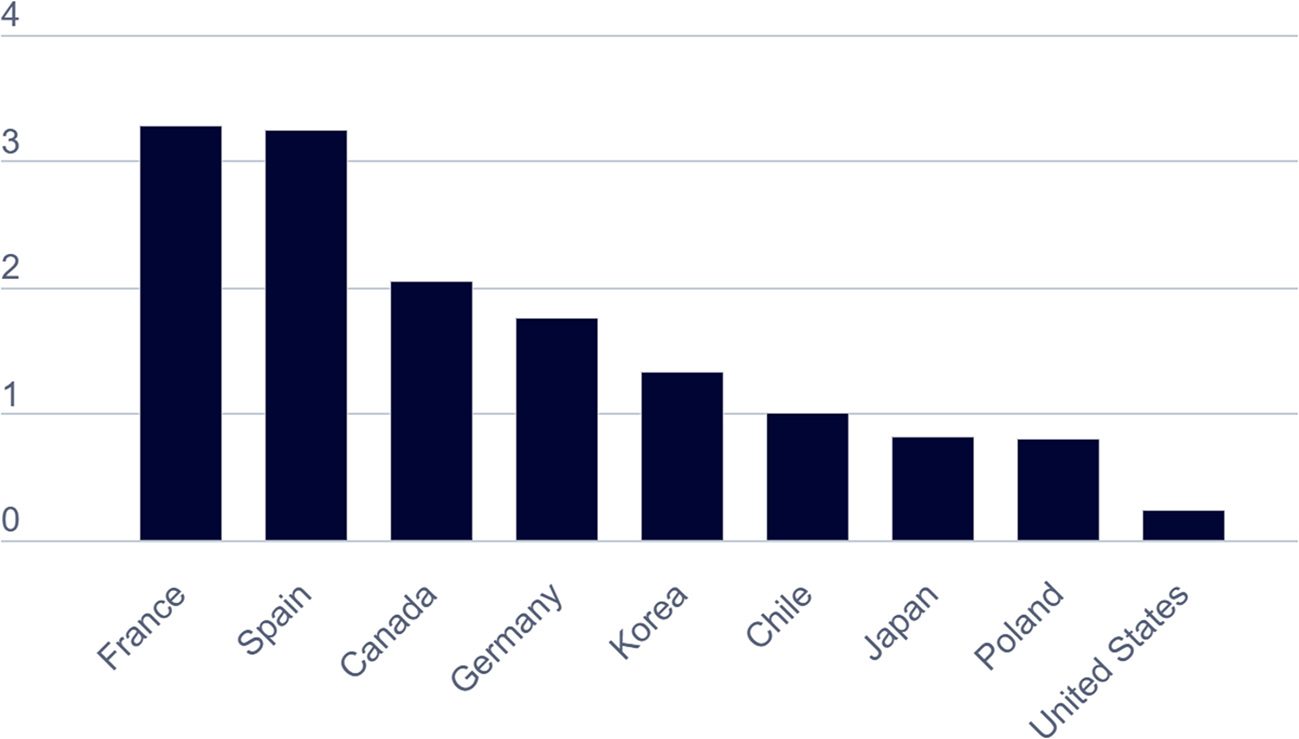
The existing mechanisms for supporting the unemployed in the USA are insufficient to cushion economic shocks. In response to industrial mutations, many OECD countries are devoting significant resources to workforce transition programs. As Figure 1 shows, the United States is clearly lagging behind. It is true that the US government introduced the Trade Adjustment Assistance (TAA) for Workers Program as early as the 1960s.Footnote 49 This instrument encompassed retraining and job search programs, but the results fell short of expectations, mainly due to a lack of funds. A studyFootnote 50 has shown that the capacity of the TAA to respond to trade shocks has declined markedly since the 1990s, i.e. during the hyperglobalization phase. Regions where the TAA was least responsive were more likely to vote for Donald Trump and thus favor a protectionist agenda. The TAA expired in 2022 and a fresh look is needed.
Public spending on labour markets % of GDP, Public employment services and administration, 2021.

So, what can be done for US deprived communities if the social shock absorbers widespread in the European Union and Canada are not available? In the absence of a nationwide adequate solution, place-based support and workforce transition programmes focused on the most affected geographical areas would provide welcome relief.Footnote 51 A complementary solution may consist of the implementation of an industrial policy targeted at disadvantaged communities and regions. A variety of instruments adapted to the circumstances would take into account, as far as possible, the interests of foreign partners in order to prevent trade conflicts. For example, it is justified to support and/or protect sectors where there is a real national security problem due to an excessive geographical concentration of production. This is the case for semiconductors in East Asia.
Finally, WTO rules need to be reformed to minimize the adverse effects of industrial policies, while identifying the situations and conditions in which state intervention would be authorized.Footnote 52 The rules governing the corrective tariff measures allowed by the WTO (including countervailing or anti-dumping duties) should also be revised to suit an environment where different economic systems coexist.
An initiative of this scale can only succeed if the main protagonists are prepared to engage in meaningful cooperation. The success of the undertaking would depend, among other things, on concrete steps from China aimed at disciplining state aids and effectively stimulating domestic consumption in order to absorb production surpluses. This issue is the subject of intense debate and falls outside the scope of this article. We will simply point out that it is not necessary to wage an all-out trade war in order to pursue a workable industrial policy.