Introduction
Little is known about how children's outcomes are affected when their mothers suffer from mental illness severe enough to warrant hospitalisation. This neglect is surprising, given that mothers with severe mental illness (SMI) are by no means a negligible population (McGrath et al. Reference McGrath, Hearle, Jenner, Plant, Drummond and Barkla1999) and that maternal depression and anxiety impact negatively on a wide range of child outcomes (Murray et al. Reference Murray, Sinclair, Cooper, Ducournau and Turner1999; O'Connor et al. Reference O'Connor, Heron, Golding, Beveridge and Glover2002; Hay et al. Reference Hay, Pawlby, Waters and Sharp2008; Pawlby et al. Reference Pawlby, Hay, Sharp, Waters and O'Keane2009). We know that SMI in the parent conveys the greatest risk for the child developing SMI (Cannon et al. Reference Cannon, Caspi, Moffitt, Harrington, Taylor, Murray and Poulton2002), but beyond interpreting such intergenerational transfer as evidence for genetic influence, few studies have addressed other potential mechanisms via which parental mental illness may affect children's development. In particular, research has largely neglected the question of how maternal SMI relates to the quality of infant–mother interaction.
Although schizophrenia has been linked to poor parenting outcomes (Howard et al. Reference Howard, Thornicroft, Salmon and Appleby2004; Abel et al. Reference Abel, Webb, Salmon, Wan and Appleby2005), such conclusions have typically been based on clinician- or carer-rated measures of parenting ability or evidence of social services intervention. Among studies involving ratings of videotaped interactions between infants and mothers with SMI made by observers unaware of maternal diagnosis, two have shown that mothers with schizophrenia are responsive and affectionate to their infants (Schachter et al. Reference Schachter, Elmer, Ragin and Wimberley1977; Sameroff et al. Reference Sameroff, Seifer and Zax1982). Others (Riordan et al. Reference Riordan, Appleby and Faragher1999; Wan et al. Reference Wan, Salmon, Riordan, Appleby, Webb and Abel2007) have found that mothers with schizophrenia are less responsive and sensitive, and more remote, intrusive and self-absorbed than their counterparts with affective disorders. One reason for the equivocal nature of these findings may be the use of global ratings scales to assess interactional quality. Recent studies (Wan et al. Reference Wan, Penketh, Salmon and Abel2008a, Reference Wan, Warren, Salmon and Abelb) involving more specific measures of interactional behaviour continue to demonstrate that, compared with mothers with affective disorders, mothers with schizophrenia are less positively responsive and their speech less infant-directed.
One weakness of previous studies has been the absence of healthy comparison groups, making it impossible to establish whether clinical-group behaviours differed from expected behaviours in healthy participants. Pawlby et al. (Reference Pawlby, Marks, Clarke, Best, Weir and O'Keane2005) included a healthy comparison group in studying in-patient mothers with SMI, where videotaped interactions were rated by diagnosis-naïve researchers using the Care Index (Crittenden, Reference Crittenden2004). Compared with a group of healthy dyads, mothers with schizophrenia or postpartum psychosis were less sensitive and responsive to their babies on admission, but on discharge there were no differences (Pawlby et al. Reference Pawlby, Marks, Clarke, Best, Weir and O'Keane2005; Pawlby & Fernyhough, Reference Pawlby, Fernyhough, Svanberg and Barlow2009). However, this study still relied on global rating scales, making it difficult to identify particular interactional behaviours that mothers with SMI might find difficult.
One relevant facet of early infant–mother interaction is mind-mindedness (Meins, Reference Meins1997), operationalised as caregivers' ability to ‘read’ their infants' internal states (Meins et al. Reference Meins, Fernyhough, Fradley and Tuckey2001; Meins & Fernyhough, Reference Meins and Fernyhough2006). Meins distinguished between appropriate mind-related comments indexing the caregiver's accurate reading of the infant's thoughts or feelings (e.g. commenting that the infant is fascinated by a toy if he/she is gazing intently at it for a period of time), and non-attuned mind-related comments indicating a misinterpretation of the infant's internal states (e.g. stating that the infant does not want a toy while he/she is still actively engaged in playing with it). Caregiver mind-mindedness in the first year of life has been found to predict infant–caregiver attachment security (Meins et al. Reference Meins, Fernyhough, Fradley and Tuckey2001; Lundy, Reference Lundy2003; Arnott & Meins, Reference Arnott and Meins2007) and children's theory of mind abilities at age 4 years (Meins et al. Reference Meins, Fernyhough, Wainwright, Das Gupta, Fradley and Tuckey2002, Reference Meins, Fernyhough, Wainwright, Clark-Carter, Das Gupta, Fradley and Tuckey2003).
With regard to depressive illness, key features such as social withdrawal, impaired concentration, fatigue and irritability are likely to prevent caregivers from ‘tuning in’ to their infants' internal states and engaging in mind-minded discourse. In support of this suggestion, Murray et al. (Reference Murray, Kempton, Woolgar and Hooper1993) reported that, although depression had no effect on the complexity or syntax of mothers' language during face-to-face interactions with their 2-month-olds, depressed mothers were less likely to talk about what the infant was experiencing and to assign agency to the infant's behaviour.
Cognitive deficits associated with schizophrenia may also impact negatively on caregivers' mind-mindedness. For example, patients with schizophrenia have been reported to score lower than healthy controls on theory of mind tasks, suggesting a deficit in their ability to infer people's thoughts and intentions from their behaviour (Corcoran et al. Reference Corcoran, Mercer and Frith1995). These deficits may carry over into how individuals with schizophrenia interact with their infants, leading one to predict low levels of mind-mindedness in schizophrenia.
The present study's first aim was to investigate how different types of SMI impact on infant–mother interaction and whether such interactions in mothers with SMI differ from those observed in healthy dyads. We hypothesized that, compared with healthy women, mothers with SMI would demonstrate lower levels of mind-mindedness, in terms of (1) few appropriate comments about the infant's internal states and (2) high levels of misinterpretations of the infant's thoughts and feelings, and that they would also be (3) less responsive and (4) more intrusive. Differences among mothers with different diagnoses were also explored, although no directional hypotheses were made.
Examining infant–mother interaction in an in-patient context also allows investigation of interactional changes as the mother's mental health improves. In a study of in-patient mothers with schizophrenia, Snellen et al. (Reference Snellen, Mack and Trauer1999) found that an improvement in maternal psychotic symptomatology was associated with an improvement in the quality of infant–mother interaction. Accordingly, we investigated changes in interactional behaviour between admission and discharge to a residential mother and baby unit (MBU), hypothesizing (5) that levels of mind-mindedness and responsiveness would increase between admission and discharge, regardless of diagnosis.
Method
Participants
Interactions in 99 infant–mother dyads were observed. Mothers in 50 of the dyads (60% boys; 42% first born) were a representative sample of in-patients on a MBU. They were observed on two occasions (within 1 week of admission when they were unwell and shortly before discharge). The MBU is a 12-bedded in-patient ward where mothers suffering from a severe episode of psychiatric illness following childbirth are admitted with their babies (aged 0–52 weeks) for treatment. On admission, clinical staff assess the level of risk posed by the mother to the child and provide appropriate support in caring for the baby. In addition to participating more in the care of their baby as their health improves, mothers are supported in developing their relationship with their babies through video recordings of infant–mother interaction, with individually tailored feedback with a developmental psychologist. All participants were discharged from the MBU with their baby after a further videotaped interaction was observed and an assessment by clinicians confirmed that the mother was well enough to return home under the care of the community psychiatric team.
DSM-IV diagnoses (APA, 1994) were given retrospectively to each mother by a consultant perinatal psychiatrist (G.S.), based on ICD-10 diagnoses and details from the discharge summaries. Mothers were then assigned to one of three diagnostic groupings based on symptom profile: (1) schizophrenia (DSM-IV codes: 295.30, n=14; 295.20, n=1); (2) depressive mood disorders with or without psychosis, ‘depression group’ (296.20, n=7; 296.23, n=1; 296.24, n=2; 296.30, n=2; 296.33, n=5; 296.34, n=1; 296.54, n=2; 298.90, n=3); (3) mood disorders where mania was the predominant feature, with or without psychosis, ‘mania group’ (296.41, n=1; 296.60, n=4; 298.90, n=7).
Of 121 admissions to the MBU over a 2-year period, 82 were eligible to be included in the study. Reasons for exclusion, but not from participating in the video feedback treatment, were: (a) prophylactic admission; (b) diagnosis other than the three diagnostic groupings selected; (c) mother's transfer to an acute ward without her baby; (d) admission for a parenting assessment; (e) baby over 12 months on discharge; (f) use of a language other than English in the interaction session.
Of the 82 eligible mothers and babies, 42 completed videos on admission and discharge, 18 completed one video only and 22 did not complete any videos. Among mothers with videos completed on admission and discharge, seven had a diagnosis of schizophrenia, 23 had depressive mood disorders with or without psychosis and 12 had mood disorders where mania was the predominant feature, with or without psychosis. Participation in both video sessions on admission and discharge did not relate to diagnostic status, suggesting representativeness of the sample. However, the study participants had longer admissions to the ward (mean=13.31 weeks, s.d.=8.07) compared with those not completing two video sessions (mean=6.25, s.d.=5.04), t (69.27, equal variances unassumed)=4.78, p<0.001, suggesting that they may have experienced more severe episodes of illness.
To increase the number of participants with a schizophrenia diagnosis, we included the next eight consecutive admissions of mothers with schizophrenia with two videotaped sessions on admission and discharge. There were no differences in the two groups of mothers with schizophrenia in maternal age, social class, ethnicity, infant gender, infant age at admission video or discharge video or in duration of MBU stay.
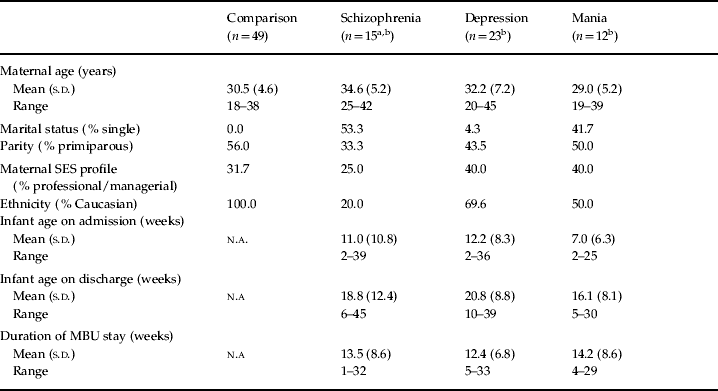
Fifty percent of the women were Caucasian, 34% were Black/Black British, 16% Asian/Asian British and 2% Latin American. Mothers with schizophrenia were less likely to be Caucasian than those in the other two diagnostic groups. Mothers in the depression group were more likely to be married/cohabiting than those in the other two diagnostic groups. Mean infant age at admission video was 10.6 weeks, s.d.=8.8, range 2–39 and at discharge video 19.1 weeks, s.d.=9.8, range 5–45. Mean length of admission was 13.2 weeks, s.d.=7.7, range 1–33. No differences obtained between diagnostic groups on any of these variables (Table 1).
Participant characteristics across diagnostic grouping

MBU, Mother and baby unit.
a For maternal age n=14.
b For socio-economic status (SES) profile group n=12 for schizophrenia, 20 for depression and 10 for mania.
The remaining 49 dyads (53% boys; 56% first born) were drawn from a sample recruited via local healthcare professionals on to a separate longitudinal study of mind-mindedness and infant–caregiver interaction in healthy mothers. Mothers were told that the study concerned individual differences in early infant–mother interaction and that the data from the whole group may be used as a comparison for separate samples of mothers who were experiencing mental health difficulties. Exclusion criteria for mothers included current treatment for a psychiatric condition or a history of mental illness. The age, parity and socio-economic status profiles of comparison group mothers were comparable with those of MBU mothers (Table 1), but all were Caucasian and married/cohabiting. Comparison dyads were observed when infants were aged 12 weeks.
Full ethical approval was granted for both studies. Informed written consent was obtained for the recordings of the play sessions to be used for research and all procedures were conducted in accordance with British Psychological Society ethical guidelines. Mothers with SMI were made aware that they could withdraw at any time without implications for their treatment.
Procedure
Mothers were invited to make 5-min video recordings of an unstructured play session with their baby. In MBU mothers, this was during the first week of admission or when they were able to give informed consent, and again a few days before discharge following clinical recovery. Video recordings for both clinical and comparison groups were made in specially designed laboratory settings. Infants were seated in a baby seat with mothers facing them. No toys were provided. For the dyads observed in the MBU, a mirror provided the camera with a full view of the mother's face. For the comparison dyads, split-screen video recording was used. Mothers were instructed to interact with their infants as they normally would.
Mind-mindedness
Interactions were transcribed verbatim and mind-mindedness was coded from transcripts in conjunction with the videotapes using Meins & Fernyhough's (Reference Meins and Fernyhough2006) scheme. Each comment containing an internal state term pertaining to the infant was coded dichotomously as either appropriate or non-attuned. Appropriate mind-related comments were coded if: (a) the coder agreed with the mother's interpretation of the infant's internal state; (b) the comment linked the infant's current activity with similar events in the past or future; (c) the comment served to clarify how to proceed if there was a lull in the interaction; or (d) the mother voiced (using the first person) what the infant might say if he/she could speak (e.g. ‘What are you doing, Mummy?’). A coding of non-attuned mind-related comments was made if: (a) the coder believed the mother was misinterpreting her infant's internal state; (b) the comment referred to a past or future event that had no obvious relation to the infant's current activity; (c) the mother asked what the infant wanted to do or commented that the infant wanted or preferred a different object or activity, when the infant was already actively engaged in an activity or was showing a clear preference for a particular object; or (d) the referent of the mother's comment was not clear. Mothers received scores for appropriate mind-related comments and non-attuned mind-related comments expressed as a proportion of the total number of comments produced during the interaction.
Maternal responsiveness
In addition to coding the interactions for appropriate and non-attuned mind-related comments, four further dimensions of maternal behaviour were coded: (1) mothers' response to change in infant's direction of gaze (by moving her eyes or head to follow the infant's gaze or commenting on what the infant may be looking at); (2) mother seeks infant's attention (by calling the infant's name, rapidly moving her face to be in the infant's line of gaze, clapping hands or snapping fingers to attract attention); (3) significant pauses (>3 s) in the interaction; (4) mother touches infant. High scores for (2) and (4) were regarded to index maternal intrusiveness. Scores for all categories of responsiveness were expressed as frequencies.
Infant behaviours
In order to control for the possibility that group differences in infant behaviour could underlie any observed differences in maternal behaviour across diagnostic groups, two types of infant behaviour were coded: (a) changes in gaze direction (infant changes focus of gaze by moving eyes or head); (b) gazes to mother. Both categories of infant behaviour were expressed as frequency scores.
Inter-rater reliability
Videotapes were coded by two independent trained raters who were completely unaware of the study's hypotheses and of the fact that some mothers had a diagnosed mental illness. A randomly selected 20% of interactions were coded by both raters for inter-rater agreement. Inter-rater reliabilities for the maternal responsiveness and infant behaviour measures were calculated as intra-class correlations (ICC). For maternal response to infant direction of gaze, ICC=0.89; for maternal attention-seeking, ICC=0.95; for significant pauses, ICC=0.99, for mother touching infant, ICC=0.95. For infant changes in gaze, ICC=0.99; for infant gazes to mother, ICC=0.95.
Inter-rater reliability for coding mind-related comments dichotomously as appropriate or non-attuned was κ=0.80.
Results
Maternal diagnosis and interactional behaviour at admission
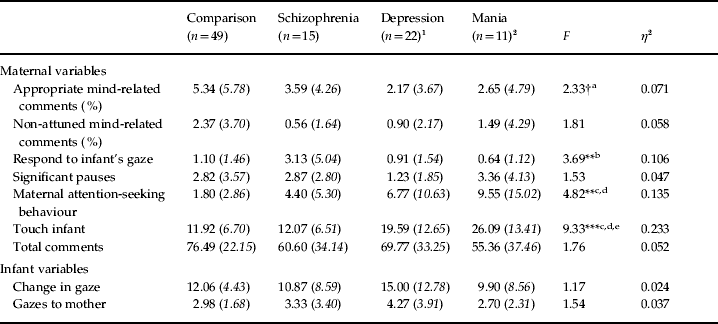
Infant gender and maternal ethnicity were both unrelated to all maternal and infant behaviour measures and are thus not considered further. Relations between mothers' diagnostic category and maternal behaviours at admission were explored in a series of one-way analyses of covariance (ANCOVA) with infant age added as a covariate. Significant main effects and post-hoc pairwise comparisons are indicated in Table 2.
Mean scores for mother- and infant-centred variables at admission, by mothers' diagnostic group

s.d. are shown in italics.
F values are calculated with infant age covaried; apost-hoc comparison indicated a trend (p=0.075) for comparison group mothers to score more highly than the depression group; bpost-hoc comparison indicated a trend (p=0.085) for the schizophrenia group to score more highly than the comparison group; cpost-hoc comparison indicated that the depression group scored more highly than the comparison group; dpost-hoc comparison indicated that the mania group scored more highly than the comparison group; epost-hoc comparison indicated that the mania group scored more highly than the schizophrenia group.
† p=0.079, ** p<0.01, *** p<0.001.
1 The sound quality of the admission video clip of one participant was not adequate for transcription.
2 There was no sound recorded on the admission video clip of one participant.
The main effect of diagnostic category on mothers' scores for appropriate mind-related comments approached significance (p=0.079), with a medium to large effect (Cohen, Reference Cohen1988) for this relation. Post-hoc tests showed a trend (p=0.075) for mothers in the depressed group to be less likely to comment appropriately on their infants' internal states than mothers in the healthy comparison group.
For the main effect of maternal diagnosis on mothers' response to infants' gaze, the ANCOVA was repeated with infants' number of gaze changes as an additional covariate. The effect of diagnostic category remained significant when infants' gaze changes were controlled for [F(3, 90)=3.81, p<0.025], suggesting that group differences were not an artefact of group differences in gaze changes. The main effect of diagnostic category on maternal attention-seeking behaviours also remained when infant gazes to mother were added as an additional covariate [F(3, 90)=4.42, p<0.01]. There were no group differences in infant behaviours (see Table 2).
Maternal diagnosis and interactional behaviour at discharge
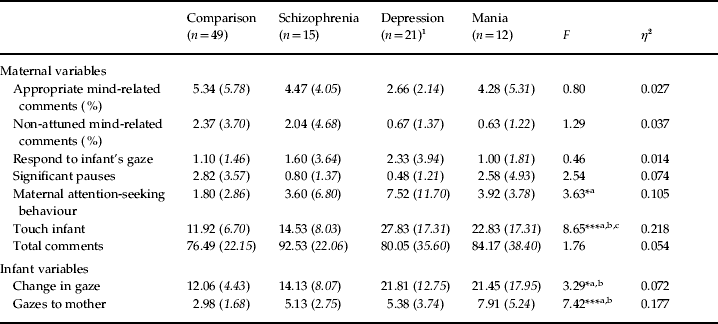
A series of ANCOVAs compared data from the clinical groups at discharge with those from the comparison group (recall that the comparison group were observed only once). Infant age at observation was added as a covariate. Significant main effects and post-hoc pairwise comparisons are shown in Table 3. The main effect of diagnostic category on maternal attention-seeking behaviours remained when infant gazes to mother were added as an additional covariate [F(3, 90)=3.28, p<0.05].
Mean scores for mother- and infant-centred variables at discharge, by mothers' diagnostic group

Comparison group dyads were observed only once; s.d. are shown in italics.
F values are calculated with infant age covaried; apost-hoc comparison indicated that the depression group scored more highly than the comparison group; bpost-hoc comparison indicated that the mania group scored more highly than comparison group; cpost-hoc comparison indicated that the depressed group scored more highly than the schizophrenia group.
* p<0.05, ** p<0.005, *** p<0.001.
1 Two participants spoke to their babies in a non-English language at discharge.
Changes in infant–mother interaction between admission and discharge
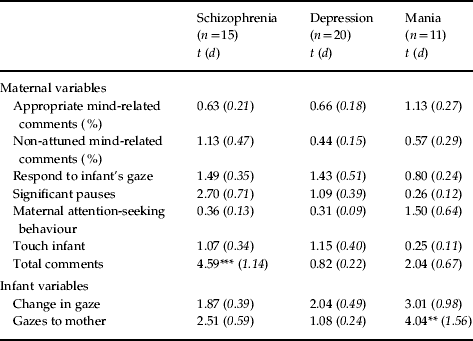
Changes in both maternal and infant behaviours between admission and discharge were investigated using paired t tests. Changes over time are reported separately for each of the three clinical groups in Table 4. Alpha was adjusted to 0.005 (0.05/11) for multiple comparisons. Comparing behaviours at admission and discharge for the schizophrenia group, mothers talked more to their infants at discharge. For the depressed group, there were no significant differences between admission and discharge for any of the maternal or infant variables. For the mania group, there were no significant changes in maternal behaviour over time, but infants were more likely to look at the mother at discharge compared with admission.
Summary of paired t tests comparing scores at admission and discharge for the three clinical groups

** p<0.005; *** p<0.001.
Discussion
Our main aim was to investigate the quality of infant–mother interaction, with particular reference to the mother's ability to ‘read’ her baby's internal states, among mothers with SMI, and to compare this with the quality of interaction observed in psychiatrically healthy mothers. A secondary aim was to investigate how infant–mother interaction in dyads where the mother was suffering from SMI changed over the course of treatment in a residential MBU.
On admission to the MBU, there were relatively few differences among mothers in the schizophrenia, depression and mania groups as indexed by the measures used here. Mothers in the clinical groups differed on only one of the seven indices of maternal interactional behaviour, with mothers in the mania group touching their infants more than did mothers in the schizophrenia group.
More differences emerged when the clinical groups' admission data were compared with those of the healthy comparison group. In answer to Hypothesis 1, there was a trend for depressed mothers to be less likely to comment appropriately on their infants' thoughts and feelings, with a medium to large effect (Cohen, Reference Cohen1988) for this relation, although this trend was observed only on admission and there were no group differences in non-attuned comments on infants' internal states (Hypothesis 2). Contrary to expectations, mothers in the schizophrenia group behaved in ways most similar to those observed in the comparison group (Hypothesis 3). In answer to Hypothesis 4, the behaviour of mothers in both the depression and mania groups was more intrusive (indexed by higher levels of attention-seeking and touching the infant) than that of comparison-group mothers both on admission and discharge. While the increased rates of intrusive behaviours in the depressed and mania groups are in line with previous findings of reduced sensitivity (Murray et al. Reference Murray, Fiori-Cowley, Hooper and Cooper1996) and heightened negative interactional behaviours (Cohn et al. Reference Cohn, Campbell, Matias and Hopkins1990) in depressed mothers, our findings provide scant support for the hypothesized lower levels of mind-mindedness in mothers with SMI and suggest that SMI does not automatically mean that mothers will be more likely to misinterpret their infants' internal states.
The fact that the mind-mindedness coding scheme was developed to assess infant–mother interaction in psychologically healthy mothers may be one reason why we failed to find differences in the clinical groups. Anecdotal evidence from the present study suggested that mothers with SMI may have demonstrated non-attunement to their infants' internal states (lower levels of mind-mindedness) in ways that were not picked up by the current coding scheme. For example, one of the mothers with SMI commented in an irritated voice that her infant ‘was just fascinated with the strap’ on the baby seat, because the child continued to ignore her bids for attention while playing with the strap. Although this mother clearly recognized the focus of her child's current interest (and was thus making an appropriate mind-related comment), her irritated tone of voice implied that accurately reading her infant's mind could not help her to improve the quality of the interaction. Classifying mind-related comments in terms of their emotional tone, and not merely their appropriateness, suggests interesting possibilities for adapting the mind-mindedness coding scheme for use with clinical populations.
Schizophrenia-group mothers were the only clinical group to show a change in interactional behaviour between admission and discharge (Hypothesis 5) with mothers talking more to their infants at discharge. Note that this change resulted in schizophrenia-group mothers' scores on discharge being more dissimilar to those of the comparison group than on admission. Present findings thus highlight the importance of determining normative levels of interactional behaviour before concluding about SMI mothers' difficulties in interacting with their babies, or evaluating any significant changes in behaviour over the course of treatment.
Our results on the behaviour of the mothers in the schizophrenia group stand in contrast to the deficits in maternal responsiveness reported by Wan et al. (Reference Wan, Salmon, Riordan, Appleby, Webb and Abel2007, Reference Wan, Penketh, Salmon and Abel2008a, Reference Wan, Warren, Salmon and Abelb). Rather, our findings are in line with those of Schachter et al. (Reference Schachter, Elmer, Ragin and Wimberley1977) and Sameroff et al. (Reference Sameroff, Seifer and Zax1982), who concluded that mothers with schizophrenia were not impaired in their ability to respond sensitively and appropriately to their infants. Pawlby & Fernyhough (Reference Pawlby, Fernyhough, Svanberg and Barlow2009) also showed that, on discharge from in-patient care, mothers with schizophrenia were as sensitive in their interactions with their babies as were healthy mothers with no psychiatric history.
Limitations
One limitation was that the healthy comparison and clinical groups were drawn from areas of the UK with different ethnic and marital profiles, resulting in no ethnic diversity and no single mothers in the comparison group. Another limitation was that comparison-group videos were made only at one time point, when infants were aged 12 weeks. We did, however, control for infant age in the analyses and there were no effects of ethnicity on our measures. Although both comparison and clinical groups were filmed in an unfamiliar laboratory setting, the clinical group had the concomitant stresses of being observed while unwell (although our impression was that MBU mothers were comfortable with the procedure). This additional stress on the MBU mothers makes the fact that we found comparatively few group differences all the more striking. Limitations in the sampling procedure include lack of precise detail on why eligible mothers did not participate, although we did show that participants were representative of patients admitted to the MBU. There was also no formal evaluation of the efficacy of the video-based feedback on the quality of mother–infant interaction provided to the MBU mothers, which was individually tailored and thus varied between dyads
Discharge videos were not made of mothers who underwent the painful procedure of being discharged or transferred from the MBU without their babies. Although this is a rare occurrence, it does mean that the mothers who did not make sufficient recovery to care for their babies were not included in the study. Future research should therefore investigate whether mothers who lose custody of their infants have different mind-mindedness and responsiveness profiles from those observed here. Another limitation is the lack of a formal measure assessing mothers' symptoms and general functioning on admission or on discharge. Future studies might ask how individual symptoms or clusters of symptoms, including measures of their severity, might impact on a mother's interaction with her baby.
Conclusion
The main implication of this study is that comparisons with healthy controls show that mothers with SMI, particularly those with a diagnosis of schizophrenia, are able to be mind-minded and responsive when interacting with their babies. It is of crucial importance, therefore, to gain knowledge of normative levels of interactional behaviour and not assume, as has often been the case in studies only comparing diagnostic groups, that higher frequencies of mother and infant behaviours (e.g. infant-directed speech) are necessarily optimal. This knowledge can then be used to inform any intervention aimed at improving the quality of infant–mother interaction in mothers with different types of mental illness.
Acknowledgements
This study was supported by ESRC grant reference RES-000-22-0395. The authors thank Alexandra Hearn and Beth Liddle for coding the videotaped interactions. Thanks also go to the mothers and babies who have so graciously allowed us to watch the development of their relationships through a very stressful period of their lives.
Declaration of Interest
None.