Introduction
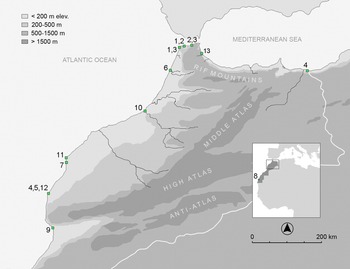
The shoreline of Morocco is over 3,500 km long and borders three dynamic seas: the Mediterranean, the Strait of Gibraltar and the Atlantic. The Rif Mountains line the Mediterranean coast whilst the high Atlas Mountain chain separates the north-western-most region of the African continent from the Sahara. This topography has created an orientation where the fertile Rharb and Saïss plains and the Meseta plateau along the Atlantic coast, north-west of the Atlas, are almost ‘island-like’ (Shaw Reference Shaw2003). These plains are intersected by extensive river systems originating in the Atlas foothills and emptying into the Atlantic and Mediterranean (Figure 1). The history of human settlement and movement in the region has been strongly influenced by this topography: most of the identified archaeological sites are situated throughout the north-west plains and plateaus, and along the coastlines and lower river courses. These locations reflect the maritime-based history of the region's local and external contacts as well as marine resource exploitation.
Overview of previous and current underwater and coastal archaeological surveys and excavations in Morocco: 1. Tangier Bay/Cap Spartel surveys; 2. Tangier Bay/Strait of Gibraltar surveys; 3. Strait of Gibraltar/Cap Spartel surveys; 4. Northern Morocco coastal surveys (Saîda to Essaouira); 5. Essaouira (Mogador Island) survey; 6. Oued Loukkos Survey; 7. Safi wreck; 8. Kaiser Wilhelm der Grosse wreck, Dakhla (see inset map); 9. Agadir wreck; 10. CBDAMM Project, Oued Bouregreg; 11. Cap Cantin survey; 12. Essaouira beach survey; 13. Sidi Driss/Sidi Abdeselam del Behar. The MarEA Project is documenting the entire coastline. (Map: A. Trakadas)

Many of the region's prehistoric sites, beginning with the Middle and Upper Palaeolithic (with a beginning sequence of human presence now dated to 125 ka), are situated near present and extinct river courses, lagoons and lakes as well as the coast, which ensured access to nearby marine and riverine fauna. It is very possible that early coastal sites have been submerged by a relative rise in sea level, although this has not yet been investigated (Barton et al. Reference Barton, Bouzouggar, Collcutt, Schwenninger and Clark-Balzan2009; Mikdad and Eiwanger Reference Mikdad and Eiwanger2000, 110–129; Ramos Muñoz and Cantillo Duarte Reference Ramos Muñoz, Cantillo Duarte and Bernal Casasola2011, 21–30). The continuity of coastal contact in the region is demonstrated through the presence of Phoenician, so-called ‘Punico-Mauretanian’ cultural sites, Roman and Late Roman cities and settlements, especially in the north-west, from the late eighth century BC to sixth–seventh centuries AD (Trakadas Reference Trakadas2018, 77–80, 94–98). Beginning in the eighth century AD, the emerging Islamic dynasties established inland settlements whilst a few strategic coastal headlands continued to be occupied (Boone et al. Reference Boone, Myers and Redman1990; Trakadas Reference Trakadas, Christides, Monferrer-Sala and Papadopoulos2009b). Borj fortifications began to be built on coastal promontories in the eleventh century, some overlooking river mouths that served as natural anchorages (such as at Larache and Rabat). By the fifteenth century, coastal fortifications began to be built near the mouths of the rivers by Portuguese, Spanish, Dutch, Danish and English missions (Cressier et al. Reference Cressier, Naïmi, Touri and Desanges1992). These developed even further in the following centuries, with jetties and breakwaters altering points along the coastline (Erbati and Trakadas Reference Erbati and Trakadas2008, 20–26; Trakadas and Claesson Reference Trakadas and Claesson2001, 4–7).
Despite the distribution of sites in Morocco along the present coast and lower river courses, the country's maritime past has been relatively under-investigated compared with some African and Mediterranean countries (Trakadas Reference Trakadas2023). However, within the last two decades, underwater and coastal archaeological surveys and excavations have taken place, revealing the types and extent of the cultural heritage. In this paper, these are referred to as ‘maritime cultural heritage’ (MCH) resources. This term is preferred instead of the often UNESCO-applied ‘underwater cultural heritage’ (UCH), as we include cultural heritage both on the coastline and under water (see Trakadas et al. Reference Trakadas, Firth, Gregory, Elkin, Guerin, Henderson, Kimura, Scott-Ireton, Shashoua, Underwood and Viduka2019; Ounanian et al. Reference Ounanian, van Tatenhove, Jahn Hansen, Delaney, Bohnstedt, Azzopardi, Flannery, Toonen, Kenter, Ferguson, Kraan, Vegas Macias, Lamers, Pita, Ferreira da Silva, Albuquerque, Alves, Mylona and Frangoudes2021). While we acknowledge the intangible aspects of MCH, this paper specifically focuses on the tangible material remains of MCH.
Initially the focus of these archaeological investigations in Morocco was the Tangier Peninsula, and more recently extended along the Atlantic coast (bold indicates the projects under the direction of the authors) (see Figure 1):
1. Tangier Bay/Cap Spartel surveys (1963–64): recovery of pre-Roman and Roman artefacts from ‘shipwrecks’ (Ponsich Reference Ponsich1964).
2. Tangier Bay/Strait of Gibraltar surveys (1999): underwater investigation to identify Ponsich's and other's ‘shipwreck’ sites and isolated finds (Trakadas and Claesson Reference Trakadas and Claesson2001).
3. Strait of Gibraltar / Cap Spartel surveys (2002–03): underwater investigation and limited coastal survey of two main sites to try to re-locate Ponsich's and other's previously reported ‘shipwreck’ sites and document a multi-period anchorage discovered during the survey (Erbati and Trakadas Reference Erbati and Trakadas2008).
4. Northern Morocco coastal surveys (Saîda to Essaouira) (2005, 2007–09): coastal walk-over surveys documenting specific points of land–sea interface for anchoring, ports, fishing activities (Trakadas Reference Trakadas2018).
5. Essaouira (Mogador Island) survey (2009): brief underwater remote-sensing survey to determine if a shipwreck was associated with amphora recently recovered by fishermen (unpublished; D. Marzoli, pers. com.).
6. Oued Loukkos Survey (2009–15): riverine/coastal landscape survey (described below).
7. Safi wreck (2013, 2021): location and identification of a historical shipwreck (unpublished).
8. Kaiser Wilhelm der Grosse wreck, Dakhla (2013): underwater visual investigation into the condition of the historical shipwreck (unpublished).
9. Agadir wreck (2014): underwater visual investigation into the condition of the historical shipwreck (unpublished).
10. CBDAMM Project, Oued Bouregreg (2016–18): riverine/coastal landscape survey (described below).
11. Cap Cantin survey (2017): underwater visual investigation of geological formations and possible cultural remains (unpublished).
12. Essaouira beach survey (2018–): documentation and mitigation of a historical shipwreck in the intertidal zone (Trakadas and Karra Reference Trakadas and Karra2022).
13. MarEA Project (entire coast) (2020–): creation of database for managing underwater and coastal cultural heritage (described below).
Findings of the above-listed investigations include the remains of Roman ships, historical naval vessels, multi-period anchorages, historical harbour structures, cannon placements and other types of fortifications, fish-salting sites and other types of marine animal processing sites, bridges and coastal fishing traps (Trakadas Reference Trakadas2009a, Reference Trakadas2012a, Reference Trakadas2012b, Reference Trakadas2015; Trakadas and Karra Reference Trakadas and Karra2022).
The aim of these previous archaeological investigations was initially research-based, to locate and document the archaeological resources present in the region. However, it is through these projects that we, as researchers from the national heritage agency and external research institutions, have been made aware of the threats and challenges to MCH. As a result, these projects under our direction have gradually changed foci, from being solely research-based to including mitigation measures and management recommendations whilst refining applied data-collection methodologies. This approach is unique to the Moroccan context, given the types of cultural resources, the threats to these, the extent of the coastline, the legislation and the people and institutions involved, but has applicability to other countries in the MENA region (Middle East and North Africa), particularly the Maghreb.
This paper will first outline the threats and challenges to these MCH resources and the legal framework in which they are currently managed. Three previous and current projects – the Oued Loukkos Survey, the CBDAMM Project and the MarEA Project – are then presented to stress that an interdisciplinary methodological approach has been key not only to research, but that they also assist in the mitigation approaches developed by the authors, working in cooperation with other national and international institutions.
Threats
Tangible MCH, by its nature and its contexts, is often fragile. This is also the case in Morocco, where the integrity of these types of heritage sites is frequently put at risk by two main threats: natural and anthropogenic.
Natural threats
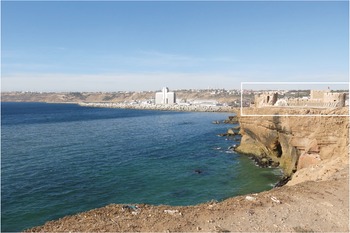
The Mediterranean and the Atlantic coasts of Morocco are undergoing different scales of sea level rise (SLR), caused by global warming. As a result, several coastal historical archaeological sites and prehistoric settlements (caves/shelters/open air) are potentially threatened by total or partial destruction by SLR. This phenomenon is all the more accentuated by storm events and swells, which degrade archaeological sites, or, in some cases, the rocky substrates on which sites and historic buildings have been built (Figure 2). The result is coastal erosion, affecting a variety of geological substrates along the Moroccan littoral (Trakadas Reference Trakadas2023).
In Safi on the Atlantic coast, the Portuguese ‘Chateau du Mer’ (white box) is being impacted by coastal erosion (Photo: A. Karra).

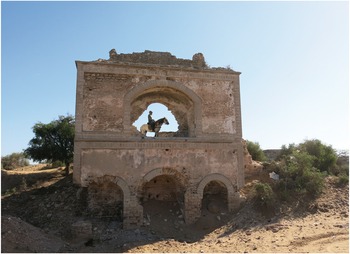
Another issue faced in Morocco is very active desertification, mainly in the semi-arid and arid zones in the central and southern regions. This is the result of a natural process, but also the increase in global temperatures from broader climate change phenomena. Along the coasts, this has resulted in intensive runoff actions that contribute to the degradation of coastal sites and their substrate through erosion. This process has also caused aeolian sand transport that leads to the partial and sometimes complete deposition of sites, and the accretion of coastal sites from offshore sediment transport (Figure 3; Trakadas and Karra Reference Trakadas and Karra2022).
One of the towers of Dar es Soltan, in Essaouira, impacted by aeolian sand transport (Photo: A. Trakadas).

Anthropogenic threats
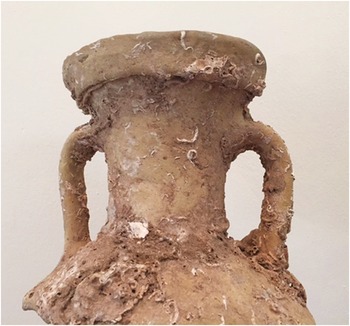
The integrity of Morocco's MCH is no less directly affected by development activities or illegal intrusive practices. For example, fishing, especially deep-sea trawling, can be disastrous to marine biodiversity and proves harmful to the submerged and intertidal MCH. In Morocco, where the seas are extremely rich in natural fish stocks, the practice of bottom trawling remains very active. Trawling with large nets that pass just over the seabed, or are dragged through the seabed, directly contributes to the destruction of shipwrecks and their cargoes as well as their natural context. This destruction has occurred several times along the coast of Morocco. For example, fishing nets recently removed two Roman amphorae from an unknown site off Cap Cantin, located 30 km north of the port city of Safi on the Atlantic coast (Figure 4).
One of the Roman amphorae fragments recovered from the sea near Cap Cantin (Photo: A. Karra).

The construction of ports and their associated facilities, through the preliminary preparations of the seabed and the construction of quays and moles that extend into the sea, causes significant alterations to the coastal and near-shore marine environment by modifying current regimes, coastal morphology and sediment transport. Morocco's ambitious port-construction programme, which includes the development of mega-commercial ports such as Tangier-Med (already built), Nador West Med (in its final construction phase) or Dakhla on the Atlantic (in progress) (Agence Spéciale Tanger Méditerranée 2021). It also involves the enlargement of existing ports, posing a real challenge for certain forms of MCH. This is also problematic as there is no legal requirement for preliminary archaeological pre-disturbance studies, and the Ministry of Culture is not included in carrying out environmental impact assessment studies.
Directly related to the development of ports and riverine navigation is dredging and sediment dumping. The importance of these operations for commercial activities cannot hide their negative impacts on the seabed, affecting all the natural and archaeological potential it contains (Trakadas Reference Trakadas2012b). In the absence of any legislative measure or preventive protection techniques, dredging and dumping will continue to actively play a role in the destruction of shipwrecks and their cargoes, and any other types of submerged cultural sites.
Oil platforms, wind farms and offshore aquaculture facilities are new forms of natural resource exploitation that are booming in Morocco. However, the extant regulations in force do not require any archaeological study prior to their installation, which represents a potential threat to the integrity of submerged sites and shipwrecks – not only through physical damage but potentially through pollution in the case of aquaculture residue and possible oil spills.
For a long time in Morocco archaeological shipwrecks and their cargoes remained devoid of any legal protection. Indeed, the responsible governmental authority, the Ministry of Culture, was completely absent from active engagement, despite the considerable development of underwater activities in the country, both professional and recreational. The sale of amphorae fished out of the coastal waters was a very common practice, particularly in certain coastal towns such as Essaouira, Tangier and Asilah. This has changed somewhat in the last few years, due to awareness and also interventions by Customs officials and legal prosecutions. Although some legislation is present (discussed below), the threats remain real in the absence of a broader legal and institutional framework specifically dedicated to this area.
Legal framework and challenges
The legal protection of MCH in Morocco is focused largely on the tangible remains that lie under water (underwater cultural heritage – UCH). This cultural heritage faces multiple challenges related mainly to the economic and social dynamics that the country experiences. Added to this is the lack of means available for its preservation and enhancement. In the last few decades, there has been considerable growth in underwater activities: the development of techniques for locating underwater sites as well as the growth in the number of associations, diving clubs and professional divers on a national scale. For example, there are hundreds of divers who work seasonally in the collection of seaweed for industrial harvesting needs. This has made archaeological sites more and more accessible, increasing the threat of destruction, looting and commercial exploitation in the absence of awareness raising and rigorous monitoring.
The protection of UCH in Morocco was first based on the few provisions included in Dahir (decree) No. 22-80, relating to the conservation of historical monuments and sites, inscriptions, works of art and antiquity (Dahir No. 1-80-341 of December 25, 1980). This law, which lays down a broad outline of the protection of tangible Moroccan cultural heritage, is mainly oriented towards the protection of terrestrial archaeological heritage. However, Article 45 addresses the issue of prior authorisations for archaeological excavations, particularly in the marine environment while specifying the exclusive fishing zone as being the area of application of this restriction. Although noting the underwater cultural resources, Dahir No. 22-80 therefore remains very insufficient to guarantee significant legal protection.
However, by ratifying the UNESCO 2001 Convention on the Protection of the Underwater Cultural Heritage (through Dahir No. 1-09-138 of December 1, 2011), Morocco placed itself within international jurisdiction levels for protection in this area. The competent authority is working to apply this agreement, specifically by creating a national centre dedicated to the study and conservation of this heritage, the commissioning of which is planned for 2023. This institution will also satisfy Article 22 of the UNESCO 2001 Convention, which requires State Parties to create competent services that will oversee the establishment, maintenance and updating of an inventory of UCH and ensuring its effective protection and enhancement.
Growing urbanisation of the coast is also a challenge to MCH in this zone. Despite the proliferation of town-planning regulations governing the coast, including a law regulating the coast (Loi [law] No. 81-12, promulgated by Dahir No. 1-15-87 of July 16, 2015), the increase in coastal urbanisation, both redevelopment and at new sites, is not stopping. This puts additional pressure on an already fragile coastal and near-shore environment that possesses numerous inventoried historic sites and monuments and certainly some not yet known. This situation is even more accentuated by the development plans for coastal tourism launched by the national government, from the well-known Azure Vision 2010 Plan to that of Vision 2020, which have given rise to several projects. These include tourist attractions on the Mediterranean and Atlantic coasts of Morocco consisting of luxury hotels, residences and marinas (Trakadas Reference Trakadas2012b; Reference Trakadas2023). Despite the positive impact of these projects on the country's sustainable economic development, they constitute a real challenge for all forms of the country's MCH.
Another recent regulation that will also assist in the protection of submerged MCH resources is one that is aimed at limiting trawling in certain Moroccan marine zones along a portion of the Mediterranean coast (Décret [decree] No. 2-20-582 of October 22, 2020). Its expansion to the Atlantic coast would undoubtedly benefit the resources being recovered here (see above).
Despite the extant legislation, there remains a lack of human and material resources to assist in the protection of tangible MCH. The economic and social dynamics experienced by the extensive ca. 3,500 km-long Moroccan coast and its offshore zone require human capacity and a technical system capable of ensuring effective resource protection. While the safeguarding of coastal sites is relatively supported by the network of conservation and inspection of historic monuments, submerged sites suffer from a flagrant lack of human and material resources dedicated to their protection. Currently, the Moroccan marine security services (Maritime Gendarmerie, Royal Navy, and Customs Services) are operational on the ground. The means of scientific research for preventive conservation made available by the supervising department remain occasional and insignificant in view of the importance of the existing potential of the resources.
Mitigation approaches
Although research had been the primary aim of the archaeological fieldwork projects listed in bold in the Introduction, this ceased to be the sole purpose of the most recent projects we conducted. Given the type of coastal environments in which we were conducting these projects (not solely under water or on land, and working within the tidal zone), an interdisciplinary methodology was deemed necessary, not just for research of the bio-cultural heritage context but also for integrated data collection. Additionally, given the locations of these projects – in areas being developed for ports, recreation and general urban growth – the level of anthropogenic and natural threats to Morocco's MCH was clearly increasing and mitigation recommendations were a necessary part of these projects’ outputs.
Interdisciplinary fieldwork-based research: the Oued Loukkos Survey
With the inception of the Oued Loukkos Survey in 2009, a more interdisciplinary approach was taken to investigate a dynamic marine environment around an archaeological site in order to address the research question: identifying the locations of land–sea interface (anchoring, landing, harbour or port facilities) that were used during the occupation of the site of Lixus (see Figure 1). The site, on the Atlantic coast of Morocco, now lies 4 km upriver, on the northern bank of the Oued Loukkos. This project involved archaeological investigations on land, with hydrographic survey of the river, and marine geological investigations on land and in the river.
The aim was to identify material remains of human activity and to reconstruct the past environment in which the activity took place. The approach and collaboration between disciplines from Moroccan and foreign institutions was very positive: partners included Institut National des Sciences de l'Archéologie et du Patrimoine (INSAP, Rabat, Morocco), Scientific Institute, University Mohammed V-Rabat (Morocco), Centre for Maritime Archaeology, University of Southampton (UK), with assistance from colleagues from the Center for Coastal and Ocean Mapping at the University of New Hampshire (USA). Funding was provided by the Society for the Promotion of Roman Studies, the Danish Institute in Damascus and the Morocco Maritime Research Group. Equipment was also kindly provided by L. Huff LLC and Ocean Server LLC.
The findings of the project revealed that when Lixus was first occupied in the ninth century BC, the marine environment was largely lagoonal, providing a sheltered area for ships to anchor and, therefore, probably did not require any built port infrastructure. Gradual infilling of the lagoon occurred, creating a meandering river course by the early medieval period. The present-day salt pans near the site are the result of recent dam projects that have created a largely estuarine downriver environment (Belkhayat et al. Reference Belkhayat, Mhammdi, Trakadas, Huff, Medina, Cunha, Dias, Veríssimo, Duarte, Dinis, Lopes, Bessa and Carmo2018; Trakadas Reference Trakadas, Gawronski, van Holk and Schokkenbroek2017).
Working in the specific setting of the Oued Loukkos also brought to the fore the natural and anthropogenic impacts affecting the cultural heritage in and around Lixus and outlined above: infrastructural development (on land, in the river and along coastal zone), extensive dredging and, to some extent, pollution. As a result, mitigation recommendations became a secondary goal of the project. Later years of fieldwork included pre-disturbance surveys on land to assist and advise on local development programmes for the Ministry of Culture. Internal reports also listed mitigation measures for other proposed activities not just at the archaeological site of Lixus, but also in the surrounding region (Trakadas Reference Trakadas2012a, Reference Trakadas2012b, Reference Trakadas, Gawronski, van Holk and Schokkenbroek2017; Geawhari et al. Reference Geawhari, Huff, Mhammdi, Trakadas and Ammar2012, Reference Geawhari, Huff, Mhammdi, Trakadas and Ammar2014; Trakadas et al. Reference Trakadas, Huff, Mhammdi, Geawhari and Jirari2010, Reference Trakadas, Huff, Mhammdi, Geawhari and Jirari2012, Reference Trakadas, Huff, Mhammdi, Hassini, Geawhari and Belkhayet2015, Reference Trakadas, Hassini, Mhammdi, Huff, Harpster, Geawhari and Belkhayat2016).
Interdisciplinary fieldwork-based research and management strategies: the CBDAMM Project
As a result of the experience gained during the Oued Loukkos Survey, a new collaboration was developed in 2016: the CBDAMM Project (Capacity Building of Data Acquisition Methods) with a view to promoting natural and cultural heritage management practices in Morocco. The focus of the project was the lower reaches of the Oued Bouregreg, from the Atlantic to ca. 12 km upriver (see Figure 1). This area was selected for several reasons. It is home to a large coastal wetland that is exposed to erosion, tsunamis, storm events and impending SLR. The area has a relatively high population density (ca. 1.2 million), with the cities of Rabat (the capital) on the southern ban and Salé on the northern bank. With such density, planned (and informal) urbanisation projects along the riverbanks (marinas, bridges, a national theatre, housing and the highest skyscraper in Africa) are increasing, along with pollution. Within this dynamic situation are extensive archaeological resources (from Homo erectus remains to medieval fortifications), including the medina of Rabat, which was inscribed to the UNESCO World Heritage List in 2012.
The objectives of the CBDAMM project were:
1) Training: Exchange of expertise and training between researchers and students in non-invasive marine sciences data acquisition methods required for impact assessment studies and monitoring.
2) Methodology development: Develop/test a multi-disciplinary data acquisition methodology to evaluate the past and present processes affecting coastal wetlands in the midst of a rapidly growing urban centre.
3) Dissemination: Better inform the implementation of preservation management policies and plans affecting relevant target groups by disseminating the study's resulting methodology.
Based on the results of the Oued Loukkos Survey, an interdisciplinary approach was also applied, and extended to include a broader array of marine sciences: marine geology; maritime archaeology and heritage management; marine biology and toxicology; and hydrography. The project's overarching tenet was that the same non-invasive data acquisition tools are used, but resulting analyses are applied in different ways. The fieldwork/data acquisition also evolved from earlier projects, with a focus on conducting marine science surveys that do not require SCUBA diving (so everyone can participate and at the same time reduce exposure to marine pollution) and building capacity in training in applicable methods, especially for the project's MA- and PhD students.
The project was a partnership between the Maritime Archaeology Programme, Department of History, University of Southern Denmark (Denmark) and the Laboratory of Geophysics and Natural Hazards, Scientific Institute, University Mohammed V-Rabat (Morocco). Researchers, PhD- and MA students partnering in the project were from the Geological Survey of Denmark and Greenland, Moroccan Ministry of Health, Moroccan Ministry of Culture, Department of Bioscience, Aarhus University (Denmark) and Department of Conservation, National Museum of Denmark and L.C. Huff Consultancy (USA). Funding was provided by the Danish Ministry of Foreign Affairs, through the Danish–Arab Partnership Programme. Outputs from the CBDAMM Project included consultations with Moroccan governmental ministries, academic conferences, best-practices pamphlet, teaching curricula, MA- and PhDs theses, as well as academic publications (Trakadas and Mhammdi Reference Trakadas and Mhammdi2018).
The project's findings thus far have identified the gradual infilling of the lower Oued Bouregreg, and, like with the Oued Loukkos, a rather rapid salination of the lower river valley and transition into an estuary due to dam projects in the mid-twentieth century. Pollution, and the presence of shipworm – for the first time identified in these environments – is a factor in the preservation of the historical shipwrecks, as well as oyster farms identified along the river's course.
Management through informed desk-based analyses: the MarEA Project
During the course of these two previous projects, the government of Morocco ratified international regulations: the UNESCO 2001 Convention on the Protection of the UCH in 2011 and the UN Integrated Coastal Zone Management (ICZM) Protocol in 2012 (UNESCO 2017; UNEP/MAP 2005–17; World Bank 2018, 20–21). It also ratified national littoral regulations or ICZM legislation in 2015 (Loi No. 81-12; see above). However, experience over the course of working in the Oued Loukkos and Oued Bouregreg made it clear that the main challenge for the management and protection of cultural resources in Morocco is filling in the existing knowledge gaps. Some studies that might include relevant data are outdated, whilst more recent studies that aim to establish a much-needed baseline assessment of how natural and anthropogenic factors impact tangible maritime cultural heritage resources remain general (Trakadas Reference Trakadas2023; Trakadas and Mhammdi Reference Trakadas and Mhammdi2018; Trakadas et al. Reference Trakadas, Karra, Gregory, Trakadas and Mhammdi2018). More quantitative data are required for enacting impactful local and site-specific mitigative actions.
Therefore, in 2020, the Maritime Endangered Archaeology in the Middle East and North Africa Project (MarEA) Project was initiated in Morocco (MarEA 2020). This is part of a broader project throughout the MENA region, led by the University of Southampton and Ulster University (UK), and funded by the Arcadia Foundation, that applies a multifaceted methodology using environmental and archaeological data and imagery to make condition assessments for coastal and nearshore sites. The data populate the open access database platform of the Endangered Archaeology in the Middle East and North Africa (EAMENA) project hosted by the University of Oxford (EAMENA 2016). This is an extensive database that can be used by managers within Moroccan cultural heritage institutions to assess the status of a site, see past changes and gain insight into future impacts (Andreou et al. Reference Andreou, Blue, Breen, El Safadi, Huigens, Nikolaus, Ortiz-Vazquez and Westley2020; Westley et al. Reference Westley, Andreou, El Safadi, Huigens, Nikolaus, Ortiz-Vazquez, Ray, Smith, Tews, Blue and Breen2023; Trakadas and Karra Reference Trakadas and Karra2022; Karra and Trakadas Reference Karra and Trakadas2022). The specific methods for this desk-based analyses (DBA) and data include:
• Analysis of archaeological data (published results of surveys and excavations) that have, by proxy, noted environmental changes or impacts upon MCH.
• Analysis of results of landscape and marine geological studies that have focused on documenting natural process and long-term geomorphological changes.
• Comparison of the above datasets with imagery that includes:
- photos and postcards
- historical plans and maps
- recent satellite imagery (from the 1960s to the present).
In the case of Morocco, we have been able to add more information to the database due to the past research and fieldwork projects. Additional information includes:
• Conducting brief but repetitive visits, over two decades (since 1999), to archaeological sites and historical structures that have, by proxy, noted impacts MCH;
• Discussing with residents during these visits their observations of change to structures and/or the environment.
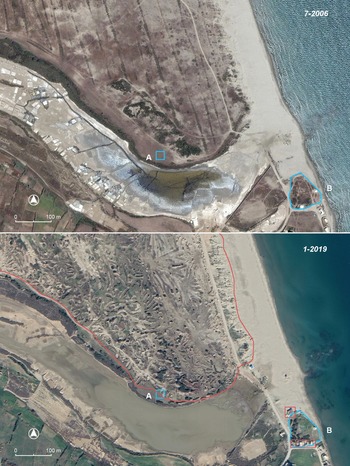
The MarEA Project is ongoing, with the database still being populated. Coverage is complete for the Mediterranean coastline, with large sections of the southern Atlantic coastline also documented. Along the Mediterranean coastline it has been possible to show that some coastal sites have experienced extensive erosion: for example, at Sidi Driss, the foundations of a historical coastal fortification overlying a Phoenician comptoir, occupied between the seventh and the fourth centuries BC, experienced a horizontal loss of over 25 m some time between 2014 and 2016. At the Roman period site of Metrouna and the Punico-Mauretanian/Roman site of Sidi Abdeselam del Behar, at the old silted-up mouth of the Oued Martil, the archaeological sites have been impacted by sand mining and coastal zone development (Figure 5).
An example of the sand mining and development impacting sites along the Mediterranean coast of Morocco at Metrouna (A) and the Punico-Mauretanian/Roman site of Sidi Abdeselam del Behar (B) at the old silted-up mouth of the Oued Martil. The archaeological sites (in blue) have been impacted by sand mining and coastal zone development (in red) (Image: A. Trakadas; Maps data: Google, © 2006, 2019/Maxar Technologies).

Part of the project has focused on the case study of Essaouira, on the mid-Atlantic coast, where recent expansion of the port basin has possibly impacted the nearby beach, where a historic shipwreck has been exposed. This site has been revisited by the authors and documentation of the shipwreck is ongoing. At the same time, discussions are being undertaken with local heritage and city management officials to mitigate the damage to the site but also to protect the public which uses this popular beach (Karra and Trakadas Reference Karra and Trakadas2022).
The population of the MarEA database is ongoing, slated to be completed by the end of 2023. The next phase of the project, in the spring of 2023, is now being discussed, with the main focus being on the activities and findings at Essaouira. (It is important to note that the larger EAMENA Project is also working on the database at interior sites of Morocco).
Concluding remarks
Archaeological research conducted in Morocco over the last two decades has revealed a wealth of diachronic MCH resources. These are distributed along the present coastline and lower river courses, as well as offshore. Initially the focus of these archaeological investigations was research based: to locate and document what tangible remains are present in the region. However, in studying the MCH resources in the coastal and riverine landscapes and under water, it is clear that natural coastal and near-shore processes are dynamic. Coastal erosion is the dominant threat, but due to man-made alterations, particularly to the morphology and material structure of parts of rivers, riverbeds and shoreline, some coastal zones are experiencing accretion. Archaeological features and historical buildings are undergoing long-term processes such as burial and erosion, both water- and wind-borne. Sea level rise will also impact these sites. These are compounded by shorter-term or more rapid processes, such as tidal cycles and storm events that cause periods of high waves. Pollution and natural resource extraction pose a more immediate threat. Due to the observation of these natural and anthropogenic threats that impact these resources, we, as researchers from the national heritage agency and external research institutions, have developed projects that address mitigation concerns.
The three main projects briefly outlined here – the Oued Loukkos Survey, the CBDAMM Project and the MarEA Project – are approaches that have been tailored to the Moroccan context: the type of resources, threats, the extent of the coastline, the legislation and the people and institutions involved. Given the challenges to managing MCH resources in a country with such an extensive coastline and limited human managerial resources, the way forward is in applying an interdisciplinary methodological approach to documentation. Data collection in the field does not need to be labour intense, by using non-intrusive methods and sampling. The methodology is then also cost effective and time efficient, with the intention that it be transferrable and scalable to use at other coastal riverine and wetland areas throughout the country. This results in not repeating surveys within different disciplines, but also allows for covering larger areas than traditional methods within archaeological investigations. It is also easily repeatable, enabling continued monitoring. We believe that such an approach is also directly relevant to other coastal MENA countries, particularly in the Maghreb.
For example, with the current MarEA Project, management is largely informed by desk-based assessment, although some of the data are based on first-hand observations over a long time frame. This combined methodology for specific site assessment can be undertaken relatively rapidly and is transferable. These data can easily inform the content of, and provide a basis for, recommendations and future research strategies in regional and national heritage management and ICZM plans that are aimed at documenting environmental change and the impacts upon maritime cultural heritage resources within the rich coastal landscapes of Morocco. As noted above, the 2001 Convention calls for competent services to oversee the establishment, maintenance and updating of an inventory of UCH and ensure its effective protection and enhancement; the MarEA Project methodology is certainly assisting in this endeavour, and a national centre to continue this work is essential.
We hope that this review of the threats facing Moroccan MCH resources under water and in the coastal zone provides a useful and comparative perspective. Challenges remain to ensure sustainability in practice by consolidating research and monitoring activities in relation to Morocco's MCH. As noted above, a national centre dedicated to the study and conservation of this heritage, planned to open in later 2023, will be able to respond to and mitigate the threats described above. This centre will also be reinforced as a focal point by an appropriate training policy in the methodologies developed by the projects described here.
Acknowledgements
The authors wish to thank the MarEA Project for their support of this current research. The previous research and fieldwork discussed here has been undertaken while the authors conducted their professional responsibilities for the Moroccan Ministry of Culture (AK) and undertook research projects (AT), the latter funded by the University of Southampton; the Danish Institute in Damascus; the Society for the Promotion of Roman Studies; the American Institute for Maghrib Studies; and the Fund for Academic Cooperation & Exchange, Danish–Arab Partnership Programme, Danish Ministry of Foreign Affairs.
Author contributions
AT and AK drafted the outline, contributed equally to the writing of text sections and edited the submitted document; AT made revisions; AK read and approved the text.
Statements and declarations
The authors state they have no conflict of interest.
Sources
Dahir No. 22-80, Relative à la conservation des monuments historiques et des sites, des inscriptions, des objets d'art et dantiquité promulguée par le Dahir No. 1-80-341 du 17 safar 1401 (25 décembre 1980). Kingdom of Morocco. Available at: http://www.auks.ma/wp-content/uploads/2019/11/Loi_n_22-80_relative.pdf (accessed on 10/2022).
Dahir No. 1-09-138 du 5 moharrem 1433 (1 décembre 2011), portant publication de la Convention sur la protection du patrimoine culturel subaquatique, faite à Paris le 2 novembre 2001). Bulletin officiel: No. 6100 -- 30 hija 1433 (15 novembre 2012). Kingdom of Morocco. Available at: https://dokumen.tips/documents/royaume-du-maroc-bulletin-officiel-bmdaorgmafrwp-contentuploads201612bo6100fr-wpptpdf.html?page=1 (accessed on 10/2022)
Décret No. 2-20-582 du 16 rabii I 1442 (2 novembre 2020), interdisant, dans certaines zones maritimes de la Méditerranée, l'emploi du chalut de fond aux navires de pêche dont la jauge brute est supérieure à quinze (15) unités de jauge. Kingdom of Morocco. Available at: http://extwprlegs1.fao.org/docs/pdf/mor204737.pdf (accessed on 10/2022)
Loi No. 81-12 relative au littoral, promulgué par Dahir No. 1-15-87 du 16 julliet, 2015. Kingdom of Morocco. Available at: http://www.environnement.gov.ma/fr/lois-et-reglementations/textes-juridiques?id=110 (accessed on 10/2022).
UNEP/MAP (UN Environment Programme-Mediterranean Action Plan). 2005–17. UN ICZM Protocol. UN Environment Programme Mediterranean Action Plan. Available at: http://www.paprac.org/iczm-protocol (accessed on 10/2021).
UNESCO. 2017. UNESCO 2001 Convention on the Protection of the Underwater Cultural Heritage. Available at: http://www.unesco.org/new/en/culture/themes/underwater-cultural-heritage/2001-convention/ (accessed on 10/2021).