Introduction
The current United States (US) medical system features considerably regionalized pediatric care with finite critical care resources for children. Although children account for roughly 25% of the US population, less than five percent require inpatient care under typical conditions.1 Due to the low incidence of illness/injury, only five percent of US hospitals offer pediatric-specific care.2
Given this lack of capacity and significant regionalization of pediatric resources, the pediatric critical care system is extremely challenged by surges of pediatric patients during disasters and pandemics.Reference Brantley, Lu, Barfield, Holt and Williams3 In these settings, children are more vulnerable and often present for medical care in proportionally greater numbers than adults. Children are prone to dehydration and hypothermia and have more limited protection of vital organs. Infants and young children are also more susceptible to disease, as they may be unimmunized, or partially immunized, and often gather in large groups (school or daycare) that increase communicable disease exposure.Reference Allen, Parrillo, Will and Mohr4
Past examples of surge events in the US include Hurricane Katrina and the 2009 H1N1 epidemic. Hurricane Katrina caused an influx of 3,500 pediatric patients at the “Katrina Clinic” in the Houston Astrodome (Houston, Texas USA) in a matter of days.Reference Gavagan, Smart and Palacio5 Most patients required simple interventions, but 50 were evacuated out of state for surgical or critical care.Reference Baldwin, Robinson, Barlow and Fargason6 The 2009 H1N1 influenza was a pandemic that similarly tested the capacity of pediatric medical care. At Seattle Children's Hospital in Washington State (USA), 245 of 250 licensed hospital beds were constantly filled, including all Intensive Care Unit (ICU) beds, requiring the emergency room to “treat and transfer” patients to other hospitals in the Northwest region.Reference Van Cleve, Hagan, Lozano and Mangione-Smith7 In Atlanta (Georgia, USA), over 190 H1N1-related admissions occurred between the city's two pediatric hospitals during the first wave of infection, 27% of which demanded over one-third of the city's pediatric intensive care beds.Reference Doshi, Stauffer and Parker Fiebelkorn8
Current disaster simulation models predict that selective allocation of resources will be required for patients of all ages in future severe pandemics or disasters.Reference Kanter9 Models based on the 1917 Spanish influenza predict a potential demand for 400% of all ICU beds and 200% of all ventilators in the US in similar pandemics.Reference White, Katz, Luce and Lo10 Given these anticipated challenges, it is important to prospectively develop nationally accepted guidelines for pediatric care during surge events, so to ensure just distribution of resources and optimized outcomes. The adult critical care community has, thus far, led in this endeavor. One example can be found in New York State (USA), which developed a set of guidelines for ventilator distribution in surge scenarios.Reference Powell, Christ and Guthrie11 In 2007, the Critical Care Collaborative Initiative set up a task force for mass critical care and created recommendations for surge capacity critical care. Although not able to go into more specifics at the time, the task force did stipulate that ethical principles must be followed in resource rationing.Reference Devereaux, Christian, Dichter, Geiling and Rubinson12
In 2011, the Pediatric Emergency Mass Critical Care (PEMCC) Task Force created a similar set of guidelines for pediatrics. The group consisted of both American and Canadian experts representing medicine, pharmacy, bioethics, public health, and health policy. The group recommended that pediatric resource allocation be based primarily on the principles of medical need, possible benefit to the patient, and resource conservation. It also recommended that a standardized pediatric severity scoring system be developed as a tool to gauge mortality risk during triage. The group could neither recommend any existing triage or allocation system, nor propose novel ones, but did suggest that public input should inform their creation.Reference Kissoon13 With the goal of providing specific input from the regional medical community, this survey questioned physicians, nurses, respiratory therapists, medical trainees, and public health personnel who attended a Northwest regional symposium on disaster medical response preparation. The survey sought consensus opinions on two facets of a medical response to a disaster situation: 1) whether a triage system for children should include a detailed subjective physical exam; and 2) how a care allocation system should consider specific age, pre-existing medical conditions, and potential neurodevelopmental outcome within the pediatric patient population when resources are limited.
Materials and Methods
A cross-sectional survey was administered in July of 2012 at a regional pediatric critical care symposium on disaster planning held at Seattle Children's Hospital in Seattle, Washington. The audience consisted of nurses, respiratory therapists, physicians and other health care workers from the Pacific Northwest interested in disaster medicine and/or pediatric critical care. Questions were developed by a three-person writing team, which included local authorities in disaster preparation and ethics. Institutional Review Board approval was obtained for exempt status, given the anonymous nature of the study.
The survey was conducted via an electronic audience response system. Each audience member was provided with a numbered voting pad to answer projected survey questions. The purposes and aims of the study were explained, and the presenter informed the audience that their participation would serve as an implicit indication of consent. The audience was given a hypothetical clinical scenario, after which nine survey questions were displayed overhead and read aloud.
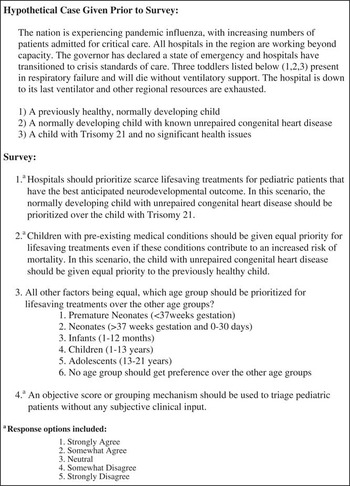
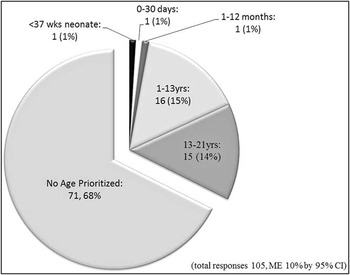
Five questions addressed audience demographics. The other four questions focused on factors that should be considered in triage and allocation. Three of the four opinion questions were posed as statements with a 5-point Likert “agree/disagree” response scale. The one non-Likert scale question (Question 3) was a multiple-choice question regarding patient ages (Figure 1).
Hypothetical Case Presented and Subsequent Survey Opinion Questions Posed to Attendees

Chi-square analysis was used to analyze differences of opinion between demographic subgroups. Data were collected on a Microsoft Office Excel 2007 spreadsheet (Microsoft Corp, Redwood, Washington USA) and statistical analysis was done with STATA version 10.1 (STAT Corp, College Station, Texas USA). The subgroups analyzed were: physicians vs nonphysicians (nurses, respiratory therapists, students, and other workers), and pediatric hospital location vs other locations (outpatient clinic, general adult hospital, public health office, etc). For the analysis, answers of “Strongly Agree” and “Somewhat Agree” were combined together in a general “Agree” category and “Strongly “Disagree” and “Somewhat Disagree” into a common “Disagree” category.
Results
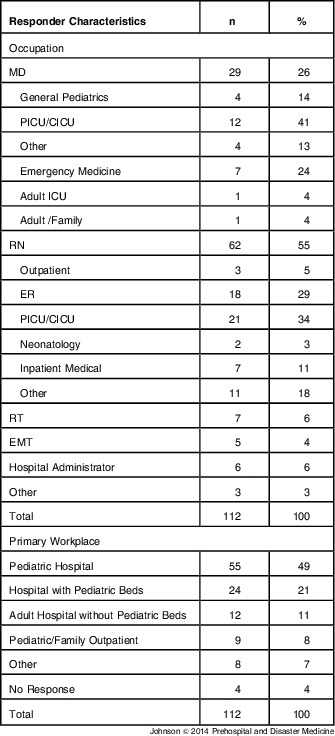
One hundred and twelve (97%) of a total 116 audience members responded to at least one question of the survey. One hundred and twelve audience members responded to demographic questions, and one hundred and eight to one hundred and ten of these responders successfully responded to subsequent content questions. Sixty-two (55%) responders were nurses, 29 (26%) physicians, and the remainder a mix of respiratory therapists, emergency medical technicians (EMTs), and “other” (see Tables 1a and 1b). Of 29 physicians, 12 (41%) were pediatric intensivists, seven (24%) emergency medicine specialists, four (14%) general pediatricians, and two (8%) adult or family physicians. Among 62 nurses, 21 (29%) worked in ICUs, 18 (34%) in an emergency department (ED), seven (11%) in inpatient non-ICU medical wards, three (5%) in outpatient clinics, and 11 (18%) in other settings. Fifty-five (49%) responders worked primarily in a pediatric hospital, and 24 (21%) in hospitals that have pediatric beds. The remainder came from solely adult hospitals, pediatric or family medicine outpatient clinics, as well as the National Institutes of Health (Bethesda, Maryland USA) and other public health workplaces (Tables 1a and 1b).
Responder Characteristics by Occupation, Specialty, and Workplace

Abbreviations: CICU, cardiac intensive care units; EMT, emergency medical technician; ER, emergency room; ICU, intensive care unit; PICU, pediatric intensive care unit; RN, registered nurse; RT, respiratory therapist.
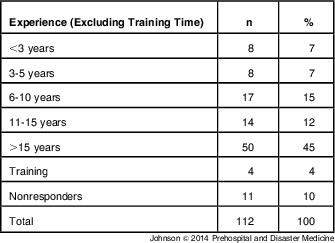
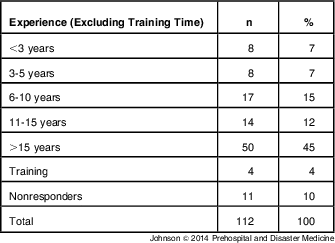
Responder Characteristics by Experience
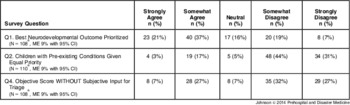
Audience responses are presented in Table 2 and Figure 2. Sixty-three (58%) responders agreed that in this resource-limited scenario, resource allocation should prioritize those with the best possible neurodevelopmental outcomes (Question 1). A large majority of responders (82, 75%) felt that children with pre-existing medical conditions should NOT be given equal priority for life-saving treatments as previously healthy children (Question 2). Finally, a majority of responders (71, 68%) also felt that no particular pediatric age group should be prioritized over others to receive limited resources (Question 3).
Responses by Total Number (n) and Percentages (%)

Abbreviations: CI, confidence interval; ME, margin of error.
aN reflects total number of responses to the specific question; not all initial responders were able to answer each question.
Age Prioritization Responses by Total Number (n) and Percentages (%) Abbreviations: CI, confidence interval; ME, margin of error.

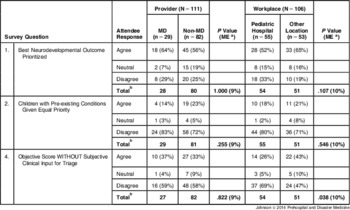
Several subgroups were analyzed to detect differences in opinion based on occupation and provider workplace. There were no significant differences by occupation (physician vs nonphysician, Table 3) or by workplace (pediatric hospital vs nonpediatric hospital, Table 3) for survey questions 1, 2, or 3. A strong majority of providers working in a pediatric hospital (37, 69%) felt that pediatric ICU resource allocation should be determined by a combined system using both an objective score and a subjective clinical evaluation, whereas only a minority (24, 47%) of providers working in nonpediatric hospital location preferred a combined system. In fact, 22 (43%) of 53 providers working in nonpediatric hospital locations preferred an allocation system based solely on an objective score as compared to just 14 (26%) of 55 responders working in pediatric hospitals (P = .038).
Response by Provider (MD vs Non-MD) and Workplace (Pediatric Hospital vs Other Location)

Abbreviations: MD, doctor of medicine/physician; ME, margin of error.
aMargin of error assumes 95% confidence interval.
bTotal indicates the total number of responses for each question amongst given subgroup of survey responders; not all survey responders were able to answer every question.
Discussion
National experts agree that there is a need for nationally standardized systems of triage and resource allocation specifically for medical surge events. Many allocation systems have been debated, including: 1) utilitarianism, or the “greatest good for the greatest number of people” (number of lives saved or number of life years saved); 2) egalitarianism (lottery or first come first serve); 3) prioritarianism (sickest first or youngest first); and 4) social utility (both broad and narrow). All existing allocation systems have ethical as well as practical flaws, and experts cannot agree that any one system should be used. What experts do agree upon is that in the setting of limited resources, a combination of medical need and possible benefit (a reflection of social utilitarianism) should inform the first tier of resource allocation.Reference White, Katz, Luce and Lo10, Reference Persad, Wertheimer and Emanuel14, Reference Antommaria, Powell, Miller and Christian15
To create an allocation system that is publically acceptable as well as ethically sound, both community and provider opinions are needed. With this goal, the Seattle and King County Department of Public Health in 2010 conducted community-based focus groups consisting of local clinicians and community representatives. The focus groups ultimately agreed that during surge events: 1) standards of medical care should be changed in an attempt to save as many people as possible; 2) children should be prioritized somewhat over adults; 3) the potential quality of the life saved should be considered in allocation; and 4) that a nationally standardized system of scoring and prioritizing patients should be developed and approved by expert clinicians.16
The current survey presented in this article was able to build on the King County community data. Although there is a general tendency to prioritize children that mirrors sentiment found in national public studies, little data exists to guide triage decisions between pediatric age groups.17 Northwest health care providers who attended this regional conference on pediatric disaster critical care strongly believed that no specific age group should be prioritized within pediatrics. The providers also felt that neurodevelopmental outcome should play a role in resource allocation, an opinion that could suggest a preference for considering social utility in allocation decisions, although the survey did not ask respondents’ reasons for their opinions. Similar to the King County community's predilection for prioritizing quality of life, prioritizing “normal” developmental outcome somewhat challenges egalitarian allocation principles. Further engagement of the community, including families and providers who care for disabled children, should be performed. Providers did agree with the King County community data that resources should be prioritized to those with the best chance of survival, even if that means chronically-ill children (who arguably are more vulnerable, requiring pediatric specialty care and commonly have established relationships with regional pediatric centers) may not receive resources.
Pediatric ICU resources in the US are typically unlimited for those requiring them, and are distributed by an expert pediatric intensivist provider based on their clinical evaluation. During resource-limited surges, however, decisions will likely have to be made under different conditions. Triage may need to be made by first responders or less pediatric-familiar local health providers. Additionally, even pediatric critical care experts may be required to choose between patients, a task with which they are not typically faced. Ideally, a triage system should be universally effective in various medical settings. It is important that the majority of potential users of the system are comfortable with its components. This data suggests a clear division amongst providers who work outside of a pediatric hospital in their approval of a subjective clinical evaluation being included in a triage tool. The reasons behind the divided opinions were not asked about directly. One possibility is that providers who practice outside a pediatric setting are uncomfortable with providing subjective clinical evaluations of severely ill children. There were not sufficient numbers to warrant a further subgroup analysis to evaluate the effect of provider type by workplace, although this may be a useful question to evaluate in the future. Regardless, this difference in opinion is important to consider when creating a universal triage tool. This local data might support either a 2-tiered critical care triage tool, or an impetus for further community-wide education on the triage assessment of severely ill or injured children. One possible 2-tiered approach might be: 1) triage based purely on an objective score at nonpediatric hospitals (to determine referral to pediatric hospitals); and 2) an objective score plus physical examination by a triage team at pediatric hospitals. Alternatively, pediatric telemedicine could be utilized to provide a specialized triage team evaluation at nonpediatric hospitals.
Although the study sample size is relatively small, it encompasses regional representation from almost all members of a critical care team, as well as emergency and nonpediatric clinicians who would be treating children in the event of a true surge event. It is also reflective of all members of a care team (nursing, physicians, and respiratory therapists) all of whom should be comfortable with a care distribution model. One advantage of how the survey was administered (with an electronic response tool) was that it allowed attendees to respond absolutely anonymously, and therefore, feel more comfortable answering questions honestly.
Limitations
A major limitation of this study is that there was no allowance for attendees to spend more time thinking about difficult ethical questions, or to change their mind once they pressed a response, as would be the case in a formal paper or e-mailed survey. Also due to this time-limited technology, every audience member that responded to the initial demographic questions was able to successfully answer every subsequent content question. There were also no follow-up questions or space for responders to explain the reasoning behind their choices. Perhaps most importantly, these data represent opinions of Pacific Northwest providers interested in pediatric disaster and pediatric critical care. They may not be generalizable to other regions, other providers, or lay community members. They do, however, fairly represent the providers most immediately likely to confront and make decisions about pediatric resource allocation, should a surge event occur in the Northwest.
Conclusions
Experts in critical care, pediatrics, and public health alike have called for a standardized pediatric resource allocation plan, as well as a functional triage system, to prepare for possible surge events. The formation of a resource allocation plan should be informed by expert opinion, as well as community input, and a triage system should be informed by its users’ preferences. In this cross-sectional survey of Northwest providers, the majority of respondents agree that a pediatric resource allocation plan should: 1) prioritize all pediatric age groups equally; 2) prioritize best possible outcomes; and 3) prioritize the best potential neurodevelopmental outcome. Providers had diverging opinions about whether the ideal pediatric triage system should include a subjective clinical evaluation in addition to an objective score. Respondents working in locations other than pediatric hospitals were less likely to favor the inclusion of a subjective clinical evaluation in triage scoring than their pediatric hospital peers. Further work is needed to both explore public opinion about pediatric resource allocation and to develop a useful objective triage scoring system that can be used in any setting in which pediatric patients might be seen.
Acknowledgments
The authors would like to thank Erica Bourget and Helene Starks for their contributions to the article.