I. INTRODUCTION
The control of the airspace and non-cooperative classification of air vehicles under adverse weather conditions, during day and night is an increasing demand as well for the civil administration as for military users.
Especially during operations in the framework of peace keeping missions, it has to be taken into account that under civil war conditions a mix-up of friendly and threat vehicles is appearing and the identification of aerial vehicles and especially the discrimination between different configurations of a certain type of helicopter is of interest.
Advanced radar sensors are able to deliver images with considerable information content, as high-resolution scattering center distributions and polarimetric features. Millimeter wave radars are especially capable to operate with high bandwidth and thus with a high range resolution capability. Using the technique of inverse synthetic aperture radar (ISAR) imaging [Reference Mensa1], it is possible to deliver high-resolution scattering center distributions of flying targets. These data can be compared with reference data from a data bank containing different possible configurations of a certain helicopter type. The paper discusses the principal techniques, which may be used, namely ISAR imaging, and demonstrates the processing chain for one certain type of helicopter. An implementation of the technique would require a bigger data base. To generate such a data base, reference data can also be generated by CAD-based radar cross section (RCS) modeling, which reduces the measurement effort to a few validation runs. The process of signature comparison, as proposed here, is based on image-based pattern recognition methods used in an off-line process. For a realistic application real-time processing would be required.
II. BASIC IDEA OF THE CLASSIFICATION CONCEPT
The experimental millimeter wave radars MEMPHIS and KOBRA have been used for the collection of high-resolution scattering center distributions of different helicopters in tower/turntable configuration using the range–Doppler (ISAR) algorithm. To image flying helicopters also by means of the ISAR technique, the MEMPHIS radar mounted on a tracking pedestal was used.
The helicopters were measured, flying along arbitrary trajectories at different velocities, heights, and ranges. Scattering center distributions were deduced in an off-line process. These images were correlated with the reference data available for 360° aspect angle range for different types of helicopters. This correlation process involves as well a best fit for the general orientation (nose to tail alignment) as for the characteristic outline, to determine the helicopter type and configuration.
In addition, signatures of sample helicopters have been simulated by a CAD-based radar simulation program [2], which also is able to generate reference data. The simulated signatures have been validated by ISAR measurements.
III. EXPERIMENTAL SETUP
A) The experimental radar KOBRA
The experimental radar KOBRA [Reference Essen, Wahlen, Sommer, Konrad, Schlechtweg and Tessmann3] is a modular system with four front-end modules at 10, 35, 94 and 220 GHz, respectively. The different front-ends are coupled to the radar control and data acquisition electronics. The data processing is done in an off-line process.
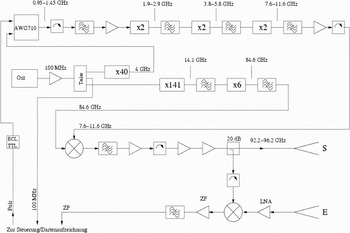
Figure 1 shows a simplified block diagram of the KOBRA 94-GHz front-end. The basic FM waveform is generated by an arbitrary waveform generator (AWG), which is synchronized to an external reference oscillator at 100 MHz. The nominal frequency of the AWG is 1200 MHz with a bandwidth of 500 MHz. This signal is amplified and doubled three times with appropriate filtering of the spurious responses thus resulting at a frequency of 9.6 GHz and a bandwidth of 4 GHz. A phase-lock oscillator, which is also synchronized by the 100 MHz crystal reference, generates an initial frequency of 14.1 GHz, which is multiplied by a factor of six to result in an output frequency of 84.6 GHz. After filtering, this signal is mixed with the 9.6 GHz signal carrying the chirp waveform. The resulting millimeter wave signal is amplified by a chain of medium, respectively, high-power amplifiers to result in a transmit signal with an output power of about 200 mW. A portion of the signal serves as local oscillator for the receive mixers. Low noise amplifiers in the input stages of the two channel receiver are employed to keep the noise floor sufficiently low. The two receiver channels are fed by orthogonally polarized horn antennas to supply co- and cross-polarized radar signals.
94-GHz front-end of the KOBRA radar.

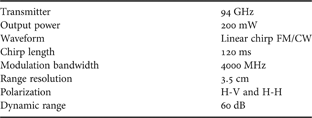
Table 1 summarizes the performance data of KOBRA.
Performance data of 94-GHz KOBRA front end.
B) The tracking radar MEMPHIS
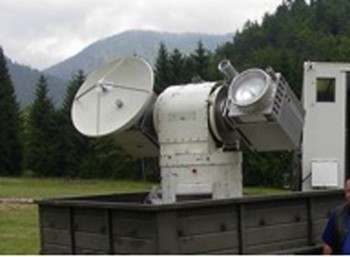
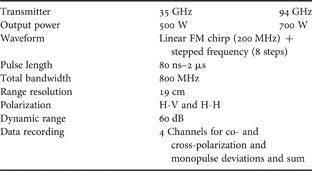
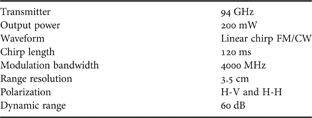
The millimeter wave radar MEMPHIS is used for a variety of applications, as airborne synthetic aperture radar (SAR) measurements [Reference Schimpf, Essen, Boehmsdorff and Brehm4] and land-based signature measurements of ships [Reference Essen, Schimpf and Wahlen5] or 3-D-ISAR measurements with fully illuminated targets on a turntable [Reference Boehmsdorff and Essen6]. The MEMPHIS radar has been described in detail [Reference Schimpf, Essen, Boehmsdorff and Brehm7]. For the investigations discussed here, it was used for dual polarization ISAR measurements in the same way as the KOBRA radar with reduced range resolution capability. To do signature measurements on flying helicopters, it was mounted on a VERTEX [8] tracking pedestal. Although MEMPHIS is equipped with a monopulse antenna and can principally be operated with a closed loop for autonomous tracking, tracking was done manually using a TV camera during the experiments described here. This method was preferred to avoid glint effects during tracking and to maintain a stable aim point and a stable illumination of the target during flight maneuvers. Figure 2 shows a photo of the MEMPHIS radar upon the tracking pedestal. Table 2 summarizes the performance data of MEMPHIS.
MEMPHIS with 35- and 94-GHz front-ends upon pedestal.

Performance data of 35/94-GHz MEMPHIS radar.

IV. TOWER–TURNTABLE ISAR MEASUREMENTS
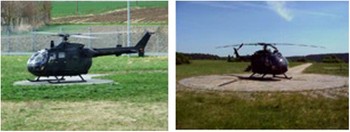
To determine high-resolution reference data of helicopters, tower–turntable measurements were conducted with different helicopters. For the measurements they were placed on a turntable. The radar range was about 200 m. The helicopters were fully illuminated by the 3-dB beam of the antennas. Figure 3 shows a BO 105 helicopter on the turntable.
BO 105 Helicopter without launcher (left) and with missile launchers (right) on turntable.

The method of ISAR or range–Doppler imaging (RDI) in tower-/turntable geometry to extract scattering center distributions has been described in the literature [Reference Mensa1, Reference Walker9]. It is the standard method to determine two-dimensional scattering center distributions of a target under controlled conditions. In its simplest form it is applied to a target, which is continuously rotating on a turntable, fully illuminated by the 3 dB antenna beam of the radar. Cross-range resolution is achieved by the evaluation of the Doppler content of the echo signal. The Doppler shift of the received signal is associated to the cross-range distance r between scattering center and the center of rotation by FD = 2ωr c/λ (r c is the component of r orthogonal to the radar beam). The Doppler frequency content is determined by a fast Fourier transformation (FFT) over a certain number of pulse periods (N).
ISAR imaging is due to the same drawbacks as SAR imaging, namely range walk and range offset. In the millimeter wave region these errors, however, can be neglected as long as the resolution is not too high and the radar frequency is sufficiently high and the target dimensions are small enough. A detailed discussion of the limitations and how to overcome them is given in [Reference Brehm, Wahlen, Sommer, Wilcke, Essen, Tessmann and Schlechtweg10]. For the millimeter wave frequencies a resolution of about 20 cm, as delivered by the MEMPHIS measurements, allows linear RDI. With increasing resolution, as possible with the KOBRA radar (3.5 cm), a thorough reformatting procedure is necessary.
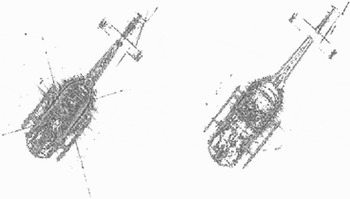
The range/Doppler map, which is yielded by the application of consecutive Fourier, respectively, inverse Fourier transformations, is a two-dimensional representation of the geometric distribution of scattering centers on the target as far as they can be separated by the range resolution of the measurement radar. A method was developed to achieve a fast processing [Reference Essen, Hägelen, Brauns, Konrad, Sommer and Wahlen11]. The algorithm takes advantage of the simple preconditions which are delivered by processing in the k-space and is done by successive two-dimensional Fourier transforms for discrete, equally spaced intervals and incoherent superposition of the images. Figure 4 gives examples for high-resolution scattering center distributions (ΔR = 3.5 cm) of the BO 105 helicopter derived with the KOBRA radar.
94-GHz ISAR images at H-H and H-V transmit/receive polarization.

Further measurements were conducted using the MEMPHIS radar equipped with monopulse antennas in a staring mode against the helicopter on the turntable. This measurement configuration allows the extraction of 3-D scattering center distributions. With two-dimensional range/Doppler imaging, ambiguities arise in the assignment of scatterers to geometric features of the target in those cases, where different scattering centers are related to the same slant range at equal lateral position although they are located at different heights. This drawback cannot be solved by two-dimensional imaging. To solve the ambiguity, three-dimensional processing has to be applied.
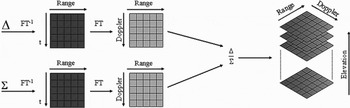
A method to extract the third dimension is based on the evaluation of the monopulse deviation in elevation. If in addition to the complex backscatter amplitudes also complex monopulse deviations are available, the same operations applied during the range/Doppler extraction process can also be applied to the monopulse deviations. The algorithm is principally equivalent to interferometric processing.
This operation yields high-resolution monopulse deviations separated by range and cross-range. This means that for each pixel of the range/Doppler map an elevation monopulse deviation is available. As the antenna beam width was chosen to maintain a full illumination of the target, and as there is a linear dependence between monopulse deviation and the position of the center of gravity of scatterers within the beam, the angular position within the beam is defined. Figure 5 demonstrates the principle of the algorithm. A detailed description has been given in [Reference Biegel, Essen, Wahlen and Brauns12].
Schematics of 3-D-monopulse ISAR imaging.

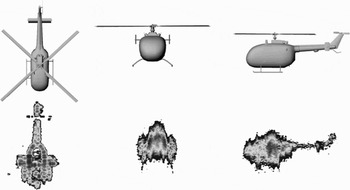
Figure 6 shows examples for the main cuts derived from the 3-D scattering center distributions for the BO 105 helicopter.
Scattering center distributions derived by 3-D-ISAR imaging.

V. SIGNATURE MODELING
While measurements, as described above, require experimental work, especially if different configurations of one type of helicopter should be characterized, it is relatively easy to generate CAD-model-based RCS simulations. For this purpose, a range of equally well suited simulation tools are available.
Here a tool developed at FGAN-FOM was used. It is an extended ray tracing approach considering SAR-specific features such as coherent processing, multiple specular reflection, speckle effect, and windowing functions. For the material description, a semi-heuristical model was implemented using Ulaby-tables [Reference Ulaby, Moore and Fung13] for diffuse scattering and a modified Fresnel reflection approach for specular reflection.
The following simplifications were assumed:
– narrow-beam approximation (ray tracing),
– transmitter and receiver on straight flight paths,
– illumination direction perpendicular to the flight path (no squint) and
– constant sensor velocity.
For the simulated scene the following parameters were used:
– look angle: 45°;
– emitter wave length: 3 cm;
– sensor altitude: 2500 m; and
– distance sensor – helicopter: 4500 m.
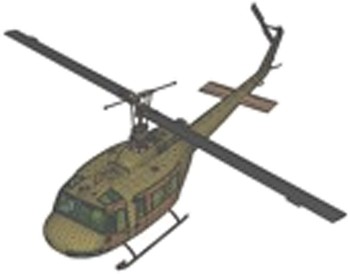
Figure 7 shows a CAD model of a UH1 used as input for the simulations.
CAD model of helicopter.

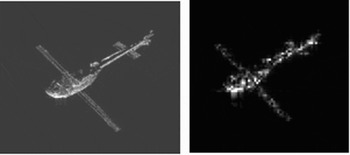
To achieve good simulation results, it is necessary to simulate the object with a spatial resolution close to or better than the used radar wavelength. The single impulse responses of the high-resolution simulation are coherently added to create images with lower resolution. Figure 8 shows a simulation result with a spatial resolution of 3 cm and one which is down sampled to 30 cm by coherent summation.
Simulation results with 3 and 30 cm resolution.

Simulated signatures can also be used as reference data.
VI. ISAR WITH FLYING HELICOPTERS
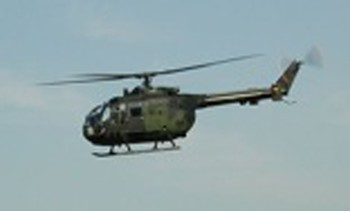
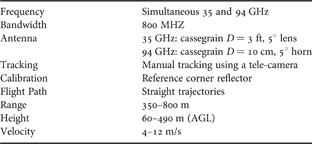
In the configuration as shown in Fig. 2 MEMPHIS was used for signature measurements of flying helicopters. Table 3 summarizes the geometrical and radar parameters effective during these measurements. Figure 9 shows the helicopter in flight.
Flying BO 105 during measurements.

Measurement parameters during helicopter airborne tests.

In principle, the algorithm to determine scattering center distributions of moving targets follows the same procedure as that described above for targets on a turntable. However the tower–turntable approach is much easier to handle, as all parameters describing the movement of the target under consideration are very well controlled and registered simultaneously with the backscatter data. For a free flying helicopter, the movement parameters are not readily fed into the data acquisition but have to be determined from the tracking parameters. Generally, the following parameters have to be determined:
– target position,
– target motion state,
– rotation rate and
– projection plane.
Range is delivered by the radar and the angular position of the antenna pedestal gives the pointing direction (azimuth and elevation), thus the trajectory of the helicopter can be determined from the measured data by a polynomial fit. The knowledge of the rotation rate is necessary for defining the integration time and a correct scaling in cross-range. It can be calculated under the assumption that the drift angle of the target is negligible. To get stable information on the target motion, the observation time has to be sufficiently long.
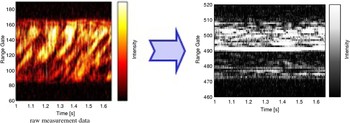
The algorithm to derive scattering center distributions needs several processing steps, namely the range compression, the motion compensation, and the cross-range processing. Figure 10 demonstrates the range compression process, which is done by an inverse filtering method using calibration data from measurements against a reference reflector.
Demonstration of range compression.

The motion compensation process has to undergo the following steps:
1) compensation of the zero range,
2) pre-alignment of range profiles by calculating the position of the RCS centroid,
3) post-alignment by correlation of adjacent range profiles and
4) phase compensation using dominant scattering (DSA) or multiple scattering algorithms (MSA).
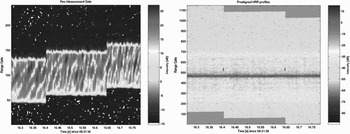
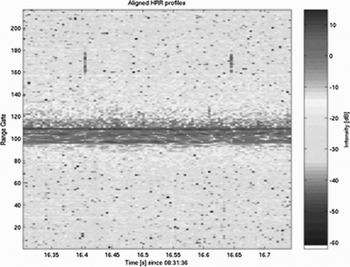
In order to achieve a continuous shifting of the range profiles, the measurement data must be resampled during each alignment step. Figure 11 shows the results for steps 1 and 3 applied on a series of range profiles. The resulting series of range profiles after the full motion compensation process is shown in Fig. 12.
Series of range profiles for the first and third processing steps.

Series of range profiles after motion compensation.

For the cross-range processing, care has to be taken regarding the limits of linear RDI, which is

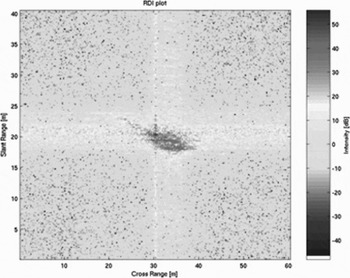
This means that undisturbed imaging of objects with a diameter up to 15 m is possible. The cross-range compression is done by application of an FFT to each range bin. To suppress side lobes, a Hamming windowing function is used, which implies a reduction of the range resolution from 19 to about 25 cm, which was felt to be tolerable. The resulting scattering distribution is shown in Fig. 13.
Scattering distribution for flying helicopter.

VII. COMPARISON OF GROUND-BASED AND AIRBORNE SCATTERING CENTER DISTRIBUTIONS
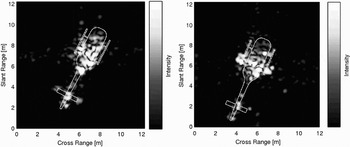
The classification process for airborne helicopters is based on an image-related approach comparing the scattering center distribution of the airborne target with data from ground-based measurements or simulated scattering center distributions. Figure 14 shows a respective comparison of scattering center distributions for the BO 105 Helicopter.
Comparison of scattering center distributions from ISAR with airborne target (left) and from turntable measurements (right).

The comparison in this specific case refers to a BO 105 without missile launchers for the airborne measurement (Fig. 14 left) and with launchers for the turntable measurement (Fig. 14 right). Inspection of different targets under different conditions showed that the resolution of about 20 cm is sufficient for the purpose envisaged in this study.
VIII. FIRST RESULTS OF IMAGE-BASED IDENTIFICATION
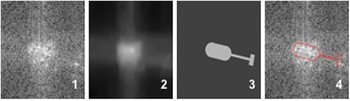
First results could be achieved with a matching process of helicopter targets from a data base containing the characteristic outline of different helicopters. Figure 15 shows a series of images used during the matching process, which has two purposes:
– to match the scattering center distribution concerning the actual aspect angle (nose to tail direction) and
– to match the measured distribution with reference data.
Demonstration of steps during the matching process for target and outline from the data base.

The matching process is done for each single ISAR image (image 1 of Fig. 15). The resulting scattering center distribution undergoes low-pass filtering (image 2 of Fig. 15), before the comparison with different outlines of targets from the data base (image 3 of Fig. 15) is done. To give an indication for the quality of the matching process, the correlation coefficient between measured scattering center distribution and the reference distribution is calculated.
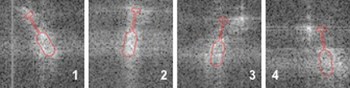
For the matching process the correct determination of the Doppler centroid of the target is most essential. If this Doppler estimation is not done correctly a wrong scaling of the target dimension is the result, which is inhibitive for a correct matching. Figure 16 shows four cases, where only for the first two aspects the scaling is correct and thus only two correct results have been produced in this case.
Four matching approaches, the first two are successful, cases 3 and 4 suffer from a wrong scaling.

IX. CONCLUSION
During the study high-resolution signatures of helicopters were determined by CAD-based RCS modeling and ground-based (tower–turntable) ISAR imaging. One of the experimental radars, equipped with different antennas to achieve an adequate illumination of the target, was used against airborne targets, which also could be imaged using an ISAR algorithm. First steps for an automatic classification process have been shown, especially the determination of the actual helicopter aspect angle and the ability for a correct scaling. Steps toward a correlation algorithm between data from airborne targets and reference data have been undertaken, but are not discusses in detail in this contribution. Also the real-time capability, which is mandatory for the envisaged application, has not yet been achieved. Work toward such an algorithm is currently underway.
 Helmut Essen graduated in Physics and received his PhD both from the University of Bonn in 1973 and 1976 respectively. He joined Max-Planck-Institute for radioastronomy where he was engaged in the development of millimeterwave radiometers until 1977. Since then he is with the FGAN-Research Institute for High Frequency Physics and Radar Techniques as research scientist and group leader. There he was engaged in the development of millimeterwave radars in the frequency range of 10 GHz to 220 GHz. His work on target background signatures covered experimental investigations and the development of signal processing algorithms using SAR, InSAR, ISAR. Further fields of research have been propagation of radio waves and terahertz imaging for security applications. Since 1995 he is heading the department of millimeterwave radar and high frequency sensors. He is a member of the German Physical Society (DPG), the German Terahertz Center and the IEEE Geoscience and Remote Sensing Society.
 Manfred Hägelen received the diploma in electrical engineering from the University Braunschweig, Germany, in 2002. He joined the FGAN Research Institute for High Frequency Physics and Radar Techniques in 2003 as research scientist. Since then his work is mainly dedicated to signal processing techniques for millimeterwave radar systems, like SAR and ISAR methods. In 2005 he additionally joined the International Postgraduate Programme (IPP) Multi Sensorics of the Center for Sensorsystems (ZESS) at the University of Siegen, where his studies are related to the use of radar-based sensors for in-house monitoring and security applications.
 Alfred Wahlen received the Ing.-grad. degree in electrical engineering from the University Gesamthochschule Siegen, Germany, Section Gummersbach, in 1973. Since then he works at the FGAN Research Institute for High Frequency Physics. Starting with the development of software for the long range TIRA radar he was engagend with signal processing techniques for the millimeterwave radars for reconnaissance and guidance applications. He was involved in the development of the millimeterwave experimental radar MEMPHIS and the evaluation software for this instrument. Currently his main concern is dedicated to SAR INSAR, and ISAR methods for millimeterwave radar applications.
 Karsten Schulz was born 1962 in Holzminden, Germany. In 1991 he received a diploma degree (Dipl.-Phys.) in Extraterrestrial Physics and Astrophysics at the Ruhr-University of Bochum, where he investigated the light scattering of cometary and interplanetary particles with microwave analogue experiments. At the Institute of Thermo- and Fluiddynamics of the Faculty of Mechanical Engineering of the Ruhr-University Bochum he investigated optical measurement techniques for the determination of local heat and mass transfer coefficients and received 1997 a doctorial degree in Mechanical Engineering. Since fall 1997 he is associated with the Institute of Optronics and Pattern Recognition (FOM) of FGAN, the German research establishment for defense related research. He is responsible for several projects comprising studies of imaging radar for military surveillance and target detection with a focus on exploitation of interferometrical SAR data.
 Klaus Jäger received his Physics Degree from the University of Karlsruhe, Germany, in 1986. Senior Scientist working in the section Target Recognition at the Institute for Optronics and Pattern Recognition (FOM) of FGAN Research Establishment for Applied Sciences. His main interests and research activities: Sensor fusion for seekerheads and drones, Aerial reconnaissance with imaging sensors, ATR applications for ground based and airborne systems, Laser range data processing for autonomous systems.
 Marcus Hebel received a diploma degree in Industrial Mathematics (Dipl. Math. techn.) at the Technical University of Kaiserslautern, Germany, in 2002. He is scientist working at the Institute for Optronics and Pattern Recognition (FOM) of FGAN Research Establishment for Applied Sciences. His main interests and research activities: Sensor data fusion for helicopter applications, synthetic and enhanced vision, change detection in laser range data.