I. INTRODUCTION
The M n+1AX n compounds, where M is an early transition metal, A is an element of IIIA or IVA, X is either C or N, and n = 1–6, are a class of hexagonal-structure ternary carbides and nitrides which have attracted extensive attention owing to the combination of the excellent properties of both metals and ceramics. Reference Barsoum1–Reference Hu, Zhang, Li, Huang and Bao3 Like metals, they have high thermal and electrical conductivity, Reference Tian, Wang, Zhang, Kan, Li and Yan4 excellent thermal shock resistance and good machinability; like ceramics, they possess high strength, Reference Ying, He, Li, Han, He and Du5 high melting point, excellent high-temperature oxidation resistance, Reference Ai6,Reference Lin, Li, Wang and Zhou7 and good thermal stability. Reference Xiao, Li, Song and Sloof8,Reference Low, Pang, Kennedy and Smith9
Moreover, the solid solution based on the MAX phases can be formed by the substitution of elements on M, A, or X site. Such as (Cr1–x V x )2AlC, Reference Tian, Sun, Hashimoto and Du10 (Ti1–x Nb x )2AlC, Reference Salama, El-Raghy and Barsoum11 (Ti1–x V x )2AlC Reference Meng, Zhou and Wang12 and Ti2Al(C0.5N0.5) Reference Barsoum, Ali and El-Raghy13 in the so-called 211 phase, and Ti3Si x Al1–x C2, Reference Li, Bei, Li, Ai, Zhai and Zhou14 Ti3Al x Sn1–x C2, Reference Ai, Zhai, Zhou, Tang, Huang, Zhang and Li15 Ti3Ge x Si1–x C2 Reference Ganguly, Zhen and Barsoum16 and Ti3Al(C0.5N0.5)2 Reference Radovic, Ganguly and Barsoum17 in 312 phase. Solid solution treatment is considered as an effective way to optimize the properties of M n+1AX n compounds. For example, Wang and Zhou Reference Wang and Zhou18 investigated the elastic stiffness and electronic band structure of M x M′2–x AlC (M and M′ = Ti, V, Cr) phases by the ab initio pseudopotential total energy method. They found that the second-order elastic constant c 44, a hardness predictor, reached a maximum value as the valence electron concentration (VEC) was in the range 8.4–8.6. So it was predicted that the mechanical properties of M x M′2–x AlC would be improved by forming solid solutions. As a member of M x M′2–x AlC, (Cr1–x V x )2AlC is of great interest to us. For this system, both experimental and theoretical studies had been conducted in the past. Schuster et al. Reference Schuster, Nowotny and Vaccaro2 first synthesized (Cr0.75,V0.25)2AlC, (Cr0.5,V0.5)2AlC, and (Cr0.25,V0.75)2AlC solid solutions by annealing a series of Cr2AlC and V2AlC powder mixtures in appropriate proportions at 1000 °C for 170 h. Their results showed that Cr2AlC and V2AlC could form a complete series of mutual solid solutions. Sun et al. Reference Sun, Ahuja and Schneider19 explored the solubility of M x M′2–x AlC (M and M′ = Ti, V, Cr) by first principle calculation method. Therein, the solubility of the (Cr1–x V x )2AlC system was also proved theoretically, which explained the results in Schuster's work. And then, Tian et al. Reference Tian, Sun, Hashimoto and Du10 synthesized several (Cr1–x V x )2AlC (x = 0, 0.1, 0.25, and 0.5) by the pulse discharge sintering (PDS) technique using Cr, V, Al, and C powders and reported the hardness and thermal conductivity of the products. Subsequently, Yeh and Yang Reference Yeh and Yang20 successfully fabricated (Cr,V)2AlC with Al2O3 addition based on chromium (III) oxide (Cr2O3)–vanadium pentoxide (V2O5)–aluminum(Al)–aluminum carbide (Al4C3) system by self-propagating high-temperature synthesis (SHS) method involving aluminothermic reduction. However, there is less systematic investigation of the microstructure, solid solution effect, and mechanical properties of bulk (Cr1–x V x )2AlC continuous solid solutions.
Generally, sintering method is the dominant process for the tailoring of the microstructures and properties of the (Cr1–x V x )2AlC solid solutions. As a promising alternative method, the in situ hot-pressing sintering has many characteristics such as in situ solid solution reaction at relatively low temperatures to achieve considerably high-density and high-purity ceramics within short sintering time, thus manifesting distinct advantages as compared with the traditional methods.
Therefore, the purpose of this work is 2-fold; First, to fabricate dense and high purity (Cr1–x V x )2AlC (x = 0, 0.25, 0.5, 0.75, and 1.0) ceramics using an in situ hot-pressing process and study the synthesis mechanism. Second, to investigate the lattice parameters, microstructure, mechanical properties, and solid solution effect of bulk (Cr1–x V x )2AlC ceramics.
II. EXPERIMENTAL PROCEDURES
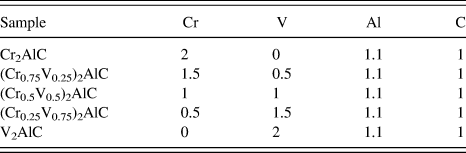
Powders (all from Xing Rong Yuan Technology Co., Ltd., Beijing, China) of Cr (99.9% in purity, 200 mesh), V (99.9% in purity, 200 mesh), Al (99.5% in purity, 200 mesh) and carbon black (99.5% in purity, 200 mesh) were used as starting materials. For the preparation of (Cr1–x V x )2AlC solid solutions, the powder mixtures containing Cr, V, Al, and C were formulated with stoichiometry. Extra 10 wt% Al was used to compensate for the loss of Al during the sintering process. And the detailed component description of the samples is listed in Table I.
The compositions of the (Cr1–x V x )2AlC (x = 0, 0.25, 0.5, 0.75, 1.0) mutual solid solutions (mole ratio).

The powder mixture was ball milled in alcohol for 1 h and then dried at less than 50 °C for several hours. Then the dried powders were compacted uniaxially at 10 MPa in a graphite mold with a protective layer of boron nitride (BN). The compacted samples were hot pressed in vacuum (less than 6.0 × 10⁻² Pa) at a rate of 5 °C/min to 1400 °C, and held for 2 h under a pressure of 16 MPa. Finally, the samples were cooled down to room temperature in the furnace. Before examination, the surface of the samples was ground to remove graphite contamination layers. To expose the grains, the surface of the samples was polished and etched using a mixture of hydrofluouric acid, nitric acid, and water (HF:HNO3:H2O) solution with a 1:1:1 volumetric ratio. The phase formation of the sintered bulks was identified by x-ray diffraction (XRD) with Cu Kα radiation (D/max-2200PCX) at a scanning speed of 0.02°/step. The microstructure of the samples was investigated by scanning electron microscope (SEM, HITACH, FE-S4800, Japan) and energy dispersive spectroscopy (EDS).
The measurements of all the mechanical properties were performed at room temperature by averaging six individual measurements. The density of (Cr1–x V x )2AlC samples was measured by the Archimedes method. Vickers hardness measurements were conducted on the HXD-1000 tester (Shanghai second optical Ltd., China) with a diamond indenter under a 1000 N load for 15 s. The three-point flexural strength test was conducted using 3 mm × 4 mm × 36 mm specimens by the PT-1036PC material tester (Perfect Instrument Co. Ltd., Taiwan, China), with a span of 20 mm and at a cross-head speed of 0.5 mm/min. The fracture toughness test was carried out by the single edge notched beam (SENB) method using 2 mm × 4 mm × 36 mm specimens with a notch depth of 0.4h (h is the height of specimen), at a cross-head speed of 0.05 mm/min, with a loading span of 20 mm. The flexural strength and fracture toughness of the specimens were calculated by the following Eqs. (1) and (2), respectively:
 $${\rm{\sigma }} = 3PL/2b{h^2}\quad ,$$
where P is the breaking load of the specimen, and L, b, and h denote the length, width, and height, respectively.
 $${K_{{\rm{IC}}}} = {{Y \times 3PL{a^{1/2}}} \mathord{\left/ {\vphantom {{Y \times 3PL{a^{1/2}}} {\left( {2b{h^2}} \right)}}} \right. \kern-\nulldelimiterspace} {\left( {2b{h^2}} \right)}}{\rm{\quad ,}}$$
where Y is a geometrical factor, and a is the notch length.
III. RESULTS AND DISCUSSION
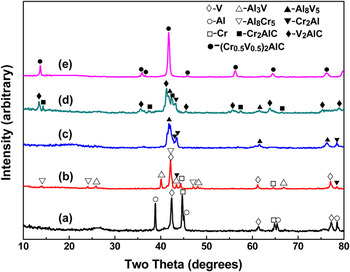
Figure 1 shows the XRD patterns of hot-pressed sample of (Cr0.5V0.5)2AlC solid solution sintered at different temperatures ranging from 500 °C to 1400 °C for 2 h. As shown in Fig. 1(a), only Cr, V, and Al phases were detected in the samples sintered at 500 °C. No diffraction peaks of C were observed because amorphous carbon black was used in this work. As the sintering temperature increased to 700 °C, which was higher than the melting point of aluminum ∼660 °C [Fig. 1(b)], the diffraction peaks of Al disappeared completely and those of Cr and V became weaker. Al8Cr5 and Al3V phases were detected noticeably, suggesting the reactions of Al with Cr and V to form Cr–Al and V–Al intermetallics, respectively according to Eqs. (3) and (4). Besides, a small amount of Cr2Al was also detected, indicating the reaction of Al8Cr5 with Cr according to Eq. (5).
XRD patterns of hot-pressed (Cr0.5V0.5)2AlC solid solution at different temperatures: (a) 500 °C; (b) 700 °C; (c) 900 °C; (d) 1100 °C; (e) 1400 °C.

As shown in Fig. 1(c), all the diffraction peaks of Cr, V, Al8Cr5, and Al3V disappeared at 900 °C, while Al8V5 became the main phase and the diffraction peak intensity of the Cr2Al phase increased noticeably. It was indicated that the Cr, V, Al8Cr5, and Al3V were exhausted completely to form the intermetallic equilibrium phases, Cr2Al and Al8V5, according to Eqs. (5) and (6), respectively. As the temperature reached 1100 °C [Fig. 1(d)], V2AlC and Cr2AlC appeared while the content of the Al8V5 and Cr2Al decreased, implying that the two MAX phases were formed by the reaction among C, Al8V5, and Cr2Al according to Eqs. (7) and (8). When the temperature further increased to 1400 °C [Fig. 1(e)], single-phase (Cr0.5V0.5)2AlC solid solution was formed by the reaction between Cr2AlC and V2AlC according to Eq. (9). The reaction Eqs. (3)–(9) are summarized as follows:
 $$8{\rm{Al}} + 5{\rm{Cr}} \to {\rm{A}}{{\rm{l}}_8}{\rm{C}}{{\rm{r}}_5}{\rm{\quad ,}}$$
 $$3{\rm{Al}} + {\rm{V}} \to {\rm{A}}{{\rm{l}}_3}{\rm{V\quad ,}}$$
 $$11{\rm{Cr}} + {\rm{A}}{{\rm{l}}_8}{\rm{C}}{{\rm{r}}_5} \to 8{\rm{C}}{{\rm{r}}_2}{\rm{Al\quad ,}}$$
 $$7{\rm{V}} + 8{\rm{A}}{{\rm{l}}_3}{\rm{V}} \to 3{\rm{A}}{{\rm{l}}_8}{{\rm{V}}_5}{\rm{\quad ,}}$$
 $${\rm{C}}{{\rm{r}}_2}{\rm{Al}} + {\rm{C}} \to {\rm{C}}{{\rm{r}}_2}{\rm{AlC\quad ,}}$$
 $$2{\rm{A}}{{\rm{l}}_8}{{\rm{V}}_5} + 5{\rm{C}} \to 5{{\rm{V}}_2}{\rm{AlC}} + 11{\rm{Al\quad ,}}$$
 $${\rm{C}}{{\rm{r}}_2}{\rm{AlC}} + {{\rm{V}}_2}{\rm{AlC}} \to 2{({\rm{C}}{{\rm{r}}_{0.5}}{{\rm{V}}_{0.5}})_2}{\rm{AlC}}{\rm{\quad .}}$$
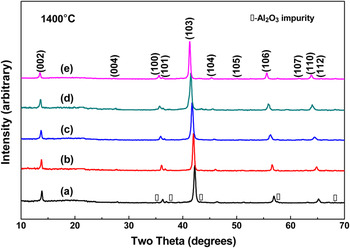
The XRD patterns of the (Cr1–x V x )2AlC solid solutions with the V content increased from 0 to 100 at.% sintered at 1400 °C for 2 h are shown in Fig. 2. The samples were only composed of (Cr1–x V x )2AlC and trace amount of aluminum oxide (Al2O3). The diffraction peaks of the main phases were very sharp, suggesting a high crystallinity of the grains obtained. And the Al2O3 impurity was commonly observed in synthetic Al-containing MAX phases and their solid solutions. Reference Salama, El-Raghy and Barsoum11,Reference Barsoum, Ali and El-Raghy13,Reference Ai, Zhai, Zhou, Tang, Huang, Zhang and Li15,Reference Yu, Li and Sloof21 As shown in the figure, all the detected diffraction peaks of the solid solutions were marked on the basis of the crystal structure of Cr2AlC [Joint Committee on Power Diffraction Standards (JCPDS) card No. 29-0017]. It could also be found that the diffraction peaks shifted to left gradually with the increase of V content. For instance, the diffraction angle of (103) crystal face changed gradually from 42.22° for Cr2AlC to 41.30° for V2AlC with the substitution of Cr. It was attributed to the increment of lattice parameters as replacing Cr by V on the M site of (Cr1–x V x )2AlC.
XRD patterns for (a) Cr2AlC; (b) (Cr0.75V0.25)2AlC; (c) (Cr0.5V0.5)2AlC; (d) (Cr0.25V0.75)2AlC; (e) V2AlC.

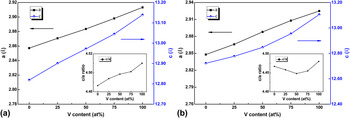
For accurately describing the changes in the lattice parameters of the solid solutions, Rietveld cell refinement of the diffraction patterns was conducted by MID jade5 software using Cr2AlC as the structural model. The final reliability factors (R p and R wp) are less than 10% in all the composition range, suggesting the sufficient accuracy of the refinement. As shown in Fig. 3(a), when the V content on the M site increased from 0 to 100 at.%, the lattice constant a changed linearly from 2.8572 Å to 2.9133 Å, and c increased significantly from 12.8188 Å to 13.1394 Å. The reason for the increment of lattice parameters was the larger radius size of the V atom (r Cr = 166 pm, r V = 171 pm). Reference Clementi, Raimondi and Reinhardt22 The more significant increment in constant c was due to the weaker electronic bonding in the c direction. For comparison, the calculated parameters and c/a ratios of (Cr1–x V x )2AlC solid solutions with different V content in Ref. Reference Sun, Ahuja and Schneider19 are plotted in Fig. 3(b). The change trend of lattice parameters in the present work was similar to that in the literature. However, the two dependences of c/a ratios on V content were different. In our work, with the substitution of Cr by V, the c/a ratio increased progressively without any peak from 4.4865 to 4.5101, which was attributed to the higher changing rate of c. For a detailed and visual display, all the data are also listed in Table II.
Calculated lattice parameters and c/a ratios for (Cr1–x V x )2AlC solid solutions with different V content on the M site from (a) the present work and (b) Ref. Reference Sun, Ahuja and Schneider19.

Summary of the measured properties of the (Cr1–x V x )2AlC solid solutions (a and c, lattice parameters; R p and R wp, reliability factors; d m, measured density; d c, calculated density; d r, relative density).

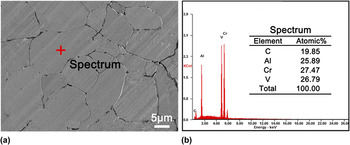
Figure 4 presents a typical SEM micrograph together with EDS spectra of the polished and etched surface of (Cr0.5V0.5)2AlC prepared at 1400 °C for 2 h. As shown in Fig. 4(a), the average size (the average of two times length and one time width) of gray grains was about 18.7 μm. As shown in Fig. 4(b), the atomic ratio of Cr:V:Al of the grain [marked as spectrum in Fig. 4(a)] was 27.47:26.79:25.89, which was quite close to the theoretical value of 1:1:1. The content of C in the result was slightly lower than the theoretical value, because the mass of C atom was too light to be detected accurately by the EDS analysis. Although it was difficult to quantify the composition in the products accurately, combined with the XRD result in Figs. 1 and 2, it was confirmed that the plate-like grains were (Cr0.5V0.5)2AlC phase.
(a) SEM micrograph of (Cr0.5V0.5)2AlC polished and etched surface; (b) EDS spectra.

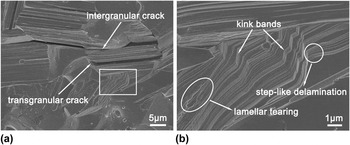
Figure 5(a) presents the SEM micrograph of a typical fracture surface of the (Cr0.5V0.5)2AlC sample. As shown in the figures, cleavage planes with the typical laminated structure were displayed. And transgranular and intergranular cracks were clearly observed, indicating the occurrence of both fracture modes in the (Cr1–x V x )2AlC solid solutions. Figure 5(b) demonstrates the high magnification image of the rectangular region in Fig. 5(a). Like other M n+1AX n phase materials, Reference Barsoum, Murugaiah, Kalidindi, Zhen and Gogotsi23–Reference Hu, Li, He, Liu, Zhang, Wang, Bao, Wang and Zhou25 Kink bands, step-like delamination and lamellar tearing were observed in the sample. The multiple microscopic deformation and damage modes were favorable for absorption of more energy during the fracture process. As a result, the energy-consuming mechanisms in the (Cr1–x V x )2AlC solid solutions would lead to high toughness and ductility.
(a) SEM micrograph of a typical fracture surface of (Cr0.5V0.5)2AlC sample; (b) the enlarged image of the rectangular region from (a).

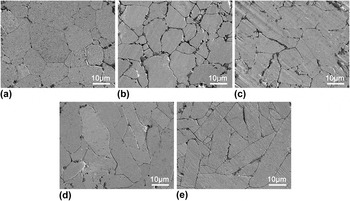
Figure 6 demonstrates the SEM micrographs of the polished and etched surfaces of the (Cr1–x V x )2AlC ceramics sintered at 1400 °C for 2 h. The average grain size of these solid solutions was about 17.9–19.5 μm (see Table III). No obvious large pores were found on the surfaces, which would contribute to excellent mechanical properties. More remarkably, as a result of the increasing aspect ratio (Table III), the shape of (Cr1–x V x )2AlC grains changed from equiaxial (for Cr2AlC, as shown in Fig. 6(a)) to elongated morphology (for V2AlC, as shown in Fig. 6(e)) with substitution of Cr by V. In the light of the previous literature, the crystal habits of Cr2AlC and V2AlC were different, i.e., Cr2AlC generally crystallized to be hexagonal grains, Reference Tian, Wang, Zhang, Kan, Li and Yan4,Reference Xiao, Li, Song and Sloof8 while V2AlC crystallized to be long-columnar ones. Reference Hu, He, Liu, Wang, Wang, Li, Bao and Zhou26 So it was indicated that the V content had an obvious effect on the crystal habit of (Cr1–x V x )2AlC solid solutions.
SEM micrographs of polished and etched surfaces of (a) Cr2AlC; (b) (Cr0.75V0.25)2AlC; (c) (Cr0.5V0.5)2AlC; (d) (Cr0.25V0.75)2AlC; (e) V2AlC.

Typical properties of the as-prepared (Cr1–x V x )2AlC solid solutions.

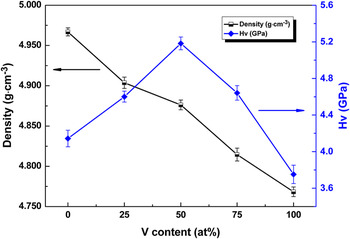
The density and Vickers hardness of (Cr1–x V x )2AlC ceramics with different V content are shown in Fig. 7. Apparently, the density decreased from 4.967 to 4.768 g/cm3 as the V content increased from 0 to 100 at.%, which was ascribed to the incorporation of relatively light V into Cr2AlC and the expansion of crystal structure of the solid solutions. As illustrated in Table II, The relative density of all products was 95.0–97.8% of the calculated one with XRD patterns. But compared with the results of several bulk (Cr1–x V x )2AlC in Ref. Reference Tian, Sun, Hashimoto and Du10, the values in the present work were slightly smaller. This was correlated with the lower applied pressure in our synthetic process (50 and 30 MPa in Ref. Reference Tian, Sun, Hashimoto and Du10). Also as depicted in Fig. 7, the change of Vickers hardness with the V content was shown as a single-peak curve, and it reached a maximum value of 5.18 GPa when the V content was 50 at.%, which was 25.1% and 38.1% higher than that of Cr2AlC (4.14 GPa) and V2AlC (3.75 GPa), respectively. These results were partly in accordance with that of Tian's research. Reference Tian, Sun, Hashimoto and Du10 But the Vickers hardness of bulk (Cr1–x V x )2AlC was larger than the one in their report (4.3 GPa).
The density and Vickers hardness of bulk (Cr1–x V x )2AlC solid solutions with different V content.

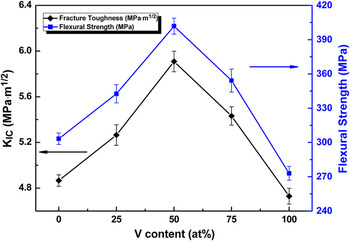
The flexural strength and fracture toughness of the (Cr1–x V x )2AlC solid solutions with different V content are shown in Fig. 8. Dramatically, the dependence of these two mechanical properties on the V content had a similar tendency with that of the Vickers hardness. The mechanical properties of the (Cr1–x V x )2AlC solid solutions are summarized in Table III. Comparing to the pure Cr2AlC and V2AlC, the flexural strength of the (Cr0.5V0.5)2AlC solid solution was increased by 32.7% and 47.3%, respectively. Likewise, the value of fracture toughness of the (Cr0.5V0.5)2AlC solid solution was increased by 21.4% and 24.9% when compared with Cr2AlC and V2AlC, respectively. Based on the results, (Cr0.5V0.5)2AlC was determined to be a solid solution with the optimal mechanical performance. This phenomenon of strengthening and toughening of was credited to a combined solid solution effect of two factors. On the one hand, the morphology of grains played a major role in modifying the mechanical properties, since there was no distinct difference between the average grain size of (Cr1–x V x )2AlC solid solutions. When the V content on the M site was 50%, the aspect ratio of (Cr0.5V0.5)2AlC grains reached about 2.1, a relatively large value. And its grains turned into a transitional shape between the hexagonal and long-columnar morphology. Such a qualitative change presumably had positive influence on improving the mechanical properties. On the other hand, according to the similar theory of alloy solid solutions, Reference Ryen, Holmedal, Nijs, Nes, Sjölander and Ekström27 it could be concluded that, when the concentrations of Cr and V on the M site simultaneously reached 50 at.% in the (Cr1–x V x )2AlC system, the size misfit between Cr and V atoms would cause more lattice distortions and local stress fields. So the dislocation motion was impeded by more interactions between dislocations and local stress fields, which would lead to the maximum solid solution strengthening effect in the (Cr0.5V0.5)2AlC ceramic.
The flexural strength and fracture toughness of bulk (Cr1–x V x )2AlC solid solutions with different V content.

IV. CONCLUSIONS
(Cr1–x V x )2AlC ceramics have been successfully synthesized at 1400 °C by in situ hot-pressing method based on the Cr–V–Al–C system. The as-prepared compounds were nearly dense and the average grain size was about 17.9–19.5 μm. The formation process included the production and phase equilibriums of intermetallics, reactions between C and intermetallics, together with the generation of solid solutions. The lattice constants of (Cr1–x V x )2AlC increased with the increment of V content. The grains of (Cr1–x V x )2AlC solid solutions changed from equiaxial to elongated morphology with increasing the V content. The energy-consuming mechanisms in the (Cr1–x V x )2AlC solid solutions would contribute to their high toughness and ductility. Moreover, the (Cr0.5V0.5)2AlC solid solution had a combination of high flexural strength of 402 MPa, high fracture toughness of 5.91 MPa m1/2, and high Vickers hardness of 5.18 GPa, due to the solid solution effect.
ACKNOWLEDGMENTS
This work was supported by the National Foundation of Natural Science, China (51272145, 51171096), the Shaanxi Provincial Foundation of Natural Science, China (2010JM6014), and the Graduate Innovation Fund of Shaanxi University of Science and Technology.