Introduction: residential property and social citizenship
In this article, we discuss the postwar development of the social distribution of homeownership in Norway in light of the concept of social citizenship. The Norwegian experience is not only of interest as an example of the wider family of Nordic welfare states, but also relevant to the general scholarly debate on housing and inequality following in the wake of Piketty’s seminal work Capital in the Twenty-First Century (cf. Piketty, Reference Piketty2014; Arundel, Reference Arundel2017; Maclennan and Miao, Reference Maclennan and Miao2017). In large parts of the world – including most of Europe, East Asia, North America and Australia – governments encourage homeownership and the accumulation of individual housing wealth. Norway is no exception to this trend: the Norwegian state has promoted owner-occupation through light property taxation and various housing policy instruments since 1945 (Sandlie and Gulbrandsen, Reference Sandlie and Gulbrandsen2017; Sørvoll, Reference Sørvoll2011). Almost 77 per cent of Norwegian households are homeowners – only Spain has a higher rate of owner-occupation in Western Europe (Dewilde and Ronald, Reference Dewilde, Ronald, Dewilde and Ronald2017: 10–11; Revold, Reference Revold2019). This makes the lessons of Norwegian case relevant for other high-homeownership countries. As demonstrated by scholars such as Galster and Wessel (Reference Galster and Wessel2019), the housing wealth accumulated by urban homeowners is frequently transferred across generations, and thus has consequences for the housing opportunities and life chances of new cohorts. This contributes to making the social stratification of owner-occupied housing – the most valuable piece of property owned by many households – a worthy topic of study.
Our analysis adds an explicit citizenship perspective to the housing inequality literature. In contrast to much of the housing-rights literature (cf. Bengtsson, Reference Bengtsson2001; Fitzpatrick et al., Reference Fitzpatrick, Bengtsson and Watts2014), this article is not primarily a theoretical enquiry, but more of an empirical investigation into the consequences of housing market processes for the realisation of the ideal of social citizenship. Drawing primarily on data from censuses and tax registers, we study the social distribution of owner-occupation over time and examine its implications with reference to three conceptions of citizenship: the socio-liberal, the republican and the libertarian (Johansson and Hvinden, Reference Johansson, Hvinden, Adalbert and Guillemard2013; see also, Miller, Reference Miller2000). Our study shows that the distribution of housing wealth in Norway is very uneven, and that the share of low-income homeowners has declined since 1990. We argue that this is problematic viewed from a socio-liberal or republican perspective; conceptions of citizenship emphasising social integration and civic engagement respectively.
In what follows, we start by discussing the general concept of housing as a civil and social right and connect our argument to scholarly debate on homeownership, inequality and citizenship. We then turn to our empirical analysis of the social distribution of homeownership and housing wealth in a citizenship perspective. In our concluding remarks, we discuss Norwegian postwar governments’ contribution to the reduction and exacerbation of economic inequality in the housing sector, and suggest three political strategies that may enhance social citizenship in all countries where owner-occupation is the norm.
Housing as a civil and social right
According to Marshall, property ownership and other rights associated with the expansion of capitalism is at odds with the concept of social citizenship. Whereas the social rights of the twentieth century – such as universal education and health services – were economic levellers and meant the ‘subordination of market price to social justice’ (Marshall, 1950/Reference Marshall, Mansa and Sauder2009: 154), the civil rights so important to free market capitalism enabled increasing economic inequality. Following the lead of the British sociologist, one may therefore say that there is an inherent conflict between the ideal of social citizenship and the civil right to own residential property. However, Marshall’s interpretation of modern history is only a sketch and does not cover the complexities in the relationship between civil rights and economic inequality. For instance, the civil right to own residential property may be a source of greater equality and inequality – both – depending on the level of analysis.
The diffusion of homeownership to new groups is a potential source of greater economic equality. Piketty (Reference Piketty2014) argues that the emergence of a property-owning middle class was the main economic leveller in developed nations in the twentieth century. This does not mean that housing wealth emanating from residential property has not led to increasing economic inequality in recent decades. In the deregulated housing markets from the 1980s onwards, residential property was increasingly a source of housing wealth. As sizeable profits were made in metropolitan areas, the housing wealth gap between urban homeowners and others increased. Arundel (Reference Arundel2017) points to growing housing wealth inequality in Great Britain as some groups, including younger generations, are increasingly denied access to the owner-occupied sector. Over time, moreover, housing wealth differences may lead to the reproduction and strengthening of social inequality. Housing assets accumulated during the golden years of homeownership expansion (1950–1980) are currently in the process of being transferred to new generations. The housing wealth of parents and grandparents help some young people to enter the owner-occupied sector throughout the OECD. At the same time, households without family backing may struggle to become homeowners (Forrest and Hirayama, Reference Forrest and Hirayama2018).
To be sure, the size of intergenerational economic transfers varies significantly from family to family. Not all homeowners are equal; some have more housing equity than others. In a recent article based on registry data, Galster and Wessel (Reference Galster and Wessel2019) show that people whose grandparents owned large homes in Oslo in 1960 were much more likely to be owner-occupiers in 2014. In addition, these people’s homes were generally worth significantly more than the homes of individuals that descended from rural tenants. According to Galster and Wessel, the main mechanism behind this reproduction of social inequality were economic transfers within families.
Three conceptions of citizenship
How can we make sense of the implications of social inequality in the distribution of homeownership and housing wealth in a citizenship perspective? Inspired by Johansson and Hvinden (Reference Johansson, Hvinden, Adalbert and Guillemard2013), we here briefly outline three different ideal types or conceptions of citizenship: the socio-liberal, the republican and the libertarian. These ideal types do not necessarily correspond to the views of individual scholars but are meant as theoretical lenses aiding interpretations of the social distribution of owner-occupation and housing wealth in a citizenship perspective (see the introductory article of this themed section for a more detailed theoretical discussion of the concept of citizenship).
The Marshallian socio-liberal conception of citizenship arguably emphasises the value of social integration, limited economic inequality, equality of opportunity and that all people should enjoy a good standard of living according to the norms dominating in the society they inhabit (Marshall, 1950/Reference Marshall, Mansa and Sauder2009: 149). This means that the socio-liberal conception of social citizenship is challenged in high-homeownership countries if some social groups, such as low-income households or immigrants, disproportionally lack the resources to become owner-occupiers over time. In these societies, homeownership is arguably the norm or the hallmark of civilised beings, to use the language of Marshall. For instance, Hirayama claims that homeownership in Japan after 1945 was a ‘key symbolic marker of membership in mainstream society’ (Hirayama, Reference Hirayama, Ronald and Elsinga2012: 173; see also, Vassenden, Reference Vassenden2014).
In general, rental housing is often insecure and low quality compared to owner-occupied housing, not least in some high-homeownership countries (cf. Kemp and Kofner, Reference Kemp and Kofner2010; Kemp, Reference Kemp2011; Sandlie, Reference Sandlie, Sandlie and Grødem2013). This is another reason that substantial social inequality in homeownership access is problematic viewed through the lens of the socio-liberal conception of citizenship. For instance, Kemp and Kofner (Reference Kemp and Kofner2010) characterise the security of tenure in the private rental market in England as weak, as most tenants only have short-term rental contracts. Fixed-term tenancies may reduce tenants’ ontological security, in the sense that it can be detrimental to their subjective feeling of control and stability (cf. Fitzpatrick and Watts, Reference Fitzpatrick and Watts2016). Unlike tenants, owner-occupiers are free to adapt their homes in accordance with individual needs and preferences, something that may strengthen agency and personal control and contribute to subjective well-being and sense of belonging to a community (Hansen and Skak, Reference Hansen and Skak2008; Bloze and Skak, Reference Bloze and Skak2012). Moreover, studies show that homeowners move less and enjoy greater residential stability compared to tenants. Recent research indicates that residential stability is associated with several positive welfare outcomes for households, including high levels of civic participation and academic success in childhood (see Aarland and Reid, Reference Aarland and Reid2018, for a literature review).
For those partial to the Marshallian socio-liberal conception of citizenship, it may also be troubling that long-term tenants are excluded from the financial advantages associated with homeownership. Residential property is not necessarily a golden investment: nonetheless, many studies show that the capital gains and forced savings of homeowners generally make them better off financially than tenants (Aarland and Reid, Reference Aarland and Reid2018).
To summarise, in countries dominated by homeownership, the socio-liberal conception of citizenship is potentially challenged by the long-term exclusion of some households from the owner-occupied sector in at least three ways. First, by subjective social stigma (cf. Vassenden and Lie, Reference Vassenden and Lie2013) and ontological insecurity experienced by some tenants. Second, by the objective reality that households unable to access homeownership must try their luck in a rental market characterised by detrimental welfare outcomes, such as low-quality housing and insecurity. Third, because the economic benefits of owner-occupation may exacerbate economic inequality between homeowners and long-term tenants. However, to what degree these challenges to the socio-liberal conception of citizenship exist will vary between different national contexts.
Adherents of the republican conception of citizenship emphasise the value of participatory democracy, civic engagement and duty to the community. There is no logical reason that the socio-liberal and the republican idea of citizenship may not be combined (cf. Dagger, Reference Dagger, Engin and Turner2002). Thus, we sometimes speak of the republican socio-liberal perspective in what follows.
Followers of the republican citizenship-ideal may have particular reason to care about the social distribution of homeownership. In a much-cited article, DiPasquale and Glaeser (Reference DiPasquale and Glaeser1999) ask whether homeowners are more likely to be good citizens. Their argument is that homeowners have a double motive to participate and contribute to the physical and social development of their local communities in terms of time and monetary contributions. Owners of residential property reap the immediate gains of a better local environment – and they benefit from capitalisation into home prices of improved local communities. This may spark off a self-reinforcing effect whereby civic engagement and contributions to society fosters more of the same. Empirical research seems to confirm that there is a link between homeownership and participation in public life, such as voting in local elections (cf. Lindblad and Quercia, Reference Lindblad and Quercia2015).
The model individual within the libertarian conception of citizenship is the consumer exercising freedom of choice and taking care of herself in the market place (see Johansson and Hvinden, Reference Johansson, Hvinden, Adalbert and Guillemard2013: 49). It is not obvious that adherents of the libertarian understanding of citizenship should care about the distribution of housing wealth and homeownership attainment. Within this conception, inequality is not a concern and the outcomes of voluntary market transactions and consumer sovereignty are respected. Because of this we will concern ourselves much less with this conception than the other two in our study of the social distribution of homeownership and housing wealth.
The Norwegian case: a short introduction
In the next sections of the article, we use the three ideal types outlined above in our interpretation of the Norwegian case. As mentioned in the introduction, the Norwegian government has promoted homeownership consistently since 1945. In what we call the long postwar years (1945–1990), housing markets were tightly regulated, and housing construction was largely financed and planned by the state. Subsidised mortgages aimed at the whole of the people provided by state-owned banks were the most important instruments of homeownership promotion in this era (Sandlie and Gulbrandsen, Reference Sandlie and Gulbrandsen2017). After the deregulation of the housing market and the reduction of brick and mortar subsidies in the 1980s, we can speak of a new and liberalised Norwegian housing policy from the 1990s onwards. The guiding principle of this policy is the concept of ‘well-functioning housing markets’ and means-tested economic support and services to disadvantaged households. In the last fifteen years, the government has attempted to expand homeownership to low-income households through a means-tested mortgage program and other demand-side subsidies (Sørvoll, Reference Sørvoll2011).
Our analysis of the development of the social distribution of homeownership in Norway draws on data from the censuses from 1960, 1980, 2001 and 2011.Footnote 1 Thus, our study covers both central parts of the long postwar years and the era of liberalised housing policy. The census data covers the entire Norwegian population, but the historical files we have access to pre-1990 do not make it possible to identify individuals in the same household. Because the empirical analysis informs our discussions on housing, inequality and social citizenship, we do not regard this as problematic – since social citizenship is also a concept situated at the individual level.
The last census was conducted in 2011. We therefore draw on studies published by the Norwegian statistics agency, to examine the development of the social stratification of owner-occupation between 2011 and the present. In addition, we have information about individual incomes from tax registers starting from 1967. For 2014, we have access to a unique family identifier that enables us to calculate household level housing wealth and income. This family identifier is used to analyse the distribution of housing wealth.
The development of homeownership rates (1960–2019)
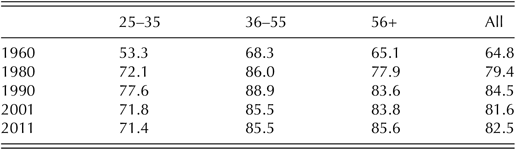
We start our empirical enquiry into the Norwegian case by showing how the homeownership rate has developed over time, across age and social strata (as defined by income). Rather than digging into the minutiae we concentrate on illustrating and interpreting broad patterns. First, we present an overview of national homeownership rates over a fifty-year period (based on data taken from census-files with complete coverage of the population). Note that we in the table report homeowner shares for individuals, and that these are typically somewhat higher than those of households, as larger families (e.g., as opposed to singles) have a higher propensity to become owner-occupiers. Moreover, we report shares at three distinct age cut-offs, each of them representing typical life course stages: young adulthood (twenty-five to thirty-five), ‘the family phase’ (thirty-six to fifty-five) and finally the empty nest phase (fifty-six plus).
The main pattern revealed by Table 1 is that the homeownership rate has increased by about twenty percentage points across all age spans from 1960 to the present. Most of this increase occurred before 1980. This indicates that the policies pursued in the ‘long postwar years’ were efficient instruments of homeownership promotion. Consider the fact that the urban homeowners that feature in Galster and Wessel’s study of Oslo are a relative novelty in a historical perspective. In 1920, only five per cent of the population in the Norwegian capital were listed as owner-occupiers in the official census. Between 1945 and 1990, however, the growth of urban homeownership was the major driver of the expansion of owner-occupation (Kohl and Sørvoll, Reference Kohl and Sørvoll2019). It is striking that the market-oriented and means-tested housing policy of the last three decades has not boosted homeownership rates. Even though the virtues of the homeownership are championed in recent policy documents, the general share of owner-occupiers has remained roughly constant after the new millennium (Revold et al., Reference Revold, Sandvik and With2018).
Homeownership rates by age 1960–2011.

Considering the results reported in Table 1, it also seems clear that long-term tenants have become increasingly marginalised over time because of the expansion of homeownership since 1960. In a social citizenship perspective, this is problematic due to the high value placed on owner-occupation in high-homeownership countries. The table also illustrates a pronounced (and admittedly not very surprising) life-cycle pattern. Relatively young adults have lower homeownership rates than the middle-aged ‘family-phase’ group; we should, however, note that the long-run increase between these two age groups are rather similar. Thus, the term ‘generation rent’, used widely in the British debate to denote falling homeownership rates among young people (cf. Forrest and Hirayama, Reference Forrest and Hirayama2018), does not really cover the Norwegian experience. The share of owner-occupation in young adulthood remained roughly similar in the first decade of the new millennium, and a recent study shows that this trend continued after 2011 (Revold et al., Reference Revold, Sandvik and With2018).
Homeownership rates in a citizenship perspective
The expansion of owner-occupied housing in Norway between 1960 and 1980 may be viewed favourably by observers partial to the socio-liberal and republican conceptions of citizenship. In this period, new social groups gained access to homeownership and received the benefits associated with this tenure in the Norwegian context, including higher housing standards and enhanced control and democratic influence over their dwellings and living environments. Throughout the country, households moved from crowded, low-quality housing to new, spacious owner-occupied dwellings with modern amenities. Particularly in large cities, such as Oslo, many households moved from small apartments owned and controlled by private landlords to new and relatively spacious housing cooperatives. These homeowner cooperatives gave residents responsibility and democratic power over their own housing situation, and were originally intended as anti-speculative and anti-landlord forms of owner-occupation (Reiersen and Thue, Reference Reiersen and Thue1996; Kiøsterud, Reference Kiøsterud2005; Sørvoll, Reference Sørvoll2014).
In brief, one may plausibly argue that the steadily increasing homeownership rate between 1960 and 1980 constitutes an extension of social citizenship or a more complete membership in society for many households measured in terms of housing standards, democratic influence and civic responsibility. This development is decidedly in accordance with a republican socio-liberal ideal of citizenship, that highlights the value of participatory democracy, community responsibility and a relative equality of living standards amongst the members of society. As noted above, however, the postwar expansion of owner-occupation had a price in terms of increasing marginalisation of long-term tenants.
In many other developed countries throughout the world, the exclusion of a growing share of young adults from the owner-occupied sector (McKee, Reference McKee2012) constitutes a significant challenge seen through the lens of the republican socio-liberal conception of citizenship. This is not true to the same extent in Norway. As shown above, since 1960 a similar share of people aged between twenty-five and thirty-five years old has had the chance to experience the individual and societal benefits of homeownership. What is particularly striking, is that the share of young adult owner-occupiers in Norway has been quite constant even though prices in residential property markets soared in both the pre-1990 boom and the long post-millennium boom (2000–2019). This is not only a product of a Norwegian oil-fueled exceptionalism. Other countries have experienced the same boom-in-bust-out phenomenon (Ortalo-Magne and Rady, Reference Ortalo-Magne and Rady1999). The simple mechanism behind this phenomenon is probably that young adults drive real estate prices upwards when they enter the market in large numbers.
The social stratification of homeownership
There exists a huge literature confirming that the propensity to be an owner-occupier increases with income. In Japan and Britain, for instance, official statistics illustrate that homeownership rates vary strongly between socio-economic groups – the richest households are unsurprisingly most likely to be owner-occupiers (Forrest and Hirayama, Reference Forrest and Hirayama2018). According to the literature, the main reason for the interdependence between income and homeownership is the simple facts that most households prefer owner-occupation and the opportunity to realise this desire depends on economic resources (Artle and Varaiya, Reference Artle and Varaiya1978; Hansen and Skak, Reference Hansen and Skak2008). Below we examine the homeownership rates across income deciles in Norway, and measure to what extent the strength of the relationship between income and homeownership has changed over time.
The available data limits our study of income and ownership in some ways. As mentioned above, we only use individual level data, even though we know that housing is consumed at the family level. Ideally, we would have studied how homeownership rates vary between deciles of family income. Since this is not possible, we choose to analyse how the homeownership rates of males aged between thirty-five and fifty-five differs according to their position in the male income distribution. It is well-known that male income correlates stronger with family income than female income (see e.g., Galster et al., Reference Galster, Andersson and Musterd2014), and this correlation may be stronger the further we go back in time.
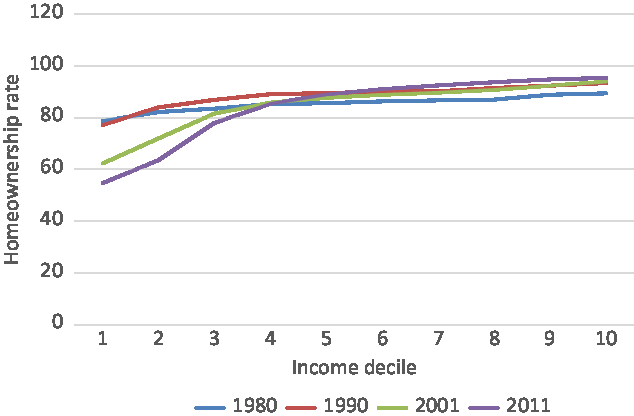
In Figure 1, we show that the ownership profiles are quite flat from the fourth income decile and onwards, in all four vintages considered. In the first two deciles, however, there are substantial differences between the four years studied. Moreover, there is a clear pattern where the most recent observations have the lowest homeownership rates at the lower income deciles. Moving from 1980 to 2011, we see that the income gradient of homeownership has become steeper. This indicates that the social marginalisation of tenancy has increased over the years considered – the relatively poor were increasingly more likely to rent a home. There are also important urban-rural differences to consider. Our claim that tenancy is increasingly becoming a tenure for the relatively poor is particularly well supported by the development in the Norwegian capital (results not shown in Figure 1).
Homeownership rates of males 35–55, across income deciles; 1980, 1990, 2001 and 2011.

Significantly, the reduction in low-income homeownership in Norway is a trend that continued after 2011. According to Revold et al. (Reference Revold, Sandvik and With2018), the total share of low-income homeowners decreased by ten percentage points between 2003 and 2016. Another study finds that the share of owner-occupiers in the bottom quarter of the income distribution decreased from 49.7 to 48 per cent between 2015 and 2018 (Revold, Reference Revold2019).
Low-income homeownership in a citizenship perspective
The decline of low-income homeownership in recent decades arguably constitutes a significant erosion of social citizenship in Norway. This claim is supported by the general benefits of owner-occupation in high-homeownership countries connected to the socio-liberal and republican conceptions of citizenship in a previous section. In addition, the centrality of the homeownership ideal in the Norwegian housing policy discourse contributes to marginalising long-term tenants. According to the current government’s strategy for the housing market, the desire to become an owner-occupier is ‘located deeply within the Norwegian national spirit’ (Departementene, 2015; see also, Sørvoll, Reference Sørvoll2011). Moreover, qualitative and quantitative studies confirm that the Norwegian rental market is characterised by (relatively speaking) low housing standards, crowdedness, social stigma and limited security of tenure and democratic influence (cf. Sandlie, Reference Sandlie, Sandlie and Grødem2013; Vassenden and Lie, Reference Vassenden and Lie2013; Sørvoll, Reference Sørvoll2019).
Almost 50 per cent of Norwegian tenants held fixed-term contracts or had no form of contract at all, according to Sandlie’s study published in Reference Sandlie, Sandlie and Grødem2013. This study also shows that tenants have a much higher probability of living in low standard housing (in terms of floor space per household member), move homes frequently and experience residential instability compared to homeowners (Sandlie, Reference Sandlie, Sandlie and Grødem2013; see also, Aarland and Reid, Reference Aarland and Reid2018). Thus, many tenants are excluded from the housing quality, security of tenure, residential stability and control associated with homeownership. This includes low-income tenants residing in municipal housing – one of the smallest and most means-tested social rented sectors in Europe. Municipal tenants in the largest cities have a weak security of tenure and risk being allocated housing in deprived neighbourhoods. They also have a very limited democratic influence and control over their dwellings and living environments. Moreover, the scarcity of social rented housing in Norway means that their freedom to choose where they want to live is virtually non-existent (Langsholt, Reference Langsholt2019; Sørvoll, Reference Sørvoll2019).
The problematic features of the Norwegian rental market in a social citizenship perspective is perhaps most troubling for disadvantaged long-term tenants, defined as households who have lived in rental housing over time and lack the capability to change their tenure status. According to a recent research report, long-term disadvantaged tenants may account for 3 to 4 per cent of the non-student adult population (Monkerud et al., Reference Monkerud, Astrup and Nordvik2018). Qualitative research confirms that there is at least a certain social stigma attached to long-term renting in contemporary Norway. Based on interviews with twenty-seven urban tenants, Vassenden and Lie (Reference Vassenden and Lie2013) show that some tenants keep information about their tenure status from acquaintances and experience social stigma as a consequence of their position in the housing market (see also, Vassenden, Reference Vassenden2014; Langsholt, Reference Langsholt2019).
To summarise the argument so far, we argue that the reduction in the share of low-income homeowners in Norway is an erosion of social citizenship viewed from a socio-liberal or republican perspective. This claim follows from the general benefits of homeownership identified in the literature, the subjective social stigma experienced by some tenants, and the objective reality that many Norwegian tenants have to learn to cope with the detrimental welfare outcomes of renting: limited security of tenure, sub-standard housing and limited influence over their dwellings and living environments. In short, the decline in low-income homeownership since 1990 meant that more disadvantaged tenants were denied the quality of housing necessary for full participation and membership in society in a republican socio-liberal sense.
From the vantage point of a narrow libertarian understanding of citizenship, social inequality in the distribution of housing tenures is of little concern. Adherents of this conception of citizenship may regard the decline of low-income homeownership in Norway as a consequence of voluntary, legitimate market transactions. On the other hand, a libertarian approach to social housing policy – focusing exclusively on disadvantaged households unable to help themselves in the market – may be stretched to include targeted subsidies to boost low-income homeownership (Norwegian Government, 2003–2004).
The distribution of housing wealth
The importance of the distinction between tenants and owner-occupiers notwithstanding, the fact is that some homeowners are more equal than others in terms of housing wealth. Based on data from Great Britain, the US and Japan, Forrest concludes that stratification ‘by income has been reinforced, not significantly modified, by the accumulation of housing wealth’ (Forrest, Reference Forrest2018: 8). Our study of housing wealth based on the tax files from 2014 (longer time series are not available), suggests there may be grounds for a similar conclusion in the Norwegian case. Unsurprisingly – but still notable – the tax data shows that housing wealth generally increases with income, albeit a more detailed study could possibly have produced a more nuanced picture.
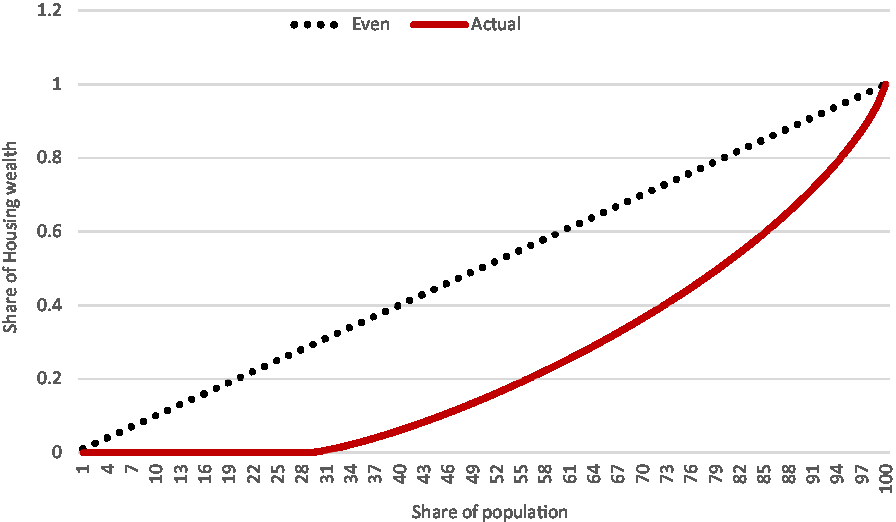
A Lorenz diagram is a typical method of displaying the distribution of wealth in a population. In Figure 2, we present the Lorenz curve of the distribution of housing wealth in Norway.
Lorenz curve Housing wealth 35–55 year old in 2014.

The Lorenz curve maps the share of the total housing wealth that is held by the z per cent of the population with the lowest housing wealth. Trivially, the curve starts in origó and ends in (1;100). The black dotted line in Figure 2 shows a hypothetical even distribution where everyone holds an equal amount of housing wealth, whereas the red line represents the real-life distribution; somewhat simplified one can say that the larger the area between the actual and the hypothetical even distribution, the higher the inequality. At a population share of, say, 50 per cent, the curve showing the actual distribution shows that the 50 per cent of the population with lowest share of the assets in question hold 14 per cent of the total housing wealth. A main explanation for this low number is the fact that a large share of the population holds zero housing wealth. Moving to the right in Figure 2, we see that the 80 per cent with the lowest housing wealth holds 50 per cent of the total wealth, whereas the top 20 per cent holds 50 per cent of the total housing wealth. The level of housing wealth inequality may also be assessed by using the Gini coefficient.
The Gini coefficient of the distribution of the housing wealth across households aged thirty-five to fifty-five in Norway in 2014 was 50 per cent. The Gini is a frequently used measure of inequality: the higher the Gini, the larger the inequality. A Gini of 50 per cent is rather high; the Gini of post-tax equivalence household income in Norway was 24.7 per cent in 2014. That the level of wealth inequality is (far) higher than income inequality is not atypical. Piketty reports a total wealth Gini for the Scandinavian countries in the 1970 and 1980s of 58 per cent – the other regions considered have total-wealth-Gini’s ranging from 67 to 85 per cent (Piketty, Reference Piketty2014: 248).
How should we interpret the very uneven distribution of housing wealth in a citizenship perspective? To phrase ourselves in Marshallian terms, the civil right to own residential property in Norway exacerbated economic inequality through the mechanism of the free urban housing markets established by the deregulation of the 1980s. For the libertarian this is of little importance, but it may be a greater concern for people who sympathise with the republican socio-liberal conception of citizenship. Seen from the perspective of a socio-liberal republican devoted to reducing inequality produced by the market, the disparities in housing capital are problematic, not least because this wealth may be transferred to new generations and influence housing opportunities, social integration and civic engagement in the future.
Concluding remarks: advancing social citizenship through homeownership promotion?
Above we argue that the decline of low-income owner-occupation and the uneven distribution of housing wealth in Norway is problematic for adherents of the socio-liberal and republican perspectives on citizenship. In our concluding remarks, we briefly evaluate the Norwegian government’s contribution to the reduction and exacerbation of social inequality in homeownership attainment and housing wealth. Finally, we suggest three policy strategies that may enhance the social citizenship of tenants in high-homeownership countries.
In the last fifteen years, the government has attempted to introduce low-income households to the benefits of homeownership through means-tested subsidies (cf. Sørvoll, Reference Sørvoll2011; Aarland and Reid, Reference Aarland and Reid2018). However, this has not been an unequivocal successful strategy of homeownership promotion, as indicated by the reduction of low-income owner-occupation after 1990. In brief, the Norwegian governments of the two last decades have not succeeded in reducing the social inequality in the distribution of homeownership.
The uneven distribution of housing wealth has not been a chief concern of Norwegian governments in the post-1990 era of deregulated housing markets and targeted housing policies. Whereas the Norwegian welfare state is still a generous and redistributive provider of universal benefits and services in a comparative perspective (Taylor-Gooby et al., Reference Taylor-Gooby, Hvinden, Mau, Leruth, Schøyen and Gyory2019), the distribution of economic resources in the field of housing is largely governed by market mechanisms. The current optimism on behalf of the market and limited emphasis on redistribution in the field of housing is partially a legacy from the long postwar years (1945–1990). From the 1980s onwards, it became possible for cooperative homeowners to make capital gains as a consequence of the deregulation of the housing market. This contributed to increasing housing wealth inequality between urban homeowners and other groups, particularly in Oslo (cf. Galster and Wessel, Reference Galster and Wessel2019). Moreover, since the mid-1970s, successive parliamentary majorities have ensured light taxation of residential property owned by individual households (Torgersen, Reference Torgersen1996; Bø, Reference Bø2019). Thus, inequalities in the distribution of housing wealth have not been seriously addressed by recent tax reforms.
Viewed through the lens of a republican socio-liberal conception of citizenship, recent Norwegian governments’ limited ambition when it comes to reducing social inequality associated with residential property is regrettable. In our view, three policy strategies may increase the level of social citizenship in the housing sector. These strategies should be relevant to all societies where owner-occupation is the norm. First, it is possible to expand homeownership to more low-income households by redeveloping the targeted policy instruments of contemporary housing policy. This may be a realistic libertarian strategy to reduce inequality in homeownership access, but does not address the uneven distribution of housing wealth. However, reforming housing taxation could kill some birds with one stone, to use the language of Erlend Bø (Reference Bø2019), and be more in line with a more ambitious socio-liberal conception of citizenship. The introduction of a more progressive housing taxation may reduce housing wealth inequality and contribute to a downward adjustment of property prices. In turn, this may make it easier for low- and medium income households to access homeownership in the largest cities, where booming housing markets has made it increasingly difficult for them to compete in the market (cf. Lund, Reference Lund2018; Bø, Reference Bø2019). Finally, the government could aim to enhance the social status and welfare outcomes of tenants. A new approach to the rental sector may focus on improving the residential stability of private and public tenants. Empirical research from different national contexts indicates that the social benefits of homeownership are connected to the high residential stability of owner-occupiers (Lindblad and Quercia, Reference Lindblad and Quercia2015; Aarland and Reid, Reference Aarland and Reid2018). In general, governments may enhance the social status and welfare outcomes of the rental sector by introducing elements associated with homeownership, such as higher security of tenure and greater democratic influence over dwellings and living environments. This would be in accordance with a republican socio-liberal conception of citizenship aiming for the inclusion and participation of low-income tenants in mainstream society.
Acknowledgements
We are grateful for the insightful comments of two anonymous referees and the editors of the themed section.