Introduction
Depression and positive symptom dimensions in psychosis are considered to be separate but inter-related dimensions of psychotic disorder (Krabbendam et al. Reference Krabbendam, Myin-Germeys, de Graaf, Vollebergh, Nolen, Iedema and van Os2004; van Os & Kapur, Reference van Os and Kapur2009) and are closely related on all levels of the psychosis continuum (Wigman et al. Reference Wigman, Lin, Vollebergh, van Os, Raaijmakers, Nelson, Baksheey and Yung2011). Clinically, this is reflected by diagnoses such as schizo-affective or mood disorders with psychotic features, in which depressive and psychotic symptoms co-occur. Depression is a commonly reported symptom in the prodromal phase of psychotic illness (Häfner et al. Reference Häfner, Maurer, Trendler, an der Heiden and Schmidt2005a; Iyer et al. Reference Iyer, Boekestyn, Cassidy, King, Joober and Malla2008) and has been shown to be associated with a transition to psychosis in ultra-high-risk samples (Yung et al. Reference Yung, Phillips, McGorry, McFarlane, Francey, Harrigan, Patton and Jackson1998, Reference Yung, Phillips, Yuen, Francey, McFarlane, Hallgren and McGorry2003, Reference Yung, Phillips, Yuen and McGorry2004). In addition, in general population samples, subclinical psychotic symptoms and depression are associated in both adolescents (Yung et al. Reference Yung, Buckby, Cotton, Cosgrave, Killackey, Stanford, Godfrey and McGorry2006; Armando et al. Reference Armando, Nelson, Yung, Ross, Birchwood, Girardi and Nastro2010; Mackie et al. Reference Mackie, Castellanos-Ryan and Conrod2011; Wigman et al. Reference Wigman, Lin, Vollebergh, van Os, Raaijmakers, Nelson, Baksheey and Yung2011) and adults samples (Krabbendam et al. Reference Krabbendam, Myin-Germeys, de Graaf, Vollebergh, Nolen, Iedema and van Os2004). Furthermore, the presence of depressive symptoms in combination with hallucinatory experiences in the general population increases the risk for a later diagnosis of clinical psychosis (Krabbendam et al. Reference Krabbendam, Myin-Germeys, Hanssen, de Graaf, Vollebergh, Bak and van Os2005).
Depression is a clinically relevant dimension in patients with schizophrenia with a prevalence range of 6–75% (average of 25%) during the course of the illness (Sands & Harrow, Reference Sands and Harrow1999; Peralta & Cuesta, Reference Peralta and Cuesta2001; Siris & Bench, Reference Siris, Bench, Hirsch and Weinberger2003; Häfner et al. Reference Häfner, Maurer, Trendler, an der Heiden, Schmidt and Könnecke2005b;van Os, Reference van Os2009). In the fully developed schizophrenia syndrome, depression has been associated with outcome (Häfner et al. Reference Häfner, Loffler, Maurer, Hambrecht and an der Heiden1999; Sands & Harrow, Reference Sands and Harrow1999; Conley et al. Reference Conley, Ascher-Svanum, Zhu, Faries and Kinon2007), higher relapse rates (Birchwood et al. Reference Birchwood, Mason, MacMillan and Healy1993) and increased risk of suicide (Siris, Reference Siris, Hwang and Bermanzohn2001; Lindenmayer & Khan, Reference Lindenmayer, Khan, Liebermann, Stroup and Perkins2006). A greater insight into the relationship between psychosis and depression can be obtained by measuring depressive symptoms and their associations with (subclinical) psychotic symptoms in siblings at genetic risk of psychosis. Siblings of patients with schizophrenia are at increased risk for psychosis, yet do not suffer from the consequences of having a chronic and disabling disorder or treatment. In addition, a higher prevalence of subclinical expression of psychotic vulnerability is found in siblings (Kendler et al. Reference Kendler, McGuire, Gruenberg and Walsh1995; Fanous et al. Reference Fanous, Gardner, Walsh and Kendler2001; Arajärvi et al. Reference Arajärvi, Ukkola, Haukka, Suvisaari, Hintikka, Partonen and Lönnqvist2006; Smith et al. Reference Smith, Cloninger, Harms and Csernansky2008). However, data on the prevalence of depression among siblings (including twins) are scarce. The majority of studies reported to date have used small numbers and their results are contradictory. Lee et al. (Reference Lee, Yoo, Kang, Lee, Ha, Wee, Lee, Kim and Kwon2008) reported that relatives of patients with schizophrenia experienced more difficulties recovering from unpleasant moods compared to healthy controls. Chang et al. (Reference Chang, Chen, Liu, Cheng, Yang, Cheng, Lane, Lin, Yang and Hwu2002) and Mortensen et al. (Reference Mortensen, Pederson and Pederson2010) found a higher risk for depression among siblings. Argyropoulos et al. (Reference Argyropoulos, Landau, Kalidindi, Toulopoulou, Castle, Murray and Picchioni2008) found that co-twins of schizophrenia probrands are more likely to be diagnosed with anxiety and depression disorders than control twins. However, other studies have not demonstrated a higher depression rate among siblings (Arajärvi et al. Reference Arajärvi, Ukkola, Haukka, Suvisaari, Hintikka, Partonen and Lönnqvist2006) and twins of schizophrenia patients (Lyons et al. Reference Lyons, Huppert, Toomey, Harley, Goldberg, Eissen, True, Faraone and Tsuang2000) compared to healthy controls. We are not aware of any investigations of the associations between depressive symptomatology and (sub)clinical psychotic symptoms in siblings of patients with non-affective psychotic disorders.
In the present study we report on the presence of, and relationship between, depressive symptoms and (sub)clinical positive and negative symptoms in a large cohort of non-psychotic siblings, their psychotic probands and healthy controls. The data were obtained in the Genetic Risk and Outcome in Psychosis (GROUP) project. Our study focused on three questions:
(1) Is the lifetime presence of depressed mood or lifetime depressive episodes according to DSM-IV more prevalent in patients with a non-affective psychotic disorder, and also in their siblings, in comparison with healthy controls?
(2) Are the severity and duration of depressive episodes associated with (sub)clinical levels of positive and negative symptoms in all three groups?
(3) Is there a familial clustering of lifetime presence of depressed mood or lifetime depressive episodes according to DSM-IV?
Method
Participants
The study sample consisted of patients with a diagnosis of non-affective psychotic disorder, their siblings, and controls from the general population in the context of the Dutch national GROUP project (Korver et al. Reference Korver, Quee, Roos, Simons and de Haan2012). Patients from selected geographical areas in The Netherlands and Belgium were identified by representative clinicians whose caseload was screened for inclusion criteria. Subsequently, a group of patients presenting consecutively at these services either as out-patients or in-patients were recruited for the study. First-degree relatives were sampled through participating patients. Control subjects were recruited through random mailings and advertisements in local newspapers. Written informed consent conforming to the guidelines approved by the local ethics committee was obtained from all subjects. We note that no participants from the Groningen site were included here because the Groningen site used the Schedules for Clinical Assessment for Neuropsychiatry (SCAN) instead of the Comprehensive Assessment of Symptoms and History (CASH; Andreasen et al. Reference Andreasen, Flaum and Arndt1992; Korver et al. Reference Korver, Quee, Roos, Simons and de Haan2012).
The inclusion criteria for the GROUP study were: fluency in Dutch; age in the range 16 to 55 years and, additionally for the patients, a DSM-IV diagnosis of non-affective psychotic disorder, assessed by clinical interview with the CASH, and first contact with mental health facilities within the past 10 years. At least one sibling of each patient was required to take part in the study. The sibling non-patient status was defined as the absence of any lifetime psychotic disorder by CASH interview. Participants in the control group lacked a personal psychotic disorder (CASH interview) and in addition did not have a first-degree family member with the Family Interview for Genetic Studies (FIGS), with themselves as informant (NIMH, 1992). It should be noted that some controls were related. This was controlled for by using multilevel analyses.
Measures
The sections on affective and psychotic disorders of CASH (Andreasen et al. Reference Andreasen, Flaum and Arndt1992) were used to confirm (a) the presence of a diagnosis of non-affective psychosis in patients; (b) the absence of such a diagnosis in their relatives; and (c) the absence of a lifetime diagnosis of any psychotic disorder or any current affective disorder in the healthy controls. Furthermore, the presence of lifetime depressed mood for a minimum of 2 consecutive weeks and the lifetime presence of clinical depression according to DSM-IV-TR criteria were derived from the CASH interview. Both depression measures (depressed mood and depressive episodes) were dichotomous (0 = absent/not meeting criteria, 1 = present/meeting criteria). The severity of depression was characterized by the duration of the longest depressive episode lifetime and the number of depressive symptoms during the longest lifetime depressive episode. Both the duration and the number of symptoms were considered as continuous variables, where the duration ranged from 0 to 997 days and the number of symptoms ranged from 0 to 8. In addition, positive and negative psychotic symptoms in the patient group were derived from the CASH. The weighted mean of a global evaluation of severity of lifetime delusions and lifetime hallucinations constituted the Positive Clinical Symptom Scale, a continuous variable ranging from 0 to 5 (0 = none, 1 = doubtful, 2 = mild, 3 = moderate, 4 = considerable, and 5 = severe). The weighted mean of a global evaluation of severity of lifetime apathy and asociality constituted the Negative Clinical Symptom Scale, a continuous variable ranging from 0 to 5 (0 = none, 1 = doubtful, 2 = mild, 3 = moderate, 4 = considerable, and 5 = severe).
The Community Assessment of Psychic Experiences (CAPE; Stefanis et al. Reference Stefanis, Hanssen, Smirnis, Avramopoulos, Evdokimidis, Stefanis, Verdouz and van Os2002; Konings et al. Reference Konings, Bak, Hanssen, van Os and Krabbendam2006) is a 42-item self-report measurement of psychotic experiences in the general population. The CAPE assesses the frequency on a scale of 0 to 3 (from ‘never’ to ‘almost always’) of lifetime subclinical psychotic experiences, and the distress associated with these symptoms also on a scale of 0 to 3 (from ‘no distress’ to ‘much distress’). The weighted mean of the positive subclinical symptom frequency items constituted the Positive Subclinical Symptom Scale and the weighted mean of the negative subclinical symptom frequency items constituted the Negative Subclinical Symptom Scale for the sibling and control groups.
Statistical analysis
First, we investigated the association between group (controls, siblings and patients) and depression. Multilevel logistic regression models were used with the categorical variable group (0 = controls, 1 = siblings, 2 = patients) as the independent variable and the two dichotomous measures of depression (depressed mood and depressive episodes) as dependent variables. Multilevel analyses were used because the patients and siblings, and also some of the controls, were related, thus invalidating the assumption of independence of observations and requiring conservative adjustment of standard errors for hierarchical clustering within families. Data were analyzed using the xtgee routine in Stata 11.0 (StataCorp, 2009). All analyses were corrected a priori for a possible confounding effect of age and sex.
In a second analysis, the association between depression and (sub)clinical psychotic symptoms in the three groups was tested separately using multilevel regression models (again using the xtreg routine in Stata 11.0). The two depression severity variables were the dependent variables in all three groups. The independent variables in the patient group were the two clinical psychosis symptom dimensions (positive and negative symptoms) of the CASH, and for the sibling and control groups the two subclinical symptom dimensions of the CAPE (positive and negative symptoms) were used. All independent variables were first put in the regression model(s) separately, and at a second stage jointly, to assess the independence of associations. All analyses were corrected a priori for age and sex.
Lastly, the familial clustering of depression was assessed using logistic regression models with the two CASH depression variables (depressed mood and depressive episodes) in the patient serving as independent variables, and with the same two CASH depression variables in their sibling(s) as dependent variables.
We thus performed a total of nine tests; as we tested research questions based on a priori assumptions, we chose not to correct for multiple comparisons. The level of significance is therefore p = 0.05. However, to allow for a conservative interpretation of the presented data, we point out that the Bonferroni (n = 9) corrected level of significance would be 0.006.
Results
Sample characteristics
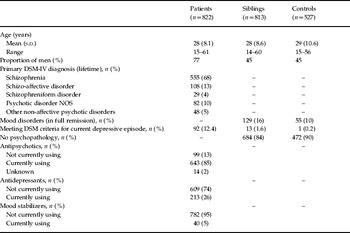
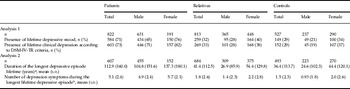
The first and the third analyses were performed on a total of 822 patients, 813 of their siblings and 527 control participants. However, as the data on the variables used in the second analyses were not available for all participants, only 607 patients, 684 siblings and 493 control participants were included in the second analyses. The sociodemographic and clinical characteristics of the three groups are presented in Table 1. The depression variables are displayed in Table 2 and the psychosis (sub)clinical symptoms variables in Table 3.
Sociodemographic and clinical sample characteristics

s.d., Standard deviation; NOS, not otherwise specified.
Scores on CASH depression variables

CASH, Comprehensive Assessment of Symptoms and History; s.d., standard deviation.
a Range 0–998.
b Range 0–8.
Scores on CASH (patients) and CAPE (siblings and controls) (sub)clinical psychosis symptom variables

CASH, Comprehensive Assessment of Symptoms and History; CAPE, Community Assessment Psychic Experiences.
Values given as mean (standard deviation).
The association between psychosis vulnerability and depression
Multilevel logistic regression analyses revealed an association between group and depressed mood (χ2 = 344.4, p < 0.0001). The patients reported more depressed mood compared to the controls [odds ratio (OR) 7.8, 95% confidence interval (CI) 5.96–10.14, p < 0.0001] and the siblings (χ2 = 275.8, p < 0.0001). No significant difference in depressed mood was found between siblings and controls (OR 1.22, 95% CI 0.95–1.57, p < 0.116). Both the patients and the siblings had a significantly increased risk of depressive episodes compared to the control participants (patients compared to controls: OR 8.9, 95% CI 6.81–11.67, p < 0.0001; siblings had borderline significantly increased risk compared to controls: OR 1.28, 95% CI 1.00–1.65, p = 0.050). Furthermore, the patients exhibited a significantly increased risk of depressive episodes compared to the siblings (χ2 = 363.3, p < 0.0001).
Depression severity and its association with (sub)clinical psychosis symptom dimensions
Multilevel regression analyses revealed that the duration of the longest depressive episode in the patient group was associated significantly with positive clinical psychosis symptoms (β = 11.22, 95% CI 1.49–20.94, p < 0.024) and negative clinical psychosis symptoms (β = 16.08, 95% CI 7.48–24.67, p < 0.0001). However, on introducing both independent variables into a single regression model, it was found that the negative clinical psychosis symptoms remained associated with the duration of the longest depressive episode (β = 14.35, 95% CI 5.27–23.43, p < 0.002), whereas the positive clinical psychosis symptoms were not (β = 6.00, 95% CI –4.22 to 16.22, p < 0.250). Slightly different results were obtained when considering the number of depressive symptoms during the longest depressive episode. Both positive (β = 0.47, 95% CI 0.33–0.61, p < 0.0001) and negative clinical psychosis symptoms (β = 0.55, 95% CI 0.43–0.67, p < 0.0001) were significantly associated with the number of symptoms in the patient group. The same conclusion was reached when both independent variables were entered into a single model.
The results for the sibling group were similar to those of the patients. The duration of the longest depressive episode was significantly associated with both positive (β = 87.32, 95% CI 45.71–128.93, p < 0.0001) and negative subclinical symptoms (β = 67.09, 95% CI 45.21–88.96, p < 0.0001). When both independent variables were entered into a single model, only the negative subclinical symptoms retained a significant association (negative symptoms: β = 58.94, 95% CI 33.21–84.66, p < 0.0001; positive symptoms: β = 28.98, 95% CI –19.29 to 77.25, p < 0.239). The number of depressive symptoms was significant in the model of positive (β = 3.73, 95% CI 2.79–4.67, p < 0.0001) and negative subclinical symptoms (β = 2.84, 95% CI 2.37–3.31, p < 0.0001) and both symptoms remained significant when entered together in one model.
The results for the control group differed from those of the siblings and the patients. In the control group, the duration of the longest depressive episode was significant in the model of negative subclinical symptoms (β = 47.13, 95% CI 15.00–79.25, p < 0.004) but not in the model of positive subclinical symptoms (β = –0.30, 95% CI –58.55 to 57.94, p < 0.992). The number of depressive symptoms was significant in the model of positive (β = 2.17, 95% CI 1.04–3.30, p < 0.0001) and negative subclinical symptoms (β = 2.08, 95% CI 1.47–2.68, p < 0.0001). When both were entered into a single model, only the negative symptoms remained significant (negative: β = 1.89, 95% CI 1.22–2.55, p < 0.0001; positive: β = 0.82, 95% CI –0.36 to 2.01, p < 0.174).
In this way we identified an association between depression and negative (sub)clinical symptoms in all three groups. In addition, we found an association between the number of depressive symptoms and positive (sub)clinical psychotic symptoms but only in the patients and the siblings.
Familial clustering of depression in families at risk for psychosis
Multilevel logistic regression analysis revealed that depressed mood in patients was significantly associated with depressed mood in their sibling(s) (OR 1.54, 95% CI 1.14–2.08, p < 0.005). Depressive episodes did not show familial clustering (OR 1.22, 95% CI 0.92–1.62, p < 0.177).
Discussion
In this study we investigated the presence of, and relationship between, depressive symptoms and (sub)clinical psychotic symptoms in a cohort of patients with a psychotic disorder, their siblings, and healthy controls. We found that patients reported more depressed mood than controls and siblings, whereas the siblings did not differ from the controls. Both patients and siblings exhibited a significantly increased risk of depressive episodes compared to the controls. The duration of the longest depressive episode was found to be associated with negative but not positive clinical psychosis symptoms in patients. However, the number of depressive symptoms was associated with both positive and negative clinical psychosis symptoms. Similar results were found for the siblings whereas in the controls only negative subclinical psychosis was associated with the duration of the depressive episode and the number of depressive symptoms. Finally, we found evidence for familial clustering at the level of depressed mood but not for depressive episodes.
The findings of a higher rate of depression in siblings compared to the controls are in line with Argyropoulos et al. (Reference Argyropoulos, Landau, Kalidindi, Toulopoulou, Castle, Murray and Picchioni2008). Nonetheless, they are at odds with a study of siblings showing similar rates of depression in siblings compared to controls (Arajärvi et al. Reference Arajärvi, Ukkola, Haukka, Suvisaari, Hintikka, Partonen and Lönnqvist2006). The higher average age of the participants in the latter study may explain the discrepancy as the majority of the non-psychotic siblings had already exceeded the age-related risk window for developing a psychosis. We are not aware of earlier studies of the association between depression and negative and positive psychotic symptoms in siblings. Our findings are in line with other results in populations with psychotic disorder (Norman & Malla, Reference Norman and Malla1991; Messias et al. Reference Messias, Kirkpatrick, Ram and Tien2001; Freeman & Garety, Reference Freeman and Garety2003; Drake et al. Reference Drake, Pickles, Bentall, Kinderman, Haddock, Tarrier and Lewis2004). However, as far as the healthy controls are concerned, our results show only a partial correspondence with other studies. Earlier studies in the general population revealed an association between depressive, negative and positive symptoms (Stefanis et al. Reference Stefanis, Hanssen, Smirnis, Avramopoulos, Evdokimidis, Stefanis, Verdouz and van Os2002; Krabbendam et al. Reference Krabbendam, Myin-Germeys, de Graaf, Vollebergh, Nolen, Iedema and van Os2004, Reference Krabbendam, Myin-Germeys, Hanssen, de Graaf, Vollebergh, Bak and van Os2005), contrasting with our finding of an association with negative symptomatology only. We note that whereas a weighted mean of all subclinical symptoms present in the CAPE was used in the study reported here, the former studies used a different methodology: only one positive symptom would identify positive psychotic symptoms.
The results in our study suggest that the duration of depression is only associated with the negative psychosis domain in patients and siblings whereas the number of depressive symptoms is associated with both negative and positive psychosis symptoms. These observations are difficult to explain in a straightforward way. They may be understood in the light of the different temporal dynamics of positive and negative psychosis. Clinically, positive symptoms tend to vary over time, as do depressive symptoms, whereas negative symptoms present themselves more continuously, in a trait-like fashion. As negative symptoms and depressive symptoms also show overlap (Siris, Reference Siris2000), negative symptoms may be found to be associated with the duration of depression. However, the co-occurrence of these symptom dimensions may also be explained by the phenomenon that raters are liable to rate conceptually similar phenomena (i.e. ‘blunted affect’ as observed in negative symptoms versus ‘depressed mood’ as seen in depression) in the same way. This obviously also relates to the important issue of whether depressive phenomena and (negative) psychotic phenomena are truly separate concepts.
The results of our study suggest that depressive symptoms are not simply a manifestation of the co-morbidity of schizophrenia or part of the risk phase of a psychosis but are inherently related to, in particular, negative (sub)clinical symptoms. This is in line with the suggestion that psychosis consists of multiple domains [positive, negative, cognitive and affective symptoms (van Os & Kapur, Reference van Os and Kapur2009)]. These domains fit in a continuous (subclinical) model in which correlated psychopathology dimensions (as seen in patients) are also apparent in risk groups and general population groups, only to a lesser extent (van Os et al. Reference van Os, Hanssen, Bijl and Ravelli2000, Reference van Os, Linscott, Myin-Germeys, Delespaul and Krabbendam2009; Myin-Germeys & van Os, Reference Myin-Germeys and van Os2007). Our findings underscore the presence of an inter-related depressive mood: a (sub)clinical negative psychosis continuum. It has been suggested that subclinical psychotic experiences and depression are interwoven phenomena that co-occur (Wigman et al. Reference Wigman, Lin, Vollebergh, van Os, Raaijmakers, Nelson, Baksheey and Yung2011). This previous finding is in accordance with suggestions that levels of depression mirror levels of subclinical psychotic experiences in the general population (Yung et al. Reference Yung, Nelson, Baker, Buckby, Baksheev and Cosgrave2009; Wigman et al. Reference Wigman, Lin, Vollebergh, van Os, Raaijmakers, Nelson, Baksheey and Yung2011). Our present study supports these findings but extends them by demonstrating that depressive phenomena are specifically related to the negative symptom domain. The overlap between negative and depressive symptomatology might play a role in this.
This study has shown an existing shared vulnerability in families with schizophrenia for both depressed mood (one of the major symptoms in a depression) and positive and negative (sub)clinical symptoms. This might indicate a familial vulnerability in families with schizophrenia for both depression and psychosis. The found associations between negative, positive and depressive symptoms in siblings (on a subclinical level) and in patients (on a clinical level) also indicate an overlap between the two concepts, depression and psychosis; there seems to be a shared risk that is also expressed at a subclinical level. In siblings, subclinical psychotic experiences and depressive symptoms may be an expression of inter-related aspects of the same underlying factor also seen in patients.
From a clinical point of view our findings are relevant; first, to underscore the increased risk of a depressed mood and a depressive episode for patients suffering from a psychosis. Determining the temporal appearance, duration and severity of depressive symptoms is necessary for diagnosis and treatment planning. A study by Yung et al. (Reference Yung, Buckby, Cosgrave, Killackey, Baker, Cotton and McGorry2007) showed an association between a reduction in depressive symptoms and a reduction in psychotic-like experiences. Treating depression may include pharmacological and psychosocial intervention. Because depressive symptoms may herald psychotic relapse, patients with depressive symptoms should be monitored carefully. Second, our results suggest that some of the healthy siblings (those with more depressive symptoms) are more at risk for psychosis then other siblings, and they have three risk factors: age, genetic liability and depressive symptoms (Hanssen et al. Reference Hanssen, Krabbendam, de Graaf, Vollebregh and van Os2005; Johnstone et al. Reference Johnstone, Ebmeier, Miller, Owens and Lawrie2005; Owens et al. Reference Owens, Miller, Lawrie and Johnstone2005; Yung et al. Reference Yung, Buckby, Cosgrave, Killackey, Baker, Cotton and McGorry2007).
Our results should be interpreted in the light of the following limitations. Our data are cross-sectional and therefore do not provide evidence regarding of the causal role of depressive symptoms on psychosis or vice versa. Another potential limitation is the difficulty in differentiating between negative and depressive symptoms, causing a risk for overlap. In addition, because of the age of our group, some of the unaffected siblings are at risk of developing psychosis.
We also need to consider several potential limitations of the GROUP study in general. The first is a selection bias; participants willing to participate in a demanding study protocol may be different from participants in other less demanding studies, or from subjects refusing to participate in research. Controls and siblings could have a current depressive episode; however, this may have reduced the chance of participation in a study. Another selection bias is the exclusion of patients without brothers or sisters. Second, differences between relatives and healthy controls may be difficult to detect because not all siblings of a specific patient are included, and siblings with more subclinical symptoms may have been more reluctant to participate in the GROUP study. Third, inter-rater reliability remains a vulnerability in large multisite studies. Within the GROUP project the inter-rater reliability of the most important diagnostic instruments was assessed. The inter-rater reliability of the diagnostic classification according to DSM-IV as measured by the CASH was satisfactory, based on assessing the concordance between the CASH diagnosis and the diagnosis assessed by the treating clinician. A randomly selected comparison of 65 subjects with a psychotic disorder revealed a difference in diagnosis in only one case. However, the specific inter-rater reliability of negative and depressive symptoms was not assessed, and this is a limitation. The inter-rater reliability of the CAPE is not an issue, as this is a self-report questionnaire. Fourth, in this study we did not have the data on relevant medication for the siblings and controls. As these may influence the severity and the course of the symptoms, this should be regarded as a limitation.
In conclusion, we have shown siblings and patients to be more at risk of a depressive episode and their depressive symptoms are associated with positive and negative (sub)clinical psychotic symptoms. These findings suggest that a co-occurring genetic vulnerability for both depressive and positive and negative psychotic symptomatology exists on a clinical and also on a subclinical level. Clinically, the question of the efficacy of treatment of depressive symptoms in siblings for reducing (sub)clinical psychotic symptoms and risk of transition to overt psychosis merits further study. Finally, to investigate the relationship between depressive symptoms and subclinical psychotic symptoms in siblings over time, longitudinal data are required.
APPENDIX. GROUP investigators
R. Kahn, D. Linszen, J. van Os, D. Wiersma, R. Bruggeman, W. Cahn, L. de Haan, L. Krabbendam and I. Myin-Germeys.
Acknowledgments
We are grateful for the generosity of time and effort of the patients and their families, healthy subjects and all researchers, who made this GROUP project possible. The infrastructure for the GROUP study is funded by the Geestkracht program of the Dutch Health Research Council (ZON-MW, grant no. 10-000-1002) and matching funds from participating universities and mental health care organizations (Site Amsterdam: Academic Psychiatric Centre AMC, Ingeest, Arkin, Dijk en Duin, Rivierduinen, Erasmus MC, GGZ Noord Holland Noord; Site Utrecht: University Medical Centre Utrecht, Altrecht, Symfora, Meerkanten, Riagg Amersfoort, Delta; Site Groningen: University Medical Centre Groningen, Lentis, GGZ Friesland, GGZ Drenthe, Dimence, Mediant, GGZ De Grote Rivieren and Parnassia psycho-medical centre; Site Maastricht: Maastricht University Medical Centre, GGZ Eindhoven, GGZ Midden-Brabant, GGZ Oost-Brabant, GGZ Noord- Midden Limburg, Mondriaan Zorggroep, Prins Clauscentrum Sittard, RIAGG Roermond, Universitair Centrum Sint-Jozef Kortenberg, CAPRI University of Antwerp, PC Ziekeren Sint-Truiden, PZ Sancta Maria Sint-Truiden, GGZ Overpelt, OPZ Rekem). The analyses were supported by unrestricted grants from Jansen-Cilag, Eli Lilly and Company, AstraZeneca and Lundbeck.
N. J. M. van Beveren has received unrestricted personal grants from AstraZeneca Netherlands and PsyNova Neurotech, Cambridge, UK.
Declaration of Interest
None.