Introduction
Antimicrobial Resistance (AMR) is recognized as one of the most threatening current issues in today’s healthcare sector, endangering the past several decades of innovations in Infection Prevention and Control (IPC). According to global estimations, if current trends continue, drug-resistant infections may lead to as many as 10 million deaths per year by the year 2050, surpassing cancer-related deaths.Reference O’Neill1 , Reference Cassini, Högberg and Plachouras2 The World Health Organization (WHO) ranks AMR in its top-ten current global health risks, explaining that it is imperative to tackle this issue by implementing comprehensive Antimicrobial Stewardship (AMS) strategies, surveillance, as well as behavioral approaches.3,Reference Zeb, Mushtaq and Ahmad4
Simultaneously, the pace of development in digital communication has transformed the dynamic between consumers of health information and publicly available data. Health information dissemination is increasingly mediated through social platforms such as Twitter/X, Reddit, and Facebook. Importantly, the virality of misinformation is driven not by social media alone but by algorithmic amplification mechanisms, including recommender systems and engagement-based ranking. In this study, misinformation refers to antibiotic-related claims that contradict established clinical guidelines or consensus public health evidence at the time of posting. Unfortunately, algorithmic ranking systems prioritize emotionally arousing postings over scientific facts, creating conditions that facilitate the rapid spread of misinformation.Reference Vosoughi, Roy and Aral5–Reference Del Vicario, Bessi and Zollo7
Health-related misinformation has been shown to influence health behaviors across multiple contexts.Reference Vosoughi, Roy and Aral5,Reference Cinelli, De Francisci Morales, Galeazzi, Quattrociocchi and Starnini6,Reference Wang, Mckee, Torbica and Stuckler8 During the COVID-19 outbreak, misinformation pertaining to vaccination, wearing masks, and treatments led to a significant indirect influence in people’s adherence.Reference Islam, Sarkar and Khan9,Reference Suarez-Lledo and Alvarez-Galvez10
In antibiotic-related issues, incorrect information may contribute to actions that work against antibiotic stewardship. Misinformation of types like “antibiotics work to cure viral infections,” “self-medication is safe,” or “natural alternatives work as well as prescription antibiotics” is common in social platforms.Reference Dyar, Huttner, Schouten and Pulcini11–Reference Zucco, Lavano, Anfosso, Bianco, Pileggi and Pavia13 Such misinformation may raise challenges of increased patient demand for inappropriate prescription, poor patient compliance, and, by association, influence healthcare practitioners’ prescription of antibiotics due to patient pressure.Reference Larson and Broniatowski14 The early studies of online patient antibiotic use during episodes of respiratory infections as well as during the COVID-19 pandemic shows that social media platforms influence both patient information acquisition as well as patient decisions to self-medicate using antibiotics.Reference Nakakande, Taremwa, Nanyingi and Mugambe15 These findings indicate that online narratives may shape real-world antibiotic consumption patterns.
Despite this increasingly acknowledged concern, little exploration exists of the relationship between misinformation in this digital age and the development of AMR or measurable outcomes in stewardship efforts. Current awareness campaigns, such as World Antimicrobial Awareness Week sponsored by WHO, remain focused on information dissemination as a principle for fostering better antimicrobial-related outcomes.16,Reference Huttner, Saam and Moja17 Nonetheless, theories of influence and communication demonstrate that exposure, trust, and social influence tend to supplant understanding in more divided online environments.Reference Lewandowsky, Ecker and Cook18,Reference Nyhan and Reifler19 Consequently, misinformation is not merely a poor communication but an epidemiological and behavioral exposure that may subvert AMS and IPC interventions.
The novel field of infodemiology, which describes an epidemic of information as it is measured in an epidemiologic study, provides an avenue to quantify this exposure.Reference Eysenbach20,Reference Gozzi, Tizzani and Starnini21 The analysis of electronic signals which precede alterations in health-related behavior could complement current systems for monitoring AMS by using infodemiologic surveillance.
Accordingly, this study utilizes a computational framework for infodemiology to study antibiotic-related misinformation as a risk factor of interest to AMS and healthcare epidemiology using 1.8 million publicly available postings from social platforms including Twitter/X, Reddit, and Facebook from (2015 to 2025). This study determines the predominant topics and emotional tone of antibiotic-related misinformation, characterizes its diffusion dynamics and network structure, and examines temporal correlations with AMS indicators.
Through the integration of digital-behavioral dynamics with real-world AMR surveillance data, this study positions antibiotic misinformation as a relevant exposure in stewardship by leveraging real-world data to better understand dynamics of AMR-related prescription risk in healthcare environments.
Methodology
Study design
This study used a retrospective observational design combining large-scale analysis of publicly available social media posts with time-series epidemiologic methods to examine whether fluctuations in online antibiotic misinformation aligned temporally with indicators relevant to AMS.Reference Von Elm, Altman, Egger, Pocock, Gøtzsche and Vandenbroucke22
Setting and data sources
Posts from publicly available platforms, including Twitter/X, Reddit, and Facebook, from January 2015 to June 2025, were collected, reflecting international discussion about antibiotic usage and resistance. Application Programing Interface (API) tools, including Twitter Academic API v2, Reddit Pushshift, and Meta’s research tools for public Facebook content (CrowdTangle prior to its deprecation in August 2024 and the Meta Content Library thereafter), were used to extract data from publicly available platforms,Reference Baumgartner, Zannettou, Keegan, Squire and Blackburn23–25 resulting in a final database of approximately 1.8 million screened posts. Twitter/X, Reddit, and Facebook were selected due to their public data accessibility, longitudinal availability across the study period, and established use in prior health misinformation research. Platforms such as WhatsApp, TikTok, Instagram, and YouTube were excluded because their data are either private, algorithmically opaque, or unsuitable for reproducible longitudinal analysis.
Keyword lists were developed using an iterative process, beginning with the World Antimicrobial Awareness Week lexicon and past studies of AMR messaging.Reference Roope, Smith and Pouwels12,26 These sources were selected to ensure alignment with internationally recognized antimicrobial messaging. Publicly available data demonstrate awareness week campaigns have, at times, led to observed changes in search engine trends and healthcare-seeking actions.Reference Keitoku, Nishimura, Hagiya, Koyama and Otsuka27,Reference Hammoudi Halat, Kassem, Osman and Manageiro28 Keywords targeted antibiotic names, inappropriate usage (e.g., “self-medication” and “leftover antibiotics”), as well as misinformation (e.g., “antibiotics cure common cold” and “natural home remedies for antibiotics’ efficacy”). Only English-language tweets contributed to this phase of analysis.
For assessing the epidemiologic significance, monthly resistance indicators for different classes of antibiotics, taken from the WHO GLASS database,3 and antibiotic consumption rates were sourced from Our World in Data (OWID),Reference Ritchie, Mathieu and Rodés-Guirao29 selected for its standardized, publicly accessible antibiotic usage indicators. Resistance indicators focused on three organism–drug pairs: Escherichia coli (third-generation cephalosporins), Klebsiella pneumoniae (carbapenems), and Staphylococcus aureus (methicillin). These organism–drug pairs were selected due to their global surveillance consistency and routine reporting within international AMR monitoring systems.
Data processing and classification
Text data underwent standard natural language processing (NLP) in Python (tokenization, lemmatization, removal of stop-words)30. Posts were labeled as misinformation or factual using a fine-tuned transformer model based upon BERT, which was trained upon manually labeled data from previous health communication corpora,Reference Gu, Tinn and Cheng31,Reference Devlin, Chang, Lee and Toutanova32 The classification accuracy of this model has been validated using a stratified 10-fold cross-validation technique (F1 = .89).
The sentiment features, as well as emotional tone, were extracted using the National Research Council (NRC) Emotion LexiconReference Mohammad and Turney33 to classify affective valence (positive, negative, fear, anger, disgust). Posts were also clustered into misinformation topics using topic modeling (Latent Dirichlet Allocation, 20 topics).Reference Blei, Ng and Jordan34 Topics were clustered into four relevant to stewardship categories: Self-medication advocacy, Promotion of natural or alternative remedies, Misinformation alleging hidden motives or suppressed evidence, and Anti-medical establishment content.
Network and diffusion analysis
For understanding the dissemination of misinformation in online networks, Gephi (version 0.9.7) software tools were used to create retweet/reply/repost graphs.Reference Bastian, Heymann and Jacomy35,36 These graphs plotted nodes as individual accounts, whereas links showed shared content as well as interactions in social media platforms to demonstrate echo chambers as well as influential nodes, also known as super-spreaders.Reference Vosoughi, Roy and Aral5,Reference Cinelli, De Francisci Morales, Galeazzi, Quattrociocchi and Starnini6 Diffusion speed is measured as an average time (in hours) to attain cumulative reshares of 90% per theme.
Temporal and epidemiologic analysis
Monthly misinformation intensity was standardized using z-scores to normalize activity across platforms with differing baseline volumes, enabling comparison of relative temporal fluctuations rather than absolute post counts. Temporal associations between misinformation intensity and stewardship-relevant indicators were assessed using Spearman rank correlations. Antibiotic search intent was defined as Google Trends query volume for consumer-oriented antibiotic acquisition and usage terms (e.g., “buy antibiotics online,” “amoxicillin dosage,” “antibiotics for flu,” and “antibiotics without prescription”).Reference Ginsberg, Mohebbi, Patel, Brammer, Smolinski and Brilliant37 Lead–lag relationships were examined using Granger causality testing across lags of 1–9 months, and cross-correlation analyses were performed for misinformation intensity and antibiotic-related search activity. Multiple testing was addressed using Benjamini–Hochberg false discovery rate adjustment, with P < .05 considered statistically significant.
Validation and sensitivity analyses
Robustness was evaluated by restricting analyses to verified account holders and subreddit moderators to reduce automated activity, adjusting for pandemic-era anomalies between March 2020 and December 2021 using dummy variables, and cross-validating model outputs with independent datasets from 2023–2025 that were not included in model training.
Software and tools
Data analyses in Python (v3.10) as well as R (v4.3) were done using the packages “pandas,” “scikit-learn,” “statsmodels,”and the graph library “igraph” for graph analysis, whereas graph visualizations were completed using tools from “matplotlib” as well as Gephi.
Ethical considerations
All data used in this study is publicly available, anonymized, and did not involve collecting any information which could identify individuals. As an institutional requirement, as well as in line with principles set in the Declaration of Helsinki, this study did not require ethics approval for human subject testing.Reference Eysenbach20 Data handling is in compliance with the respective platform terms of service and General Data Protection Regulation (GDPR) data-processing criteria.
Analytical workflow
A brief overview of the total analytics process, data acquisition, as well as integration, is described in Figure 1. This graphic shows how data acquisition from social media, preprocessing of texts, classification of misinformation, topic modeling, link analysis between data from WHO GLASS, Google Trends, and finally integration into an AMS dashboard is accomplished.
Analytical workflow for digital misinformation and AMR-surveillance integration. The following figure provides an overview of the key steps in the analytical workflow adopted in the study. Social-media data from Twitter/X, Reddit, and Facebook were collected and processed through text-cleaning pipelines before misinformation classification using a fine-tuned BERT model. Thematic and network structures were derived using LDA topic modeling and Gephi, followed by temporal linkage with WHO GLASS and Google Trends data and final integration into an antimicrobial stewardship (AMS) dashboard. Abbreviations: BERT, bidirectional encoder representations from transformers; LDA, latent Dirichlet allocation; GLASS, global antimicrobial resistance surveillance system; AMS, antimicrobial stewardship.

Results
Finally, after data preprocessing, a total of 1.8 million posts were selected from Twitter/X (57%), Reddit (28%), and Facebook (15%) between January 2015 and June 2025. Posts were classified into misinformation and factual/neutral categories prior to thematic and temporal analysis, of which 19.3% (n = 347,000) contained verifiable antibiotic-related misinformation, whereas 80.7% (n = 1.45 million) contained factual or neutral content.
Misinformation intensity and thematic composition
Out of 1.8 million posts analyzed overall, 19.3% (approximately 347,000 posts) were categorized as antibiotic misinformation. By applying topic modeling analysis, there were four distinct and exclusive themes associated with antibiotic misinformation identified as self-medication promotion (32%, ∼111,000 posts), promotion of natural or alternative methods (28%, ∼97,000 posts), misinformation alleging hidden motives or suppressed evidence (23%, ∼80,000 posts), and anti-establishment messages (17%, ∼59,000 posts). Posts categorized as misinformation contained negative or fear-linked emotional content at a rate 2.4 times higher than factual or neutral posts (P < .001). Fear and disgust were the predominant emotions observed in misinformation posts, whereas trust and anticipation predominated in factual and neutral posts. Regarding time-series analysis, there were periods associated with an overall escalation in antibiotic misinformation during World Antibiotic Awareness Week in 2017 and in relation to COVID-19 in 2020 and Seasonal Flu Peaks in 2022 (Figure 2).
Temporal trends in antibiotic-related misinformation versus factual posts, 2015–2025. Standardized (z-score) monthly trends of misinformation (red), factual information (blue), and antibiotic-related search interest (gray dashed line) from 2015 to 2025. Vertical dashed lines indicate periods of major public health events. Z-scores represent relative monthly surges compared with each platform’s baseline activity. Abbreviations: z-score, standardized score.

Diffusion dynamics and network structure
Network analysis revealed highly uneven patterns of content dissemination across platforms. On Twitter/X, 0.21% of users accounted for 41% of all reshares, while on Reddit, misinformation diffusion was concentrated within 27 highly active subreddits. On Facebook, dissemination was driven primarily by fewer than 100 public pages that repeatedly reposted similar content. Misinformation spread significantly faster than factual information, reaching 90% of cumulative reshares in a mean of 4.1 hours compared with 11.6 hours for factual content (P < .001). High modularity indicates that misinformation circulated within tightly clustered user groups with minimal interaction between communities, whereas factual information showed lower modularity and greater cross-group exchange. Overlap between misinformation networks and verified medical or public health accounts was limited, with only 6.8% of misinformation posts intersecting with accounts identified as reputable medical sources (Figure 3).
Network structure of antibiotic misinformation versus factual information. (A) Misinformation network with high modularity (Q ∼ 0.71), indicating tightly clustered communities with limited cross-group interaction. (B) Factual-information network with lower modularity (Q ≈ 0.38) and more links between the nodes. This pattern reflects greater network polarization in misinformation content compared with factual information. Abbreviations: Q, network modularity index.

Cross-platform temporal correlations
Monthly misinformation intensity showed a strong concurrent association with antibiotic-related search activity measured using Google Trends (Spearman ρ = .74; P < .001) and with traffic to online pharmacy platforms (ρ = .63; P < .01). Granger lead–lag analysis across lags of 1–9 months identified the strongest associations at 2–3 months (P < .01). Temporal alignment between misinformation intensity and antimicrobial-resistance indicators from WHO GLASS demonstrated peak correlations at lags of 6–9 months for Escherichia coli (third-generation cephalosporins), Klebsiella pneumoniae (carbapenems), and Staphylococcus aureus (methicillin), with correlation coefficients ranging from 0.30 to 0.40 (Figure 4).
Temporal lag between misinformation peaks and antimicrobial-resistance indicators. Analysis of lag-correlation between monthly MIS intensity andReference Alghadeer, Aljuaydi, Babelghaith, Alhammad and Alarifi38 antibiotic-related search behavior,Reference Auta, Hadi and Oga39 traffic on online pharmacies, andReference Bastian, Heymann and Jacomy35 WHO GLASS resistance data. The maximum correlation for behavioral factors occurred earlier, at 2–3 mo, with ρ values of .74 and .63 for search behavior and traffic on online pharmacies, respectively. The maximum correlation for resistance occurred at 6–9 mo, with ρ values ranging from .30 to .40 for E. coli (3 GC), K. pneumoniae (carbapenem), and S. aureus (methicillin). Abbreviations: AMR, antimicrobial resistance; GLASS, global antimicrobial resistance surveillance system; 3 GC, third-generation cephalosporins; ρ = spearman correlation coefficient.

Sensitivity analyses
Sensitivity analyses yielded similar estimates across analytic conditions. Exclusion of suspected automated accounts resulted in changes of less than 5% in correlation coefficients. Adjustment for pandemic-period anomalies between March 2020 and December 2021 produced minimal variation in effect sizes. In geolocated analyses, correlations were higher in countries where antibiotics were accessible without prescription (ρ = .79) compared with countries with stricter regulatory controls (ρ = .51).
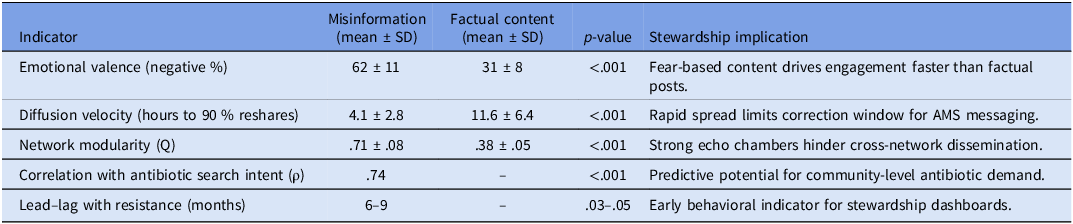
Table 1 summarizes quantitative differences between antibiotic misinformation and factual content across platforms.
Key quantitative indicators comparing antibiotic misinformation and factual content (2015–2025)

Note. Means ± standard deviation for data from Twitter/X, Reddit, and Facebook platforms. ρ = Spearman rank correlation coefficient; Q, modularity index of studied networks. AMS, antimicrobial stewardship. GLASS, Global Antimicrobial Resistance Surveillance System. p-values are for two-tailed tests (t-tests, correlation). Resistance markers for pathogens Escherichia coli (third-generation cephalosporin antibiotics), Klebsiella pneumoniae (carbapenems), Staphylococcus aureus (methicillin). All correlations passed false discovery rate correction (p-values<.05).
Discussion
From this study, large-scale, cross-platform data supports the interpretation of digital misinformation as a measurable behavioral exposure temporally aligned with stewardship-relevant indicators in AMS and healthcare epidemiology. Through examining approximately 1.8 million postings of social media, this study showed that antibiotic misinformation is optimized in a manner that is structured for amplification and is also correlated to trends in antibiotic demand and resistance measures. This is an extension of previous research that primarily focused upon clinical and agricultural misuseReference Holmes, Moore and Sundsfjord40,Reference Ventola41 by revealing an informational and behavioral layer of AMR propagation that operates outside clinical settings but ultimately influences prescribing and adherence within them.
Behavioral contagion and stewardship risk
From this analysis, it is clear that misinformation diffuses at an epidemic speed–diffusing approximately three times faster than correct statements–and sustains itself in strongly cohesive echo chambers. This impedes correction by traditional methods of public health.Reference Vosoughi, Roy and Aral5,Reference Cinelli, De Francisci Morales, Galeazzi, Quattrociocchi and Starnini6 From an AMS standpoint, this information diffusion process could raise inappropriate patient expectations, patient self-medication, and physician prescribing pressure.Reference Dyar, Huttner, Schouten and Pulcini11,Reference Roope, Smith and Pouwels12 Furthermore, the lead-lag of approximately 6–9 months between episodes of misinformation diffusion and AMR markers indicates that online stories could provide early warnings of potential changes in antibiotic usage, which would appear as antimicrobial-resistance markers in later antibiograms.
Probable mechanisms linking misinformation to resistance trends include increased inappropriate antibiotic demand, higher rates of self-medication and incomplete courses, and greater prescribing pressure on clinicians. These behaviors increase selective pressure on circulating bacterial populations, potentially contributing to observed resistance patterns.
Integrating digital surveillance into stewardship systems
While traditional methods of AMS monitoring, which utilize data from point prevalence surveys, pharmacies, and microbiological laboratory results, remain vital, they tend to trail behind actual shifts in behavior. Furthermore, results from this study demonstrate that electronic analyses of actual behavior might serve as a complement to current dashboards for stewardship, offering an early warning for an impending spike in community demand for, or misunderstanding of, particular drug categories. While methods for this kind of analysis have been discussed in relation to infodemiology for vaccine-related issuesReference Gallotti, Valle, Castaldo, Sacco and De Domenico42,Reference Eysenbach20 as well as for tracking misinformation, they have, as of yet, been untried in relation to actual antimicrobial use stewardship.
Implications for infection prevention and healthcare epidemiology
IPC campaigns mostly utilize strong adherence to evidence-based behaviors, including hand washing, isolation procedures, and antimicrobial resource management. Digital misinformation hampers this by denting confidence in healthcare organizations and fostering patient-controlled healthcare approaches. Inclusion of misinformation surveillance in hospital epidemiology would align with the fundamental aims of healthcare authorities, namely, risk forecasting, determining intervention time, and assessing program effectiveness. For example, an upsurge in misinformation spread about natural antibiotics may initiate pharmacist staff educational campaigns in weeks, not after several months of receiving data about antibiotic drug-resistance rates.
Policy and communication considerations
From a policy perspective, these findings provide strong support for WHO/CDC recommendations to include infodemic response in national AMR plans.16 A combined effort of infection control, communication, and data science experts may provide real-time responses to misinformation surges associated with particular pathogens/drug classes in order to prevent censorship but apply precision communication by disseminating accurate/corrected information via the same communication platforms where misinformation is circulating.
Limitations
There are several issues to note in relation to this study. First, this research analyzed English-language publications only, whereas analysis across multiple languages in a generalizable study could prove useful in further research. The observed relationships here are ecological, rather than causal, in nature, although they do provide informative insights into human behavior.
Comparative analysis between countries with differing levels of social media penetration was not feasible due to inconsistent resistance surveillance coverage and platform usage metrics and represents an important direction for future research.
Classification of misinformation is inherently context-dependent, and skepticism toward medical institutions or interest in alternative therapies does not uniformly indicate falsehood. Additionally, unmeasured confounders such as seasonal outbreaks, pandemic waves, and heightened disease activity may independently increase both antibiotic use and online engagement.
Future directions
Future work should test the validity of such cyber signals against prescribing data at a hospital level, so also at a level of resistance, in quasi-experimental studies where misinformation surges are set to trigger predefined AMS intervention measures.
Conclusions
Digital misinformation about antibiotics is an emerging frontier in infection prevention and AMS. The study shows, in fact, that online misinformation diffused quickly, fell into echo chambers, and preceded actual changes in related online behaviors regarding antibiotics. A proactive, data-driven strategy for AMR prevention in healthcare epidemiology is possible by identifying misinformation as a relevant behavioral exposure within contemporary epidemics, as well as by adding digital analytics of those behaviors to actual AMS strategies.
Acknowledgements
The authors wish to extend their gratitude to the research support office at University of Tabuk, as well as to IPC Department, Ministry of Health (Saudi Arabia) for providing them support in this study. The authors also appreciate open-access data contributors, including Twitter/X Academic Research, Reddit Pushshift, Meta’s research tools for public Facebook content, WHO GLASS, and Google Trends, for providing data for scientific use.
Financial support
This study did not receive any external funding.
Competing interests
The author(s) declare no conflicts of interest.