Introduction
Several researchers have argued that establishing an explanation for abuse and neglect of older adults is crucial because understanding the reasons for the mistreatment makes possible the development of preventative programs and targeted interventions (McDonald, Reference McDonald2011). Bonnie and Wallace (Reference Bonnie and Wallace2003) have noted that without some type of theoretical approach to data collection, facts about elder abuse and neglect in domestic or institutional settings will continue to be misleading and non-cumulative (p. 60). Theory guides the scope and reach of a study, provides the basis for predicting causation, and influences how terms are conceptualized and operationalized. Regrettably, the theorizing about abuse and neglect that occurs in the community or institutions has been limited in scope. No overarching theoretical framework has guided research in this field (Ansello, Reference Ansello, Baumhover and Beal1996; Bonnie and Wallace, Reference Bonnie and Wallace2003; McDonald, Reference McDonald2011). Most theories address only some aspects of potential causes of elder abuse and neglect. Situational theory, for example, posits that caregivers can be overburdened, unable to satisfy the demands of their care recipients, and consequently perpetrate abuse. Exchange theory suggests that unhealthy interactions among family members begin at an early stage in their relationship, continue on into adulthood, and later lead to abuse. According to social learning theory, abusive behavior is learned over time, until it is finally acted upon. Under political economic theory, elderly adults exist in the context of a society in which they first are marginalized and then are subjected to abuse (Wolf, Reference Wolf1992; Fulmer, 2004). These theories have been critiqued extensively to the point that it is evident that they are not especially helpful (McDonald, Reference McDonald2011; NICE, 2012). Indeed, many scholars have now proposed that there is a broad diversity of manifestations of abuse and neglect and are searching for new theories that can explain a single dimension of mistreatment such as sexual abuse (Teaster and Roberto, Reference Teaster and Roberto2004). None of these theories can link structural and individual factors like ageism (Dow and Joosten, Reference Dow and Joosten2012) and abuse and many inadvertently blame the victim (McDonald, Reference McDonald2011). Much of the literature on elder abuse does not sufficiently distinguish between theoretical explanations and the individual factors related to mistreatment. Factors, such as caregiver stress or dependency, are often treated as complete theoretical explanations although they are only factors and could be incorporated into any theory (McDonald, Reference McDonald2011). Because of the lethal outcomes of elder abuse and neglect such as higher rates of mortality for the abused (Lachs et al., Reference Lachs, Williams, O'Brien, Pillemer and Charlson1998), researchers have understandably focused on solutions rather than causes.
In a recent review of domestic prevalence studies worldwide – two studies from Canada (Podnieks, Reference Podnieks1993; Pottie Bunge, Reference Pottie Bunge, Pottie Bunge and Locke2000), four from the United States (Pillemer and Finkelhor, Reference Pillemer and Finkelhor1988; Laumann et al., Reference Laumann, Leitsch and Waite2008; Acierno et al., Reference Acierno2010; Lifespan of Greater Rochester Inc., 2011); one from India (Chokkanathan and Lee, Reference Chokkanathan and Lee2005), five from Europe (Comijs et al., Reference Comijs, Smit, Pot, Bouter and Jonker1998; Iborra, Reference Iborra2005; O'Keeffe et al., Reference O'Keeffe2007; Garre-Olmo et al., Reference Garre-Olmo, Planas-Pujol, Lopez-Pousa, Juvinya, Vila and Vilalta-Franch2009; Executive Agency for Health and Consumers, 2010), and one from Israel (Lowenstein et al., Reference Lowenstein, Eisikovits, Band-Winterstein and Enosh2009) – the only common feature among them was the absence of a theoretical model or framework to guide the research except where a family violence perspective was inferred but not declared (e.g. Pottie Bunge, Reference Pottie Bunge, Pottie Bunge and Locke2000).
Although the life course perspective has been applied more frequently in the clinical and research settings, it has never been applied directly to the mistreatment of older adults despite the recommendations by experts (Podnieks, Reference Podnieks1992; Selwood et al., Reference Selwood, Cooper, Owens, Blanchard and Livingston2009). The life course perspective links the individual and the social structure and captures accumulative advantage/disadvantage over time. The main architect of the approach, Glen Elder, developed several core principles that provide a conceptual map of the life course. Development and aging are viewed as lifelong processes marked by sequential life stages, beginning with early childhood, followed by adolescence, young adulthood, middle age, and late adulthood. Early developmental experiences continue to be important even in later life. The lives of family members, friends, and close associates are linked, although individuals are the agents of their own lives, differing in the quality of the choices they make, and the constraints they are faced with (Elder et al., Reference Elder and Schulz2006). The versatility of the life course perspective is its hallmark since it can either be incorporated into existing theories like caregiver stress models or conversely, it can be utilized as a shell-like framework that can host other theories and concepts at macro, meso, and micro levels of analysis and link them to each other (George, Reference George, Mortimer and Shanahan2003). In short, the life course perspective is a framework that leaves policy-makers, researchers, and practitioners free to choose an approach at each level depending on the question of interest. It also opens the theoretical doors to make way for new or emerging theories about elder mistreatment. For these reasons, this approach was used to guide the formulation of the pilot study, so the data could be used by a broad number of clinicians, policy-makers, and researchers.
As part of a national pilot study that was a precursor to a Canadian prevalence study of elder abuse and neglect, the aim of the research reported here was to test the life course perspective as an organizing theoretical framework for the national prevalence study now underway. The hypothesis that earlier abuse in the life course would be related to abuse in later life is considered here, one main feature of the life course.
Methods
Study design
Defining and Measuring Elder Abuse and Neglect was a two-year pilot study that used a life course perspective to develop conceptual and operational definitions of physical, psychological, sexual, and financial abuse and neglect of older adults who lived in the community. A bilingual questionnaire (French and English) was developed based on the definitions. The questionnaire was cognitively tested and piloted in a national telephone survey (N = 267) between June and July 2011. Known-group validation that compared the responses of older adults who were known to have been abused prior to the study (N = 39) with those who were not abused (N = 228), provided evidence of the construct validity of the community survey instrument (NICE, 2012). The questionnaire was developed for use in a future prevalence study of abuse and neglect of older adults in Canada.
Sampling
Respondents from the general Canadian population were selected from among volunteers recruited through medical and social agencies, through direct advertising and electronic messaging by the National Initiative for the Care of the Elderly (NICE). Potential respondents signed up online or called to make appointments for a screening interview. Participants were screened for eligibility according to the following criteria: (1) aged 55 years or more, (2) cognitively intact, (3) able to communicate either in English or French, (3) both known victims of abuse and others known to be non-victims, and (4) living in the community.
Procedures
The University of Toronto and Sherbrooke University Research Ethics Boards approved the study. Eligible subjects were included only after they gave informed consent. An expert in elder mistreatment was on call to provide immediate support and to offer referrals for additional counseling if respondents experienced distress during the interview or wanted to talk with a professional about their experiences after completing the interview. Respondents were assured that their answers were confidential and that they could decline to answer specific questions or terminate the interview at any time. Completed surveys were stored in locked cabinets; no phone numbers or names were printed on the instruments to preserve anonymity. Many respondents were grateful for the opportunity to discuss the topics in the survey; some of them took advantage of the additional support that was offered. Respondents took an average of 32.2 minutes to complete the interview. Only four respondents declined to participate after beginning the interview and six others were not available for their scheduled appointment (together these non-respondents represented 4% of the original sample). Two other respondents became too ill during the survey period to take part in the study.
Measures
A structured questionnaire was used to collect the data. In addition to respondent demographic information (12 items) based on the Canadian Longitudinal Study on Aging (CLSA, 2012) and a brief test of competency developed for the US Mental Health Treatment Study of 2,238 disability insurance beneficiaries (Westat, 2011), the instruments were adapted for the study according to three requirements: national and international comparability, the ability to expand and contract definitions, and the potential for longitudinal analyses. No gold standard exists for measuring elder abuse or its components, or for examining risk factors. The most widely used measure such as the Conflict Tactics Scale (Straus et al., Reference Straus, Hamby, BoneyMcCoy and Sugarman1996) has, at best, been examined for content validity only and rarely in the field of elder abuse (Harris, Reference Harris1996; Oh et al., Reference Oh, Kim, Martins and Kim2006; Cooper et al., Reference Cooper, Selwood and Livingston2008). As Dow and Joosten (Reference Dow and Joosten2012) have argued, we need valid measures of elder mistreatment in conjunction with adequate standards for validity.
Nine risk factors for abuse and mistreatment were included in the questionnaire based on current research (age, sex, ethnicity, language spoken, level of education, marital status, lives alone, physical limitations, and depression). Five modules on abuse cover neglect (16 items), physical abuse (15 items), psychological abuse (10 items), sexual abuse (8 items), and financial abuse (11 items). The development of the measures and tests of construct validity are reported elsewhere (NICE, 2012). Suffice it to say, all measures contained adaptions of previously used items and scales such as the Conflict Tactics Scale 2 (e.g. Straus et al., Reference Straus, Hamby, BoneyMcCoy and Sugarman1996) for physical and psychological abuse, and measures of Activities of Daily Living and Instrumental Activities of Daily Living for neglect (e.g. Lawton and Brody, Reference Lawton and Brody1969), financial exploitation (e.g. O'Keefe et al., Reference O'Keeffe2007), and sexual abuse (e.g. Soares et al., Reference Soares2010), so that national and international comparisons could be made.
While Canadian laws were represented in the definitions underlying the questions (e.g. financial abuse) and systemic abuse was addressed (age and language discrimination), the life course perspective provided the blueprint for the study. The survey instrument included direct questions about the life course including whether respondents had experienced mistreatment at earlier points in their lives, including childhood (age 17 and younger), young adulthood (ages 18 to 24), mature adulthood (ages 25 to 54), and older adulthood (age 55 to 12 months prior to the interview date). These four questions about the life course were asked following each module on psychological, physical, and sexual abuses and for questions on financial abuse during the last three time periods. Respondents were not asked about experiences of financial abuse during childhood since this form of abuse usually is not relevant for children. Neglect was not included as a form of abuse in the life course questions, since the nature of what constitutes neglect varies considerably across the life span, and often depends on one's physical or mental condition. Respondents answered each of the items with yes or no and if yes they were asked to identify the perpetrator. The abuse variables representing the three earlier stages in the life course were used as predictors of elder abuse in later life.
Analysis
We used SAS 9.3 statistical software to analyze the data. Descriptive and summary statistics were used to describe the sample, the types of abuse at each life stage prior to elder mistreatment, and patterns of abuse found over the life course. Logistic regression models were estimated to predict elder abuse and multinomial models to predict the frequency of elder abuse. Coding of the variables appears in the notes to Tables 4–5.
Findings
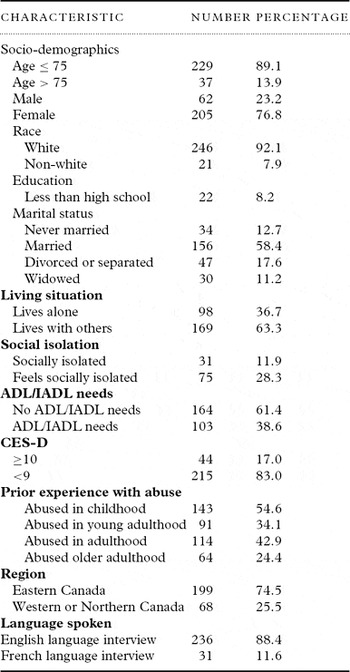
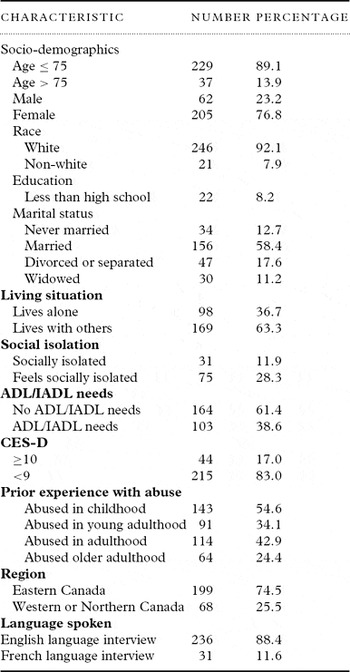
Among community residents in the sample, most were younger than 75 years of age (86%), female (77%), White (92%), and had at least a high school diploma (92%). Fifty-eight percent of the respondents were married. Sixty-three percent lived with someone else. Respondents typically spent time socializing with friends or relatives and used the telephone or the computer to stay in touch with people. Twenty-eight percent reported feeling socially isolated and felt that they did not spend enough time with friends or others. Approximately, 17% of older adults living in the community scored as possibly depressed on the modified Center for Epidemiological Studies Depression Scale (CES-D) instrument. Nearly, 40% reported at least one limitation of the Activities of Daily Living or Instrumental Activities of Daily Living (ADL/IADL). A history of mistreatment was common among the study participations. Abuse was reported more frequently for childhood than during any other life stage. Over half of the sample (54.6%) reported abuse during childhood, and more than one-third (34.1%) reported abuse during young adulthood. Forty-three percent said they were abused during mature adulthood, and one-quarter (24.4%) said they were abused since age 55 but prior to the interview date (see Table 1).
Socio-demographic and clinical characteristics of respondents (N = 267)
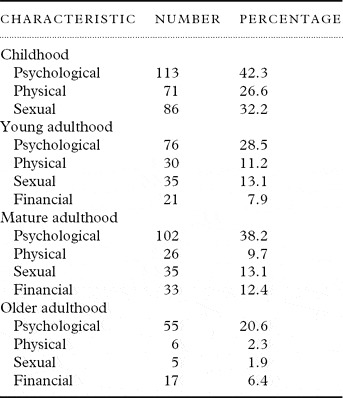
Three types of abuse were more common during childhood than during any other time period: psychological (42.3%), sexual (32.2%), and physical abuses (26.6%). Psychological abuse was the most common type of abuse at each life stage wherein 42.3% of children, 28.5% of young adults, 38.2% of mature adults, and 20.6% of older adults reported psychological abuse (see Table 2).
Prevalence of perception of abuse at each life stage, by type of abuse

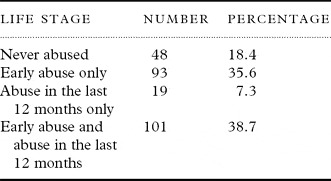
There is considerable continuity of abuse across the life course. Respondents were divided into four distinct groups based on whether and when they first experienced abuse: (1) those who never experienced abuse, (2) those who experienced abuse prior to older adulthood but not in the last 12 months, (3) those who did not experience abuse earlier in their lives but experienced it for the first time in the last 12 months, and (4) those who experienced abuse both earlier in life and in the last 12 months. Only 18.4% of the sample never experienced abuse over the entire life course. The largest group experienced abuse both earlier and in the last 12 months (38.7%). Slightly fewer respondents experienced early abuse only (35.6%). Few respondents experienced abuse for the first time in the last 12 months (7.3%) (see Table 3).
Prevalence of perception of abuse and neglect, life course patterns

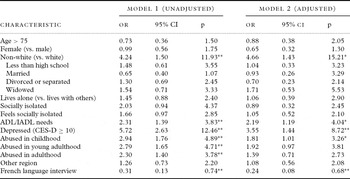
Table 4 gives the odds ratios, 95% confidence intervals for the odds ratios, and p-values for the models predicting abuse. Model 1 includes each potential risk factor individually. Several of the variables were significantly related to experiencing abuse. Non-white individuals were more likely to experience abuse than were White individuals (OR = 4.24, p = 0.006). Being non-white was associated with a nearly fivefold increase in the odds of experiencing abuse. Having one or more ADL or IADL limitations was also related to abuse (OR = 2.31, p = 0.001). Specifically, individuals with one or more ADL or IADL limitations were more than twice as likely to experience abuse compared to those with no such limitations. Depression was also strongly associated with abuse (OR = 5.72, p = 0.000). The odds of abuse for individuals who were depressed (a score of 10 or greater on the CES-D) were more than four times higher than for those who were not depressed. Minority status (Lachs et al., Reference Lachs, Williams, O'brien, Hurst and Horwitz1997), presence of physical limitations (Wolf and Pillemer, Reference Wolf and Pillemer1989), and depression have been associated with abuse in other studies as well (Thomas and Tatara, Reference Thomas and Tatara1998; Thomas, Reference Thomas2000). Having experienced abuse in all three life stages (childhood, young adulthood, and adulthood) was associated with a heightened risk of abuse as an older adult. For each life stage, abuse increased the odds of abuse in older adulthood by a factor of 2 to 3.
Odds ratios, 95% confidence intervals, and p-values from logistic regression models predicting abuse

Note: *p < 0.05; **p < 0.01.
Dichotomous variables: age > 75 = 1 if older than 75 year; female = 1 if female; non-white = 1 if ethnicity is 1; less than high school = 1 if did not graduate from high school; never married = 1 if single, never married; married = 1 if married; divorced or separated = 1 if divorced or separated; widowed = 1 if widowed; lives alone = 1if lives alone; socially isolated = 1 if socializes with friends or relatives a few times a month, once a month or less, or never; feels socially isolated = 1 if feels spend not enough time with friends or relatives; ADL/IADL needs = 1 if needs help all of the time or some of the time with at least 1 out of 11 ADL/IADL needs including using the telephone, eating, bathing, or showering, etc.; depressed = 1 if score of 10 or higher on Center for Epidemiological Studies Depression Scale; abused in childhood = 1 if felt experienced abuse before 18 years old; abused in young adulthood = 1 if felt experienced abuse between 18 and 24 years old; abused in adulthood = 1 if felt experienced abuse between ages 25 and 54; Eastern Canada = 1 if province is Ontario, Quebec, New Brunswick, Prince Edward Island, Nova Scotia, or Newfoundland and Labrador; Western or Northern Canada = 1 if province is British Columbia, Alberta, Saskatchewan, Manitoba, Yukon, Northwest Territories, or Nunavut; French language interview = 1 if interview was conducted in French.
Model 2 included all of the potential risk factors simultaneously. As can be seen, the results were largely unchanged. Non-white respondents were still more likely to be abused (OR = 4.66, p = 0.011). The odds ratios for having one or more ADL or IADL limitation were still significant (OR = 2.19, p = 0.012). Depression was still a strong risk factor for abuse (OR = 3.55, p = 0.006). However, when abuse during all three life stages was considered simultaneously, only a history of abuse during childhood retained its importance (OR = 1.81, p = 0.046).
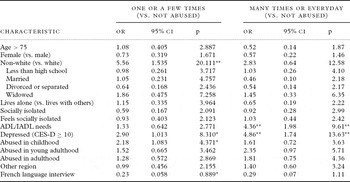
Table 5 presents the results from the multinomial logistic regression models predicting the number of different types of abuse. The odds ratios for Model 1 represent the odds of experiencing only one type of abuse relative to not experiencing abuse. The odds ratios for Model 2 give the odds of experiencing two or more types of abuse compared to no abuse. Only results from a full model (including all potential risk factors simultaneously) are presented.
Odds ratios, 95% confidence intervals, and p-values from multinomial logistic regression models predicting the frequency of abuse

Note: *p < 0.05; **p < 0.01.
Dichotomous variables: age > 75 = 1 if older than 75 year; female = 1 if female; non-white = 1 if ethnicity is 1; less than high school = 1 if did not graduate from high school; never married = 1 if single, never married; married = 1 if married; divorced or separated = 1 if divorced or separated; widowed = 1 if widowed; lives alone = 1if lives alone; socially isolated = 1 if socializes with friends or relatives a few times a month, once a month or less, or never; feels socially isolated = 1 if feels spend not enough time with friends or relatives; ADL/IADL needs = 1 if needs help all of the time or some of the time with at least 1 out of 11 ADL/IADL needs including using the telephone, eating, bathing, or showering, etc.; depressed = 1 if score of 10 or higher on Center for Epidemiological Studies Depression Scale; abused in childhood = 1 if felt experienced abuse before 18 years old; abused in young adulthood = 1 if felt experienced abuse between 18 and 24 years old; abused in adulthood = 1 if felt experienced abuse between ages 25 and 54; Eastern Canada = 1 if province is Ontario, Quebec, New Brunswick, Prince Edward Island, Nova Scotia, or Newfoundland and Labrador; Western or Northern Canada = 1 if province is British Columbia, Alberta, Saskatchewan, Manitoba, Yukon, Northwest Territories, or Nunavut; French language interview = 1 if interview was conducted in French.
Non-white ethnic background increased the risk of experiencing one type of abuse relative to no abuse but was unrelated to experiencing two or more types of abuse compared to no abuse. Having one or more ADL/AIDL needs was unrelated to experiencing one type of abuse but significantly predicted two or more types of abuse. A similar pattern was observed for depression. Depression was unrelated to experiencing one type of abuse but significantly predicted two or more types of abuse. Abuse in childhood increased the risk of experiencing one type of abuse relative to no abuse but was also unrelated to experiencing two or more types of abuse compared to no abuse.
Discussion
The results indicate that the life course perspective provides a reasonable addition to existing theoretical perspectives on elder mistreatment. The various analyses, though rudimentary, consistently highlighted the importance of the history of abuse of older persons that is seldom considered by clinicians or researchers. A substantial percentage of respondents reported at every stage of the life course that they experienced some type of abuse. This finding supports two concepts that are intrinsic to a life course perspective. The first principle of lifelong development and aging has an addendum that the life course is composed of a set of multiple, interdependent trajectories similar to that of careers that can be punctuated with turning points. Turning points are considered major directional changes or discontinuities in a trajectory (Settersten, Reference Settersten2003). It is possible that child abuse is a major turning point in childhood and could set the individual on an unusual trajectory of abuse that carries through until later life. When the life patterns of abuse were examined, there appeared to be a central life course pattern: those who experienced abuse early in life and in the last 12 months exhibited the most common life course pattern (38.7%). The least common life course pattern was the pattern where those who experienced abuse in the last 12 months of their life (7.35%) – abuse for the first time in old age. These data suggest that on presentation of elder abuse, there is likely to be more trauma in the history of the individual than most assessment tools and interventions would indicate. Because the data are retrospective, however, it is possible that experiences of abuse later in life could influence someone's perception of whether earlier experiences constituted mistreatment.
The data also provide some support for the principle of timing. There are age-based statistical patterns for human development, best captured in the “normal curve” that refers to weight, height, intelligence, etc. While not formalized, there also are shared ideas in society about certain transitions such as when birth should occur, young adults should finish school or leave home or when older adults should leave the labor force to retire. When the types of abuse at the different stages of the life course are considered, they tend to follow the incidence and prevalence of abuse as reported in separate studies for different age groups.
For example, younger Canadians aged 25–34-year old were three times more likely than those aged 45 years and older to state that they had been physically or sexually assaulted by their spouse, which may help explain some of mature adulthood abuse. Similarly, close to one in five Canadians aged 15 years and older (17%) reported that their current or ex-partner had been emotionally or financially abusive at some point during their relationship providing some backing of the data that the most likely type of abuse consistent across the life course is psychological abuse (Statistics Canada, 2011). That psychological abuse is highest for children and this data is not supported by child abuse data on emotional abuse, but this data is reportedly under reported (PHAC, 2010). Nevertheless, at the very least, practitioners and researchers will have some signs as to the types of experiences that older adults have themselves reported, making assessments and interventions more sensitive.
The positive predictive value of the life course stage was apparent in the findings. Only four factors were consistent in predicting abuse: non-white ethnicity, depression, ADL/IADL, and childhood abuse. While the first three factors have been supported in previous studies with the strongest support for depression, there have been no extant tests of the influence of the life course stages on abuse (NICE, 2012). The implication of these findings is that childhood abuse may be an important risk factor for elder abuse that can be quickly assessed. It is important to note that this effect did not represent a cumulative disadvantage over time since it was not likely to predict two or more types of abuse. At its most fundamental level, however, a risk factor could have a causal influence, be the result of mistreatment, or simply vary with the mistreatment influenced by some common factor. Given the significance and the consistency of this factor in the data, it is worthy of further research with a large random sample.
Limitations
It is important to note that the results from this analysis were based on a purposive sample rather than a national probability sample. Consequently, reported frequencies, such as the frequency of a particular type of abuse, or of abuse at a particular life stage, do not represent national estimates. Since respondents were asked to enroll in the study on their own initiative, they may have had a unique interest in elder abuse and neglect, which might have resulted in atypical responses to some items in the questionnaire. The questions about abuse in earlier life stages were retrospective and therefore subject to issues of recall. Since the study was cross sectional rather than longitudinal, it is possible that at least one of the purported risk factors – depression – could have occurred after the abuse rather than before it. Despite these limitations, this is one of the first studies to indicate that a life course perspective could have merit in understanding elder mistreatment, especially in predicting episodes of mistreatment.
Conclusion
To our knowledge, this is one of the first uses of a life course perspective in the study of elder mistreatment.
Results suggest that a life course perspective provides a useful framework for understanding elder abuse and neglect. In this sample, a childhood history of abuse had a deciding influence on later mistreatment, over and above what happened later in life. For many older adults, abuse and neglect may be part of a continuing pattern of mistreatment that begins very early in life. These findings suggest that professionals assisting victims of elder abuse should ask questions about previous experiences with abuse, including the life stage during which other abuse occurred, and the type of abuse. Early experiences with abuse, however, are by no means deterministic of subsequent mistreatment; risk factors measured later in life, such as ADL/IADL impairments and depression, also were associated with abuse and neglect. All predictors may serve as potential points for assessment and intervention. Such preliminary findings could be confirmed in a national study.
Conflict of interest
None.
Description of authors' roles
Lynn McDonald prepared the manuscript and Cynthia Thomas rewrote and revised sections of it. Lynn McDonald was the PI for the design of the pilot study, with advice from members of an international research team. Cynthia Thomas, also a Co-PI, oversaw the analysis.
Acknowledgments
The financial support for this study was received from the Human Resources and Skill Development Canada under HRSDC Solicitation Number 9137-09-00100. Joseph Gasper and Priyanthi Silva performed the data analysis.