1 Introduction
The recent heated debate about publically funded purchases of swine flu vaccinations shows that pharmaceutical lobbying is a pivotal topic in health policy in Europe (Nicoll and McKee, Reference Nicoll and McKee2010). Their most prominent critics (e.g. Angell, Reference Angell2005) allege that drug companies often use unethical lobbying methods that lead to sub-optimal treatment outcomes and a substantial waste of resources (Cohen and Carter, Reference Cohen and Carter2010). More broadly, pharmaceutical lobbying is said to contribute to unwanted social phenomena such as medicalisation (Conrad, Reference Conrad2007), disease mongering (Moynihan et al., Reference Moynihan, Heath and Henry2003) and pharmaceuticalisation (Abraham, Reference Abraham2010).
Policy analyses of pharmaceutical lobbying to date have focused largely on drug regulation, particularly registration of medicines with drug regulatory agencies (Abraham and Lewis, Reference Abraham and Lewis2000; Abraham, Reference Abraham2002). In our view, this literature understates the fact that the successful registration of a medicine is only the initial step in drug companies’ efforts to achieve a sufficient volume of sales to guarantee a large profit. Separately, research has examined the role of pharmaceutical marketing targeted at physicians (Moynihan, Reference Moynihan2003; Oldani, Reference Oldani2004; Health Committee, 2005: 58). However, these areas of study are inextricably linked, as doctors’ prescribing decisions, especially those concerning new and expensive therapies, are increasingly shaped by policy developments in the field of drug reimbursement (Abraham, Reference Abraham2009: 951–959).
In this paper, we examine pharmaceutical lobbying as it relates to policies on reimbursement for ‘innovative’ medicines in Poland. As in the rest of Europe, new and expensive drugs cannot reach a mass market unless they are included in state-funded reimbursement schemes. Tellingly, lobbying figures as an important tool in the ‘market access’ strategy adopted in recent years by major global drug companies with support from governments (Tiedemann, Reference Tiedemann2009; Burson-Marsteller, Reference Burson-Marsteller2010). Yet, the role of pharmaceutical lobbying in drug reimbursement decisions has not been sufficiently recognised in the literature (notable exceptions include Vuorenkoski et al., Reference Vuorenkoski, Toiviainen and Hemminki2003; Abraham, Reference Abraham2009). However, we can gain some insights from another European Union (EU) member state, the United Kingdom, where pharmaceutical lobbying methods have been examined in depth over many years. Pharmaceutical lobbying in the UK is largely premised on using seemingly independent ‘third parties’ to endorse policy choices favourable for drug companies. Specifically, two seminal debates hosted by British Medical Journal (BMJ) showed that drug companies pay particular attention to co-opting and securing policy support of Key Opinion Leaders (KOLs) in the medical milieu (Buckwell, Reference Buckwell2008; Fava, Reference Fava2008; Moynihan, Reference Moynihan2008; Cohen and Carter, Reference Cohen and Carter2010), and that of patient organisations (Herxheimer, Reference Herxheimer2003; Kent, Reference Kent2007; Mintzes, Reference Mintzes2007; see also Health Committee, 2005: 74–77). Another vital form of pharmaceutical lobbying, aimed at reaching policymakers through appealing to public opinion, involves generating media coverage of illnesses as well as treatment options (Wilson et al., Reference Wilson, Booth, Eastwood and Watt2008). Apart from the ‘third parties’, drug companies encourage ‘political influencers’ such as members of parliament to exert pressure on decision-makers at the National Institute for Health and Clinical Excellence and the Department of Health (The Lancet Editors, 2005; Berrett et al., Reference Berrett, Roques, Small and Smith2006; Ferner and McDowell, Reference Ferner and McDowell2006). Importantly for our purposes, reports from other European countries, although in less detail, indicate that this is the usual model (García-Sempere and Artell, Reference García-Sempere and Artell2005; Traufetter, Reference Traufetter2009; Choukroun, Reference Choukroun2010; Hemminki et al., Reference Hemminki, Toiviainen and Vuorenkoski2010; Parliamentary Assembly of the Council of Europe, 2010; Payet, Reference Payet2010). It is vital to ascertain whether pharmaceutical lobbying methods identified in the pre-2004 EU are also seen in the post-communist new member states. Given the extremely limited research on this region (Kopřivová, Reference Kopřivová2007), it is methodologically justified to select Poland as a prototypical case study (Hague and Harrop, 1992: 24–25). Crucially, Poland is the largest pharmaceutical market in Central and Eastern Europe (IMS Health and Rynek Zdrowia, 2010) and an increasingly important player globally. According to the General Manager of Intercontinental Medical Statistics (IMS) Poland, “[W]e notice the increase in the significance of emerging economies in shaping the global balance of power in the pharmaceutical sector. Poland belongs to the group of countries whose importance will continue to grow” (Zarzycki, Reference Zarzycki2010).
The Polish health-care system is dominated by the Ministry of Health (MoH – Ministerstwo Zdrowia), which is the regulator of health care, and the National Health Found (NHF – Narodowy Fundusz Zdrowia), which manages the health-care insurance scheme. In drug reimbursement policy, the respective roles of the two actors have been evolving over the last ten years and are not entirely formally specified. It can be argued, however, that the primary responsibility of the MoH is shaping the policy content, while the NHF provides funding for therapies selected by the MoH.
Two major state reimbursement schemes exist in Poland: open reimbursement (refundacja otwarta) and therapeutic programmes (programy terapeutyczne). The former concerns prescription-only (Rx) medicines obtained by patients at a pharmacy for up to 50% of their original price, whereas the latter refers to therapies provided by hospitals, free of charge, for narrowly defined groups of patients, particularly those suffering from rare diseases or selected types of cancer. Open reimbursement is institutionalised in the form of ‘reimbursement lists’ (listy refundacyjne), issued periodically as a regulation of the Minister of Health. A therapeutic programme usually consists of one to three drug therapies to treat a specific condition and is published as a regulation of the Minister of Health (until 2009, in regulations of the President of the NHF). Unlike reimbursement lists that are dominated by generic drugs, therapeutic programmes comprise exclusively innovative drugs.
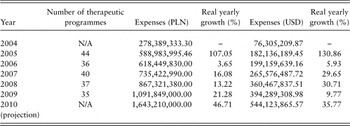
In this paper, we focus on therapeutic programmes as they are highly attractive for innovative drug companies. This is illustrated by the fact that over the last 7 years expenses on therapeutic programmes have risen 601.58% in real USDFootnote 1 (Table 1).

2 Methods
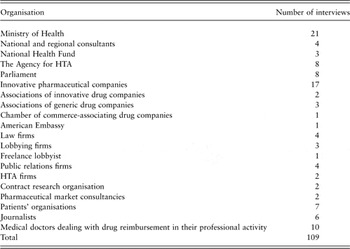
The fieldwork for this article was conducted between February 2009 and April 2010 by P.O. in collaboration with L.K. The bulk of the data were collected by means of in-depth, semi-structured, anonymous, elite interviews with representatives of major stakeholders in the domain of drug reimbursement policy in Poland (Table 2).
Categories of interviewees

HTA = Health Technology Assessment.
The initial phase of the fieldwork involved interviewing a purposive sample of representatives of organisations engaged directly and indirectly in shaping reimbursement policy. Overall, out of 70 interview requests 57 were successful (the non-response rate was 22.81%). The largest category of non-respondents (n = 5) were employees of innovative drug companies (three communications managers, a public affairs director and a former corporate affairs director). To establish contacts with the under-represented categories of interviewees, especially employees of drug companies and middle-ranking public officials, snowball sampling was subsequently used. This also proved vital in gaining access to highly knowledgeable interviewees without organisational affiliations (for instance, an extremely experienced freelance lobbyist with no institutional email address) and those currently on leave from work. In the snowball-sampling phase, the response rate was 100% – all 26 interview requests were successful. In total, 83 people were interviewed, yet the number of interviews was 109, as 20 people played the role of key informants (Malinowski, Reference Malinowski2002) and were interviewed twice, and three people were interviewed three times. Two interviewees were asked about their two separate professional roles and, in these cases, we treated the corresponding questions as separate interviews. Crucially, the characteristics of multiple respondents did not bias the purposive sample, as they were relatively evenly spread among all categories of interviewees. For example, the people interviewed three times were an Agency for Health Technology Assessment (AHTA) official, a high-ranking MoH official and the key account manager from a drug company.
Using open questions, we asked our interviewees to reconstruct the prevalent methods of pharmaceutical lobbying and to evaluate their effectiveness. The interviews were conducted in Polish and typically lasted approximately 1 hour. The interviewing took place in line with the ethical guidelines of American Sociological Association (American Sociological Association, 1999). All interviewees were briefed about the broad goal of the study and gave informed verbal consent to participate in it. Furthermore, we took particular care to ensure their anonymity in presenting our data as citations. For instance, bearing in mind that in several instances the number of people occupying a given organisational position is very small, we created relatively broad interviewee categories (e.g. ‘middle-ranking’ or ‘high-ranking officials’).
To strengthen the validity of our findings, we triangulated our interview data (Silverman, Reference Silverman1993: 156–158) with additional data sources: reimbursement legislation, policy documents (Ministerstwo Zdrowia, 2004, 2005), Supreme Chamber of Control reports on reimbursement policy (Najwyższa Izba Kontroli, 2004, 2007, 2009) and articles from the daily and specialised press on pharmaceutical lobbying.Footnote 2 Furthermore, we conducted observations of two disease-awareness campaigns organised by an innovative drug company specifically to gain an additional perspective on relationships between drug companies, KOLs and patient organisations.
One of the researchers (P.O.) performed standard procedures of content analysis (Kvale, Reference Kvale1996) facilitated by a computer programme (Atlas.ti 6.2). This involved using a deductive–inductive approach to coding. The main codes were generated from research questions, while ‘open’ and ‘in vivo’ coding was applied to detailed or unexpected themes (Strauss, Reference Strauss2001: 28–34). The coded empirical material was interpreted by establishing relationships between the code categories, which enabled building of code families and networks. The data that were extracted and organised were then compressed based on discussions between two of the authors (P.O. and L.K.). In the writing-up phase, the interpreted data were recontextualised using fragments of interviews relevant to the conclusions emerging at a higher level of abstraction. When translating the most problematic citations, the authors received help from a bilingual researcher. In presenting our findings, we use the principle of ‘thick description’ (Geertz, Reference Geertz1973: 3–30) and thus provide multiple citations representing various perspectives that validate the constructed argument.
3 Results
From the perspective of innovative drug companies, “Therapeutic programmes present a great opportunity [in terms of] … the effectiveness of financing. … It can be expected that the innovative character of a product will play an important role in convincing decision makers. The chance of being introduced to a programme is quite high.” (1).Footnote 3
At the time of writing, there were no detailed legal regulations concerning the development of therapeutic programmes. “Therapeutic programmes are legal terra incognita.” (2). Our reconstruction of the policy process, based on the reading of scattered fragments of legislative acts and the interview data, suggests the existence of considerable space for effective pharmaceutical lobbying. To start with, the development of a therapeutic programme is initiated from outside state organisations. “[The drug company] can approach the Minister informally and say that there is a topic he should take up and that they have a nice drug.” (3). Alternatively, the establishment of a therapeutic programme may be triggered by political pressure exerted on the Minister. “[T]he television shows a sick child who desperately needs a very expensive drug, and there is pressure on the NHF to finance this drug. … Later experts from the medical field say that it's precisely this drug that should be used because it will help a such and such patient group.” (4).
In making reimbursement decisions, the Minister of Health draws on a recommendation issued by the AHTA, which evaluates drugs in terms of safety, effectiveness and cost-effectiveness according to the principles of evidence-based medicine (EBM). However, rarely can such a recommendation provide undisputable scientific arguments for reimbursing drugs, given the nature of clinical and pharmacoeconomic data submitted by drug companies (Sismondo, Reference Sismondo2008; Spielmans and Parry, Reference Spielmans and Parry2010). “In half of the research results (submitted by drug companies), we deal with drugs whose effectiveness cannot be established. This makes our assessment so difficult.” (5). The role of EBM is further diminished by the incomplete implementation of the EC Transparency Directive (89/105/EEC). The directive sets the maximum time for taking individual pricing and reimbursement decisions (90 and 180 days, respectively), specifies that they must be based on ‘objective and verifiable criteria’ and grants the applying firm the right to appeal to national courts. In Poland, only the first requirement is occasionally met while the main object of criticism is reimbursement criteria applied by the MoH. “[They] are very vague, very general. It's black magic for us. We don't know how it happens, how decisions are taken.” (6). Moreover, the existing criteria are unstable (Najwyższa Izba Kontroli, 2004: 36) and sometimes not applied in practice (Najwyższa Izba Kontroli, 2004: 30–31). Consequently, “The Minister takes an inherently political decision – is a medical problem important or not?” (6).
Lastly, negotiations between the MoH, the NHF and drug companies tend to be entirely informal. “There is no formal procedure saying that the manufacturer approaches [the MoH or the NHF], what happens next, and how he is included in the process.” (2).
In the reminder of the paper, we demonstrate how drug companies exploit these loopholes in the reimbursement system.
3.1 Informal persuasion
An opaque reimbursement process provides multiple opportunities for informal persuasion as a lobbying method. “That the firm comes with scientific evidence is far from enough. It is the ease of access to particular people that really counts.” (7). What enables informal lobbying are close personal relationships with decision makers at the MoH, the NHF and the AHTA. “A lot depends on his [an official's] willingness to meet with one or another person. This is all based on relationships.” (7). Therefore, “[P]harmaceuticals are an extremely relational, ‘wining and dining industry’. … There are always attempts to establish personal contact [with decision makers].” (1).
The crucial form of informal lobbying is “the path of mutual favours”. “Suppose your mum is very ill and someone helps you ‘arrange’ a good hospital. You will surely react positively, if this person asks you to read some paperwork. … The exchange of favours is a debt everyone runs into but eagerly pays off.” (8). In particular, a lucrative position in the pharmaceutical sector is a means of reciprocating past favours granted by a public official. “X [a former high-ranking MoH official] used to keep some firms’ reimbursement applications in a drawer [i.e., delay them]. Having left the MoH, he started working for the firms whose applications he hadn't kept there.” (9).
Insiders describe informal persuasion as a highly effective lobbying method. For example, in 2007, a cardiology drug was accepted for reimbursement even though the scientific evidence behind it was doubtful and the decision-making process evidently breached formal regulations. The press uncovered that the positive reimbursement decision had been preceded by the help that a high-ranking ministerial official received from the drug company in ‘arranging a flat’ for his relative. ‘These totally informal relationships very often influence the policy process.’ (10).
Ironically, the widespread conviction about the effectiveness of informal lobbying stands in stark contrast with the apparently stringent ‘procedure of receiving external clients’ (procedura przyjmowania klientów zewnętrznych) established at the MoH (Procedura, 2009). “We are very cautious against contacts with the industry which might be perceived as attempts of exerting influence.” (11). However, the formal consultations are universally criticised by representatives of drug companies for the long waiting periods, infrequent meetings and limited topics discussed. Importantly, the ‘procedure of receiving external clients’ is viewed as an instrument limiting access by ‘unfriendly’ drug companies to the MoH. “The Polish law is like web: a horsefly will squeeze through yet a bee will bog down” (3; a quotation from a 16th century poet). In fact, formal regulations are “Much ado about nothing, really. What they practically mean is that the Rabbit's ‘relatives’ and ‘acquaintances’ will met outside [state organisations], while others are muzzled and can't communicate.” (3).
Our interviews indicate that drug firms lacking close personal connections with decision-makers rely on endorsements expressed by KOLs, patient organisations and the media rather than on informal lobbying. “If the door to the MoH is closed, the industry searches around and tries to find a place to enter.” (12).
3.2 The voice of experts
The most important type of KOLs relevant to Polish drug reimbursement policy are ‘national consultants’ (konsultanci krajowi) representing 84 fields of medical and pharmacological specialisation. These prominent experts – professors of medicine or pharmacology and directors of important clinics – advise the MoH, the NHF and the AHTA, drawing on their on-the spot clinical experience. “The MoH obviously asks the AHTA to assess quantitative data, but this is all in theory. The MoH very often relies on consultants and asks them if the drug is really worth reimbursement.” (6). National consultants can be remarkably effective in convincing the Minister about the merits of even controversial medicines. For instance, in 2008–2009 the national consultant in neonatology led a successful campaign aimed at the acceptance of a vaccine for Human Respiratory syncytial virus (RSV) for reimbursement (Jakubiak, Reference Jakubiak2009a), even though the drug had received two negative AHTA recommendations stressing the lack of compelling evidence of its effectiveness.
That said, “Because of their formal location, national consultants are always an indispensable element of actions aimed at drug reimbursement.” (13). Not surprisingly, the interviewed national consultants point out their personal independence from pharmaceutical companies. Notably, they are less emphatic, however, about the integrity of their colleagues: “I sometimes observe those presentations [at medical congresses], not only in Poland but also abroad. They are very emotional, saying how wonderful a drug is. I always wonder to what degree this is … induced by gratification or [results from] deep internal conviction. … Sometimes, when I listen to acknowledged professors singing praises of a medicine during a meeting organised by the firm, I keep saying to myself: ‘Gosh, I would never sell myself like this for any money.’ ” (14).
It is also worthwhile to consider the perspective of an organisation utilising national consultants’ expertise. “I have never ever heard X [a national consultant] expressing a negative opinion about a drug. He is always the greatest enthusiast. I do not know why that is, but do not think he is such a devotee, so to speak, by nature. And the more enthusiastic the expert, the greater our scepticism and uncertainty. But [we] lack good arguments to challenge him.” (15). Paradoxically, attempts to introduce more stringent regulations on national consultants’ conflicts of interests turned out to be counter-effective. “We have a big problem with external experts as many of them don't want to fill in the declaration of conflicts of interest. And even if they agree to say who they have worked for, they don't want to disclose how much they have been paid.” (16).
Consequently, for pharmaceutical companies, “Achieving KOLs’ support is vital. We do need to have permanent relationships with them. … This is the essence of pharmaceutical lobbying.” (1). Given the limited number and the important role of national consultants, “Firms obviously compete for KOLs’ attention.” (13). In doing so, innovative drug companies use a wide array of instruments key to building the professional status of national consultants. In particular, invitations to organise clinical trials give them broad access to cutting-edge exclusive medical knowledge through “regular collaboration with other KOLs and getting practical knowledge about a drug.” (6). Also, because of their high profitability, “Clinical trials are the main form of rewarding and building long-term relationships with national consultants.” (11). Finally, “A clinical trial, especially a multicenter one, is a real treat for professor X. By taking part in it he can meet big names from France, the US and the UK. This is extremely valuable, since his peers in Poland look up to him when his name appears next to those foreign names in The Lancet or BMJ.” (17).
What facilitates establishing close relationships with national consultants is, first, the fact that the MoH does not adequately reward their professional activity. “[They] should be attending congresses and visiting clinics in the country but the state does not provide [them] with funding. So they sometimes take money from drug companies. It is obviously very hypocritical of politicians to eagerly criticise relations between national consultants and the industry, whereas they give them no money.” (8). Second, it is the ability of consultants to secure reimbursement of innovative therapies that largely determines the balance of power between different medical specialities. “Doctors’ lobbies are centred on consultants. There are the very powerful oncological and cardiorogical lobbies. … They win vast sums of money to finance new, very expensive drugs.” (15).
3.3 Pressure from patients
“In Poland – as opposed to the West – there are considerable problems with access to drugs. As a result, although Polish patients also organise to provide themselves with group support, their main goal is lobbying to exercise their rights to health protection.” (6).
The shared interest with drug companies in introducing innovative drugs to reimbursement is strengthened by the weak financial and organisational resources available to patients’ organisations. “[P]ublic grants for patients’ associations … are, putting it mildly, very limited. Consequently, they rely on various other forms of external financial aid. And … this help comes predominantly from drug companies.” (18).
As the imbalance of organisational resources between the two sides is more evident in Poland than in the UK, pharmaceutical firms find it easier to control patients’ organisations in the former (Jones, Reference Jones2008; Solska, Reference Solska2009). Some drug companies create patient organisations tailored to specific lobbying campaigns. “The reimbursement application [concerning a drug for kidney cancer] was immediately followed by the appearance of the patients’ association. … It could not have been a coincidence.” (3).
Alternatively, drug companies support existing organisations, primarily through money transfers. “If the firm pays the association, then it can also draft its statute.” (19). Moreover, drug companies control organisations through manipulating medical information provided to patients. “Those people are indoctrinated and they will pass on what they were led to believe.” (20). Moreover, drug companies orchestrate patient organisations’ lobbying activities. “They [drug companies] think this way: ‘Since we want to lobby effectively for our product, we will prepare a letter which will be distributed among the association's members to save them the trouble of writing it. We will also develop an appeal list which you will just sign.’ ” (21).
The superior power of pharmaceutical companies is also acknowledged by representatives of patient organisations. “Firms support us because we don't have another source of income. We try to maintain good relationships with them to get by.” (22). One of a few strategies of restoring independence from drug companies is diversifying cooperation. “It is my aim to cooperate with all firms working for people suffering from diabetes. And I'm very principled about this.” (22).
When drug companies have no personal connections to exploit, using patient organisations as a third party “is the most effective solution.” (8). Specifically, it enables drug companies to conceal their commercial interests “under the cover of defending patients’ rights.” (23). Elected politicians find it very difficult to resist pressure involving potential voters. “It is said that officials do not react [to the patients’ pressure]. But ultimately they have to react.” (8).
A highly effective lobbying method used by patients’ organisations is “accessing the Minister of Health mediated by the medical milieu cooperating with the association.” (21). On the other hand, KOLs also rely on patients’ political support. “I protested against them [pharmacotherapy changes proposed by the MoH] and also asked the patients’ association to express their opinion on this issue. We had this type of cooperation.” (14).
3.4 Engineering media support
“Pharmaceutical lobbying primarily comprises actions in the media and informational sphere.” (11). First, “Media reports serve as a propaganda machine which builds the social awareness of the need of a certain drug. This in turn creates pressure on decision makers aimed at reimbursing this drug.” (11).
Second, pharmaceutical firms use the media to generate negative publicity against decision makers. “It's great for a [drug] company when the material is broadcast during prime-time news releases. It shows a pretty girl who suffers a lot and loves painting. The only missing thing is the drug. … It can be purchased. So why don't do it?” (8).
The extreme variant of negative publicity is the uniquely postcommunist ‘kompromat’ campaigns designed to destroy a politician's reputation (Ledeneva, Reference Ledeneva2006). For instance, in 2002, a group of innovative drug companies in conflict with Maciej Łapiński, the then Minister of Health, was linked to a series of publications accusing his closest collaborator of corruption. This eventually led to the Minister's dismissal by the Prime Minister. However, a subsequent Supreme Court ruling stated that the allegations had been unsubstantiated (Money.pl, 2007). In his book, Łapiński recounts: “I have recently met the boss of the most effective company in ‘black public relations.’ From what I have heard, three firms chipped in $3,000,000 to do away with me. It all came down to buying articles” (Łapiński, Reference Łapiński2005: 108).
Our interviewees indeed mentioned attempts of transferring money to individual journalists. “A lady from a pharmaceutical company called me [once] and said she would like to order an article with me. … I explained that I didn't do such things. I also told her they could provide us with this article and we would print it as an advertisement.” (4). Publications favourable for drug companies may also result from the fact that “For the majority of journalists, medicine is just one of many topics.” (8). Therefore, cooperation with journalists sometimes takes the form of ghost-writing: “Briefing journalists typically comes down to providing them with already prepared texts. Firms prefer to give them materials on a pen drive or a CD, so that the journalist can just do the ‘copy-paste.’ ” (8).
“The media and the public sphere … are decisive” (23) in exerting pressure on the MoH. Generating media support compensates for the lack of close personal relationships with decision-makers. “[F]irms are simply not able to access everyone. But … media pressure is strong. The press and television can broadcast what they want.” (11). In addition, using the media enables stealth lobbying. “Firms handle this with velvet gloves. … Someone passes some materials to a friend who approaches another friend who eventually goes to a journalist with them. The chances to establish who initiated the process are minimal given that the subsequent links come into play.” (13). Using the media is also highly efficient because “Sometimes there is a case of one patient which focuses a whole range of issues [and] can lead to achieving money for the whole therapeutic group.” (8).
Moreover, using the media makes it possible to combine the efforts of ‘third parties’: national consultants and patients’ organisations. “During my stay at the office, there was a problem with drug X: some national consultants were expressing themselves unreasonably. They did it publically, during press conferences. They were cited by serious media.” [23] Similarly, “Using media appearances of patients’ organisations is … a very strong lobbying method.” (24).
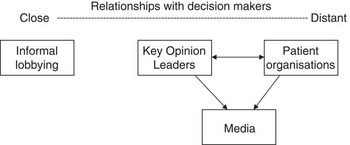
We summarise the relationships between the main pharmaceutical lobbying methods used in Polish reimbursement policy in Figure 1.
Key pharmaceutical lobbying methods in Poland

Our interviews also point to two supplementary lobbying methods, which involve support from two types of ‘influencers’, namely, domestic and foreign political organisations, which we now discuss.
3.5 Getting around the reimbursement process
Pharmaceutical firms exert indirect pressure on the Minister of Health through other ministries and members of parliament. For instance, a company may attempt to convince the Ministry of Economy that reimbursing a particular drug will positively affect its investment in the Polish pharmaceutical sector. Although a firm does not manufacture innovative medicines in Poland, “We are still an employer who pays taxes and an important partner for the scientific milieu. … Consequently, the Ministry of Economy understands that it should care for innovative drug companies.” (13). Furthermore, the opinion of the Ministry of Finance may prove crucial in persuading the Minister of Health that the reimbursement of a drug is acceptable financially. “The element of cooperation with people responsible for finances and convincing them to support our idea to reimburse the drug may greatly contribute to the eventual success.” (7).
Drug companies “expect that lobbying of members of parliament will make them understand that our problem is crucial and that they will later support our position before the MoH. We often look for an ‘ambassador’ of a particular problem among members of parliament.” (13). To this end, “firms take every opportunity to build relationships with members of parliament.” (13). A powerful variant of this method is disguised money transfers directed to well-connected politicians. “Someone from a drug company suggested that I should set up a foundation which could focus on any health-related issue … This conversation clearly suggested that money wouldn't be a problem at all, they will obviously provide it. … Their goal was to access someone with extensive political contacts. … It's important for them to influence decision making circles using such soft methods.” (10).
Drug companies also use patient organisations as intermediaries in exerting pressure on members of parliament. “Firms are cautious. They don't lobby blatantly. It's not a problem to send the president of an [patients’] association instead of going themselves.” (11). Thus, “Sometimes it is difficult to distinguish between their [members’ of parliament] contacts with firms and those with patients.” (11).
Members of parliament use a range of formal powers to facilitate the inclusion of new drugs in reimbursement. “I can write to the Minister of Health and ask if the AHTA is processing this particular application and when the recommendation can be expected. I'm the intermediary for the [patients’] association. And sometimes the ‘accelerator’ of decisions.” (25). The support that members of parliament give to new therapies is intense: “Between December 2008 and September 2009 we received 41 [parliamentary] questions concerning long-lasting insulin analogues.” (11).
3.6 Playing diplomacy
Lobbying campaigns by multinational pharmaceutical companies’ are often supported by the governments of their countries of origin. In particular, “The US is most active in supporting its firms.” (26). This is because “Drug companies have great influence on the American government and it can do a lot for them on the international stage.” (27). In doing so, they exploit the fact that the Polish government strives to attract investment from and maintain positive political relationships with its key international partner.
First, American drug companies persuade congressmen and high-ranking officials from the executive branch to offer endorsements to Polish decision-makers in the MoH. For instance, “Two congressmen sent us once a letter saying that we had made a gigantic mistake in not reimbursing a particular drug. … At present, in the MoH shows less servility to Americans. … But some time ago when they were coming, one could only hear big ‘Wow!’ ” (28).
Second, the American Embassy in Warsaw and the American–Polish Chamber of Commerce facilitate access to Polish decision-makers. “It is often the US Ambassador who brings the firm along for a meeting with the Minister of Health.” (29). The Embassy applies a range of flexible forms of pressure: “We can send a letter, the problem gets mentioned in various ways, and governments talk to each other. Everything depends on the case and the alignment of players. Everything depends on the issue.” (30). “A personal endorsement by the Embassy does help, since everyone knows each other in this milieu [people dealing with drug reimbursement]. The Embassy can organise pressure effectively.” (27).
4 Discussion
Our investigation of the pharmaceutical lobbying process in Poland has identified two sets of key lobbying methods: informal persuasion and third-party endorsements. The last of these includes support from KOLs, patients’ organisations and the media. We also find that the key lobbying methods are supplemented by two others: reliance on domestic political influencers and foreign diplomatic pressure.
4.1 Strengths and limitations of the study
The strengths of our study include a comprehensive sample of interviewees, an extensive qualitative dataset, rigorous data analysis and a ‘thick description’ of our findings.
However, there are some weaknesses. First, given the lack of access to confidential internal documents produced by drug companies and state organisations, we were unable to corroborate our dataset with other potentially valuable sources. Second, the highly controversial nature of pharmaceutical lobbying often prevented our interviewees from providing details of particular lobbying campaigns. Consequently, our analysis does not systematically juxtapose the general patterns of pharmaceutical lobbying with lobbying efforts concerning particular drugs. Finally, similar to other analyses of policymaking from a social science perspective, our study confronted the fundamental problem of measuring the influence that various stakeholders have on policy decisions. As this obstacle cannot be entirely resolved either on theoretical or empirical grounds (Grant, Reference Grant2000: Ch. 10; Baggot et al., Reference Baggot, Allsop and Jones2005: 21–22), we attempted to address it in three ways. First, multiple interviews with well-informed participants and observers of the reimbursement process should have moderated any lack of knowledge or candour by individual interviewees. Second, the principle of ‘thick description’ enhanced the validity of our findings (Silverman, Reference Silverman1993: 144–170; Peräkylä, Reference Peräkylä1997). Third, the authors’ discussions throughout the course of the research, drawing also on our experience outside this study, minimised the subjectivity of our interpretation.
4.2 Contribution to the research on pharmaceutical lobbying
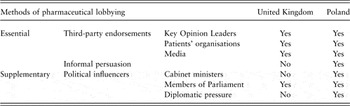
We offer the first comprehensive analysis of pharmaceutical lobbying methods in a post-communist country. In Table 3 we outline how the patterns of pharmaceutical lobbying in Poland compare with these observed in the United Kingdom.
Comparison of pharmaceutical lobbying methods in the United Kingdom and in Poland

The literature on pharmaceutical lobbying in the UK has not documented the widespread use of informal persuasion, which is a pivotal technique used by drug companies in Poland, contrary to the impression given by observers of its response to pandemic influenza (Parliamentary Assembly of the Council of Europe, 2010). This may be considered as part of a broader syndrome of the prominence of informal institutions in post-communist policymaking (Meyer, 2006). In contrast, in Poland pharmaceutical lobbying using third parties clearly follows patterns well established in the United Kingdom. What may be unique about Poland, though, is the exceptionally high level of control exercised by drug companies, especially over KOLs and patient organisations. This stems from the imbalance of economic resources between multinational drug companies and other actors in the drug reimbursement policy domain. Lastly, our analysis suggests that two types of ‘political influencers’, that is, cabinet ministers and diplomatic representations, may be used more extensively in Poland than in the United Kingdom. This is likely to result from, on the one hand, the weak position of the MoH within the Polish executive, and on the other Poland's relationships with more powerful economic and political partners.
Clearly, the lobbying methods described here should not be seen in isolation. “Lobbying takes place on multiple levels. In drug reimbursement, there are no simple mechanisms.” (8). Furthermore, “Coordination and links between various types of actions are crucial.” (31). Thus, the methods are joined in a complex lobbying process, making it possible to ‘outflank’ the policymakers (Ferner and McDowell, Reference Ferner and McDowell2006). In conclusion, in contrast to what has been suggested in relation to drug approval, Poland is not unique.
4.3 Policy implications
We believe that the Polish reimbursement process is in need of comprehensive reform to moderate the impact of pharmaceutical lobbying. On the basis of the analysis presented in this article, we propose five broad directions for institutional change.
First, it is necessary to introduce effective regulation of consultations between the MoH and drug companies, in line with the EC Transparency Directive. Such reform should increase formal access by drug companies to state organisations, while also minimising informal contacts. We contend that this effect can be achieved not only through penalties but also by means of offering pharmaceutical firms powerful incentives, such as timely, inclusive and comprehensive consultations, to comply with formal regulations. Crucially, the burden of the regulations should be shared by both drug companies and the state organisations involved in the reimbursement process.
Second, it is vital to ensure independent medical advice to policymakers. Enhancing the role of professional bodies in selecting national consultants (Ustawa, 2009) could be a step in this direction. This should, nonetheless, be coupled with instruments increasing the transparency and effective monitoring of consultants’ conflicts of interests. At the same time, the MoH should adequately reward consultants for their expertise, thereby supporting their independence from drug companies.
Third, we see the need for the institutionalisation of the role of patient organisations in the reimbursement process. Introducing a requirement to disclose sources of funding as a precondition of consultations with the Minister is a possible solution (Jakubiak, Reference Jakubiak2009b). What has been overlooked so far, however, is strengthening of patient organisations through public grants. As in the case of national consultants, only sufficient support from the state may curb drug companies’ domination of patient organisations.
Fourth, one way of constraining the impact of media campaigns and, more broadly, short-term political considerations on reimbursement policy, is by strengthening the position of the AHTA vis-à-vis the Minister of Health. Under present regulations, the Minister exerts tight control over the AHTA primarily through budgeting, nominations and an administrative procedure of accepting its expert positions before they become official recommendations. These institutional arrangements encourage ministerial attempts to secure the AHTA recommendations that enable avoiding political blame for decisions that are either unpopular or not sufficiently grounded in EBM (Hood, Reference Hood2011). What seems to be crucial to restoring the balance between the politics and science of drug reimbursement is an increase in the organisational resources, institutional independence and, not least, the prestige of the AHTA. Only then may EBM become a real basis for reimbursement decisions.
Lastly, we argue that the intersection between drug reimbursement policy and pharmaceutical industrial policy should be more transparent. In reality, it is unavoidable that the Minister of Health also considers the possible implications of a reimbursement decision for investment by multinational drug companies and, on the other hand, profitability of local generic producers (cf. Abraham, Reference Abraham2009: 947). We contend that making the MoH's economic considerations more explicit will be conducive to decreasing the opacity of pressures from other ministries or states.
At least some of the suggestions outlined above may be addressed by a reform of the reimbursement policy that is currently being considered by the Polish parliament (Rynek Zdrowia, 2010). Most importantly, it is hoped that the reform will increase compliance of reimbursement regulations with the EC Transparency Directive by introducing clear criteria. However, the actual effects of the reform, if successfully enacted, can only be evaluated in the longer term.
4.4 Future research
Future research should provide an evaluation of the effectiveness of pharmaceutical lobbying. One approach would be a cross-national comparison of pharmaceutical reimbursement decisions and corresponding lobbying campaigns.
Acknowledgements
We are grateful to Łukasz Raciborski for conducting 27 interviews and contributing to the conceptualisation of our research on pharmaceutical lobbying in Poland. In addition, we would like to thank David Stuckler and Weronika Ozierańska for their comments on earlier drafts of this article, as well as Chris O'Neill for his linguistic assistance. We also feel indebted to the two anonymous reviewers for their valuable comments and suggestions. Finally, PO is grateful to the Department of Sociology, University of Cambridge and St Edmund's College for supporting his fieldwork through travel grants.
Appendix. Cited interviewees