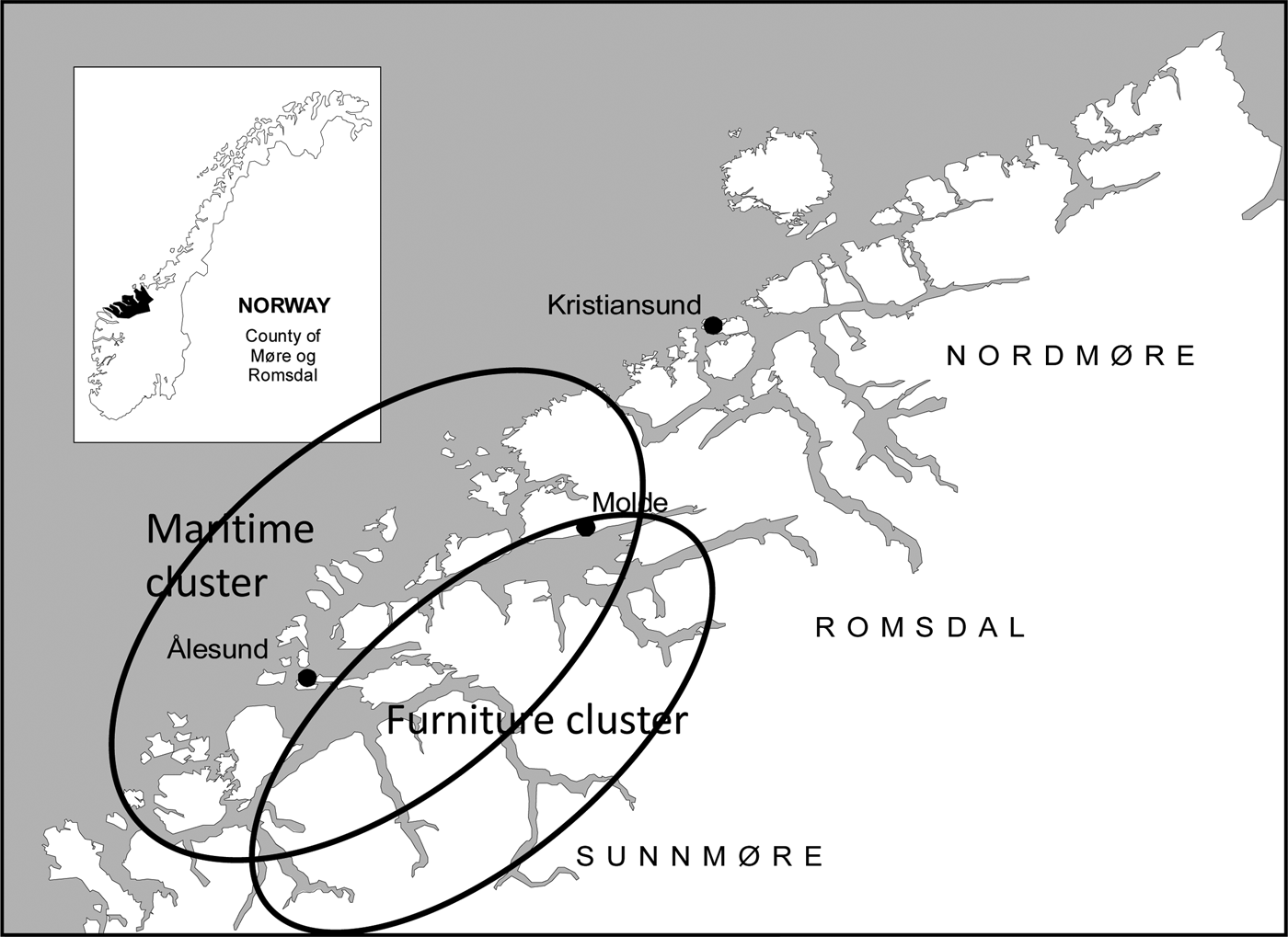
The development and character of industrial clusters have had a strong impact on the formation of modern capitalism worldwide. Since the 1990s, in particular, many local industrial clusters have been challenged by globalization and have experienced dramatic changes. Some clusters have declined, and others have taken advantage of the new international opportunities and continued to grow.Footnote 1 One example of this is the development of two industrial clusters in the same county, Møre og Romsdal, on the west coast of Norway: the maritime cluster, which grew from a local cluster to a strong international cluster in the period of globalization from the 1980s onward, and the furniture cluster, which disintegrated in the same period (Figure 1).
The maritime cluster and the furniture cluster in Møre og Romsdal, Norway. (Source: Map created by Knut Bryn, The Møre Research Centre, Molde, Norway. Cluster areas added by the authors.)

The area, which has five percent of Norway's population, emerged as the center of these two different industries in Norway during the 1900s. From the 1920s onward, the southern part of the county, Sunnmøre, took the position of the most dynamic and important Norwegian district for the industrial production of furniture.Footnote 2 Since the 1950s, no other region in Norway has matched it. During the first part of the twentieth century, moreover, the local shipbuilding industry evolved as one of several regional maritime agglomerations in Norway, a development closely linked to the expansion of the deep-sea fishing fleet in the same area.Footnote 3 During the 1970s the maritime industry was the dominating and most vigorous regional agglomeration within this field in Norway. From this basis of comparable strength and high national importance, the two clusters developed differently in the following period. In 2007 the Norwegian maritime industry employed 37,000 people in total, and turnover was NOK 105 billion (US$20 billion). The maritime cluster in the region represented roughly 50 percent of these figures. The furniture industry, however, employed only 2,430 in the mid-Norway area, which Møre og Romsdal dominated for furniture, and the turnover was approximately NOK 5 billion (US$0.9 billion).Footnote 4
The unequal development of two clusters in one geographical area makes this an interesting case for studying the effect of recent globalization on regional development. Generally, business historians have contributed greatly to the understanding of the dynamic development of industrial clusters, as shown by historian Jonathan Zeitlin's chapter in The Oxford Handbook of Business History (2008).Footnote 5 Since 2008 research has added more knowledge to the understanding of the creation and growth of clusters by studying topics like the rise of the Spanish canned fruit and vegetable clusters, the tourism cluster in Majorca, the role of family firms in the Sheffield cutlery district, and steam power's impact on the creation of German clusters.Footnote 6 Tomoko Hashino and Takafumi Kurosawa added new knowledge to the question of cluster governance by researching the role of Japanese regional trade associations, and Montserrat Llonch-Casanovas, in a study of trademarks in Catalan knitwear, shows the usefulness of comparing industrial districts.Footnote 7
The question of why clusters have developed differently as they have been integrated into the global economy has so far mainly been studied from the perspective of economic geography.Footnote 8 Nevertheless, historian Jonathan Zeitlin argues that historical studies show that successful responses to globalization have been based on more formalized collaboration among economic actors within clusters, while this element has been much weaker in disintegrating clusters.Footnote 9 Like Zeitlin we will argue here for the usefulness of including contributions from economic geography in studies of cluster resilience, and consequently follow up his recommendation for a “productive dialogue” between these two streams of literature, which business historians Andrew Popp and John Wilson have also alluded to.Footnote 10 In line with economic geography we will argue that individual firms will be heavily affected by processes at a regional level, while our institutionally oriented approach implies that firm-based strategies will feed back to institutions and structures and eventually decide the outcome of the reaction to globalization.
The comparative analysis is structured as follows.Footnote 11 In the next section we discuss how the contribution of the economic geography and strategy literature can enhance the business history analysis of clusters. Then we analyze the formation of the two different clusters in the same area and how they evolved into two central clusters at the national level. The following sections focus on how these clusters became part of the global economy from the 1970s onward and are followed by concluding remarks. The article is based on archival work supported by information from a rich local history literature on these two industries in the region.
Perspectives on Cluster Development
According to Michael Porter, strong clusters are characterized by a demanding and competitive environment at the regional level with strong linkages among firms, suppliers, customers, and related industries and institutions.Footnote 12 A combination of competition and cooperation, including the sharing of knowledge between firms, is an essential upgrading mechanism, and specialized factor conditions (skilled labor, capital, and infrastructure) contribute to the competitiveness of the cluster. In line with this perspective, historian Håkon With Andersen has shown that supporting institutions have made a strong contribution to the innovation and transformation of the maritime cluster in Møre og Romsdal since the 1970s. These supporting institutions (insurance and ship classification societies, brokers, consultancies, and research institutions) together with the maritime industry created a maritime complex.Footnote 13
Another stream of economic geography literature is more concerned with the explanation of cluster development over time and through life cycles.Footnote 14 In this perspective, clusters develop over time through different phases such as emergence, growth, sustainment, and decline or death.Footnote 15 The life-cycle literature has searched for general societal laws with a biological connotation and has been inspired by evolutionary theories in natural sciences.Footnote 16 The later development of a cluster thus depends on path dependencies that can be traced back to its emergence and growth phases. These path dependencies create trajectories for further development. Clusters can also be “locked in” by socioeconomic conditions that were once comparative advantages.Footnote 17
Seen from a business history perspective, with its strong tradition of researching the behavior of individual and collective actors in processes of change, this life-cycle tradition might be considered deterministic and accordingly less relevant. Andrew Popp and John Wilson, for example, have claimed that cycle theories tend to be deterministic. Based on their studies of the development of English industrial clusters, they argue for a nondeterministic life-cycle model that can be applied as a methodological tool and not as a theory. For example, lock-ins that once contributed to the creation of the cycle are idiosyncratic, are not given, and are thus the results of “choices made and not made.”Footnote 18
Recently, several scholars within economic geography and regional studies have searched in the same vein for more idiosyncratic explanations for the different development tracks of clusters, and these searches should be welcomed as a response to the business historians’ request for a “productive dialogue.” For example, Raphaël Suire and Jérôme Vicente argue that the reason why some clusters decline and others grow as they enter the period of globalization has to do with the fact that some clusters are resilient and some are not. A resilient cluster is one that has developed adaptive abilities to resist external shock.Footnote 19 Fiorenza Belussi and Silvia Rita Sedita have studied the development of Italian industrial districts, and shown that instead of following standardized life cycles, the different districts followed a multiple growth pattern.Footnote 20 Our article aims to develop this dialogue between business history and economic geography, building on Popp and Wilson's perspective of life cycles as well as exploring Jonathan Zeitlin's observations that in the period of globalization, the development of clusters has been increasingly based on a formalized collaboration among actors.Footnote 21
The Formation of Two Industrial Clusters
The first part of the twentieth century up to the 1970s was a period of formation and development of both the maritime and the furniture clusters in the region. The formation of the maritime cluster was closely linked to the development of the region's shipping and fisheries business from the late nineteenth century, which shows the strong vertical links between producers and customers.Footnote 22 Historically, the area had developed a rich tradition for shipbuilding, fishery services, and coastal transport. Small yards worked closely with skippers and ship owners to satisfy the need for specially designed boats and equipment that were fit to operate under different local sea and weather conditions. The dispersed and local ownership of ships and yards implied that many fishermen owned shares in their boats together with neighbors and relatives.Footnote 23
Coastal societies in Norway were reluctant to adopt industrialized fisheries that were based on the British models from the late 1800s. The British system was a “steel and steam” system, concentrated in larger industrialized cities with a proletarian class of fishermen who did not own boats or equipment. Fisheries were based on larger trawlers operating on the deep seas in different parts of the world and having little relation to coast-based fisheries. Obviously, the Norwegian coastal and seasonal fisheries carried out with the “wood and sail” system could not be competitive in the long run. However, by introducing small motors that were fitted into smaller wooden boats that were modified to operate in different seasonal fisheries, the “wood and motor” system evolved as a pillar in a gradual modernization of the fisheries. This modernization included the steady development of larger boats with larger machinery and deck technology, which would in the end be suitable for deep sea fishing.Footnote 24
New shipyards grew up in the town of Ålesund and Vestnes municipality in the 1860s to produce vessels for fishing on the North Sea coasts and even for exploring fishing in Iceland and the Faroe Islands. Yards subsequently grew up in Ulsteinvik and other villages before the 1920s, making clearly visible the transformation of the fishing fleet in the 1920s and 1930s.Footnote 25 In the 1950s and 1960s the area emerged as the leading maritime and marine region in Norway, with strong ties among fisheries, related yards, mechanical workshops, and equipment producers.Footnote 26 Skippers were also owners of deep-sea fishing vessels to a larger extent than in any other area of Norway. They continuously experienced the need for improvements and conveyed their ideas for innovations to the yards upon their return from the various fishing fields. The yards, banks, and other supporting institutions trusted these ideas and with the skippers they took substantial financial risks to begin modernizing the fleet. These networks knitted diverse actors together in cluster-like relations. Many fishermen worked at the yards between seasons, and mechanical workers were employed in fisheries. These shifting employment relationships within the system promoted the spread of new ideas and solutions from the yards and equipment producers to the fleet deployed in the fishing fields. They laid the foundation for the revolution based on steel vessels for deep sea fishing that took place during the 1960s and 1970s.Footnote 27
The “wood and motor” era came to an end in the 1960s with the breakthrough in steel hulls. The transition to steel vessels was accompanied by innovations in electronic instruments for detecting fish (sonar/asdic).Footnote 28 Although the combination of technologies initially led to soaring catches and output in the herring sector, the technologies had a distinctly generic character and affected all deep-sea fishing. The use of new ring nets and power blocks and the development of new propulsion systems (side propellers) totally revolutionized the pelagic sector in terms of geographical range, catch, and output. The transition to steel hulls catalyzed this revolution. In the late 1970s, another breakthrough extending fishing range and flexibility was the development of the combined ring net and trawler, made possible through the construction of the stern as a lateral axis.
Returning to the furniture industry, in 1908 the first furniture company opened in Sunnmøre, which became a regional center for furniture production in the 1920s.Footnote 29 Over the next three decades it went from a marginal source to become the most important and dynamic Norwegian furniture district. This expansion has been interpreted as a reaction to the economic crises in Norway in the 1920s and 1930s, and Norwegian historians have used it as an example of how entrepreneurs confirm Schumpeter's theory on creative destruction by creating new activities in crisis.Footnote 30 The establishment of several small-scale production firms was an attempt to do something creative in order to avoid unemployment and the other negative consequences of the economic crises. The founders were men from the region, many of them sons of small farmers of limited means, but the start-ups did not require much financial capital. Very often, these men started production in the basements of their own houses with no employees or only a few. The success of the furniture industry in the region is explained by two factors. First, factory owners and employees came from the same rural communities, which meant the new factories were able to produce furniture at a lower cost, since the price of labor was substantially lower than in the cities where most furniture production had traditionally taken place. Second, the small factories were innovative, especially in introducing small electro-motors that favored small-scale production.
The accounts of how these two clusters emerged confirm the impression of an entrepreneurial and egalitarian culture in the region.Footnote 31 There were, however, some striking differences. While the maritime industry grew as a result of demand from the local fishing fleet and consequently developed strong links with very demanding local customers from the outset, these vertical relationships were missing in the furniture industry, which had no local competitive advantage apart from cheap labor. Suppliers were national or international, and customers came from all over the country.
However, during the 1950s, while production and the number of employees declined in the rest of the Norwegian furniture industry, these figures increased in this region.Footnote 32 New companies emerged, developed into a cluster, and contributed to the creation of a more demanding competitive environment. These horizontal relationships were also characterized by cooperation. For example, in 1956 four of the largest producers joined forces and established a joint export organization, Westnofa.Footnote 33 For domestic distribution, the company Johan Riise emerged as a dominating multifirm distribution agency for most producers in the area. These developments strengthened the vertical relationships in the region's furniture cluster, but the impact of demanding local customers and suppliers was still weak compared to the maritime industry.
When we compare the furniture and maritime industries we see that, as early as the beginning of the 1950s, the furniture industry in the county had gained a dominating national position. According to a study made by the regional authorities in 1954, the furniture and textile industries were the most important manufacturing sectors in the area. Of the 1,424 manufacturing firms in the county, 282 were furniture producers and they accounted for 18 percent of the manufacturing labor force. Out of 3,212 employees in the region's furniture industry, 914 were employed in Sykkylven and 456 in Stranda. These two municipalities were small microagglomerations of the furniture industry and employed 75–80 percent of the total workforce of the region's manufacturing industry.Footnote 34 The local maritime industry did not occupy an equally dominating position at the national level, but nevertheless it made a major contribution to the growth of the fishing sector. Being the dynamic center for the national fishing industry, with supporting yards and an emerging business in processing fish to make such products as fish oil, as well as having a long tradition in exporting (especially dried cod [bacalhau]), the region took a lead position in Norway's marine activities. As in the furniture industry, there were microagglomerations of small shipyards, such as the municipality of Vestnes, which had around three thousand inhabitants and where the majority of the nonagricultural population worked in small shipyards.Footnote 35
During the 1970s, the maritime cluster in the region also emerged as the dominating cluster in Norway, as we will explore in the next section.Footnote 36 Its growth had also been strong in the 1960s, and from 1960 to 1970 the number of employees in the shipbuilding industry grew by 121 percent, from 2,088 to 4,537; at the same time employment in the building and maintenance of steel vessels grew by 365 percent, from 733 to 3,405.Footnote 37 Parallel to this development of the industrial structure, the establishment of stronger local and regional banks and area industry associations significantly expanded the institutional supports.Footnote 38
In 1974 about 25 percent of the total industrial workforce in the region worked in the maritime industry, and about 14 percent in the furniture industry. In Sykkylven, 75 percent of the industrial workforce was employed in the furniture industry, and in Ulsteinvik 93 percent in the maritime industry. For both sectors, the horizontal links were strong, which is shown by the large number of local producers. In 1970 there were 38 shipyards and in 1974 there were 169 furniture companies.Footnote 39 The horizontal links were reflected in the way local firms cooperated and acted jointly, and not only as individual firms, for example, by establishing regional industrial laboratories in cooperation with the Norwegian Productivity Institute (NPI) and the semigovernmental technological consulting and training organization, Statens Teknologiske Insitutt (STI).Footnote 40 Regarding developing new technologies for maritime and furniture production these networks acted as important supporting institutions in the development of the two clusters.
One of the networks’ key activities was to organize seminars and projects on different business administration and management topics, including how to improve regional vertical integration.Footnote 41 For example, in the late 1950s, 160 local firms from different industries participated in meetings and seminars on how to improve subcontracting within the region.Footnote 42 Vertical integration was one cluster-related dimension that revealed striking differences between the maritime and furniture industry clusters. The shipbuilding industry had developed close links to demanding local customers (in the fishing industry) and local suppliers of diverse equipment, including hydraulic winches from Hydraulik Brattvaag and compressors from Sperre in the local community of Ellingsøya in the 1940s.Footnote 43 In comparison the furniture industry had few local subcontractors and suppliers of raw materials were primarily from outside the region.
Finally, both clusters were very innovative. In the maritime industry, several radical innovations made a huge impact on all sectors of deep sea fishing, shipyards, and related activities during the 1960s.Footnote 44 Within the white fish sector, the development of automatically driven long lines assisted with two of the most demanding operations in terms of the crew needed and the workload during fishing: the baiting of the lines and the hauling-up operation. The construction of sheltered decks facilitated the use of new forms of sterns and automatic hauling. Within the white fish sector, moreover, local entrepreneurs developed a compact factory-trawler concept. All of these technological solutions represent “conceptual” innovations that enjoyed tremendous international success. It is fair to say that although some of these technologies imitated or refined ideas generated outside the region, the diffusion of new technology within the county was unmatched in any other area. Thus, Møre og Romsdal evolved as a significant national maritime center.
In the furniture industry, this region again was the most productive and innovative in Norway in the 1960s and 1970s. The manufacturers were pioneers in introducing standardized production methods. They also developed new technology to produce laminated furniture. In 1971 the company Sandela in Sykkylven introduced technology to form-cast foamed plastic on metal frames, which revolutionized the production of stuffed furniture. From the 1950s onward, more and more local companies began to cooperate with designers to develop new models of furniture. This movement resulted in some successful models on the Norwegian market, like Siesta (produced by Vestlandske) and Laminette (produced by Møre Lenestolfabrikk). In 1971 Ekornes launched the Stressless armchair, a brand that was marketed in Stressless shops in several European, Asian, and American countries from the 1990s onward. In 1972, Stokke announced its Tripp Trapp highchair—“the chair that grows with the child”—designed by Peter Opsvik, a chair that has also had tremendous international success.Footnote 45
According to professor of business strategy Julian Birkinshaw, dynamic clusters with high innovation activities have tended to respond more positively to globalization than less dynamic business clusters.Footnote 46 From this perspective, both clusters should have been prepared to enter the global economy, but, as we will see, the maritime cluster managed better than the furniture cluster.
Responses to Globalization in the Maritime Cluster
The maritime industry in Møre og Romsdal was substantially transformed during the 1970s. While in other parts of Norway this industry suffered from the global oil crisis of 1973, the local industry was strengthened as a cluster. The shipyards were relatively small and flexible, with local owners, and they could, for example, easily move from producing ships to repairing them. More important, however, was their ability to innovate and develop new fishing vessels and equipment, as well as respond proactively to the need to construct supply ships to serve the new oil and gas fields in the North Sea.Footnote 47 Offshore supply vessels (OSVs) are fairly small boats that are required to operate in very similar conditions as fishing vessels, and the local shipyards applied their experience with fishing fleets more or less directly to the new OSVs. During this process the linkages to the national technical university Norges Tekniske Høgskole (NTH) and its research organization (SINTEF) as supporting institutions were strengthened. The family firms’ need for financial capital to expand was met by the merger of the local bank, Sunnmørsbanken, with a national bank, Kreditkassen. The climate for cooperation improved as many actors realized that there was a need for tighter cooperation to counteract downturns in the fisheries and shipbuilding. A formal expression of this was the transformation of the regional business association of yards, Vestlandske Fartøybyggjarlag, into an agency for marketing and financing new ships.Footnote 48 Here we focus on how the actors in the cluster increasingly acted jointly in the process of innovation and internationalization as if they were following a metastrategy at cluster level. We argue that, in order to understand the dynamic development of clusters, it is not only decisions at the single-firm level that should be consulted, but also behavior that represents shared thoughts and visions among the members of the cluster. This metaperspective is inspired by two researchers in regional studies, Marco Bellandi and Annalisa Caloffi, who define metamanagement as a local governance mechanism that formulates shared visions and suggests strategies and actions based on a collective diagnosis and taking into account the interests of the actors in the cluster. These visions, diagnoses, and strategies may be expressed explicitly or act as hidden norms for action.Footnote 49
The local maritime industry had already become involved in international activities in the 1950s. Hatløy Verkstad built vessels for the Faroe Islands in the 1950s for line fishing, and the company Ulstein built line vessels and ring-net trawlers for Iceland in the 1960s.Footnote 50 Another key company, Hydraulik Brattvaag, produced hydraulic winches at a unit in Spain from 1971 onward.Footnote 51 In other words, some actors already had international experience when the industry was challenged by crisis in 1973. An expression of metamanagement in this period was a business trip that several small yards and suppliers organized to the Faroe Islands in the early 1970s to promote exports.Footnote 52
From the mid-1970s to the mid-1980s, the demand for new fishing vessels declined substantially, which affected the entire cluster, shipbuilding as well as equipment producers.Footnote 53 The fisheries were heavily exposed to the reduction in the number of species and to national and international regulations to counteract overfishing. However, new fisheries were established, and the state policies launched to cope with this crisis stimulated a renewal of the fishing fleet. In the dawn of globalization, the maritime complex in the region began to become international in response to the challenges. One of the earliest internationalization processes in terms of foreign direct investment (FDI) took place in the late 1970s, when Sjøvik, one of the fishing companies in Romsdal, established a subsidiary in Grimsby, U.K., which distributed frozen fillets from the company's factory trawlers to the European market. The same company extended its foreign operations in the mid-1980s. By building a new factory trawler, they took on a risky shell-fishing operation in the Barents Sea. The fishery collapsed, however, and a very innovative move was launched, establishing new shell-fishing methods in Canada. This operation turned out to be a success, owing to the export of regional know-how and reverse knowledge transfer from foreign operations, which had long-term effects.
Drawing on local knowledge as well as international experience Sjøvik widened its global operations. The internationalization of the ship design segment in the cluster furthered this expansion. Based on a regional design, sold by some of the ship design consultants within the cluster, a substantial number of modern fishing vessels were built for companies in East Germany and Russia. The companies lacked the competence to run the fleet, however, and Sjøvik operated the fleet from the local headquarters in Romsdal, drawing on its experience operating in various international fisheries including in Argentina and Canada.Footnote 54
A diminishing cod population and national regulations imposed on cod fishing from the mid-1970s hindered the factory trawler companies’ efforts to modernize the fleet and build new vessels. However, optimistic forecasts for future cod fishing as well as relaxed regulations led to a substantial renewal of the fleet in the mid-1980s. The forecasts were wrong, and from the late 1980s the modernized fleet of factory trawlers was forced to explore global fisheries. By 1990 40 percent of this fleet operated in areas like the Falkland Islands, Oman, Argentina, New Zealand, Australia, South Africa, and Canada. This global move was strongly supported financially by the regional office of the bank Kreditkassen in Ålesund. In general actors who internationalized their activity could lean on the cluster infrastructure, not least the strengthening of regional financial institutions through bank mergers and the creation of a new bank, Sunnmørsbanken, in 1975.Footnote 55
The regional concept of designing smaller, compact factory trawlers emerged, as mentioned above, as a key factor in the cluster's success. The ship-design consultants established a profitable market for this concept, and in fact from 1983 until 1992, 85 factory trawlers were built for companies in the U.S.S.R., Canada, the United States, the European Union, and other countries, based on the regional design. From 1985 to 1990, almost 100 percent of the regional capacity for shipbuilding was engaged in building factory trawlers. Despite the crises, by the mid-1980s Møre og Romsdal had become Norway's leading shipbuilding center. Regional entrepreneurs established operations in the United States, and even constructed a new American fleet for crab fishing. The regional shipyards were also heavily involved in this construction.Footnote 56
Thus, there was a distinct pattern, in this early phase of internationalization, of entrepreneurial decisions materializing within a wider cluster framework of supporting institutions. Moreover, the well-developed and complete cluster structure and diverse mechanisms for innovation, cooperation, and competition led to the upgrading of the entire cluster. International knowledge transfer played a vital part in this upgrading. The entrepreneurs engaged regional resources in this internationalization because they had a developmental perspective. Advances within the new OSV segment further strengthened this trend. Although some vital technological steps emanated from more top-down vertical relations, the horizontal networks within the regional geographical scope were, in general, more important, and were essential in order to take advantage of global opportunities. For example, at the end of the 1980s, when oil wells were established in Brazilian territory, in very deep water, some shipping companies in the cluster saw the opportunity to build vessels for these operations.Footnote 57
The offshore networks that largely formed the OSV segment in the region were, from the outset, international. The local networking was paramount, insofar as shipowners built their first OSVs using knowledge transferred from deep-sea fishing and expertise in building vessels for this sector, which meant that there was both knowledge-based and production-based capacity in the region for beginning petroleum-related activity. Moreover, some of the design companies transferred vital knowledge into the local networks through their international operations. Through this process the shipyards developed new knowledge that was essential for local innovative projects.Footnote 58 This was an important move for the cluster's development, as otherwise many of the larger shipping companies in this phase would have ordered vessels overseas.
However, the offshore vessel sector was struck by heavy crises in the early 1980s that peaked in 1983 and 1986. In 2002 the shipyards experienced a serious new crisis stemming from an overly strong Norwegian currency, accompanied by wage increases and a reduced regime of state support. They declined in competitiveness and lost market share to shipyards in Asia and Eastern Europe. Employment fell from 5,500 to 3,800 in 2002. As in the 1970s, this crisis also led to a renewal and to a deeper involvement in the global economy for the maritime cluster. The shipyards in the cluster restored their competitiveness through substantial investment in modern production facilities, updated technology, upgraded competencies, and stronger and wider market networks, as well as intensified cooperation within the cluster. Norwegian shipyards captured new markets and market share. In 2010 there were thirty offshore OSV companies and a world-leading community of ship-design consultants who brought many international contracts to Norwegian shipyards.
In general, the soaring demand from Asia for the building of ships and offshore vessels led to a growing demand for Norwegian shipbuilding from around 2000. In particular, industrial growth in China created a fast-growing demand for ships and for equipment for offshore petroleum-related activities. In 2004, the world fleet of supply service vessels amounted to approximately 2,000 ships, 270 of them operated by Norwegian companies that mostly belonged to the cluster. From 2004 to 2006, twenty five Norwegian shipping companies contracted to build such vessels for a sum of NOK 41 billion (US$ 6 billion), and 56 percent of these new orders were granted to companies in the cluster. In 2004, more than 50 percent of the new ships for which contracts were signed across the world were ordered by Norwegian shipping companies.Footnote 59
Offshore shipowners in the cluster doubled their revenues from 2002 to 2006, with the earnings almost exclusively coming from markets outside the North Sea.Footnote 60 The growing international demand for OSVs was met by transforming several local companies to multinational enterprises (MNEs). High labor costs made it difficult to maintain production capacity in Norway, and most of the production of hulls was outsourced to eastern European transition economies, like Poland and Romania, from the late 1990s. Some firms, like Ulstein, based their production offshore by using strategic partners in countries like China, Brazil, and Spain. Others like STX established subsidiaries in, for instance, Romania, France, Ukraine, and Vietnam.
From the 1970s to 2010 the maritime cluster was transformed from a local cluster serving the fishing industry to the most international business environment in Norway. For example, among Norway's nineteen counties none exported as much per capita as Møre og Romsdal did in 2011.Footnote 61 A survey shows that in the Shanghai region in 2011 there were sixteen subsidiaries of Norwegian firms that had their headquarters or a strong presence in Møre og Romsdal.Footnote 62 While the internationalization of the local yards was originally motivated by cost, the motives have become more complex. The industry wanted to be located in global hubs like Shanghai and Rio de Janeiro, and there was a strong element of metamanagement in the decisions to enter these two locations. One CEO said about the local investments in Brazil from the 1990s: “A vision or idea was developed horizontally among shipping companies, shipyards and equipment producers.”Footnote 63 Companies also searched for core competencies, which was the motive behind Ulstein's acquisition of Sea Solution of the Netherlands in 2008.Footnote 64 The international MNEs that entered the cluster by acquisition were also seeking competencies. Global actors such as Rolls Royce, Aries, Trieste, Bourbon, ABB, and STX became major players within the cluster from around 2000, and they acted as institutional players, supporting research and development and competence building in the region.Footnote 65
Responses to Globalization in the Furniture Cluster
While the maritime industry experienced a radical shift in the international competitive environment in the 1970s, the furniture industry had already been gradually exposed to international competition from the end of the 1950s. In 1953 the value of imported furniture was only one percent of the value of total production in Norway. The value of exports was just half of one percent. In 1960 the value of imports was still only 1.5 percent, but from the mid-1960s this figure began to increase substantially, from 3.5 percent in 1965 to 16 percent in 1970.Footnote 66
Challenges were met by a proactive approach. The new competition was foreseen before Norway became a member of the European Free Trade Association (EFTA) in 1960. The furniture industry was more positive about the possibilities of reaching new markets than other industries that produced for the domestic market.Footnote 67 Even in the 1950s several important decisions and actions that expressed elements of an internationalization strategy were taken at the cluster—and not at the firm—level; for example, in the establishment of Westnofa in 1956. Most importantly, the producers joined forces to go abroad and search for new knowledge. In 1966 a group of more than ten furniture producers from the region, including Ekornes, the largest, went to the United States on a study tour to obtain new expertise and to meet foreign competitors.Footnote 68
Two companies in the cluster also became small MNEs in this period by establishing production units abroad; these were Stokke in Spain in 1972 and Slettvold in Malaysia in 1977.Footnote 69 The main international strategy of the cluster firms was, however, to continue their joint efforts from the 1950s to promote exports. More and more the cluster served as a unit for important strategic actions taken to globalize. The efforts to increase exports only partly paid off. From 1970 to 1975 exports doubled in value, from NOK 121 million to NOK 219 million. However, imports more than tripled, from NOK 164 million to NOK 527 million.Footnote 70 The industry increasingly feared that it would be lagging behind its competitors in Sweden, Denmark, Germany, France, and Spain, meeting the same external pressures that had largely destroyed the textile industry in the region. Many feared that eastern European countries might also develop into new competitors.Footnote 71 Even in the domestic and regional market, Danish and Swedish firms captured a steadily growing share. A local branch of the national furniture industry association, Møbelprodusentenes Landsforening, and the STI took on the task of investigating the apparent competitive advantage of the Swedish and Danish producers abroad and in the Norwegian market. A project group consisting of representatives from businesses, the STI, the Norwegian Productivity Institute, labor unions, and county authorities was formed with the aim of seeking new knowledge in different European countries to prepare for the anticipated crisis. The senior officer at the STI, Peder Myrstad, was the leader of the group, which actually split into several project groups supported by the governmental financial institutions Distriktenes Utbyggingsfond and Industrifondet.
The project group made several study trips, first to Scandinavian corporations, and then to manufacturers in Germany, France, and Spain.Footnote 72 The group tapped diplomatic channels to get access to the leading companies. The visit to German corporations, which had to be upgraded to an official bilateral meeting between industry attachés from Germany and Norway in order to take place, demonstrated, in particular, that Norwegian companies lagged behind technologically, especially in the application of computerized laser technology in the production process. This technology allowed great savings in material costs, labor costs, and throughput, in addition to raising quality. This impression was confirmed by visits to the French multinational corporation Lectra, the leading producer of this technology, and the Sunnmøre furniture companies realized that they were compelled to invest in it. However, none of them had anything near the financial capacity to introduce this new technology to the region.
The modernization process thus rested heavily on the cluster level and on a cluster-oriented corporate strategy, as shown by the following process: Through a cooperative venture, ten producers established a common laser-based production unit in the regional center of the furniture industry, Sykkylven. Moreover, Lectra moved its Scandinavian head office to Sykkylven to reap the benefits of the cluster's ability to facilitate knowledge flow and the dissemination of technology. The cooperative venture and the establishment of Lectra in the cluster in 1984 marked the start of a project lasting from 1984 to 1987, called Møbeldata. Through this project, Lectra's technology was refined and adapted to the local production facilities. After a few years the new technology was adopted and more widely diffused in the region, and the local producers far outperformed their foreign competitors in the local market and advanced in international markets.Footnote 73 In these years, production increased, as well as the importance of exports. While the value of exports was 14 percent of total production in 1980, it rose to 18 percent in 1984 and 22 percent in 1989.Footnote 74 All the major producers, including Ekornes, had to cooperate to get access to the new technology; it would have been too risky and too expensive for firms to invest in the computer-based technology on their own. Thus, it is fair to say that it was the cluster that reacted to the growing external pressure, and not the individual companies.
The firms in the furniture cluster met the international challenges of the 1970s by collectively searching abroad for new technology to adopt to increase exports. While the cluster's key firms had reacted collectively to both emerging global competition in the 1960s and new technological and market challenges in the 1970s and 1980s, that was not the case when global competition increased during the 1990s. Instead of firms reacting jointly, two different internationalization strategies crystallized: one was to send production offshore to low-cost countries; the other was to improve exports by introducing advanced robots to save labor costs.
Five firms chose the strategy of sending production offshore in the late 1990s, investing in Thailand, Estonia, and Lithuania.Footnote 75 Tougher international competition led these firms to set up factories offshore, as illustrated by some figures on how the Norwegian furniture industry became more integrated into the global economy. The value of furniture imports increased from NOK 2 billion in 1989 to NOK 6 billion in 2000; the value of exports increased from NOK 0.6 billion to NOK 2.9 billion in the same period. If we take the investments in Lithuania as an example, it is clear that the main motive for this was cost reduction, since Lithuanian workers’ wages were 15 to 20 percent of wages in Norway. Structural similarities between the Norwegian and the Lithuanian furniture regions suggest that the subsidiaries had the potential to use Lithuania as a new source of knowledge. But in practice, the subsidiaries copied the routines of the Norwegian production system: “The furniture producer has established a copy of the factory in Norway,” a newspaper wrote of one company.Footnote 76 The subsidiaries not only copied production but also the idea of agglomeration. Four subsidiaries from the cluster started production in the same industrial park in Lithuania, which was known as “Little Sunnmøre.”
This case tells us two things. The first is how strategy changed in a period of strong external pressure, from searching abroad for new knowledge to searching abroad for lower production costs. The second is how strategic actions shifted from the cluster level to the corporate level. According to the national association of the furniture industry, firms cooperated less within the cluster, and a 2003 report stated that “the activities within the different regional groups of producers have decreased over the last years.”Footnote 77 While Hjellegjerde and some other companies chose the international strategy of offshoring production and partly closing down production in Norway, the largest actor, Ekornes, decided to strengthen its presence in Norway and sell its foreign subsidiaries. In 1984 and 1985 Ekornes had transformed into an MNE by acquiring one Swedish and one German producer, but it discovered after a few years that it could not manage to develop its organization into a successful MNE. The foreign units were sold, and from 1994 all production units were in Norway.Footnote 78 The new international strategy was one of growth through exports, based on highly robotized production to save labor costs. These contradictory strategies reflected the breakdown of the cluster as a unit for strategic action.
Conclusion
The two industrial clusters emerged in the same region and in the same period at the beginning of the twentieth century. When international competition increased in the 1960s and 1970s, they were both dynamic and proactive, but when the depth and speed of globalization changed in the 1980s, they reacted differently. The furniture cluster declined while the maritime cluster developed from a dynamic regional cluster to one strongly embedded in the global maritime offshore vessel industry.
Both clusters were originally innovative and open to change. The horizontal links between producers of ships and furniture were strong and were characterized by both competition and cooperation, which was expressed in joint initiatives and knowledge sharing within a relatively small geographical region. There were also, however, structural factors that were different. From the very beginning, the furniture industry had much weaker vertical ties to both suppliers and customers. The emergence of the furniture cluster was built on cheap and skilled labor as the most important specialized factor, not on the existence of local suppliers or raw material. The customers were consumers from all over the country, and the regional furniture industry had, with some exceptions, limited control over the distribution system.
Even in its formative period the maritime cluster appeared to be more complete. In the local maritime complex, local suppliers of equipment, yards, fishermen who demanded high quality vessels, and supporting institutions were tightly interwoven, as has been shown by the historian Håkon With Andersen.Footnote 79 Because of the strong vertical relationships in the maritime cluster, demanding customers served as the main driver for internationalization. The customers, especially the deep-sea fishing fleet and later the offshore companies, always functioned as drivers of modernization. When customers became international, the maritime industry followed. This process was strengthened by the emergence of new markets, especially in Asia, and by foreign MNEs investing in the region to get access to local competencies. The driver for the internationalization of the furniture industry, however, was the need for cost savings. The export of furniture increased gradually from the 1960s onward, but the industry lacked a strong, united group of demanding customers. When the industry spread internationally by establishing production abroad around 2000, the geographical localization (Lithuania, Estonia, and Thailand) was decoupled from the market (Scandinavia, Germany, and the United States).
We could say that there were structural features characterizing the two clusters that support the argument from the economic geography tradition that endogenous institutional factors dating back to the emergence of the clusters created a situation of lock-in that strongly influenced the development of their life cycles at a later time.Footnote 80 However, there are also factors affecting these two clusters that show a much more dynamic and unpredictable development track. One observation in this respect concerns the development of supporting institutions. In the 1950s and 1960s, both the local furniture industry and the maritime complex were part of a regional network that was unique in Norway for developing an informal and flexible regional system of testing, consultancy, and training.Footnote 81 From the 1970s the maritime cluster became much more strongly involved in research and innovation networks, especially with the technical university in Trondheim (NTNU) and the SINTEF research center, as well as the global classification society for ships, DnV.Footnote 82 In 2010 the local maritime industry financed five professors at the local Ålesund University College, where several MSc programs in marine and maritime disciplines were offered. In 2013 the local cluster organization, the National Center of Excellence, Maritime, was one of two (out of twelve) cluster organizations in Norway that were upgraded to a Global Center of Excellence.Footnote 83 The furniture industry had no such center and struggled from the 1990s onward to offer one class for the furniture industry at high school level.
Another observation is that the development of these two clusters was also affected by decisions taken by firms, both as single units and jointly, as expressions of shared visions and objectives within the clusters. Referring to Jonathan Zeitlin's request for a productive dialogue between business history and economic geography on industrial clusters, one contribution of our article is to show how both the single-firm unit and a formal cooperative organization are too limited to give an understanding of how clusters have responded to globalization. Recently, some scholars within the economic geography tradition have argued for the need to expand from focusing on endogenous structural phenomena to include firms’ behavior and strategy when explaining why some clusters fail and others do not. Belussi and Sedita mention differences in firms’ strategies as a reason for multiple path-dependency differences among comparable clusters.Footnote 84 Aitziber Elola and colleagues talk about differences in strategic capabilities among firms.Footnote 85 We, however, argue that the strategies and behaviors of firms in a cluster should be studied not only at firm level, but also at cluster level. In both clusters we see several examples of key decisions that transcended the firm level. When meeting endogenous challenges, firms in the clusters acted jointly, and these actions were primarily the result of informal dialogues more than decisions in formal organizations.
We can observe a high degree of metamanagement when important strategic decisions and actions express the interests and shared thoughts and visions of most actors in a cluster rather than one single firm.Footnote 86 We have seen several expressions of metamanagement within both industries. When the maritime industry cluster really became involved in the global economy around 2000, the key actors in the cluster all acted in the same way in transforming themselves into firms with a strong international presence. In the furniture industry cluster, however, radical changes occurred. The difference in internationalization strategy around 2000 between the largest furniture producer, Ekornes (which chose to export), and some of the other firms (which chose to move production offshore) shows that the tradition of taking core decisions informally at cluster level was replaced by corporate-based management in the furniture industry. In our case these differences help explain the different reactions of the two clusters to globalization.