

Introduction
The purpose of this paper is to fill a gap in current scholarship by publishing a case study on the use of Google Translate (GT), a free and easily accessible Web-based machine translation (MT) program, by tertiary-level beginner Latin students. Although scholars have been publishing regularly on large language models (LLMs) for ancient Languages,Footnote 1 the use of artificial intelligence (AI) for intermediate and advanced students,Footnote 2 and the use of technology in general,Footnote 3 no study has focused specifically on examining the benefits and pitfalls of using GT as a tool to complete assessment in Tertiary Introductory Latin courses by students with no prior Classical Languages background. To date, most scholarship on GT has focused on modern language pairs,Footnote 4 MT use in intermediate-level modern language courses,Footnote 5 and GT’s potential for improving writing in the second modern language.Footnote 6 This case study investigates whether the use of GT helped students to build foundational grammar and vocabulary acquisition and critical thinking skills effectively at different stages of the course. It does this by analysing the use of GT in assessment exercises submitted by six students in 2024 (Students A and B) and 2025 (Students C, D, E, F) in the Beginner ‘Introductory Latin’ course at the University of Queensland in Brisbane, Australia.
Introductory Latin at the University of Queensland
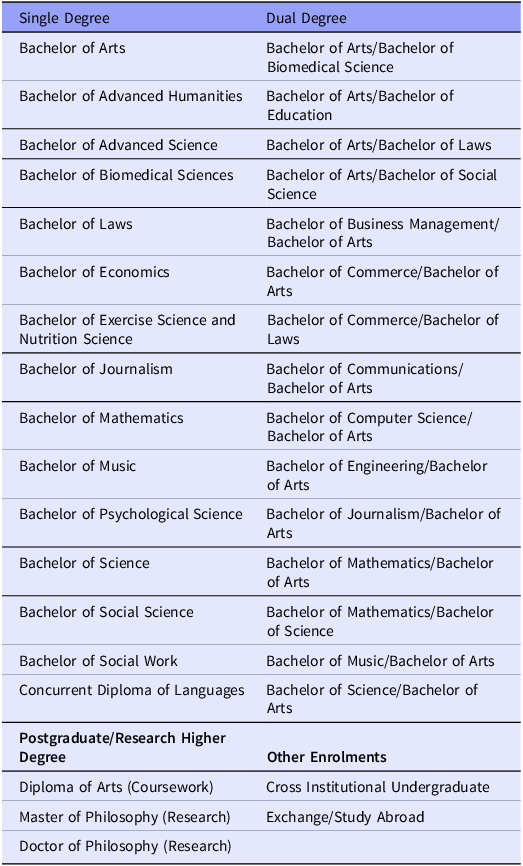
‘Introductory Latin’ is the compulsory first-year course in the Latin Major, the Latin Minor, and the Diploma of Languages (Latin).Footnote 7 It runs in the first semester of the academic year annually and is designed for students with no Latin language background. ‘Introductory Latin’ can also be taken as an elective in the various Bachelor’s degrees listed in Table 1. The average cohort size over the last 10 years is 56 students,Footnote 8 and each intake comprises a mix of first-year students who have not studied at tertiary level previously, second- and third-year undergraduate students,Footnote 9 and research higher degree (HDR) students.Footnote 10 As Table 1 demonstrates, students come from 29 different undergraduate Bachelor degrees (12 stand-alone, 17 dual),Footnote 11 1 postgraduate coursework (Diploma of Arts), and 2 HDR programmes (MPhil and PhD). Thus, the course contains students completing a wide range of degrees who are concurrently completing courses from a broad range of subject areas.
Degree Enrolment Types of Students Enrolled in ‘Introductory Latin’ (2015–2025)

Table 1. Long description
The table compares single degree programs with dual degree programs. It has two columns: Single Degree and Dual Degree. The Single Degree column lists Bachelor of Arts, Bachelor of Advanced Humanities, Bachelor of Advanced Science, Bachelor of Biomedical Sciences, Bachelor of Laws, Bachelor of Economics, Bachelor of Exercise Science and Nutrition Science, Bachelor of Journalism, Bachelor of Mathematics, Bachelor of Music, Bachelor of Psychological Science, Bachelor of Science, Bachelor of Social Science, Bachelor of Social Work, Concurrent Diploma of Languages, and Postgraduate/Research Higher Degree. The Dual Degree column lists Bachelor of Arts/Bachelor of Biomedical Science, Bachelor of Arts/Bachelor of Education, Bachelor of Arts/Bachelor of Laws, Bachelor of Arts/Bachelor of Social Science, Bachelor of Business Management/Bachelor of Arts, Bachelor of Commerce/Bachelor of Arts, Bachelor of Commerce/Bachelor of Laws, Bachelor of Communications/Bachelor of Arts, Bachelor of Computer Science/Bachelor of Arts, Bachelor of Engineering/Bachelor of Arts, Bachelor of Journalism/Bachelor of Arts, Bachelor of Mathematics/Bachelor of Arts, Bachelor of Mathematics/Bachelor of Science, Bachelor of Music/Bachelor of Arts, Bachelor of Science/Bachelor of Arts, Cross Institutional Undergraduate, Exchange/Study Abroad, Diploma of Arts (Coursework), Master of Philosophy (Research), and Doctor of Philosophy (Research).
The class materials used in ‘Introductory Latin’ include the ‘Introduction’ to ‘Section 2C’ of Jones and Sidwell (Reference Jones and Sidwell1986a, Reference Jones and Sidwell1986b) Reading Latin, supplemented by physical and digital materials created by me as course coordinator and instructor. Students study this material over a 13-week semester using the Grammar Translation Method. In preparation for classes, students translate, with the assistance of glossed ‘running’ and ‘learning’ vocabulary, set sections of graded text. They are also provided with a translation, which they may use if they are having difficulty.Footnote 12 Students then learn and reinforce grammar and build reading skills in class by analysing and discussing examples of unseen text, completing exercises from Reading Latin, and re-reading the set text from Reading Latin in conjunction with answering questions asked by the instructor and by the students themselves.Footnote 13 A mid-semester and final exam, weekly online quizzes, and fortnightly assignments provide students with the opportunity to complete both formative and summative assessment tasks which assist in their learning.
Use of machine translation and AI at the University of Queensland
Up until the end of Semester One 2025, the use of AI was not permitted by the University of Queensland; MT was not permitted in any Greek or Latin Language Courses, and their use constituted Academic Misconduct. Although the University now realises that a blanket ban on AI use is unrealistic and is perhaps detrimental to preparing students for real-world scenarios, it has also acknowledged that using AI and MT in some courses undermines not only learning objectives, but also the basic skill development needed to progress to advanced levels of learning.Footnote 14 From July 2025, the University of Queensland permitted individual course coordinators to communicate appropriate and inappropriate use to their students. In Greek and Latin Language courses, the use of AI and MT is still not permitted for specific assignments or in-person exams.
‘Introductory Latin’, Google Translate, AI, and academic integrity
In 2007, Google introduced GT as a free-of-charge digital platform on the internet, accessible via devices using Application Programming Interfaces. It provided automatic translations in approximately 50 languages.Footnote 15 In 2009, Google then launched the GT Toolkit, which enabled users to upload texts for automatic translation in over 100 languages by evaluating ‘millions of natural bilingual text pairs’.Footnote 16 Although the accuracy of GT has improved significantly for modern language pairs since Google replaced its phrase-based statistical system with a neural MT system in late 2016,Footnote 17 which has resulted in an error reduction rate of 60–94% for major language pairs,Footnote 18 as this paper demonstrates below, its accuracy for Latin was relatively poor in 2024 and 2025. This supports the findings of Volk et al. (Reference Volk, Fischer, Fischer, Scheurer and Ströbel2024), who found in their testing and comparison of multilingual LLMs to translate 16th-century letters written in Latin and Early New High German that ‘Google Translate has not improved much for Latin MT in recent years’.Footnote 19
In Week 1 of the course, time is spent on both introducing students to the print and digital course materials and also on briefly discussing other online resources. As GT is potentially problematic for beginner Latin learners because of its inaccuracies, time is also spent on discussing the potential pitfalls of using it to complete formal assessment. While many students are aware of GT and may have used it informally to translate from modern languages to English and vice versa, or are students whose first language is not English who may use it fairly regularly to translate modern language pairs, many do not realise that its use to complete formal course assessment is a form of cheating,Footnote 20 or that it constitutes plagiarism according to the rules of academic integrity enforced by the University.Footnote 21 Nor are many students aware that the accuracy of GT for Latin-English and English-Latin pairing, particularly for the completion of assessment in ‘Introductory Latin’, is relatively poor. Thus, students are advised that use of GT does not result in good marks for many students if used to complete translation assignments. It is also reinforced that reliance on MT and AI can result in poor performance in mid-semester and final exams, which require the acquisition of skills not mastered unless students complete assessment and class preparation work themselves.
In the first week of the course, it is difficult to use examples of inaccurate sentence translations from Latin into English or English into Latin produced by GT because the students have no or very little knowledge of grammar, syntax, inflexion, or vocabulary. Therefore, two Latin nouns are used as examples. The course begins with Reading Latin’s adapted version of Plautus’ Aulularia, which contains the story of the old man Euclio discovering that he has been left a pot full of gold. The gold was hidden long ago by his now-deceased grandfather Demaenetus, who returns as a ghost to reveal the pot’s location. Thus, it is explained to the students that the word for pot used by Plautus is aula, and this is why the only English meaning given in the learning vocabulary is ‘pot’, because in the context of the story, other meanings are inaccurate.Footnote 22 However, the only English translation for aula given by GT when translating sentences is ‘hall’, which does not suit any of the contexts in which aula is used in the play. Plautus’ aula is related to olla ae 1f, a pot or jar,Footnote 23 whereas GT uses one of the meanings for aula not related to Plautus’ use.Footnote 24 GT, as noted by Mundt and Groves,Footnote 25 has no ‘reader awareness’. Unable to think critically or adapt to context, GT is unable to determine meaning based on factors such as context, changes in word usage over time (e.g. from Republic to Empire), or author word-choice preference, such as Plautus using the form aula for olla.
The noun Euclio is also used to reinforce the potential problems of using GT in the second class session in Week 1.Footnote 26 Students are asked to translate the ‘Introduction’ in Reading Latin in pairs by using the glossed running vocabulary.Footnote 27 Although the students have not yet been formally introduced to Latin declensions and cases, which takes place in Week 2, and do not meet third declension masculine nouns until Week 3, the gloss given in the Reading Latin running vocab for the genitive singular Latin form Euclionis is ‘of Euclio’. GT offers as the translation of the sentence ego sum Phaedra. filia Euclionis sum as ‘I am Phaedra. I am the daughter of Euclion’. Although scholars have noted that Euclio’s name is related either to Greek words which imply that Euclio was a man of ‘good reputation’, or a pun on or κλϵίω ‘I close up’,Footnote 28 and is also attested as a Greek personal name,Footnote 29 students are advised not to follow GT’s transliterated Greek version Euclion, but to use ‘Euclio’ for their English translations of the main character’s Latin name form.
After these discussions, students normally agree that (a) use of GT is a form of plagiarism and cheating, and (b) that relying on it for assessment is inherently risky because GT might make mistakes that they are unaware of, and simply using it uncritically will not improve their Latin skills.Footnote 30 Despite the diversity of students in the ‘Introductory Latin’ course, and the traditional perception that Latin is either a ‘very hard’ or a ‘challenging’ subject by a large proportion of course participants,Footnote 31 until 2024 the misuse of GT did not occur. As mentioned above, the ‘Introductory Latin’ course is well-supported by both printed and electronic resources designed specifically for the course, and students are provided with comprehensive verbal and written feedback. As the majority of students genuinely want to develop skills in the reading and comprehension of Latin texts, they do the work themselves. Thus, it was surprising to have a small number of students use GT to complete assignments in 2024 and 2025.Footnote 32
Misuse of Google Translate in 2024
All students are required to submit assignments through Turnitin, an online assessment security and integrity tool that identifies unoriginal or improperly cited student writing ‘by highlighting similarities to the world’s largest collection of internet, academic, and student paper content’.Footnote 33 Markers check this tool before providing feedback and grading an assignment, and undertake a comprehensive check into similarity matches if they suspect that mistakes are not those usually made by beginner learners in ‘Introductory Latin’ assignments. As demonstrated below, GT use is also often easy to detect because it makes grammatical and lexical errors, and provides vocabulary meanings that differ from those used in course learning vocabularies.
The first two cases of the misuse of GT in 2024 were detected in conjunction with the completion of Assignment 1 by Students A and B, submitted in Week 3. Student A had been attending class regularly and was participating in reading aloud and translating from Latin to English, participating in exercises in declining first and second declension nouns, conjugating verbs in the present indicative active, and in learning prepositions that indicate movement or position. Although Student B was not attending classes as regularly, both students were successful in completing the simple tasks of translating single verbs in the present tense on the first part of the assignment (75% of answers were correct for A, 80% for B). However, both performed poorly in the second half of the assignment. This was surprising for Student A, given their in-class performance.
Question 3 was based on the Latin sentence question:
Dāuus, cūr mensam sub scaenā celās?
The translation provided by Student A was ‘God, why was the table raised under the stage?’ and Student B ‘God, why did he raise the table under the stage’. The use of ‘God’ instead of the name Davus and ‘raise/raised’ rather than ‘you hide’ by both students were immediate flags, as these are not typical mistakes made by students in this assignment. Turnitin similarity reports were checked, and it was identified that these mistakes were similar to GT, whose translation was ‘God, why did he raise the table under the scene?’ Thus, GT incorrectly identified Dāuus as deus, and gave the wrong person, number, tense, and meaning of celās. Footnote 34 Other than correctly changing ‘scene’ to ‘stage’, Student B copied GT verbatim, thus reproducing the GT errors. Student A also correctly changed ‘scene’ to ‘stage’, but may have been misled by GT’s treatment of celās: although the use of the past tense ‘was’ in translating this sentence question may be a beginner error, other students who offered an English past tense translated celās as ‘did you hide’.Footnote 35
Question 3 also asked students to complete the more complex tasks of identifying the subject and direct object of the sentence question and then to explain how this identification was made. While Student A repeated rules they believed relevant, such as ‘the subject of the sentence performs the action of the verb’, and Student B that ‘In Latin, word order is subject-object-verb’, neither chose Dauus nor explained that Dauus was in the nominative singular and agreed with the person and number of the verb. Instead, both incorrectly identified the accusative mensam as the subject and the ablative scaenā as the direct object. Student B’s justification was that the stage was on the receiving end of the verb; thus, it was receiving the raised table, possibly because GT added ‘he’ into the translation. Student A’s answer was partially correct, explaining that the direct object is in the accusative and that an ablative used with a preposition indicated position, despite identifying the Latin words themselves incorrectly. While it is not necessarily unexpected for students to mix up the roles of cases at this stage of the course, it is possible that the translation provided by GT caused confusion,Footnote 36 making both students doubt their correct answers. For this question, GT provided incorrect information which the student did not have enough experience or knowledge to critique successfully. Other than a few students translating as celās as ‘did you hide’, other students in the class successfully identified the subject, object, and use of the preposition.
Question 4 of Assignment 1 was based on ad mensam aulās coquī portant.
As well as identifying the named subject coquī (the cooks) and direct object aulās (pots), students were also required to give their gender, case, and number, to translate the preposition ad and identify its role, and finally, to translate the whole sentence into English. Student B correctly identified all answers up to the translation. Although the subject of the sentence was still incorrectly identified by Student A as mensam, correct answers were provided for questions other than the sentence translation, indicating that both students understood all or many of the individual sentence components. However, both A and B gave translations identical to, or very similar to, the GT translation, despite it not making sense. Thus, GT’s ‘They bring to the table the halls of the kitchen’ was used word-for-word by A, while B offered ‘to bring the cook to the palace table’. The expected translation, ‘The cooks carry/are carrying the pots to/towards the table’, not only reflects the learning vocabulary meanings set for the course, but also makes logical sense.Footnote 37 Other students successfully translated coquī as cooks (subject), aulās as pots (direct object), and portant as ‘carry’. Beginner errors made by three other students were to translate portant as ‘they carried’, and one student translated the words above the Latin correctly but did not complete the final step of putting them into English word order. English was not student A’s first language, though at this point in the course, it did not seem to be a problem affecting in-class performance.
If aula is entered into GT as a single word, ‘palace’, ‘court’, and ‘inner court’ are also given as potential English meanings, which may have influenced Student B’s word choice: although Student B, a native English speaker, knew that GT was off the mark, it is likely that they returned to GT to find another meaning for aulās. They then paired the preposition ad with GT’s meaning of portant ‘bring’ to formulate ‘to bring’, translating it as an English infinitive. They also combined ad with both mensam and aulas, resulting in ‘to the palace table’. Although not agreeing in number, both mensam and aulās are accusative. As B correctly explained in the earlier question that ad when used with an accusative indicated ‘ movement towards’, it is possible to see how they came up with ‘to the palace table’. However, while A and B’s errors are understandable at beginner level, the use of GT seems to have focused attention away from what they potentially might have correctly translated if they had only used the recommended learning resources.
Both Student A and B clearly used GT for Question 5, which was designed to test their understanding of the use of est and sunt at the beginning of the sentence:
est tībicīna. serua est. sunt Dāuus et Pamphyla. quoque seruī sunt.
The expected translation of ‘There is the pipe-girl. She is a slave-woman. There are Davus and Pamphyla. The are also slaves’. was not given by GT, which interpreted the sentence in 2024 as ‘is tībicīna. it is closed. are Davus and Pamphyla. are also secret’.Footnote 38 Student A added ‘It is tībicīna’, perhaps thinking that tībicīna was the English translation, and that ‘it’ was needed at the beginning of the sentence because this is what GT added to the next sentence ‘it is closed’. However, A made no attempt to change GT’s translation of the rest of the sentence, despite it not making sense. Nor could A explain how they translated est and sunt in relation to position in the sentences, a question answered successfully by other students in the course. Instead, A placed a = sign between the Latin words and GT’s translations (‘est = it is, serua = closed, sunt = they are, et = and, serui = secret, quoque also/too’) despite ‘closed’ and ‘secret’ being incorrect meanings for serua and serui.
Student B offered a few more emendations: ‘[She is] the pipe-girl. [She is] the closed in slave-woman. They [are] Dauus and Pamphyla. And they [are] in service (slaves) in secret’, attempting both to make GT’s translations more understandable by interpreting ‘closed’ and ‘secret’ to be referring to the status of the people named in the sentence as slaves. Entering serva individually into GT does produce ‘slave-woman’, though it could not translate tībicīna in 2024, so B must have consulted course learning resources for ‘pipe-girl’, as this meaning is not given in other online dictionaries. As their explanation of how they translated est and sunt in relation to position in the sentences, B wrote:
The verbs are translated to English from the sentence is ‘they are’ and ‘she is the’ because of gender, case, and number of the sentence, the gender being female for ‘she is the’ and masculine for ‘they are’, the case is vocative (the case of address) and number is singular for ‘she is the’ but plural for ‘they are’.
Although some beginner learners do initially confuse the properties of nouns and verbs, this is not a mistake made by other students in this question. Thus, it appears that GT’s lexical choices in particular contributed to Student B’s incorrect attempts to explain their translation of est and sunt.
In Assignment 2, submitted in Week 5, Student A, who continued to come and participate in class and to answer questions correctly, did very well on all questions bar the translation of the passage below:
Lar in aedīs intrat. deus Eucliōnis familiae est. aulam habet. in aulā thēsaurī et aurum Dēmaenetī sunt. Lar aulam sub terrā cēlat quod Eucliō, dominus familiae, Larī dat nūllum unguentum, nūllās coronās, honōrem nūllum. Phaedram autem, senis auārī fīliam bonam et honestam, Lar amat, quod dat semper deō multa unguenta, multās coronās et magnōs honōrēs. Lar igitur aulam Dēmaenetī Eucliōnī dat. sed Eucliō, quod auārus senex est et fūrēs clam timet, aulam sub terrā iterum collocat.Footnote 39
GT’s translation:
Lar enters the temple. He is the god of the Euclioni family. He has a hall. In the hall are the treasures and gold of Demaenet. Lar hides the hall under the ground because Euclione, the master of the family, gives Lar no perfume, no crowns, no honor. But Phaedra, the good and honest daughter of an old man, is loved by Lar, who always gives the god many ointments, many crowns and great honors. Lar therefore gives the hall to Dēmaenetī Eucliōnī. But Euclius, being an old man and secretly afraid of fires, places the hall again underground.
Student A offered several emendations, including changing in aedīs from ‘the temple’ to ‘into the house’, ‘hall’ to ‘pot’, correcting the different versions of Euclio (‘Euclioni’, ‘Euclius’, ‘Euclione’) to match the correct case and number, correcting ‘Demaenet’ to ‘to Demaenetus’, changing unguentum/a from ‘perfume’ to ‘ontiment(s)’, coronās from ‘crowns’ to ‘garlands’, and honōrem/honōrēs from ‘honor’ to ‘respect’. These changes reflect an awareness of class discussion and familiarity with the learning vocab.
Student A’s parsing and analysis answers, which scored 20/23 marks, indicated both that they did understand the passage, and that they potentially could have changed more of the GT errors, including uses of the dative, which was also being tested in this assignment. Many students translated Phaedram autem, senis auārī fīliam bonam et honestam, Lar amat as ‘But Phaedra, the good and honourable daughter of Euclio, loves the household god’. Although GT also confused subject and direct object, it made the verb passive, which was not detected by Student A because only active voice has been covered at this point in the course. Student B scored 7/23 for the remainder of Assignment 2, and made only one emendation to GT’s version of the passage above, changing ‘temple’ to ‘house’, but without translating the preposition ‘in’. Use of GT increased both A and B’s parsing errors, as judgements were made on the basis of the GT English translation rather than on the Latin itself. While again these could potentially be identified as beginner errors, class scaffolding and discussion prior to the assignment equips students both to translate and parse, and the majority make only minor mistakes, unlike Student B. This demonstrates that GT has the potential to undermine the development of critical thinking skills.
As previous studies of GT use in modern languages have demonstrated, one major appeal of GT to users is that it provides instant and effortless translations. Thus, it needs to be used as a learning tool in conjunction with other learning tools to ‘post-edit’ the translations it provides.Footnote 40 Student B not only failed to look at their assignment marks, feedback, and warnings about their continued use of GT,Footnote 41 but in Week 13, the last week of the course, used GT for all questions in Assignment 6, the final assignment for the course. Here, B used GT’s translations verbatim for four questions, one of which was an English into Latin exercise.Footnote 42 The minor emendations made by B to GT’s translations of the other questions were largely cosmetic, and demonstrated no definitive understanding of the grammatical and lexical concepts tested by this assignment. For example, B corrected GT’s ‘Christalus’ and ‘Christ’ for Chrȳsalus (the name of an enslaved character), but incorrectly changed GT’s translation of Chrȳsalus seruus audāx Nicobūlī est from GT’s ‘Christsalus is a bold Nicobūlī servant’ to ‘The servant[s] Chrysalus and Nicobuli is bold’, and GT’s ‘Christ takes a learned counsel’ for Chrȳsalus consilium capit doctum to ‘Chrysalus makes a learned decision’. Question 2 required students to translate model Latin sentences into English, then translate English sentences into Latin based on these model sentences using the vocabulary list provided on the assignment. Student B reproduced both GT’s translation of the model sentence into English, and the English sentence into Latin verbatim. B made no attempt to correct either translation, and did not have the knowledge to realise that for one of the sentences, GT had used a grammatical structure that they had not yet learnt, an indirect command with a subjunctive verb, to translate ‘We will order you (s.) to help your town today’. GT offered praecipimus tibi ut hodie oppidum tuum adiuvet, in contrast to the expected tē oppidum tuum adiuuāre hodiē iubēbimus. GT may again have caused confusion for Student B, a finding not dissimilar to other studies of MT use among second language beginner students.Footnote 43 While many students do find the task of translating English into Latin more challenging, in this sentence, students who made mistakes mixed up the use of the personal pronoun tu tui and adjective tuus a um, but were able to translate the rest of the sentence successfully. Despite passing the mid-semester exam with a mark of 52%, B failed the final exam with a mark of 15%, as they had not mastered the skills required to translate, parse, and critically interpret the Latin without assistance.
Misuse of Google Translate in 2025
At the beginning of Semester 1, 2025, students in ‘Introductory Latin’ were given the same warning about GT. For the first half of the course, students were not misusing GT, and performance on the mid-semester exam reflected performance in Assignments 1 to 3. However, four students used GT for part of Question 2 in Assignment 4 submitted in Week 9. After successfully translating a model Latin sentence into English, students were instructed to translate ‘But in the shrine, what are all the men saying to the unhappy thief?’ into Latin using the vocabulary provided, following the word order of a model Latin sentence. GT’s ‘Sed in delubro quid omnes dicunt latroni misero?’Footnote 44 was reproduced word-for-word by Student C, despite delubrum, latro, and miser not the words provided on the assignment. Nor are delubrum or latro words in the learning vocabulary, or in the UQLatin word lookup tool. Student C was a non-native English speaker, but was attending class regularly and had passed the mid-semester exam (67%). Their assignment marks averaged 78%, demonstrating a good grasp of the majority of the course content to date. The mistakes made on these assignments by C were those typically made by beginner Latin learners.
Students D, E, and F, although able to follow the word order of the model sentence and to choose correct gender, case, and number, and also person, number, tense, mood, and voice, each used at least one word that was not in the vocab list supplied for the question. Instead, they used a word that was in GT’s Latin translation. Student D, also a non-native English speaker, submitted sed in sacro quid omnes furi misero dicunt? Both sacer and miser are words in the learning resources, though sacer is not an adjective learnt in ‘Introductory Latin’, and not the word used throughout the course for ‘shrine’. Student D attended class regularly and had performed very strongly in the mid-semester exam (87%), and Assignments 1–3 (91%). Students E and F, both native English speakers, chose to use delubro and misero, and latroni and misero respectively, rather than the vocab provided. Student E, also a regular class participant, scored 81% on the mid-semester exam and 88% on Assignments 1–3, while Student F, a more erratic participant, achieved 55% on the mid-semester exam and 70% on Assignments 1–3. As no further use of GT was detected, all four students took note of their warnings. Students D, E, and F all passed the course, D and E with High Distinctions, and F with a strong Credit. Student C, who copied GT’s translation verbatim for Question 2, also completed the course successfully with a Credit.
Students D and E both apologised in person once they had received their feedback for Assignment 4, explaining that they had used GT because they had not left themselves sufficient time to complete Question 2.Footnote 45 As GT’s translation of the sentence was grammatically correct, it did not create confusion for Students D, E, and F at this stage of the course because they had acquired the critical evaluation skills to judge whether the properties of each word in the sentence were correct. However, all four students failed to notice that the question asked them to use the correct form of homo, a word not translated by GT into Latin. Although Students C, D, E, and F did not demonstrate mastery of the skills Question 2 was designed to test, some learning did occur for Students D, E, and F.
Conclusion
This case study demonstrates that although one of the perceived benefits of GT for students is access to instant translations from Latin into English and vice versa, without the knowledge to identify GT’s grammatical, syntactical, lexical, and morphological mistakes, its use negatively impacted learning and assessment results when used in the early stages of the ‘Introductory Latin’ Course at UQ. As demonstrated by Students A and B, use in Week 3 led to confusion, as they had not yet acquired the knowledge and skills to identify all GT’s errors. Moreover, in Week 5, although their skills had increased, Students A and B attempted to answer grammar and parsing questions based on GT’s misleading English translations rather than on the Latin itself, and attempts at post-editing largely failed. Thus, GT use resulted in errors that they might not have made if they had used the recommended course resources alone. Student B’s dependency on GT did not result in the necessary levels of vocabulary learning, grammatical understanding, or skill development in Latin reading and comprehension to pass the course. Use of GT in Week 9 by Students C, D, E, and F made it difficult to judge whether they had acquired the skills being tested by the specific question they used GT to answer. Moreover, when GT is accurate and provides students with correct translations, simply writing down these translations does not enable students to develop vocabulary, or the higher-order reading, comprehension, and analysis skills that they need to complete exams and to progress to intermediate and advanced levels of Latin learning. Although MT and AI platforms have the potential to be used as Latin learning tools, it is clear that in introductory Latin courses, their use needs to be scaffolded by course designers and used in combination with other post-editing tools.

 Open access

