


1. Introduction
The Western Carpathians in central Europe (Fig. 1a) represent the northernmost branch of the Alpine orogenic belt and form the westernmost segment of a curved Carpathian orogenic belt. Similar to other sectors of this belt, the Western Carpathians have experienced a rather complex Alpine tectonothermal history, comprising Jurassic rifting and basin formation, Cretaceous collisional tectonics, extensional collapse and lateral escape of fragments of the Adriatic (Apulian) plate and their intricate interaction with the European foreland in the Tertiary period (Royden, Horváth & Burchfiel, Reference Royden, Horváth and Burchfiel1982; Royden et al. Reference Royden, Horváth, Nagymarosy and Stegena1983; Maheľ, Reference Maheľ1986; Ratschbacher et al. Reference Ratschbacher, Frisch, Linzer and Merle1991a, Reference Ratschbacher, Merle, Davy and Cobboldb; Csontos, Reference Csontos1995; Plašienka et al. Reference Plašienka, Grecula, Putiš, Kováč, Hovorka, Grecula, Hovorka and Putiš1997; Tari et al. Reference Tari, Dövényi, Dunkl, Horváth, Lenkey, Stefanescu, Szafián and Tóth1999; Frisch, Dunkl & Kuhlemann, Reference Frisch, Dunkl and Kuhlemann2000; Wortel & Spakman, Reference Wortel and Spakman2000; Sperner, Ratschbacher & Nemčok, Reference Sperner, Ratschbacher and Nemčok2002). The dynamics of the Western Carpathian orogen are, in general, well described by conceptual models (Ratschbacher et al. Reference Ratschbacher, Frisch, Linzer and Merle1991a; Plašienka et al. Reference Plašienka, Grecula, Putiš, Kováč, Hovorka, Grecula, Hovorka and Putiš1997; Sperner, Ratschbacher & Nemčok, Reference Sperner, Ratschbacher and Nemčok2002; Kováč et al. Reference Kováč, Kráľ, Márton, Plašienka and Uher1994, Reference Kováč, Anderyeva-Grigorovich, Bajtrakteravić, Brzobohatý, Filipescu, Fodor, Harzhauser, Nagymarosy, Oszczypko, Pavelić, Rögl, Saftić, Sliva and Studencka2007). Owing to a lack of empirical data and the sparse geological record, however, a number of fundamental questions regarding the orogenesis (e.g. timing and grade of metamorphism, thermal histories of crystalline and sedimentary rocks, or the timing and nature of exhumation processes), remain open or controversial.
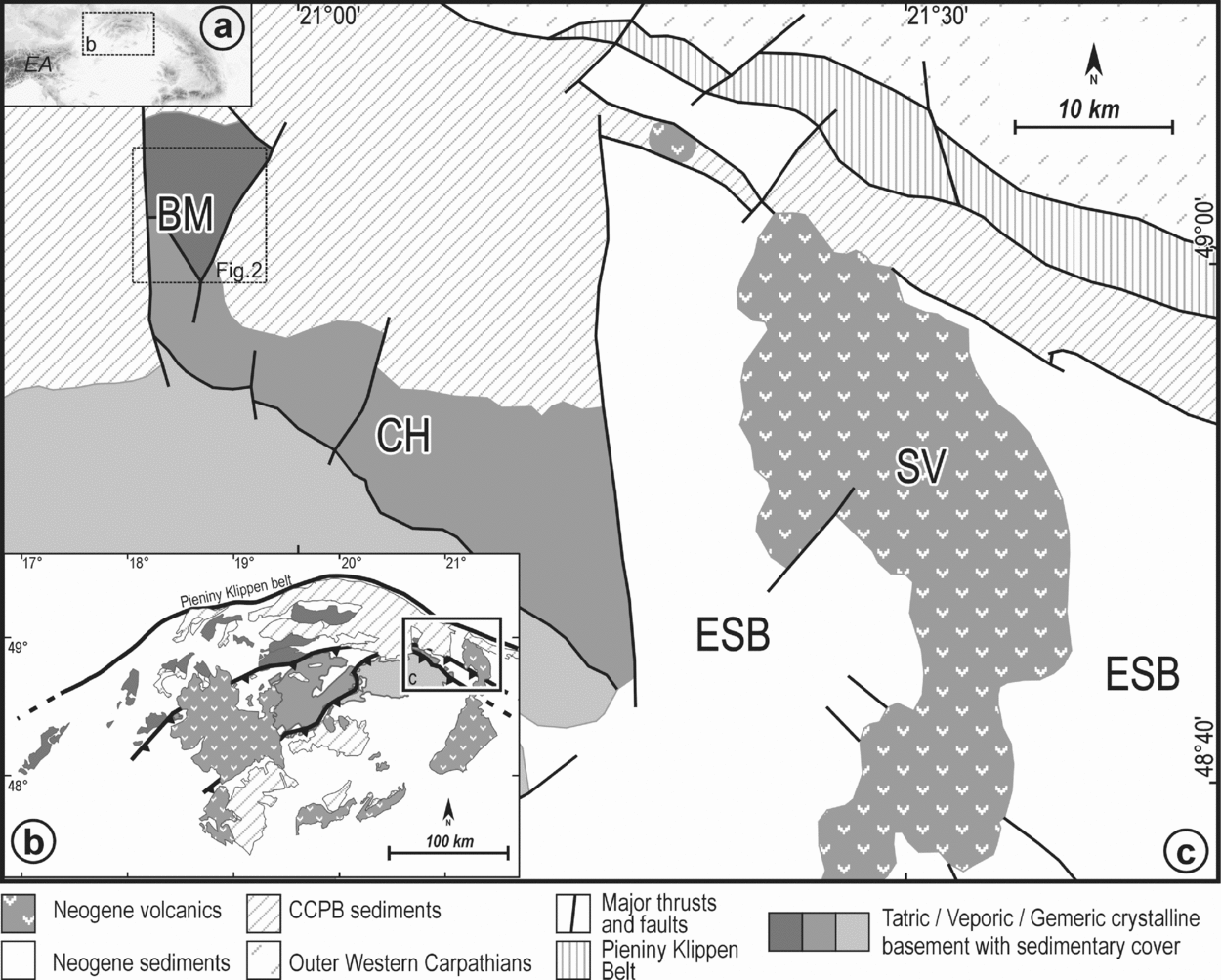
(a) The location of map (b) within the Alpine–Carpathian realm; EA – Eastern Alps. (b) Simplified geological map of the Western Carpathians with exposures of Variscan crystalline complexes (Tatric, Veporic and Gemeric superunits), occurrences of Palaeogene (CCPB) sedimentary and Neogene volcanic rocks, and location of the study area. (c) Geological map of the BM and surrounding areas (modified after Lexa et al. Reference Lexa, Bezák, Elečko, Eliáš, Konečný, Less, Mandl, Mello, Pálenský, Pelikán, Polák, Potfaj, Radocz, Rylko, Schnabel, Stráník, Vass, Vozár, Zelenka, Biely, Császár, Čtyroký, Kaličiak, Kohút, Kovacs, Mackiv, Maglay, Nemčok, Nowotný, Pentelényi, Rakús and Vozárová2000). Abbreviations: BM – Branisko Mts, CH – Čierna Hora Mts, SV – Slánske Mts, ESB – Eastern Slovakian Basin.
For instance, two competing opinions on the Alpine metamorphism dominate the literature. One traditional view is that Variscan crystalline basement complexes of the Tatric principal unit either completely lack or are only weakly overprinted by the Alpine metamorphism that is restricted only to shear zones, reaching P–T conditions of the anchizone or lower greenschist facies (Krist et al. Reference Krist, Korikovsky, Putiš, Janák and Faryad1992; Madarás et al. Reference Madarás, Hók, Siman, Bezák, Ledru and Lexa1996; Plašienka et al. Reference Plašienka, Grecula, Putiš, Kováč, Hovorka, Grecula, Hovorka and Putiš1997; Plašienka, Reference Plašienka2003). The other opinion is that the Tatric crystalline complexes did experience a distinct very low-grade (anchizonal) Alpine metamorphic overprint (Faryad & Dianiška, Reference Faryad and Dianiška2002; Danišík et al. Reference Danišík, Kohút, Dunkl and Frisch2008a, Reference Danišík, Kohút, Broska and Frisch2010, Reference Danišík, Kadlec, Glotzbach, Weisheit, Dunkl, Kohút, Evans, Orvošová and McDonald2011). Likewise, there are two competing views on the timing and nature of exhumation in the Western Carpathians. Whereas Kováč et al. (Reference Kováč, Kráľ, Márton, Plašienka and Uher1994) favour a progressive exhumation migrating from internal parts of the belt towards the orogenic front, and a simple cooling of crystalline complexes, Danišík et al. (Reference Danišík, Dunkl, Putiš, Frisch and Kráľ2004, Reference Danišík, Kohút, Dunkl and Frisch2008a, Reference Danišík, Kohút, Broska and Frisch2010, Reference Danišík, Kadlec, Glotzbach, Weisheit, Dunkl, Kohút, Evans, Orvošová and McDonald2011) argued for a complex thermal history with at least one phase of reheating related to Palaeogene sedimentary burial and/or Miocene mantle upwelling associated with volcanic activity and increased heat flow.
In an effort to evaluate and better distinguish between the contrasting models of Carpathian metamorphic and exhumation histories, we used a combination of three thermochronometers: zircon (U–Th)/He (ZHe), apatite fission track (AFT) and apatite (U–Th)/He (AHe), whose sensitivities cover the temperature range of ~ 40–200°C (Hurford, Reference Hurford1986; Wagner & Van den haute, Reference Wagner and Van den haute1992; Wolf, Farley & Kass, Reference Wolf, Farley and Kass1998; Carlson, Donelick & Ketcham, Reference Carlson, Donelick and Ketcham1999; Farley, Reference Farley2000; Reiners et al. Reference Reiners, Spell, Nicolescu and Zanetti2004). In addition to providing constraints on material paths at mid- to shallow crustal levels, allowing exhumation rate estimates over different portions of the thermal histories of the rocks, this temperature range can be an effective tool to detect very low-grade metamorphism, which is of particular importance here.
In this study, we target the Branisko Mts (BM), a relatively small, but quite unique crystalline complex in the eastern part of the Western Carpathians (Fig. 1a, b). At least three aspects make the BM an interesting area to study the Carpathian orogenesis:
(i) The structure of the basement is fairly simple when compared to other massifs. While we acknowledge that some authors attributed the whole BM basement complex to the Veporic unit (Vozárová & Vozár, Reference Vozárová and Vozár1986, Reference Vozárová and Vozár1988; Polák et al. Reference Polák, Jacko, Vozárová, Vozár, Gross, Harčár, Sasvári, Zacharov, Baláž, Liščák, Malík, Zakovič, Karoli and Kaličiak1997), we prefer the traditional classification (Rösing, Reference Rösing1947; Andrusov, Reference Andrusov1958; Fusán, Reference Fusán1963; Maheľ, Reference Maheľ1986; Biely, Reference Biely1996; Lexa et al. Reference Lexa, Bezák, Elečko, Eliáš, Konečný, Less, Mandl, Mello, Pálenský, Pelikán, Polák, Potfaj, Radocz, Rylko, Schnabel, Stráník, Vass, Vozár, Zelenka, Biely, Császár, Čtyroký, Kaličiak, Kohút, Kovacs, Mackiv, Maglay, Nemčok, Nowotný, Pentelényi, Rakús and Vozárová2000; Plašienka, Reference Plašienka2006) where two principal basement units are identified in the BM: the Tatric unit (or Tatricum) and the Veporic unit (Veporicum), which were juxtaposed during Alpine collision.
(ii) The Tatric part of the basement represents the easternmost outcrop of the Tatric unit in the Western Carpathians and no thermochronological data have been presented from this region yet.
(iii) Despite extensive research on the Variscan history (Rösing, Reference Rösing1947; Vozárová, Reference Vozárová1993; Faryad, Reference Faryad1996; Jacko, Reference Jacko1998; Méres, Ivan & Hovorka, Reference Méres, Ivan and Hovorka2000; Faryad, Ivan & Jacko, Reference Faryad, Ivan and Jacko2005; Bónová & Broska, Reference Bónová and Broska2006; Kohút et al. Reference Kohút, Sherlock, Poller, Konečný, Siman and Holický2004, Reference Kohút, Mänttäri, Sergeev, Putiš and Uher2007, Reference Kohút, Uher, Putiš, Broska, Siman, Rodionov, Sergeev and Kohút2010), the Alpine tectonothermal evolution of the BM is virtually unconstrained.
Owing to the lack of thermochronological data, one can only speculate whether the BM escaped or experienced an Alpine metamorphic overprint (Plašienka et al. Reference Plašienka, Grecula, Putiš, Kováč, Hovorka, Grecula, Hovorka and Putiš1997; Faryad, Reference Faryad, Dunkl, Balintoni, Frisch, Hoxha, Janák, Koroknai, Milovanovic, Pamić, Székely and Vrabec2002). It is also not clear whether the BM were exhumed in the Palaeogene as inferred from the analogy with other surrounding crystalline complexes (Kováč et al. Reference Kováč, Kráľ, Márton, Plašienka and Uher1994), or were buried and reheated by sediments of the Central Carpathian Palaeogene Basin (Danišík et al. Reference Danišík, Dunkl, Putiš, Frisch and Kráľ2004), and/or were reheated by the regional Miocene thermal event that was detected in several other crystalline massifs of the Western Carpathians (Danišík et al. Reference Danišík, Dunkl, Putiš, Frisch and Kráľ2004, Reference Danišík, Kohút, Dunkl and Frisch2008a, Reference Danišík, Kuhlemann, Dunkl, Székely and Frischb, Reference Danišík, Kadlec, Glotzbach, Weisheit, Dunkl, Kohút, Evans, Orvošová and McDonald2010, Reference Danišík, Kadlec, Glotzbach, Weisheit, Dunkl, Kohút, Evans, Orvošová and McDonald2011). The new multi-thermochronological dataset presented in this study allows these hypotheses to be critically evaluated.
2. Geological setting
The focus of this study is largely on the northern, Tatric part of the BM (the so-called Smrekovica massif), which exhibits a typical Western Carpathian ‘core mountain’ structure (Fig. 2). It consists of a Variscan crystalline basement ‘core’ exposed in the central part of the massif and the Choč nappe comprising upper Carboniferous to upper Triassic formations preserved mostly along the northern margin of the BM. The Tatric part of the BM forms a N–trending, fault-bounded horst structure with elevations of ~ 950 m. To the west, north and east, it is flanked by the sediments of the Central Carpathian Palaeogene Basin (CCPB); to the south, it is bordered by a Veporic basement unit (the so-called Sľubica massif). Although the contact of both basement units is not exposed, it is assumed that the Veporic basement is in the hanging-wall position separated from the Tatric part by the ‘Harakovska’ syncline and Kluknava thrust fault (Maheľ, Reference Maheľ1986).
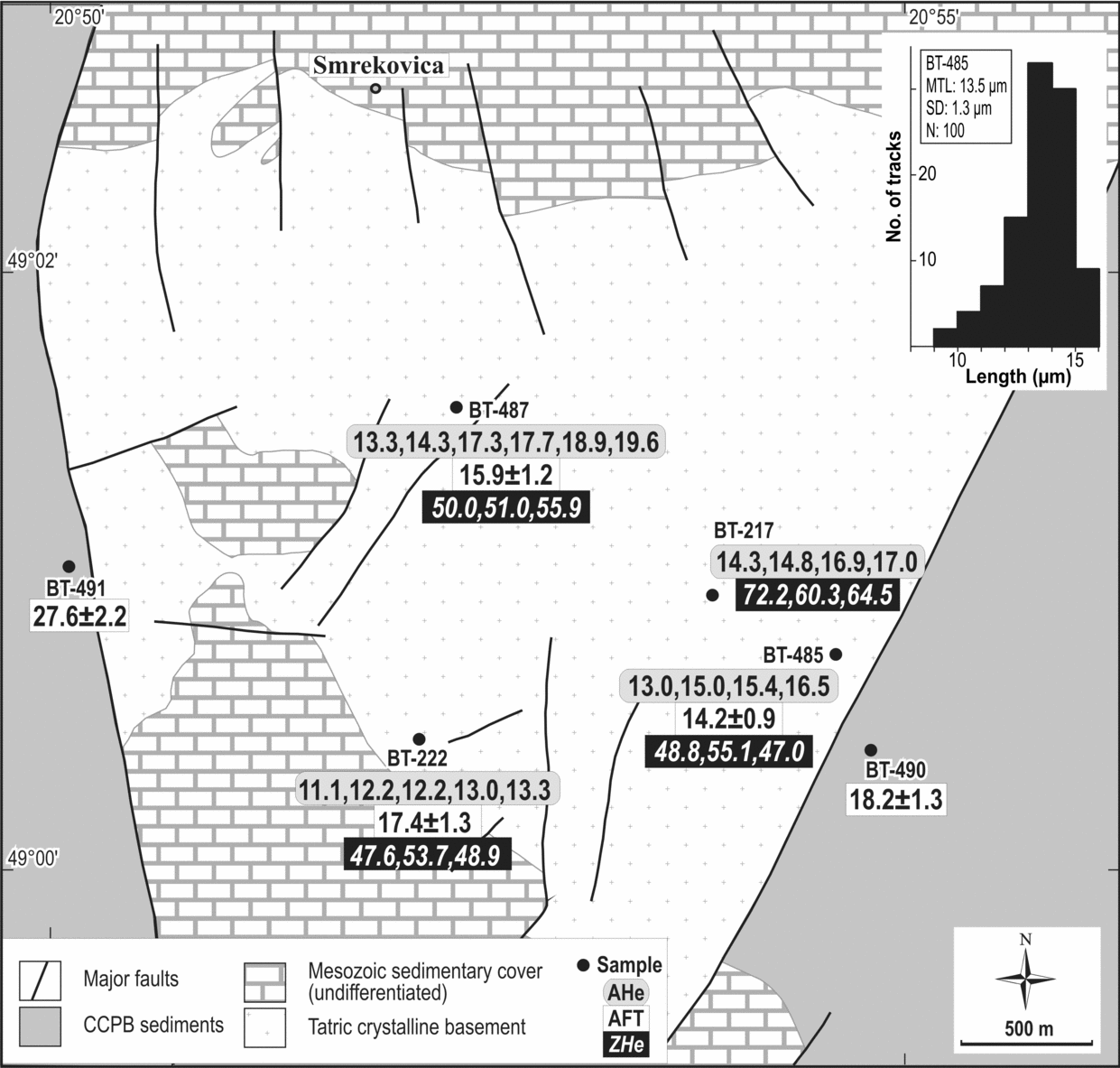
Thermochronological results (from top to bottom: sample code, single grain AHe ages measured on replicates, central AFT age with 1σ error, single grain ZHe ages measured on replicates; all ages are quoted in Ma). Inset: track length distribution of sample BT-485. Abbreviations: MTL – mean track length ± standard deviation (SD) in μm; N – number of measured tracks.
The basement of the Tatric part consists of granitoids (including granite, granodiorite and tonalite) and medium- to high-grade metamorphic rocks, mostly gneisses, amphibolites and migmatites (Vozárová, Reference Vozárová1993; Faryad, Ivan & Jacko, Reference Faryad, Ivan and Jacko2005) ascribed to the Meso-Variscan metamorphic/magmatic event at ~ 350 Ma (monazite Th–U–Pb ages: 346 ± 6 Ma to 332 ± 10 Ma; zircon rim U–Pb ages: 351 ± 1.5 Ma; biotite Ar–Ar ages: 382 ± 8 Ma to 339 ± 2 Ma; Kohút et al. Reference Kohút, Sherlock, Poller, Konečný, Siman and Holický2004, Reference Kohút, Mänttäri, Sergeev, Putiš and Uher2007, Reference Kohút, Uher, Putiš, Broska, Siman, Rodionov, Sergeev and Kohút2010; Bónová et al. Reference Bónová, Jacko, Broska and Siman2005). A systematic appearance of older ages (~ 475–455 Ma and ~ 420–390 Ma) revealed by zircon cores via SHRIMP as well as hornblende Ar–Ar data may record the Ordovician protomagmatic age and a Silurian–Devonian tectonometamorphic event (Kohút et al. Reference Kohút, Sherlock, Poller, Konečný, Siman and Holický2004, Reference Kohút, Mänttäri, Sergeev, Putiš and Uher2007, Reference Kohút, Uher, Putiš, Broska, Siman, Rodionov, Sergeev and Kohút2010). The post-Variscan sedimentary cover is represented by Permian arkoses, greywackes, conglomerates and sandy shales with thickness of up to 200–300 m and Scythian quartzites and variegated sericite schists reaching thicknesses of up to ~ 120 m (Polák et al. Reference Polák, Jacko, Vozárová, Vozár, Gross, Harčár, Sasvári, Zacharov, Baláž, Liščák, Malík, Zakovič, Karoli and Kaličiak1997).
During the Eo-Alpine shortening in the period ~ 110–85 Ma, the Tatric crystalline basement with its sediments was juxtaposed next to the Veporic basement and overthrust by the Choč nappe dominated by Triassic dolomites (Plašienka, Reference Plašienka1997; Plašienka et al. Reference Plašienka, Grecula, Putiš, Kováč, Hovorka, Grecula, Hovorka and Putiš1997). The burial depth and possible Eo-Alpine metamorphism of the crystalline basement related to the thrusting is not precisely known. Faryad (Reference Faryad, Dunkl, Balintoni, Frisch, Hoxha, Janák, Koroknai, Milovanovic, Pamić, Székely and Vrabec2002), inferring from mineral assemblages in granite (replacement of plagioclase and biotite by white mica, epidote and chlorite), noted that the grade of Alpine metamorphism must have been lower than that observed in the adjacent Čierna Hora Mts, for which P–T conditions of 250 ± 25°C and 3 kbar were reported on the basis of mineral assemblages (prehnite, pumpellyite, epidote, chlorite, albite and white mica; Faryad, Ivan & Jacko, Reference Faryad, Ivan and Jacko2005; Korikovskij et al. Reference Korikovskij, Jacko, Boronichin and Šucha1992).
The post-tectonic evolution remains unclear because there are no post-tectonic sediments preserved directly on the horst of the BM. Clasts of Mesozoic carbonates present in the Middle Eocene basal sequence of the CCPB suggest that only the Mesozoic cover nappes were exposed to erosion prior to the Palaeogene transgression. No crystalline pebbles from the BM have been found in the CCPB suggesting that the crystalline basement remained buried.
The CCPB sediments surrounding the BM horst are represented mostly by deep marine flysch sediments of Bartonian to Eggenburgian age deposited by turbidity currents. At present, borehole and seismic data indicate that the CCPB column reaches a thickness of ~ 3.5 km (e.g. seismic profile 753/92 (Hrušecký, Pospíšil & Kohút, Reference Hrušecký, Pospíšil, Kohút and Hrušecký2002); boreholes P1–1, Li-1, Li-2, Š-1 (Gross, Köhler & Samuel, Reference Gross, Köhler and Samuel1984; Soták, Reference Soták1998; Gross et al. Reference Gross, Buček, Ďurkovič, Filo, Maglay, Halouzka, Karoli, Nagy, Spišiak, Žec, Vozár, Borza, Lukáčik, Mello, Polák and Janočko1999; Gross, Reference Gross2008)). Fluid inclusion data indicate that an additional ~ 6 km of CCPB sediments have been eroded (Hurai et al. Reference Hurai, Świerczewska, Marko, Tokarski and Hrušecký2000). Such an enormous thickness together with the lack of material derived from the BM in the CCPB sedimentary record suggests a complete burial of the massif to a depth of a few kilometres during Palaeogene times (Vass, Konečný & Šefara, Reference Vass, Konečný and Šefara1979; Kázmér et al. Reference Kázmér, Dunkl, Frisch, Kuhlemann and Ozsvárt2003), but the burial temperatures are not known. Inversion and disintegration of the CCPB basin occurred in latest Oligocene–early Miocene times as a result of NEE to NE compression (Nemčok, Reference Nemčok1993) and is documented by gradual changes in the depositional environment (from deep marine to lagoonal), and by an angular unconformity between Egerian and Eggenburgian sediments (Rudinec, Reference Rudinec1978, Reference Rudinec1989; Vass & Čverčko, Reference Vass and Čverčko1985). There are no rocks of Ottnangian or younger age in the BM area, which points to an erosion event, but there is no evidence to indicate the timing of exhumation and erosion of the BM during this period.
The only geological record of the Neogene period is preserved ~ 30 km east of the BM, and comprises sediments of the East Slovakian Basin (ESB) and volcanic rocks, constituting a prominent chain of andesitic stratovolcanoes called the Slánske Mts.
The ESB opened in a pull-apart regime in Karpatian time and, until Middle Badenian time, it was filled mostly by deep to shallow marine sediments (clays, sandstones, siltstones) reaching thickness of ~ 3 km (Károli & Zlínska, Reference Károli and Zlínska1988; Zlínska, Reference Zlínska1992; Kováč et al. Reference Kováč, Kováč, Marko, Karoli and Janočko1995). The Upper Badenian–Lower Sarmatian depositional environment in the NW part of the basin is characterized by development of large deltas, indicating uplift and erosion of pre-Neogene rocks from the Western Carpathians (Vass & Čverčko, Reference Vass and Čverčko1985; Janočko, Reference Janočko and Vass1993; Kováč et al. Reference Kováč, Kováč, Marko, Karoli and Janočko1995). In Late Sarmatian time, the basin was connected to, and became a part of the Pannonian basin system (Horváth, Reference Horváth1993) and the environment changed from brackish shallow marine to lagoonal and from freshwater deltaic to lacustrine (Kováč et al. Reference Kováč, Kováč, Marko, Karoli and Janočko1995). The youngest deposits of Late Miocene–Pliocene age indicate inversion of the basin (Mořkovský & Lukáčová, Reference Mořkovský and Lukáčová1986, Reference Mořkovský and Lukáčová1991).
The first pulses of volcanic activity in the ESB were related to subduction in front of the Western Carpathians and were documented by rhyolitic tuffs and small intrusions of Karpatian and Early Badenian age (~ 17 Ma and ~ 15.5–14.5 Ma; Slávik, Reference Slávik1968; Vass & Čverčko, Reference Vass and Čverčko1985; Lexa et al. Reference Lexa, Konečný, Kaličiak and Hojstričová1993; Konečný et al. Reference Konečný, Kováč, Lexa and Šefara2002). Subsequent volcanism of Late Badenian to Late Sarmatian age (14.2–10.5 Ma) was, in contrast, related to extension and upwelling of asthenospheric mantle, producing rhyolitic extrusive domes and tuffs as well as andesite lava flows, intrusions and stratovolcanoes with diorite intrusions (Slávik et al. Reference Slávik, Bagdasarjan, Kaličiak, Tözsér, Orlický and Vass1976; Vass et al. Reference Vass, Tözsér, Bagdasarjan, Kaličiak, Orlický and Ďurica1978; Kaličiak & Repčok, Reference Kaličiak and Repčok1987; Repčok, Kaličiak & Bacsó, Reference Repčok, Kaličiak and Bacsó1988; Lexa et al. Reference Lexa, Konečný, Kaličiak and Hojstričová1993; Žec & Ďurkovičová, Reference Žec and Ďurkovičová1993; Konečný et al. Reference Konečný, Kováč, Lexa and Šefara2002).
The BM is dissected by NE–SW-, NW–SE- and N–S-trending faults of Neogene age, whose origin can be related to the ‘pull-apart’ opening of the ESB (Kováč et al. Reference Kováč, Kováč, Marko, Karoli and Janočko1995).
3. Samples and methods
Four crystalline basement samples previously used for U–Pb geochronology (Kohút et al. Reference Kohút, Sherlock, Poller, Konečný, Siman and Holický2004, Reference Kohút, Mänttäri, Sergeev, Putiš and Uher2007) were used for thermochronological investigations. In addition, two sandstone samples of the CCPB were collected from the western and eastern foothills of the range (for sample locations, coordinates and lithology see Fig. 2 and Table 1).
AFT results

N – number of dated apatite crystals; ρs (ρi) – spontaneous (induced) track densities (×105 tracks/cm2); Ns (Ni) – number of counted spontaneous (induced) tracks; ρd – dosimeter track density (×105 tracks/cm2); Nd – number of tracks counted on dosimeter; P(χ2) – probability obtaining Chi-square value (χ2) for n degree of freedom (where n = no. of crystals − 1); Age ± 1σ – central age ± 1 standard error (Galbraith & Laslett, Reference Galbraith and Laslett1993); MTL – mean track length; SD – standard deviation of track length distribution; SE – standard error of mean track length; N (L) – number of horizontal confined tracks measured; Dpar – average etch pit diameter of fission tracks. Ages were calculated using zeta calibration method (Hurford & Green, Reference Hurford and Green1983), glass dosimeter CN-5, and zeta value of 313.6 ± 3.7 year/cm2. Dpar measured on Durango apatite: 1.8 μm.
Zircon was dated by the (U–Th)/He method; apatite was dated both by fission track (FT) and (U–Th)/He methods. FT analysis was carried out using standard procedures described in Danišík et al. (Reference Danišík, Kuhlemann, Dunkl, Székely and Frisch2007). The external detector method (Gleadow, Reference Gleadow1981) was applied with the etching protocol of Donelick, Ketcham & Carlson (Reference Donelick, Ketcham and Carlson1999) (5.5 M HNO3 for 20 seconds at 21°C). The zeta calibration approach (Hurford & Green, Reference Hurford and Green1983) was adopted to determine the ages. FT ages were calculated using TrackKey 4.2g (Dunkl, Reference Dunkl2002). Only one sample (BT-485) was suitable for measuring track lengths. In this sample, only horizontal confined tracks in tracks were measured in c-axis parallel surfaces and were normalized for crystallographic angle using a c-axis projection (Donelick, Ketcham & Carlson, Reference Donelick, Ketcham and Carlson1999; Ketcham et al. Reference Ketcham, Carter, Donelick, Barbarand and Hurford2007a). The annealing properties of apatite were assessed by measuring the long axis of the track etch pits (Dpar; Burtner, Nigrini & Donelick, Reference Burtner, Nigrini and Donelick1994).
For (U–Th)/He analysis, apatite and zircon crystals were hand-picked following strict selection criteria (Farley, Reference Farley2002; Reiners, Reference Reiners, Reiners and Ehlers2005), then photographed and measured. Apatite was loaded in Pt tubes, degassed at ~ 960°C under vacuum using laser-heating and 4He was measured using a Pfeiffer Prisma QMS-200 mass spectrometer. Following He measurements, the apatite was spiked with 235U and 230Th, dissolved in nitric acid and analysed by isotope dilution inductively coupled mass spectrometry (ID ICP-MS) for U and Th on an Agilent 7500 ICP-MS. Zircon was loaded in Nb tubes, degassed at ~ 1250°C and analysed for 4He using the same facility as for apatite. Degassed zircon was dissolved following the procedure of Evans et al. (Reference Evans, Byrne, Keegan and Dotter2005) and analysed by ID ICP-MS for U and Th using the same facility as for apatite. For more details on analytical procedures, the reader is referred to Evans et al. (Reference Evans, Byrne, Keegan and Dotter2005) and Danišík et al. (Reference Danišík, Sachsenhofer, Privalov, Panova, Frisch and Spiegel2008c).
The low-temperature thermal history based on FT and (U–Th)/He data was modelled using the HeFTy modelling program (Ketcham, Reference Ketcham, Reiners and Ehlers2005) operated with the multi-kinetic FT annealing model of Ketcham et al. (Reference Ketcham, Carter, Donelick, Barbarand and Hurford2007b) (using Dpar values as annealing kinetic parameter and initial track length estimated from Dpar) and the diffusion kinetics of the Durango apatite after Farley (Reference Farley2000) and zircon after Reiners et al. (Reference Reiners, Spell, Nicolescu and Zanetti2004).
4. Results
The results of thermochronological analyses are summarized in Tables 1 and 2 and shown in Figure 2. All dated samples yielded consistent results and the reproducibility of (U–Th)/He ages on replicates is excellent. ZHe ages are clearly older than AFT and AHe ages that record cooling of the samples through lower temperatures, which is in agreement with the closure temperature concept (Dodson, 1963).
(U–Th)/He results

Nc – number of dated apatite crystals; Th – 232Th; U – 238U; He – 4He; TAU – total analytical uncertainty; Unc. age – uncorrected He age; Ft – alpha recoil correction factor after Farley, Wolf & Silver (Reference Farley, Wolf and Silver1996) and Hourigan, Reiners & Brandon (Reference Hourigan, Reiners and Brandon2005); Cor. age – corrected He age.
4.a. Basement samples
Single grain ZHe ages of three out of the four basement samples form a tight cluster of Early–Middle Eocene age, ranging from 55.9 ± 3.5 Ma to 47.0 ± 3.0 Ma (9 replicates). Sample BTZ-217 revealed slightly older ZHe ages, loosely defining a Late Cretaceous–Paleocene age cluster (72.2 ± 4.8 Ma, 64.5 ± 4.2 Ma, 60.3 ± 4.0 Ma).
AFT and AHe results of all basement samples overlap within error and define one distinct cluster of late Early–early Late Miocene age: AFT and AHe ages range from 17.4 ± 1.3 Ma to 14.2 ± 0.9 Ma and from 19.6 ± 1.3 Ma to 11.1 ± 0.7 Ma (19 replicates). All AFT samples yielded narrow age spectra passing the chi-square test and are therefore considered to form one age population. The average Dpar value for all samples is ~ 1.7 μm, indicating fluorine-rich apatite, typified by a relatively low annealing temperature (~ 60–120°C; e.g. Wagner & Van den haute, Reference Wagner and Van den haute1992; Ketcham, Donelick & Carlson, Reference Ketcham, Donelick and Carlson1999). Track length distribution is unimodal and narrow with relatively short mean track length (MTL: 13.5 μm) (Fig. 2), which is typical for rocks with moderate cooling through the apatite partial annealing zone (~ 60–120°C; Gleadow, Duddy & Green, Reference Gleadow, Duddy and Green1986a, Reference Gleadow, Duddy and Greenb; Wagner & Van den haute, Reference Wagner and Van den haute1992).
4.b. CCPB samples
Two samples (BT-490 and BT-491) from the Oligocene (Rupelian) and Eocene (Priabonian) sandstones of the CCPB yielded central AFT ages of 18.2 ± 1.3 Ma and 27.6 ± 2.2 Ma, respectively (Fig. 3; Table 1). This clearly shows the samples have undergone a thermal overprint after deposition. The samples revealed broad single grain age spectra and failed the chi-square test, which shows that the samples consist of two or more age populations and that central AFT ages are not representative. In order to identify the individual age components we used the PopShare software (Dunkl & Székely, Reference Dunkl and Székely2003). Both samples contain a distinct Miocene age population (15.9 ± 4.3 Ma, and 11.0 ± 1.9 Ma or 18.0 ± 7.4 Ma) but also some apatite grains of Palaeogene to Late Cretaceous AFT age that are clearly older than the depositional age (Fig. 3). These older grains, which are likely more resistant to annealing despite no deviation in the Dpar parameter, show the AFT thermochronometer was only partially reset after deposition, suggesting maximum temperatures below ~ 130°C (assuming a slightly higher temperature range of partial annealing zone for more resistant apatite; e.g. Carlson, Donelick & Ketcham, Reference Carlson, Donelick and Ketcham1999). Sample BT-490 east of the BM was reset to a higher degree than sample BT-491 to the west, as it contained a much higher proportion of fully reset grains than the latter (~ 87% versus ~ 41%, respectively).
AFT data of two CCPB samples BT-490 and BT-491 (upper and lower panel, respectively) clearly documenting Miocene reheating: (left) radial plots (after Galbraith, Reference Galbraith1988) with depositional age (grey); (right) histograms of single grain ages with the youngest age population of the samples identified by PopShare software (Dunkl & Székely, Reference Dunkl and Székely2003). Note that for sample BT-490 two alternative solutions (11.0 ± 1.9 Ma or 18.0 ± 7.4 Ma) without preference are proposed.

5. Interpretation and discussion
5.a. Alpine metamorphism
The Late Cretaceous–Eocene ZHe ages show that the BM crystalline basement reached temperatures above ~ 180°C (closure temperature of the ZHe system; Reiners et al. Reference Reiners, Spell, Nicolescu and Zanetti2004) during post-Variscan times as the ZHe system was fully reset. When only thermochronological data are considered, the maximum temperature is constrained to less than ~ 310°C (the closure temperature of Ar/Ar system in biotite; Harrison, Duncan & McDougall, Reference Harrison, Duncan and McDougall1985; McDougall & Harrison, Reference McDougall and Harrison1988), since the biotite Ar–Ar ages are Variscan (382 ± 8 Ma to 339 ± 2 Ma; Kohút et al. Reference Kohút, Sherlock, Poller, Konečný, Siman and Holický2004, Reference Kohút, Mänttäri, Sergeev, Putiš and Uher2007, Reference Kohút, Uher, Putiš, Broska, Siman, Rodionov, Sergeev and Kohút2010). Therefore, the Tatric crystalline complex must have experienced a very low-grade or low-grade Alpine metamorphic overprint (assuming 300°C as an arbitrary boundary between the two fields; Árkai, Sassi & Desmons, Reference Árkai, Sassi and Desmons2002). This conclusion supports Faryad (Reference Faryad, Dunkl, Balintoni, Frisch, Hoxha, Janák, Koroknai, Milovanovic, Pamić, Székely and Vrabec2002) who noted similar mineral assemblages in the adjacent Čierna Hora Mts, and argued for P–T conditions of less than 250 ± 25°C and 3 kbar.
From the perspective of regional geology this is another strong argument against the traditionally accepted notion that there was no Alpine overprint in the Tatric superunit (Maheľ, Reference Maheľ1986; Plašienka et al. Reference Plašienka, Grecula, Putiš, Kováč, Hovorka, Grecula, Hovorka and Putiš1997; Plašienka, Reference Plašienka2003). These data clearly support a very low-grade to low-grade Alpine overprint, as observed in other Tatric crystalline complexes (Faryad & Dianiška, Reference Faryad and Dianiška2002; Faryad, Ivan & Jacko, 2003; Danišík et al. Reference Danišík, Kohút, Dunkl and Frisch2008a, Reference Danišík, Kohút, Broska and Frisch2010, Reference Danišík, Kadlec, Glotzbach, Weisheit, Dunkl, Kohút, Evans, Orvošová and McDonald2011).
Although the presence of Alpine metamorphism is univocally documented by the ZHe data, its timing and geodynamic context remains somewhat uncertain for the following two reasons. First, it is not entirely clear whether the ZHe ages are cooling ages corresponding to the age of a cooling event, or apparent ages resulting from some younger partial rejuvenation. Second, no distinct latest Cretaceous–Eocene tectonothermal event has so far been reported from the Western Carpathians in traditional models.
We speculate about the following interpretations of the ZHe data:
The most plausible interpretation assumes that the ZHe ages are cooling ages recording a cooling of the basement through the ZHe partial retention zone (~ 160–200°C; Reiners et al. Reference Reiners, Spell, Nicolescu and Zanetti2004) during latest Cretaceous–Eocene times. The validity of this assumption may find support in good reproducibility and relatively low scatter of single grain ZHe ages (see Table 2), which is typical for quickly cooled samples (e.g. Fitzgerald et al. Reference Fitzgerald, Baldwin, Webb and O'Sullivan2006). The latest Cretaceous–Eocene ZHe ages are younger than the well-known Eo-Alpine collision in the Western Carpathians at ~ 100–85 Ma, which is documented by stratigraphy, Ar–Ar ages from shear zones and zircon FT data from crystalline rocks (Plašienka, Reference Plašienka1997; Plašienka et al. Reference Plašienka, Grecula, Putiš, Kováč, Hovorka, Grecula, Hovorka and Putiš1997; Dallmeyer et al. Reference Dallmeyer, Neubauer, Handler, Fritz, Müller, Pana and Putiš1996; Danišík et al. Reference Danišík, Kohút, Dunkl and Frisch2008a; Putiš et al. Reference Putiš, Frank, Plašienka, Siman, Sulák and Biroň2009). During the collision, the Tatric crystalline complexes were overthrust by superficial nappes. Their internal portion, including the BM, were perhaps partly overridden by the Veporic basement/cover complex, and reached the maximum pressure and temperature conditions. As explained above, the BM was buried to depths reflecting temperatures between ~ 160 and ~ 250°C. The Eo-Alpine compression ceased after ~ 80 Ma and our ZHe ages likely record the cooling related to exhumation of the BM basement, pointing to an extensional collapse of the Carpathian orogenic wedge during latest Cretaceous–Eocene times.
Alternatively, since the distinct cluster of Early–Middle Eocene ZHe ages may appear too young to have the effect of straightforward cooling after the mid-Cretaceous thermal peak of Eo-Alpine metamorphism at ~ 100–85 Ma, we acknowledge these ages could have been slightly rejuvenated by the Late Palaeogene burial thermal event and/or, more likely, by the Miocene thermal event discussed in the next Section. If this was the case, the ages would be apparent and the true timing of the post-metamorphic cooling as well as the post-orogenic collapse would have been older.
Almost identical Eocene ZHe and zircon FT track ages were reported from other Tatric crystalline complexes (e.g. in the Tribeč Mts, Malá Fatra Mts, Nízke Tatry Mts, Považský Inovec Mts and Malé Karpaty Mts; Kováč et al. Reference Kováč, Kráľ, Márton, Plašienka and Uher1994; Danišík et al. Reference Danišík, Kohút, Broska and Frisch2010, Reference Danišík, Kadlec, Glotzbach, Weisheit, Dunkl, Kohút, Evans, Orvošová and McDonald2011) that should have a common or similar evolution to the BM throughout the Mesozoic and possibly also throughout the Tertiary. Danišík et al. (Reference Danišík, Kohút, Broska and Frisch2010) provide extensive discussion on the possible meaning of these Eocene ages. In addition to the explanations presented above, Danišík et al. (Reference Danišík, Kohút, Broska and Frisch2010) proposed an Eocene orogeny that perhaps might also extend to the BM. Notwithstanding this possibility and the plausibility of all interpretations, we prefer the first (i.e. the exhumation-related cooling following the mid-Cretaceous thermal peak) as the simplest explanation of the data.
5.b. Mid-Miocene thermal event
A tight cluster of late Early–early Late Miocene AFT and AHe ages from the basement samples (Fig. 2), distinct late Early and Middle Miocene age populations in the sedimentary samples and thermal modelling results (Fig. 4) offer strong evidence for a thermal event in about Middle Miocene time (hereafter termed the ‘mid-Miocene thermal event’). However, given the lack of Neogene geological record in the study area, unravelling the meaning and the geodynamic context of this distinct event is not straightforward.
(Upper panel) Thermal modelling results of ZHe, AFT and AHe data displayed in a time–temperature diagram modelled with the HeFTy program (Ketcham, Reference Ketcham, Reiners and Ehlers2005). The best fit is shown as a black line, light and dark shaded polygons show acceptable and good fit, respectively; dashed rectangles are constraints discussed in the text. MTL – mean track length in μm; SD – standard deviation in μm; GOF – goodness of fit (statistical comparison of the measured input data and modelled output data, where a ‘good’ result corresponds to value 0.5 or higher; ‘best’ result corresponds to value 1). Note that this model aims to test timing and magnitude of the mid-Miocene thermal event recorded by a basement sample BT-485. According to the modelling results, between ~ 18 and 11 Ma the minimum and maximum temperatures must have exceeded ~ 100°C and reached up to ~ 240°C, respectively. However, maximum temperatures in the range of 190–240°C (hatched area) could have been reached only at extremely high, rather unrealistic cooling rates (> 50°C/Ma) and are therefore less likely. Also note that this model provides little information on the thermal history prior to the Miocene thermal maximum. (Lower panel) Chronostratigraphic chart of the study area and surrounding regions with existing geological record and documented/presumed tectonothermal events (solid/dashed lines, respectively). Note the conspicuous overlap of the thermal maximum revealed by AFT data with contemporaneous volcanism and sedimentation in the area.

During this event, the Palaeogene sediment samples were heated to ~ 120–130°C (see Section 4.b) and experienced the post-depositional thermal maximum. Since the timing of the thermal peak overlaps with several geodynamic events in the area, we provide three alternative explanations:
First, the heating could have been related to burial by Neogene sediments. Despite the fact that at present there are no Neogene sedimentary formations preserved in the study area (only in the Košice depression further east) and that no palaeogeographic reconstructions account for this possibility (Kováč et al. Reference Kováč, Kováč, Marko, Karoli and Janočko1995, Reference Kováč, Anderyeva-Grigorovich, Bajtrakteravić, Brzobohatý, Filipescu, Fodor, Harzhauser, Nagymarosy, Oszczypko, Pavelić, Rögl, Saftić, Sliva and Studencka2007), at least three lines of evidence support the plausibility of Neogene burial. The first is the sedimentary record in the ESB, where up to ~ 3000 m thick, deep to shallow marine sediments of Karpatian to Middle Badenian age occur, without traces of terrigenous sediment influx from a nearby landmass (Kováč et al. Reference Kováč, Kováč, Marko, Karoli and Janočko1995). This suggests that the sea must have had a much larger extent at that time, likely blanketing a much larger area of the Western Carpathians, including the BM. Another argument is the spatial distribution of Miocene sediments in the Western Carpathians, which at present are preserved as isolated patches in intramontane depressions (Fig. 5). The similar character of the basin fill suggests that these isolated patches may have been interconnected or connected with the Pannonian basin system to the south of the Western Carpathians, indicating a much larger extent of Neogene cover. Lastly, Dunkl & Frisch (Reference Dunkl, Frisch, Cloething, Horváth, Bada and Lankreijer2002) using AFT, vitrinite reflectance and seismic data showed that up to 1–1.5 km of Miocene sediments have been eroded from the northern margin of the Pannonian basin. This also supports a larger Pannonian basin in Miocene times and is thus consistent with the plausibility of the Miocene burial of the BM area.
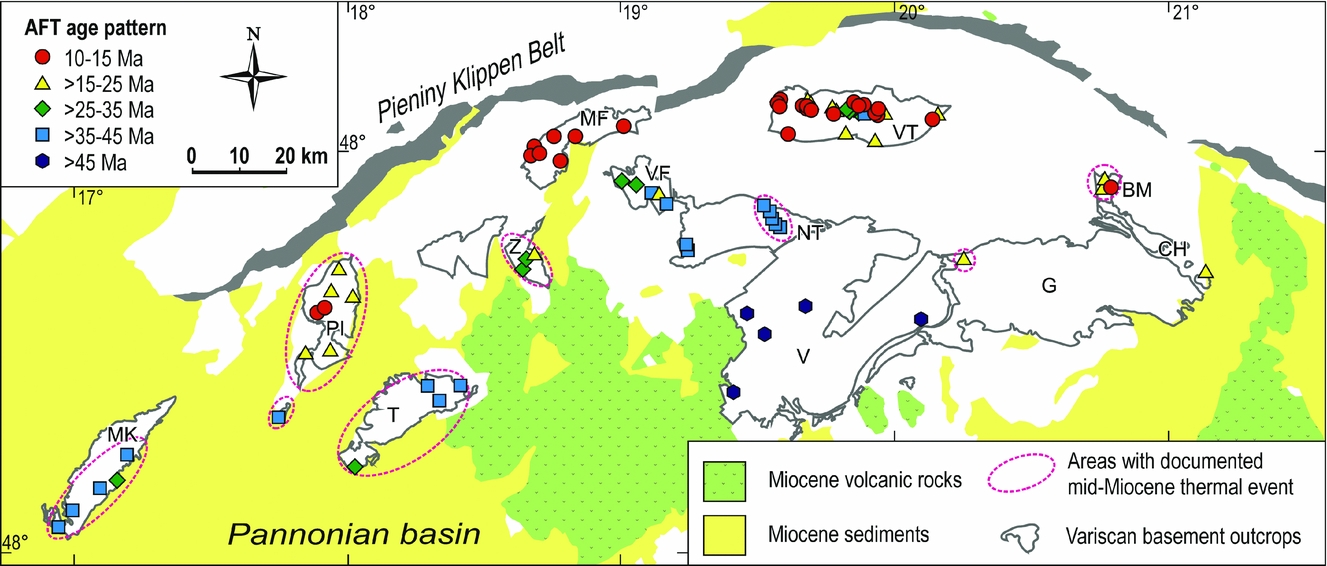
Simplified map of the Variscan crystalline outcrops (modified after Lexa et al. Reference Lexa, Bezák, Elečko, Eliáš, Konečný, Less, Mandl, Mello, Pálenský, Pelikán, Polák, Potfaj, Radocz, Rylko, Schnabel, Stráník, Vass, Vozár, Zelenka, Biely, Császár, Čtyroký, Kaličiak, Kohút, Kovacs, Mackiv, Maglay, Nemčok, Nowotný, Pentelényi, Rakús and Vozárová2000) and existing AFT data, where a clear younging trend towards the former plate boundary (Pieniny Klippen Belt) is visible. Note that in several places with pre-Miocene AFT ages, a Miocene thermal event has been reported. We speculate that this regional event was related to the well-known magmatic activity in the Carpathian–Pannonian region manifested by Neogene volcanism (green) and/or to the burial by Neogene sediments belonging to the Pannonian basin that may have covered significant parts of the Western Carpathians, but due to later erosion were removed leaving only their remnants in isolated patches. AFT data are compiled from the following studies: Burchart (Reference Burchart1972), Kráľ (Reference Kráľ1977), Kováč et al. (Reference Kováč, Kráľ, Márton, Plašienka and Uher1994), Struzik, Zattin & Anczkiewicz (Reference Struzik, Zattin and Anczkiewicz2002), Baumgart-Kotarba & Kráľ (Reference Baumgart-Kotarba and Kráľ2002), Danišík et al. (Reference Danišík, Dunkl, Putiš, Frisch and Kráľ2004, Reference Danišík, Kohút, Dunkl and Frisch2008a, Reference Danišík, Kohút, Dunkl, Hraško and Frischb, Reference Danišík, Kohút, Dunkl and Frisch2009, Reference Danišík, Kohút, Broska and Frisch2010, Reference Danišík, Kadlec, Glotzbach, Weisheit, Dunkl, Kohút, Evans, Orvošová and McDonald2011). Abbreviations: BM – Branisko Mts, CH – Čierna Hora Mts, G – Gemeric superunit, MF – Malá Fatra Mts, MK – Malé Karpaty Mts, NT – Nízke Tatry Mts, PI – Považský Inovec Mts, T – Tribeč, V – Veporic superunit, VF – Veľká Fatra Mts, VT – Vysoké Tatry Mts, Z – Žiar Mts.
Second, the heating could have been partly related to changes in the thermal regime. This interpretation finds support in the magmatic activity in the adjacent Slánske Mts, which occurred between ~ 17 and 11 Ma (cf. Pécskay et al. Reference Pécskay, Lexa, Szakács, Seghedi, Balogh, Konečný, Zelenka, Kovacs, Póka, Fülöp, Márton, Panaiotu and Cvetković2006) and was related to subduction and mantle upwelling in the Carpathian–Pannonian region associated with high heat flow and an increased geothermal gradient (Král, Lisol & Janáček, Reference Král, Lisol and Janáček1987; Szabó, Harangi & Csontos, Reference Szabó, Harangi and Csontos1992; Tari, Horváth & Rumpler, Reference Tari, Horváth and Rumpler1992). An extreme example of thermal regime reported from other parts of the Pannonian basin affected by volcanism (i.e. Styrian Basin) has shown that the Miocene heat flow could have reached as much as ~ 250 mW/m2 (Sachsenhofer, Reference Sachsenhofer1994; Sachsenhofer et al. Reference Sachsenhofer, Dunkl, Hasenhüttl and Jelen1998). This value corresponds to the geothermal gradient of ~ 80°C/km when the average thermal conductivity of 3.0 W/mK for granite is assumed. If our samples resided at crustal depths of 2–2.5 km with a geothermal gradient of ~ 25°C/km prior to the mid-Miocene thermal maximum, a doubling of the geothermal gradient to a reasonable ~ 50°C/km in the study area during the thermal maximum could easily suffice to reach the desired ~ 120–130°C.
Third, a combination of both mechanisms (i.e. magmatic heating and burial heating) appears to be the most likely scenario. The Miocene sequence in the ESB contains layers of fine-grained sediments with low thermal conductivity averaging ~ 2 W/mK (Dövényi & Horváth, Reference Dövényi, Horváth, Royden and Horváth1988; Král, Reference Král and Franko1994; Král & Vitáloš, Reference Král and Vitáloš2003). Even a relatively thin blanket of such sediments on the top of the BM area may have produced thermal isolation for underlying rocks and, in combination with an increased geothermal gradient induced by magmatism (Král, Lisol & Janáček, Reference Král, Lisol and Janáček1987), could easily achieve the observed partial reset of the CCPB sediments.
The Eggenburgian–Ottnangian sedimentary record in the ESB may suggest exhumation and cooling of the BM in Early Miocene time. Considering this and the thermal history of the CCPB samples, one could postulate that during the mid-Miocene thermal event, the basement samples were heated from relatively colder conditions to their peak temperatures and were then brought back to the surface. In order to quantitatively constrain the maximum temperature of the basement during Miocene time, we used the HeFTy modelling program (Ketcham, Reference Ketcham, Reiners and Ehlers2005) to calculate thermal histories that reconcile the ZHe, AFT and AHe data. For the modelling (Fig. 4), we chose sample BT-485, for which ZHe, AFT and AHe ages and FT lengths were measured (Tables 1, 2). Available information was converted into time–temperature (t–T) constraints in the form of boxes, through which the thermal histories are forced to pass, and the modelled t–T path was constrained as follows: the beginning of the t–T path was set as T = ~ 180–250°C at ~ 100–85 Ma, according to the Eo-Alpine metamorphic peak temperatures discussed in Section 5.a. In Palaeogene time, the area was likely buried by flysch of the CCPB (Vass, Konečný & Šefara, Reference Vass, Konečný and Šefara1979; Kázmér et al. Reference Kázmér, Dunkl, Frisch, Kuhlemann and Ozsvárt2003). However, as we cannot draw any conclusion from our data as to the burial depth owing to the Miocene reset, no constraint for the Palaeogene was defined in the model. Since we assume that the basement resided at ‘colder’ conditions before reaching the Miocene thermal maximum (see Section 5.b), which fully reset the AHe and AFT systems, another constraint was set as T = 20–60°C at 24–18 Ma. The time component of this constraint was placed according to the time of CCPB inversion and the onset of volcanic activity and the Neogene sedimentation cycle, when the temperature minimum for the basement was most likely. For the rest of the Neogene we defined a broad temperature range (T = 60–200°C) in order to find all analytical solutions for the thermal peak. The end of the t–T path was set as T = 10°C at 0 Ma according to the annual mean surface temperature. We would like to emphasize that the aim of this model was to constrain the peak temperatures of the basement during the mid-Miocene thermal event and was not designed to unravel the Palaeogene burial history.
Results of the modelling (Fig. 4) suggest that the basement was heated to temperatures above ~ 100°C to up to ~ 190°C between ~ 18 and 11 Ma, and subsequent cooling to the near-surface conditions took place between ~ 15 and 9 Ma. Following the case of the CCPB samples, the thermal peak in the basement samples can be readily explained by magmatic and/or burial heating. The final cooling is most likely, although with some degree of uncertainty (see below), related to the exhumation of the basement. This interpretation may find indirect support in the Neogene sedimentary record in the ESB and also fits perfectly with the regional exhumation pattern of the crystalline basement complexes in the Western Carpathians (Danišík et al. Reference Danišík, Kohút, Broska and Frisch2010).
Neogene sediments in the ESB show shallowing of the depositional environment since Middle Badenian time. In Late Badenian–Early Sarmatian times, large southeastward prograding deltas developed (Kováč et al. Reference Kováč, Kováč, Marko, Karoli and Janočko1995), indicating increased uplift and erosion of the catchment areas in the northwest that likely included the BM. Uplift and erosion continued until Late Miocene time when the environment gradually changed from deltaic to lacustrine (Kováč et al. Reference Kováč, Kováč, Marko, Karoli and Janočko1995). It is very likely that the uplift and erosion resulting in exhumation is reflected in the modelled final cooling phase.
The Middle–Late Miocene exhumation of the BM is another valuable and well-fitting piece towards making the Western Carpathian exhumation puzzle complete. A clear younging of AFT ages towards the former plate boundary (Pieniny Klippen Belt) is evident in this picture (Fig. 5): internal massifs retain mostly Palaeogene or Cretaceous AFT ages and thus did not experience temperatures above 120°C during the Neogene. In contrast, all the external massifs, including the BM, located closer to the plate boundary show almost exclusively Middle Miocene or younger AFT ages, which indicates their residence in a relatively ‘hotter’ environment (i.e. > ~ 120°C) in the Miocene prior to the final cooling.
Despite this seemingly unequivocal interpretation, it has to be noted that the Middle–Late Miocene exhumation of the BM is not directly corroborated by the geological record. And in fact it is not known when the basement was exposed to erosion. If the mid-Miocene thermal event was related solely to magmatic heating, it is entirely possible that the BM could have been exhumed and eroded already in Early Miocene time after inversion and disintegration of the CCPB. Therefore, it must be kept in mind that, if a mid-Miocene thermal event is detected in an area of the Western Carpathians and appropriate geological constraints are absent, interpretation of the thermal evolution prior to the thermal peak (including the Palaeogene history) remains ambiguous.
From a regional perspective, the existence of the mid-Miocene thermal event in the Western Carpathians has been documented in several crystalline bodies by AFT and AHe data (Fig. 5; Danišík et al. Reference Danišík, Dunkl, Putiš, Frisch and Kráľ2004, Reference Danišík, Kohút, Dunkl and Frisch2008a, Reference Danišík, Kohút, Dunkl, Hraško and Frischb, Reference Danišík, Kohút, Broska and Frisch2010, Reference Danišík, Kadlec, Glotzbach, Weisheit, Dunkl, Kohút, Evans, Orvošová and McDonald2011). Although its regional character is not in doubt, opinions regarding its cause are diverse. Danišík et al. (Reference Danišík, Dunkl, Putiš, Frisch and Kráľ2004, Reference Danišík, Kohút, Dunkl and Frisch2008a, Reference Danišík, Kohút, Dunkl, Hraško and Frischb, Reference Danišík, Kadlec, Glotzbach, Weisheit, Dunkl, Kohút, Evans, Orvošová and McDonald2011), using the distribution of Neogene volcanism as an argument (Fig. 5), tended to attribute the thermal event primarily to the magmatic heating and associated high heat flow, whereas a Miocene sedimentary burial (favoured by Dunkl & Frisch, Reference Dunkl, Frisch, Cloething, Horváth, Bada and Lankreijer2002), would play a less important role. In this study, we are inclined to suggest that both burial and magmatic activity associated with high heat flow and sedimentary burial might have been equally responsible for the heating.
6. Conclusions
New ZHe, AFT and AHe data enabled us to constrain the tectonothermal evolution of the BM and provide important constraints on the thermal and geodynamic evolution of the Western Carpathians. The most important results are summarized as follows:
(i) The Variscan crystalline basement of the BM was heated to temperatures between ~ 180 and 250°C and thus did experience a very low-grade to low-grade Alpine metamorphic overprint recorded by ZHe data;
(ii) Latest Cretaceous–Eocene ZHe ages are interpreted as cooling ages recording the exhumation of the BM basement related to the extensional collapse of the Carpathian orogenic wedge after the mid-Cretaceous (Eo-Alpine) collision and thrusting;
(iii) The basement and surrounding CCPB sediments experienced a mid-Miocene thermal event related to magmatic and/or burial heating. According to AFT, AHe and thermal modelling results, the CCPB sediments and the basement were heated to ~ 120–130°C and ~ 110–190°C, respectively;
(iv) Final exhumation of the BM occurred in Early–Late Miocene times according to the thermal modelling. This conclusion is in good agreement with the sedimentary record in the adjacent ESB and fits well with the general exhumation pattern of crystalline bodies in the Western Carpathians with well-defined spatial AFT age patterns. The exhumation is, however, not directly corroborated by evidence from the geological record;
(v) Owing to the Miocene partial resetting of the CCPB samples, our data do not allow us to better constrain the CCPB burial history;
(vi) Detecting the mid-Miocene thermal event in the Western Carpathians by AFT and AHe systems proved to be a viable tool for reconstructing the original extent of Neogene sediments with application to palaeogeographic reconstructions.
Acknowledgements
We thank C. Scadding and A. Thomas for assistance with ICP-MS. MD received financial support from the WA Geothermal Centre of Excellence. MK was supported by the Slovak Research and Development Agency (No. APVV-549-07). An earlier version of the manuscript benefited from constructive reviews by Cristina Persano (Scotland) and an anonymous reviewer.



