Cardiovascular disease is a major cause of morbidity, and a leading contributor to mortality, worldwide.Reference Murray and Lopez1 Consequently, there is an increasing medical focus on the issue of hyperlipidaemia.Reference McCrindle2 Dyslipidaemia is an abnormal state of concentrations of lipids and lipoproteins in the blood, and is more and more common in children around the world.Reference Primrose, Savage, Boreham, Cran and Strain3, Reference Freedman, Dietz, Srinivasan and Berenson4 Hyperlipidaemia can alter vascular endothelial function, and initiate the atherosclerotic process. There are obvious changes in the vascular wall that correlate strongly with hyperlipidaemia in children from both pathologic and non-invasive measurements. Hyperlipidaemia in children and adolescents is directly related to both pathologic changes and functional abnormalities, which are predictive of progression to manifest atherosclerotic cardiovascular disease in adulthood.Reference Newman, Freedman and Voors5–Reference Davis, Dawson, Riley and Lauer8 As demonstrated in the Bogalusa Heart Study, the best predictor of concentrations of total cholesterol in young adult was measurements taken 12 years previously. Approximately half of children and adolescents who had concentrations of total cholesterol or low density lipoprotein-cholesterol greater than 75th percentile had elevated concentrations at follow-up in young adulthood.Reference Webber, Harsha, Phillips, Srinivasan, Simpson and Berenson9 Most children, nonetheless, were asymptomatic, even when their concentrations of total cholesterol or triglyceride were very high, so early detection of high levels of total cholesterol in the blood of asymptomatic children would likely allow the identification of an important risk factor for coronary arterial disease. In addition, evidence that most cardiovascular disease is preventable has led to development of the initial “Guidelines for Primary Prevention of Cardiovascular Disease” by the American Heart Association, along with further guidelines for “Primary Prevention of Atherosclerotic Cardiovascular Disease” in the young population.Reference Pearson, Blair and Daniels10, Reference Kavey, Daniels, Lauer, Atkins, Hayman and Taubert11 Screening for levels of lipids in childhood has also received increased attention in recent years in many countries.Reference Kouda, Nakamura, Tokunaga and Takeuchi12–Reference de Franca and Alves16
Obesity has also become a major health problem in recent years, and is known to be associated with increased mortality, largely due to cardiovascular disease.Reference Kopelman17, Reference Calle, Thun, Petrelli, Rodriguez and Heath18 There have also been secular trends of obesity in children around the world, which is thought to be with a concomitant increase in the prevalence of cardiovascular risk factors.Reference Gidding, Bao, Srinivasan and Berenson19, Reference Cook, Weitzman, Auinger, Nguyen and Dietz20 In addition, the most prevalent secondary cause of hyperlipidaemia is thought to be overweight and obesity.
China is a developing country, experiencing rapid economic progress during the past 20 years, and the Chinese are changing their lifestyle to a more Western pattern, consuming more and more Western-type food, but decreasing their physical activity.Reference Cheng21 All these changes are leading to more serious states of dyslipidaemia in Chinese adults.Reference He, Gu and Reynolds22 The levels of total cholesterolol on children, however, is as yet unknown. The main aim of our cross-sectional study, therefore, was to establish the characteristic lipid profiles in Beijing, establishing any differences between boys and girls, and those living in urban as opposed to rural settings.
Materials and methods
Participants
Our study was designed to be cross-sectional. In the sampling therefore, we tried to limit any bias in selecting those who would participate in the study. Considering Beijing to have, as one of its demographic features, both urban and rural districts, we randomly selected 7 districts, 4 of which, specifically Dongcheng, Xicheng, Chaoyang and Haidian, were randomly sampled from the urban districts, and 3, namely Daxing, Pinggu, and Yanqing, from the rural districts. From these 7 districts, we recruited a total of 18,944 school children aged from 7 to 18 years, using the method of cluster sampling. This ratio of urban to rural districts is representative of Beijing as a whole. Of the cohort, 5020 (26.5%) were boys, and 5114 (23.4%) girls living in urban districtes, with 4433 (27.0%) boys, and 4377 (23.1%) girls, living in rural districts. All were randomly sampled from the schools in the respective districts, with no significant differences found in the distribution of children based on gender or area of residence (p greater than 0.05). The ratios of genders of males to females residing in urban and rural areas were 0.98 to 1, and 1.02 to 1, respectively. No differences were noted in these ratios for the children living in urban as opposed to the rural areas (p less than 0.05). The mean age of females and males living in the urban and rural areas were 2.47 ± 3.08, 12.33 ± 3.04, 12.89 ± 3.31 and 12.58 ± 3.24, respectively. No statistical difference was found for mean age among the children.
Measurements
Biochemical analyses
To confirm the consistency of our methology, levels for total cholesterol and triglycerides were detected by both a point-of-care testing device and a standard enzymatic method, using an Accutrend GCT Detector (Roche Diagnostics, Beijing Branch, Germany).Reference Halkes, Van Wijk, Ribalta, Masana and Castro Cabezas23, Reference Luley, Ronquist and Reuter24 Having confirmed the consistency of the two methods, we subsequently determined the levels of total cholesterol and triglycerides in capillary blood of all participants after fasting for 12 hours with the Accutrend GCT Detector.
Anthropometric measurements
The subjects were assessed on the same morning of the measurement of their fasting lipids, weight being measured to the nearest 0.1 kilogram, and height to the nearest 0.1 centimetres.
Ethics committee approval
This research has received the approval of the protocol by the First Hospital Institute Research Committee and obtaining written informed consent from the children and their parents.
Definitions
Body mass index was defined as the body weight indexed to the square of the height, in kilograms per metre squared. Hypercholesterolaemia was defined as greater than 5.2 mmol/L, using the standard set in the United States of America for children older than 2 years.Reference Castro Cabezas, Halkes, Meijssen, van Oostrom and Erkelens25 Hypertriglyceridaemia was defined as greater than 1.7 mmol/L, which was similar to definitions used in Japan, and for Chinese adults.26, Reference Okada, Murata, Yamauchi and Harada27 Combined hyperlipidaemia was defined as both hypercholesterolaemia and hypertriglyceridaemia.28 Hyperlipidaemia was defined as either hypercholesterolaemia or hypertriglyceridaemia.
Statistical analysis
We used SPSS 11.5 for statistical analysis. Data is expressed as means plus and minus standard deviations, using Student’s t-test, one-way analysis of variance, the chi-square test, and correlative analysis to assess significance, taking values for p of less than 0.05 to indicate statistical significance.
Results
Comparison of levels of total cholesterol and triglyceride capillary and venous blood
There were no significant differences in levels measured in venous as opposed to capillary blood by the two methods (t = 1.78, p = 0.09 and t = −0.58, p = 0.57, respectively). The relative coefficients for levels of both total cholesterol and triglycerides between venous and capillary blood detected by different methods were both 0.98 (p greater than 0.05).
Sample features according to gender, area of residence, and age (Table 1 and Figs 1 and 2)
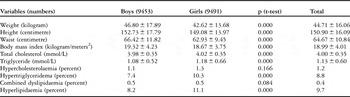
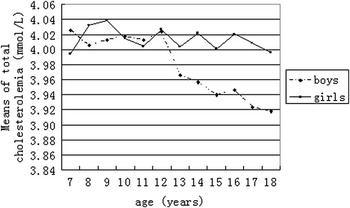
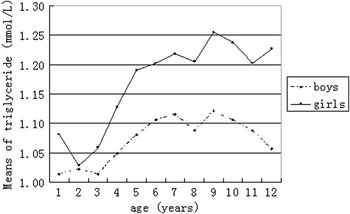
For the entire group of children aged from 7 to 18, the weight, height, waist circumference, and body mass index were all significantly higher for boys than girls (p less than 0.05). The values of total cholesterol and triglycerides for boys were all lower than for girls (p less than 0.05). The incidences of hypertriglyceridaemia, and hyperlipidaemia were higher in girls than boys (p less than 0.05). Boys and girls showed different trends in changes in the levels of total cholesterol and triglycerides during periods of growth.
Basic characteristics of the children.

Age trends for means of TC in girls (dashed line) and boys (solid line). Total cholesterol (TC).

Age trends for means of TG in girls (dashed line) and boys (solid line). Triglyceride (TG).

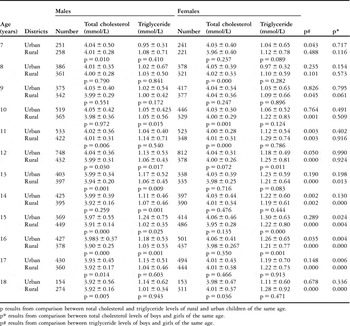
The levels of total cholesterol and triglycerides according to age, gender, and areas of residence (Table 2)
The levels of triglycerides for most boys aged from 11 to 18 years were higher for those living in urban than rural areas (p less than 0.05). Similarly, the levels of total cholesterol were higher for boys aged 12 to 16 years who were living in urban areas (p less than 0.05).
Distribution of the means for total cholesterol and triglycerides means according to district, age, and gender, with values shown plus and minus the standard deviation.

p results from comparison between total cholesterol and triglyceride levels of rural and urban children of the same age.
p* results from comparison between total cholesterol levels of boys and girls of the same age.
p results from comparison between triglyceride levels of boys and girls of the same age.
For those living in the rural districts, the levels of total cholesterol for boys aged from 13 to 18 years were all lower than for girls of the same age (p less than 0.05). The levels of triglycerides in the boys aged 9 to 18 years were likewise all lower than for girls of the same age (p less than 0.05). Again for those living in the urban districts, the levels of total cholesterol in boys aged from 15 to 17 years were all lower than for girls of the same age (p less than 0.05).
Distribution of dyslipidaemia among children based on gender for those living in urban as opposed to rural areas (Table 3)
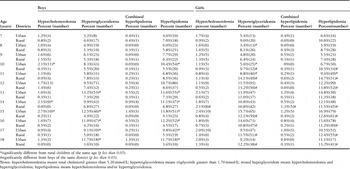
The prevalence of hypertriglyceridaemia in boys aged from 15 to 18 years living in urban areas was higher than for the boys living in the rural areas (p less than 0.05), while the prevalence of hyperlipidaemia in urban boys aged from 13 to 18 years was also higher when compared to rural boys of these ages (p less than 0.05). There was no difference in the prevalence of mixed dyslipidaemia between boys living in urban as opposed to rural areas (p greater than 0.05), nor was there any difference in the prevalence of hypercholesterolaemia between girls living in the urban and rural areas (p greater than 0.05). The prevalence of hyperlipidaemia in girls aged 11 years was lower, however, for those living in urban as opposed to rural areas (p less than 0.05). There was no difference in the prevalence of mixed dyslipidaemia between girls living in urban and rural areas (p greater than 0.05).
Distribution of the prevalences of lipid disorders among the children according to gender in urban or rural areas (percent).

*significantly different from rural children of the same age (p less than 0.05).
significantly different from boys of the same district (p less than 0.05).
Notes: hypercholesterolemia means total cholesterol greater than 5.20 mmol/L; hypertriglyceridemia means triglyceride greater than 1.70 mmol/L; mixed hyperglyceridem means hypercholesterolemia and hypertrglyceridemia; hyperlipidemia means hypercholesterolemia and/or hypertrglyceridemia.
When comparing the prevalence of dylipidaemia between girls and boys of the same ages, no differences were noted in the prevalence in the four comparisons of dyslipidaemia for those living in urban areas (p greater than 0.05). For those in the rural areas, however, the prevalence of hypertriglyceridaemia in girls aged 10 to 12 years, and 15 to 18 years, was higher than in boys of the same ages (p less than 0.05).
Distribution of body mass index according to age, gender, and area of residence (Figs. 3 and 4)
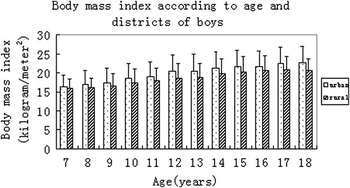
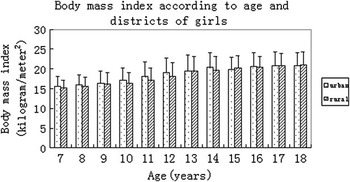
For each age group, the body mass indexes of boys living in urban areas were all higher than for those living in rural areas (p less than 0.05). The body mass indexes of the girls living in urban areas, however, were higher only for those aged 7 and 8, and from 10 to 14 years (p less than 0.05).
BMI of boys (kg/m2). Body mass index (BMI).

BMI of girls (kg/m2). Body mass index (BMI).

When comparing body mass index between boys and girls of the same age and area of residence, we found that the body mass index was higher for boys when living in urban areas (p less than 0.05). The body mass indexes of boys younger than 12 years of age were all higher than girls in the rural area (p less than 0.05). The body mass indexes of boys aged 13 years, however, were lower than for girls of this age (p less than 0.05).
Correlation between levels of lipids and body mass index
There was a weak positive correlation between the concentration of triglycerides and body mass index (r = 0.074, p = 0.01), but a relatively strong correlation between the concentration of total cholesterol and body mass index (r = 0.217, p = 0.01). In the urban areas, the correlations between the concentration of total cholesterol and the body mass index were r = 0.348, and r = 0.231, for boys and girls, respectively, (p = 0.01). In the rural area, the correlations were r = 0.198 and r = 0.130 (p = 0.01).
Discussion
Atherosclerotic cardiovascular disease remains one of the leading causes of both death and disability around the world.Reference Murray and Lopez1, Reference de Graaf, van der Vleuten and Stalenhoef29–Reference Popkin, Horton, Kim, Mahal and Shuiqao32 Levels of lipids, including fasting levels of triglyceride in the plasma, have been thought to be an independent risk factor for atherosclerosis.Reference Stavenow and Kjellström33 Evidence that most cardiovascular disease is preventable has led to guidelines, proposed in 2003, for the primary prevention of atherosclerotic cardiovascular disease, beginning in childhood.Reference Kavey, Daniels, Lauer, Atkins, Hayman and Taubert11 The criterions for the normal level of total cholesterol, however, differ among populations.Reference Verschuren, Jacobs and Bloemberg34 Due to the absence of a large scale investigation since 1987 in Beijing,Reference Li, Nv and Li35 we designed our study to show the characteristic lipid profiles of children, and to explore any differences according to gender and areas of residence.
Beijing, the capital of China, covers a vast area, and can be regarded as a representation of North China. People in urban areas are living a relatively wealthy city life. In rural areas, in contrast, most of the people depend on farming, with some living in the mountains. Our investigation, therefore, is representative of relative general living conditions.
For our overall cohort, including children aged from 7 to 18 years, the body mass index of the boys was significantly higher than for girls, but values of total cholesterol and triglycerides were all lower (p less than 0.05). There was a slightly decreasing trend of total cholesterol with increasing age, regardless of gender, with the level of total cholesterol decreasing faster in boys than girls. In contrast, there were slightly increased trends of triglyceride as the age increased, regardless of gender, and the levels of triglyceride in the girls increased faster than the boys.
When comparing the levels of total cholesterol and triglycerides levels of different districts, ages, and genders, we found that both levels in a majority of boys living in urban districts, and for comparable girls of some ages, were higher than for those living in the rural areas. The concentrations were never higher for those living in the rural districts, regardless of age and gender. Those living in urban areas, as already emphasized, live a relative wealthy life compared to those in the rural areas, and their intake of fat and calories is higher. This is, perhaps, the cause of the differences.
We also compared levels for girls and boys of the same ages. For those in urban areas, the levels of triglycerides were higher in boys than girls prior to the age of 12 years, but became lower as the girls aged. In the rural districts, in contrast, the levels of triglycerides in boys aged from 9 to 18 years were all significantly lower than for girls of the same age. These results suggested that the relatively higher levels of triglycerides in girls began from as young as 9 years of age. The wealthy lifestyle eliminated the difference to some extent, but the effect of the menarche persisted.Reference Regitz-Zagrosek, Lehmkuhl and Mahmoodzadeh36 In urban cities in China, it had been found that female puberty begins at the age of 11 years.Reference Ji, Hu and He37 Regarding the levels of total cholesterol, there was a similar trend for those living in urban as opposed to rural areas. The concentrations of total cholesterol for urban boys older than 14 years of age were lower for than girls, while the concentrations for rural boys older than 12 years of age were lower than for girls. These changes correspond to the time of puberty of boys. Figure 1 shows that the difference in total cholesterol between boys and girls is due to the abrupt decrease in total cholesterol in boys, which occurs when the Chinese boys enter puberty.Reference Ji, Hu and He37 The impact of a wealthier life in urban areas perhaps induced an increase in the baseline of triglyceride, which accounts for the age difference.
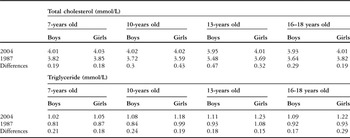
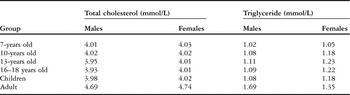
Compared to the profile of of lipids for children living in Beijing in 1984,Reference Li, Nv and Li35 our study shows that levels of both total cholesterol and triglycerides have increased over the past 17 years (Table 4). The prevalence of hypercholesterolaemiam using the same cut-off point, however, is unchanged, while the prevalence of hypertriglyceridaemia, again using the same cut-off point, has increased twofold, and now stands at 4.2%. The concentrations were measured 17 years ago by routine enzymatic methods. These results, therefore, may reflect a change in lifestyle over the past 17 years, with the levels of triglyceride perhaps more susceptible to changes in lifestyle than those for total cholesterol. When compared with the recent published levels of total cholesterol and triglyceride for adults living in Beijing (Table 5), the prevalence of hypercholesterolaemia and hypertriglyceridaemia in children is lower than for adults.Reference Li, Yang, Xu and and Xia38 As we know, after 18 years of age, most people in China experience great changes in lifestyle, as they pass from senior school to become college students or employees. This is, perhaps, the main cause for the differences in our measured levels.
Comparison of mean concentrations of lipids with the study performed in Beijing for the period 1984 through 1986, with values shown as means.

Comparison of the means of total cholesterol and triglyceride with those of adults.

Another phenomenon is that there was no difference in the prevalence of combined dyslipidaemia between boys and girls living in rural as opposed to urban districts. Combined dyslipidaemia is the main manifestation of dysbetalipoproteinemia,28 which is inherited as an autosomal recessive train, and is impacted little by the environment and diet. Longitudinal follow-up and genetic analyses are needed in those children.
There were no differences in the prevalence of dyslipidaemia between urban boys and girls (p greater than 0.05). The prevalence of dyslipidaemia in the majority of rural girls aged from 10 to 18 years, nonetheless, was higher than in boys. When taking note of the relatively higher prevalence of dyslipidaemia in urban than rural boys, as discussed above, the lack of a significant difference between urban girls and boys was perhaps due to the relatively higher levels of lipids in urban boys.
In the United States of America, data from the survey from 1988 to 1994 made by the Third National Health and Nutrition Examination of those aged 4 to 19 years showed that the mean concentration of total cholesterol was 4.27 mmol/L. Age specific values for the mean concentration peaked at 4.42 mmol/L for those aged from 9 to 11 years.Reference Hickman, Briefel and Carroll39 The values subsequently decreased during pubertal development. In our investigation, studying children aged from 7 to 18 years, the mean total concentration was 4.00 ± 0.35 mmol/L, slightly lower than that of the American study. The age specific trend of concentration also slightly differed. The level of cholesterol was relatively stable for boys living in Beijing before the age of 12 years, rather than peaking at 9 to 11 years, and showed a trend to decrease after 12 years of age. This has important implications for the timing of screening for cholesterol, and the cut points used, because concentrations of lipids are age, sex, and ethnic dependent.
Obesity is a major health problem associated with increased mortality, largely due to cardiovascular disease.Reference Calle, Thun, Petrelli, Rodriguez and Heath18 The body mass index of urban boys in Beijing was always significantly higher than for rural boys, as it was for a majority of urban girls. In the rural areas, only the body mass index of boys younger than 12 years of age was higher than girls. We found a weak positive correlation between body mass index and, and a relatively strong positive correlation between body mass index and triglyceride total cholesterol.
In conclusion, our research suggests that the levels of total cholesterol and triglycerides are now both higher than they were two decades ago in Beijing. We noted significant influences of age, districts of residence, and gender on the levels of lipids, features which need further attention in the prevention and treatment of dyslipidaemia. Accurate planning and routine investigations will be required if early diagnosis is to be achieved in asymptomatic individuals.
Acknowledgment
We acknowledge the support received from the Key Science and Technology Program of Beijing (H030930030530 and H030930030031), and the Major Basic Research Project of China (2006CB503807).