Introduction
Amphibian oocytes are arrested in prophase I of meiosis until ovulation. At this time, follicular cells release progesterone (P4) to induce meiosis resumption, however mechanisms involved in this process have not been fully elucidated. P4 interacts with the oocyte surface and starts a cascade of events that leads to meiosis resumption or germinal vesicle breakdown (GVBD) (Sánchez Toranzo et al., Reference Sánchez Toranzo, Bonilla, Zelarayán, Oterino and Bühler2006; Zelarayán et al., Reference Zelarayán, Ajmat, Bonilla and Bühler2012).
Although lipids have traditionally been considered as storage molecules, their involvement in gonadal function regulation is being increasingly recognized (Sorbera et al., Reference Sorbera, Asturiano, Carrillo and Zanuy2001). Seasonal variations in polyunsaturated fatty acids (PUFAs) composition have been linked to reproductive performance because of their effect on pituitary and gonadal hormone levels (Cerdá et al., Reference Cerdá, Zanuy, Carrillo, Ramos and Serrano1995, Reference Cerdá, Zanuy and Carrillo1997; Navas et al., Reference Navas, Bruce, Thrush, Farndale, Bromage, Zanuy, Carrillo, Bell and Ramos1997, Reference Navas, Mañanos, Thrush, Ramos, Zanuy, Carrillo, Zohar and Bromage1998). Moreover, PUFAs and their metabolites produced through cyclooxygenase (COX) and lipoxygenase (LOX) pathways may have modulatory effects on the gonadal steroid metabolism of mammals and birds (Lin, Reference Lin1985; Johnson et al., Reference Johnson, Tilly and Levorse1991).
The role of PUFAs in oocyte maturation was examined in certain species. In starfish, arachidonic acid (AA) and eicosapentaenoic acid were capable of inducing maturation. Moreover, LOX inhibition prevented meiosis resumption. PUFAs appear to be involved in the mechanism by which methyladenine induces oocyte maturation (Meijer et al., Reference Meijer, Brash, Bryant, Kwokei, Maclouff and Sprecher1986). In zebrafish, Lister & Van Der Kraak (Reference Lister and Van Der Kraak2008) showed that follicles expressed enzymes that were involved in AA release, such as phospholipase A2 (PLA2) and phospholipase Cγ1, or enzymes that can metabolize AA such as COX1, COX2 and prostaglandin synthase-2. In agreement with this finding, it was shown in Rhinella arenarum that P4-induced maturation caused significant changes in the amount and composition of phospholipids and neutral lipids in both fully grown ovarian oocytes and plasma membrane-enriched fractions (Caldironi & Alonso, Reference Caldironi and Alonso1996; Mata et al., Reference Mata, Zelarayán, Sánchez Toranzo, Alonso and Bühler2000; Zelarayán et al., Reference Zelarayán, Alonso, Mata, Sánchez Toranzo, Oterino and Bühler1999). These changes may occur due to lipolytic enzymes activation, especially PLA2, that release AA. In some mammalian species, AA has been proposed to be a prostaglandins (PGs) source. PGs are produced by COX under gonadotrophin control in granulosa cells. It is well known that PGs are the major paracrine agents in ovarian physiology during ovulation. To our knowledge, there are no previous works that explore the role of AA and its metabolites in oocyte maturation in Rhinella arenarum.
In this work we evaluated the role of AA metabolites during Rhinella arenarum oocyte maturation using in vitro approaches; we focussed on the participation of enzymes involved in AA metabolism – PLA2, COX and LOX.
Materials and methods
Adult specimens of Rhinella arenarum were collected in northwestern Argentina throughout the year and kept at 15°C until use, up to 15 days after collection. Follicles and denuded oocytes were obtained in accordance with Zelarayán et al. (Reference Zelarayán, Sánchez Toranzo, Oterino and Buhler2000) and kept in amphibian Ringer solution (AR) until use. In vitro cultures were carried out using multiwell culture dishes (Costar 3524, Cambridge, MA, USA). Randomized samples of 20 oocytes or follicles were distributed into separate wells that contained 2 ml of AR. Duplicates were routinely run in each experimental group. Oocyte maturation was assessed by detection of germinal vesicle breakdown (GVBD) 18–20 h after inducer addition. All reagents were purchased from Sigma or Merck.
In order to obtain a dose–response curve of melittin (0.02–0.08 μM), denuded oocytes or follicles were incubated in the presence of melittin for 60 min, then transferred to AR where incubation was completed and GVBD was assessed. Continuous exposure or high doses of melittin were deleterious for oocytes (lysis signs and irregular pigment distribution).
Inhibition experiments were conducted by pre-incubation of samples for 60 min in the presence of inhibitors and then the inducer was added. The inhibitors used were: quinacrine (Quin): 10–20 μM, indomethacin (Indo): 5–100 μM, rofecoxib: 50–400 μM, lysine clonixinate (LC): 25–100 μM, and nordihydroguaiaretic acid (NDGA): 2.5–30 μM. In all cases, P4 (3 μM) was used as the positive maturation control.
Results are expressed as means ± standard deviation (SD). Comparisons among different treatments were carried out using Student's t-test. A value of P < 0.05 was considered to be statistically significant.
Results and Discussion
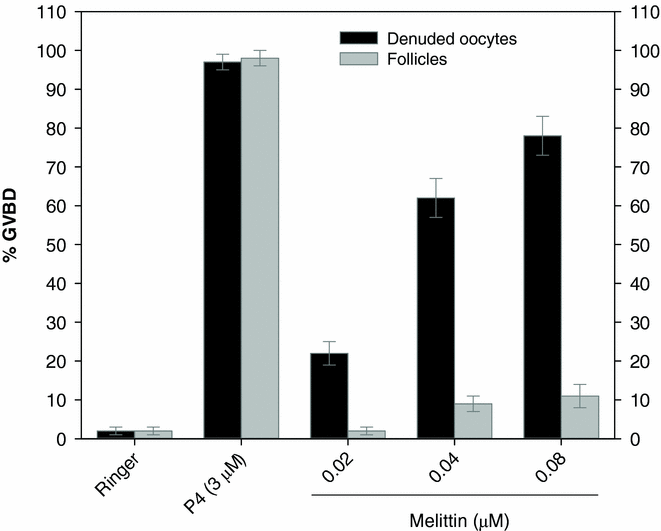
Given that PLA2-mediated hydrolysis of phospholipids results in AA release, we analysed whether this enzyme was involved in the maturation process. Denuded oocytes and follicles were treated with melittin (0.02–0.08 μM), an enzyme activator. In denuded oocytes, PLA2 activation induced meiosis resumption in a dose-dependent manner; highest response (78 ± 6% GVBD) was scored with 0.08 μM (Fig. 1). In follicles, PLA2 activation did not significantly induce meiosis resumption at the assayed doses (12 ± 3% GVBD).
Melittin dose–response curve. Denuded oocytes and follicles were incubated in the presence of different melittin doses (0.02–0.08 μM) for 60 min and then samples were transferred to amphibian Ringer solution (AR) in which incubation was completed at 18–20 h. After this procedure, meiosis resumption was assessed, determined as a percentage of germinal vesicle breakdown (GVBD). Progesterone (P4) 3 μM was used as a control. Values represent the mean ± standard deviation (SD) of four experiments performed in triplicate on different animals.

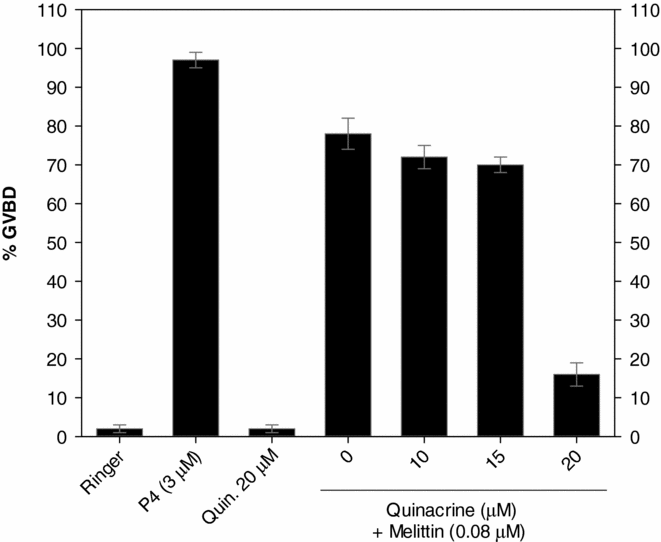
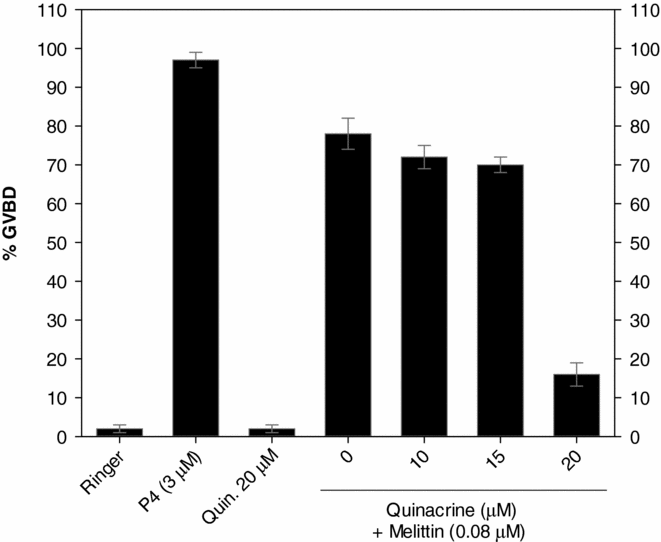
The direct role of PLA2 activation in GVBD was demonstrated using quinacrine, a specific enzyme inhibitor. As PLA2 activation had no effect on follicles, they were not treated with quinacrine. Denuded oocytes were pre-incubated for 1 h in the presence of different quinacrine doses (0–20 μM) before induction of maturation with melittin (0.08 μM). PLA2 inactivation prevented melittin-induced GVBD in a dose-dependent manner (Fig. 2). Highest quinacrine dose (20 μM) significantly reduced maturation to 15 ± 3% GVBD, while the control reached 78 ± 6% GVBD. This result suggests that PLA2 could participate in mechanisms related to maturation. Enzyme inhibition by quinacrine had a limited effect on P4-induced maturation.
Effect of quinacrine on melittin-induced maturation. Denuded oocytes were incubated for 1 h with different quinacrine doses (0–20 μM) and then maturation was induced with melittin (0.08 μM). After incubation for 20 h, germinal vesicle breakdown (GVBD) was assessed. Values represent the mean ± standard deviation (SD) of six experiments performed in triplicate on different animals.
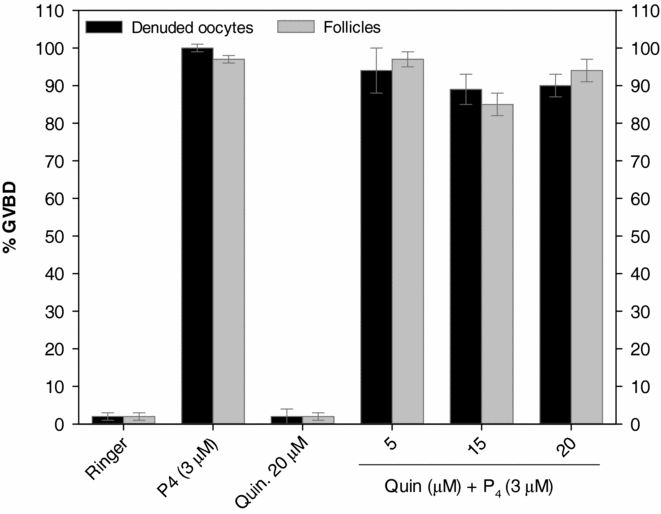
In order to analyse the involvement of PLA2 in P4-induced maturation, denuded oocytes and follicles were pre-incubated in the presence of different quinacrine doses (0–20 μM) for 1 h before induction of maturation with P4. PLA2 inhibition did not significantly affect P4-induced maturation in oocytes or follicles (Fig. 3). This result suggests that other phospholipases could be involved in P4-induced maturation. One of these could be phospholipase C (PLC), which hydrolyzes membrane phosphatidylinositol 4,5-bisphosphate (PIP2) into inositol 1,4,5-trisphosphate (IP3) and diacylglycerol (DAG). It was reported that these messengers would act as potential maturation inducers in Rhinella arenarum oocytes treated with P4 (Zelarayán et al., Reference Zelarayán, Sánchez Toranzo, Oterino and Buhler2000). However, results obtained in fish (European sea bass) indicate that PLA2 blockade with quinacrine significantly inhibited human chorionic gonadotropin (hCG)-induced maturation (Sorbera et al., Reference Sorbera, Asturiano, Carrillo and Zanuy2001) in follicles.
Effect of quinacrine on progesterone (P4)-induced maturation. Denuded oocytes and complete follicles were pre-incubated with different quinacrine doses (10–20 μM) for 60 min before the addition of P4 (1 μg/ml). The samples were incubated for 20 h and fixed to assess germinal vesicle breakdown (GVBD). Values represent the mean ± standard deviation (SD) of three experiments performed in triplicate on different animals.
PLA2 has been mainly associated with ovulation rather than maturation. In rodents, expression and activity of PLA2 in granulosa cells were induced by gonadotropins (Kurusu et al., Reference Kurusu, Iwao, Kawaminami and Hashimoto1998). In ruminants, an increase in PLA2 expression after preovulatory gonadotropin surge has been reported, so that this enzyme could be responsible for the AA mobilization necessary for PGs synthesis during ovulation (Diouf et al., Reference Diouf, Sayasith, Lefebvre, Silversides, Sirois and Lussier2006).
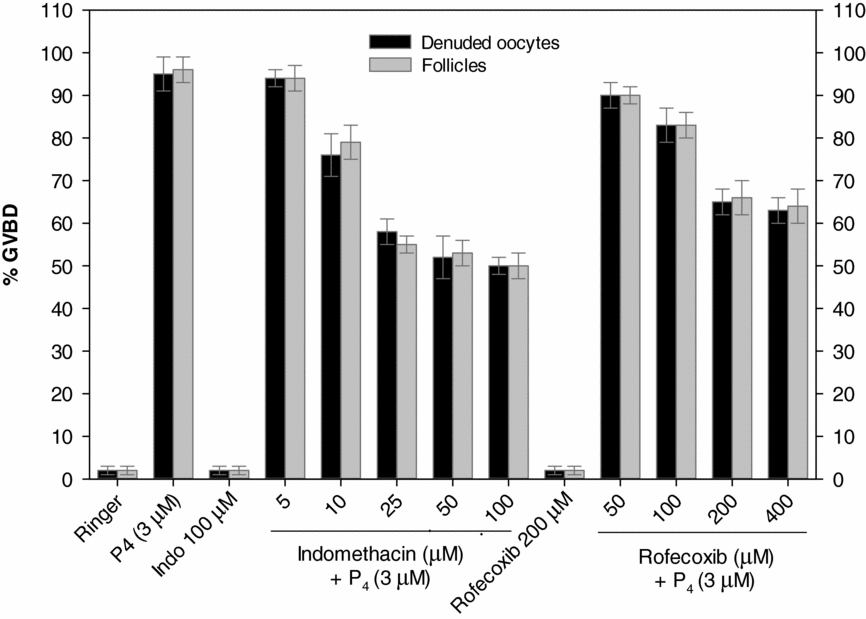
Arachidonic acid is usually metabolized by an oxidation process in which COX and/or LOX participate. It has been suggested that AA metabolites produced by these enzymes were involved in fish oocyte maturation (Sorbera et al., Reference Sorbera, Asturiano, Carrillo and Zanuy2001). The participation of COX, a key enzyme in PGs synthesis, was studied in P4-induced maturation. Two COX inhibitors were assayed: indomethacin (5–100 μM), which inhibits both isoforms (COX1 and COX2), and rofecoxib (50–400 μM), a selective COX2 inhibitor. Highest indomethacin dose (100 μM) inhibited P4-induced maturation by 50% (Fig. 4). Denuded oocytes and follicles showed a similar response. Maturation was never blocked completely. Indomethacin had a stronger effect than rofecoxib on maturation inhibition in oocytes and follicles. In fact, oocytes reached 63 ± 3% GVBD with the highest assayed dose (400 μM) (Fig. 4), a finding that suggests that COX would participate in the mechanism by which P4 induces maturation. Inhibition caused by these nonsteroidal antiinflammatory drugs was partial; other enzymes would be involved in this process (Fig. 4).
Effect of indomethacin or rofecoxib on progesterone (P4)-induced maturation. Denuded oocytes and follicles were pre-incubated with different doses of each inhibitor (indomethacin: 5–100 μM; rofecoxib: 50–400 μM) for 1 h before the addition of P4. At the end of incubation (20 h) germinal vesicle breakdown (GVBD) was assessed. Values represent the mean ± standard deviation (SD) of eight experiments performed in triplicate on different animals.
Although in Rhinella arenarum oocytes P4-induced maturation takes place throughout the year, oocytes showed a different P4 response capacity dependent upon the period in which animals had been captured (Zelarayán et al., Reference Zelarayán, Ortiz, Unáas, Ajmat, Bonilla, Sánchez Toranzo and Bühler2009). Moreover, Medina et al. (Reference Medina, Ramos, Crespo, González-Calvar and Fernández2004) reported that Rhinella arenarum females revealed seasonal variations in the serum levels of steroid hormones associated with reproductive biology.
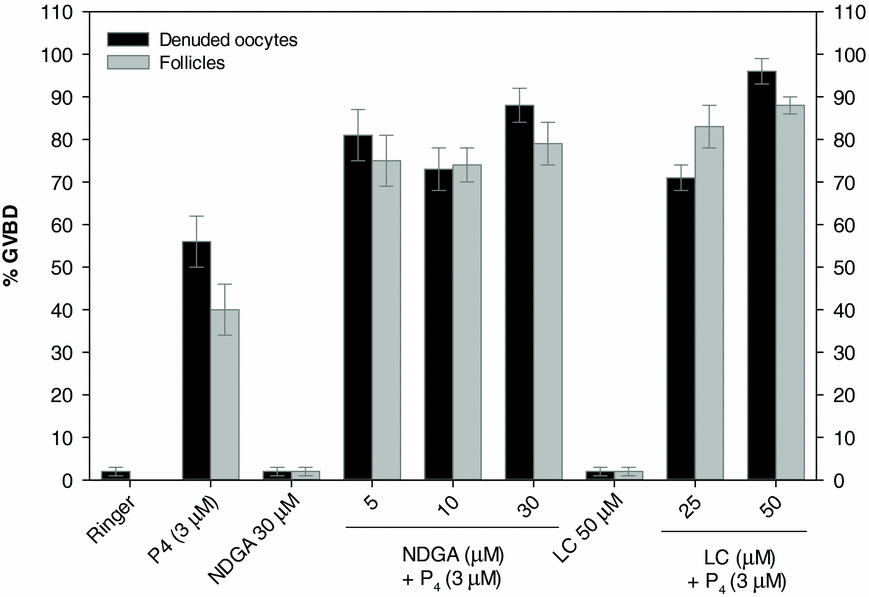
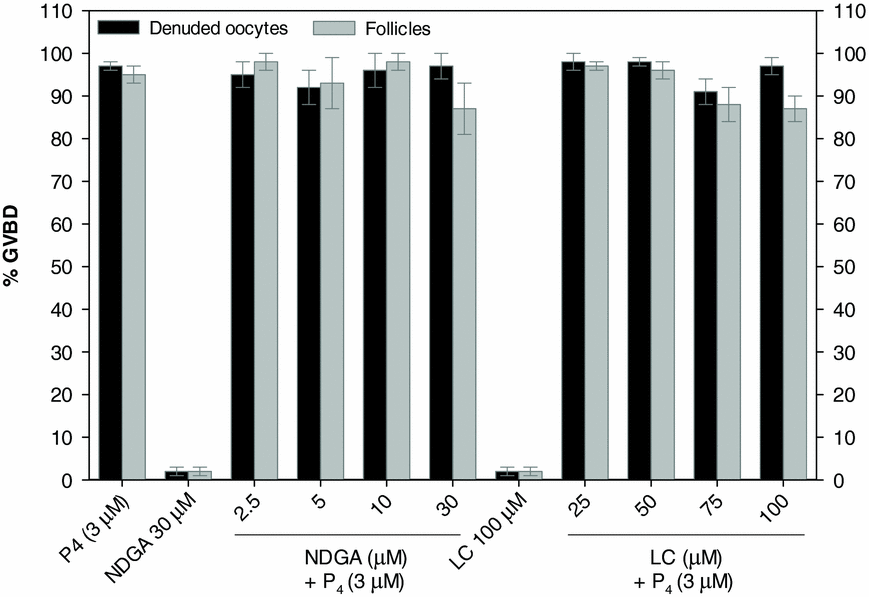
The participation of the AA cascade in the reproductive process of Rhinella arenarum seems to be also correlated with seasonal variations in the ovarian response to P4. During the February to June period, P4-induced maturation was low in both oocytes and follicles (56 ± 5% and 40 ± 5% GVBD, respectively) (period of low P4 response capacity). During this period, LOX inhibition by NDGA (5–30 μM) or LC (25–50 μM) had a stimulatory effect on P4-induced maturation. Interestingly, oocytes and follicles treated with P4 plus NDGA 30 μM reached higher maturation values (80 ± 5% and 90 ± 4% GVBD, respectively) than controls (Fig. 5). Samples incubated in the presence of NDGA or LC alone did not show maturation signs. During the July to January period, when oocytes and follicles showed maximum P4-induced maturation values, LOX inhibition had no effect on hormone-induced maturation at the assayed doses. Only a slight decrease in GVBD percentage was observed at NDGA 30 μM and LC 100 μM (Fig. 6). During all seasons of the year, higher doses resulted in increased lysis of samples treated with the inhibitors.
Effect of nordihydroguaiaretic acid (NDGA) or lysine clonixinate (LC) on progesterone (P4)-induced maturation during the February to June period. Denuded oocytes and follicles were incubated for 60 min in the presence of different doses of NDGA (5–30 μM) or LC (25–50 μM), after which P4 (3 μM) was added. The incubations were performed in triplicate at a controlled constant temperature of 26°C. At 20 h of incubation germinal vesicle breakdown (GVBD) was assessed. Values represent the mean ± standard deviation (SD) of six experiments performed on different animals in triplicate.
Effect of nordihydroguaiaretic acid (NDGA) or lysine clonixinate (LC) on progesterone (P4)-induced maturation during the July to January period. Maturation was considered as the percentage of germinal vesicle breakdown (GVBD) after 20 h of incubation of denuded oocytes and follicles. They were pre-incubated for 60 min with different doses of NDGA (2.5–30 μM) or LC (25–100 μM) before the addition of P4. Values represent the mean ± standard deviation (SD) of five experiments performed on different animals in triplicate.
Montelukast, an antagonist for leukotriene Cyst-LT1-receptor, was also evaluated. The addition of this antagonist did not affect hormone-induced maturation and oocytes reached GVBD values similar to the one reached with P4 (results not shown).
Arachidonic acid can be metabolized through either the COX or LOX pathways. In Rhinella arenarum oocytes, it is probable that inhibition of LOX results in metabolism of available AA through the COX pathway only, and thereby leads to an increase in PG synthesis that could be positively correlated with the maturation process. LOX participation in oocyte maturation in fish showed different results; LOX inhibition by NDGA inhibited hCG-induced maturation, a finding that suggested that products of this enzyme could be involved in hormone-induced maturation (Patiño et al., Reference Patiño, Yoshizaki, Bolamba and Thomas2003).
In summary, these results suggest that AA metabolites that result from COX or LOX pathways could be involved in P4-induced Rhinella arenarum oocytes maturation.