Antisocial behavior (ASB) is defined as actions that violate societal norms and the personal or property rights of others, and includes both overt or aggressive behaviors (fighting, hitting, bullying) and covert or non-aggressive/rule-breaking behaviors (stealing, lying, vandalism). Consistent with modern operationalizations of psychopathology, ASB is operationalized here as a continuous trait. Males engage in significantly more ASB than do females beginning in the toddler years and continuing throughout the lifespan, with typical Cohen's d effect sizes ranging from 0.4 to 0.8 (Hyde, Reference Hyde1984; Knight et al., Reference Knight, Fabes and Higgins1996; Archer, Reference Archer2004). Mean sexFootnote †Footnote 1 differences are especially large for severe violence, with observed odds ratios of 18.8 and higher (e.g. Daly and Wilson, Reference Daly and Wilson1990; van Lier et al., Reference van Lier, Vitaro, Barker, Koot and Tremblay2009). They are smaller, but still moderate-to-large in magnitude, for more garden-variety acts of physical aggression (Hyde, Reference Hyde1984; Knight et al., Reference Knight, Fabes and Higgins1996; Archer, Reference Archer2004), and small-to-moderate in magnitude for non-aggressive ASB (Moffitt, Reference Moffitt, Lahey, Moffitt and Caspi2003; Burt, Reference Burt2012). This male preponderance persists across numerous human societies (Ramirez et al., Reference Ramirez, Andreu and Fujihara2001; Archer, Reference Archer2004) and across most mammalian species, including humans’ nearest phylogenetic cousin, the chimpanzee (Gray, Reference Gray1971; Maccoby and Jacklin, Reference Maccoby and Jacklin1980; Manson et al., Reference Manson, Wrangham, Boone, Chapais, Dunbar, Ember, Irons, Marchant, McGrew and Nishida1991).
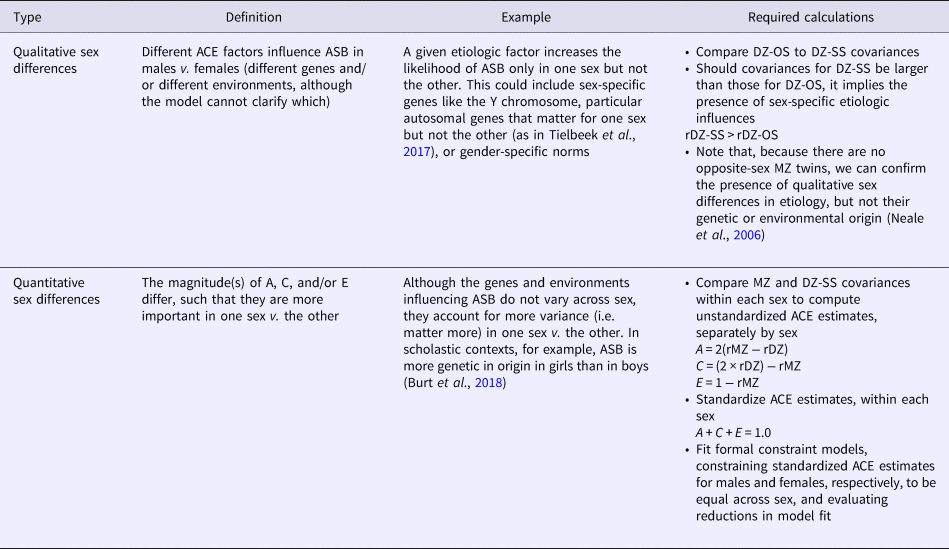
Given these seemingly clear sex differences in ASB at the level of actual behavior, one might expect equally robust differences in genetic and environmental etiology of ASB across sex. One possible manifestation involves ‘qualitative sex differences’ in etiology, in which different genes and/or different environments influence ASB in males v. females. As detailed in Table 1, qualitative sex differences in etiology should theoretically act to decrease the similarity of opposite-sex siblings relative to same-sex siblings, since (for example) hormonal effects that contribute to ASB only in boys would degrade similarity between male and female siblings and/or increase same-sex sibling similarity. Consistent with this possibility, at least one twin study (Rose et al., Reference Rose, Dick, Viken, Pulkkinen and Kaprio2004) found evidence of sex-specific genetic influences on ASB. These results are bolstered by a recent GWAS (Tielbeek et al., Reference Tielbeek, Johansson, Polderman, Rautiainen, Jansen, Taylor, Tong, Lu, Burt and Tiemeier2017), although this GWAS made use of a relatively small sample by GWAS-standards (N = 8535 females and 7772 males). That said, these two findings appear to be exceptions to the rule. The majority of twin studies, and all adoption studies, have found no/minimal evidence of qualitative sex differences in ASB etiology (e.g. Eaves et al., Reference Eaves, Silberg, Meyer, Maes, Simonoff, Pickles, Rutter, Neale, Reynolds, Erikson, Heath, Loeber, Truett and Hewitt1997; Jacobson et al., Reference Jacobson, Prescott and Kendler2002; van Hulle et al., Reference van Hulle, Rodgers, D'Onofrio, Waldman and Lahey2007), an important set of null findings given that twin-family designs are able to simultaneously evaluate both genetic and environmental influences (something that cannot be done using molecular genetic designs). Jacobson et al. (Reference Jacobson, Prescott and Kendler2002), for example, evaluated this possibility in a large longitudinal study with over 1000 opposite sex twin pairs, comparing opposite-sex twin covariances to same-sex twin covariances in qualitative sex limitation models. They found no evidence that the same-sex dizygotic twin correlation statistically exceeded that for opposite-sex dizygotic twins in their models, arguing against qualitative sex differences in the etiology of ASB. Such results are compelling, given the large sample size of opposite-sex pairs, but we note that no meta-analysis examining the question of qualitative sex differences in ASB has ever been conducted. While such work is needed before any firm conclusions can be drawn, extant data generally suggest that genetic and environmental contributions to ASB do not differ across males and females.

Note: MZ, DZ-SS, and DZ-OS represent monozygotic, same-sex dizygotic, and opposite-sex dizygotic twins, respectively. rMZ and rDZ represent intraclass correlations for monozygotic and dizygotic twins, respectively. A, C, and E represent, additive genetic, shared environmental, and non-shared environmental variances, respectively.
Another potential manifestation of sex differences in etiology is quantitative in nature. Findings of quantitative sex differences would indicate that, although the specific genes and environments influencing ASB do not differ across sex (i.e. there are no qualitative differences), the magnitude(s) of those influences do differ, such that they are more important for one sex v. the other (see Table 1). Unfortunately, results regarding quantitative sex differences in ASB etiology are quite inconsistent across the literature. Some studies have reported clear evidence against quantitative sex differences in etiology (e.g. Eaves et al., Reference Eaves, Silberg, Meyer, Maes, Simonoff, Pickles, Rutter, Neale, Reynolds, Erikson, Heath, Loeber, Truett and Hewitt1997; Slutske et al., Reference Slutske, Heath, Dinwiddie, Madden, Bucholz, Dunne, Statham and Martin1997; Taylor et al., Reference Taylor, McGue and Iacono2000; Burt et al., Reference Burt, Krueger, McGue and Iacono2001; Gelhorn et al., Reference Gelhorn, Stallings, Young, Corley, Rhee and Hewitt2005), while others have reported clear evidence for quantitative sex differences (e.g. Silberg et al., Reference Silberg, Erickson, Meyer, Eaves, Rutter and Hewitt1994; Van den Oord et al., Reference Van den Oord, Boomsma and Verhulst1994; Eley et al., Reference Eley, Lichtenstein and Stevenson1999; Jacobson et al., Reference Jacobson, Prescott and Kendler2002; Bartels et al., Reference Bartels, Hudziak, Van den Oord, Van Beijsterveldt, Rietveld and Boomsma2003; Rose et al., Reference Rose, Dick, Viken, Pulkkinen and Kaprio2004). Critically, however, some of the latter found ASB to be more heritable in males (Silberg et al., Reference Silberg, Erickson, Meyer, Eaves, Rutter and Hewitt1994; Van den Oord et al., Reference Van den Oord, Boomsma and Verhulst1994; Bartels et al., Reference Bartels, Hudziak, Van den Oord, Van Beijsterveldt, Rietveld and Boomsma2003), while others found that ASB was more heritable in females (e.g. Eley et al., Reference Eley, Lichtenstein and Stevenson1999; Jacobson et al., Reference Jacobson, Prescott and Kendler2002; Rose et al., Reference Rose, Dick, Viken, Pulkkinen and Kaprio2004).
Given these inconsistencies, it is perhaps not surprising that the question of quantitative sex differences in the etiology of ASB has also been addressed as part of several large-scale meta-analyses of twin and adoption studies. These studies have uniformly suggested that ASB is equally heritable in males and females (Burt, Reference Burt2009a, Reference Burt, Krueger, McGue and Iacono2009b; Rhee and Waldman, Reference Rhee and Waldman2002). When the original meta-analytic data analyzed in Burt (Reference Burt2009a) were additionally disambiguated by informant (Burt et al., Reference Burt, Slawinski and Klump2018), however, the conclusion changed: rather than no quantitative sex differences in etiology at all, the data indicated that there were no sex differences in etiology when ASB was assessed using maternal informant-reports of child behavior. When examining teacher informant-reports of child ASB, however, ASB was more shared environmental in origin in boys than in girls, but more genetic in origin in girls than in boys – a conclusion that persisted to an independent twin sample not included in the original meta-analysis (Burt et al., Reference Burt, Slawinski and Klump2018). Such findings are thought to reflect the ‘attribution bias context model’, whereby mothers and teachers are exposed to different slices of the child's behavior and thus develop different opinions/ attributions regarding the same child (De Los Reyes and Kazdin, Reference De Los Reyes and Kazdin2005). For example, ASB might be more gendered in its presentation at school (perhaps due to child-enforced social norms that constrain physical aggression with peers in girls) and less gendered in the home, where mothers may observe their daughter hitting her sibling(s). Alternately, it may be the case that ASB on the part of any one child is simply easier to observe in scholastic settings because it is so disruptive to the functioning of the classroom, or because the teacher has a large pool of children to which they can compare any given child. Either way, the etiological differences observed for teacher informant-reports, but not maternal informant-reports, suggest that quantitative sex differences in the etiology of ASB are specific to (or more detectable in) school settings, a peculiar finding given that mean differences in ASB are seen across all informants.
What do the above findings mean for our understanding of sex differences in ASB?
Although interesting, this specificity of etiologic differences to teacher-informant reports in particular still leaves us with something of a conundrum. When examining maternal informant-reports of their children (by far the most frequently examined of the informant-reports), available data robustly suggest that ASB is far more prevalent in boys as compared to girls, while also indicating that neither the magnitude nor the composition of its etiology vary across boys and girls. In more specific terms, extant data indicate that (1) the same genetic and environmental influences underlie maternal informant-reports of ASB in males and females, (2) these genetic and environmental influences are equally influential in males and females, and yet (3) ASB is notably more common in males than in females (a phenotypic difference observed for both maternal and teacher-informant-reports). How do we make sense of these seemingly incompatible sets of findings?
Before we dive in to possible answers, it is worth highlighting one key distinction between phenotypic and etiologic sex differences. Discussions of phenotypic sex differences are almost exclusively based on mean differences across sex, such that average levels of ASB are higher in males than they are in females. This does not imply, however, that all or even most males evidence higher rates of ASB than do females, since there is a great deal of variability around each of these sex-specific meansFootnote 2. Discussions of etiology, by contrast, are based on decompositions of the variance (or observed individual differences) around the mean, without regard to the mean itself. Put another way, phenotypic and twin studies are respectively focused on different statistical moments (i.e. means v. variances). As such, the fact that their conclusions are difficult to reconcile is frustrating but does not necessarily imply that either is incorrect (although they could be, and indeed, there are nuanced issues for both that warrant additional consideration, as discussed below).
Despite this statistical truism, our core question remains unanswered: How do we make sense of mean sex differences in ASB if not via differences in genes, environments, hormones, and/or culture? The current review will consider a variety of answers to this question, ultimately highlighting areas where new theoretical and empirical designs could yield novel and much needed insights.
Could phenotypic sex differences in ASB be less pronounced than we think?
One possible contribution to the interpretive mismatch between sex differences in phenotype and sex differences in etiology could be that phenotypic differences are in fact smaller than is typically reported. Indeed, this concern has been raised several times, both in more general terms and for ASB in particular. In terms of the former, a large body of work has strongly suggested that, while there may be moderately-sized mean sex differences in ASB, most psychological constructs show only minimal sex differences, if any (see review in Hyde, Reference Hyde2005). For ASB more specifically, it has previously been argued that sex differences in physical aggression were due a failure to assess aggressive behaviors that are more salient for females, and particularly those that used interpersonal relationships to harm others (e.g. Crick and Grotpeter, Reference Crick and Grotpeter1995). Namely, it could be the case that girls’ heavy focus on interpersonal relationships and social functioning means that relational aggression is their preferred weapon. Girls’ smaller physical size and reduced physical strength may accentuate this tendency by limiting their capacity to use physical aggression effectively (Björkqvist, Reference Björkqvist1994). More recent meta-analytic work, however, has indicated that this early (and very influential) ‘mean girl’ ASB hypothesis may not be correct, since boys engage in just as much relational aggression as do girls (Card et al., Reference Card, Stucky, Sawalani and Little2008). In short, there is as yet scant evidence that phenotypic sex differences in ASB stem from sex biases inherent to its operationalization.
It would also be important to meaningfully consider the issue of measurement invariance across sex, or the assumption that the underlying structure and properties of a measure are consistent across males and females. Measurement invariance evaluates whether the same construct is being measured across groups, and can be tested several ways. Configural invariance models, for example, would evaluate whether the factor structure of ASB is equivalent across sex, while metric invariance models would evaluate whether the ASB factor loadings are equivalent across sex. Evidence against measurement equivalence across sex would thus indicate that any observed sex differences were actually artifacts of measurement (e.g. informants using the scale differently for males and females) rather than true mean differences across sex. As it happens, however, empirical research robustly supports measurement invariance across sex for measures of ASB, and does so across developmental periods, informants, community/clinical settings, and nationalities (e.g. Palmieri and Smith, Reference Palmieri and Smith2007; Fonseca-Pedrero et al., Reference Fonseca-Pedrero, Sierra-Baigrie, Lemos-GirÂldez, Paino and Muñiz2012; Smits et al., Reference Smits, Theunissen, Reijneveld, Nauta and Timmerman2018). Such findings argue against the possibility that observed sex differences in ASB stem from measurement invariance across sex.
Although the sexually dimorphic nature of ASB may not be attributable to bias or measurement invariance, it could conceivably reflect other aspects of its operationalization, including the omission of underlying emotional and cognitive processes. ASB arises from a complex interaction of deficits across inhibitory control, reward and punishment sensitivity, emotionality and emotion regulation, and empathy (Hyde et al., Reference Hyde, Shaw and Hariri2013; Waller et al., Reference Waller, Murray, Dotterer, Hyde and Toga2015). The failure to observe sex differences in these underlying traits and cognitive processes could thus suggest that sex differences in ASB are less pronounced than they appear (although this is not the only possible interpretation). To date, however, there is at best inconsistent evidence to support this conjecture. Some (but not all) of these more basic psychological processes do appear to show sex differences, though the evidence for these differences is sometimes mixed and they are often small-to-moderate in magnitude. For example, boys are considerably less empathic than girls when empathy is measured by questionnaire, although these sex difference shrink when empathy is measured by physiology or observation (Eisenberg and Lennon, Reference Eisenberg and Lennon1983). Impulsivity, a well-documented predictor of both the onset and development of ASB, demonstrates robust sex differences, such that males are more impulsive and risk-taking than females as well as less responsive to punishment across the lifespan (Cross et al., Reference Cross, Copping and Campbell2011). That said, delay discounting, a narrower measure of reward sensitivity, demonstrates either no sex difference (Cross et al., Reference Cross, Copping and Campbell2011) or one of very small effect (d = 0.06) (Silverman, Reference Silverman2003). Similarly, high Negative Emotionality/Neuroticism is also a known predictor of ASB, but is more pronounced in females than in males (Schmitt et al., Reference Schmitt, Realo, Voracek and Allik2008), although this female preponderance is far more pronounced for anxiety and other internalizing traits than for those related to ASB (i.e. hostility). In short, the sexually dimorphic nature of ASB extends to several but not all of its core emotional and cognitive predictors.
Diving deeper, we could also ask whether there are consistent sex differences in the neural circuits underlying ASB (Alegria et al., Reference Alegria, Radua and Rubia2016). Unfortunately, much of this research has focused on male participants in prison settings (e.g. Crooks et al., Reference Crooks, Anderson, Widdows, Petseva, Koenigs, Pluto and Kiehl2018b), and the handful of studies that have included females (e.g. Fairchild et al., Reference Fairchild, Hagan, Walsh, Passamonti, Calder and Goodyer2013; Crooks et al., Reference Crooks, Anderson, Widdows, Petseva, Decety, Pluto and Kiehl2018a) have not included males, making it difficult to draw substantive conclusions. That said, results from the few community studies containing men and women thus far suggest little (or insufficient) evidence for sex differences in the neural correlates of ASB (Carré et al., Reference Carré, Hyde, Neumann, Viding and Hariri2012, e.g., Dotterer et al., Reference Dotterer, Hyde, Swartz, Hariri and Williamson2017, though see Waller et al., Reference Waller, Corral-Frías, Vannucci, Bogdan, Knodt, Hariri and Hyde2016). Interestingly, however, when we instead focus on the basic functioning of specific regions of interest to ASB (e.g. regions involved in emotion and reward), consistent sex differences do emerge. Men have smaller amygdala volumes (Lenroot and Giedd, Reference Lenroot and Giedd2010; Ruigrok et al., Reference Ruigrok, Salimi-Khorshidi, Lai, Baron-Cohen, Lombardo, Tait and Suckling2014), reduced amygdalar responsivity to negative stimuli (Stevens and Hamann, Reference Stevens and Hamann2012), and different patterns of neural reactivity to reward (Dreher et al., Reference Dreher, Schmidt, Kohn, Furman, Rubinow and Berman2007). As an example of this duality, Hyde et al. (Reference Hyde, Byrd, Votruba-Drzal, Hariri and Manuck2014) found that sex predicted threat-related neural activity in the amygdala, while also finding no evidence that sex moderated associations between neural reactivity in those regions and ASB (Hyde et al., Reference Hyde, Byrd, Votruba-Drzal, Hariri and Manuck2014). In sum, extant data indicate that, although there may be sex differences in brain volume and activation in the structure and function of neural regions related to ASB, it is not the case that (for example) amygdalar activation is associated with ASB more in one sex v. the other. That said, more work is needed before any firm conclusions can be drawn. Future studies should clarify whether (as we would assume) the aforementioned sex differences in brain volume and activation explain the preponderance of ASB in men as compared to women. There is also a need for studies using larger samples that directly examine whether sex moderates associations between neural reactivity and ASB. Pending those studies, however, we preliminarily conclude that, as with the personality and cognitive correlates discussed above, there is little evidence that the neural correlates of ASB differ across sex.
Are twin studies well-suited for the detection of qualitative sex differences?
Another possible contribution to the interpretive mismatch between phenotype and etiology could be that twin family studies may not be appropriate vehicles for evaluations of qualitative sex differences. One key hurdle in this regard relates to sex-specific cultural norms. Norms against aggression, for example, are especially salient for girls, who are socialized against this behavior by both adults and peers to a greater extent than boys (Keenan and Shaw, Reference Keenan and Shaw1997; Crick et al., Reference Crick, Ostrov, Kawabata, Flannery, Vazsonyi and Waldman2007). Critically, however, the effects of these (and other) sex-specific cultural norms are detectable in twin studies only under particular scenarios. One such scenario would occur if individuals within a given sex are differentially responsive to cultural norms based on their genetic predilections to ASB (e.g. if women with a higher genetic loading for ASB are more or less responsive to cultural gender norms than women without that loading). Because responsiveness to the cultural norm depends on one's genetic influences in this case, the effect of sex-specific norms would actually be subsumed in the genetic component of variance in ASB, and should thus be detectable in qualitative sex difference analyses. Similarly, should individuals be differentially exposed to ASB-relevant cultural norms, it would also be detectable (likely within the shared environmental component of variance, since it involves exposure rather than genetically-influenced responsiveness).
The qualitative sex differences model would be quite useful for detecting sex differences in etiology under either those scenarios (both of which are quite reasonable a priori). Even so, there are other reasonable scenarios that would be more difficult to detect within a qualitative sex differences twin design. A key proviso of twin models is that they are blind to any factors that are shared by all persons in a sample; if something does not differ across a specific population, it cannot alter individual differences in that population. Put another way, it would not alter their rank ordering across the population (i.e. those highest in a given trait remain highest, etc). To the extent that norms against aggression (for example) are communicated more or less universally to any girl growing up in a particular place at a particular time, it is theoretically possible that these norms could suppress mean levels of ASB across all girls without affecting the rank-order of ASB among girls. Because the rank-ordering of girls remains unaffected under this scenario, this manifestation of cultural effects should not alter either same-sex or opposite-sex twin correlations. As such, we would be unable to detect the norm's effect in qualitative sex difference analyses despite its clear sex-specific effect on ASB.
Yet another possible hurdle for the interpretation of qualitative sex difference analyses relates to gonadal hormone exposure (which is ironic given that sex-specific gonadal hormones often motivate studies of qualitative sex differences). Gonadal hormones are foundational to the sexual differentiation of humans. It is the presence of prenatal testosterone in males, and the relative absence of prenatal testosterone in females, that lead to male and female physiology, respectively. These organizational effects of prenatal testosterone also permanently alter brain structure and function, and in doing so, contribute to many different types of sex differentiated behaviors, including aggression (Ryan and Vandenbergh, Reference Ryan and Vandenbergh2002; Spencer et al., Reference Spencer, Pasterski, Neufeld, Glover, O'connor, Hindmarsh, Hughes, Acerini and Hines2017). When considered alongside the presence of strong and very early sex differences in aggression (the peak prevalence of aggression is between the ages of 2 and 4 years), it thus seems likely that prenatal testosterone may contribute both to the etiology of ASB and to the male predominance in risk. There is one key caveat to these findings, however: within normal limits of prenatal testosterone exposure, there are at most modest associations between level of exposure and behavioral outcomes in males (Ryan and Vandenbergh, Reference Ryan and Vandenbergh2002; Tapp et al., Reference Tapp, Maybery and Whitehouse2011). Thus, despite prominent sex-specific effects on ASB, it is quite plausible that prenatal testosterone exposure elevates risk for ASB in all males without altering the rank ordering of males across the population (much like the final cultural norms possibility detailed above). Put another way, prenatal testosterone exposure could increase the mean level of ASB among males without differentially affecting opposite-sex sibling similarity and same-sex sibling similarity. If so, prenatal testosterone effects could be quite difficult to detect in typical qualitative twin studies.
What's more, some data suggest that the female co-twin in opposite-sex pairs may be exposed to higher levels of testosterone in utero by her male co-twin, and is therefore more ‘masculinized’ in her brain and behavior (Cohen-Bendahan et al., Reference Cohen-Bendahan, Buitelaar, van Goozen and Cohen-Kettenis2004; Tapp et al., Reference Tapp, Maybery and Whitehouse2011) and aggression (Cohen-Bendahan et al., Reference Cohen-Bendahan, Buitelaar, Van Goozen, Orlebeke and Cohen-Kettenis2005) than girls from same-sex pairs. Should this be true, it would also act increase the similarity between male and female co-twins from opposite sex pairs to levels more similar to those of same-sex pairs, thereby attenuating estimates of qualitative sex differences. In sum, under a few particular scenarios, it is possible that null findings in qualitative sex difference analyses (i.e. the absence of significant sex differences) may represent false negatives.
Are twin studies well-suited for the detection of quantitative sex differences?
Less optimal elements inherent to current quantitative sex difference approaches may also contribute to the interpretive mismatch between phenotype and etiology. As outlined in Table 1, studies of quantitative sex differences in etiology are typically conducted as follows. First, we compare MZ and same-sex DZ covariances, separately for each sex, to determine standardized sex-specific heritability estimates. We then compare these sex-specific heritability estimates across sex, constraining parameter estimates to be equal across sex and evaluating changes in model fit. These constraint analyses require ample statistical power. As such, only large differences are likely to consistently emerge as statistically significant, an important consideration given the fact that even phenotypic sex differences are only moderate in magnitude in all but the most violent forms of ASB. Accordingly, at the level of the individual study, limited statistical power could account for the absence of consistent sex differences in etiology. This explanation falls short, however, when we consider the absence of sex differences in etiology in most meta-analytic studies, which typically rely on raw intraclass correlations (rather than summary statistics) to compute meta-analytic effect sizes.
The more important statistical concern with twin studies of quantitative sex differences may instead be the comparison of second-order genetic and environmental parameter estimates. Current statistical modelling approaches specify that genetic and environmental variances cannot be lower than zero (i.e. cannot be negatively-signed), thereby avoiding negative variances (as they are not possible in theoretical terms). This specification is necessary because genetic and environmental variance estimates are based on the comparison of MZ and DZ covariances, and can thus yield negative variances under a variety of circumstances (e.g. when the MZ correlation is more than double the DZ correlation, the estimated shared environmental variance would be negatively signed). As noted in recent work by Verhulst and colleagues (Reference Verhulst, Prom-Wormley, Keller, Medland and Neale2019), however, this approach has some significant drawbacks, not least of which is that it leads to questionable Type I Error rates and introduces bias into all estimated parameters (since they are proportional to one another). They have thus developed a new approach that corrects the above issues by allowing for negative variances. As this new approach has yet to be applied to examinations of sex differences in the etiology, however, it remains unclear whether the absence of quantitative sex differences in the etiology of ASB will persist once unbounded analyses are conducted.
A related approach, and one that completely avoids the computation of higher-order genetic and environmental parameter estimates (but, to our knowledge, is rarely conducted), would be to formally compare intraclass correlations for a given zygosity across sex (e.g. compare male-male DZ similarity to female-female DZ twin similarity). This approach would have the significant advantage of increased statistical power relative to comparisons of proportions of variance across sex, and could also enhance understanding. For example, should we find that MZ females are usually more similar than are MZ males, it would support early suggestions that girls require a high genetic liability to engage in ASB (Cloninger et al., Reference Cloninger, Christiansen, Reich and Gottesman1978). Similar approaches are now being applied to genotype-environment interaction models, to promising effect (Turkheimer et al., Reference Turkheimer, Beam, Sundet and Tambs2017). In sum, analyses that focus on intraclass correlations or allow for negative heritability estimates would increase our certainty that the magnitudes of genetic and environmental influences on ASB are equivalent across sex.
Conclusions
The above review was motivated by the following question: How do we make sense of mean sex differences in ASB in the absence of sex differences in its etiology? Our specific goal was to critically examine the overall question (e.g. could there be undetected differences in etiology across sex?), and in doing so, illuminate possible answers. We specifically explored the presence of true sex differences in ASB at the level of behavior, as well as the suitability of twin-family designs for qualitative and quantitative sex difference analyses, with the goal of gaming out reasonable scenarios under which the twin design would be unable to detect actual sex differences in the etiology of ASB.
Our review found little evidence that bias or measurement invariance across sex accounted for phenotypic sex differences. Similarly, several (but not all) relevant personological, cognitive, and emotional correlates appear to vary across sex in ways consistent with ASB. Based on this review, we thus conclude that the male preponderance of ASB is likely to reflect a true sex difference in observed behavior. By contrast, our exploration of the suitability of twin-family designs for uncovering sex differences in etiology yielded some intriguing possibilities. In terms of qualitative analyses, there are two potentially critical variables – sex-specific cultural norms and prenatal testosterone in males – that could conceivably alter mean levels of ASB (perhaps substantially so) without altering individual differences within a given sex. Under this particular scenario, sex-specific etiologic influences on ASB would be very difficult to detect using standard qualitative sex difference analyses (or quantitative analyses, for that matter). We also highlighted potential problems with the current approach to uncovering quantitative sex differences, most notably the central focus on the comparison of standardized heritability estimates. In short, although twin studies are widely used to uncover the presence of sex differences at the etiologic level, there are specific scenarios and specific types of sex differences that these models are unlikely to detect. The possibility of false negatives should give researchers some considerable pause when interpreting the results of null (or no-sex-difference) findings. Positive findings, on the other hand, seem more likely to reflect actual sex differences in etiology (be they quantitative or qualitative).
Given these results, efforts should now be made to explore and address potential limitations to twin study methods and interpretation. Our review indicated that current issues with quantitative sex difference analyses could likely be resolved with one or more relatively simple analytic tweaks (e.g. focusing on intraclass correlations, allowing variances to be negatively-signed). The concerns raised regarding qualitative sex difference analyses are more challenging to address, and as such, notably undermine our confidence in null results obtained using that model. Indeed, these concerns appear to be significant enough that they may require a considerable revamping of current qualitative approaches and/or the use of additional analyses to illuminate the interpretation of null results. As one example, we could leverage the fact that different cultures have different cultural norms regarding female ASB to try and tease out sex-specific effects of culture on etiology, asking whether brother-sister similarity for ASB varies across communities or societies according to their gender norms (e.g. are opposite-sex twins/siblings more similar to one another in societies with less pronounced gendered norms or higher gender equality?). Migration studies (Breslau et al., Reference Breslau, Borges, Saito, Tancredi, Benjet, Hinton, Kendler, Kravitz, Vega, Aguilar-Gaxiola and Medina-Mora2011) provide yet another strategy for examining cultural effects in general, since immigrants alter their environmental conditions without altering their genotypes. As an example of the overall logic, Breslau et al. (Reference Breslau, Borges, Saito, Tancredi, Benjet, Hinton, Kendler, Kravitz, Vega, Aguilar-Gaxiola and Medina-Mora2011) examined Mexicans in various stages of migration to the United States: (1) Mexicans living in non-migrant households in Mexico, (2) Mexicans living in the United States as adults but who were raised in Mexico, as well as Mexicans living in Mexico but with an immediate family member living in the United States, (3) those of Mexican ancestry who were born in the United States or Mexicans who came to the United States as children, and (4) Mexican-Americans born in the United States to at least one US-born parent. Comparing migrants (i.e. group 2) to those born and/or raised in the new country (i.e. groups 3 and 4) allowed them to examine the influence of societal environmental conditions on behavior prevalence. Had they also examined these effects separately across sex, we could begin to evaluate gendered cultural effects on behavior prevalence as well. By contrast, to test theories regarding effects of prenatal testosterone, we may need to leverage naturally-occurring hormonal perturbations (e.g. Androgen Insensitivity Syndrome) and/or reinvigorate connections between human and animal behavioral genetic research (given that the latter allow for hormonal manipulations in utero). We are hopeful that the field will tackle these interesting possibilities.
As we close, we would like to reiterate a point made earlier on: the fact that the conclusions of phenotypic and etiologic studies are difficult to reconcile is frustrating but does not necessarily imply that either is incorrect. Even so, this review did undermine our confidence in null findings obtained using standard qualitative and quantitative biometric sex difference analyses. We hope the field will begin development of new methods for studying sex differences in etiology.
Author ORCIDs
S. Alexandra Burt, 0000-0001-5538-7431.
Financial support
This project was supported by an administrative supplement for R01-MH081813 from the National Institute of Mental Health (NIMH). The content is solely the responsibility of the authors and does not necessarily represent the official views of the NIMH or the National Institutes of Health.
Conflict of interest
None.
Ethical standards
The authors assert that all procedures contributing to this work comply with the ethical standards of the relevant national and institutional committees on human experimentation and with the Helsinki Declaration of 1975, as revised in 2008.