Introduction
The maintenance of reproductive colonies faces many logistical, financial, and ethical challenges (Hart-Johnson and Mankelow, Reference Hart-Johnson and Mankelow2021). Therefore, the cryopreservation of germplasm from valuable rodent models can be an alternative to overcome those bottlenecks. Embryo and gamete cryopreservation has been used as the main method (Hart-Johnson and Mankelow, Reference Hart-Johnson and Mankelow2021). However, such procedures are expensive due to the requirement for supplies and equipment (Campos-Junior et al., Reference Campos-Junior, Alves, Dias, Assunçao, Munk, Mattos, Kraemer, Almeida, Russo, Barcelos, Camargo and Viana2016). Conversely, ovarian cryopreservation is a promising tool, allowing the storage of a large number of follicles (Lotz et al., Reference Lotz, Maktabi, Hoffmann, Findeklee, Beckmann and Dittrich2016; Donfack et al., Reference Donfack, Alves, Araújo, Cordova, Figueiredo, Smitz and Rodrigues2017). Ovaries can be obtained at any time of the oestrous cycle (Lotz et al., Reference Lotz, Maktabi, Hoffmann, Findeklee, Beckmann and Dittrich2016) and for further transplantation. Recipient mice can have their cyclicity and fertility recovered, with more than 60% of viable offspring (Terren et al., Reference Terren, Fransolet, Ancion, Nisolle and Munaut2019); however, this still requires the establishment of more efficient transplantation protocols. Most recently, our laboratory demonstrated that, despite cryopreserved and heterotopically transplanted ovaries having shown several transcriptomic modifications, they were able to sustain complete oogenesis. Therefore, this article aims to describe a surgical procedure for murine ovariectomy and subcutaneous autotransplantation while providing technical details and the efficiency of this technique.
Materials and methods
All procedures were approved by the Ethics Committee on the Use of Animals (025/2018) of the Federal University of São João del Rei. Female C57B1/6J mice (n = 18), 6 weeks of age, were used. The sample size was calculated by power analysis. All animals underwent the procedures during proestrus. There was no control group, and it is a descriptive study. The animals were kept under controlled light (12 h:12 h, light:dark cycle), temperature (21°C ± 2°C), and ad libitum diet.
Inhalatory anaesthesia with isoflurane was used (Zhao et al., Reference Zhao, Meng, Lu, Hyde, Kennedy, Houghton, Evelhoch and Hines2020). Meloxicam was administered subcutaneously before and 24, 48 and 72 h after surgery. The animals were trichotomized bilaterally above the hind limbs and on the dorsal midline at the height of the forelimbs, then, the skin was disinfected. A lateral incision (1 cm) was made in the flank region and above the posterior limb. After locating the ovary under the membrane of the peritoneum, an incision (0.5 cm) was made and then the ovary was exposed. After that, a single ligature was performed around the oviduct and the ovary was removed. The oviduct was re-inserted into the peritoneal cavity, which was sutured, and the skin incision was closed using metal clips.
After ovariectomy, the gonads were placed in a phosphate-buffered saline solution. The ectopic autotransplantation was performed in the dorsal subcutaneous region of the forelimbs. Two incisions (1 cm) were made forming pockets in which the ovaries were grafted. The incisions were closed with metal clips.
The stage of the oestrous cycle was determined by visual (Champlin et al., Reference Champlin, Dorr and Gates1973) and vaginal cytology methods (Byers et al., Reference Byers, Wiles, Dunn and Taft2012). Then, 23 days after transplantation, the animals were euthanized and the grafts were harvested. In some animals (n = 9), the transplanted ovaries were fixed and proceeded to follicle quantification (Pereira et al., Reference Pereira, Nascimento, Jorge, Segatelli, Coutinho, Viana and Campos-Junior2020). The grafts of other animals (n = 9) were collected and germinal vesicle (GV) oocytes were obtained according to Pereira et al. (Reference Pereira, Nascimento, Jorge, Segatelli, Coutinho, Viana and Campos-Junior2020), in which ovarian grafts were punctured with a 26G needle in a PBS solution supplemented with 20% fetal bovine serum, to assess their ability to support GV oocyte growth. There were no excluded animals, as no animals died during the procedures and there was no need for humane endpoints. The data are shown as mean ± standard error of the mean (SEM) and no comparison tests were used.
Results
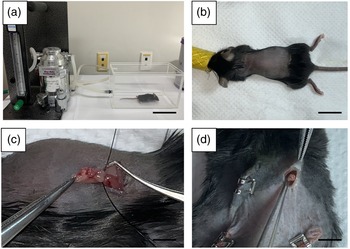
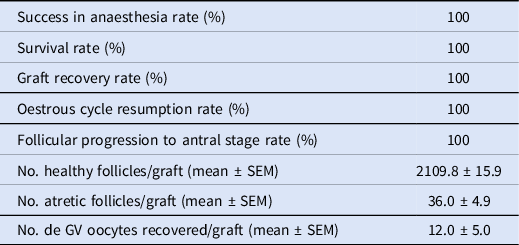
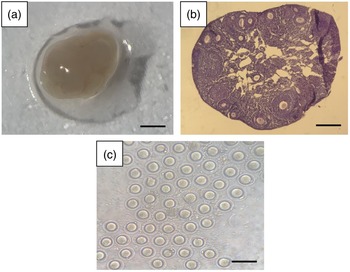
All methodological steps were feasible and carried out successfully, as shown in Fig. 1. The results obtained by the autotransplantation surgery in mice are shown in Table 1. The ovaries were successfully recovered 23 days after the procedure (Fig. 2a) and follicles were observed at all stages of development (Fig. 2b). In addition, GV oocytes were recovered (Fig. 2c), which indicated the efficiency of the transplant and recovery of graft functionality.
Ovariectomy and autotransplantation. (a) Anaesthetic induction chamber. (b) Animal sedated. (c) Exposed ovary. (d) Ectopic transplantation. Bars: (a) 8 cm; (b) 2.5 cm; (c) 1 cm; (d) 2 cm.

Surgical and follicular parameters for murine ovarian autotransplantation. Rates for surgery are in percentages (%) and follicular and GV oocyte quantities retrieved by graft are mean ± SEM

GV, germinal vesicle; SEM, standard error of the mean.
(a) Grafts recovered. (b) Histological picture of ovarian grafts. (c) Germinal vesicles. Bars: (a) 0.7 mm; (b) 200 µm; (c) 150 µm.

Discussion
Ovariectomy can be performed through a single incision on the middle back, double dorsolateral incisions, or a single ventral transverse incision in the abdomen (Souza et al., Reference Souza, Mendes, Casaro, Antiorio, Oliveira and Ferreira2019). Due to the quicker postoperative recovery, we used and recommend access through dorsolateral double incisions. The anaesthesia survival rate was 100% (Table 1); currently, isoflurane is considered the anaesthetic agent of choice for laboratory animals (Cicero et al., Reference Cicero, Fazzotta, Palumbo, Cassata and Lo Monte2018). Postoperative monitoring is one of the most important steps in animal recovery and, as apparent, it was well done, as no animal was lost (Cicero et al., Reference Cicero, Fazzotta, Palumbo, Cassata and Lo Monte2018).
Complete gametogenesis and endocrine recovery can be achieved after ovarian transplantation and this technique would be useful to explore regulatory mechanisms of folliculogenesis (Cao and Lin, Reference Cao and Lin2019). Different heterotopic ovarian autotransplantation sites have been explored to preserve ovarian function (Cao and Lin, Reference Cao and Lin2019). Our study demonstrated that the dorsal subcutaneous region of the forelimbs is a promising site, once all grafts were successfully recovered (Table 1 and Fig. 2a).
The vaginal cytology reflects the endocrine changes of rodent females during an oestrous cycle. At 7–30 days after transplantation, the immature follicles develop until the preovulatory stage (Sugishita et al., Reference Sugishita, Okamoto, Uekawa, Yamochi, Nakajima, Namba, Igarashi, Sato, Ohta, Takenoshita, Hashimoto, Tozawa, Morimoto and Suzuki2018), indicating that grafted ovaries resumed their endocrine function and maintained the cyclicity. These facts also corroborate our morphological analysis, in which all follicle classes were observed (Fig. 2b) indicating that ovarian autotransplantation can be used to preserve ovarian morphophysiology and investigate aspects of folliculogenesis (Cao and Lin, Reference Cao and Lin2019).
Ovarian grafts are capable of producing oocytes giving birth to live pups (Waterhouse et al., Reference Waterhouse, Cox, Snow, Jenkin and Shaw2004). In our study, GV were recovered, indicating the efficiency of the transplant (Fig. 2c) as the collection of oocytes after the entire procedure is considered a ‘gold standard’ in the investigation of the graft functionality (Pereira et al., Reference Pereira, Nascimento, Jorge, Segatelli, Coutinho, Viana and Campos-Junior2020). Therefore, these results indicated that the method of ovary collection and autotransplantation here described has potential application to maintenance of endocrine function and progression of folliculogenesis, however this study has its limitations as the developmental ability of these oocytes was not evaluated.
In conclusion, this article describes briefly ovariectomy and ovarian autotransplantation to the dorsal subcutaneous region and demonstrated that the ovarian follicles developed until the ovulatory stage. Most importantly, this technique has potential use for experimental tests for the maintenance of oogenesis and ovarian endocrine function in rodents, it can be used in animal facilities to reduce the number of necessary laboratory animals.
Financial support
This work was supported by the National Council for Scientific and Technological Development (CNPq, Brazil), Minas Gerais State Research Foundation (FAPEMIG, Brazil) and Coordination for the Improvement of Higher Education Personnel (CAPES, Brazil). BRN, GAGL and DSF received scholarships from FAPEMIG, CNPq and CAPES.
Author contributions
PHACJ designed and supervised the experiments, and revised the manuscript. BRN, GAGL and DSF performed the experiments, analyzed all data and prepared the manuscript.
Conflicts of interest
The authors declare that there are no known conflicts of interest associated with this publication and there has been no significant financial support for this work that could have influenced its outcome.
Data availability
The datasets generated during and/or analyzed during the current study are available from the corresponding author (paulohenrique@ufsj.edu.br) on reasonable request.