Selective attention is strongly involved in the activities we carry out in our daily life. In fact, many of the problems or errors that we commit in daily tasks are explained by attentional lapses or failures. A central aspect linked to the study of selective attention refers to the control of the interference generated by irrelevant stimuli (Theeuwes et al., Reference Theeuwes, Atchley, Kramer, Monsell and Driver2000). As different authors explain (Schmeichel & Baumeister, Reference Schmeichel, Baumeister and Bruya2010), there is a set of stimuli that quickly and involuntarily capture our attention: a strong smell, an unexpected cry, a bright color, a blue cup among several yellow ones, a novel object. In these cases, we pay attention almost effortlessly. Due to their salience or their biological significance developed through years of evolution, these objects or characteristics attract our attention quickly and automatically. However, in many situations we must avoid focusing our attention on these stimuli to prioritize the processing of others that are less salient, but more relevant and congruent with our objectives. It is in these cases, where we must make a mental effort to direct our attention to the relevant stimuli and thus, achieve our main goal. Self-control refers to the ability to substitute a dominant response for a sub-dominant one and intervenes in the regulation of a wide variety of behaviors, thoughts and emotions (Nigg, Reference Nigg2017). When the control mechanism is involved in the regulation of attention, it is referred to as attentional control. In the case of selective attention, self-control makes it possible to focus attention on the stimuli that are relevant or congruent with our objectives and divert it from those that are irrelevant and activate a dominant response (Schmeichel & Baumeister, Reference Schmeichel, Baumeister and Bruya2010).
Research on development carried out in the last 20 years has shown that throughout the course of life not all processes follow the same developmental path. In general terms, while declarative knowledge –or crystallized intelligence- presents a little or almost non-existent decline during adulthood, the same does not occur with fluid intelligence that depends to a great extent on cognitive control (Bialystok & Craik, Reference Bialystok and Craik2006). In the case of cognitive control (or self-control), most studies report a systematic and linear decline that begins in early adulthood and continues for decades. This decline affects functions such as working memory (Alloway & Alloway, Reference Alloway and Alloway2013) and attention (Madden, Reference Madden2007). Regarding attention, recent research has shown different developmental patterns for different manifestations or types of attention such as selective attention and sustained attention. The decline experienced by these attentional processes differs in magnitude and trajectory throughout the life course (McAvinue et al., Reference McAvinue, Habekost, Johnson, Kyllingsbæk, Vangkilde, Bundesen and Robertson2012; Salthouse, Reference Salthouse2017), which justifies the specific and discriminate analysis of each of these processes.
Furthermore, selective attention and other forms of attention directly affect the functioning of other cognitive functions such as memory, learning, reasoning and decision-making (Geary et al., Reference Geary, Boykin, Embretson, Reyna, Siegler, Berch and Graban2008; Mesulam, Reference Mesulam, Stuss and Knight2002). Based on the foregoing, it is not only interesting to know the development pattern linked to selective attention, but also the cognitive mechanisms that have been proposed in order to explain the specific path linked to each cognitive function. In this sense and in relation to adult life, the central question is which are the cognitive mechanisms that explain the decline in selective attention that for most authors occurs from the age of 20 (Hommel et al., Reference Hommel, Li and Li2004; McAvinue, et al., Reference McAvinue, Habekost, Johnson, Kyllingsbæk, Vangkilde, Bundesen and Robertson2012; Trick & Enns, Reference Trick and Enns1998). In relation to this question, the information processing model has given rise to a group of theories that, although they share certain basic assumptions linked to the general model (see Kail & Bisanz, Reference Kail, Bisanz, Sternberg and Berg1992), they clearly differ in the cognitive mechanisms they propose to explain the changes associated with development. Although there are other proposals, there are two theories that dominate the discussion on the subject: The theory of inhibitory inefficiency and the theory of processing speed.
The theory that considers processing speed as the main mechanism of cognitive change (Kail & Salthouse, Reference Kail and Salthouse1994; Rabbit, Reference Rabbitt2017; Salthouse, Reference Salthouse1993) states that the speed involved in different forms of processing presents a regular trajectory throughout the life course. This trajectory is characterized by the constant increase in speed during childhood and adolescence, the achievement of maximum performance in early adulthood, and the gradual and slow decline throughout adulthood (Salthouse & Kail, Reference Salthouse, Kail, Babes and Brin1983). Processing speed is defined as the maximum speed of execution of cognitive operations. Thus, the central idea of this proposal is that the higher the processing speed, the better the performance in a wide range of cognitive tasks that do not necessarily involve speed as a main component (e.g., memory, reasoning, etc.).
Thus, it is proposed that the improvement in the resolution of cognitive tasks that is observed from childhood to early adulthood depends largely on the increase in processing speed that is registered during this period. Consequently, the decline in performance of these tasks is mainly explained by the decrease in processing speed that occurs from adulthood (Kail & Salthouse, Reference Kail and Salthouse1994). There are numerous studies that have provided substantial evidence in favor of this position. In general terms, much of this evidence is based on showing that, when controlling or canceling the variation associated with speed, age-related differences in performance in different cognitive tasks disappear or decrease significantly (Salthouse, Reference Salthouse1993, Experiment 3).
Another of the most influential theories link0ed to development is the one that proposes inhibition as the main mechanism of cognitive change (Dempster, Reference Dempster1992; Hasher, Lustig et al., Reference Hasher, Lustig, Zacks, Conway, Jarrold, Kane, Miyake and Towse2007; Ortega et al., Reference Ortega, Gómez-Ariza, Román and Bajo2012; Solesio-Jofre et al., Reference Solesio-Jofre, Lorenzo-López, Gutiérrez, López-Frutos, Ruiz-Vargas and Maestú2011, Reference Solesio-Jofre, Lorenzo-López, Gutiérrez, López-Frutos, Ruiz-Vargas and Maestú2012). In this proposal, inhibition plays a leading role, as it is the mechanism responsible for keeping the content of working memory or the focus of attention, free from strange or irrelevant (internal or external) interferences. In short, the main function of inhibition is to “clean up” the irrelevant information or contents from working memory. Thus, by favoring the maintenance of the relevant items in the focus of attention, the efficiency of the processing system is maximized as it generates an increase in speed and response precision. Available evidence shows that inhibition exhibits a regular pattern of change throughout the life course.
The developmental trajectory is characterized by a constant increase during childhood and adolescence and by a gradual decrease from adulthood (Hasher et al., Reference Hasher, Lustig, Zacks, Conway, Jarrold, Kane, Miyake and Towse2007). Briefly, the differences in inhibitory efficiency are the ones that explain the variations that occur in the performance of a wide range of cognitive tasks throughout development. Specifically, this position states that during aging, the progressive decrease in inhibitory efficiency generates a significant overload in working memory, which affects its functioning and, therefore, performance in a wide range of cognitive tasks. Thus, most of the cognitive deficits that occur during adulthood such as text comprehension, distractibility and typical memory problems result from a decrease in inhibitory efficiency.
Some authors interested in the mechanisms that make cognitive change possible during childhood and adulthood, argue that processing speed and inhibition should not be considered as unique and exclusive theoretical proposals, but rather as complementary ones. In this line, the evidence reported in Hommel et al.’s (Reference Hommel, Li and Li2004) study in relation to selective attention suggests that neither the slowdown in the processing speed nor the inhibitory inefficiency can exclusively explain the decrease in the performance that older adults exhibit, compared to younger ones in visual search tasks (e.g., Folk & Lincourt, Reference Folk and Lincourt1996; Scialfa & Joffe, Reference Scialfa and Joffe1997; Zacks & Zacks, Reference Zacks and Zacks1993).
What cognitive mechanisms explain the decrease in selective attention that is reported during aging? Is there a single mechanism or, as Hommel et al. (Reference Hommel, Li and Li2004) posed, could the participation of different mechanisms be considered? Furthermore, what is the weight of inhibition and processing speed in this decrease? Do they contribute in the same way at different stages of adult life? The evidence provided in Hommel et al.’s (Reference Hommel, Li and Li2004) study shows that both inhibition and processing speed contribute to the decrease in selective attention in older adults. However, so far, no other antecedents have been found that analyze this issue among this population and that take this type of attention as their object of analysis. Therefore, this study proposes to analyze the participation of both mechanisms in the decrease of selective attention under the assumption that the combination of inhibitory inefficiency and slower processing speed explain, at least in part, the decrease in attention at this developmental stage. The main difference of this study with respect to that of Hommel et al.’s (Reference Hommel, Li and Li2004) resides in the use of a visual search task that includes a condition of greater demand for selective attention, as it adds a search condition in which the participant must identify the target stimulus among 32 distractors (18 more distractors than in Hommel et al.’s task). In addition, to evaluate the response speed, a simple response speed task without the presence of distractors is used, which minimizes the participation of the inhibitory mechanism by not generating the interference effect. On the other hand, to evaluate inhibitory control, an index is obtained based on the difference between two measures -conditions- of the visual search task that differ from the general performance measure of selective attention. Finally, to evaluate the performance of the participants in all the tasks, the inverse efficiency index is used, as it is considered a more appropriate measure to evaluate and interpret the performance in tasks based on precision and response time such as those used in this study (see method section for an index description).
In summary, the present study proposes as its main objective to analyze the specific contribution of processing speed and inhibitory control to the changes that selective attention experiences in adults between 20 and 80 years of age. In relation to this topic, and as mentioned above, two main hypotheses are proposed. Firstly, the existence of a gradual decrease in the performance of a selective attention task from early adulthood, and secondly, the contribution of two cognitive mechanisms - processing speed and inhibitory control - to performance in said task. In this sense, the results obtained constitute a relevant contribution linked to developmental psychology and cognitive psychology by including as a central theme the study of some of the factors or mechanisms that are considered to help explain the cognitive changes associated with age.
Method
Participants
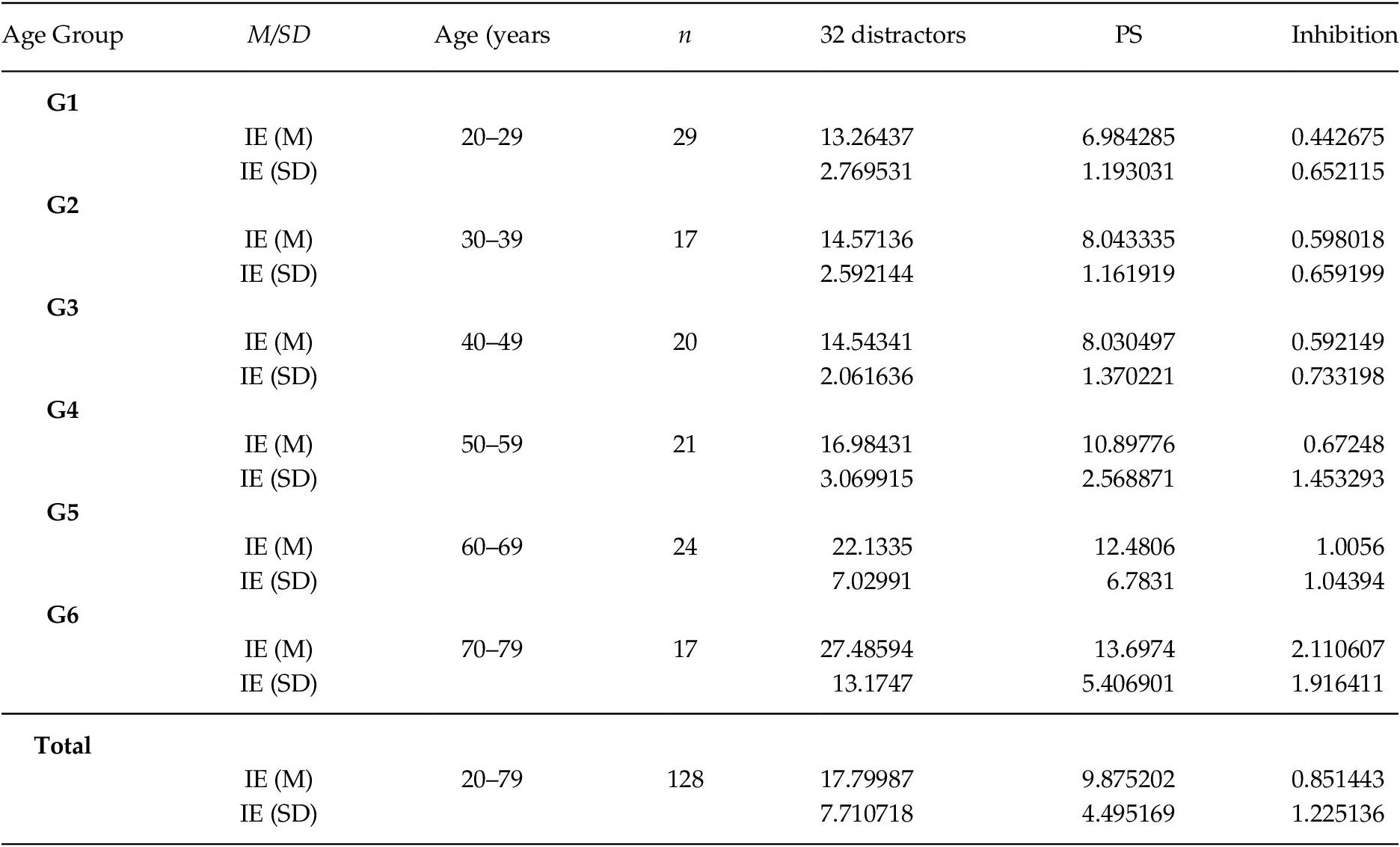
An intentional, non-probabilistic sample, made up of 128 adults, of both sexes (70 women and 58 men), aged between 20 and 80 years took part in this study. They were subdivided into groups every 10 years of age: G1 (n = 29), G2 (n = 17), G3 (n = 20), G4 (n = 21), G5 (n = 24) and G6 (n = 17). The grouping shown in Table 1 was as follows: 20–29, 30–39, 40–49, 50–59, 60–69, 70–79 years (mean ages 24, 34, 44, 55, 63, and 74 years, respectively), each including between 17 and 29 participants.
Inverse Efficiency Index (IE) for Selective Attention, Processing Speed and Inhibitory Control Expressed in Mean RT (in Milliseconds) and Standard Deviations (SD), according to the Age Group

Note: G1 = group 1; G2 = group 2; G3 = group 3; G4 = group 4; G5 = group 5; G6 = group 6. M = Mean; SD = Standard Deviation; PS = Processing Speed.
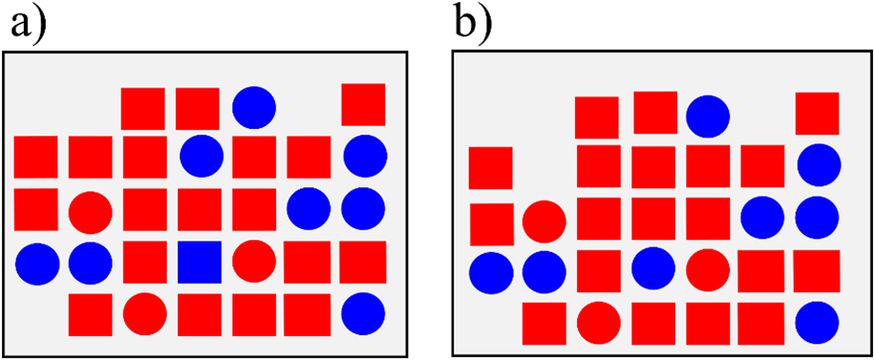
32 Distractors of the CVS Task Condition
Note. In the first screen (a), the condition with target is presented, while in the second screen (b), the condition without target is presented.

The participants between 20 and 40 years of age were students of an educational institution that offers various tertiary careers. Participants over 40 years of age were selected from non-governmental organizations - development societies and adult education programs taught by the National University of Mar del Plata. For the selection of the participants, the following inclusion criteria were considered: Adults between 20 and 80 years old; not undergoing psychological and/or psychiatric treatment; absence of diagnosis of psychiatric and/or neurological, focal or degenerative diseases; a level of formal education of more than seven years; a score greater than 26 points (Argentine version of Butman et al., Reference Butman, Harris, Drake, Baumann, De Pascale, Allegri, Mangone and Ollari2001) on the Mini Mental State Examination (MMSE), and having normal or corrected to normal vision.
Design
Based on current evidence, it is assumed that a gradual decline in performance will be recorded from Early Adulthood on a visual search task designed to assess selective attention. Likewise, according to the findings obtained in Hommel et al.’s (Reference Hommel, Li and Li2004) study, a substantial contribution of both processing speed and inhibition to performance in this task is expected. However, in a task that records response time (RT) and response accuracy, the differences in performance can be observed both in the RT and in precision, and there may even be a compromise between both measures, that is, a preference of the participant to optimize one of them. For example, participants may respond quickly but inaccurately, while others may give a slower but more accurate response. In this case, considering RT or accuracy in isolation does not fully reflect performance, and therefore several studies have considered it desirable to use measures that combine speed and accuracy (Klein et al., Reference Klein, Christie and Ivanoff2004). One of these measures was proposed by Townsend and Ashby (Reference Townsend and Ashby1983) and consists of dividing the RT by the proportion of correct answers (accuracy). It was later named Inverse Efficiency (IE) by Christie and Klein (Reference Christie and Klein1995) because the higher the IE score, the less efficient the performance. In addition to combining both measures, this index compensates for the relationships between speed and accuracy (Christie & Klein, Reference Christie and Klein1995). As RTs are expressed in milliseconds (ms) and are divided by proportions, the EI is also expressed in ms.
For the analyses of these hypotheses, a cross-correlational, non-experimental design was implemented, which contrasts two main models: Model 1, which analyzes performance without the inclusion of covariates, and Model 2, which analyzes performance with the inclusion of covariates. The basic assumption that guides the study is that, by including the inhibitory control and processing speed variables into the analysis, one of the following results should be obtained: (a) the disappearance of the significance of the differences associated with age, or (b) a decrease in the percentage of explained variance associated with age.
To compare both models, the attenuation index was used (see Kail & Salthouse, Reference Kail and Salthouse1994), which represents the difference in the proportion of explained variance with respect to Model 1 without covariates. Models 1 and 2 and their corresponding analyses plan are described below:
Model 1. Age-related performance of selective attention without inclusion of covariates (ANOVA with an inter-subject factor and an intra-subject factor). An ANOVA was applied with an inter-subject factor –Age- and an intra-subject factor - Inverse Efficiency Index in the 32 distractors condition. The inter-subject factor called Age was composed of six age groups.
Model 2. Age-related performance of selective attention controlling for the effects of processing speed and inhibitory control (ANCOVA with an inter-subject factor and an intra-subject factor and two control variables). The covariates used were a measure of processing speed and the calculation of an index that allowed evaluating inhibitory control (see instruments section). According to the hypothesis proposed in this study, if both measures contributed to the differences in performance associated with age, when controlling for only one of the covariates, the effect of interaction with age should not disappear, but a decrease in the proportion of the explained variance with respect to Model 1 should be seen. On the other hand, the joint control of both covariates should generate a decrease with respect to the proportion of the explained variance by Model 1. This result would provide evidence congruent with the hypothesis of the joint contribution of both cognitive processes to the changes that selective attention experiences during adult life.
Procedure
Participation was voluntary. First, participants were presented with an informed consent explaining the objectives, the tests to be administered in this research, the treatment and the confidential use of data in accordance with the Declaration of Helsinki (Asociación Médica Mundial, 2013), and in line with the ethical principles and the code of conduct for psychologists established and reformulated by American Psychological Association (2017). The procedures outlined in the Argentinian National Law No. 25.326 (Protección de Datos Personales, Ley N° 25.326, 2000) on the protection of personal data regulated by Decree 1158/2001 were followed. The consent was signed by all participants, as a prerequisite to their participation in this study. The administration was carried out through an individual interview with a duration of between 10 to 15 minutes. The visual search task was applied on an HP LAPTOP–RJSENA2U computer with Windows 10 and a 15’6” screen. In addition, the group of older adults was first administered the MMSE (Argentine version of Butman et al., Reference Butman, Harris, Drake, Baumann, De Pascale, Allegri, Mangone and Ollari2001) to assess cognitive functions and ensure that they exceeded the cut-off score established for inclusion in this study.
Instruments
Visual Search Task: Conjunctions Search
In order to evaluate selective visual attention and inhibitory control, one of the tasks that compose the CST - Cognitive Self-Regulation Tasks- was used (Canet-Juric et al., Reference Canet-Juric, Stelzer, Andrés, Vernucci, Introzzi and Burin2018; Introzzi, Andrés, et al., Reference Introzzi, Andrés, Canet-Juric, Stelzer and Richard’s2016; Richard’s et al., Reference Richard’s, Introzzi, Zamora and Vernucci2017). It is a visual search task that has been designed based on the Conjunction Visual Search paradigm (CVS; Treisman & Gelade, Reference Treisman and Gelade1980). In the task, the participants must identify the presence or absence of a target stimulus –blue square- that appears mixed between a variable set of distracting stimuli –red squares and blue circles-. Stimuli consist of double conjunctions, which are defined by the combination of two visual characteristics: Shape and color. Furthermore, all distractors share one of these visual characteristics with the target, a condition that guarantees the effect of interference and the participation of selective attention. The task is composed of a block of 10 practice trials, followed by three experimental blocks of 40 trials each. Each experimental block contains 10 tests per condition of Number of distractors: 4, 8, 16 and 32 distractors. The 40 trials are randomly distributed in each block; in 50% of the trials in each block the target is present while in the rest it is absent. The participant must always issue an answer, either affirmative or negative, as quickly and accurately as possible, pressing the corresponding key (the "Z" key if the target is present and the "M" key if it is absent). Once the answer has been issued, the following trial appears. Task performance is analyzed through two main measures, response time (RT) and the percentage of correct responses (accuracy of responses). In this way, two indices are obtained for each of the conditions of number of distractors (4, 8, 16 and 32). RT is only registered on the basis of correct answers. Typical performance corresponds to an increase in the mean RTs at the same time as there is a decrease in the response accuracy as a function of the increase in the number of distractors. In this way, as the number of distractors increases, a significant decrease in performance is recorded (Treisman & Gelade, Reference Treisman and Gelade1980). The visual search task yields two different indices for the assessment of selective attention and inhibitory control that are described below.
Selective Attention Performance Index
To evaluate selective attention, the Inverse Efficiency index –IE- was used in the condition of 32 distractors of the CVS Task. This measure was selected because it is the one that requires the greatest demand for selective attention and the one that makes it possible to maximize intra and inter-subject variability according to what has been reported in other studies carried out in this area with this task (Comesaña et al., Reference Comesaña, Richard’s and Vido2019; Introzzi, Andrés, et al., Reference Introzzi, Andrés, Canet-Juric, Stelzer and Richard’s2016; Richards’ et al., Reference Richard’s, Introzzi, Zamora and Vernucci2017).
Inhibitory Control Index
To evaluate the inhibitory control mechanism, the differences in performance between the IE indices corresponding to the conditions of 4 and 8 distractors of the Visual Search Task were calculated. This measure is often used to assess the effect of interference and inhibitory control in different populations and conditions (see Mullane et al., Reference Mullane, Corkum, Klein and McLaughlin2009). There are two main reasons why the difference between the conditions of 4 and 8 distractors is calculated: (a) The possibility of comparing a condition where there is little interference effect and a minimal intervention of the inhibitory control (4 distractors), with respect to a condition with interference and greater participation of inhibition (8 distractors); and (b) the possibility of comparing two similar conditions (4–8 distractors) regarding the visual tracking intervention. In this sense, if the conditions of 4 and 16 distractors, or 4 and 32 distractors were compared, the differences in performance between them could be explained to a greater extent by visual tracking than by the intervention of inhibitory control.
Response Speed Task
To evaluate processing speed, a response speed task that integrates the Cognitive self-regulation tasks computerized battery (Tareas de Autorregulación Cognitiva -TAC) was administered, based on the paradigm used by Hommel et al. (Reference Hommel, Li and Li2004). This task is similar in all respects to the visual search task (setpoint, stimuli, presentation times, response keys) except that there are no distractors (i.e., that in this task, only one stimulus per test appears). Thus, the task does not generate an interference effect, which minimizes the intervention of the inhibitory mechanism and distinguishes it from the Visual Search Task. A blue square (the target), a blue circle and a red square are presented. The participant must press as fast as possible the "Z" key on the keyboard if the blue square is present on the screen and the "M" key if a red square or a blue circle appears. The task is composed of an initial practice phase of 10 trials and an experimental phase of 20 trials, where the two main performance indices are recorded: RT and accuracy. As in the Conjunction search task, in 50% of the trials, the blue square is presented and in the other 50% of the trials, the distractors are presented, of which half are red squares and the other half, blue circles. The fundamental difference between this task and the Visual Search Task is that, in this case, there are no distractors, which allows for the intervention of selective attention and inhibitory control to be minimized.
Mini Mental State Examination
This instrument was administered first to the group of older adults, in accordance with the agreed administration rules for Argentina and the normative data established by Butman et al. (Reference Butman, Harris, Drake, Baumann, De Pascale, Allegri, Mangone and Ollari2001). The MMSE (Folstein et al., Reference Folstein and McHugh1975) is commonly used in clinical practice for the initial screening of cognitive decline. It consists of a series of tests that evaluate orientation, short and long-term memory, attention, language, praxis and visoconstructive ability. The score ranges from 0 to 30, with the cut-off score set at 26, below which cognitive failure is suspected. Individuals with scores below this cut-off were not included as participants in this study, as aforementioned.
Results
Table 1 shows the descriptive statistics discriminated by age group for the variables under study.
Model 1
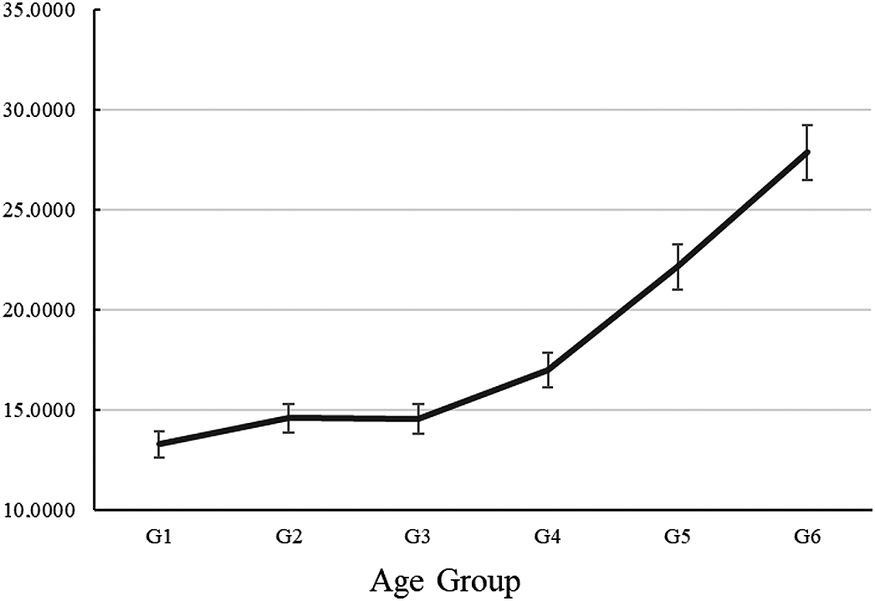
An effect of the Inverse Efficiency Index (IE) was observed with 32 distractors associated with age, F(5) = 16,494, p < .001, η 2p =.403. Comparisons between groups indicated no difference between G1, G2, G3, and G4. While G1, G2 and G3 showed differences with G5 and G6 (p < .001). Regarding G6, there were differences in the performance of selective attention with G1, G2, G3 and G4 (p < .001). In general, in the G4, G5 and G6 groups, a statistically significant decrease in performance was observed (an increase in the RT of IE) as age increased (see Figure 2).
Inverse Efficiency Index (IE) of Performance in Selective Attention (IE with 32 distractors) Discriminated by Age Group (Model 1)

Model 2
The results of Model 1 indicated that age had an effect on the IE index with 32 distractors, F(5) = 10,32; p < .01, R 2 = .34. In the second model, the processing speed and inhibitory control covariates were also added to analyze the effect of age on performance in selective attention. The results showed a significant effect on the differences associated with age, by independently controlling, on the one hand, the processing speed F(5) = 16,77; p < .01, R 2 = .12, and, on the other hand, the inhibitory control F(5) = 8,28; p = .01, R 2 = .06.
By controlling both covariates together, the effects associated with age disappeared. Analyses were used to determine the proportion of explained variance associated only with age, in the Processing speed task and in the inhibitory control index, before and after eliminating that variance, independently and jointly considering both covariates. The Attenuation index was used to compare the fit between Models 1 and 2, because very similar results were reported in Salthouse’s (Reference Salthouse1993) study (see Table 2).
Explained Variance (R2) Associated with Age in the Performance of Selective Attention with and without Control of Processing Speed and Inhibitory Control. Comparison between Model 1 and Model 2

Note. PS = Processing Speed; IC = Inhibitory Control.
aThe formula used for attenuation is [0.34 – 0.12] /0.34 = 0.64 and [0.34 – 0.06] /0.34 = 0.82
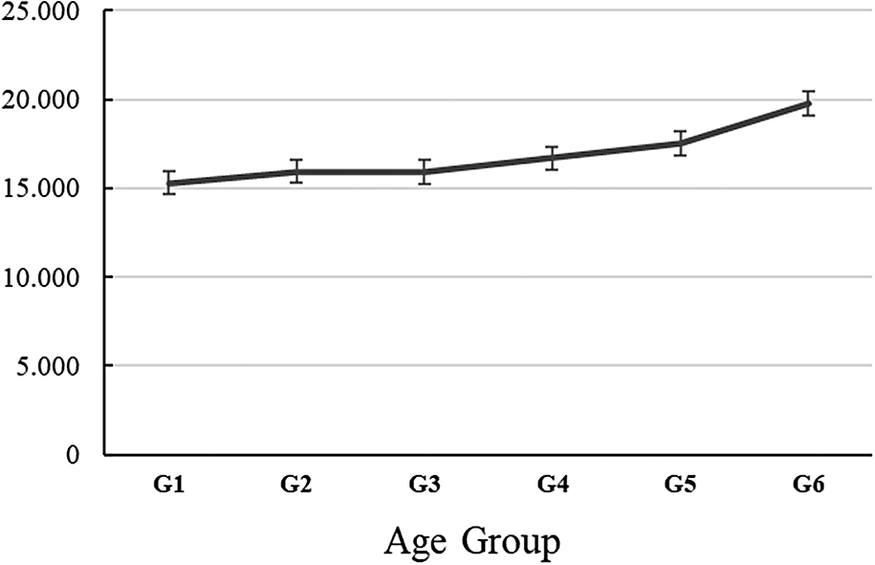
The results showed that, with the inclusion of the processing speed as a covariate, the significance of the interaction between performance in selective attention x age obtained in Model 1 was maintained. However, a decrease in the proportion of explained variance of 22% was presented. Regarding the inclusion of inhibitory control as a covariate, a greater decrease in the proportion of the explained variance of 28% was observed with respect to Model 1. Finally, with the inclusion of both covariates, the effects associated with age disappeared.
The results in Table 2 show that the effect of age on selective attention decreased by controlling the processing speed, inhibition, and both covariates together. Figure 3 shows the decrease in differences in selective attention between age groups when controlling for both covariates.
Inverse Efficiency Index (IE) of Performance in Selective Attention (IE with 32 distractors) Discriminated by Age Group, with Inclusion of Covariates: Processing Speed and Inhibitory Control (Model 2).

Discussion
The study has focused on the analysis of selective attention during different stages of adulthood. Specifically, the study has focused on two aspects: on the one hand, finding the developmental pattern associated with selective attention and, on the other, exploring the two main cognitive mechanisms postulated as candidates to explain the differences associated with age.
With respect to the trajectory of development of selective attention, the evidence obtained is congruent with the current literature that shows a gradual decrease in the efficacy of this function during adulthood. However, unlike what was reported by other studies (Hommel et al., Reference Hommel, Li and Li2004; McAvinue et al., Reference McAvinue, Habekost, Johnson, Kyllingsbæk, Vangkilde, Bundesen and Robertson2012; Trick & Enns, Reference Trick and Enns1998), the decline seems to start around the age of 60 and not in early adulthood, which corresponds to the interval between 20 and 30 years. When observing the performance of the different age groups in the conjunction search task, the results indicate that between 60 and 70 years of age selective attention presents a gradual decrease that continues to advance throughout the years. Taken as a whole, the data show that between the ages of 20 and 60 there are no substantial differences in selective visual attention, as the groups seem to behave in a homogeneous way in terms of performance. However, evidence shows that, from the age of 60, the groups begin to clearly differentiate. On the other hand, although a progressive decline in selective visual attention is observed around the age of 60, the differences between 60 and 70 are not significant. According to the obtained trend, it is probable that at the age of 80 there will be a substantial difference in performance compared to previous decades. So far, and since this study did not evaluate participants older than 80 years of age, we can only conclude that there is a relatively homogeneous performance among adults between 60 and 80 years of age. Regarding the age intervals used and the trajectory of selective attention during the life course, it would have been of interest to include adults older than 80 years and to form smaller intervals - of at least 5 years - as the latter would have allowed to reflect with greater precision interindividual variations in selective attention.
In summary, the evidence described above shows that there is a decrease or decline associated with age in the efficiency of selective attention. At this point, we ask ourselves how to explain these differences, that is, what are the main cognitive mechanisms that contribute to explaining them. To do this, two analysis models were compared: Model 1 and Model 2, with and without the inclusion of covariates. In general, the results of this comparison revealed that controlling for the effects of processing speed and inhibition separately maintains all the differences associated with age. On the contrary, when jointly controlling for inhibition and processing speed, the effect associated with age is no longer significant.
These results allow us to establish two main conclusions: First, that both the decrease in processing speed and the inhibitory efficiency contribute to the decline in selective attention. This is congruent with the findings obtained by Hommel et al.’s (Reference Hommel, Li and Li2004) study, where the contribution of both mechanisms to the decline in selective attention is reported. Like the authors, we did not ask which mechanisms carry more weight in the performance of the visual search task. In relation to this question, the analysis of the results suggests that inhibitory control plays a more relevant role than processing speed in explaining the differences associated with age in selective attention. Thus, when controlling for inhibition, it is observed that the effects of age are less with respect to the control of processing speed (see Table 2). This is consistent with the inhibitory inefficiency hypothesis that sustains that these differences largely explain variations in performance on complex tasks that require high cognitive effort (Hasher et al., Reference Hasher, Lustig, Zacks, Conway, Jarrold, Kane, Miyake and Towse2007). Furthermore, unlike Hommel et al.’s study, the evidence shows that the weight of inefficiency in inhibitory control is greater than the decrease in processing speed in explaining age-related differences in selective attention. Likewise, and in a manner consistent with other studies, it is observed that the progressive slowing down of the processing speed during aging contributes to the decline in selective attention (Hommel et al., Reference Hommel, Li and Li2004; Kail & Salthouse, Reference Kail and Salthouse1994; McAvinue et al., Reference McAvinue, Habekost, Johnson, Kyllingsbæk, Vangkilde, Bundesen and Robertson2012; Salthouse, Reference Salthouse1993; Trick & Enns, Reference Trick and Enns1998).
Second, it was found that by jointly controlling for the effect of processing speed and inhibition, age-related performance differences disappear. In other words, when controlling both cognitive mechanisms, the groups obtain similar levels of performance. This indicates that the variability between the groups in attention is mainly explained by a decrease in processing speed and inhibitory efficiency.
In summary, these results and conclusions suggest the need for future studies that further delve into the analysis of the role of processing speed and inhibitory control in explaining the differences in selective attention and other cognitive processes during adulthood. Clearly, the speed with which we carry out simple cognitive operations and the ability to decrease the activation of information or irrelevant environmental stimuli are essential cognitive mechanisms in explaining interindividual differences in selective visual attention. As expressed by Hasher et al. (Reference Hasher, Lustig, Zacks, Conway, Jarrold, Kane, Miyake and Towse2007), inhibitory control is relevant not only to explain the increase in attention during childhood but also the decrease that it experiences during adulthood and aging. This motivates the development of studies aimed at analyzing the role that these mechanisms play in different cognitive processes and in different developmental stages of life.