In recent years, obesity in childhood has had an increasing frequency. In children with heart disease, physical activity restrictions because of haemodynamics of existing pathology and parents’ concerns may result in these children to lead a more sedentary life. This matter may predispose to obesity. The rates for obesity among children with congenital and acquired heart disease in our country have not been reported. This study was conducted to determine the prevalence of obesity in children with heart disease and to identify groups, if they exist, at an increased risk.
Nowadays, obesity attracts the attention as a disease not only affecting the adult population but also as a serious public health problem in childhood and adolescence. While different rates of obesity have been established from various countries, ~17% of children aged 2–19 years in the United States of America are obese, with an additional 15% that are overweight.Reference Hedley, Ogden, Johnson, Carroll, Curtin and Flegal 1 Although many factors are known to tend to obesity, it has been predicted that children and adolescents with heart disease have tendency to obesity, particularly because of increased caloric intake and restricted physical activity. A limited number of studies exist on the prevalence of obesity in children with congenital and acquired heart disease.Reference Pinto, Marino and Wernovsky 2 – Reference Chen, Wang, Lue, Hua, Chang and Wu 4 The present study aimed to determine the prevalence of obesity among children with heart disease in the Kocaeli Region of Turkey.
Methods
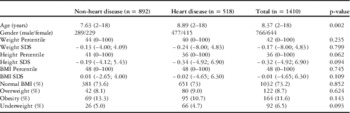
This study was conducted prospectively on 1410 children and adolescents who were admitted to the outpatient clinic of Kocaeli University School of Medicine’s Pediatric Cardiology Department from March, 2011 through March, 2013. Age, gender, height, weight, cardiac diagnosis, surgical status, and follow-up period of every patient were recorded. A total of 1410 children and adolescents who met the inclusion criteria were enrolled in the study. The study population composed of 518 children (289 boys, 229 girls) as control group and 892 children (477 boys, 415 girls) as heart disease group. Study population characteristics are described in Table 1.
Baseline characteristics of the total study population and subgroups.

BMI=body mass index; SDS=standard deviation score
The body mass index, calculated according to the patient’s most recent height and weight using the Quetelet Index [body mass index (kg/m2)=weight (kg)/height (m)Reference Pinto, Marino and Wernovsky 2 ], was plotted on the Turkish children growth charts for girls and boys aged 2–18 years to determine the body mass index percentile.Reference Kondolot, Balci and Ozturk 5 , Reference Ozturk, Mazicioglu and Hatipoglu 6 A body mass index below the 85th percentile was defined as normal, whereas a body mass index at the 85th percentile or higher was defined as overweight, and a body mass index at the 95th percentile or higher was defined as obese, underweight was defined as body mass index<5th percentile.Reference Barlow 7
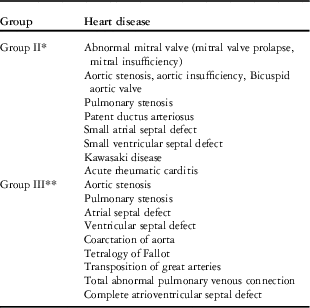
Patients were evaluated under four groups: Group I (n=518) designated as the control group and consisted primarily of patients referred to the cardiology clinic for evaluation of chest pain, palpitations, murmur, or family history of heart disease but found to have no any organic disease and arrhythmias; Group II (n=559) mild heart diseases that have not required either surgical or catheter intervention; Group III (n=145) diseases requiring a surgical or interventional procedure; and Group IV (n=188) arrhythmia. Children with any other chronic disease other than cardiac illness and those with genetic disorders such as Down syndrome and Marfan syndrome were excluded from the study. In addition, complex congenital heart diseases that could not have been completely repaired, those with single ventricular physiology, and the ones with ongoing haemodynamical problems were also not included into the study. Table 2 summarises the different types of congenital and acquired diseases affecting the patients in our study.
Different types of congenital and acquired heart diseases affecting the patients.

* Group II; mild heart diseases that have not required either surgical or catheter intervention
** Group III; diseases requiring a mild surgical or interventional procedure and diseases that were completely repaired after the operation such as tetralogy of Fallot, transposition of great arteries, and complete atrioventricular septal defect
An informed consent was obtained from patients and parents. The study was reviewed and approved by the institution’s committee on human experimentation.
Statistical analyses
χ2 test and Fisher’s exact test were used to analyse categorical data as appropriate. Summary statistics for continuous variables were reported as mean±standard deviation for normally distributed variables and as median and range for non-normally distributed variables. Student t-test and Mann–Whitney U tests were used where appropriate. For the analysis of relationships between two parameters, Pearson and Spearman correlation coefficients were assessed. Logistic regression analysis was used to examine the relationship between obesity and the variables of interest. Odds ratio with 95% confidence intervals were calculated to express the magnitude of the effect between obesity and the variables of interest. A p-value <0.05 was considered significant for all analysis. Statistical tests were conducted using SPSS software, version 16.0.2 (SPSS Inc, Chicago, Illinois, United States of America).
Results
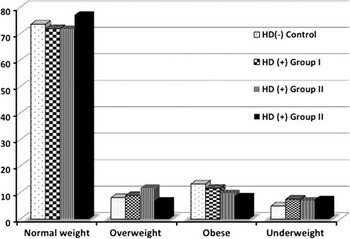
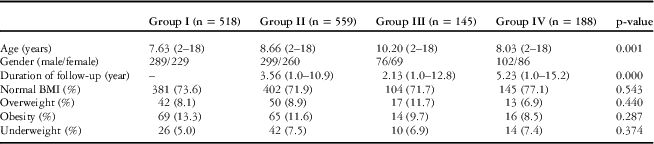
In our study, we did not detect an association between heart disease and obesity. There was no difference in the rates of overweight, obesity, and underweight between the healthy control subjects and patients with heart disease (p=ns) (Table 1). When patients with heart disease were divided into subgroups according to diagnostic categories, all groups had a similar prevalence of underweight, overweight, and obesity as the healthy control population (p=ns) (Table 3, Fig 1).
Distribution of body mass index class in the subgroups of heart disease and controls.

Age, gender, and BMI distribution according to subgroups of the heart disease and control groups.

BMI=body mass index
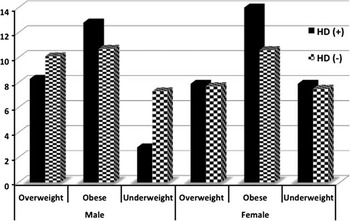
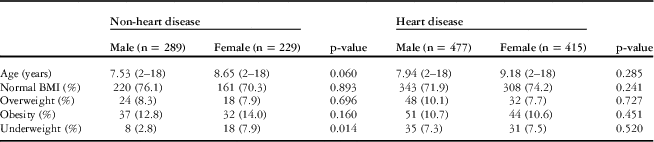
In the control group, body mass index percentiles were within normal range in 76.1% of male subjects and in 70.3% of female subjects, and there were similar rates in children with heart disease (Table 4, Fig 2). Within the heart disease population, the overall prevalence rates for overweight, obesity, and underweight were similar between the boys and girls (p=ns). Accordingly, the overall prevalence rates for overweight and obesity were similar between boys and girls within the non-heart disease population (p=ns). However, the underweight rates differed significantly between boys (2.8%) and girls (7.9%) with heart disease (p=0.014). We found that male subjects without heart disease have the lowest rates of underweight.
Prevalence rates of overweight, obesity, and underweight by sex.

Age and BMI distribution in male and female subjects of the heart disease and control groups.

BMI=body mass index
The mean of duration of follow-up was 4.70±3.76 (median 3.73, minimum 1, maximum 18) years. Although patients in the arrhythmia group have the longest follow-up period among all the subgroups, ratios of overweight, obesity, and underweight were not different from the other groups. Pearson correlation analysis showed a significant negative correlation between age and body mass index percentile (r=−0.129, p=0.000), and body mass index standard deviation score (r=−0.120, p=0.000) in control group and also patient with heart disease groups. In contrast, duration of follow-up was not correlated with body mass index percentile and body mass index standard deviation score (p=ns).
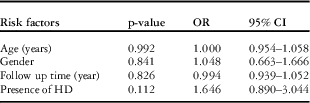
We used logistic regression analysis to determine the predictors of obesity. Age, gender, presence of heart disease, and duration of follow-up were not identified as risk factors for obesity (p=ns) (Table 5).
Logistic regression analysis of risk factors for obesity.

CI=confidence interval of 95%; HD=heart disease; OR=estimated relative risk showed by odds ratio
Discussion
Obesity, as in adult population, continues to be an important problem with regard to public health in childhood and adolescence. In recent years, tendency to obesity in otherwise healthy children has had an increasing trend. Coexistence of obesity in other paediatric age groups with various chronic diseases, such as chronic lung disease, end-stage renal disease, endocrine disorders, and oncologic disease, has been investigated. However, status of patients with heart disease has been much less studied that only a few studies have been reported previously. In 2005, Stefan et al demonstrated that children with congenital heart disease, whose exercises are restricted, are at risk for obesity.Reference Stefan, Hopman and Smythe 8 In 2007, the first large study to investigate obesity in children with congenital heart disease found that 26% of patients were overweight and obese.Reference Pinto, Marino and Wernovsky 2 After that, report of the national heart, lung, and blood institutes working group on obesity and cardiovascular risk factors in congenital heart disease was published in 2010.Reference Pemberton, McCrindle and Barkin 9 Until now, there have not been enough longitudinal data on weight trends in children with congenital heart disease. On this subject, the current study is one of the – two to three reported studies conducted on a large population.
In a study carried out in the Kocaeli Region in 2009, the overall prevalence of overweight and obesity in healthy children were reported as 11.5% and 6.8%, respectively.Reference Cizmecioglu, Etiler, Hamzaoglu and Hatun 10 In our study, rates of obesity in both healthy subjects and patients with heart disease were found to be higher than in the report in 2009 (13.3% and 10.7%, respectively). Overweight prevalence in both groups was 8.1% and 9.0%, respectively.
In the study by Pinto et al, the overall prevalence of obesity in patients with any heart disease was noted as 13.8%, and combined obesity and overweight was noted as 26.2%.Reference Pinto, Marino and Wernovsky 2 Shustek et al reported these rates as 12% and 27%, respectively. The overall rates in our study were similar (10.7% and 27%, respectively).Reference Shustak, McGuire, October, Phoon and Chun 3 As in studies by Pinto et al and Shustek et al, our study also found no difference in the prevalence of obesity or underweight between the control subjects and the heart disease group. It was reported only in the study by Pinto et al that univentricular heart group had much lower rates. In our study, such patients were not included.
Although the prevalence of overweight and obesity in both healthy children and patients with heart disease in our region is slightly lower than in developed countries, it is at a substantial level.
As it is seen today, children with heart disease have predisposition to obesity at least that their healthy peers have. When the negative effects of obesity on cardiovascular system are considered, potential problems will be particularly important to individuals with preexisting heart disease.
In our study, the degree of interference of body mass index, and therefore occurrence of obesity according to the diagnostic categories of heart disease was not found to be significantly different. The current study, including 850 patients with acquired or congenital heart disease or arrhythmia, allowed for comparison among different categories of paediatric heart disease. The prevalence rates of obesity were similar across all of these groups. Pinto et alReference Pinto, Marino and Wernovsky 2 found that patients with univentricular heart disease have the lowest rates of obesity. Shustak et alReference Shustak, McGuire, October, Phoon and Chun 3 also reported the same results. In our study, we could not analyse such group of patients, because patients with complex congenital heart disease and haemodynamically unstable cases were excluded from our study. There are also a few reports about specific congenital heart disease and obesity. Pasquali et alReference Pasquali, Marino and Pudusseri 11 reported that almost one-third of the patients aged 6–19 years who had operated with arterial switch operation and Ross procedure were overweight or obese.
In this study, no association was detected between gender and obesity in both the heart disease group and the control group. Shustak et alReference Shustak, McGuire, October, Phoon and Chun 3 found that, whereas rates of overweight within heart disease group were similar in both boys and girls, male patients with heart disease had higher rates of obesity than their female counterparts.
In our study, although rates of overweight and obesity in the arrhythmia group – Group IV – which had the longest follow-up period, seemed to be lower, the difference was not statistically significant. Furthermore, logistic regression analysis showed that the follow-up period had no effect on obesity. Other studies did not mention the follow-up period or the duration of disease. The impact of the follow-up period on obesity will be determined more clearly after periodical measurements were taken from diagnosed patients.
Besides obesity and overweight, the ratios of underweight were also searched by the current study and results showed no significant difference between healthy subjects and the haemodynamically stable patient group. The overall prevalence of underweight or obesity in patients with any heart disease was not found to be higher than the healthy counterparts. Chen et alReference Chen, Wang, Lue, Hua, Chang and Wu 4 reported a shift in body mass index distribution from more underweight and less overweight/obesity in Asian children and adolescents with congenital heart disease compared with healthy children. In their study, the ratio of underweight was found higher than our results. In our study, underweight was defined <5th percentile in contrast to 15th percentile as determined in the study by Chen et al. Thus, we think that the difference was resulted from the determination of underweight.
The impact of obesity on long-term outcomes of paediatric patients with heart disease is not exactly known. However, in specific heart disease groups, obesity-related problems such as endothelial dysfunction, hypertension will have more detrimental effects on morbidity and mortality.Reference Woo, Chook and Yu 12 , Reference Sorof and Daniels 13 Preventive measures regarding cardiovascular risk factors such as obesity, hypertension, and atherosclerosis in patients with congenital heart disease will decrease morbidity and mortality.
Stefan et alReference Stefan, Hopman and Smythe 8 noted that activity restriction in children with congenital heart disease was associated with the development of obesity. Even these children who were of normal weight at baseline became obese after their activity had been restricted. Physical activity restriction in children with heart disease is not only determined by physician recommendations, but may also be initiated by anxiety of parents, regardless of medical indication. Behavioural factors appear to influence inactivity more than the severity of the condition. Cheuk et alReference Cheuk, Wong, Choi, Chau and Cheung 14 found that 41% of parents were unable to identify their child’s activity restrictions often resulting in excessive limitations. Lunt et alReference Lunt, Briffa, Briffa and Ramsay 15 reported that fewer patients, particularly boys, are as vigorously active as their peers. To minimise such problems, if possible, physical activity restriction should be avoided and guidelines of American Heart Association and Bethesda conference should be taken into account in decision-making process. 16 If the limitation of physical activity is decided, individuals should be guided for diet and other measures. Lentzner at al reported that 63% of paediatric cardiologists discussed diet and nutrition with their parents and that even fewer discussed weight.Reference Lentzner, Connolly and Phoon 17 According to our experience, we suppose that this ratio is much lower in our country owing to the intensity of the patients.
As mentioned by Cohen M.S. in her review on obesity and congenital heart disease, children with congenital heart disease are not immune to the traditional risk factors for obesity such as genetic predisposition, sedentary behaviour, and poor diet habits.Reference Cohen 18 Furthermore, most of the children with heart disease survive into adulthood. Because a considerable rate of obesity is determined in patients with heart disease, paediatric cardiologists should dwell on this reality. Height, weight, and body mass index should be assessed during every outpatient visit and necessary instructions should be provided. If needed, suggestions on lifestyle changes should become a part of counselling.
Conclusions
Obesity in children with heart disease has high prevalence rates, at least as in healthy children in Kocaeli. Although long-term effect of obesity on cardiovascular health in patients with heart disease is not exactly known, it has possession of additional risks for cardiovascular morbidity. Therefore, besides recommendations and measures taken in healthy subjects, additional preventive modalities are needed in children with heart disease. Measures against obesity such as regular dietary habits, appropriate exercise programmes, and participation in physical activities should be important parts of the pediatric cardiologist’s care of children with cardiac disease.
Study limitations
In this study, patients with any heart disease who were followed up for at least 1 year were evaluated by using a single measurement. Body mass index measurements could not be taken periodically. Factors such as physical activity and socio-economic status that have effects on obesity could not be evaluated. The association between overweight/obesity and some of the complex congenital heart diseases has not been examined. Our control group consisted of children with palpitation who were found to have no arrhythmias in ECG and Holter recording. However, they might have had arrhythmias and these children may overlap with the ones in Group IV.
Acknowledgement
None.
Financial Support
This research received no specific grant from any funding agency, commercial, or not-for-profit sectors.
Conflicts of Interest
None.