
Introduction
In widely differing regions of the world, the shift from hunting and gathering to agro-pastoralism is accompanied by the appearance of impressive communal or ceremonial centres (Lavallée Reference Lavallée2000; Kaner Reference Kaner2007; Hastorf Reference Hastorf2008; Belfer-Cohen & Goring-Morris Reference Belfer-Cohen and Goring-Morris2010, Reference Belfer-Cohen and Goring-Morris2011; Cohen Reference Cohen2011; Schmidt Reference Schmidt2012; Stordeur Reference Stordeur2015). Despite its seemingly isolated location more than 2500m asl, at the southern tip of the Salar (salt flats) de Atacama, the small Tulán Valley is no exception. Intensive surveys and excavations have brought to light a local process of increasing sedentism, camelid domestication and small-scale horticulture that marks the transition from Late Archaic hunter-gatherers to the Early Formative communities. The partially excavated site of Tulán-52 (c. 3450–2250 BC), with its clustered stone structures and the earliest evidence for modest exploitation of domestic camelids in this area, has been considered a representative example of semi-sedentary Late Archaic residential settlements (de Souza et al. Reference de Souza, Cartajena, Núñez and Carrasco2010). Two and a half millennia later, the nearby ceremonial centre of Tulán-54 (c. 1250–650 BC) is considered to mark the culmination of a process of increasing social and ritual complexity (Núñez et al. Reference Núñez, Cartajena, Carrasco and de Souza2005, Reference Núñez, Grosjean and Cartajena2010; de Souza et al. Reference de Souza, Cartajena, Núñez and Carrasco2010; Núñez & Santoro Reference Núñez and Santoro2011; Cartajena Reference Cartajena2013). Tulán-54 has recently been described in detail (Núñez et al. Reference Núñez, Cartajena, Carrasco, López Mendoza, de Souza, Rivera, Santander and Loyola2017a & Reference Núñez, Cartajena, Carrasco, López, de Souza, Rivera and Santanderb); here we focus on the Late Archaic Period and, in particular, the site of Tulán-52.
Although many studies categorise sites as habitational or ceremonial, there are no universally agreed criteria to support this distinction (Aldenderfer Reference Aldenderfer1991; Barrowclough & Malone Reference Barrowclough and Malone2007). The interpretation of Tulán-54 as a ceremonial centre, or templete, has posed no problem considering its massive architectural features, neonate burials and offerings of gold and exotic materials from both the Amazonian and the Pacific regions. Conversely, the earlier site of Tulán-52, despite also having massive architecture, had no internal burials, lacked obvious ‘prestige goods’ and yielded numerous artefacts usually associated with domestic activities. It was therefore interpreted as a settlement site. Nevertheless, as we argue below, there are converging lines of evidence for the reinterpretation of Tulán-52 as a prototype of a ceremonial centre, defining, together with Tulán-54, a long-lasting and original tradition, specific to the Circumpuna de Atacama.
Tulán-52 would thus be one of the rare, long-duration ceremonial centres known among mobile hunter-gatherers of the Andes (Aldenderfer Reference Aldenderfer1991; Dillehay Reference Dillehay2011). Such sites invite reassessment of the Neolithisation process, as the social and ritual complexity that they document would constitute a driving factor rather than an outcome. In this respect, it would also align the Atacama transition from the Archaic to the Formative with those of other primary centres of Neolithisation around the world, despite its much later date and profoundly different environmental conditions.
The early prehistoric occupation of the Salar de Atacama
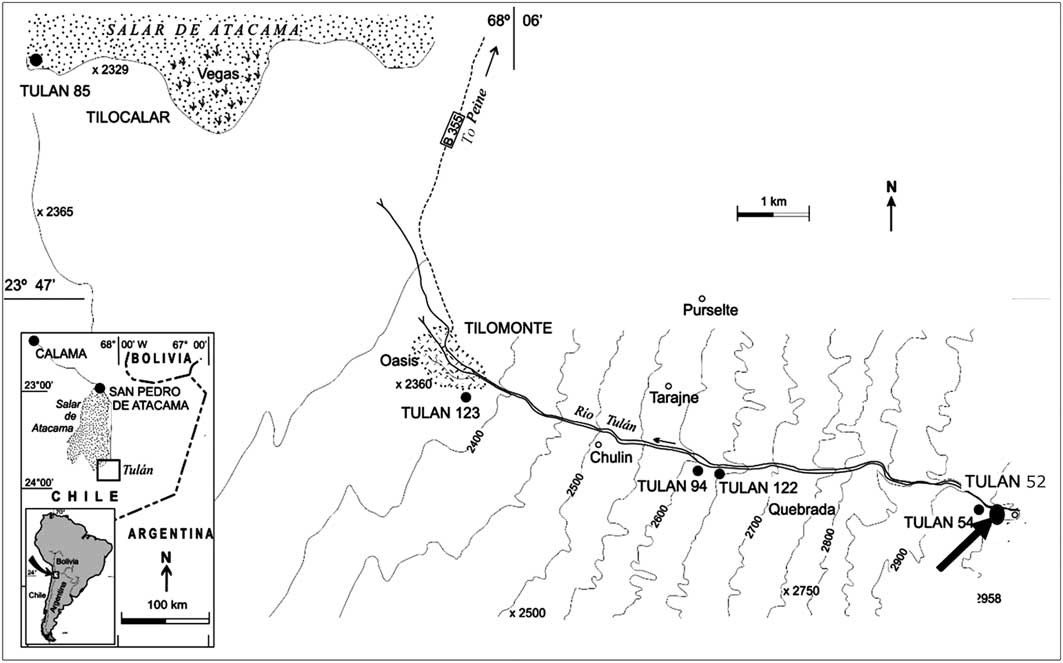
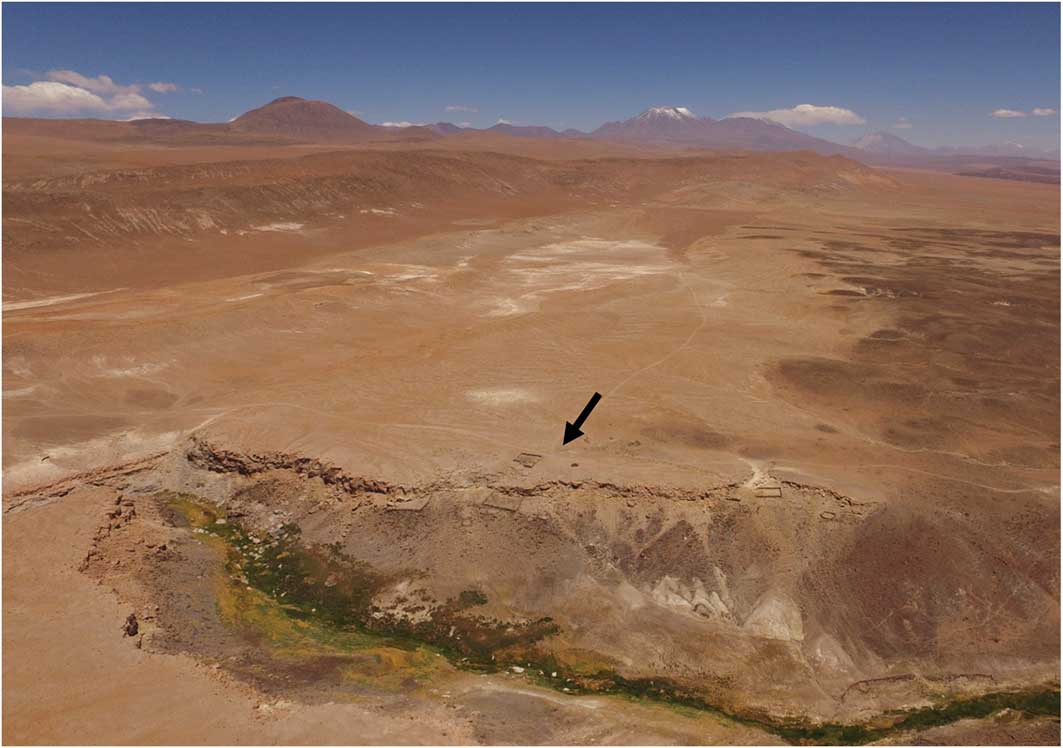
The area of Tulán, along the quebrada (ravine) of the same name (Figures 1–2), is located south-east of the Salar de Atacama, at more than 2500m asl, on the western slopes of the Puna de Atacama in the southern Andes (22–24° south). The Atacama Desert is one of the driest in the world, with current annual precipitation levels of less than 20mm in the Salar de Atacama, but reaching up to 2000mm on the Andean summits over 5000m asl (Núñez et al. Reference Núñez, Grosjean and Cartajena2002, Reference Núñez, Cartajena and Grosjean2013). The first human occupations date back to the Early Archaic Tuina phase (10 150–7150 BC), when the climate was much more humid, with rainfall estimated at approximately 200mm per annum (Geyh et al. Reference Geyh, Grosjean, Núñez and Schotterer1999; Grosjean et al. Reference Grosjean, Núñez and Cartajena2005, Reference Grosjean, Santoro, Thompson, Núñez and Standen2007). Mobile hunter-gatherers occupied caves and rockshelters, and exploited the intermediate ravines (3000–3600m), as well as the oases along the Salar de Atacama, and the palaeolakes of the high puna over 4000m asl. They hunted llamas (Lama guanicoe) and vicunas (Vicugna vicugna), deer, a Pleistocene equid, and they also gathered plants in the spring-fed ravines, meadows and lagoons.
Location of Tulán-52 and Tulán-54 (arrow) and other sites of the Early Formative period along the Quebrada Tulán basin and the Salar de Atacama.

Aerial view of the highlands of the Puna de Atacama and the fertile eco-refuge of Quebrada Tulán. The arrow indicates the location of Tulán-52 (photograph courtesy of Gonzalo Pimentel).

The following phase, known as Tambillo, is dated to c. 7050–6050 BC, but the apparent hiatus is certainly due to the hazards of 14C samples. During the Tambillo phase the exploitation of the high puna increased, but the longer-lived settlements mainly concentrated around wetlands and relict lagoons on the eastern edge of the present Salar de Atacama, where resources were available year-round. Hunting was focused on camelids—llamas and vicunas—while large mortars with characteristic conical depressions indicate intensive exploitation of wild fruits from native trees, such as the chañar (Goeffroea decorticans). Settlements comprised circular structures slightly sunken into the ground; the oldest-known cemetery in the region was uncovered at Tambillo-1, on the north-eastern side of the Salar de Atacama. Long-distance contacts are attested by the presence of obsidian from the Argentinian highlands, and by sea shells (Oliva peruviana) from the Pacific Ocean (Núñez & Santoro Reference Núñez and Santoro2011).
This dynamic towards semi-sedentary occupations and the specialised exploitation of particular plant and animal species, the usual pre-conditions of a Neolithisation process (Gebauer & Price Reference Gebauer and Price1992), appears to have been interrupted by the arid and unstable climatic pattern that started c. 7000 BC and lasted until c. 2500 BC. The severity and temporal extent of this episode is debated (Latorre et al. Reference Latorre, Betancourt, Rech, Quade, Holmgren, Placzek, Maldonado, Vuille and Rylander2005; Grosjean et al. Reference Grosjean, Santoro, Thompson, Núñez and Standen2007; Núñez et al. Reference Núñez, Cartajena and Grosjean2013), and the Mid Holocene climatic variability of the Atacama appears complex and heterogeneous, with rapid short-term fluctuations between wet and arid conditions (Grosjean et al. Reference Grosjean, Cartajena, Geyh and Núñez2003; Latorre et al. Reference Latorre, Betancourt, Rylander, Quade and Matthei2003; Rech et al. Reference Rech, Pigati, Quade and Betancourt2003). Nevertheless, the palaeolakes of the altiplano (high plateaux) dwindled, and most Tuina and Tambillo settlements were abandoned. Sterile layers filled caves and rockshelters, and there appears to have been a sharp decrease in settlement density. The period corresponds to what has been termed the ‘archaeological silence’ (Núñez et al. Reference Núñez, Grosjean and Cartajena2002, Reference Núñez, Cartajena and Grosjean2013). Conversely, these environmental conditions also led to the creation of localised eco-refuges. North of the Salar de Atacama, the natural damming of a lateral stream created shallow lakes and meadows in the Puripica area. To the south, the flow of the Tulán stream changed from intermittent to perennial, and new grazing areas were created as falling water levels transformed the Miscanti Lake, located at 4120m asl above the quebrada, into a wetland (Núñez et al. Reference Núñez, Grosjean and Cartajena1999; Grosjean et al. Reference Grosjean, Santoro, Thompson, Núñez and Standen2007; Núñez et al. Reference Núñez, Loyola, Cartajena, López, Santander, Maldonaldo, de Souza and Carrasco2018).
Resources in these eco-refuges may have been limited in variety, but they were sufficiently abundant to permit recurrent occupations and progressive cultural transformations that are well documented at Puripica-1 (c. 3350 cal BC) in the quebrada of the same name, some 25km north of the Salar de Atacama (Grosjean et al. Reference Grosjean, Núñez, Cartajena and Messerli1997, Reference Grosjean, Santoro, Thompson, Núñez and Standen2007). By the Late Archaic (c. 3650–2250 BC), semi-sedentary settlements of circular and sub-circular dwellings, built on stone foundation walls, were established in the two quebradas of Vilama (Agüero & Uribe Reference Agüero and Uribe2011) and Puripica north of the Salar, and in the Tulán area to the south (Núñez et al. Reference Núñez, Grosjean and Cartajena1999, Reference Núñez, Grosjean and Cartajena2010; Núñez & Santoro Reference Núñez and Santoro2011). Some structures were associated with large boulders engraved with representations of camelids. The settlements of this ‘Puripica-Tulán’ phase are located between 2000 and 3000m asl in the quebradas, or by perennial springs and around high-altitude wetlands, where plant and animal resources were concentrated. The lithic toolkit was more diversified than before and included numerous borers for the production of beads. The use of exotic raw materials such as obsidian indicates mobility towards the high puna, while the presence of numerous shells from the Pacific Ocean demonstrates contacts with the coast. Large and small camelids were widely hunted, but a decrease in their median size and increased variability among the larger specimens, which cannot be related to climatic factors, suggest that some domestic llamas (Lama glama) were already present (Cartajena Reference Cartajena2009, Reference Cartajena2013). This interpretation is reinforced by the presence at Puripica-1 of pathological bones that only belong to the larger camelids, and indicate that the animals were kept in captivity (Cartajena et al. Reference Cartajena, Núñez and Grosjean2007: 165–66). Large conical mortars, inherited from the Tambillo phase, testify to the continued use of plant resources, as well as the first evidence for pigment processing. The presence at Tulán-52, in the more recent levels of the Puripica-Tulán phase, of gourd remains (Lagenaria sp.) shows that, in parallel with the incipient domestication of camelids, some horticulture started to be practised (Núñez & Santoro Reference Núñez and Santoro2011).
During the following, Early Formative Tarajne phase (c. 1850/1650–1160 BC), when pottery was first introduced, herding and horticulture were well established, although vicunas were still actively hunted. Soon after, the more humid conditions that prevailed during the Tilocalar phase (c. 1150–550/430 BC) led to an improvement of the pre-Andean wetlands and expansion of high-altitude lakes. In turn, the increased availability of water led to widespread reoccupation of the whole area, beyond the eco-refuges, with complementary exploitation of all their resources (Grosjean et al. Reference Grosjean, Santoro, Thompson, Núñez and Standen2007; Núñez & Santoro Reference Núñez and Santoro2011). Small-scale horticulture of maize (Zea mays), quinoa (Chenopodium quinoa), oca (Oxalis tuberosum), chillies (Capsicum sp.) and cucurbits (Cucurbita sp.) was now being practised in the bottoms of the quebradas, but did not supersede the exploitation of wild plant resources in economic importance (Núñez et al. Reference Núñez, McRostie and Cartajena2009). Mining and copper and gold metallurgy, along with the appearance of monochrome ceramics, the bow and arrow, and coiled basketry, constitute other innovations introduced by these first Early Formative pastoralists, and led to the production of rare ‘prestige goods’ (infra, Tulán-54). The location of the settlements and basic architectural conception were similar to those of the Puripica-Tulán phase, but the settlements were denser (Núñez et al. Reference Núñez, Cartajena, Carrasco, de Souza and Grosjean2006a; Adán & Urbina Reference Adán and Urbina2007; Agüero & Uribe Reference Agüero and Uribe2011). Large-scale naturalistic rock art, mainly depicting camelids, also appears at this time in the quebradas (Núñez et al. Reference Núñez, Cartajena, Carrasco, de Souza and Grosjean2006b).
Tulán-54: an archetypal ceremonial centre
Tulán-54 (Núñez et al. Reference Núñez, Cartajena, Carrasco, López Mendoza, de Souza, Rivera, Santander and Loyola2017a & Reference Núñez, Cartajena, Carrasco, López, de Souza, Rivera and Santanderb) has all the diagnostic characteristics of a fully developed ceremonial centre of the Early Formative in the Salar de Atacama region. These include a large and specific type of architecture that required considerable expenditure of energy for its design, construction and maintenance, along with significant evidence for food preparation and consumption, the production of personal ornaments, and deposits of high value.
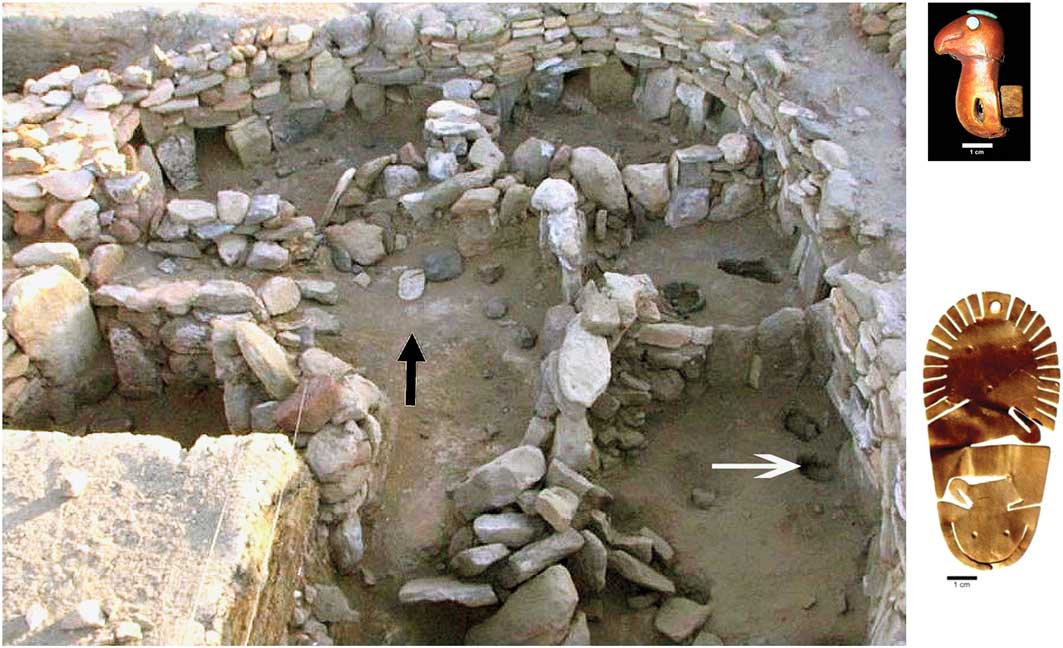
The central, semi-subterranean precinct of the templete, surrounded by various complementary structures of ritual use, was erected between 1110–900 BC, and remained in use until 550–360 BC (Núñez et al. Reference Núñez, Cartajena, Carrasco and de Souza2005, Reference Núñez, Cartajena, Carrasco, López Mendoza, de Souza, Rivera, Santander and Loyola2017a & Reference Núñez, Cartajena, Carrasco, López, de Souza, Rivera and Santanderb; Núñez & Santoro Reference Núñez and Santoro2011). It was delimited by a sturdy, oval-shaped wall, of large vertical slabs overlaid by layers of small horizontal slabs. The wall included several niches, framed with large vertical pillars and lintels. The internal area was divided into smaller rooms by radiating walls joining a central sub-circular chamber, from where the richest offerings were uncovered (Figure 3).
Partial view of the templete at Tulán-54 in its setting and details of the structures. The black arrow indicates the location of the infant burial with the gold plaque (to the right). The white arrow marks the infant burial pit with the golden-plated head of a vulture, with inlaid malachite eyes and crest.
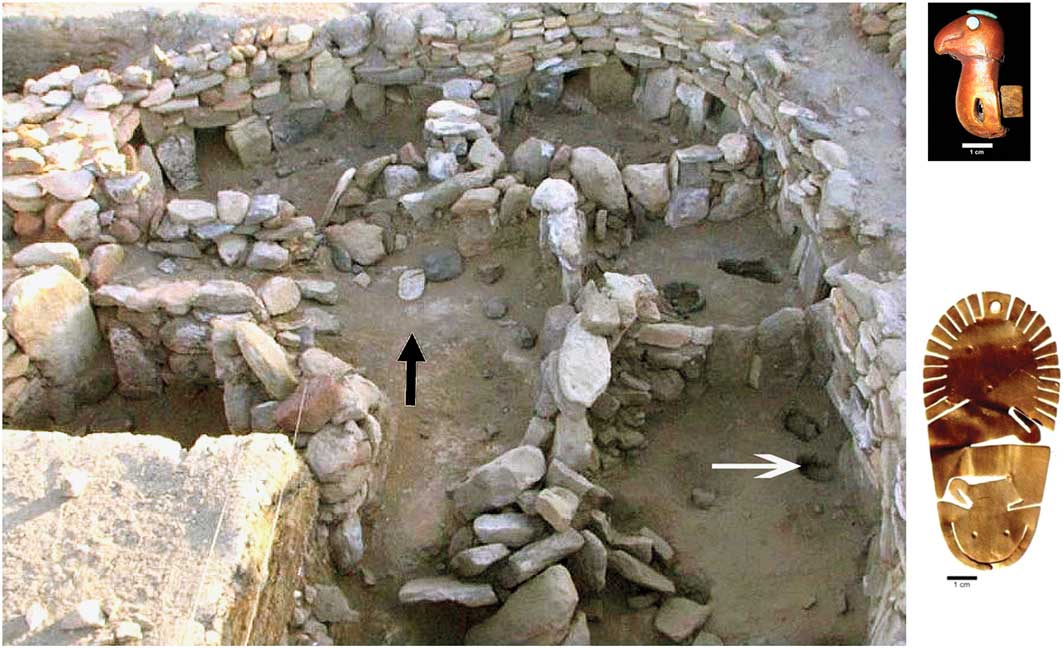
The floors of the different rooms contained 10 hearths delimited by carefully laid fragments of ground stones, associated with pits, and 28 richly endowed infant pit-burials at the base of the niches. In particular, two of the four burials in the central structure contained large and elaborately manufactured anthropomorphic gold pendants, while a burial from a peripheral structure was associated with a gold-plated wooden vulture head with inlaid green malachite eyes and crest, radiocarbon dated to 690–540 cal BC (Richardin et al. Reference Richardin, Herault and Mussard2017) (Figure 3).
Repeated combustion activities took place above these ceremonial burial foundation offerings, especially in the central chamber. This led to microstratified deposits along with redeposited secondary waste, rich in ash and charcoal, camelid bones, lithic material, sherds of local and non-local pottery, red pigment, copper mineral and shells. In addition, some 5000 drills used in bead manufacture, along with fragments of copper oxides and numerous beads, show that ornament production, a seemingly domestic activity, was also directly related to the ceremonial centre. Numerous mortars and grinding slabs attest to the intense preparation of pigments, foodstuffs and beverages, as well as hallucinogens made from the seeds of cebil (Anadenanthera sp.) and maize (Zea mays), both imported from the lowlands of north-east Argentina (Núñez et al. Reference Núñez, McRostie and Cartajena2009). Finally, in the last period of use, the cemetery of Tulán-58 was established just 50m away. The burial positions of adult and neonate inhumations show a mix of Archaic and later Formative traditions, corresponding possibly to groups from different areas of the Tulán region (Núñez et al. Reference Núñez, Cartajena, Carrasco, de Souza and Grosjean2006a: 107).
Reconsidering Tulán-52: a prototype of ceremonial centres
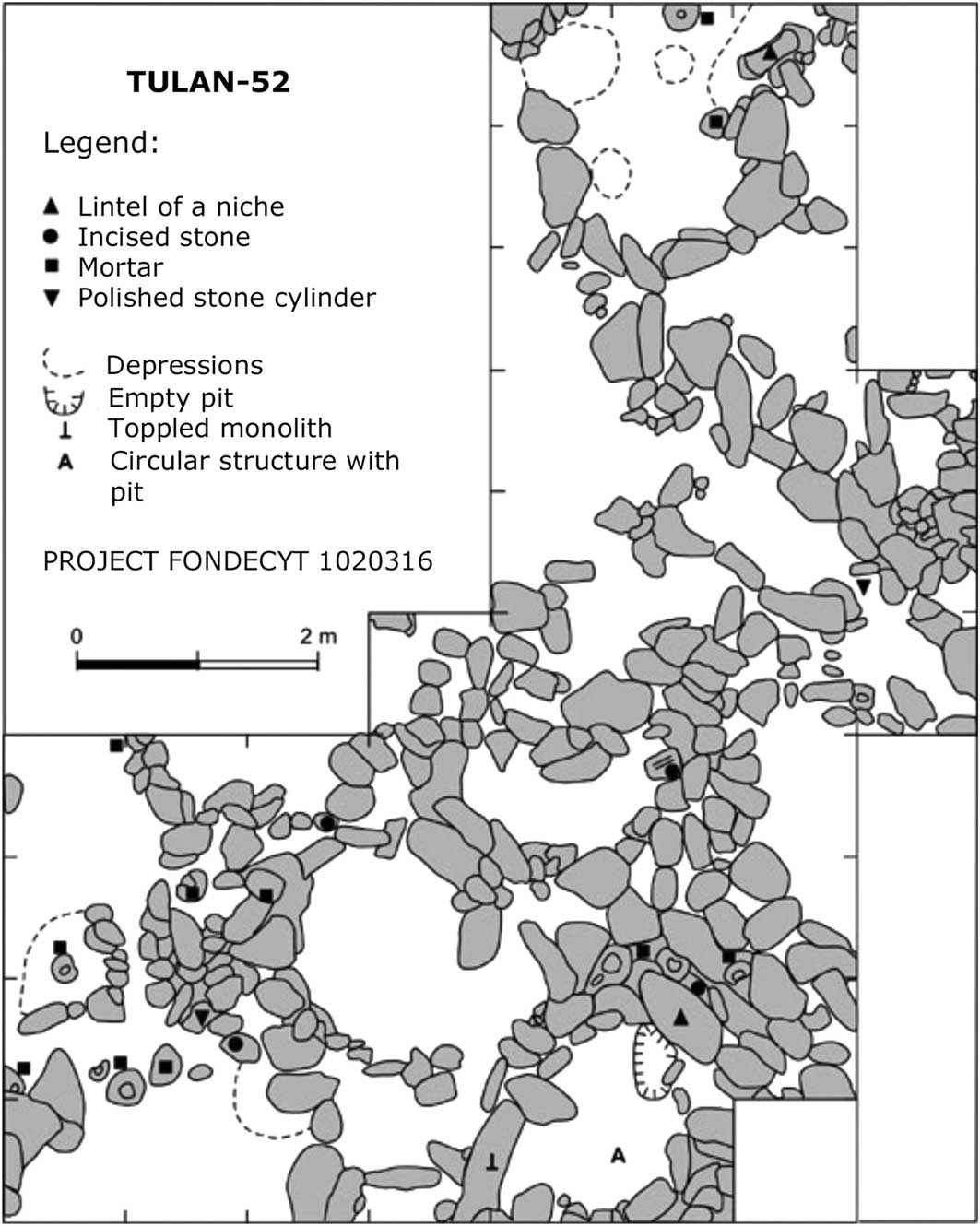
The earlier site of Tulán-52 is located 1km upstream from Tulán-54, also overlooking the Tulán quebrada and in a similar setting, at 2969m asl. It appeared as a low mound, about 1.3m above the ground, covered with eroding fireplaces, lithics and animal bones. Excavations through to 1985 uncovered 50m2 of an estimated total site area of no more than 90m2 (Figure 4). Test pits on the periphery showed that no domestic structures surrounded the main building.
Plan of the stone structures at the centre of the Tulán-52 site.

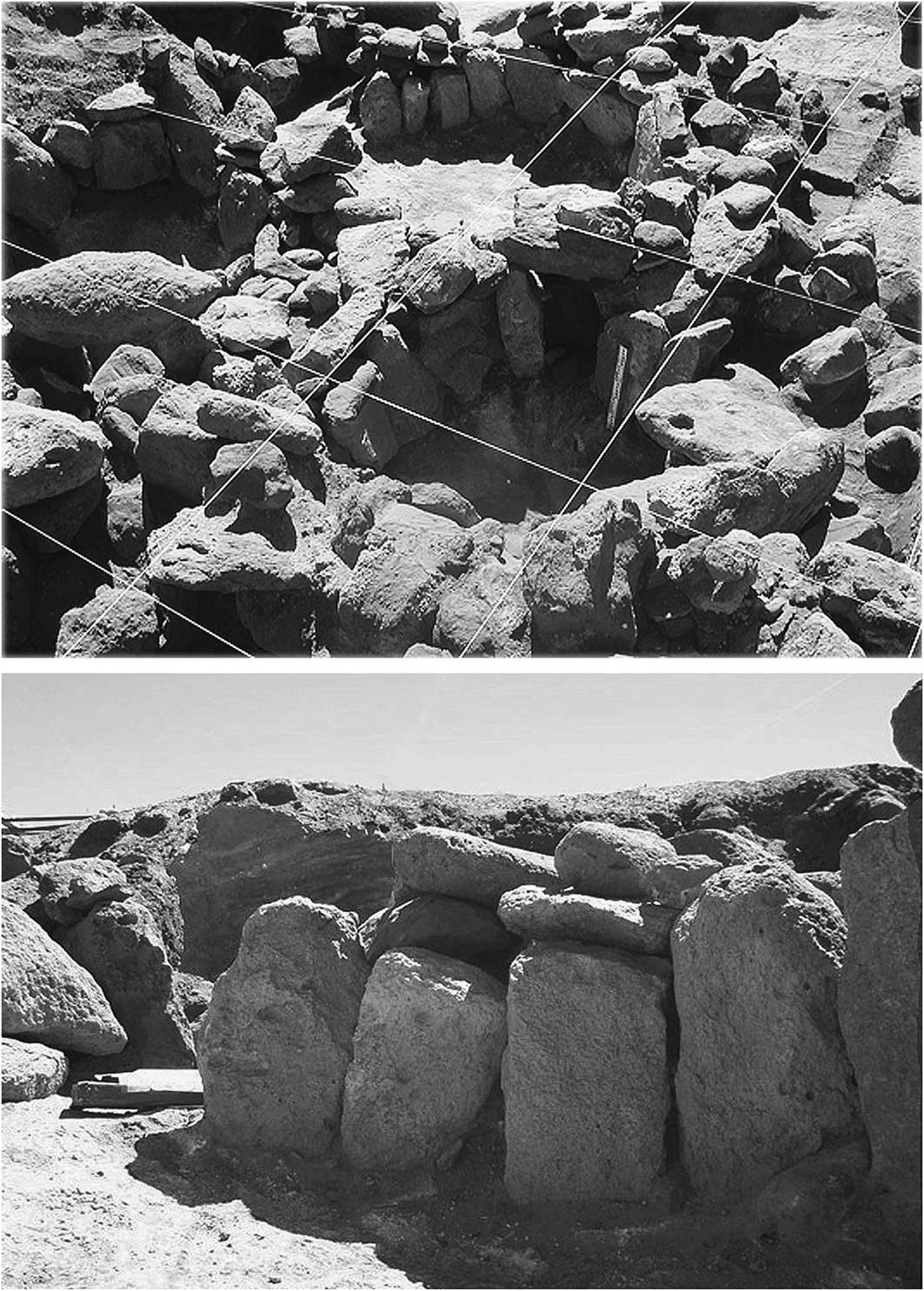
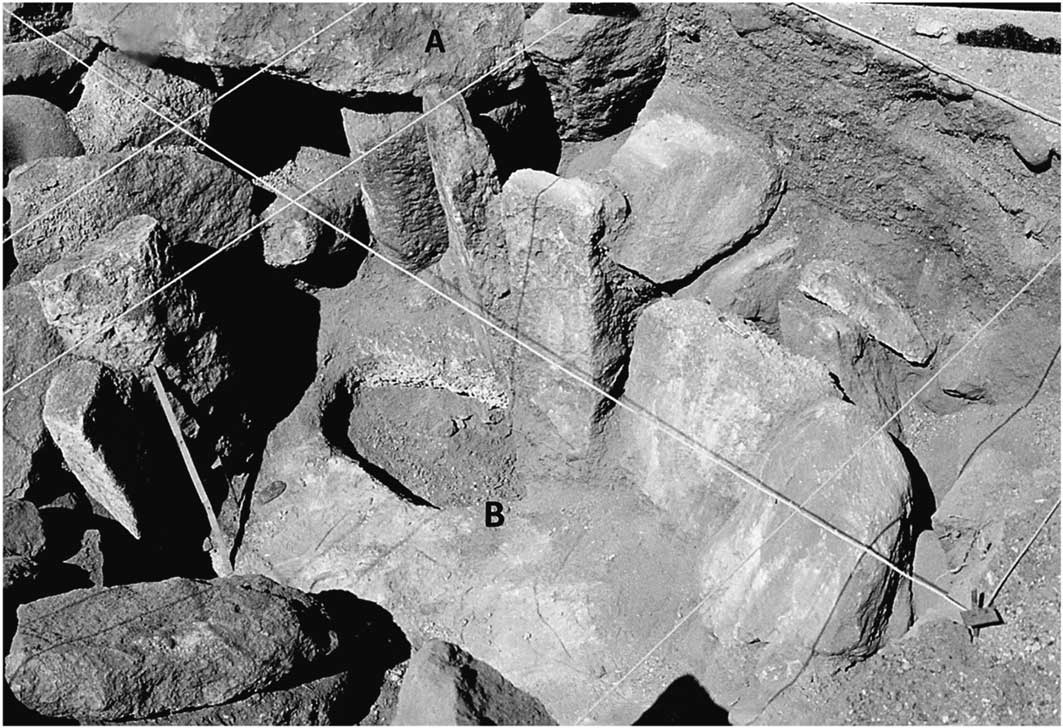
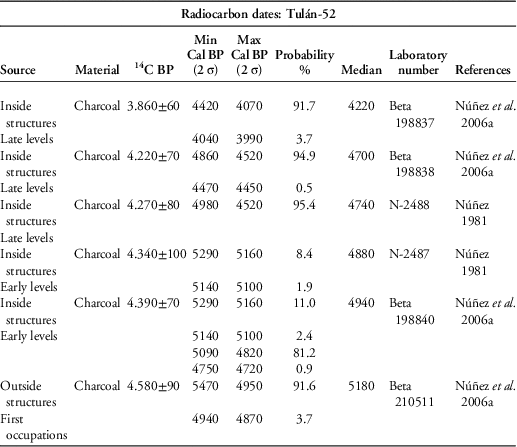
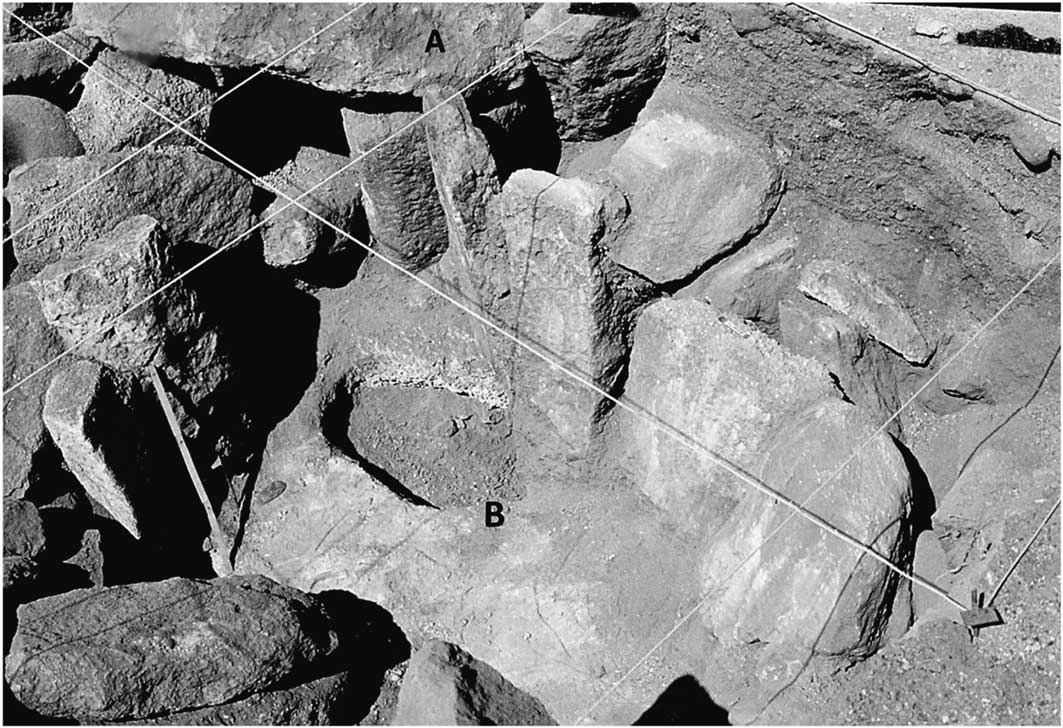
The site was first occupied c. 3000 BC, before the first structures were erected; it was abandoned c. 2200 BC (Table 1). Excavation has revealed several semi-subterranean agglomerated structures, built with large vertical slabs up to 1.5m in height, sometimes slightly shaped by flaking to fit, and topped with large horizontal slabs (Figure 5). Several niches with pillars and lintels were incorporated in the walls. Depressions were dug in the floors and a pit, 0.5m in diameter, contained a block with linear incisions, analogous to engraved slabs from Puripica 1 and Tulán-54. The pit was clearly associated with one of the niches (Figure 6). As at Tulán-54, these stone structures were progressively filled and covered with thick deposits resulting from repeated and intensive food-preparation and -consumption activities, stone knapping, pigment processing and bead production (de Souza et al. Reference de Souza, Cartajena, Núñez and Carrasco2010).
General view of the Tulán-52 structures and detail of a wall with large vertical building slabs topped by horizontal ones. The stratigraphic profile of the mound that covered the site is visible in the background.

Detail of the north-eastern cell during excavation, showing a niche capped by a lintel (A) and an empty pit dug into the floor (B).
Radiocarbon dates for Tulán-52. Calibration using OxCal 4.2, curve SHCal13 (Hogg et al. Reference Hogg, Hua, Blackwell, Niu, Buck, Guilderson, Heaton, Palmer, Reimer, Reimer, Turney and Zimmerman2013).

This fill of the stone structures was rich in the bones of camelids, which, considering the size of the meat cuts, were possibly linked with feasting ceremonies (Twiss Reference Twiss2008). As indicated above, the increasing variability in the size of the larger camelids suggests that some domestic llamas were already present, although the bulk of the meat came from hunting vicunas. In parallel to this, the remains of gourds in the latest deposits attest to incipient horticulture. Raw materials for flaked stone tools primarily consisted of local tuffs and local siliceous rocks, but also obsidian, which amounts to >25 per cent of the artefacts. Numerous lithic preforms, retouch flakes and finished artefacts indicate the in situ production of foliate and lanceolate projectile points. As at Tulán-54, borers are abundant and even dominate the lithic assemblage outside the central precinct. Wear-traces analysis indicates that they were also associated with the production of ornaments, primarily made from shells, but also bone and copper oxides.
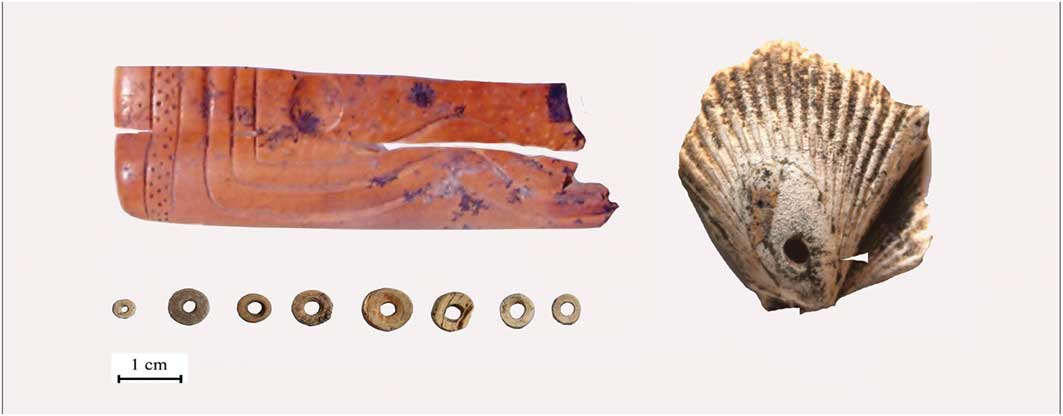
A number of the finds constitute innovations in this chronological context, including a large stone polished cylinder, a bone with pyrographic engraving (Figure 7), bifacial tanged points, the abundance of drills and bead production on a large scale. These represent the first manifestations of traditions that matured during the Formative period. Wide-ranging exchange networks are attested by exotic goods: chonta palm wood (Astrocaryum chonta), obsidian from at least 100–150km away in Argentina, shells from the Pacific coast (Oliva peruviana and Pecten purpuratus) and imported (as well as local) copper oxides (Figure 7).
Tulán-52: fragment of a bone artefact with pyro-engraved designs (left), pectoral ornament made from a scallop shell (Pecten sp.) from the Pacific Ocean (right), and stone and shell beads (lower left).

As indicated above, Tulán-52 had previously been interpreted as a small residential settlement composed of agglomerated semi-subterranean dwellings (de Souza et al. Reference de Souza, Cartajena, Núñez and Carrasco2010; Núñez & Santoro Reference Núñez and Santoro2011). Several observations, however, lead us to suggest now that it too was a ceremonial centre rather than a residential locus. Despite the absence of infant burials, hearths surrounded by stones, figurative rock art or elaborate offerings, the site shares many structural and functional features with Tulán-54:
a) The stone constructions at both sites were built at locations with evidence for earlier activity but which lacked domestic structures.
b) The stone structures share similar basic construction patterns with vertical slabs embedded in sterile ground or over earlier occupational refuse. At both sites, the structures are built with large vertical and capping slabs, up to 1.5m in height.
c) Both sites have an ‘agglomerated’ building plan, but whereas Tulán-54 had a large internal space divided by radiating walls, Tulán-52 created a similarly partitioned space by tightly clustering several round stone cells; this agglomerated arrangement distinguishes Tulán-52 from contemporaneous Late Archaic settlements.
d) Niches framed with pillars and lintels—a feature considered typical of Andean Archaic and Formative ceremonial buildings (Núñez et al. Reference Núñez, Cartajena, Carrasco and de Souza2005: 309), and not found in residential structures—are found at both sites.
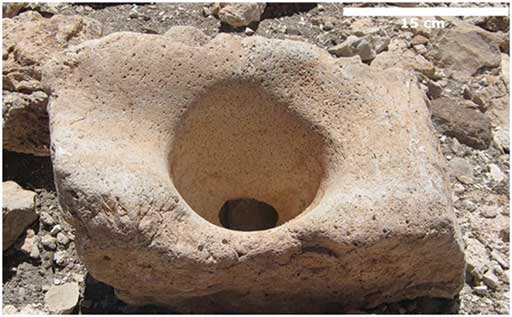
e) A high proportion of the mortars and grinding stones from both sites are associated with deposits of red pigment (staining and small fragments)—probably iron oxides. The conical mortars, inherited from the Tambillo phase (Figure 8), are frequently found broken in two, even when the depression is relatively shallow, raising the possibility of intentional breakage.
f) The long duration of activity at both complexes differentiates them from more typically short-lived residential structures; as with Tulán-54, Tulán-52 was periodically reoccupied over several hundred years.
g) The progressive covering and hiding of the stone structures at both sites by thick deposits resulting from craft production and food preparation and consumption, despite the labour that their construction had required, is possibly one of the most significant common features, and clearly differentiates them from domestic settlements.
h) Late Archaic settlements are indeed known from the northern Salar de Atacama (Núñez et al. Reference Núñez, Grosjean and Cartajena1999, Reference Núñez, Cartajena, Carrasco, de Souza and Grosjean2006a; Agüero & Uribe Reference Agüero and Uribe2011: 56), but differ from Tulán-52. The stone-based circular dwellings are dispersed, not agglomerated; the walls are lower in height and would have been far less demanding in terms of building time and technical expertise (see Agüero & Uribe Reference Agüero and Uribe2011: fig. 5). The size of the internal spaces at Tulán-52 also precludes a domestic function: the two best-defined structures are very small, with diameters between 1.4 and 2m; domestic structures at Puripica-1 or at Ghatchi 2C, on the Vilana quebrada, measure 4–5m in diameter.
Mortar with worn-down conical hole from Tulán-52.

Discussion
Tulán-52 shares many features with Tulán-54 and can therefore be considered an early instance of an aggregation site, far from any settlement, around a ceremonial complex where social interaction and ritual took place alongside intensive production activities. The development of ceremonial precincts in the Salar de Atacama region, previously considered to date to the Early Formative period (Adán & Urbina Reference Adán and Urbina2007; Núñez & Santoro Reference Núñez and Santoro2011), should therefore be pushed back two millennia, and attributed to the last hunter-gatherers of the Late Archaic period. The construction of ceremonial centres can no longer be viewed as the outcome of growing social complexity driven by increasingly dynamic pastoralism and the use of camelids for long-distance exchange. On the contrary, the appearance of those ceremonial centres was a major driving factor for these social and economic developments.
This process may actually have been initiated even earlier, in the Tambillo phase, when semi-sedentism is suggested by the partially dug dwellings, the appearance of heavy stone mortars and the presence of cemeteries. It is also the period during which long-distance trade to the east and west is first attested by the importation of obsidian and sea shells. This process would have been interrupted, however, by the aridity of the Mid Holocene climatic episode, which led to a marked depopulation and an economic reorganisation centred on restricted eco-refuges. When a certain demographic threshold was reached, socio-political re-organisation was required to cope with the larger communities constrained to these areas. The period during which Tulán-52 was in use witnessed the rising importance of ritual practices and ceremonies that developed as an answer to these problems (Dunbar Reference Dunbar2013; Feinman Reference Feinman2016).
The amount of work implied by the transport of the slabs and the construction of the proto-templete suggest the control and provisioning of taskforces by leaders, possibly belonging to a religious elite (Carballo et al. Reference Carballo, Roscoe and Feinman2014; Hadad Reference Hadad2014; Stordeur Reference Stordeur2015). Accordingly, some form of social complexity, understood as functional differentiation among social units (Feinman Reference Feinman2013), was already present. There is no evidence, however, that this necessarily corresponded to a hierarchical organisation (Price & Brown Reference Price and Brown1985; contra Artusson et al. Reference Artusson, Earle and Brown2016). On the contrary, Kelly’s ethnographic survey of hunter-gatherers shows that no hierarchically organised societies erected collective monuments (Kelly Reference Kelly1995). Collective monumental ceremonial spaces (as opposed to lavishly endowed elite burials) appear to be characteristic of heterarchical societies, organised along collaborative and corporate systems, where power is shared and does not lead to the individual accumulation of wealth (Ehrenreich et al. Reference Ehrenreich, Crumley and Levy1995; Feinman Reference Feinman1995, Reference Feinman2016: 7; Blanton et al. Reference Blanton, Feinman, Kowalevski and Peregrine1996).
It can be surmised, therefore, that the major innovations which took place during the two millennia that separate Tulán-52 from Tulán-54—such as the increasing use of domestic camelids for long-distance transport, plant cultivation, use of hallucinogens, pottery and gold metallurgy—primarily served the needs of increasingly elaborate rituals and demanding elites. Indeed, considering the very slow increase in the consumption of domestic plants and camelids between the Puripica-Tulán and Tilocalar phases, alongside the continuing importance of wild plant and animal species during the later phase, it is clear that subsistence needs were not the primary factor of this ‘Neolithisation’ process.
Evidence for ritual complexity in Archaic hunter-gatherer societies has already been documented elsewhere in the Andes (Aldenderfer Reference Aldenderfer1991; Dillehay Reference Dillehay2011; Marquet et al. Reference Marquet, Santoro, Latorre, Standen, Abades, Rivadeina, Arriaza and Hochberg2012), but Tulán-52 is a unique instance of early monumentalism. Similarly, the architectonic conception of Tulán-54 is unparalleled amongst Andean Preceramic and Early Formative ceremonial centres (e.g. Caral, Kotosh Mito, La Galgala, Bandurria; see Lavallée Reference Lavallée2000: fig. 30). The similarities with Tulán-52 demonstrate that it was the outcome of an original tradition of the Circumpuna de Atacama, in a Neolithisation process later than, but independent from, that of the Central Andes.
Monumentalism associated with hunter-gatherers, both mobile and sedentary, is documented in other regions of the world, such as the North American Archaic Midwest, the Near East, Japan and China, where ceremonial centres precede the adoption of fully agropastoral economies. The Tulán area thus constitutes yet another example to support the view that social complexity was not the outcome of economic mutations, but rather the base on which the latter developed.
Acknowledgements
Fieldwork on the region of Tulán was made possible thanks to the collaboration of the Atacameña community of Peine and all colleagues of the Tulán teams. It was supported by Fondecyt grants (Fondecyt 1930022, 1020316, 1070040, 1130917) and by project NGS-5836-96. The collaboration between the French UMR 7055 and the Institute of Archaeology, Anthropology and the Museum at the Universidad Católica del Norte is supported by the PICS ‘Approche technologique des sites des derniers chasseurs-cueilleurs et premiers agro-pasteurs du Salar d’Atacama (Chili)’ and the LIA-Mines ‘Archéologie, histoire et anthropologie des systèmes miniers dans le désert d’Atacama’. We wish especially to thank the collaborators who studied and published Tulán-52, as well as an anonymous reviewer who suggested interesting new perspectives that we hope to explore in the future.