Introduction
The successful parasitization is related primarily to the suitability of a given host for the parasitoid, where, as first defined by Salt (Reference Salt1938), a suitable host is defined as one on which the parasitoid can generally produce fertile offspring. Later, Doutt (Reference Doutt1959) proposed that two steps, host acceptance and parasitoid offspring development in the host, better reflect host suitability to a given parasitoid. Vinson (Reference Vinson1976) and Vinson & Iwantsch (Reference Vinson and Iwantsch1980) reviewed the suitability of hosts by analyzing host acceptance and the development of parasitoid progeny, respectively. Larval parasitoids do not have enough time to determine the host quality when they encounter a strong response from host larva. In contrast, as egg parasitoids, Trichogramma have sufficient time to evaluate the host suitability before they oviposit in the host egg. The examination of suitability of a putative host by a Trichogramma wasp occurs at two steps: external examination with appendages including antenna, ovipositor and legs and internal examination with ovipositor. The suitability of host eggs affects the oviposition preferences of female Trichogramma, which may refuse to insert her ovipositor into unsuitable host eggs. Moreover, one ovipositor pierce does not necessarily result in an egg laid in a non-suitable host egg (Pavlík, Reference Pavlík1993; Babendreier et al., Reference Babendreier, Rostas, Hofte, Kuske and Bigler2003). Studies have indicated that an experienced Trichogramma will generally refuse to oviposit in unsuitable host eggs such as eggs previously parasitized by itself or other individuals (van Dijken & Waage, Reference van Dijken and Waage1987; Liu & He, Reference Liu, He, Wajnberg and Vinson1991; Wang et al., Reference Wang, Lu, He, Shi, Tu and Gu2016), eggs in which the host embryo has developed past a certain stage (Ruberson & Kring, Reference Ruberson and Kring1993; Godin & Boivin, Reference Godin and Boivin2000; Pizzol et al., Reference Pizzol, Desneux, Wajnberg and Thiéry2012), or eggs that are non-suitable at all (Babendreier et al., Reference Babendreier, Rostas, Hofte, Kuske and Bigler2003). However, superparasitism can occur when an inexperienced Trichogramma encounters a host even if that host has already been parasitized (Liu & He, Reference Liu, He, Wajnberg and Vinson1991; Miura et al., Reference Miura, Matsuda and Kobayashi1994; Wang et al., Reference Wang, Lu, He, Shi, Tu and Gu2016), or when host is in shortage (van Lanteren & Bakker, Reference van Lenteren and Bakker1975; Narendran, Reference Narendran1985; Corrigan et al., Reference Corrigan, Laing and Zubricky1995).
The nutrient component of host eggs affects the development of immature Trichogramma (Nettles et al., Reference Nettles, Morrison, Xie, Ball, Shenkir and Vinson1983; Barrett & Schmidt, Reference Barrett and Schmidt1991; Li et al., Reference Li, Dai and Fu2008; Dias et al., Reference Dias, Parra and Cônsoli2010). When heavy superparasitism occurs, nutrition competition can result in numerous detrimental fitness costs for the parasitoid offspring. Consequently, the number of Trichogramma eggs laid in a given host egg will affect the development, emergence, and even sex ratio of the wasp offspring (Klomp & Teerink, Reference Klomp and Teerink1978; Grenier et al., Reference Grenier, Grille, Basso and Pintureau2001; Boivin & Martel, Reference Boivin and Martel2012).
Corn is widely grown around the world. The Asian corn borer, Ostrinia furnacalis (Güenée) (Lepidoptera: Crambidae) is a serious corn pest that can cause heavy crop yield losses (Wang et al., Reference Wang, He, Zhang, Lu and Babendreier2014). Trichogramma ostriniae Pang et Chen and Trichogramma dendrolimi Matsumura, two native Trichogramma species, have been released to control O. furnacalis in East Asia, especially in China (Wang et al., Reference Wang, He, Zhang, Lu and Babendreier2014). Because the mass rearing of T. dendrolimi on large host eggs (such as those of Antheraea pernyi Guérin-Mèneville, which are easy to obtain en masse) is substantially more cost-effective that mass rearing of T. ostriniae, which can be reared only on small host eggs such as those of Corcyra cephalonica (Stainton), the former is mostly used as a biological agent to control the Asian corn borer in North-eastern China (Wang et al., Reference Wang, He, Zhang, Lu and Babendreier2014). However, in laboratories, the percentage of female T. dendrolimi parasitized O. furnacalis eggs ranged within low rates (from 3.28% (Li et al., Reference Li, Dai, Jiang, Fu and Sun2002) to 30% (Liu et al., Reference Liu, Zhang and Zhang1998)), compared with that of nearly 100% by T. ostriniae (Li et al., Reference Li, Dai, Jiang, Fu and Sun2002; Zhang et al., Reference Zhang, Song, Zhang and Li2010). The data of field surveys in several Chinese provinces also indicated that T. ostriniae is the dominant egg parasitoid on O. furnacalis eggs (Zhang et al., Reference Zhang, Huang, Zhu, Wang, Kang, Pan, Yin, Zhang, Yun and Sun1979, Reference Zhang, Wang, Cong and Yang1990). However, the parasitism rate of O. furnacalis eggs by T. dendrolimi reached >80% after inundative releases (30,000 wasps/667 m2) (Feng, Reference Feng1996). Later data of field surveys indicated that the parasitism rate of the subsequent (post-release) generation of O. furnacalis by T. dendrolimi decreased to <8% unless supplemented by continued releases of the parasitoid; without such releases, the dominant egg parasitoid of O. furnacalis switched to T. ostriniae (Zhang et al., Reference Zhang, Huang, Zhu, Wang, Kang, Pan, Yin, Zhang, Yun and Sun1979, Reference Zhang, Wang, Cong and Yang1990; Feng, Reference Feng1996). These results raise questions about what caused the failure of the laboratory results to conform to the field trial results and why the initial successful parasitism at release immediately drop off in subsequent generations.
Here, we hypothesize that the low rate of successful parasitism of O. furnacalis eggs by T. dendrolimi may have occurred because fewer to no wasp eggs were laid into each host egg resulting from low host suitability. A high ratio of wasps to host eggs results in high number of parasitoid encounters with the same host, increasing the probability of superparasitism and, thus, increasing the initial success rate of parasitoids in the field; however, the high ratio also results in the production of low-quality offspring, which, along with the low suitability of O. furnacalis eggs, contributes to a sharp decline in parasitism of the pest by the wasp of following generation. Thus, we investigated the relationship between the number of attacks and the number of parasitoid eggs oviposited into host eggs and the effect of the number of attacks on the successful parasitism rate of O. furnacalis eggs by T. dendrolimi. Furthermore, the O. furnacalis eggs used in laboratory are predominantly laid by adults that emerged from larvae fed on artificial food, whereas, the eggs in field are laid by adults emerged from larvae fed on corn. Several studies reported that host food affected the parasitization preference or bionomics of Trichogramma (Song et al., Reference Song, Bourchier and Smith1997; Nathan et al., Reference Nathan, Kalaivani, Mankin and Murugan2006). Thus, we also investigated the effects of diet (plant vs. artificial) during host rearing. Additionally, to assess the effect of the quantity of Trichogramma released to control O. furnacalis, we investigated the number of parasitoid eggs laid per host egg under different ratios of parasitoids to hosts.
Materials and methods
Insect cultures
O. furnacalis larvae were collected from a corn field in the suburb of Nanjing, Jiangsu Province, China, in 2010 and separated into two populations that were fed on either corn (abbreviated as OfC) or a modified artificial diet (Zhou et al., Reference Zhou, Wang, Liu and Ju1980) (abbreviated as OfA) under the following laboratory conditions: 25 ± 2°C, 70 ± 10% relative humidity (RH) with a photoperiod of 14:10 (L:D). For each population, pupae were collected and placed inside a cage (25 cm × 25 cm × 40 cm), the top of which was covered with an iron screen of 1 cm × 1 cm mesh. A piece of tracing paper was placed on top of the cage to collect O. furnacalis eggs, and the paper was replaced daily to obtain <24-h-old eggs. The paper was cut into pieces with one egg mass on each piece. Then, one or two egg masses were affixed to a 2 cm × 2 cm piece of paper to make an O. furnacalis egg card.
C. cephalonica were introduced from the Department of Pesticide of Nanjing Agricultural University and reared in the laboratory on ground wheat and corn at 25 ± 1°C. Trichogramma dendrolimi introduced into the laboratory from the Institute of Biological Control of Jilin Agricultural University in 2007 were thereafter continually reared on C. cephalonica eggs at 25 ± 2°C, 70 ± 10% RH and a photoperiod of 14:10 (L:D). Ten percent sucrose solution was provided as food when the wasps began to emerge. From this population, 24-h-old mated naive T. dendrolimi wasps were used in the following experiment.
Relationship between number of wasp eggs laid in the host and the number of attacks
An <24-h-old egg mass containing approximately six eggs of O. furnacalis (OfA) was used to make an egg card, which was placed in a glass tube (9.5 cm in length and 3.5 cm in diameter). One 24-h-old T. dendrolimi female wasp that had been exposed to O. furnacalis eggs for 1 h to learn the eggs was introduced into the tube. The attack behavior of the wasp was observed under a stereoscopic microscope (Nikon SMZ 800; Nikon Instrument Inc., Tokyo, Japan). An attack was determined according to the following wasp's behavior: (1) ovipositor insertion, (2) approximately 10 s of internal examination, (3) stability for several seconds, and (4) abdomen trembling and pulling out of ovipositor (Suzuki et al., Reference Suzuki, Tsuji and Sasakawa1984; Liu & He Reference Liu, He, Wajnberg and Vinson1991). A new female wasp was introduced to replace any female that failed to parasitize the eggs (the wasp stops examining the eggs and rests). Thirty wasps were used in this experiment. All the parasitized eggs were dissected under a stereoscopic microscope to check for wasp eggs inside.
Number of attacks by T. dendrolimi, the fate of O. furnacalis eggs, and wasp development
One egg card was placed inside a glass tube (3.5 cm in diameter and 9 cm in length). Then, one 24-h-old mated female wasp was introduced into the tube. The behavior of the T. dendrolimi female wasp was carefully observed under a stereoscopic microscope. The egg-laying behavior of T. dendrolimi was evaluated according to the methods of Liu & He (Reference Liu, He, Wajnberg and Vinson1991). Female wasps that failed to parasitize were replaced by fresh wasps. The locations of all parasitized eggs were marked on a paper photocopy of the egg card (Chen et al., Reference Chen, Li, Wang, Zhang and Li2013).
After all the eggs in an egg mass had been parasitized, the eggs were classified according to the number of attacks they had experienced. The eggs were then placed in an incubator at 25 ± 1°C and 70 ± 10% RH with a photoperiod of 14:10 (L:D) and checked once every 12 h. On day 3, eggs containing a moving black head of O. furnacalis larvae were destroyed using a pin tip to avoid cannibalism and recorded. On days 6–7, the eggs that had been attacked once or twice were destroyed, while 30 eggs that had been attacked three times remained in the egg masses. A similar process was followed to obtain the egg masses with eggs that had been attacked once and twice.
The emerged wasps were moved to a new tube containing a 0.5 cm × 0.5 cm piece of wet filter paper to provide water. The adults were checked once every 12 h. Any dead wasps were sexed and the hind tibia was measured. To check the status of the host eggs, O. furnacalis eggs without emergence holes were dissected 3 days after the last wasp emerged. The successful parasitism rate was calculated by dividing the black eggs, which means the Trichogramma inside have developed into pupae, by the total number of host eggs that were attacked once, twice or three times. The emergence rate was calculated by dividing the number of host eggs from which wasps emerged by the number of black eggs.
To understand the difference in host suitability between larvae fed corn and those fed artificial diet, both OfC and OfA eggs were tested in this experiment. In total, there were six treatments: two host strains (OfC and OfA) multiplied by three attack times (attacked once, twice, or three times). We conducted five replicates for OfC eggs with one attack and four replicates for all the other treatments.
Ratio of T. dendrolimi wasps to host eggs and number of wasp eggs laid in per egg of O. furnacalis
To determine whether the number of wasp eggs oviposited into the host would increase with the ratio of wasp to O. furnacalis eggs, a 5-egg mass <24-h old was exposed to one, two or three mated and <24-h-old T. dendrolimi female wasps for 6 h. Ten percent sucrose solution was provided as food. Then, all the exposed eggs were dissected under a microscope, and the number of wasp eggs was counted. Thirty replicates were performed for each of three wasp:host egg ratios (1:5, 2:5 and 3:5). However, because some wasps died during the experiments (7, 9, and 10 wasps in the 1:5, 2:5, and 3:5 ratios, respectively), data from 23, 21, and 20 replicates for the 1:5, 2:5, and 3:5 wasp:egg ratios, respectively, were analyzed.
Data analysis
SPSS software (version 13.0; SPSS Inc., Chicago, IL, USA) was used to analyse the data. The proportions of O. furnacalis eggs that contained different numbers of T. dendrolimi eggs were subjected to one-way analysis of variance (ANOVA) tests. Development and parasitism rate data were subjected to two factors (number of attacks and host diet). The ANOVAs were based on a 3 (attack 1, 2 and 3 times) × 2 (corn fed host and artificial fed host) factorial design, and the effects of the interaction between number of attacks and host diet was the dependent variable. The means were analyzed by Tukey's HSD test. The percentages were arcsine square-root transformed before being subjected to ANOVA, and untransformed data are presented. All the graphs were constructed using GraphPad Prism 6 software (GraphPad Software, San Diego, CA, USA).
Results
Relationship between number of attacks and number of wasp eggs per host egg
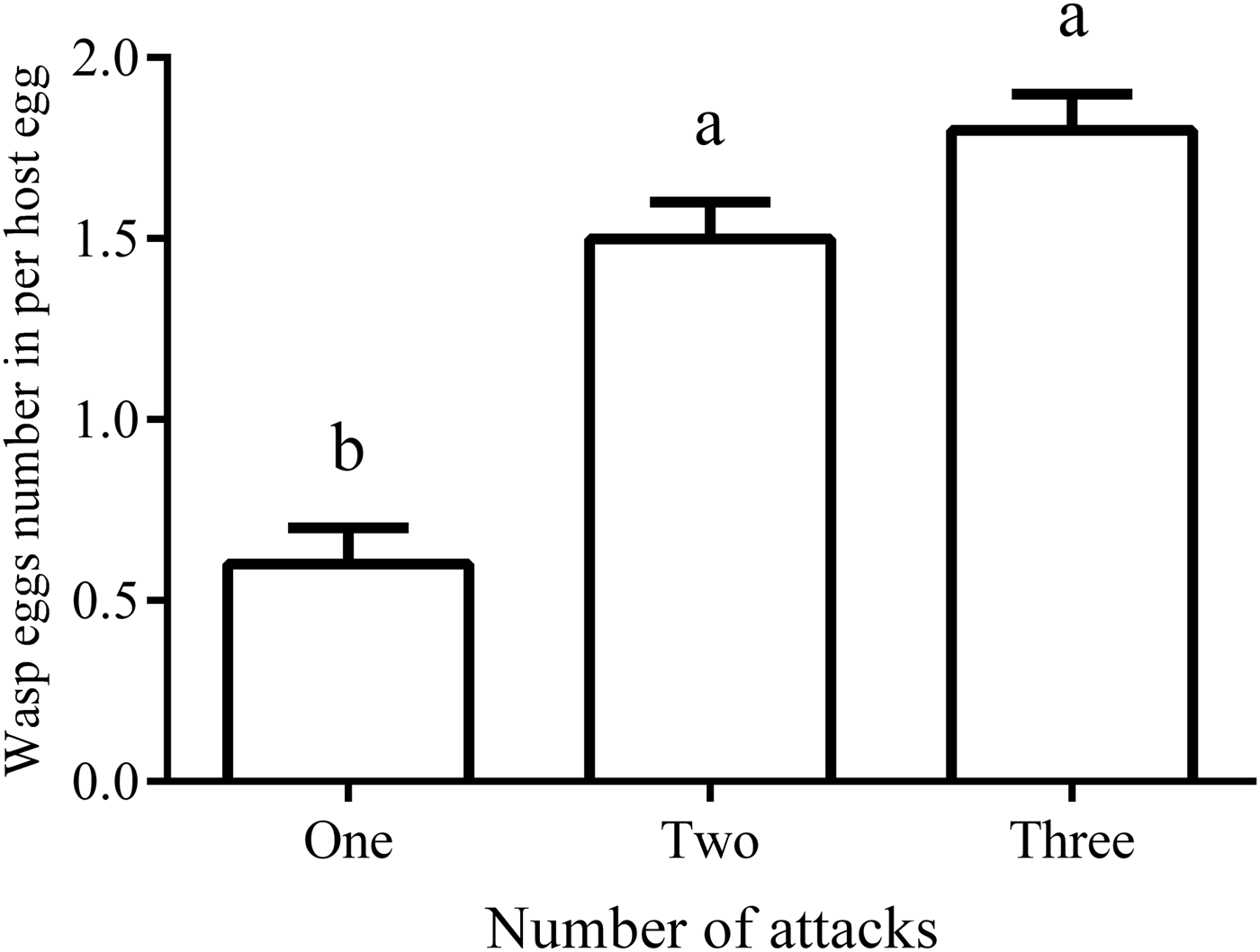
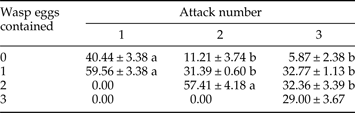
In total, 59.56% of the O. furnacalis eggs contained one wasp egg after being attacked once by T. dendrolimi, while 57.41% of the O. furnacalis eggs contained two wasp eggs after being attacked twice. Among the host eggs that were attacked three times, only 29.00% contained three wasp eggs; this percentage was significantly lower than 59.56% and 57.41% (F = 27.70, df = 2,6, P < 0.001) (table 1) resulting from only one or two attacks. The number of wasp eggs per host increased significantly as the number of attacks increased (F = 55.24, df = 2,262, P < 0.001) (fig. 1).
The number of wasp eggs per O. furnacalis host egg after one, two or three attacks by T. dendrolimi; different letters indicate significant differences (Tukey's test, P < 0.01).

Percentage (mean ± SE) (%) of host eggs containing wasp eggs after different numbers of attacks by T. dendrolimi.

Note: Different lowercase letters in the same row indicate significant differences among the percentages (Tukey's test, P < 0.05).
Parasitism of O. furnacalis eggs by T. dendrolimi and wasp emergence rate
The parasitism of O. furnacalis eggs by T. dendrolimi increased as the number of attacks increased (for OfC: F = 28.98, df = 2,10, P < 0.01; for OfA: F = 12.69, df = 2,9, P < 0.01) (table 2). Except for those eggs with two attacks, there were no significant differences in the parasitism rate between attacks on the OfC and OfA eggs (three attacks: F = 0.22, df = 1,6, P = 0.65; two attacks: F = 1.16, df = 1,6, P < 0.01; one attack: F = 1.03, df = 1,7, P = 0.35). The interaction between host diet and number of attacks had no significant effect on the parasitism rate (F = 1.42, df = 2,19, P = 0.27).
Parasitism success rate, developmental time (day) and emergence number of T. dendrolimi after different numbers of attacks on O. furnacalis eggs.

Note: The values are means ± SE; the lowercase letters denote comparisons among different number of attacks of the same host type, and the uppercase letters indicate comparisons between OfC and OfA with the same number of attacks. Data followed by different letters are significantly different (Tukey's test, P < 0.05).
1 No significant differences were found among different numbers of attacks or different host diets.
2 No significant differences were found between host diets with the same number of attacks.
Emergence rates ranged from 72.3 to 93.3%, and there were no significant differences among different numbers of attacks (for OfC: F = 3.11, df = 2,10, P = 0.09; for OfA: F = 1.54, df = 2,9, P = 0.27). However, the interaction between host diet and number of attacks significantly affected the emergence rate of Trichogramma (F = 4.17, df = 2,19, P = 0.032).
The number of wasps that emerged from per O. furnacalis egg increased with attack number for both OfC and OfA host eggs, there was no significant differences between OfC and OfA hosts with the same number of attacks (table 2), and the effect of the interaction between host diet and the number of attacks was not significant (F = 0.04, df = 2,19, P = 0.958).
However, the number of attacks significantly affected the proportion of female offspring (F = 27.01, df = 2,19, P < 0.01). The proportion decreased as the number of attacks increased. The host diet did not significantly affect the proportion of female offspring (F = 3.88, df = 1,19, P = 0.06).
Development time of T. dendrolimi offspring on O. furnacalis eggs
For the same number of attacks, the offspring development time for the OfC eggs was significantly longer than the that for the OfA eggs (three attacks: F = 21.25, df = 1,75, P < 0.01; two attacks: F = 11.62, df = 1,75, P < 0.01; one attack: F = 5.80, df = 1,112, P = 0.02) (table 2). As the number of attacks increased, the development time of the wasp offspring increased (on OfC: F = 78.79, df = 2,109, P < 0.001; on OfA: F = 26.90, df = 2,107, P < 0.001). The interaction between host diet and number of attacks significantly affected the development time of Trichogramma (F = 10.78, df = 2,216, P < 0.001).
Size of T. dendrolimi offspring
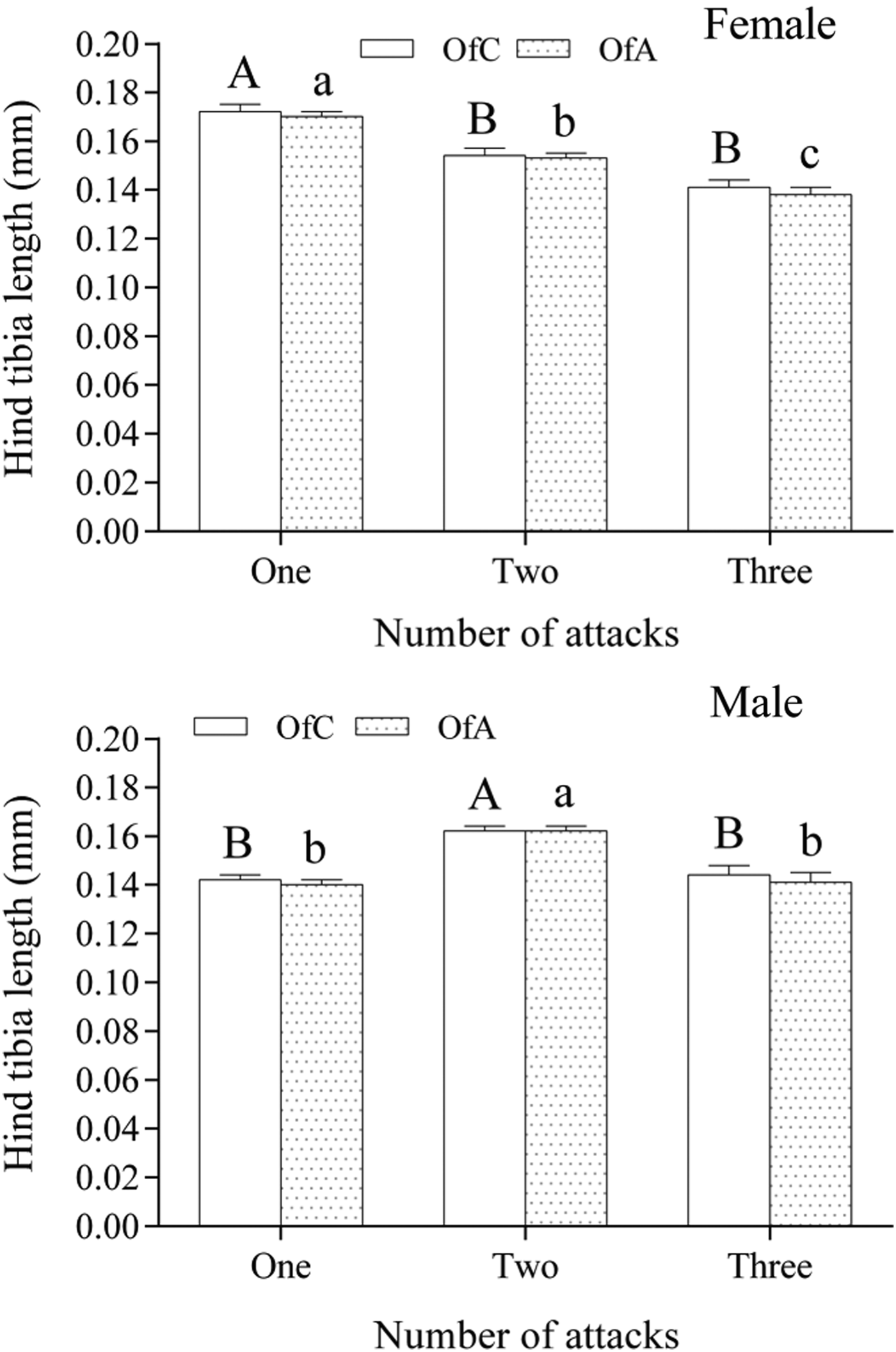
The number of attacks also significantly affected the size of the emerged wasps, and the size of female offspring decreased as the number of attacks increased (on OfA: F = 28.27, df = 2,73, P < 0.001; on OfC: F = 34.10, df = 2,72, P < 0.001) (fig. 2). However, among the male offspring, the largest wasps emerged from host eggs that had suffered two attacks (on OfA: F = 5.31, df = 2,39, P < 0.01; on OfC: F = 10.91, df = 2,46, P < 0.001). There were no significant differences between host diets on the size of offspring of the same gender from eggs with the same number of attacks. No significant effects of the interaction between host diet and number of attacks were found on offspring size (for females: F = 0.03, df = 2,145, P = 0.97; for males: F = 0.07, df = 2,85, P = 0.93).
Hind tibia length (mean ± SE) of T. dendrolimi adults that emerged from O. furnacalis eggs that were attacked different numbers of times. The uppercase letters denote the comparison results from OfC eggs with different numbers of attacks, and the lowercase letters denote the comparison results from OfA eggs with different numbers of attacks. Different letters indicate significant differences (Tukey's test, P < 0.01). There were no significant differences between OfC and OfA eggs with the same number of attacks.

Fate of O. furnacalis eggs attacked
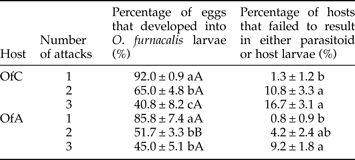
After being attacked by T. dendrolimi, some parasitized O. furnacalis eggs developed into O. furnacalis larvae (table 3). The percentage of O. furnacalis eggs that developed into host larvae differed significantly among attack numbers (for OfC: F = 42.41, df = 2,10, P < 0.001; for OfA: F = 19.44, df = 2,9, P < 0.001). There were no significant differences in the percentage of eggs that developed into host larvae between OfC and OfA except for eggs that were attacked twice (three attacks: F = 0.26, df = 1,7, P = 0.63; two attacks: F = 1.95, df = 1,6, P = 0.04; one attack: F = 1.80, df = 1,6, P = 0.22). The interaction between host diet and number of attacks was not significant (F = 1.62, df = 2,19, P = 0.22).
Fate of O. furnacalis eggs that did not turn into black after being attacked by T. dendrolimi.

Note: The values show means ± SE; data in the same column were analyzed by Tukey's tests at P < 0.05. The lowercase letters denote comparisons among different numbers of attacks of the same host type and the uppercase letters denote comparisons between OfC and OfA with the same number of attacks. Different letters indicate significant differences.
There were also eggs that failed to develop into O. furnacalis larvae and from which no T. dendrolimi emerged. Only light liquid was found inside these eggs at dissection. Both number of attacks and host diet significantly affected the percentage of undeveloped host eggs (attack number: F = 21.33, df = 2,19, P < 0.01; host diet: F = 6.40, df = 2,19, P < 0.02). However, no significant interaction effects were found (F = 0.94, P = 0.41).
Number of wasp eggs in host eggs after exposure for 6 h at different ratios of wasps to host eggs
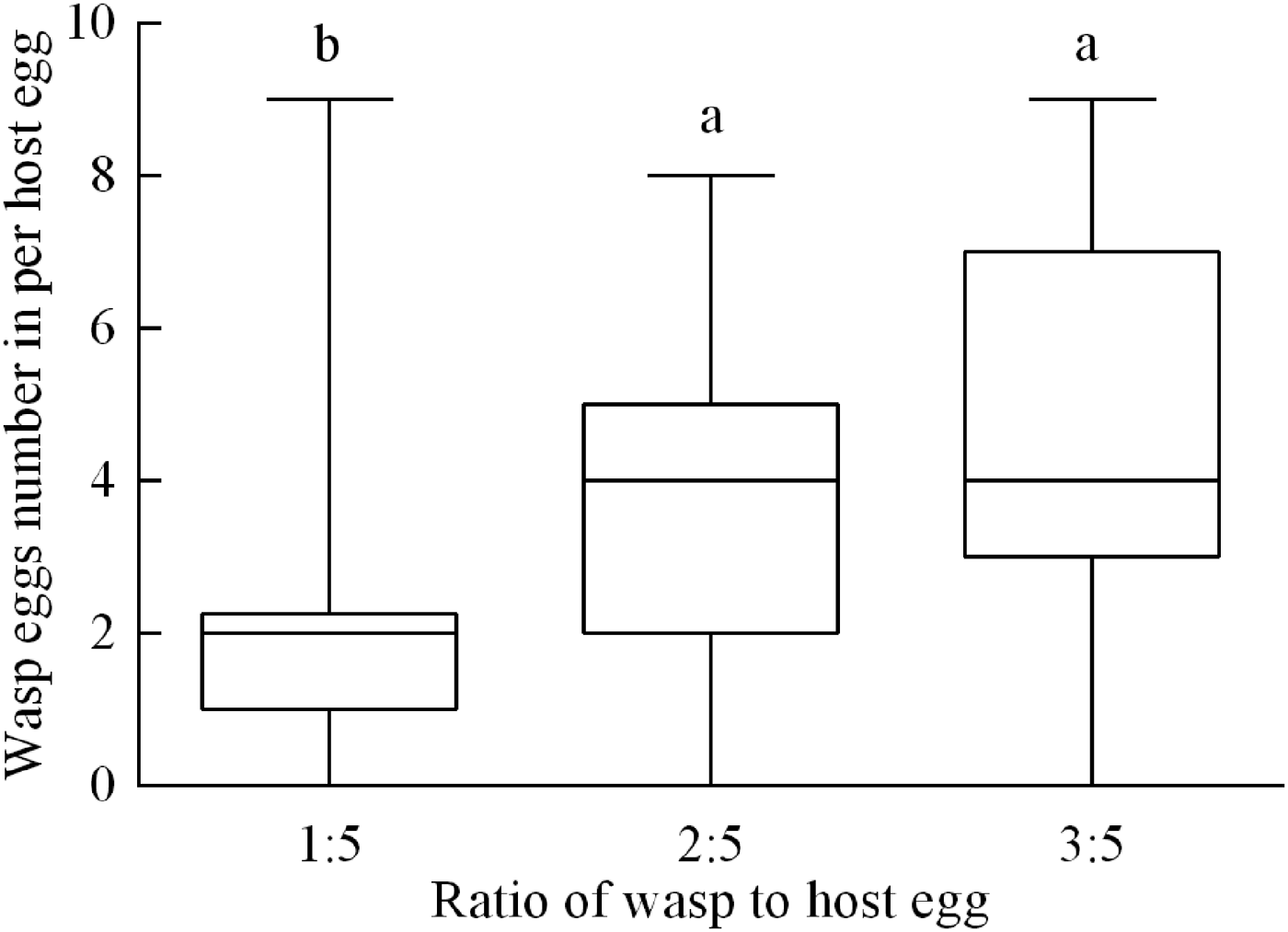
There were 70, 65, and 64 host eggs containing wasp eggs at dissection in the 1:5, 2:5, and 3:5 treatments, respectively, and the ratio of wasps to host eggs significantly affected the number of wasp eggs per host egg after a 6-h exposure (F = 35.61, df = 2,196, P < 0.01) (fig. 3).
Box plot of the number of Trichogramma eggs per host after 6 h exposure at different ratios of wasps to host eggs. Different letters indicate significant differences (Tukey's test, P < 0.01).

Discussion
Number of attacks of T. dendrolimi and successful parasitism of O. furnacalis eggs
Although T. dendrolimi female did not like laying eggs in O. furnacalis eggs and often performed several examinations before laying an egg into a host egg in the present experiments, we obtained O. furnacalis eggs that were attacked up to three times by placing one female together with an egg mass. Trichogramma females will lay one egg in a small suitable egg with each attack (Klomp & Teerink, Reference Klomp and Teerink1962; Suzuki et al., Reference Suzuki, Tsuji and Sasakawa1984). In experiments of counting number of attacks, we observed all the parasitization behavior before carefully scrutinizing Trichogramma eggs under stereomicroscope. Intact wasp eggs were readily to be distinguished from the background substrate. However, we cannot ensure that no wasp eggs were destroyed at dissecting O. furnacalis eggs, and the destroyed wasp eggs would mix with debris of host eggs chorion and thus be missed. Nevertheless, the number of eggs increased with the number of attacks. In addition, up to nine the wasp eggs were laid in one egg of O. furnacalis. These results indicated that superparasitism can occur when a wasp repeatedly encounters a host egg, even if the egg is not well suitable for the Trichogramma wasp (van Dijken & Waage, Reference van Dijken and Waage1987; Liu & He, Reference Liu, He, Wajnberg and Vinson1991; Miura et al., Reference Miura, Matsuda and Kobayashi1994; Wang et al., Reference Wang, Lu, He, Shi, Tu and Gu2016). Superparasitism may be common in egg parasitoids when suitable host are insufficient (Narendran, Reference Narendran1985; van Alphen & Visser, Reference van Alphen and Visser1990) or under inter/intraspecific competition (van Dijken & Waage, Reference van Dijken and Waage1987; Dasilva et al., Reference Dasilva, Morelli and Parra2016).
As the number of attacks increased, the rate of successful parasitism of eggs of O. furnacalis by T. dendrolimi increased significantly. Furthermore, the percentage of eggs that failed to result in either parasitoid or host larvae emergence increased as the number of attacks increased. This can be considered a control effect of Trichogramma (Abram et al., Reference Abram, Brodeur, Burte and Boivin2016). When the ratio of wasps to host eggs increased to 3:5, which is close to that 3:4–6 in the field after an inundative release (Shen et al., Reference Shen, Wang and Meng1986; Gu et al., Reference Gu, Liang and Zhang1989; Wang et al., Reference Wang, Lu, He and Zhou2000; Feng et al., Reference Feng, Li, Jing, Wang and Huang2011; Bai et al., Reference Bai, Sun, Zheng, Hou, Liu, Feng and Yang2014; Zhou et al., Reference Zhou, Lu, Wang, Li, Zhang and Ding2014), the number of eggs per host egg increased to 4.6 (fig. 3), which is far above the average (1.8) from three attacks, resulting in the death of the host egg. These results likely explain the high rate of successful parasitism of O. furnacalis eggs by T. dendrolimi after an inundative release, which results in successful borer control.
Effects of the number of attacks on Trichogramma offspring
As the number of attacks increased, the proportion of female offspring decreased (table 2). One model to explain the sex ratio of haplodiploidy hymenopteran is local mate competition (LMC) (Hamilton, Reference Hamilton1967), which predicts that the increase in number of female would results in increasing in proportion of male offspring. In our experiments, different females may have been used to parasitize same one egg mass. Thus, a female introduced into the arena might have detected the trail of previous females, potentially representing unidirectional intraspecific competition, which is similar to competition in the LMC model. A modified model by Suzuki et al. (Reference Suzuki, Tsuji and Sasakawa1984) may be more specific to explain the sex ratio in our experiment, when eggs were attacked by more than one female, the female offspring suffered higher mortality than male offspring, and thus, superparasitism would result in lower female proportion. Even after being attacked thrice, that the emerged wasps from per host egg were less than two individuals indicated the superparasitism did occur in present study. Martel & Boivin (Reference Martel and Boivin2004) observed similar phenomena in Trichogramma pintoi. A decrease in female proportion caused by superparasitism has also been reported in Trichogramma evenescens (Waage & Ming, Reference Waage and Ming1984) and Trichogramma minutum (Corrigan et al., Reference Corrigan, Laing and Zubricky1995). A low female offspring proportion means that fewer T. dendrolimi females would emerge to parasitize the eggs of the next O. furnacalis generation. Furthermore, as the extent of superparasitism increase, the size of emerged female wasps decrease (Waage & Ming, Reference Waage and Ming1984; Grenier et al., Reference Grenier, Grille, Basso and Pintureau2001; Boivin & Martel, Reference Boivin and Martel2012), and smaller Trichogramma females contain fewer eggs (Honěk, Reference Honěk1993; Durocher-Granger et al., Reference Durocher-Granger, Martel and Boivin2011; Huang et al., Reference Huang, Zhang, Zhang and Li2015). These results most likely contribute to the sharp decline in the parasitism rate of O. furnacalis eggs by T. dendrolimi that are observed in the field after an inundative release (Zhang et al., Reference Zhang, Huang, Zhu, Wang, Kang, Pan, Yin, Zhang, Yun and Sun1979; Feng, Reference Feng1996).
Effects of host diet on host suitability
Although the artificial diet did not affect the biological characteristics of the Asian corn borer (Zhou et al., Reference Zhou, Wang, Liu and Ju1980; Wang & Zhou, Reference Wang and Zhou1998), our results indicated that the diet affected the eggs’ suitability for T. dendrolimi: among eggs that experienced two attacks, the parasitism rate of OfC eggs was significantly different from that of OfA eggs (table 2). In a choice test, Song et al. (Reference Song, Bourchier and Smith1997) found that T. minutum parasitized more eggs from Choristoneura fumiferana Clemens that were reared on artificial diets than those reared on balsam fir. The authors thought that host diet affected volatile and contact kairomones that repel parasitoids from egg masses of C. fumiferana that were reared on balsam fir or attracted parasitoids to C. fumiferana reared on an artificial diet. In the present study, we did not find obvious differences in the parasitization behavior of Trichogramma between OfC eggs and OfA eggs; however, we did not investigate whether there were differences in the egg laying after each attack between the two host strains because we did not dissect the OfC eggs. Nathan et al. (Reference Nathan, Kalaivani, Mankin and Murugan2006) found that the diet (millet, wheat, rice, and sorghum) of C. cephalonica affected the Trichogramma chilonis emergence rate but not the host parasitism rate. Here, the diet probably affected the quality of O. furnacalis eggs and, thus, the successful parasitism and development of immature Trichogramma. The mechanism of the influence of host diet on egg parasitism by an egg parasitoid remains unclear.
Fate of host eggs attacked by wasps
Some host eggs failed to develop into host larvae or wasps: only yellow liquid was found in these eggs. Furthermore, among eggs that were attacked twice, 11.21% did not contain wasp eggs, while 65.0% of the OfC eggs and 51.7% of the OfA eggs developed into O. furnacalis larvae. These findings indicate that host eggs may be capable of suppressing wasp egg development. It was found that the activities of immulectin-V, prophenoloxidase, prophenoloxidase activating protease I, and proparalytic peptide increased in fresh Manduca sexta (Linnaeus) eggs after the eggs were parasitized by Trichogramma evanescens Westwood, and the decrease in successful parasitism rate of M. sexta eggs was supposed to be related to this change (Abdel-latief & Hilker Reference Abdel-latief and Hilker2008). The immune response to parasitoid eggs by M. sexta eggs even could be improved through transgenerational immune priming (Trauer-Kizilelma & Hilker, Reference Trauer-Kizilelma and Hilker2015). Such a mechanism might explain the low suitability of O. furnacalis eggs to T. dendrolimi. Trichogramma females may secret parasitization factors to confront the host's immune response (Takada et al., Reference Takada, Kawamura and Tanaka2000; Jarjees & Merritt, Reference Jarjees and Merritt2004). Zhu et al. (Reference Zhu, Zhang, Song, Zhang and Li2014) reported that the venom of T. ostriniae females significantly increased the successful parasitism of O. furnacalis eggs by T. dendrolimi. This suppression and anti-suppression may determine the suitability of a given host to a Trichogramma species. Regardless of the underlying mechanism, some attacked O. furnacalis eggs that failed to produce parasitoids or host larvae, and the percentage of such non-producing eggs increased significantly as the number of attacks increased, an outcome that also contributes to the control effects (Abram et al., Reference Abram, Brodeur, Burte and Boivin2016).
Conclusions
In conclusion, we found that despite the low suitability of O. furnacalis eggs to T. dendrolimi, successful parasitism increased with the number of attacks by T. dendrolimi. The attack increase resulted in a lower proportion and smaller size of female offspring. Increasing the ratio of Trichogramma females to O. furnacalis eggs resulted in a high level of superparasitism, which resulted from more attacks. These results partially illustrated the high rate of successful parasitism of O. furnacalis eggs in field after an inundative release of T. dendrolimi and the sharp decrease in parasitism rate by T. dendrolimi without repeated wasp releases.
Acknowledgements
The authors thank Dr Yin-Quan Liu of Zhejiang University for his constructive suggestions on an early draft of the manuscript. Funding was provided by the National Basic Research Program of China (Grant No. 2013CB127605) from the Chinese Ministry of Science and Technology and the National Natural Science Foundation of China (Grant No. 30871671), and these institutions are gratefully acknowledged.