Introduction
A consistent feature of addiction is the attentional bias for drug-related stimuli (eg, drug paraphernalia). As reviewed elsewhere in this edition, behavioral studies have shown that processing a nonsalient stimulus in the presence of a salient drug-related stimulus presents a significant difficulty for those who are substance-use dependent (SUD).Reference Field and Cox1, Reference Field, Munafo and Franken2 This difficulty in controlling attention away from a drug-related stimulus has been observed irrespective of whether it is imperative to current task goals. While much more is understood about the underlying neural mechanisms of drug craving, and the process by which drug-related stimuli attain salience, a small but growing literature has begun to focus on the neural mechanisms underlying the inability to ignore such stimuli. Given the potential contribution of such biases to perpetuating drug use, and the development of interventions (both pharmaceutical and cognitive-behavioral) to treat biases, understanding their neural basis has the potential to contribute to improving treatment outcomes.
Drug-related attentional bias appears to implicate the countermanding forces of cognitive control and reward salience.Reference Franken3 The attentional bias that drug-related stimuli hold is relative to their level of personal salience, rather than reflecting a specific stimulus feature or characteristic. For example, behavioral studies have demonstrated that the level of bias shown to drug-related stimuli is equivalent to stimuli in other “reward”-related categories, such as food or sex.Reference Cox, Hogan, Kristian and Race4 In the context of models of attention, drug-related stimuli have explicit, rather than implicit, attentional salience,Reference Corbetta and Shulman5, Reference Pessoa, Kastner and Ungerleider6 insofar as their competition for attention relates to feedback from nonvisual cortices on their salience. For example, behavioral experiments have been unable to demonstrate subliminal (nonconscious) biases or visual search preference for drug-related stimuli,Reference Bradley, Field, Mogg and De Houwer7, Reference Munafo, Mogg, Roberts, Bradley and Murphy8 suggesting that drug-related stimuli attain bias from post-conscious processing by the dorsal, top-down visual salience network.
The salience of a stimulus determines its capacity to hold attention, and to an extent, to direct attention. Drug-related stimuli appear to attain attentional salience in SUD populations via the reinforcing properties of drugs and their influence on the mesocorticolimbic “reward” network.Reference Franken3 This circuit, which includes the nucleus accumbens, amygdala, and hippocampus, has been associated with the acute reinforcing properties of addictive drugs.Reference Robinson and Berridge9 Repeated administration of a drug alters the responsiveness of these brain regions, insofar as they become sensitized to the association between the drug, its many related stimuli (eg, context and surroundings in which it is taken), and the euphoria that accompanies intoxication. Indeed, studies of drug craving where drug-related stimuli are presented to either active or abstinent users have demonstrated significant activation in regions such as the amygdala, nucleus accumbens, and hippocampus.Reference Garavan, Pankeiwicz and Bloom10–Reference Grant, London and Newlin13 These results have been interpreted as an example of the Pavlovian, or conditioned associative learning, whereby repeated pairing of a cue stimulus (eg, spoon used to heat and administer crack cocaine) and the subsequent drug-induced euphoria results ultimately in the cue stimulus alone being able to evoke a similar response from the underlying neural circuit.Reference Koob and Volkow14 Presentation of the cue alone does not evoke euphoria; rather activation of the system appears to increase “wanting” and increased compulsion to seek the drug. This type of conditioned associative learning is typically found with other reinforcing stimuli (eg, food, pain), and items conditioned in this way are reinforced as salient to the individual.Reference Berridge and Robinson15
Learning the salience of stimuli and, in turn, allowing salience to reflexively direct our attention (particularly visual attention) appears to have a logical and evolutionary advantage. Thus, when navigating a complex multistimulus environment, our attention is captured by those items that we find rewarding (eg, food) or that could harm us (eg, predators). As salience directs attention reflexively, a greater level of cognitive control must be imposed to ignore, or control attention away from, the salient stimulus and instead attend to a less salient stimulus.Reference Pessoa and Ungerleider16 Top-down cognitive control, the process whereby conscious internal goals take precedence over automatic processes,Reference Miller and Cohen17 is critical to a number of psychological processes that may contribute to drug addiction,Reference Goldstein and Volkow18 such as inhibitory control and selective attention.
Exerting cognitive control over salient but task–goal irrelevant stimuli has been demonstrated by cognitive neuroscience research in healthy participants to require activation in the anterior cingulate cortex (ACC), dorsolateral prefrontal cortex, and inferior parietal regions.Reference Kerns19 Egner and Hirsch,Reference Egner and Hirsch20 using variants of the Stroop visual paradigm often used in attentional bias work, have demonstrated that reducing attentional bias for salient, but task-irrelevant, information involves amplification of processing (and associated cortical activity) of task-relevant information by cognitive control regions such as the dorsolateral prefrontal cortex. When reducing bias to emotionally evocative stimuli, the dorsolateral prefrontal gyrus (DLPFC) and medial prefrontal cortex (both rostral and dorsal ACC) show increased activity that is reciprocal to a reduction of amygdalar activity, suggesting some level of top-down inhibition of emotional processing.Reference Etkin, Egner and Kalisch21
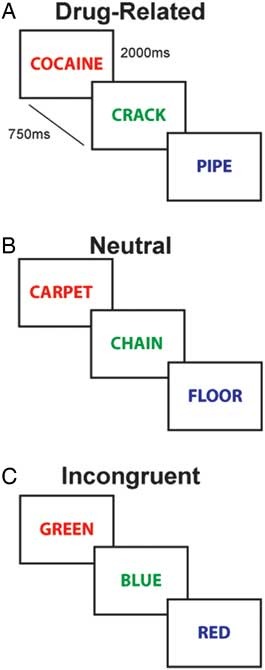
If ignoring emotionally evocative stimuli in our environment requires both up-regulation of control networks and down-regulation of emotional processing, then the neural basis of attentional bias for drug-related stimuli may be the result of a reduction in the efficiency of either regulation mechanism, or indeed, both. Goldstein etal. Reference Goldstein, Alia-Klein and Tomasi22–Reference Goldstein, Woicik and Maloney24 performed a series of studies in cocaine users in which they consistently demonstrated hypoactivation of the dorsal and ventral region of the ACC during a modified emotional Stroop task. They also found hyperactivation in cocaine users for cocaine words in the subcortical striatal regions (substantia nigra).Reference Goldstein, Tomasi and Alike-Klein25 Further analysis of the hypoactivation observed in the ACC during cocaine cues indicated that it was also present during other task conditions when cocaine-dependent patients were compared to matched controls. This result suggests that the ACC hypoactivity could not be the result of attentional bias for cocaine cues, but rather reflects a more general deviant cognitive process in cocaine users. While the imaging data are consistent with the hypothesis of failing to up-regulate control regions being associated with increased attentional bias for drug-related stimuli, these studies did not find a significant group difference in reaction-time measures of attentional bias. The modified version of the emotional Stroop task (eg, see Figure 1) used to measure attentional bias, which for the purposes of imaging separated the presentation of the drug-related word from the opportunity to respond to it by 2 seconds, was unable to measure the effect of the attentional incongruence during stimulus presentation during the subsequent opportunity to respond. Interestingly, one study that showed a similar pattern of decreased cognitive control activity (left dorsolateral prefrontal cortex) and increased mesocorticolimbic activity (nucleus accumbens and amygdala)Reference Nestor, McCabe, Jones, Clancy and Garavan26 during an attentional bias task, also failed to find a significant bias to drug-related stimuli in its sample of cigarette smokers. The reduction in the control network activity was also identified irrespective of stimulus condition, and the effect was more pronounced in abstinent ex-smokers when compared to current smokers or non-smokers.
An example of stimuli from the drug-related emotional Stroop task (adapted from Hester etal. Reference Hester, Dixon and Garavan42). In the emotional Stroop task, word stimuli are presented in a range of colored fonts, with participants instructed to respond as quickly and accurately as possible with the response button associated with the words’ font color. A single trial presented the word stimulus for 2000 ms awaiting the participant's response, followed by a blank screen [interstimulus interval (ISI)] for 750 ms. Blocks of trials were presented in a range of categories: drug-related words (see panel A), neutral words (panel B), and incongruent words (panel C). Drug-related words in this example were stimuli that cocaine-dependent participants generated prior to the experiment, which they associated with cocaine. The task attempts to measure attentional bias by requiring participants to control their over-learned but task-irrelevant response (to read the word) and thereby ignore the salient stimulus (drug-related word), in favor of responding to the task-relevant stimulus feature (font color). Neutral words (panel B) are used in the experiment to act as a control comparison, and are matched to the drug-related words for word length and frequency of use, but they differ in terms of emotional salience. Incongruent stimuli (panel C), or classic “Stroop” stimuli, index underlying cognitive control ability by requiring participants to ignore the salient but task-irrelevant feature (the word) in favor of the less salient but task-relevant feature (font color).

Subsequent functional magnetic resonance imaging (fMRI) studies in SUD samples have typically failed to replicate these findings of down-regulation of cognitive control regions during attentional bias. Studies examining dependent stimulant-,Reference Marhe, Luijten, van de Wetering, Smits and Franken27–Reference Ersche, Bullmore and Craig29 alcohol-,Reference Vollstädt-Klein, Loeber and Richter30 and nicotine-usingReference Luijten, Veltman and van den Brink31–Reference Luijten, Veltman and Hester34 participants have found increased activation in the control network, principally the lateral prefrontal and dorsal ACC regions, during attentional bias for drug-related stimuli. Interestingly, almost all of these studies have found one of lateral prefrontal or ACC, rather than both, regions to be up-regulated during within-subject comparisons between drug-related and neutral conditions. A recent study has also demonstrated that neurochemical evidence of greater dorsal ACC (dACC) dysfunction [via magnetic resonance (MR) spectroscopy] was correlated with higher levels of attentional bias in cigarette smokers.Reference Janes, Jensen and Farmer35 Similarly, the majority of these studies have also been able to show a relationship between individual differences in attentional bias and cognitive control network activity. For example, Hester and GaravanReference Hester and Garavan28 showed that increased bias for cocaine-related stimuli (relative to neutral stimuli) was associated with increased right inferior frontal cortex activity (r = .47), and Janes etal. (2010)Reference Janes, Pizzagalli and Richardt32 found that dACC activity was correlated with bias for nicotine stimuli (r = .41). Given the relatively small samples of participants and the distribution of bias scores, the moderate strength of these correlations is encouragingly robust. They do, however, appear consistent with the behavioral research highlighting the predictive value of bias scores within samples of drug-dependent participants, wherein the within-group variability of attentional bias has been sufficient to predict treatment outcomes measures.Reference Field and Cox1, Reference Marhe, Luijten, van de Wetering, Smits and Franken27
In keeping with the increased cognitive control network activity during attentional bias, drug-dependent populations have also demonstrated increased activity in limbic and mesocorticolimbic networks. A number of studies have found that the increased attentional bias shown to drug-related stimuli is associated with increased activity in the insula cortex,Reference Vollstädt-Klein, Loeber and Richter30–Reference Janes, Pizzagalli and Richardt33 amygdala,Reference Nestor, McCabe, Jones, Clancy and Garavan26, Reference Hester and Garavan28, Reference Ersche, Bullmore and Craig29, Reference Janes, Pizzagalli and Richardt32, Reference Janes, Pizzagalli and Richardt36 and striatum.Reference Nestor, McCabe, Jones, Clancy and Garavan26 For example, Luijten etal. Reference Luijten, Veltman and van den Brink31 showed that activation in the left insula was associated with attentional bias related craving. Interestingly, Janes etal. (2010) showed that the functional connectivity between the insula and cognitive control regions was reduced in smokers who slipped after an attempt to quit. Nestor etal. Reference Nestor, McCabe, Jones, Clancy and Garavan26 found that the nucleus accumbens was more strongly activated in current smokers, as compared to ex-smokers, for smoking pictures in a pictorial Stroop task. Because the difference in nucleus accumbens activation was not significant between smokers and nonsmoking controls, the difference between current smokers and ex-smokers may suggest that smokers who show reduced attentional bias–related brain activation in the nucleus accumbens (ie the ex-smokers in the current study) have greater success in quitting smoking over time (at least 12 months in this study).
The pattern of increased attentional bias and greater activity in both cognitive control and limbic networks across these studies has typically been interpreted via a reciprocal mechanism. The increased saliency of drug-related stimuli requires a greater level of control to ignore, hence the greater activity in the control system to counteract the greater activity in the limbic system to the salient stimulus. While control systems are more active, they are not sufficient to reduce the level of bias to control-group levels. That within-SUD group differences in bias level have been found to correlate with either control activity,Reference Hester and Garavan28, Reference Ersche, Bullmore and Craig37 limbic activity,Reference Janes, Pizzagalli and Richardt32 or the connectivity between themReference Janes, Pizzagalli and Richardt32 also appears consistent with the hypothesis that successfully controlling bias requires up-regulation of the control system and down-regulation of the limbic response. This hypothesis is not unique to attentional bias; for example, research examining cognitive strategies to reduce craving in cigarette smokers has demonstrated a similar reciprocal relationship.Reference Kober, Mende-Siedlecki and Kross38
Successful control of attention in healthy control studies has suggested that avoiding bias is typically achieved by preparatory up-regulation of control systems to focus on task-related, rather than salient, stimuli.Reference Kerns19, Reference Egner and Hirsch20, Reference Egner, Etkin, Gale and Hirsch39 Rather than having to shift attention away from salient (drug-related) stimuli, the more successful approach has been for prefrontally driven control mechanisms to up-regulate preparatory activity in those regions critical to the nonsalient but task-related stimuli. Research to date has not typically explored the issue of whether SUD groups do not attempt such preparatory control network activity (see Stippekohl etal. Reference Stippekohl, Walter and Winkler40 for an exception), or whether having attempted it, they fail to engage the necessary level of activity to reduce bias. The clinical intervention research specifically targeting attentional bias appears predicated on the principle that with sufficient training and incentive, such preparatory control can assist in reducing bias. The relative success of such approaches to date,Reference Schoenmakers, Bruin and Lux41 although they are in the relatively early days, appears consistent with the hypothesis that attentional bias arises from the failure, rather than an inability, of SUD patients to engage in preparatory control.
Conclusion
The current neuroimaging literature examining attentional bias in SUD samples has demonstrated a pattern of increased bias for drug-related stimuli being associated with both increased activity in cognitive control (prefrontal and anterior cingulate cortices) and emotion processing (amygdala, insula, nucleus accumbens) brain networks. The inconsistencies in the small, but growing, literature include the variation in finding group differences for key nodes of the control network, notably the dorsal ACC. Some of the variation may be due to specific neuroimaging task design parameters, for example, those tasks that limit the behavioral bias shown by participantsReference Goldstein, Alia-Klein and Tomasi22, Reference Goldstein, Woicik and Maloney24 or the extent to which they produce stimulus conflict.Reference Nestor, McCabe, Jones, Clancy and Garavan26, Reference Luijten, Veltman and van den Brink31 Many of the tasks used rely on the presented stimulus prompting an overlearned response, which must be overcome via greater cognitive control. The cognitive control demands of a specific task can influence its ability to detect attentional bias toward drug-related stimuli, but not always. For example, the level of attentional bias shown by an individual on the emotional Stroop test does not always correlate with their incongruent Stroop bias.Reference Hester, Dixon and Garavan42 It seems likely that some variability in dACC activity is due to the extent to which such conflict resolution is required. While such effects are consistent with the finding of dACC activity differences between groups across a variety of executive function tasks,Reference Goldstein and Volkow18 it may not necessarily be specific or informative to our understanding of attentional bias.
The current data appear largely consistent with the hypothesis that attentional biases for drug-related stimuli emerge from a failure to sufficiently increase control of attention over salient, but task-irrelevant, stimuli. While SUD samples have consistently shown increased activity in the cognitive control network during attentional bias, such increases appear to have been insufficient for the concomitant increases in processing by the emotion network. Two questions arising from this remain relatively unanswered: The first question is whether this underlying neural mechanism for bias is specific to drug-related stimuli when compared to other emotionally salient stimuli (see Field and Cox1). While behavioral studies of drug-related bias and imaging studies of craving suggest that other evocative stimuli will induce the same effect,Reference Garavan, Pankeiwicz and Bloom10, Reference Bauer and Cox43 imaging studies of drug-related attentional bias have typically not explored this more general relationship. Second, to date, the literature has not focused on comparing successful and failed attempts to ignore drug-related stimuli, either within a session or between them. While statistical power may be at issue, such analyses would help to identify the neural mechanism associated with successfully reducing bias in the short- and long-terms. Given the recent development of specific interventions targeting attentional bias,Reference Schoenmakers, Bruin and Lux41 analyses of pre–post intervention fMRI data examining the neural mechanisms associated with the successful reduction of bias could be highly influential to treatment intervention development.
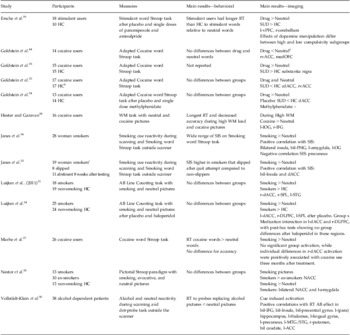
Functional MRI studies of attentional bias for drug-related stimuli in SUD samples

HC, healthy controls; SUD, substance use–dependent patients; RT, reaction times; AB, attentional bias; SIS, smoking interference score, defined as the difference in reaction time between smoking and neutral scores (positive SIS scores reflect attentional bias for smoking cues); WM, working memory; bil-, bilateral; r-, right; l-left; vPFC, ventral prefrontal cortex; ACC, anterior cingulate cortex (rv, rostroventral; cd, caudal dorsal; d, dorsal); medOFC, medial orbitofrontal cortex; IOG, inferior occipital gyrus; IFG, inferior frontal gyrus; PHG, parahippocampal gyrus; OG, occipital gyrus; SPL, superior partietal lobe; STG, superior temporal gyrus; DLPFC, dorsolateral prefrontal gyrus; NACC, nucleus accumbens, MTG, middle temporal gyrus.
aSignificant at trend level.
b15 cocaine users and 11 controls were also included in Goldstein etal. (2009).Reference Goldstein, Alia-Klein and Tomasi22
c19 smokers were also included in Janes etal. (2010).Reference Janes, Pizzagalli and Richardt32
Disclosures
The authors do not have anything to disclose.