The number of alien species in the Mediterranean Sea has been increasing rapidly over the past three decades (Zenetos et al., Reference Zenetos, Gofas, Morri, Rosso, Violanti, Garcia Raso, Cinar, Almogilabin, Ates, Azzurro, Ballesteros, Bianchi, Bilecenoglu, Gambi, Giangrande, Gravili, Hyams-Kaphzan, Karachle, Katsanevakis, Lipej, Mastrototaro, Mineur, Pancucci-Papadopoulou, Ramos Espla, Salas, San Martin, Sfriso, Streftaris and Verlaque2012). To date, 986 alien species have been introduced into the Mediterranean Sea (Zenetos et al., Reference Zenetos, Gofas, Morri, Rosso, Violanti, Garcia Raso, Cinar, Almogilabin, Ates, Azzurro, Ballesteros, Bianchi, Bilecenoglu, Gambi, Giangrande, Gravili, Hyams-Kaphzan, Karachle, Katsanevakis, Lipej, Mastrototaro, Mineur, Pancucci-Papadopoulou, Ramos Espla, Salas, San Martin, Sfriso, Streftaris and Verlaque2012). The number of reported alien marine species in Greek waters was 237, of which 76 have been recorded from the South Aegean, excluding the Dodekanisos area (Zenetos et al., Reference Zenetos, Katsanevakis, Poursanidis, Crocetta, Damalas, Apostolopoulos, Gravili, Vardala-Theodorou and Malaquias2011). The majority of these have been introduced from the Red Sea and the Indo-Pacific Ocean into the Mediterranean Sea since the opening of the Suez Canal in 1869. The introduction of such species into the Mediterranean Sea has been named Lessepsian migration (Por, Reference Por1978). In Turkish waters, the increase of alien species introductions has been observed over recent years. According to Cınar et al. (Reference Cınar, Bilecenoglu, Ozturk and Can2006), the number of recorded alien species off Turkish coasts was 263, of which 202 have been reported from the Levantine coast of Turkey. Overall, 74 Lessepsian fish species have been recorded from the Mediterranean Sea during the past decades (Golani, Reference Golani, Golani and Appelbaum-Golani2010), while 53 were reported from the Mediterranean Turkish coasts (Turan, Reference Turan2010).
Siganids are herbivorous species and widely distributed in Indo-West Pasific Ocean. Four Siganus species inhabit the Red Sea (Golani et al., Reference Golani, Ozturk and Basusta2006). Among them, two species, Siganus luridus (Rüppell, 1829) and Siganus rivulatus (Forsskål, 1775), have become very common in most parts of the eastern Mediterranean and strongly interact with native herbivorous fish species through competition for food resources and habitat (Bariche et al., Reference Bariche, Letourneur and Harmelin-Vivien2004). The rabbitfish Siganus luridus was first recorded in 1931 off the coast of Syria (Gruvel, Reference Gruvel1931). After that it rapidly spread to the eastern Mediterranean. To date, Siganus luridus has been recorded along the coasts of Levantine (Golani, Reference Golani, Golani and Appelbaum-Golani2010), Libya (Stirn, Reference Stirn1970; Lamboeuf, Reference Lamboeuf2000), Tunisia (Ktari-Chakroun & Bouhalal, Reference Ktari-Chakroun and Bouhalal1971), Italian Waters-Islands of Linosa (Azzurro & Andaloro, Reference Azzurro and Andaloro2004), Cape d'Orlando, Northern Sicily (Castriota & Andaloro, Reference Castriota and Andaloro2008), the French Mediterranean (Daniel et al., Reference Daniel, Piro, Charbonnel, Francour and Letourneur2009), in the Gulf of Trieste – Northern Adriatic Sea – (Poloniato et al., Reference Poloniato, Dulčić and Lipej2010) and in Greek and Turkish waters (Bilecenoglu, Reference Bilecenoglu, Golani and Appelbaum-Golani2010; Corsini-Foka et al., Reference Corsini-Foka, Pancucci-Papadopoulou and Kalogirou2010). Recently established populations of Siganus luridus were recorded off the Greek Islands, southern Aegean Sea (Katsanevakis, Reference Katsanevakis2011), in the Cyclades Archipelago, central Aegean Sea (Giakoumi & Kokkoris, Reference Giakoumi and Kokkoris2013; Giakoumi, Reference Giakoumi2014), off the coast of Chios Island, northern Aegean Sea (Katsanevakis & Tsiamis, Reference Katsanevakis and Tsiamis2009) and in Izmir Bay, northern Aegean Sea (Kara & Akyol, Reference Kara and Akyol2011). Currently, both siganus species, Siganus luridus and Siganus rivulatus, are of commercial importance in many areas of the Mediterranean (Shakman, Reference Shakman2008; Bardamaskos et al., Reference Bardamaskos, Tsiamis, Panayotidis and Megalofonou2009).
Until now, Siganus luridus has only been recorded in the southern-central areas of the Aegean Sea; the Dodecanese islands (Kavalakis, Reference Kavalakis1968); the Rhodes coast (Papaconstantinou, Reference Papaconstantinou1990); the waters of Crete (Golani et al., Reference Golani, Orsi-Relini, Massuti, Quignard and Briand2002); the Messiniakos Gulf, Ionian Sea (Bardamaskos et al., Reference Bardamaskos, Tsiamis, Panayotidis and Megalofonou2009); and the Cyclades Archipelago (Katsanevakis, Reference Katsanevakis2011; Giakoumi, Reference Giakoumi2014). Up to now, along the southern-central Aegean coasts of Turkey, Siganus luridus had reached Fethiye Bay in 1994 (Torcu & Mater, Reference Torcu and Mater2000), Gökova Bay, Akyaka in 2006 (Ceyhan et al., Reference Ceyhan, Akyol and Erdem2009) and later the coastal waters of the Datça-Bozburun Peninsula in 2007 (Oz et al., Reference Oz, Okus and Yuksek2007). It was also recently confirmed at Sıgacık Bay in 2007 and at Izmir Bay in the northern Aegean Sea (Kara & Akyol, Reference Kara and Akyol2011).
On 11 November 2014, a specimen of Siganus luridus was captured by trammel net (200 m long, with a mesh size of 30 mm, usually used for captures of bluefish, Atlantic bonito, striped sea bream, etc.) off the Assos coast, Edremit Bay, at a depth of about 2–3 m, in a site mostly characterized by sandy, rocky bottoms mixed with Posidonia beds (Figure 1). The specimen has been deposited in the fish collection of the Fisheries Laboratory of the Marine Science and Technology Faculty, Canakkale Onsekiz Mart University (reference number; NES-LF/2014-001).
Map of the area where the specimen of Siganus luridus was caught.

The specimen measured 22.0 cm in total length (TL) and 183.1 g in total weight (Figure 2). Its meristic features were; dorsal fin I + XIII + 10, anal fin VII + 9, pelvic fin I + 3 + I and pectoral fin 0–16.
Siganus luridus (22 cm TL) caught off the Assos coast, northern Aegean Sea.
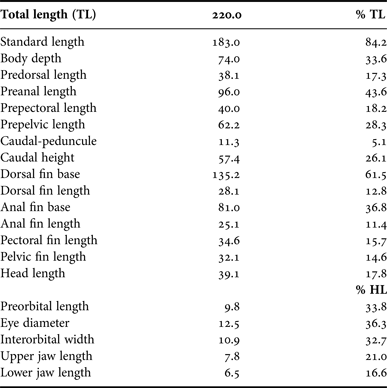
The morphometric characteristics, expressed as a percentage of the TL and head length (HL) in millimetres, for Siganus luridus are presented in Table 1.
Morphometric characteristics of the Siganus luridus specimen from the Assos coast, northern Aegean Sea (TL in mm).
This capture demonstrates a considerable extension of the distribution range of Siganus luridus within the Aegean Sea. The settlement success of Siganus luridus in the Mediterranean Sea has been ascribed to its large eco-physiological plasticity and the scarcity of native herbivorous fish (Lundberg & Golani, Reference Lundberg and Golani1995). It has become dominant in many coastal areas, outcompeting the main indigenous herbivores, Sparisoma cretense and Sarpa salpa (Bariche et al., Reference Bariche, Letourneur and Harmelin-Vivien2004), and changing the community structure and the native food web of the distribution area (Sala et al., Reference Sala, Kizilkaya, Yildirim and Ballesteros2011; Giakoumi, Reference Giakoumi2014). Also, the climate changes and the rise in water temperature of the whole Mediterranean, together with these characteristics, may accelerate the northward expansion of Siganus luridus (Bianchi, Reference Bianchi2007; Corsini-Foka, Reference Corsini-Foka, Golani and Appelbaum-Golani2010; Poloniato et al., Reference Poloniato, Dulčić and Lipej2010; Por, Reference Por, Golani and Appelbaum-Golani2010; Raitsos et al., Reference Raitsos, Beaugrand, Georgopoulos, Zenetos, Pancucci-Papadopoulou, Theocharis and Papathanassioua2010). The fact that Siganus luridus, a thermophilic, highly invasive species, was found in one of the coldest sector of the Mediterranean, should be of major concern. Further research is needed to better assess the expansion of this Lessepsian siganid in the Aegean Sea. Its spreading towards the northern coasts of the Aegean Sea and its biology and ecology should be continuously monitored to improve our understanding of the population dynamics of the species and the linkages with environmental variability.
ACKNOWLEDGEMENTS
The authors would like to thank the fishermen, Hasan Ali Özden and Muzaffer Özden, for supplying the specimen. The authors are also grateful to Semih Kale for providing technical support.