INTRODUCTION
Jojoba [Simmondsia chinensis (Link) Schneider] plant, a perennial and native of Arizona, southern California and northern Mexico, is of immense industrial value. It is sexually dioecious, bearing male and female flowers on different plants, and mature male and female plants differ in their vegetative structure and floral morphology. Male flowers occur in axillary inflorescences which may contain 3–20 flowers. Each male flower consists of four to six sepals and 8–16 large, erect anthers. Female flowers also occur in axillary positions but usually contain a single flower. Each female flower consists of one to four large bracts, four to six sepals and three to four long styles. The jojoba fruit is a green ovoid-shaped capsule enclosing one peanut-sized, dark-brown seed (Gentry Reference Gentry1958; Benzioni & Dunstone Reference Benzioni and Dunstone1986; Buchmann Reference Buchmann1987; Kohorn Reference Kohorn1994).
In jojoba, sex is genetically determined and there are no reports of plants changing sex, indicating that environment does not play a role in sex expression. Since neither male nor female flowers of jojoba plants have nectaries or petals, bees generally do not visit them. Jojoba is a wind-pollinated plant and pollen is known to travel distances of c. 33 m in relatively mild breezes (Yermenos Reference Yermenos1979). Flowering period can vary from 30 to 45 days depending on ambient temperatures, which have a large effect on stigmatic receptivity. Depending on the ambient temperatures, female flowers are receptive for a period of 3–6 days. There are also dramatic differences in jojoba pollen viability depending on the ambient temperatures and humidity (Coates & Ayerza Reference Coates and Ayerza2008).
Commercial production of jojoba has spread in recent times to South and Central America, southern Africa, Australia and even the Middle East. The product of primary interest is the seed oil, which is a unique liquid wax consisting of esters formed from acids and alcohols with chain lengths of 20 or 22 carbon atoms (Wisniak Reference Wisniak1987). As many as 300 products containing jojoba oil have appeared on the market in recent years and the use of jojoba products is expected to increase in the future (Benzioni & Vaknin Reference Benzioni and Vaknin2002; Benzioni et al. Reference Benzioni, Mills, Van Boven and Cokelaere2005).
The objectives of jojoba breeding studies involve the selection of superior genotypes producing large seeds, flowers at every node, more than one seed per node in clusters, early flowering, consistent high production from year to year, production of large quantities of highly viable pollen, co-ordinated bloom periods for male and female plants in the plantation, upright growth habit and high oil content with the desired wax properties such as viscosity, boiling point and thermal stability, which are important for future requirements of the jojoba industry. However, the most common method for jojoba improvement has been the selection of plants with desirable characteristics and propagating them asexually, since the development of cultivars having large seed, fruit at every node and seeds in clusters can be accomplished through vegetative propagation in a relatively short period of time (Yermenos Reference Yermenos1979; Vaknin et al. Reference Vaknin, Mills and Benzioni2003; Tobares et al. Reference Tobares, Frati, Guzman and Maestri2004; Benzioni et al. Reference Benzioni, Mills, Van Boven and Cokelaere2005). However, the use of clones or cuttings in commercial plantations faces problems of low seed yield and seed wax content (Dunstone et al. Reference Dunstone, Benzioni, Tonnet, Milthorpe and Shani1985). Several studies have investigated ways in which to improve jojoba seed yield and wax yield; however, no significant correlation has been found between the seed yield and seed weight, or between seed yield and seed wax content (Tobares et al. Reference Tobares, Frati, Guzman and Maestri2004). In order to increase jojoba seed yield, the application of supplemental pollen has been proposed and indications of increased seed yield by supplemental pollination were reported by Coates et al. (Reference Coates, Ayerza and Palzkill2006). However, yield increases were not dramatic and were not consistent between years.
Selection of suitable male and female genotypes for plantation and breeding studies is important. Several studies have indicated that low yields in commercial jojoba plantations around the world have resulted from a high female:male plant ratio (Benzioni & Ventura Reference Benzioni and Ventura1998) and undesirable weather conditions during flowering and fruit set (Coates et al. Reference Coates, Ayerza and Palzkill2006). Weather temperature and relative humidity for jojoba production cannot be directly changed by humans but the female:male plantation ratio could be easily manipulated by planting new male plants at appropriate distances from the existing females. However, a period of 3–6 years would be required for the new male plants to produce sufficient pollen to be effective. Furthermore, the selection of male plants for plantations requires genetic knowledge about them, since the effect of the male and female parents on yield and wax compositions are additive and highly significant (Benzioni & Vaknin Reference Benzioni and Vaknin2002).
Commercial jojoba is sexually dioecious and its sex type cannot be determined from morphological characters till the reproductive maturity age of 3 or more years. This creates a problem for early sex diagnosis in plantation and breeding studies. In jojoba improvement programmes, this prompts remarkable constraints for a priori mating design of superior individuals in breeding practices and for sex allocation of seedlings in seed orchard establishment.
Plants can be dioecious, monoecious or hermaphrodite (Hamadina et al. Reference Hamadina, Craufurd and Asiedu2009). Some species have hermaphroditic flowers and female flowers on the same plant, known as gynodioecy or female-hermaphrodite, while others have hermaphroditic flowers and male flowers on the same plant (gynomonoecy or male-hermaphrodite; Borges Reference Borges1998; Ordas et al. Reference Ordas, Serrano, Ordas, Butron and Revilla2009). Although jojoba is a dioecious species, one hermaphrodite jojoba plant called ‘Hermaphrodite’ has been identified and used in studies (Vaknin et al. Reference Vaknin, Mills and Benzioni2003). Furthermore, a naturally occurring female-hermaphrodite jojoba plant called ‘LaRonna’ has been identified; it has both male and female reproductive organs, with the female trait being dominant (http://www.laronnajojoba.com, verified 9 September 2010). However, there is no record on the existence of male-hermaphrodite jojoba.
In most cases, hermaphrodite plants, for example, papaya (Carica papaya L.), are desired for commercial production (Deputy et al. Reference Deputy, Ming, Ma, Liu, Fitch, Wang, Manshardt and Stiles2002). Identification of hermaphroditic jojoba plants could be important for jojoba production and breeding studies. However, the presence of the two types of flowers on a single jojoba plant may influence plant fitness because geitonogamy, i.e. fertilization of one flower with pollen from another flower on the same plant, may generate inferior offspring through inbreeding depression (Collin & Shykoff Reference Collin and Shykoff2003). However, females and males of dioecious species may not allocate the same proportions of assimilate to plant protection (McGowan et al. Reference McGowan, Joensalo and Naylor2004; Cisneros-Lopez et al. Reference Cisneros-Lopez, Mendoza-Onofre, Zavaleta-Mancera, Gonzalez-Hernandez, Mora-Aguilera, Cordova-Tellez and Hernandez-Martinez2010).
DNA markers offer several advantages in plant identification and genetic studies in comparison with morphological markers. In comparison with morphological markers, DNA markers are variable and exhibit a high level of allelic variation, neutral to the environmental factors and developmental stages and, not influenced by other genes and factors (Tan et al. Reference Tan, Callahan, Zhang, Karaca, Saha, Jenkins, Creech and Ma2003; Karaca et al. Reference Karaca, Saha, Callahan, Jenkins, Read and Percy2004). DNA markers have also been used in sex identification in many crop species (Kumar & Arumuganathan Reference Kumar, Arumuganathan, Rao and Rao1997; Alstrom-Rapaport et al. Reference Alstrom-Rapaport, Lascoux, Wang, Roberts and Tuskan1998; Ruas et al. Reference Ruas, Fairbanks, Evans, Stutz, Andersen and Ruas1998; Culley & Wolfe Reference Culley and Wolfe2000; Shibu et al. Reference Shibu, Ravishankar, Anand, Shaanker and Ganeshaiah2000; Kafkas et al. Reference Kafkas, Cetiner and Perl-Treves2001; Khadka et al. Reference Khadka, Nejidat, Tal and Golan-Goldhirsh2002; Torjek et al. Reference Torjek, Bucherna, Kiss, Homoki, Finta-Korpelova, Bocsa, Nagy and Heszky2002; Jiang et al. Reference Jiang, You, Li and Shi2003; Xu et al. Reference Xu, Wang and Cui2004; Danilova & Karlov Reference Danilova and Karlov2006; Prakash & van Staden Reference Prakash and Van Staden2006; Chaves-Bedoya & Nunenz Reference Chaves-Bedoya and Nunenz2007; Gangopadhyay et al. Reference Gangopadhyay, Roy, Ghose, Poddar, Bandyopadhyay, Basu and Mukherjee2007; Jhang et al. Reference Jhang, Kaur, Kalia and Sharma2010; Li et al. Reference Li, Yang, Li, Yang, Yin and Gan2010).
Efforts have been made to identify molecular markers in jojoba linked to sex alleles. Although male-sex-linked random amplified polymorphic DNA (RAPD) and inter-simple sequence repeat (I-SSR) markers have been reported (Agrawal et al. Reference Agrawal, Sharma, Gupta, Kumar and Prasad2007; Sharma et al. Reference Sharma, Agrawal, Gupta, Kumar and Prasad2008), these markers were not useful in jojoba sex identification. Ince et al. (Reference Ince, Karaca and Onus2010a) reported a novel jojoba male-sex-specific touchdown polymerase chain reaction (Td-PCR)-based DNA marker (JMS900). The JMS900 DNA marker is reproducible and distinct and it may not be necessary to convert it into the advanced markers of cleavage-amplified polymorphic sequence (CAPS) or PCR-restriction fragment length polymorphism (PCR-RFLP) and sequence-characterized amplified region (SCAR). However, the JMS900 DNA marker is generated using a single primer only 10 nucleotides long, thus being very vulnerable to PCR conditions and quality of the genomic DNA (Karaca & Ince Reference Karaca and Ince2008). Furthermore, JMS900 cannot discriminate hermaphrodite jojoba from male and female plants. New sex diagnostic markers simultaneously identifying female and male jojoba plants could be very helpful not only in sex identification but also in jojoba breeding studies. This study reports three new CAPS markers, different from JMS900, and discusses their application in jojoba plantation and breeding studies.
MATERIALS AND METHODS
Plant material
Jojoba plants were grown in a plantation located 102 km from the Mediterranean Sea coast of Kumluca, Antalya, Turkey (36°N, 30°W, 55 m asl). The average annual precipitation over the last 10 years ranged from 600 to 1500 mm; the highest temperature was recorded in August (c. 28·0°C), while the average lowest temperature was recorded in February (c. 7·0 °C). The average humidity ranged from c. 65 to 78%. The leaves of 60 female and 60 male jojoba plants were used as plant materials. Using the leaves of female and male plants, several male- and female-bulked samples (sex-specific bulks) were made. In addition to these, a total of 36 leaf samples collected individually from 36 different jojoba seedlings whose sexes were not known during the collection time were used as control samples to test the reliability and reproducibility of male-sex-specific and female-sex-specific markers developed in this study. These seedlings were obtained from cuttings of mature male and female jojoba plants and sexes of the control samples were determined using the records.
Genomic DNA extraction
A sample of leaves (10 g) from sex-specific bulks or 2–3 leaves of individual male or female samples were ground in a wide or small-sized mortar using liquid nitrogen. Total genomic DNA was extracted and analysed according to Karaca et al. (Reference Karaca, Ince, Elmasulu, Onus and Turgut2005). Concentration of DNA samples was determined using a spectrophotometer and concentrations were readjusted so that each sample contained 0·12 μg in 8·5 μl for PCR analysis. DNA extraction studies from those control samples used single leaf material.
PCRs
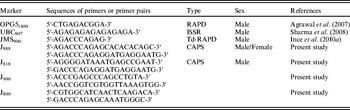
PCRs and agarose gel electrophoresis analyses of OPG51400, UBC807 and JMS900 markers using the primers listed in (Table 1) were performed as reported in Agrawal et al. (Reference Agrawal, Sharma, Gupta, Kumar and Prasad2007), Sharma et al. (Reference Sharma, Agrawal, Gupta, Kumar and Prasad2008) and Ince et al. (Reference Ince, Karaca and Onus2010a), respectively. The following steps were used for amplification of the OPG51400 marker: one cycle consisting of 60 s at 94°C, 30 s at 36°C and 60 s at 72°C followed by 45 cycles of 5 s at 94°C, 15 s at 36°C, and 60 s at 72°C and a final cycle of 7 min at 72°C. UBC807 amplification was carried out with a preliminary cycle of 3 min at 94°C, followed by 35 cycles of 20 s at 94°C, 60 s at 50°C, 90 s at 72°C and a final cycle of 7 min at 72°C. Amplification of JMS900 marker was carried out with the following amplification profiles: 3 min hold at 94°C, followed by a 10 cycle pre-PCR consisting of 1 min at 94°C for denaturation, 50 s at 42°C for annealing and 2 min at 72°C for extension. The annealing temperature was reduced by 0·5°C per cycle for the first 10 cycles (touchdown cycles). Amplification of the targeted DNA templates continued for further 30 cycles at 37°C annealing temperature and ended with a final extension step at 72°C for 10 min. The amplification products were resolved on 1–2% agarose gels in TRIS-borate ethylenediaminetetra-acetate (EDTA) buffer (89 mM TRIS-borate and 2 mM EDTA), and stained with ethidium bromide.
Primer pairs used in this study and related information

Cloning and sequencing
Agarose gel electrophoresis studies indicated that male-specific markers reported in Agrawal et al. (Reference Agrawal, Sharma, Gupta, Kumar and Prasad2007) and Sharma et al. (Reference Sharma, Agrawal, Gupta, Kumar and Prasad2008) were not co-segregated with male samples. Therefore, these markers were not cloned for sequence analysis. However, the JMS900 marker reported in Ince et al. (Reference Ince, Karaca and Onus2010a) was found to be reproducible and specific to male-jojoba plants.
A total of 12 JMS900 amplicons obtained from genomic DNA of different male plants were recovered from agarose gels and purified using purification kits (QIAgen, Hilden, Germany). Sizes and integrity of the purified amplicons were confirmed using agarose gel electrophoresis studies. Amplicons were transformed to Escherichia coli strain (JM107) using InsTAclone cloning kit/Transform Aid protocol (MBI Fermentas Life Sciences, Amherst, NY, USA). Vectors carrying JMS900 amplicons were extracted from bacteria using a plasmid isolation kit (MBI Fermentas Life Sciences). Inserts carrying the amplified products were confirmed using PCR or restriction enzyme digestions and gel electrophoresis studies (Ince et al. Reference Ince, Karaca and Onus2010b). A total of 12 vectors carrying amplicons were commercially sequenced in duplicates using both M13F and M13R primers (Macrogen Inc., Seoul, Korea).
Analysis of male-specific DNA sequences
Sequences of vectors including the M13F/R primer pair were removed from the insert sequences and assembled into contiguous sequences (contigs) using the Sequencher software (Gene Codes, Ann Arbour, MI, USA). Contig assembly parameters were set to a minimum overlap of 100 bases and 0·95 identity match. Contig analyses of the sequences grouped into four from which four primer pairs flanking the sequences were designed using the PRIMER3 software (Rozen & Skaletsky Reference Rozen, Skaletsky, Krawetz and Misener2000). Sequences were also analysed using the Basic Local Alignment Search Tool (BLAST) to identify homology within the GenBank databases.
Optimization of JMS900-derived primer pairs for PCR studies
A gradient PCR procedure was used to determine optimal annealing temperatures of the JMS900-derived primer pairs. Two different gradient PCR procedures were used, one with annealing temperatures of 60–70 °C and the other 50–60°C. Among the four primer pairs, one did not produce single amplicons, producing instead multiple weak amplicons at a lower annealing temperature, while the remaining three primer pairs produced single amplicons at annealing temperatures between 60 and 65°C. In order to use a single amplification protocol for all the three primer pairs, a Td-PCR procedure was developed and used.
Td-PCRs
Td-PCR was carried out in 25 μl reaction volume containing 120 ng genomic DNA as a template, 0·5 μm of each primer pair (Table 1), 12 mm tris-(hydroxymethyl) aminomethane-hydrogen chloride (TRIS–HCl; pH 8·8), 60 mm KCl, 0·34 mm Nonident P-40, 0·28 mm of each deoxyribonucleotide triphosphate (dNTP), 3 mm MgCl2 and 2 units of Taq DNA polymerase (MBI Fermentas Life Sciences).
The Td-PCR amplification profile was as follows: initial denaturation at 94°C for 3 min, 10 cycles with denaturation at 94°C for 30 s, annealing at 65°C for 50 s in the first cycle, diminishing by 0·5°C each cycle and extension at 72°C for 1 min in a 96-well P×2 thermal cycler (Thermo Hybaid, Miami, USA). An additional 30 PCR cycles were run using the same cycling parameters with constant annealing at 60°C. Denaturation and extension conditions were the same as indicated above. The amplifications finished with final extension at 72°C for 10 min.
After completion of Td-PCR, 1 μl DNA loading buffer (MBI Fermentas Life Sciences) was added to 5 μl amplified products and these mixtures were loaded on to 2–3% (w/v) high-resolution agarose gels (Serva, Heidelberg, Germany or Metaphor, FCM BioProducts, Rockland, ME, USA) containing 0·6 μg/ml ethidium bromide. Amplicons were then electrophoresed at 0·5–0·8 V/mm at constant voltage for 8–12 h in the presence of 1×TRIS–borate EDTA buffer (89 mm TRIS, 89 mm Borate and 2 mm EDTA, pH 8·3) and photographed on an ultraviolet (UV) transilluminator for analysis.
Restriction enzyme digestion studies
Five microlitres of amplified products were digested separately using each of Aat II, Hae III, Hind III, Rsa I, Hin6 I, Hinf I, Hha I, Cla I, Hpa II, EcoR I, Msp I, Mse I, Vsp I (MBI Fermentas Life Sciences) and Taq I (Bioron, Ludwigshafen, Germany) restriction enzymes in 10 μl of reaction volume according to the recommendations of the manufacturers. Agarose gel electrophoresis analyses were performed as stated above after completion of the reactions.
Female- and male-specific DNA markers
A sex-specific CAPS DNA marker was defined based on the following simple criteria: a male-sex-specific CAPS DNA marker should distinctly differentiate males from females, a female-sex-specific CAPS DNA marker should distinctly differentiate females from males, and gender-specific CAPS DNA marker should distinctly differentiate males and females in male–female mixtures mimicking the hermaphrodites.
RESULTS
Male-specific OPG51400 and UBC807 markers were screened on a total of 36 jojoba control samples. Results indicated that these markers could not be effectively used in jojoba sex identification studies. Furthermore, none of the amplicons of OPG51400 and UBC807 obtained from bulked female and male plants produced sex-specific products, and therefore were not used in further studies.
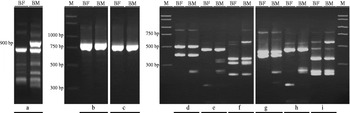
Agarose gel electrophoresis studies showed that JMS900 marker was not present or not detectable in female-bulked samples, while all the male samples contained JMS900 markers (Fig. 1a). Male-specific JMS900 amplicons were cloned and sequenced. Sequence analysis indicated that JMS900 amplicons contained at least four different DNA sequences ranging in size from 888 to 852 base pairs (bp). This indicated that single amplicons in agarose gels contained at least four different sequences. Using the four JMS900 amplicon sequences, a total of four primer pairs were developed.
Amplification and restriction enzyme digestion studies. (a) Amplification of the MS900 marker showing clear male-specific amplicon at about 900 bp. (b and c) Amplified products of J888 and J818 primer pairs showing monomorphic amplicons in male and female samples, respectively. (d–f) J888 primer pair-amplified products digested with Hind III, Hinf I and Cla I restriction enzymes, respectively. (g–i) J818 primer pair-amplified products digested with Hind III, Hinf I and Cla I restriction enzymes, respectively. M, DNA size markers; BF, bulked female; BM, bulked male jojoba genomic DNA.

Gradient PCR studies indicated that one of the four primer pairs could not amplify, or produced very weak, amplicons among female and male genomic DNA samples. Three primer pairs were used for screening the genomic DNA of bulked male and female samples; however, none of the amplicons were polymorphic among the female and male jojoba plants. It is possible that female DNA samples might have contained the JMS900 amplicon, but they were not detected using the standard agarose gel electrophoresis studies (Figs 1a–c), or females may have a mutation around the JMS900 sequences and hence no amplicons were produced.
Amplified products of the three primer pairs derived from the sequence of JMS900 were digested with several restriction enzymes to investigate whether JMS900 marker could be converted to CAPS markers. Analyses indicated that among the restriction enzymes used three (Cla I, Hind III and Hinf I) produced polymorphic fragments in male- and female-bulked samples amplified with J880 (Figs. 1d–f) and J818 primer pairs (Figs 1g–i, Table 1). Although majority of the other restriction enzymes digested the amplicons, they could not produce polymorphism between female and male samples. The results also indicated that the product of the J880 primer pair, although digested with majority of the restriction enzymes, could not differentiate between male and female samples.
Development of male-specific CAPS marker (CAPS J888-Hind III)
A male-specific CAPS DNA marker distinctly differentiating males from females was developed. The forward and reverse (F/R) primer pair of J888 contained 10 bases of the JMS900 primer (5′-AGACCCAGAG-3′) at their 5′ ends. The F primer contained an addition of 10 bases of CACACACAGC and the R primer contained an addition of 11 bases of GATGAGGAATG. In order to evaluate the differentiation power of the J888 primer pair-amplified product, 16 male and female genomic DNA bulks were used. The results clearly indicated that this primer pair was able to amplify a single DNA amplicon in all of the male and female plants analysed, the size of which agrees well with the target sequence.
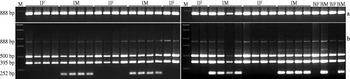
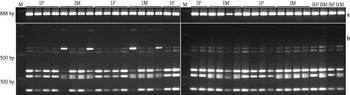
Analyses indicated that when digested with Hind III restriction enzyme all female amplicons were cut into two fragments and all the male amplicons were cut into three fragments (Fig. 2). The PCR amplification and restriction enzyme studies were repeated three times and all the analyses results were consistent, indicating reliability of the male-specific CAPS marker. Further analyses were performed on the genomic DNA of 36 control jojoba samples to test the reliability and reproducibility of this CAPS marker. Results clearly indicated that amplified products of the J888 F/R primer pair and Hind III restriction enzyme digestion could be used in male jojoba plant identification. This marker was called (CAPS J888-Hind III).
CAPS J888-Hind III marker. (a) Amplified products of J888 primer pair showing clear single amplicon at about 888 bp. (b) Amplified products digested with Hind III restriction enzyme. At about 252 bp products were always present in individual and bulked male samples, while these products were not seen in individual and bulked female samples. M, DNA size markers; IF, individual female; IM, individual male; BM, bulked male; BF, bulked female jojoba genomic DNA.

Development of male-specific CAPS marker (CAPS J818-Hinf I)
J818 F/R primer pair was developed based on the 818 bp in JMS900 sequence. The F primer consisted of 5′-AGGGGATAAATGAGCCGAAT-3′ and the R primer consisted of 5′-GACCCAGAGGATGAGGAATG-3′ nucleotides. In order to evaluate differentiation power of the J818 F/R primer pair a total of 36 male and female genomic DNA was used. Agarose gel electrophoresis studies clearly indicated that this primer pair was able to amplify a single DNA amplicon in all the male and female plants analysed.
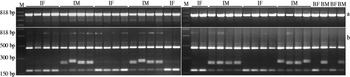
Two Hinf I digests (digested amplicons) were present in all the male samples, while these fragments were absent in female samples. One of two digestion products in male samples segregated among male plants and the other fragment was specific to male plants. Fragments of higher molecular weight in the male samples (Fig. 3) segregated as a recessive allele (being present in eight samples out of 40) as judged from 40 male jojoba genomic DNA, while the lower fragment segregated as the dominant allele (being present in 32 samples out of 40, data not shown). One of the two amplicons was present in all the male samples without segregations. Further analyses were also performed on the genomic DNA of 36 control jojoba samples to test the reliability and reproducibility of this CAPS marker. Analyses clearly indicated that amplified products of the J818 F/R primer pair and Hinf I restriction enzyme digestion could be used in male jojoba plant identification. This marker was called (CAPS J818-Hinf I).
CAPS J818-Hinf I marker. (a) Amplified products of J818 primer pair showing clear single amplicon at about 818 bp. (b) Amplified products digested with Hinf I restriction enzyme. Two distinct products at about 260–280 bp products were always present in individual and bulked male samples, while these products were not seen in individual and bulked female samples. M, DNA size markers; IF, individual female; IM, individual male; BM, bulked male; BF: bulked female jojoba genomic DNA.

Development of gender-specific CAPS marker (CAPS J888-Cla I)
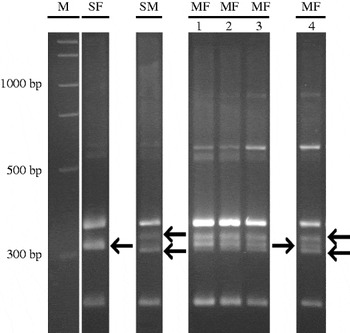
Amplified products of the J888 primer pair were digested with Cla I restriction enzyme. Cla I digestion resulted in several fragments (Fig. 4). The sizes of gender-specific markers were between 500 and 300 bp, with female plants containing two and male plants containing three fragments of these sizes. In order to evaluate this CAPS marker, PCR amplification and restriction enzymes studies were repeated thrice using the genomic DNA of individual male and female samples (Fig. 5). The results clearly indicated that amplified products of the J888 F/R primer pair and Cla I restriction enzyme digestion could be used in male and female jojoba plant identification.
CAPS J888-Cla I marker. (a) Amplified products of J888 primer pair showing clear single amplicon at about 888 bp. (b) Amplified products digested with Cla I restriction enzyme. There were three restriction enzyme products between 500 and 300 bp. Female plants contained two and male plants contained three fragments. Female-specific fragment sized between the two female-specific fragments. M, DNA size markers; IF, individual female; IM, individual male; BM, bulked male; BF, bulked female jojoba genomic DNA.

Differentiation power of female- and male-specific CAPS-Cla I markers. M, DNA size marker; SF, single female; SM, single male; MF, male and female genomic DNA were mixed. MF1, 0·33 female and 0·67 male; MF2, 0·67 female and 0·33 male; MF3, 0·25 female and 0·75 male’ MF4, 0·20 female and 0·80 male.

This marker, called CAPS J888-Cla I, will probably also useful in the identification of hermaphrodite jojoba plants. Although monoecious or hermaphrodite plants are uncommon in jojoba, dioecious, monoecious or hermaphrodites coexist in some plant species (Hamadina et al. Reference Hamadina, Craufurd and Asiedu2009). When hermaphrodites are found in natural populations of jojoba, or mutagenesis-directed hermaphrodite jojoba is obtained by, e.g. targeting induced local lesions in genomes (TILLING), a DNA marker specific to only male or female individuals could give contradictory results. In order to test the sensitivity of the CAPS J888-Cla I marker, the genomic DNA from male and female samples were mixed to make artificial hermaphrodite samples by mixing male and female genomic DNA in different proportions: 0·33 female and 0·67 male, 0·67 female and 0·33, 0·25 female and 0·75 male and 0·20 female and 0·80 male (Fig. 5). Also several male and female DNA were equally mixed (data not shown). In all cases, the CAPS J888-Cla I marker could identify male and female fragments in different male and female genomic mixtures.
Sequence analysis of cloned amplicons
Analyses indicated that DNA sequences from which J888 and J818 primer pairs were designed were very similar showing several single nucleotide polymorphisms. Different restriction enzyme digestion patterns on amplicons amplified with J888 and J818 primer pairs confirmed that two sequences were not identical. All the DNA sequences (four in total) were searched using BLAST for identifying homology within the GenBank databases. However, none of the sequences had significant homology within the GenBank databases.
Both sequences from which J888 and J818 primer pairs obtained were analysed using the Sequencher program (Gene Codes, Ann Arbor, MI, USA). Results indicated that both sequences had recognition sites for Cla I, Hind III and Hinf I digestions. However, when genomic DNA was amplified with the J888 and J818 primer pairs and digested with these enzymes, some extra fragments were obtained. This was probably due to the fact that J888 and J818 primer pairs amplify different regions related with sex loci in the genome.
DISCUSSION
PCR has been proved to be a reliable strategy for detection of sex-specific markers in dioecious plant species. Among the PCR-based DNA markers, RAPD is the cheapest technique, but it has several drawbacks including false positive/negative and reproducibility problems. Thus, its use gradually paved the way for more advanced molecular techniques (Karaca & Ince Reference Karaca and Ince2008) such as SCAR and CAPS markers, originating from RAPD markers and developed to identify sexes in many plant species (Urasaki et al. Reference Urasaki, Tokumoto, Tarora, Ban, Kayano, Tanaka, Oku, Chinen and Terauchi2002; Jhang et al. Reference Jhang, Kaur, Kalia and Sharma2010; Li et al. Reference Li, Yang, Li, Yang, Yin and Gan2010).
The CAPS marker is expected to solve the false-negative/positive and reproducibility problems associated with RAPD methods. In comparison with RAPD, CAPS is more resilient (less sensitive) of false-positives as the detection of a specific target is dependent on restriction digestion instead of PCR amplification, which is usually more vulnerable to experimental conditions than restriction enzyme digestion. However, CAPS and SCAR systems require primer pairs that can amplify all the targeted genomic sequences simultaneously and equally. The CAPS system, unlike SCAR, also requires selection of restriction enzymes for the detection of specific sequences (Ince et al. Reference Ince, Karaca and Onus2010b).
This study intended to develop SCAR or CAPS markers from OPG51400, UBC807 and JMS900 previously reported (Agrawal et al. Reference Agrawal, Sharma, Gupta, Kumar and Prasad2007; Sharma et al. Reference Sharma, Agrawal, Gupta, Kumar and Prasad2008; Ince et al. Reference Ince, Karaca and Onus2010a). However, in contrast to the reports by Agrawal et al. (Reference Agrawal, Sharma, Gupta, Kumar and Prasad2007) and Sharma et al. (Reference Sharma, Agrawal, Gupta, Kumar and Prasad2008), OPG51400 and UBC807 were not male specific and therefore were not included in cloning and sequencing analyses in this study. Several primer pairs were developed from the sequences of male-specific JMS900 marker. However, none of these primer pairs used in SCAR analyses differentiated male from female samples.
Sequence and restriction enzyme digestion studies indicated that JMS900 amplicon consisted of several DNA sequences whose primer binding sites were identical. Two sequences of JMS900 amplicon were very similar, differed only few nucleotide differences (J818 and J888). The other two sequences were different from each other and from J818, and J888 sequences. Using all the four sequences, no similar sequence was found by BLAST search within the GenBank databases (http://blast.ncbi.nlm.nih.gov/Blast.cgi). Results indicated that the frame −2 of J888 and J818 sequences contained an open reading frame (ORF) starting 306 bp with an ATG and ending at 428 bp with a TAA, coding 40 amino acids. Frame −2 sequence also contained 207 bp length without an ATG start codon. However, it is not possible to ascertain whether the sequence is part of the gene(s) for sex determination in jojoba, and therefore, these sequences were not submitted to GenBank databases. Further studies required to identify gene(s) responsible for sex determination in jojoba.
None of the four primer pairs developed from four sequences could differentiate male and female samples; therefore, they could not be converted to SCAR markers. However, in this study, three different CAPS assays, based on three different restriction enzymes and two primer pairs, were determined. These are the first CAPS markers ever developed, to our knowledge, for determination of male and female jojoba plants. They could be used in the plantation of jojoba with a well-balanced male and female ratio and breeding studies.
The CAPS markers developed in this study could be used for identifying male and female seedlings obtained from seeds. Since the male:female ratio of plants obtained from seeds has a 5:1 male and female ratio, as reported earlier (Harsh et al. Reference Harsh, Tiwari, Patwal and Meena1987), CAPS markers could be used in early determination of sexes in jojoba plantation. Among the CAPS markers reported in this study, J888-Cla I differed from JMS900. The use of JMS900 assumes that female jojoba plants are those which do not have the JMS900 marker. However, the JMS900 marker could not identify individual sexes from mixed male and female DNA samples, and so it is assumed that it cannot differentiate naturally occurring hermaphrodite jojoba, reported in Vaknin et al. (Reference Vaknin, Mills and Benzioni2003), or induced hermaphrodite jojoba plants which could be obtained using reverse-genetic and TILLING experiments (Martin et al. Reference Martin, Troadec, Boualem, Rajab, Fernandez, Morin, Pitrat, Dogimont and Bendahmane2009). Therefore, researchers dealing with TILLING studies or identifying hermaphrodite from seedlings could use the gender-specific CAPS marker developed in this study.
The CAPS markers (CAPS J818-Hinf I and CAPS J888-Hind III) provide several advantages over JMS900. The RAPD marker MS900 is more prone to reproducibility problems owing to the fact that it uses shorter and single primers, unlike CAPS markers developed in this study, and is more vulnerable to experimental conditions (Karaca & Ince Reference Karaca and Ince2008). The CAPS system is easy to assay and more informative than dominant markers such as JMS900.
It is known that the composition of jojoba wax, simmondsin and its derivatives in the seeds and leaves is influenced by both male and female genotypes, along with environmental factors such as climate and salinity. The use of male jojoba plants with desirable traits including production of large quantities of highly viable pollen, and bloom period at the same time as the female plants in the plantation is critical in jojoba improvement (Benzioni & Vaknin Reference Benzioni and Vaknin2002; Vaknin et al. Reference Vaknin, Mills and Benzioni2003; Benzioni et al. Reference Benzioni, Mills, Van Boven and Cokelaere2005). Therefore, the CAPS markers reported in this study along with DNA markers linked to agronomically important traits will be useful in jojoba breeding studies. For instance, one of the CAPS markers reported in this study, CAPS J818-Hinf I, contained another marker showing segregation in dominant fashion with the male-specific marker. These kinds of markers could be used in the selection of superior genotypes with desired characteristics. Current jojoba improvement programmes generally use several criteria including high seed yield, consistency in production, wax content and quality, and plant habit. Thus, DNA markers linked to these criteria will be very helpful in jojoba breeding.
This research was supported by the Scientific Research Projects Coordination Unit of Akdeniz University and the Scientific and Technological Research Council of Turkey. We thank three anonymous referees for contributing valuable information to this manuscript.