Introduction
The defeat of the Taiwan's Democratic Progressive Party (DPP) in the presidential election in March 2008 was a blow for the party, but the shocking aid scandal that forced three top DPP officials to resign was the final straw.Footnote 1 The scandal refers to the mislaying of US$30 million in foreign aid. Reportedly, Taiwan remitted the money to a joint account of two brokers in a Singapore bank on 24 September 2006 in the hope of establishing diplomatic ties with Papua New Guinea. The project was abandoned after the Republic of China (ROC) government stated that Papua New Guinea was unlikely to extend diplomatic recognition to Taiwan. It was unclear whether the officials embezzled the missing funds, but the usage of fraudulent brokers to win allies for Taiwan truly highlighted the nature and dilemma of Taiwan's foreign aid policy.
Taiwan possesses two unique features. Economically, Taiwan is regarded as an economic miracle in the region. So although Taiwan is a small state with scarce natural resources, it has grown strong through successful economic development in terms of its foreign reserves, foreign trade, and gross national product. This has all been accomplished despite the fact that Taiwan has been diplomatically isolated in the international arena since 1971, when it lost its membership in the United Nations (UN) to China. Moreover, China has sought to exclude Taiwan from the international arena, vowing to sever or downgrade relations with any country that endeavors to strengthen diplomatic relations with Taiwan. Consequently, as of March 2016, only 22 countries officially recognized Taiwan.Footnote 2 In order to engage in the diplomatic competition across the Taiwan Strait, as well as to remain competitive globally, Taiwan launched a policy of pragmatic diplomacy at the end of the 1980s, employing its economic strength to foster interactions with friendly countries and enlarge its web of connections with the international community. One important instrument that has been frequently utilized by Taiwan to pursue its foreign policy goals is foreign aid – defined here as bilateral official development assistance (ODA).
Theories of foreign aid behavior focus primarily on discussions of the motivation for foreign aid giving by major donors and strong states, but little light is shed on the management of foreign relations of small states that are caught between the push and pull of greater powers and aid recipient states. Two primary donor state motivation discussions center around an economic/mercantilist argument or a political reform/humanitarian approach. Schraeder et al. (Reference Schraeder, Hook and Taylor1998) analyzed four major aid donors – US, France, Japan, and Sweden – during the Cold War and found that economic, security, and cultural interests determined their aid allocation decisions. Foreign aid in the US in the 1950s and1960s served as a tool for US economic statecraft, and economic sanctions were often used to exert power and influence over aid recipients (Baldwin, Reference Baldwin1985). The intent to spread democratic values and human rights also often drives the foreign aid decisions of strong states (Stokke, Reference Stokke1996). However, Taiwan, as a middle power small state and a former aid beneficiary turned donor, is empirically intriguing. Given its political situation with China, there is a stark mismatch between the size of Taiwan's economy and its international status. Faced with political restrictions, ODA is used as an instrument of soft power and as a tool to achieve status change by promoting upward mobility internationally and building stronger relationships with countries aspiring similar economic growth. In addition, a relational lens is needed to examine a middle power state's foreign aid motivations and transitions.
Simultaneously at the global level, we have also witnessed a substantial transformation of traditional bilateral ODA into a concept of international development and cooperation. Compared to strategic and diplomatic considerations during the Cold War era, the issue of human development is now receiving more attention from donor and recipient governments. The emergence of the international aid regime and non-state actors also illustrates the growing priority of human development. In this context, the nature of foreign aid has been gradually modified from a state-centered to a society-centered perspective. A state-centered perspective underlines features of ODA that rely mainly on politically motivated governmental transactions between donor and recipient countries. Building on a people-oriented approach, however, the society-centered aspect highlights the core value of individual development, which in turn emphasizes the important issues of poverty eradication, human rights, health, sanitation, technical support, education, environmental protection, and women's rights for people living in developing countries. This also demonstrates the role and function of non-governmental organizations (NGOs) internationally (Clark, Reference Clark1991; Hulme and Edwards, Reference Hulme, Edwards, Hulme and Edwards1997; Bebbington and Farrington, Reference Bebbington and Farrington1993; Brown and Timmer, 2006).
It is in this context that Taiwan's foreign aid entered into a transitional phase, even though diplomatic and aid competition across the Taiwan Strait never ceased. The sophisticated concept of international development and cooperation also implies that governments are no longer able to monopolize their foreign aid programs, in terms of aid design and implementation. Moreover, the complexity of the issue of human development has inevitably transformed the traditional ODA to become more diversified and specialized. In this paper, we aim to understand what motivated the direction of Taiwan's aid policy from a relational perspective, that brought about the transition in aid approaches to one that incorporated civil society actors. We claim that the enhancement of international status has continually been the most important determinant in Taiwan's foreign aid policy-making. Strong diplomatic motivation determines the distribution of Taiwan's aid recipients, and the selection of aid recipients largely reflects the competition between Taiwan and China. We also argue that Taiwan's economic development trajectory has played a crucial role in shaping the essence of Taiwan's foreign aid program. However, under the guidance of the ‘Millennium Development Goals’ and the new revisions of the foreign aid programs of the International Cooperation and Development Fund (ICDF),Footnote 3 Taiwan's foreign aid program along with NGOs, have been gradually extended to countries without any official relations with Taiwan. The integration of a civil society approach in aid to regions without diplomatic ties demonstrates the maneuvering of a small state to stay relevant internationally, but at the same time it fills a niche that its big state competitor ignores, since China has no civil society organizations (CSOs) conducting foreign aid at the moment.
Political determinants and the selection of aid recipients
In studies of foreign aid policy, scholars have argued that a strong relationship exists between foreign policy and foreign economic assistance (von Vorys, Reference von Vorys1967; Black, Reference Black1968; Huntington, Reference Huntington1970; White, Reference White1974; Norr, Reference Norr1975; Baldwin, Reference Baldwin1985; Lin, Reference Lin1996). The donor's motivation in giving aid is to pursue its own national interest. The pattern of aid distribution not only highlights the donor's strategic or political interests, but also indicates some historical relationships between donors and recipients (Lin, Reference Lin1996: 61). In other words, the discrepancies in the donors’ foreign aid policies underline the fact that the donors may pursue their different policy goals toward various recipient countries.
The merits of the donor approach help explain the momentum of bilateral aid transactions from the donor's perspective. This approach assumes that the interaction between donors and recipients tend to begin with the diplomatic considerations of the donor government (Lin, Reference Lin2000: 155). There is abundant statistical evidence that the donor's political interests, rather than general considerations of efficiency or the recipient countries’ policies and needs, have dominated the donor country's allocations of bilateral aid (von Vorys, Reference von Vorys1967; McKinley and Little, Reference McKinley and Little1978; McKinley and Little, Reference McKinley and Little1979). As a result, whether one country should give aid to another is a question that is certainly related to the donor's foreign policy (Black, Reference Black1968: 18). Developmental, humanitarian, and commercial motives are related to or combined with diplomatic motives. However, these studies mainly focus on big states (e.g., the US) or major donors (e.g., Japan). For Japan, aside from mercantilist and humanitarian motives, scholars have also argued that Japan's foreign aid had ‘reactive’ and dependent characteristics, much reflecting its relationship and strategy alignment with the US (Brook and Orr, Reference Brook and Orr1985; Yasutomo, Reference Yasumoto1986; Calder, Reference Calder1988; Inada, Reference Inada1989; Katada, Reference Katada1997; Katada, Reference Katada2001). This highlights an important relational framework for analyzing foreign aid decisions – states make foreign aid decisions in relation to other states whether in collaboration (US and Japan) or in competition (Taiwan and China). Particularly, the management of foreign relations of small states or ‘middle powers’,Footnote 4 which are situated among greater powers, and aid recipient states should be studied with a relational emphasis.
As a former aid recipient but now a middle power state with a complex political relationship with China, Taiwan perceives its foreign aid primarily as an instrument for improving or maintaining its status (Taylor, Reference Taylor2002) and striving for recognition in the international community (Larus, Reference Larus2006). Taiwan is a country that is economically strong but diplomatically weak (Chan, Reference Chan1997), and it maintains official relations with mostly small states. Not only do aid recipients directly benefit from Taiwan's foreign aid programs, but Taiwan would also benefit from its aid-giving by gradually upgrading its relations with recipient countries, politically or economically. In 1988, Taiwan's International Economic Cooperation and Development Fund (IECDF) was expected to achieve the following goals:Footnote 5 (1) to assist friendly developing countries in their economic development; (2) to enhance bilateral economic cooperation; (3) to help Taiwan reenter the international community; and (4) to help Taiwan break out of its diplomatic isolation.Footnote 6 Moreover, according to the regulations governing the IECDF, developing countries that receive low-interest loans should be ‘friendly’ towards Taiwan. Taiwan's foreign aid policy was thus centrally politically motivated,Footnote 7 with expectations of recipient reciprocity. In 1993, the IECDF was further enhanced to address the following foreign policy goals through its foreign aid: to secure existing diplomatic relations; to achieve diplomatic breakthroughs with aid recipients or with countries interested in becoming recipients of foreign aid; to advance existing relations with recipients; to maintain or improve substantive relations with recipient countries; and to develop relations with countries that are interested in such aid programs (MOFA Yearbook, 1988).
It may be difficult to understand the aid distribution patterns of China and Taiwan in the 1990s without appreciating the extent of the diplomatic competition that has long existed between these two governments. As a result of political antagonism across the Taiwan Strait, Taiwan has engaged in pragmatic diplomacy since the end of the 1980s in an attempt to reenter the international community and to establish more diplomatic relations with foreign countries. For example, both China and Taiwan deployed hefty sums of monetary aid in the 1990s to Africa and beyond, with China offering financial rewards to states willing to switch their allegiances (e.g. Zambia, St. Lucia) (Snow, Reference Snow, Robinson and Shambaugh1994). China and Taiwan have also both competitively courted ‘unimportant’ and problematic regimes for recognition. Even while the global community was considering economic sanctions against the Nigerian regime in 1997, China was negotiating infrastructural deals with the country. Taiwan also supported the former junta in Guatemala and the warlord/president in Liberia (Taylor, Reference Taylor2002).
The cross-strait diplomatic competition is particularly fierce within the UN and it may explain why certain aid recipients were chosen by Taiwan. Since 1971, after losing membership in the UN, coupled with the intensifying political antagonism across the strait, Taiwan has maneuvered its foreign policy goals by using foreign aid as an instrument, with the intention of reentering the international community and enhancing diplomatic relations with developing countries. The pursuit of the above foreign policy goals greatly determined Taiwan's selection of its aid recipients (Lin, Reference Lin1996; Lin, Reference Lin2000). Since 1993, Taiwan's attempts to reenter the UN have also become a dominant foreign policy goal in Taiwan.Footnote 8 The movement has accordingly ignited another new phase for Taiwan to reinforce its aid giving to gain diplomatic support among its aid recipients. Because the voting mechanism in the UN is one country, one vote, Taiwan is thus obliged to mobilize the necessary support from as many members of the UN as possible.Footnote 9
Countries that support Taiwan's bid for UN reentry are known to have received foreign aid from Taiwan as a reward for their support. In the 1990s, the geographical distribution of these aid recipients was mainly concentrated in Latin America and Africa. For example, the Solomon Islands, Nauru, Malawi, Palau, Swaziland, Tuvalu, Sao Tome and Principe, St. Christopher and Nevis, St. Vincent and the Grenadines, Honduras, Burkina Faso, Kiribati and Belize not only supported Taiwan's bid for UN membership in the 1990s, but they were also aid recipients of Taiwan at the time. It is worth noting that, although ODA has been an indispensable tool for Taiwan in eliciting the diplomatic support for its bid to join international organizations such as the UN and the WHO,Footnote 10 the limited number of the countries that recognize Taiwan has been a demoralizing impediment to Taiwan's efforts.
Regardless, foreign economic assistance became a useful means to pursue its foreign policy goals (MOFA Yearbook, 1988). These foreign policy goals had a direct impact on Taiwan's selection of aid recipients and explain its desperate need for diplomatic support from its own aid recipient countries. From 2008 to 2016, during which President Ma Ying-jeou was in office, there was a ‘diplomatic truce’ between Taipei and Beijing, based on consensus that China would not poach any of Taiwan's remaining allies as long as Taiwan did not actively seek new ones. However, in the case of Taiwan's former diplomatic ally, the Republic of Gambia – who severed ties with Taiwan in 2013 – resumed ties with China in March 2016, demonstrating the volatile nature of diplomatic support towards Taiwan.
In sum, it is clear that in a traditionally bilateral ODA framework, the donor seeks to induce any influence on the recipient government, either looking for the recipient's international support, to change its voting behavior or for diplomatic recognition. However, the selection of the recipient countries reflects a relational framework under which the decision was made – a contextually competitive relationship with China. In addition, to be a middle power, a state ‘must exercise international leadership but usually does so only on certain issues and in cooperation with other states or through international organizations’ (Gilboa, Reference Gilboa2009). Empirically, Taiwan has not done much in terms of foreign aid cooperation with other states given its status and international competition with China; however, a later shift in foreign policy towards a civil society approach has expanded Taiwan's collaboration with international organizations (Jie, Reference Jie2001) and states without actual diplomatic ties. Taiwan poses as an interesting case, reflecting a strongly relational decision-making process vis-à-vis China, and in a highly competitive instead of collaborative environment that is often assumed to be the starting point for discussions of international development.
Characteristics of Taiwan's pre-2000 aid program and geographical trends
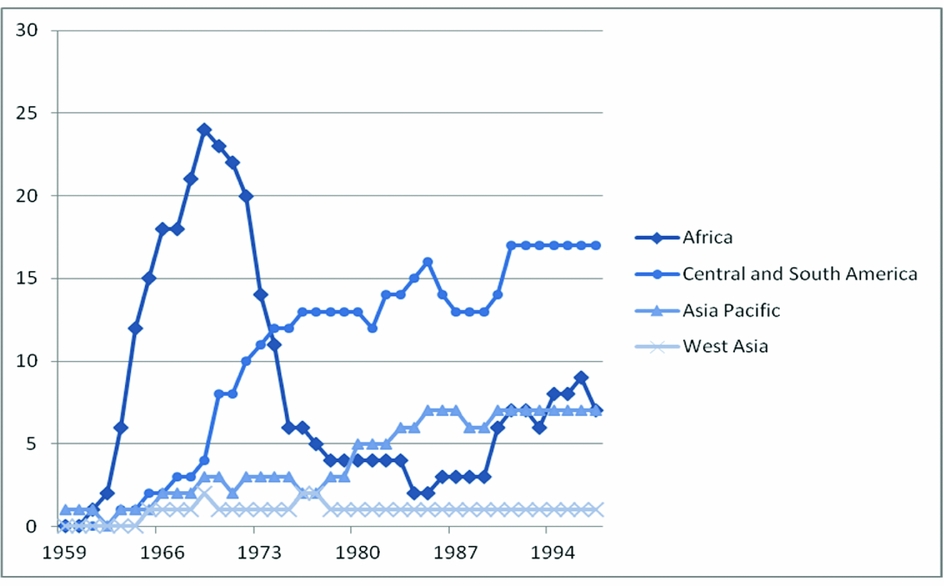
In 1956, China launched its foreign aid to Africa. In 1959, Taiwan followed suite and started providing economic aid for countries in the Asia region.Footnote 11 The changes in Taiwan's foreign aid recipient distribution largely reflected its diplomatic position. As we can see from the longitudinal data on technical mission groups (Figure 1), prior to the 1970s, Taiwan had largely provided assistance for African nations. However, after losing its UN membership in 1971, the number of technical mission groups sent to Africa drastically declined, with only three countries remaining in the 1980s. As China increased diplomatic relations with African nations and focused on infrastructural development projects in Africa as part of its aid program, we observe a clear geographical shift in Taiwan's technical mission groups. After 1971, Taiwan gradually shifted its aid missions to Latin American countries. Assistance in the Asia Pacific region also gradually increased in the 1980s. This is largely a reflection of Taiwan's diplomatic plight and, relationally, its foreign aid competition with China. However, in addition to political and diplomatic incentives in aid recipient selection, these trends demonstrate another important characteristic of Taiwan's aid program – one that adheres to its own economic development story.
Number of technical mission groups sent by Taiwan by geographical region, 1959–1997

Taiwan has experienced rapid economic development since the late 1980s. Its participation in the free market has become an economic model for many developing countries. The spirit of this development model is reflected in the characteristics of Taiwan's foreign aid policies since then. From 1988 to 1996, Taiwan's aid package emphasized low-interest loans, re-lending loans, technical cooperation, and training programs in an effort to promote the spirit of Taiwan's economic development miracle to recipient developing countries.
In 1992, the IECDF extended loans amounting to US$314.65 million to sixteen countries.Footnote 12 For instance, the IECDF provided re-lending loans to friendly developing countries for the purpose of helping their small and medium-sized businesses to increase production and create more jobs, thereby raising national income and attaining sustained economic growth and equitable distribution of wealth. These loans are offered through the government or other intermediary agency of a friendly developing country for the exclusive use of small and medium-sized enterprises. In 1993, the IECDF offered Vietnam and Costa Rica loans of US$15 million each for reinvesting in the development of their medium and small-sized enterprises.
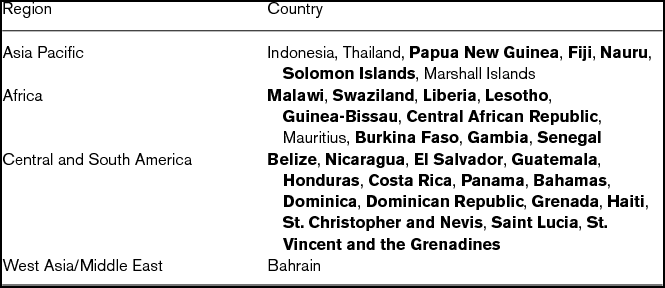
All of the IECDF's technical assistance was provided in the form of grants. The aim of such assistance was to help developing countries make full use of their human resources, upgrade their technological capability, and stimulate their economic growth. Operations under this category include conducting feasibility studies for development projects, dispatching of experts, and donation of equipment and materials. For example, in 1993 Taiwan provided project technical assistance to 19 countries, with a total amount of US$6.654 million and NT$70.528 million.Footnote 13 According to Table 1, from 1988 to 1997, the technical assistance mission groups were sent mainly to countries that have, or at some point had, official diplomatic relations with Taiwan (28 out of 33, or 84.8%). The remaining five countries, although without official diplomatic relations, had substantive relations with Taiwan. For example, each of these countries had a TECO (Taipei/Taiwan Economic and Cultural Office) established.
Taiwan's technical assistance mission groups by country and region, 1988–1997

Note: Countries in bold are those countries that have or once had official diplomatic ties with Taiwan.
Source: Authors’ own compilation with data from Overseas Technical Cooperation Committee, Hai wai ji shu he zuo wei yuan hui li jing 36 nian zhi hui gu (Reviewing 36 Years: Overseas Technical Cooperation Committee) (Taipei: Overseas Technical Cooperation Committee, 1997, pp. 47–56).
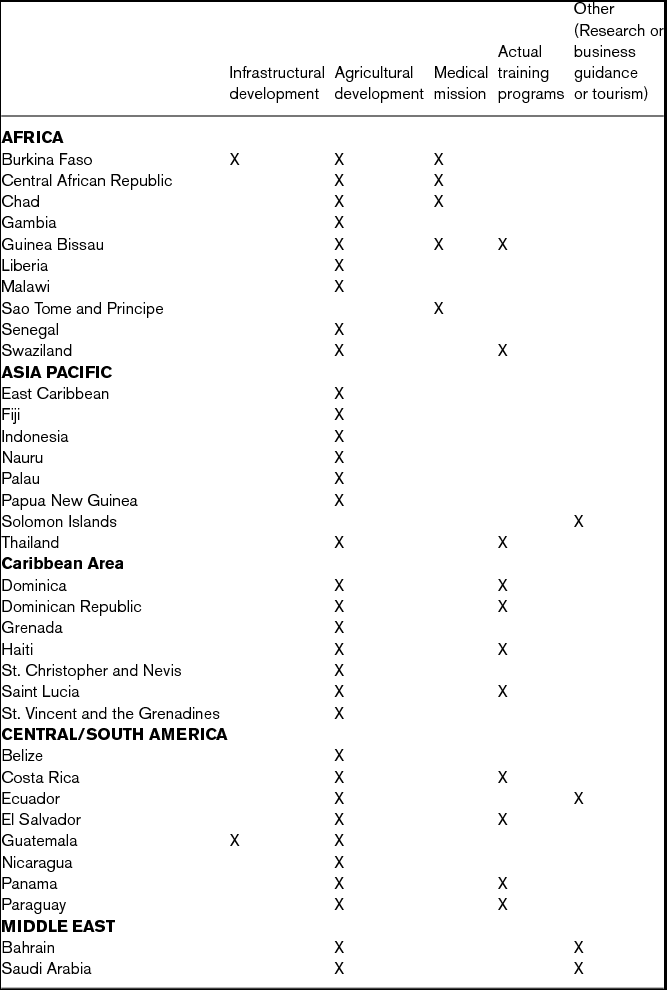
According to ICDF data, the technical mission program includes areas such as agricultural development projects, training programs, medical missions, and to a lesser extent, infrastructural development projects (see Table 2). In 1998, the language of the report focused on mission and program ‘achievements’ such as the number of classes provided or the number of animals raised. There was a large focus on agricultural development projects and training programs, particularly in the Latin American region. However, in 1999 and 2000, there was a shift to more detailed reporting on the ‘supervision and evaluation’ of programs and names of actual supervising personnel rather than achievements. The reports detail dates of mission conducted and nuanced program descriptions such as, ‘Haiti: assessment of microcredit program, potable water project, and Institute of Female Entrepreneurs project’ or ‘Costa Rica: assessment of small farmer loan program and supervision of Costa Rica Moin Harbor Project, Naranjo to Florencia Freeway Project, CABEI infrastructure project and SME relending loan for Five Central American Countries’.
Taiwan Aid Program Content by Country/Region (1998)

Source: Authors’ own compilation based on 1998 ICDF Annual Report.
Prior to 2000, Taiwan's aid recipients geographically cluster in the regions of Southeast Asia and Latin America. Compared to African nations that receive aid from China, Southeast Asian and Latin American countries appear to have a higher level of economic development, which mirrors the discrepancy of the developmental models between Taiwan and China. This demonstrates that the development experience of Taiwan as reflected in the aid package corresponds with the development needs of these recipient countries. While China's foreign aid programs are predominantly shaped by the principle of economic self-reliance with a strong commitment to infrastructural development, the development of medium and small-sized enterprises has been recognized as the key factor for Taiwan's economic prosperity (Lin, Reference Lin2000). Furthermore, the disparity of development levels among Taiwan's and China's aid recipients also contributes to the understanding of their choices in selecting aid packages from either Taiwan or China.
Millennium development goals and changing aid philosophy
Multilateral or bilateral ODAs generally aim to help developing countries bolster their economic development. Although the successful linkage of the donor's foreign aid and the recipient's economic development can be identified in many countries in the 1950s and 1960s, such as Taiwan, South Korea, and Japan, a great number of developing countries still failed to achieve economic growth to a great extent. As a result, at the end of the 1980s, many developing countries, after receiving great amounts of foreign aid from various donors, still suffered from underdevelopment and poverty. In addition, based on empirical studies, foreign economic assistance is not necessarily an essential factor for promoting a recipient's economic development and growth (Mikesell, Reference Mikesell1968).
In contrast to bilateral ODA, the concept of international development and cooperation highlights the importance of people-centered values, while traditional ODA mainly emphasizes governmental dimension. International development and cooperation also puts more emphasis on the ownership of developing countries in their process of development. The developing countries must also play a cooperative role with the donors in determining their developmental issues. In other words, the developing country or even a recipient country must be able to set up its own developmental agenda and autonomously determine how to conduct its own development. The reconceptualization of development thus involves the internal efforts from the recipient to reduce the issues of poverty and promote human rights among the grassroots (Mitlin, Reference Mitlin and Bernard1998).
To this end, studies indicate that development is a natural process that cannot be copied from any developed country. The economic assistance directed toward developing countries should not be intended to transplant a specific development model from the donor itself, but should be involved directly in the existing developmental process (Wilber and Jameson, Reference Wilber, Jameson and Wilber1988; Chilcote, Reference Chilcote and Wiarda1985; Smith, Reference Smith and Wiarda1985; Wiarda, Reference Wiarda and Wiarda1985; Kaplan, Reference Kaplan, Lewis and Wallace2000). Strengthening people's capacity to determine their own values and priorities, and to act on them, is thus the core value of development (Eade, Reference Eade1997). Contextual factors also need to be taken into account in order to truly diagnose the problems encountered by developing countries (Staniland, Reference Staniland1985). In this context, the UN announced its Millennium Development Goals (MDGs) in 2000.
Eight goals and 18 targets were set forth in the MDGs, which set priorities and directions for international development cooperation. Basic goals include eradicating extreme poverty, hunger, and disease. On a broader level, the MDGs also covered topics such as education, gender equality, health, environmental sustainability, trade, finance, debt relief, and information and communications technology. The announcement of the MDGs provided concrete objectives for the international community in carrying out aid work, and helped to promote the coordination and integration of aid resources. Although most developed countries had been shifting towards a framework of international development and cooperation, Taiwan and China were still locked up in a diplomatic and foreign aid competition with each other. As Taiwan's primary aid institution was dedicated to development assistance, the ICDF quickly revised its aid program to achieve similar goals. This demonstrates that Taiwan is eager to follow UN agendas and goals to remain in good standing with the institution and internationally. Taiwan ICDF's updated aid program covered four areas,Footnote 14 all of which adhered with its technical expertise: (1) Agricultural upgrading: pursuing added-value and sustainability;Footnote 15 (2) Private Sector Development: building a better business environment, and raising efficiency;Footnote 16 (3) ICT applications: reducing the digital divide, establishing the information society;Footnote 17 (4) Health care: training locals, creating a comprehensive public framework.Footnote 18 In 2013, MOFA announced that MDGs were to be the framework for Taiwan's international cooperation, seeking improved cooperative partnerships for developmental aid among countries with diplomatic relations, international organizations, and NGOs.Footnote 19
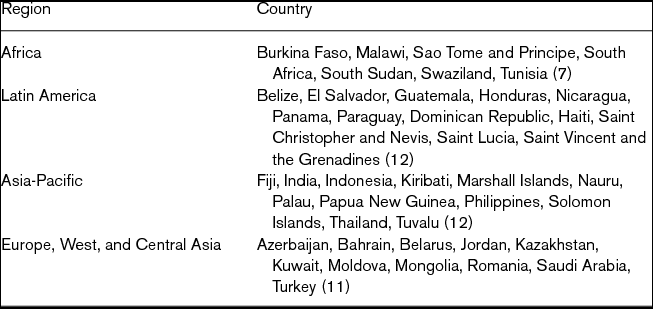
It is worth noting that in 2014, among Taiwan's 42 partner countries, 24 countries (57%) were mainly concentrated in Latin America and the Asia-Pacific region while 21 of these countries had official diplomatic relations with Taiwan (87.5%). In other words, the countries that officially recognized Taiwan all received aid from Taiwan. According to Table 3, geographically speaking, Taiwan's aid recipients are still concentrated in Latin America and the Asia-Pacific region. In Latin America, 12 countries received aid from Taiwan, and all are Taiwan's allies. In the Asia-Pacific region, however, only Kiribati, Marshall Islands, Nauru, Palau, Solomon Islands, and Tuvalu have diplomatic relations with Taiwan. In Africa, only Burkina Faso, Sao Tome and Principe, and Swaziland are Taiwan's diplomatic allies.Footnote 20 None of the countries in Europe, Western and Central Asia has diplomatic ties with Taiwan. These patterns reflect that Taiwan's provision of international development and cooperation are consistently motivated by the pursuit of foreign policy goals, although aid content had been revised after 2000. The slight increase in aid to Europe, Western and Central Asia is related to the shift towards humanitarian relief missions and projects in cooperation with NGOs, as we will address in the following section.
Geographical distribution of Taiwan's partner countries, 2014

Source: Authors’ own compilation based on ICDF, ICDF Yearbook 2014 (Taipei: ICDF, 2014).
Non-governmental organizations and civil society approaches to foreign aid
Under the framework of international development, non-state actors have come to gradually play important roles in conducting programs transnationally. In conducting poverty reduction, human rights promotion, environment protection and health enhancement in developing countries, NGOs have their own missions and expertise in pursuing of their goals. Often, they complement the work of governments internationally, but this is especially obvious in the case of Taiwan. As a state with only 22 recognized diplomatic ties, government ODA coverage is severely limited. Studies have shown that transnational NGO activities tend to contribute to mutual dialogue, cooperation, and coalitions (Khagram et al., Reference Khagram, Riker, Sikkink, Khagram, Riker and Sikkink2002; Clark, Reference Clark1995; Rosenau, Reference Rosenau1997). Therefore, NGOs are especially needed for Taiwan to be able to expand international work, and consequently, its international status. However, for most states, NGOs do not face restrictions from other non-recipient states when conducting work in a recipient country. But Taiwanese NGOs constantly experience repression from China when conducting international work, since the work can be interpreted as political expansion. Although government diplomatic motives encouraged early cooperation efforts between the government (ODA) and NGOs (humanitarian aid), we also witness how Taiwanese NGOs became increasingly autonomous in pursuing their own international agendas.Footnote 21 We also discuss the repression of Taiwanese NGOs internationally by China which is counterintuitive to the concept of cooperation in international development and traditional civil society approaches.
Beginning in the late 1990s, and coinciding with an extended period of democratization and economic growth, Taiwanese NGOs started to reach out to the international community with government encouragement. The international work of NGOs started being conducted alongside with governmental ODA. For example, in January 1999, the Taiwanese government not only promised US$300 million in ODA for Macedonia but Taiwanese NGOs also provided humanitarian assistance to Macedonia during the Kosovo crisis.Footnote 22 In the same year, Macedonia established diplomatic ties with Taiwan. After 2000, when the DPP became the ruling party in Taiwan, the concept of ‘people's diplomacy’ was frequently emphasized, with its intention to supplement the ineffectiveness of the so-called track-one diplomacy. In other words, Taiwanese NGOs have gradually been encouraged to participate further in the international community.
In order to facilitate the development of Taiwan's NGO sector and their international participation, MOFA established the NGO Affairs Committee in 2000. The goals of this committee were to promote Taiwan NGO's international activities, as well as to assist local organizations in taking part in international organizations, conferences, and exchange projects. In addition, the group also reviews the applications of domestic NGOs for the Ministry's financial and other forms of assistance. For example, the Committee supports NGO staff internships at international non-governmental organizations (INGO)s. This committee also monitors attendance at international NGO conferences and other activities, such as the American Council for Voluntary Action in Washington DC, and works towards strengthening cooperation between the Ministry and domestic NGOs in order to broaden relations with INGOs. This committee has also supported NGOs in humanitarian disaster relief efforts abroad (e.g. Indian Ocean tsunami relief efforts), particularly in helping NGO staff obtain visas and flights for relief efforts. The Taiwan Root Medical Peace Corps and the Buddhist Compassion Relief Tzu-Chi Foundation (Tzu-Chi Foundation) were both NGOs that conducted disaster relief efforts with support from MOFA.
In 2000, the ICDF (the primary aid institution dedicated to development assistance) actively sought out cooperation with NGOs that had expertise in core ICDF focus areas. The ICDF documented the first case of NGO–ICDF cooperation in humanitarian aid efforts in 2002: Taiwan Root Medical Peace Corps together with the ICDF set up free clinics for Tibetan refugees and children. The ICDF provided the medical supplies and equipment while the NGO contributed medical personnel. The scope of such cooperation expanded rapidly in the following years. For example in 2005, the ICDF worked with 16 Taiwanese NGOs, INGOs such as the Noordhoff Craniofacial Foundation, Mercy Corps, and the Chinese Christian Medical Mission and on several disaster relief, public health, and education projects across more than eight countries,Footnote 23 providing approximately US$300,000 in support. We can see that development aid through the cooperation of the ICDF and NGOs had begun expanding beyond countries with diplomatic ties. In addition, groups of Taiwanese NGOs with similar expertise and interests started frequently encountering one another in these cooperative ICDF projects. This manifested in the formation of their own alliance: the Taiwan Alliance in International Development (Taiwan AID), which was officially registered in 2013. This alliance, with nearly 30 members, serves as an interaction platform for Taiwanese NGOs working internationally, and aims to facilitate cooperation in development projects.
Although above are instances of government support and ICDF–NGO cooperation, Taiwanese NGOs now largely have autonomous agendas and goals in which the government does not intervene. In particular, religious NGOs in Taiwan such as Tzu-Chi Foundation, Dharma Drum Mountain Social Welfare and Charity Foundation, and Buddha's Light International Association have strong and active overseas activities. Interestingly, these NGOs are not part of the Taiwan AID alliance, even though the alliance includes many religious organizations. MOFA and ICDF cooperate only occasionally with these NGOs.Footnote 24 In 2008, the Tzu-Chi Foundation was the first Taiwanese organization to legally register with the Chinese government. In 2010, it was the only overseas NGO in China to receive permission from the Chinese Ministry of Civil Affairs to set up a nationwide charity foundation, despite being a religious organization. The foundation maintains a low-profile image, its own organizational agenda, 47 international locations, and generally does not seek Taiwanese governmental funding. China has not interfered with Tzu-Chi Foundation's work locally or overseas. The only other legally registered Taiwanese NGO in China is the Eden Social Welfare Foundation, which is one of the original organizers of the Taiwan AID NGO alliance.
However, Taiwanese NGOs have also increasingly faced restrictions imposed by China in recent years. For example, Taiwan Root Medical Peace Corps organized a medical mission to Myanmar in 2010, but, at the last minute, the Myanmar government did not authorize the trip, citing political instability reasons. However, internal communications revealed that Chinese officials had put pressure on the Myanmar government to refuse the mission. Myanmar does not have diplomatic ties with Taiwan, and China viewed the trip as one with a diplomatic expansion intent.Footnote 25 Again in July 2016, Taiwan Root Medical Peace Corps was refused entry to Kyrgyzstan where it was scheduled to conduct a medical mission. However, this time, a direct political reason was provided – the Kyrgyzstan governed cited the ‘one China’ principle when refusing entry to the NGO, even though arrangements had already been approved beforehand. Other examples include pressure from China for Taiwanese NGOs to change organizational names. For example, the Taiwan Society for Reproductive Medicine was first asked to change their name to ‘Chinese Taipei’, and later ‘Taiwan, China’, or the Taiwan Society for Internal Medicine as ‘Taiwan, China’.
While politically at odds with each other internationally, Taiwan and China have mutually provided disaster relief aid on numerous occasions. For example, after the May 2008 Wenchuan Earthquake in China, the DPP government provided a total US$66 million in aid, some paid in the form of cash and food by the government and the rest raised from civil servants and the public (US$50 million more than for the Indian Ocean tsunami aid).Footnote 26 In February 2016, following the magnitude 6.4 earthquake in Taiwan, China also donated US$304,059 to help with relief and reconstruction efforts.Footnote 27 With regards to NGOs, Taiwan's Tzu-Chi Foundation also donated US$73.53 million to the 2008 Wenchuan Earthquake, in addition to sending volunteers. This highlights the complex nature of Taiwan and China relations at the cross-strait level (less competitive) and at the international level (more competitive).
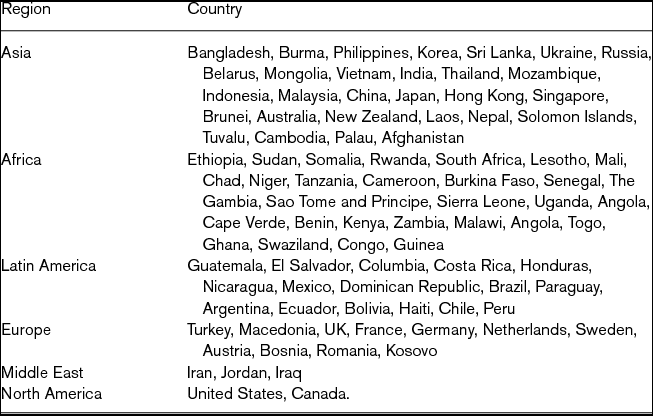
Overall, compared to Taiwan's ODA program, the international activities of Taiwan's NGOs have not only complemented the performance of so-called people's diplomacy or civil society-centered approaches, but also highlight two characteristics. Firstly, the recipients of their provision of humanitarian relief, development cooperation, and medical health are not only geographically located in Latin America and Southeast Asia, but are also conducted in Africa and other areas. According to Table 4, Taiwan's NGOs have cooperated with 29 Asian countries, 29 African countries, 16 Latin American countries, 11 European countries, three Middle Eastern countries, and two Northern American countries. Secondly, a great number of the recipients do not have official diplomatic relations with Taiwan. Among the 92 countries that cooperate with Taiwan NGOs, only 14 countries, Gambia, Swaziland, Saint Tome and Principe, Tuvalu, Palau, Solomon Islands, Costa Riga, Guatemala, Paraguay, El Salvador, Haiti, Dominican Republic, Honduras and Burkina Faso, diplomatically recognize Taiwan. Thirdly, Taiwan NGOs’ activities also extend to some developed countries, such as Japan, Singapore, Australia, New Zealand, United Kingdom, France, Germany, Netherlands, Sweden, Austria, United States, and Canada.
Regional distribution of Taiwan NGOs’ international activities, 2000–2007

Source: Authors’ own data.
The integration of a civil society approach in development aid to places without diplomatic ties demonstrates a small state's governmental efforts to stay relevant internationally. Under relational considerations, this fills a niche that its big state competitor does not have, since China has no NGOs currently conducting foreign aid. Although MOFA and its NGO Affairs Committee design programs that boost Taiwan's international standing, through supporting Taiwanese NGOs in international events and participation, it has also bolstered the development of civil society organizations, leading to sustainable NGO alliances and increasingly independent NGO development agendas.
Conclusion
Since the 1950s, both Taiwan and China have utilized foreign aid as an instrument of foreign policy. After Taiwan's forced withdrawal from the UN in 1971, diplomatic and aid-giving competition with China became much more intense and expansive. As a result, Taiwan's and China's struggles to gain supporters have historically demonstrated the importance of political incentives in their foreign aid policy-making. Taiwan's bid for the UN and the WHO, which started in 1993 and 1996 respectively, and the issue of diplomatic recognition all empirically illustrate the utilization of aid by Taiwan as a means to an end of obtaining diplomatic support from aid recipients. From the above analysis, even after the introduction of MDGs in 2000 and the changing content of ICDF's aid program, strong political motivations still play a dominant role in Taiwan's selection of its small state aid recipients, and the selection reflects its competitive relationship with China.
The development of Taiwan's civil society in recent years and the increasing international activities of Taiwanese NGOs in their provision of humanitarian relief and development projects have formed a new set of geographical distribution patterns of Taiwan's aid. Firstly, Taiwanese NGOs have extended their cooperation to more than 90 countries, although only 15 of the 90 countries officially recognize Taiwan. This indicates that the expertise of Taiwanese NGOs in international development and cooperation are highly sought despite the country's diplomatic situation. States must be willing to face potential pressure from China when accepting Taiwanese NGO assistance, and sometimes we see NGO aid missions blocked, as demonstrated in Myanmar recently. Secondly, development has been diverted from previous patterns, as now the partner countries of Taiwan's NGOs are symmetrically spread into different regions. In the past, Taiwan's aid recipients tended to cluster in small states in Latin America. However, in the current stage, the partners of Taiwan's NGOs are more inclined to be concentrated in Asia and Africa than in Latin America. This changing geographical pattern illustrates the global distribution of Taiwan's NGO work and also represents the ideals of civil society approaches. Taiwanese NGOs are thus becoming an indispensable component for Taiwan's international development and cooperation.
While the incorporation of civil society organizations was initiated as a government-directed process, most Taiwanese NGOs have demonstrated autonomy in agenda, direction of development, and the formation of civil society alliances. As government-initiated ODA processes began incorporating civil society actors, the frequency of collaboration among a set of NGOs that focus on similar issues in Taiwan increased, leading to formation of civil society alliances both formally and informally. While Taiwanese NGOs do not currently influence the allocation of ODA, such alliances may indicate the increasing organization and capacity of civil society actors in lobbying and participation in decision-making processes.
Some Taiwanese NGOs have even overcome diplomatic barriers and competition with China by establishing international branches but also simultaneously having legally approved Chinese branches and conducting work within China. Foreign aid competition remains between Taiwan and China, and aid considerations reflect political motives. However, while cross-strait competition is not likely to go away in the short term, increasing exchanges are occurring between Taiwanese and Chinese NGOs in the form of research and technical workshops or professional meetings. Internationally speaking, under the one China principle, China not only continues utilizing ODA and other diplomatic strategies to limit Taiwan's global survival, but also blocks the participation of Taiwanese NGOs in international activities. However, as a small state, Taiwan has even more of a reason to reinforce the capacity of civil society organizations doing international work, especially considering that the bigger and stronger state China does not currently conduct overseas aid work through civic organizations. Since a lot of the work of Taiwanese NGOs focus on international humanitarian relief or emergency aid, it helps build a positive reputation for Taiwan. But for China, although meetings and workshops are held jointly at the cross-strait level, international participation still remains a zero-sum game. The ODA competition among the two states and China's repression of Taiwanese NGOs continues. The shifting of political power in Taiwan from the KMT to the DPP in 2016 further complicates the situation, as the DPP has demonstrated unwillingness to accept the 1992 consensus.Footnote 28 Cross-strait ODA and NGO competition and conflict may be intensified, further challenging Taiwan's international status.
About the authors
Teh-chang Lin is a Professor in the Institute of China and Asia-Pacific Studies at National Sun Yat-sen University, Kaohsiung, Taiwan. He has published many articles and books on issues of foreign economic assistance, cross-Strait political and economic relations, and civil society and NGO development in Taiwan and China.
Jean Yen-chun Lin is a Postdoctoral Fellow at the Center on Philanthropy and Civil Society at Stanford University. She has a PhD in Sociology from the University of Chicago. She has published on issues of social movements and civil society development in China as well as NGO sector development and policies in Taiwan and China.