Introduction
Infectious microorganisms are a major threat to the poultry industry, as they reduce growth rate and efficiency and are responsible for economic losses. Conventionally, these infectious microorganisms are controlled using vaccines and antibiotics but this has been linked to the emergence of drug resistance in susceptible microbial populations (Doyle et al., Reference DOYLE, BUSTA, CORDS, DAVIDSON, HAWKE, HURD, ISAACSON, MATTHEWS, MAURER and MENG2006). The residual concentrations of these drugs in poultry products may pose risks to consumer's health, and, thus, some countries have restricted the use of antibiotics as growth promoters as well as chemo-prophylactic agents against poultry diseases (Ohimain and Ofongo, Reference OHIMAIN and OFONGO2012). Researchers are therefore searching for consumer friendly and residue-free alternatives to develop profitable poultry business.
Nanotechnology is one among the highly anticipated technologies currently, owing to its associated advantages for use in various disciplines of science. The properties of particles at a nano-scale may change in unpredictable ways. Nano-particles (NPs) are defined as particles that have at least one dimension smaller than 100 nm (Laurent et al., Reference LAURENT, FORGE, PORT, ROCH, ROBIC, VANDER ELST and MULLER2008). NPs could be used as an alternative to chemo-prophylactic drugs in poultry. In the last decade, NPs have been widely used in medicine for different purpose, such as drug delivery (De Jong and Borm, Reference DE JONG and BORM2008), vaccines (Adair, Reference ADAIR2009) and diagnostics (Bentolila et al., Reference BENTOLILA, EBENSTEIN and WEISS2009). Hamza et al. (2019) reported the use of the yeast cell wall beta-glucan encapsulated humic acid NPs as an aflatoxin B1 mycotoxin binder. The potential of nanotechnology in the poultry industry has not been adequately explored because of lack of sufficient knowledge and research in this area. Continuous advancement in nanotechnology will enable scientists to produce more meat, which assist in developing countries and ultimately improve the poultry business (Carmen et al., Reference CARMEN, CHITHRA, QINGRONG, PAUL, SEAN and KOKINI2003). For this purpose, researchers are exploring different types of NPs to improve poultry production.
To date, different types of NPs have been investigated for use in the poultry industry through feeding (nano-nutrition), watering or other routes to improve the health of the birds. Keeping in view the potential applications of NPs to improve poultry health, this review has been compiled to examine the current status numerous applications of NPs for the improvement of growth performance, immune status and microflora of commercial poultry birds. It has been compiled to serve as a ready reference for the scientific community.
Silver (Ag) NPs
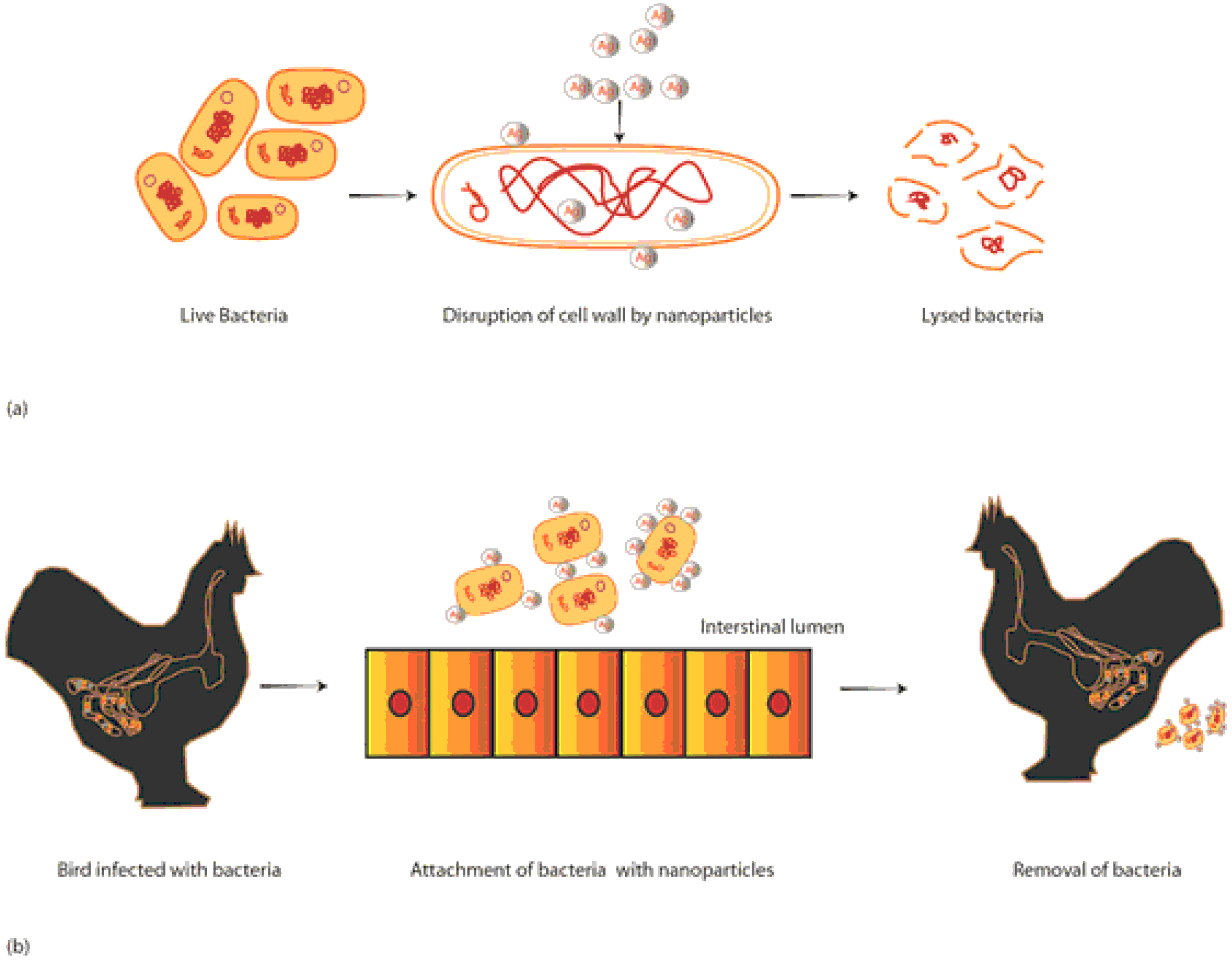
Ag-NPs are effective in killing pathogenic, Gram-positive and Gram-negative bacteria including antibiotic-resistant strains (Wright et al., Reference WRIGHT, LAM, BURET, OLSON and BURRELL2002; Percival et al., Reference PERCIVAL, BOWLER and DOLMAN2007). Ag-NPs have exhibited antibacterial properties against Escherichia coli and Staphylococcus aureus by disrupting the cell wall, with minimal inhibitory concentrations of 100 and 50 ppm, respectively (Cho et al., Reference CHO, PARK, OSAKA and PARK2005) as illustrated in Figure 1a. NPs attach to pathogenic microorganisms and remove them from bird's body, as shown in Figure 1(b). Elkloub et al. (Reference ELKLOUB, MOUSTAFA, GHAZALAH and REHAN2015) proved that broilers given Ag-NPs at a dose rate of 4 ppm/kg feed showed reduced numbers of harmful bacteria (E. coli) while they had no effect on the beneficial Lactobacillus spp. in the microflora. These Ag-NPs have been reported to improve growth performance, body weight (BW), feed intake (FI) and feed conversion ratio (FCR) at a dose rate of 900 ppm (Ahmadi, Reference AHMADI2009), as a result of this antibacterial activity.
Bacterial killing or removal via; (a) disruption of the cell wall by NPs and (b) binding of pathogenic microbes with NPs.

The use of Ag as a microbicidal agent in the form of solutions, suspension and/or NPs have recently been observed. Owing to their confirmed antimicrobial properties, NPs of noble metals (mainly Ag) are currently used in animal production as a disinfectant and to reduce emission of ammonia and nitrogen oxides (Xu et al., Reference XU, TANG, LIU, WANG and LIU2013). A study conducted by Dobrzanski et al. (Reference DOBRZANSKI, ZYGADILK, PATKOWSKA-SOKOLA, NOWA-KOWSKI, JANCZAK, SOBCZAK and BODKOWSKI2010) demonstrated the use of nano-Ag as a microbicidal preparation with a reduction in numbers of harmful Salmonella, E. coli, and Streptococcus spp. and total number of mesophilic bacteria. Recently, in vitro, in vivo, and in ovo research on the use of nano-Ag and nano-gold as prophylactic feed additives for animals has been undertaken (Sawosz et al., Reference SAWOSZ, GRODZIK, ZIELIŃSKA, NIEMIEC, OLSZAŃSKA and CHWALIBOG2009; Ahmadi and Kurdestany, Reference AHMADI and KURDESTANY2010). Duffy et al. (Reference DUFFY, OSMOND-MCLEOD, JUDY and KING2018) reported antibacterial activity of Ag-NPs against various strains Salmonella and Campylobacter spp. isolated from poultry. The rationale for these studies lies in reports indicating a positive, often selective, effect of Ag-NPs on microflora in the digestive tract in poultry, mainly by their ability to inhibit the development of pathogenic bacteria.
From an immunological perspective, it is acknowledged that phagocytosis of Ag-NPs stimulates inflammatory signalling by the cohort of reactive oxygen species (ROS) in macrophage cells, followed by the activated macrophage cell-induced secretion of tumour necrotic factor alpha (TNF-α). As the level of TNF-α increases, it causes damage to the cell membrane and apoptosis. An involuntary recognition of Ag-NPs as a foreign particle by immune cells may result in a multilevel immune response and finally lead to toxicity in the host (Park et al., Reference PARK, YI, KIM, CHOI and PARK2010). However, when the Ag-NPs are recognised as self or there is an absence of immune recognition, then their ability to stimulate an immune response may decide the fate of Ag-NPs in the host. In vivo studies have confirmed that NPs are capable of promoting inflammation (Nygaard et al., Reference NYGAARD, HANSEN, SAMUELSEN, ALBERG, MARIOARA and LØVIK2009). The NPs-induced inflammatory response may have an impact on immune defence, and the T-helper 1 (Th1)/T-helper 2 (Th2) cell balance. Grodzik and Sawosz (Reference GRODZIK and SAWOSZ2006) assessed the effect of Ag-NPs at a concentration of 10 ppm on the foetal bursa of Fabricius and growth, which showed a reduction in the size and number of follicles and had no major effect on the growth of the chickens. Ahmadi and Kurdestany (Reference AHMADI and KURDESTANY2010) investigated changes in the relative weight of bursa after administration of 20, 40, and 60 ppm concentrations of Ag-NPs. Their results reported a reduction in the size and number of follicles. The reason for this could be due to the antimicrobial properties of Ag-NPs that affected microbial populations in the gut. Ag-NPs carry available oxygen and reduce the growth of strictly anaerobic microorganisms which result in negative effects on growth of bursa of Fabricius. According to Matsumura et al. (Reference MATSUMURA, YOSHIKATA, KUNISAKI and TSUCHIDO2003) the same effect of Ag-zeolite might be due to the intake of Ag+ in bacterial cells when they come in contact with Ag-zeolite, which inhibits cellular functions and damages the cell. Secondly, it can be explained by the generation of reactive oxygen molecules, which inhibit cellular respiration. It is logical that the existence of microorganisms in the gastrointestinal tract is necessary for the growth and development of bursa in healthy broilers. Ag-NPs appear to have no effect on immunoglobulin M (IgM) and immunoglobulin G (IgG) levels (Pineda et al., Reference PINEDA, CHWALIBOG, SAWOSZ, LAURIDSEN, ENGBERG, ELNIF, HOTOWY, SAWOSZ, GAO, ALI and MOGHADDAM2012). Additionally, Ag-NPs in combination with amino acids (cysteine and threonine) have been shown to increase immunocompetence by improving innate and adaptive immunity in chicken during embryonic development (Bhanja et al., Reference BHANJA, ANNA, MANISH, EWA, LANE, KRISHNA, NATALIA and ANDRÉ2015; Saki and Salary, Reference SAKI and SALARY2015). Another study has reported antiviral activity of Ag-NPs solution against infectious bursal disease virus in embryonated chicken eggs (Pangestika and Ernawati, Reference PANGESTIKA and ERNAWATI2017).
Gold (Au) NPs
The large surface area-to-volume ratio makes the Au-NPs an appealing choice for their use in poultry, as their surface can be coated with hundreds of molecules. Au-NPs, taurine or Au-NPs conjugated with taurine supplemented in ovo to the chicken embryo enhanced the organisation of breast muscle by activating molecular mechanisms i.e. expression of nuclear antigen of proliferating cells to improve the growth performance (Zielińska et al., Reference ZIELIŃSKA, SAWOSZ, CHWALIBOG, OSTASZEWSKA, KAMASZEWSKI, GRODZIK and SKOMIA2010). While improvements in growth performance can be maximised by the control of communicable diseases, for that purpose early detection of diseases is necessary. Therefore, an effective on-farm disease control program is mandatory to monitor diseases at their early onset for profitable poultry farming. Nanotechnology provides a platform for quick and early detection of different poultry diseases. Au-NPs have served in diagnostics for the detection of peptides derived from avian influenza hemagglutinin H5 with a detection limit of 2.2 pg/ml (Jarocka et al., Reference JAROCKA, RÓŻA, ANNA, AGNIESZKA, WŁODZIMIERZ, JERZY and HANNA2014). Au-NPs were utilised to coat the immobilin-polyvinylidene difluoride membrane with some immuno-dominant sequences of non-structural-1 protein of avian influenza virus to detect this virus in the serum of infected birds (Emami et al., Reference EMAMI, MADANI, REZAYAT, GOLCHINFAR and SARKAR2012).
Copper (Cu) NPs
Cu is an essential trace mineral that is involved in numerous physiological and biochemical processes like angiogenesis, vasculogenesis, synthesis of haemoglobin and redox processes (Mroczek-Sosnowska et al., Reference MROCZEK-SOSNOWSKA, SAWOSZ, VADALASETTY, ŁUKASIEWICZ, NIEMIEC, WIERZBICKI, KUTWIN, JAWORSKI and CHWALIBOG2015). Cu supplementation improved the performance of broilers and layers (Leeson, Reference LEESON2009; Karimi et al., Reference KARIMI, SADEGHI and VAZIRI2011), whereby Cu-NPs and CuSO4 stimulated development of blood vessels at the molecular and systemic level, prolonging a dominance of hyperplasia over hypertrophy to the end of embryogenesis. Muscle growth during embryogenesis depends on vessel development, which is stimulated by Cu, and the number of muscle fibres is established mainly in the prenatal period. Such stimulation of cell proliferation by Cu might have a crucial impact on subsequent chicken growth (Mroczek-Sosnowska et al., Reference MROCZEK-SOSNOWSKA, ŁUKASIEWICZ, WNUK, SAWOSZ and NIEMIEC2014; 2016). Sawosz et al. (Reference SAWOSZ, ŁUKASIEWICZ, ŁOZICKI, SOSNOWSKA, JAWORSKI, NIEMIEC, SCOTT, JANKOWSKI, JÓZEFIAK and CHWALIBOG2018) reported that, by using Cu-NPs, it is possible to reduce the level of Cu supplementation in chicken feed (75% reduction of Cu in feed compared to global commercial standards) as well as excretion of Cu into the environment. In another study, it was reported that in ovo injection of Cu-NPs on different days during incubation significantly altered oxygen consumption and heat production, that indicated changes in metabolic rate. This might be related to decreased fat oxidation and depressed organ development. However, Cu-NPs had no effect on inflammatory mediators like nuclear factor-kappa B (NF-kB), TNF, IgM and IgG (Pineda et al., Reference PINEDA, SAWOSZ, VADALASETTY and CHWALIBOG2013). Intramuscular injections of Cu-NPs stimulate growth and metabolic changes quickly. At the same time, RBC count, Hg, Cu and protein concentration were increased in the serum 24 hours post-injection of Cu-NPs (Miroshnikov et al., Reference MIROSHNIKOV, ELENA, ELENA, ELENA and VLADIMIR2015). Mroczek-Sosnowska et al. (Reference MROCZEK-SOSNOWSKA, ŁUKASIEWICZ, ADAMEK, KAMASZEWSKI, NIEMIEC, WNUK-GNICH, SCOTT, CHWALIBOG and SAWOSZ2017) reported that in ovo administration of Cu-NPs significantly improved the physical characteristics of bones in broiler chicken. Thus, Cu-NPs have potential applications in improving the growth performance of poultry birds which ultimately can help in increasing the meat and eggs production.
Chitosan NPs
Chitosan is a linear polysaccharide composed of randomly distributed β-(1-4)-linked D-glucosamine and N-acetyl-D-glucosamine. Chitosan is considered to have various bioactivities such as immune-enhancing effects and antibacterial activities (Jan et al., Reference JAN, DENG-CHENG, XIAO-YING, YONG-MING and JIN-DING2012; Alishahi, Reference ALISHAHI2014). This polysaccharide has been used as an effective adjuvant for delivery of biological materials, such as drugs and vaccines. Chitosan adjuvant vaccines enhanced antibody titres against influenza, in comparison to vaccines without chitosan (Leenaars et al., Reference LEENAARS, HENDRIKSEN, KOEDAM, CLAASSEN and CLAASSEN1995; Illum, Reference ILLUM1998). Wang et al. (Reference WANG, WANG, YE, TAO and DU2011) reported that Cu-loaded chitosan-NPs supplementation at a dose rate of 100 mg/kg could improve growth performance, immunity, protein synthesis and caecal microbiota of broilers. In another study, it was noticed that chitosan-NPs loaded with avian influenza vaccine (H9N2) induced protective antibody titres after a single immunisation, while only requiring a low dose of antigen (Khalili et al., Reference KHALILI, RAHIM, SAEED, MOHSEN, MOHAMMAD, NASER, YOUSEF and MOHAMMAD2015). Chitosan-NPs loaded with Newcastle disease virus (La Sota) showed stronger cellular, humoral and mucosal immune responses via intranasal route (Dai et al., Reference DAI, HONG, WANQIU, JINYAN, CHUNLONG, GUOGANG, GUANGYU, XIAOHUA, XIN, ZHENG and KAI2015).
Zinc (Zn) NPs
Zinc is an essential trace element for growth, wound healing, immune function, fertility, metabolism and oxygen free radical scavenging in animals (Kietzmann and Braun, Reference KIETZMANN and BRAUN2006; Feng et al., Reference FENG, MA, NIU, WU, WANG and FENG2010; Liu et al., Reference LIU, LU, LI, ZHANG, XI, ZHANG and LUO2011). The bioavailability of organic Zn is higher than that of inorganic Zn, but the application of organic Zn in animal diets can be limited owing to its higher cost (Bratz et al., Reference BRATZ, GOLZ, RIEDEL, JANCZYK, NOCKLER and ALTER2013). Nevertheless, high dietary Zn can lead to excess excretion which causes environmental pollution (Poulsen, Reference POULSEN1995; Broom et al., Reference BROOM, MILLER, KERR and TOPLIS2003). Furthermore, high Zn supplementation may affect the balance of other trace elements in the body and decrease the stability of vitamins and other nutrients. Additionally, long-term exposure can cause Zn residue in the animal body (Case and Carlson, Reference CASE and CARLSON2002; Sundaresan et al., Reference SUNDARESAN, ANISH, SASTRY, SAXENA, NAGARAJAN, SUBRAMANI, LEO, SHIT, MOHAN, SAXENA and AHMED2008).
In the last decade, nanotechnology has been extensively used in animal husbandry to improve the utilisation of trace elements in the diet (Scott, Reference SCOTT2005; Scheerlinck et al., Reference SCHEERLINCK, GLOSTER, GAMVRELLIS, MOTTRAM and PLEBANSKI2006). Manufactured zinc oxide NPs (ZnO-NPs) were the first nano-scale material used in commercial and industrial products (Tsuzuki et al., Reference TSUZUKI, HE, WANG, SUN and WANG2012; Tan et al., Reference TAN, ZHONG, LI, CHEN and CHEN2013). Compared with ZnO, ZnO-NPs have stronger chemical activity and undergo oxidation reactions with a variety of organic compounds. Moreover, permeability of ZnO-NPs can help to prevent adverse gastrointestinal reactions and improve the absorption of medicine (Sinha et al., Reference SINHA, KIM, NIE and SHIN2006; Lucas, Reference LUCAS2010). The interactions between different dietary fatty acids (FAs), Zn sources and levels on carcass and meat quality traits of Cobb 500 broiler chicks proved that using palm oil with ZnO-NPs at level of 80 mg/kg in diet improved carcass traits and meat quality of broiler reared under summer heat conditions (Selim et al., Reference SELIM, REFAIE, ABEER and ABD EL-HAKIM2014). It has been proved that an appropriate concentration of dietary ZnO-NPs improved growth performance and anti-oxidative capabilities in broilers at the dose rate of 20 mg/kg (Zhao et al., Reference ZHAO, SHU-XIAN, XI-YU, XIAN-SHUAI, JIA-QIANG and ZHAO-XIN2014). The supplementation of ZnO-NPs to dry diets improved carcasses yield and increased the relative weight of digestive and lymphoid organs of broilers compared to wet diet during the starter period (Mohammadi et al., Reference MOHAMMADI, AHMADI and AMIRI2015; Esfahani et al., Reference ESFAHANI, FARHAD and MOHAMMAD2015).
Calcium phosphate (Ca-P) NPs
Calcium (Ca) and phosphorus (P) are essential minerals for the optimum growth and performance of poultry. Reducing Ca and P in the diet of birds can cause bloody meat and broken bones during processing of the carcass (Chen and Moran, Reference CHEN and MORAN1995). The supplementation of minerals in nano-form increases their bioavailability and efficiency of utilisation. Ca-P NP supplementation can improve the growth performance of broilers and reduce the quantity of mineral supplementation that in return reduces the feed cost. Since P is expensive among the mineral sources, its requirement as dicalcium phosphate can be replaced by the nano-form of Ca-P at levels as low as 50%. Birds fed with 50 and 60% Ca-P NPs had significantly (P<0.05) higher BW gain as compared to control. While birds fed 50% Ca-P-NPs replacement showed the best FCR which differed significantly from the control group (without supplementation of Ca-P-NPs; Vijayakumar and Balakrishnan, Reference VIJAYAKUMAR and BALAKRISHNAN2014).
Selenium (Se) NPs
Selenium NPs have the advantage of high absorption rate, anti-oxidant activity, egg-laying capacity and better growth performance (Cai et al., Reference CAI, QU, WEI and YANG2013). The addition of Se-NPs in chicken feed exerts significant effects on the growth of broilers (Cai, Reference CAI2012). Senthil et al. (Reference SENTHIL, SUGAPRIYA, MANIVANNAN and CHANDAR2015) reported that supplementation of Se-NPs at the dose rate of 0.3 mg/kg in feed enhanced growth rate in broiler birds. In addition, nano-vitamin D3 has an impact on shinbone quality and production performance of hens (Yang et al., Reference YANG, GAN, SONG, ZHAO and GONG2014). Supplementation of minerals and vitamins to the poultry birds in nano-forms reduces the stress, leading to better productivity and meat quality of the birds. Thus Se-NPs may be used as potential anti-stress factors in the poultry birds to boost production.
Diamond (D) NPs
The D-NPs, being allotropic in nature are highly biocompatible and have high adsorption capacity with an extremely large surface area (Zhu et al., Reference ZHU, LI, LI, ZHANG, YANG, CHEN, SUN, ZHAO, FAN and HUANG2012), which are easily taken up by cells (Zhang et al., Reference ZHANG, YIN, KANG, LI, ZHU, LI, HUANG and ZHU2010) and are non-toxic (Bakowicz and Mitura, Reference BAKOWICZ and MITURA2002; Schrand et al., Reference SCHRAND, HUANGM, CARLSON, SCHLAGER, OMACR, HUSSAIN and DAI2007; Zhu et al., Reference ZHU, LI, LI, ZHANG, YANG, CHEN, SUN, ZHAO, FAN and HUANG2012). Administering D-NPs and L-glutamine (Glu) and Glu/D-NPs solutions up-regulated expression of genes related to muscle differentiation and cell proliferation. Glu/D-NPs enhanced differentiation as well as proliferation of pectoral muscle cells, and accelerated the maturation and growth of muscle cells (Grodzik et al., Reference GRODZIK, SAWOSZ, SAWOSZ, HOTOWY, WIERZBICKI, KUTWIN, JAWORSKI and CHWALIBOG2013).
Polystyrene NPs
Polystyrene NPs have the potential to influence iron uptake and iron transport in poultry. Increased iron transport in intestinal cells may be due to the disruption of cell membranes by NPs. Prolonged exposure to polystyrene NPs may increase iron absorption by remodelling the intestinal villi to increase surface area for absorption. In this way, NPs have the potential to increase iron absorption which, consequently, increases body weight (Mahler et al., Reference MAHLER, MANDY, ELAD, TERESA, SHIVAUN, RAYMOND and MICHAEL2012).
Montmorillonite nano-composite (MMN)
Aflatoxin (AF), ochratoxin (OC) and zearalenone (Zea) are the most common mycotoxins found in poultry feed. Their intake via contaminated feed results in reduced productivity, poor health status, decreased body weight gain, inferior egg quality, immunosuppression and increased mortality in poultry. These mycotoxins ultimately lead to considerable economic losses to the poultry industry. The risks associated with mycotoxin residues in poultry meat and eggs represent a concern for human health as well. Nanotechnology has a potential to eliminate these hazardous toxins from poultry feed and birds to improve their health status. Including MMN at a dose rate of 3 g/kg diet has the potential to reduce toxicity of AF in broiler chicks and are ameliorator of aflatoxicosis in poultry birds, while magnetic NPs were found to successfully improve the injurious effects of AF B1 and Zea in poultry (Shi et al., Reference SHI, XU, FENG and WANG2006; Kim et al., Reference KIM, KIM, LEE, CHOI, LEE, KANG and CHA2012).
Conclusions
Nanotechnology has provided various kinds of potentially important NPs to improve the growth performance, reduce microbial load, prevent various health hazards including drug resistance in endemic pathogen populations and drug residues in poultry meat. Studies on the scientific applications of NPs for increasing meat quantity and quality by reducing disease overload can definitely help the poultry business. However, the potential of nanotechnology in the poultry industry is not yet fully explored. There is great potential to explore the benefits of NPs on the activity of exogenous enzymes in feed as well as their toxicological evaluation on the health of poultry birds.
However, there are some specific issues that need to be addressed for the appropriate use of NPs in poultry. The mode of delivery of NPs in any experimental system should adequately reflect the exposure scenarios. Expressing the dose levels in terms of mass alone is not sufficient; it needs to be expressed in terms of total surface area, number of particles, or a combination of the two. These are some concerns about use of NPs including; 1) Extent to which it is possible to calculate the toxicology of Nps from the knowledge on the same chemicals in larger physical forms, 2) Movement of NPs inside the body and the effects that NPs cause at the cellular level and 3) How target organs respond to different doses of NPs. Once these issues are addressed, more targeted use of NPs with more reliable outcomes in poultry parameters can be achieved.