The study of first-language acquisition has at its core a research question that accurately reflects the sense of wonder that this phenomenon evokes in linguists and parents alike: How do children learn so much, so fast, and so well? It has proven surprisingly difficult to provide an answer to this question, in part because of a long-standing and still inconclusive debate over the role of experience versus innate principles in the language acquisition process.
The phenomenon of heritage language acquisition could prove vital for moving this debate forward. Common in immigrant communities, this type of language acquisition is characterized by normal exposure to the parental (i.e., heritage) language in the first few years of life, followed by an abrupt shift to the majority language when formal schooling begins. The difference between this experiential profile and the one associated with more typical monolingual language acquisition, together with differences in the circumstances of individual heritage learners, creates the opportunity to observe substantial variation in the quality and quantity of the input available to young children.
Heritage language acquisition is thus a classic example of an experiment in nature—that is, a naturally occurring event that sheds light on the effect of factors that, for ethical or practical reasons, could not be controlled in a laboratory setting. On the one hand, exploring heritage language acquisition allows for the investigation of the importance of continuous long-term experience for the acquisition and maintenance of particular linguistic phenomena whose precise ontogeny has long been a matter of controversy. On the other hand, by allowing for the observation of how the language acquisition mechanisms operate under a variety of conditions, it opens the door to the discovery of much needed new information on the character of these mechanisms as well. Before turning to a more detailed consideration of these matters, some general comments on research into language acquisition are in order.
For several decades, the study of language acquisition has been shaped by two competing ideas. One idea, especially popular in formal linguistic theory and based on the pioneering work of Chomsky, holds that language is the product of a dedicated acquisition device that includes an inborn set of grammatical categories and principles—namely, Universal Grammar (UG). Crain and Thornton (Reference Crain and Thornton1998), Guasti (Reference Guasti2002), Roeper (Reference Roeper2007), and Valian (Reference Valian and Bavin2009), among many others, have provided detailed instantiations of this view.
The other idea—less developed and more varied—holds that language emerges from the interaction of a myriad of nongrammatical factors—ranging from processing and working memory, to perception and physiology, to general conceptual capacities and social interaction. Such a view is often called emergentist because of its (loose) affiliation with the general philosophical perspective of the same name, which is characterized by its commitment to the idea that objects of many different types (chemical compounds, economies, bird flocks) have properties that are not found in their constituent parts. In these cases, it is argued that an object’s properties emerge—often in surprising ways—from the interaction of its parts, yielding systems of a completely different order of complexity (e.g., Goodenough & Deacon, Reference Goodenough, Deacon, Clayton and Simpson2006; Holland, Reference Holland1998; Morowitz, Reference Morowitz2004). Following earlier work by O’Grady (Reference O’Grady2005, Reference O’Grady2008a, Reference O’Grady, Ellis and Robinson2008b), the particular idea that will be explored here instantiates a variety of emergentism that focuses quite narrowly on the importance of processing considerations for understanding why language has the properties that it does and how those properties come to be acquired with such apparent ease in the early years of life.
Such an approach makes good strategic sense. It is a matter of consensus that language acquisition involves mastering the various types of mappings that underlie the relationship between form and meaning in a language—mappings between sound waves and phonemes, between concepts and morphemes, between events and linear strings of words, and so on (e.g., Fodor, Reference Fodor, Piatelli-Palmarini, Uriagareka and Salaburu2009). It is also widely recognized, both in the UG tradition and in emergentist work, that the processor has a major role to play in computing these form-meaning associations (Berwick, Reference Berwick1985; Chang, Dell, & Bock, Reference Chang, Dell and Bock2006; Ellis & Larsen-Freeman, Reference Ellis and Larsen-Freeman2009; Pinker, Reference Pinker1984; Seidenberg & MacDonald, Reference Seidenberg and MacDonald1999; Truscott & Sharwood Smith, Reference Truscott and Sharwood Smith2004). The particular view adopted here is that the processor is responsible for strengthening form-meaning mappings made available to it by other cognitive systems. Thus, to take a trivial example, upon exposure to a situation in which the acoustic shape [bΛs] is used to refer to a large multipassenger vehicle, the processor takes note of that association of form with meaning and strengthens it upon each subsequent encounter, thereby creating a routine in which the form [bΛs] is linked to the interpretation “bus” and vice versa.Footnote 1
This simple example illustrates the very fundamental role of the processor in language learning. Indeed, it makes sense for a theory of language acquisition (including a theory of heritage language acquisition) to take the processor’s role in the establishment of mapping relations as a starting point and to consider the extent to which it might contribute to an account of what is acquired, of what is subsequently retained or lost, and of what is never acquired in the first place. This article will explore this line of inquiry from two perspectives, beginning with considerations of the input-related factors—namely, salience, frequency, and transparency—that arguably facilitate the establishment and strengthening of form-meaning mappings at the word and morpheme levels. The key point here will be that the types of phenomena that have proven most susceptible to partial acquisition or attrition are those for which the form-meaning mapping is likely to be problematic to the processor, either because the form’s phonetic profile is acoustically compromised or because its precise semantic function is difficult to discern. It will be argued that such mappings are acquired only with the help of high-frequency instantiations in the input—a condition that is often not met in the case of heritage language learning.
Additionally, a phenomenon in heritage language acquisition that has thus far received virtually no attention—namely, the interpretation of scope in sentences containing negation and a universal quantifier (as in Jane didn’t read all the books)—will be explored. The interest of this type of pattern stems from the fact that it occurs quite infrequently in speech to children, raising the usual poverty-of-stimulus questions about whether and how the properties of scope can be acquired. The interpretation of scopal patterns by Korean heritage learners will be explored, with the help of data from several groups of subjects, including children and adults who were raised in Korean-speaking homes in the United States as well as those who grew up in a monolingual setting in Korea. The key claim will be that the success in scopal interpretation attained by these groups is best attributed to processing effects. The result is thus a unified theory of heritage language learning according to which both failure and success can be traced to a single underlying cause—the operation of the processor.
THE NATURE OF DEFICITS IN HERITAGE LANGUAGE LEARNING
It is widely acknowledged that repeated exposure to particular mappings strengthens the association between form and meaning that these mappings embody. This suggests a role for frequency, and indeed there are well-documented examples of just such an influence. This is why, to take a trivial example, children typically acquire the word car before they learn the word automobile and why more commonly used vocabulary items are accessed faster than their less frequent counterparts, even by adults (Ellis & Morrison, Reference Ellis and Morrison1998; Jescheniak & Levelt, Reference Jescheniak and Levelt1994; Oldfield & Wingfield, Reference Oldfield and Wingfield1965). It is also why a wide range of psycholinguistic studies report a correlation between the frequency of particular structure types and the accuracy with which they are produced and comprehended (Chang et al., Reference Chang, Dell and Bock2006; Chater & Manning, Reference Chater and Manning2006; Dick et al., Reference Dick, Bates, Wulfeck, Aydelott Utman, Dronkers and Gernsbacher2001; Ferreira, Reference Ferreira2003). Ellis (Reference Ellis2002) offered a helpful overview of the various ways in which frequency effects have been shown to shape the acquisition and structure of language (see also Bybee & Hopper, Reference Bybee and Hopper2001; Gennari & MacDonald, Reference Gennari and MacDonald2009).
In light of the importance of frequency to the creation and strengthening of mappings between form and meaning, it is somewhat surprising that the profile of linguistic development is not entirely shaped by frequency effects, especially if, as Ellis (Reference Ellis2006a) suggested, language acquisition essentially involves “the gathering of information about the relative frequency of form-function mappings” (p. 1; see also, e.g., Ambridge, Theakston, Lieven, & Tomasello, Reference Ambridge, Theakston, Lieven and Tomasello2006; Goldberg, Reference Goldberg and MacWhinney1999; Goldberg & Casenhiser, Reference Goldberg, Casenhiser, Robinson and Ellis2008; Tomasello, Reference Tomasello2003). At least part of the explanation may lie in the character and quality of the mappings themselves, as suggested by Ellis and others in a tradition that goes back to the pioneering work of Brown (Reference Brown1973; see Goldschneider & DeKeyser, Reference Goldschneider and DeKeyser2001, for an extensive discussion of a parallel tradition in SLA).
The English definite article, the most frequently used word in the language, is a case in point. Although there are early and largely accurate instances of the in child speech (Valian, Solt, & Stewart, Reference Valian, Solt and Stewart2009), it is not used with 90% accuracy in obligatory contexts until quite late—after the mastery of hundreds of other vocabulary items, including several grammatical morphemes (Brown, Reference Brown1973). The explanation as to why this might be so arguably lies in the fragile nature of the form-meaning mapping. The form side of the mapping is complicated by the fact that the is typically unstressed, permits weakening of the initial consonant (yielding [ðə], which is almost homophonous with a), and can even be deleted in sentence-initial position in colloquial speech (Gerken, Reference Gerken1991), as in the example in (1).Footnote 2
(1) Is this restaurant any good?
Man over there seems to think so.
The English definite article is thus often not identifiable on the basis of bottom-up acoustic evidence alone—a common state of affairs for function words in general (Ellis, Reference Ellis2006b; Herron & Bates, Reference Herron and Bates1997).
On the semantic side, the function of the is often difficult to discern, due to the difficulty of teasing apart definiteness and specificity.Footnote 3 If a child hears his mother say Please use the backdoor, is she using the because world knowledge establishes a unique referent for backdoor (definiteness), or because she has in mind a particular noteworthy door (specificity), or both? Some cases are clear, of course, with a definite but nonspecific referent for the noun, as in I’d like to meet the author, whoever that is. However, such sentences appear to be quite rare, which led Ionin, Zubizarreta, and Maldonado (Reference Ionin, Zubizarreta and Maldonado2008) to observe that the establishment of the form-meaning mappings underlying the use of articles “is likely to be a fairly long and difficult process” (pp. 573–574).
Nature’s remedy for nonoptimal deficiencies in the quality of form-meaning mappings appears to involve a quantity-based strategy: The greater a mapping’s frequency, the greater the chance that a sufficient number of clear cases will be encountered to establish and strengthen the relevant associations between form and function. This is not good news for heritage language learners, who, from the time they begin school, typically experience dramatically reduced exposure to input from their parents’ language, not only outside the home but often inside the home as well. In the case of Korean American families, for instance, it has been observed that parents start speaking to their children more in English once the children have begun to attend mainstream schools (Kondo-Brown, Reference Kondo-Brown and Kondo-Brown2006; Park, Reference Park and Kondo-Brown2006). Any reduction in input undoubtedly magnifies the factors that already obscure the clarity of form-meaning mappings—the low perceptibility of key forms and the indeterminacy of particular semantic functions. Herein lies the likely explanation for morphosyntactic deficits in heritage learners’ first language (L1). This point can be illustrated with the help of the concrete example of case in Korean.
Case in Korean
Like a large portion of the world’s languages, Korean uses case-marking (in the form of suffixes) to distinguish subjects from direct objects. At first glance, Korean case seems to embody a fairly transparent form-meaning mapping: As illustrated in (2), the nominative (NOM) suffix –ka is used to mark the subject and the accusative (ACC) suffix –lul is used to indicate the direct object.
(2) Yeca-ka namca-lul anacwue.
woman-nom man-acc hug
“The woman is hugging the man.”
However, two features of case in Korean substantially complicate matters for language learners. First, case is frequently absent, especially in casual speech. Based on longitudinal data from three mother-child dyads, Cho (Reference Cho1981) reported that mothers use the nominative case on subjects little more than half the time (56.8%). The accusative is used for direct objects even less frequently—about 10% of the time.
Second, both the nominative and the accusative are associated with more than just the expression of grammatical relations. As Lee (Reference Lee2006a, Reference Lee2006b) reported, based on a corpus analysis and experimental work, the accusative is far more commonly used when the direct object is focused, has a human referent, or is definite than when it is unfocused, has an inanimate referent, or is indefinite. There is a reverse effect for the nominative case.
In this regard, Korean children are therefore in a difficult situation. Instead of finding an obligatory one-to-one mapping between a salient form and a single contextually clear semantic function (the ideal situation implied by Brown, Reference Brown1973), they encounter a complex, contingency-laden association between case and at least four interrelated factors—grammatical relation, focus, animacy, and definiteness—each with a different weight (Lee, Reference Lee2006a, reported that the strongest nongrammatical factor that contributes to use of the accusative case is contrastive focus, followed by animacy and then definiteness). Sorting out such a nonoptimal mapping between form and meaning will obviously require very significant amounts of input. Furthermore, accumulation of the necessary experience is made difficult, and perhaps even impossible, by the relatively short time span during which heritage learners typically have intense access to parental input in their L1. Substantial deficits can thus be expected in constructions in which case is crucial.
Such a deficit has been documented for the comprehension of sentences such as (3), with so-called scrambled (i.e., direct object-subject-verb) word order.
(3) Oli-lul thokki-kaanacwue.
duck-acc rabbit-nom hug
“The rabbit is hugging the duck.”
For native speakers of Korean, case trumps word order in determining interpretation—because of the accusative case on oli “duck” and the nominative case on thokki “rabbit,” the sentence can only mean “the rabbit is hugging the duck.”
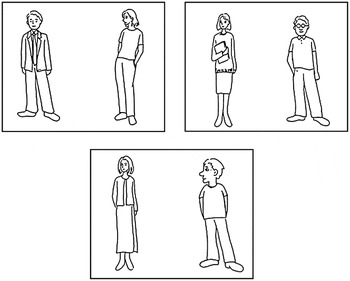
Song, O’Grady, Cho, and Lee (Reference Song, O’Grady, Cho, Lee and Kim1997) investigated the ability of 68 monolingual Korean children in Seoul (ages 2–8) and 28 Korean heritage learners in the United States (ages 3–8) to interpret scrambled sentences such as (3) by selecting the appropriate picture, as illustrated in Figure 1. Whereas the monolingual children responded at above-chance levels by age 4, even 8-year-old heritage children performed well below chance, revealing a systematic disregard for case-marking (however, both groups did well when the more common subject-direct object-verb order was used).
Sample picture used to test for attentiveness to case in the interpretation of the sentence oli-lul thokki-ka anacwue (duck-acc rabbit-nom hug) “the rabbit is hugging the duck.”

Relative Clauses in Korean
Another construction type whose interpretation and use is crucially dependent on case involves the relative clause patterns illustrated in (4). The suffix –n, glossed here as a relative clause marker (REL), also indicates that the event occurred in the past.
(4) a. Subject relative clause
[_ yeca-lul po-n] namca
woman-acc see-rel man
“The man that saw the woman”
b. Direct object relative clause
[yeca-ka _ po-n] namca
woman-nom see-rel man
“The man that the woman saw”
As can be seen by these examples, the choice of case is crucial for the interpretation of the relative clause. Use of the accusative case on yeca “woman” yields the meaning “the man that saw the woman,” whereas use of the nominative case yields “the man that the woman saw.” As might be expected, Korean heritage learners encounter serious difficulties with relative clause constructions. In a study of 16 adult heritage learners (all students in the Korean program at the University of Texas, Austin), O’Grady, Lee, and Choo (Reference O’Grady, Lee and Choo2001) reported low success rates on a picture selection task designed to test the interpretation of relative clauses (see Figure 2).
Sample picture used to test for comprehension of subject and object relative clauses.

The heritage learners made the right choice just 65% of the time for subject relatives and 41.3% of the time for direct object relatives. Using a similar methodology, Kim (Reference Kim2005) reported comparable findings for another group of 88 adult heritage learners.
Differential Object Marking in Spanish
A structure in Spanish provides yet another example of the impact of restricted input on the acquisition of nonoptimal mappings by heritage language learners. As Montrul (Reference Montrul2004) explained, following Torrego (Reference Torrego1998), standard Spanish uses the preposition a “to” when the referent of the direct object is both human and specific, but not otherwise. This pattern is illustrated by the examples in (5).Footnote 4
(5) a. Specific human referent
Buscan a un profesor.
search.3pl OM a professor
“They are looking for a particular professor.”
b. Nonspecific human referent
Buscan un profesor.
search.3pl a professor
“They are looking for any professor.”
c. Inanimate referent
Buscan un libro.
search.3pl a book
“They are looking for a particular/any book.”
As documented by Montrul (Reference Montrul2004) and Montrul and Bowles (Reference Montrul and Bowles2009), heritage learners of Spanish have significant difficulty with the use of a as a direct object marker.
As with case marking in Korean, there is a plausible input-related impediment here, especially when the likely frequency of unambiguous mappings between form and meaning is considered. Because most direct objects have nonhuman referents (e.g., Gennari & MacDonald, Reference Gennari and MacDonald2009), there are relatively few opportunities to encounter the use of a to mark a direct object with a human referent. Matters are made more difficult by the fact that a is relatively nonsalient (as Montrul, Reference Montrul2004, observed) and that its function is far from transparent—does it occur in (6) because the referent of the direct object is human, because it is specific, or both?
(6) Buscan a Juan
search.3pl OM Juan
“They are looking for Juan.”
Children who are confronted with reduced input, as heritage learners typically are, may not encounter a sufficient number of clear-cut mappings to identify the acoustic and semantic correlates associated with the use of a to mark direct objects in their parents’ speech.
In sum, it seems that partial language acquisition in heritage learners is essentially a processing phenomenon. As illustrated by the examples considered here, a language is learnable only to the extent that the processor is able to access the acoustic and contextual input in ways that allow the establishment and strengthening of form-meaning mappings. However, it has also been noted that the data relevant to many crucial mappings, especially those involving inflection, is often less than optimal—the form has low audibility and the relevant contextual factors are obscured by various confounds. This problem is magnified in circumstances in which the input is limited in one way or another, creating the sorts of consequences for heritage language learners considered here.Footnote 5
However, this is not the whole story. The processor has properties that go beyond a sensitivity to the clarity and frequency of the mappings instantiated in the input. Of special importance in this regard is the fact—widely recognized in the psycholinguistic literature (e.g., Caplan & Waters, Reference Caplan and Waters2001; Grodner & Gibson, Reference Grodner and Gibson2005)—that the processor draws on limited working memory resources for its operation. This, in turn, creates strong propensities in favor of particular types of mappings—propensities that shape both the properties and the developmental profile of many phenomena that have long been central to theoretical work on language. Of special interest in this regard are phenomena whose properties involve substantial intricacy and yet are manifested infrequently (if at all) in the input. Scope is a case in point.
SCOPE
The term scope refers to the interaction between logical operators (essentially, negation and quantity-denoting expressions) that happens in sentences such as (7).
(7) Jane didn’t use all the pencils.
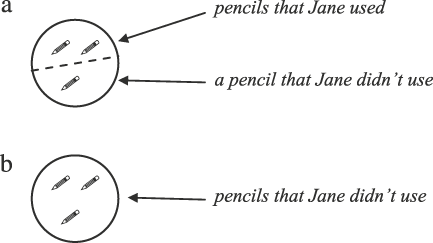
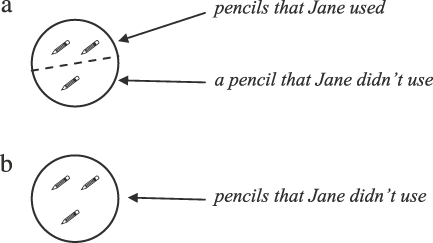
The strongly preferred interpretation for such sentences in English involves what will be called the partitioned set reading, to indicate that only some of the pencils were used by Jane. For reasons that will be discussed in due course, things work differently in Korean. Speakers of this language typically assign sentences such as (8) a full set reading, favoring the interpretation in which all of the pencils were unused.Footnote 6 The two interpretations are illustrated in Figure 3.
Visual representation of the (a) partitioned set and (b) full set interpretations of Jane didn’t use all the pencils.
(8) Jane-i motun yenphil-ul an ss-ess-ta
Jane-nom all pencil-accneg use-pst-decl
“Jane didn’t use all the pencils.”
Scopal patterns that involve a negated verb and a quantified direct object are quite infrequent in the input. In a search of the 100-million-word British National Corpus for five of the most common transitive verbs in English (know, take, see, want, and give), just 29 not VERB all … patterns were found. Moreover, a search in the CHILDES database for negated verbs with a direct object that contained the quantifier all also produced very few examples.Footnote 7 In the case of Adam (one of the three children in Brown’s, Reference Brown1973, pioneering Harvard study), the maternal input from more than 2 years of 1-hr biweekly speech samples contained just seven negated sentences with all in the direct object position. Of the examples that did occur, four involved the partitioned set interpretation exemplified in (9a) and two involved the full set interpretation shown in (9b). (One example could not be classified.)
(9) a. Partitioned set interpretation
Don’tuse all the tape.
“Use just some of the tape.”
b. Full set interpretation
Why don’t you put all of those from one truck into the dairy farm?
“Put each and every one of them…”
There were no relevant examples at all in the maternal speech to Eve, another of the children in Brown’s (Reference Brown1973) study, nor were there any in caregiver speech to Timothy, one of the bilingual English-Cantonese children in Yip and Matthews’ (Reference Yip and Matthews2007) study. There is no comparable maternal speech corpus for Korean, but a search of the more general 10-million-word Sejong corpus of spoken and written Korean uncovered just 23 instances of the relevant pattern. Of these, 18 (88%) instantiated the full set interpretation.
A potential poverty-of-the-stimulus problem thus arises—proficiency in language requires mastery of highly abstract phenomena about which there is little information in the input. The traditional response to this state of affairs is to assume that the relevant principles are inborn, as part of UG. For example, Han, Lidz, and Musolino (Reference Han, Lidz and Musolino2007) developed a detailed proposal along these lines, suggesting that the partitioned set interpretation is available only when the negative is structurally higher than the direct object, as determined by a variety of abstract raising operations.
Processing-based emergentism offers an alternative: The facts follow from the operation of a simple processor designed to minimize the burden on working memory in accordance with the following two uncontroversial assumptions (e.g., Grodner & Gibson, Reference Grodner and Gibson2005):
1. As the processor works its way through a sentence, it immediately assigns each word and phrase an interpretation.
2. The revision of a previously assigned interpretation is costly because it disrupts the normal linear operation of the processor, forcing it to go back and redo its work.
Consider in this regard how a processor of this sort goes about constructing the scopal relationship in a Korean sentence as in (10).
(10) Jane-i motun yenphil-ul an ss-ess-ta.
Jane-nom all pencil-accneg use-pst-decl
“Jane didn’t use all the pencils.”
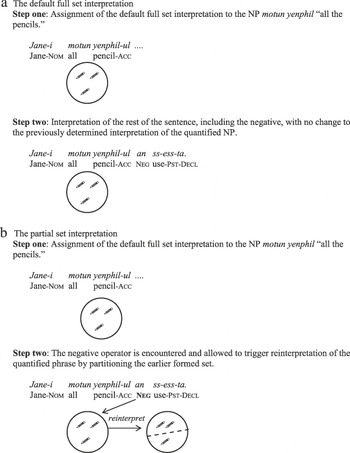
As illustrated in Figure 4, derivation of the strongly preferred full set reading is completely straightforward: The quantified noun phrase (NP) simply retains its initially assigned interpretation. Matters are very different in the case of the partitioned set interpretation. To derive the partitioned set reading, the processor has to reinterpret the quantified phrase, converting its initial full set interpretation to the partitioned set interpretation and thereby increasing the processing cost. Independent evidence for this scenario comes from experimental work by Lee (Reference Lee2009), who showed that adult native speakers of Korean slowed down at the negative when reading sentences of this type in contexts that supported the partitioned set interpretation.
Derivation of the (a) full set and (b) partitioned set interpretations of Jane-i motun yenphil-ul an ss-ess-ta “Jane didn’t use all the pencils.”

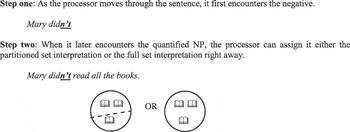
The situation is very different in English: The negative precedes the quantified direct object, thereby making it possible for the processor to produce either the full set interpretation or the partitioned set interpretation for a sentence as in (11) without having to retrace its steps, as illustrated in Figure 5.
(11) Mary didn’t read all the books.
Figure 5.Processing of Mary didn’t read all the books.


As explained in Musolino and Lidz (Reference Musolino and Lidz2006) and Lee, Kwak, Lee, and O’Grady (in press), the preference for the partitioned set interpretation in these patterns is due to pragmatic factors rather than processing.
If these ideas are on the right track, then processing considerations offer an explanation for how learners of Korean are able to acquire abstract facts about scope in the absence of rich input. Because processing considerations—rather than experience—shape the preference for the full set interpretation in the patterns considered here, all learners of Korean, including heritage learners, should favor this reading. A series of experiments was conducted to test the accuracy of this prediction.
EXPERIMENTS
Experiment 1
Participants. Twenty children (aged 5.0–6.9), all native speakers of Korean living in Seoul, served as participants for the first experiment.
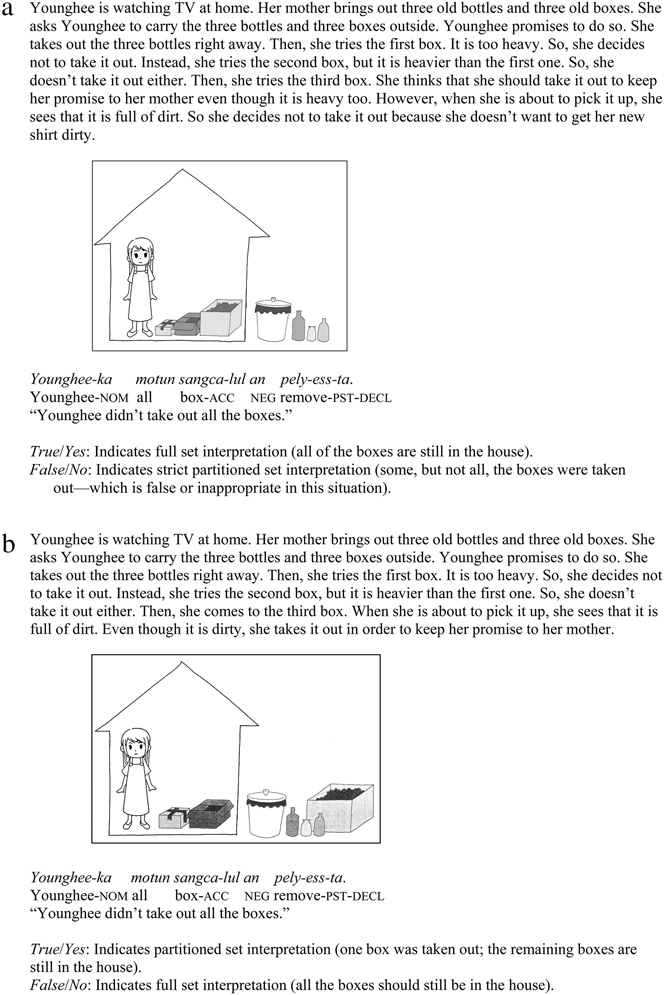
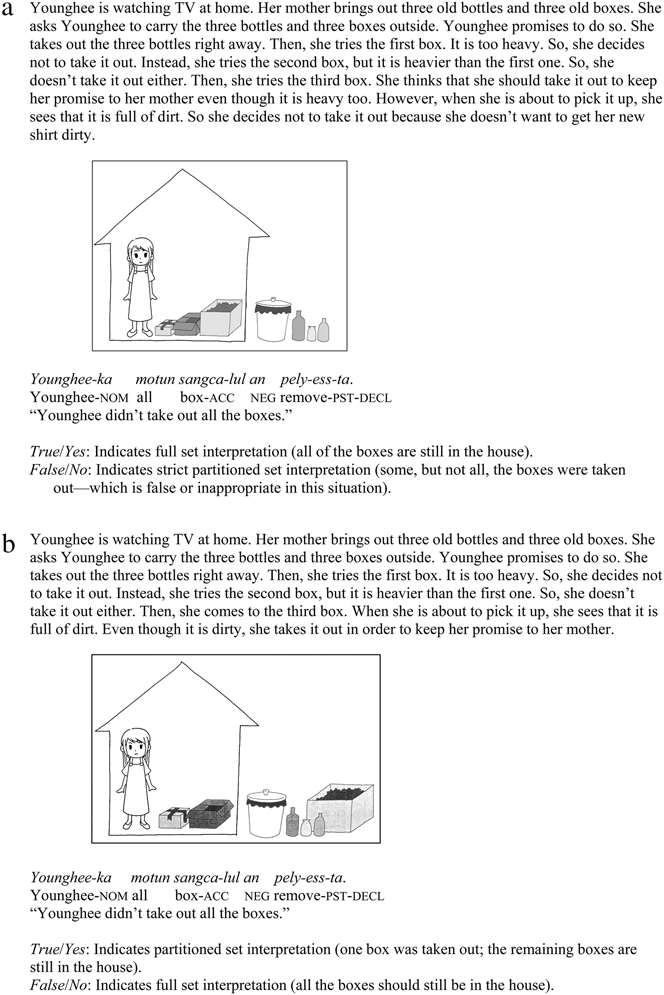
Procedure and Materials. The children’s interpretive preferences were assessed through short stories such as those illustrated in Figure 6.Footnote 8 Each story, which was presented orally and illustrated with pictures on a laptop computer, consisted of a context-setting situation and a test sentence, produced by a puppet. Stories and test sentences were presented in Korean. The child’s task was to judge whether the sentence offered an accurate summary of the story. There were three test items per condition, arranged in a Latin square design so that none of the participants heard the same test item in more than one context. The experimental protocol also included two practice and four filler items.
Sample test items supporting (a) full set and (b) partitioned set interpretations.
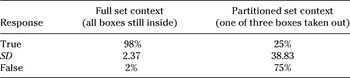
Results and Discussion.Table 1 summarizes the results of the first experiment (the label true indicates that the test item was judged to be an accurate summary of the story).
Interpretive preferences of children born and raised in Korea

As these results show, the children exhibited a very strong preference for the full set interpretation in Korean, accepting it as true in contexts that favor it 98% of the time. In contrast, the partitioned set interpretation was judged to be true in supporting contexts just 25% of the time—a significantly lower rate, t(19) = 8.53, p < .001. This asymmetry points to a strong preference for the full set interpretation, replicating the results reported by Han et al. (Reference Han, Lidz and Musolino2007) for a group of 4-year-old monolingual Korean children. The second experiment considered how heritage language learners fared on the same task.
Experiment 2
Participants. The participants for the second experiment were 16 American children of Korean parents living in the United States. These children, who ranged in age from 6.0 to 11.9 (M = 8.0), had been exposed to English for at least 3 years and in most cases for far longer. Ten had been born in the United States, and all were English-dominant. Consistent with the classic profile of heritage language learners (Montrul, Reference Montrul2008), all of the children attended English-language schools, spoke to each other in English, and had relatively few opportunities to use Korean outside the home.
Procedure and Materials. The same procedures and materials used in the first experiment were also used for the second experiment.
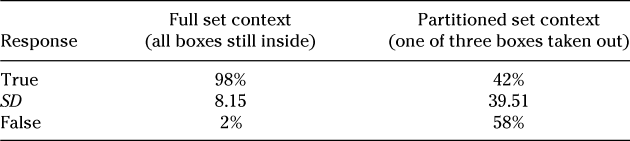
Results and Discussion.Table 2 summarizes the results from this experiment. As these results show, these children exhibit a very strong preference for the computationally less costly full set interpretation in Korean negated all sentences—just like their Korean-dominant counterparts in Seoul. They accepted the full set interpretation 98% of the time, compared to just 42% for the partitioned set reading. This difference was significant, t(15) = 5.91, p < .001.
Interpretive preferences of child heritage learners in the United States
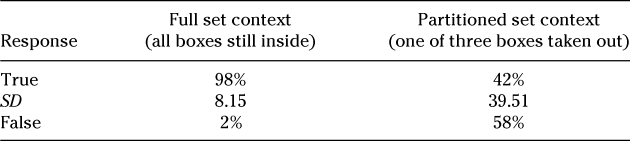
The acceptance rate for the partitioned set interpretation (42%) was higher than the rate of 25% reported in Experiment 1 for children in Korea. This may reflect the influence of English, although it is worth noting that Korean heritage learners accept the partitioned set interpretation of the corresponding English sentences at rates ranging from 59% to 73% (see Lee et al., in press). Moreover, it is clear that English did not influence the heritage learners’ overall preference for the full set interpretation typical of Korean, as this interpretation is not dominant in English.
The next two experiments were designed to determine whether the preference for the full set interpretation is maintained into adulthood by monolingual and heritage speakers of Korean.
Experiment 3
Participants. Fifty-one native speakers of Korean, all of whom had grown up in Korea and were undergraduate students at Hanyang University in Seoul, participated in this experiment.
Procedure and Materials. The interpretive preferences of the adult participants were assessed using a written questionnaire. Each test item was preceded by a context and accompanied by a corresponding picture, as in the version of the materials used with the child participants in the first two experiments. There were four test items per condition, arranged in a Latin square design so that none of the participants encountered the same test item in more than one context. The questionnaire also included two practice and 10 filler items.
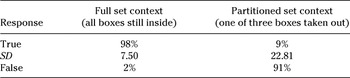
Results and Discussion. The results for the third experiment are summarized in Table 3. Consistent with the predictions of the processing theory adopted here, the adult native speakers manifested a strong preference for the full set interpretation in Korean, compared to the partitioned set interpretation—98% versus 9%, t(50) = 26.82, p < .001. It remains to be seen whether adult heritage learners also exhibit this preference. The fourth and final experiment addressed this issue.
Interpretive preferences of adults who grew up in Korea

Experiment 4
Participants. The participants for the fourth experiment were 10 adults (aged 18–26) who grew up in Korean immigrant families living in the United States. All had been born in the United States, and, like the child heritage learners from Experiment 2, these participants spoke Korean to varying degrees at home as children but attended English-language schools. All were students at an English-language university in the United States and considered English to be their stronger language.
Procedure and Materials. The interpretive preferences of the adult heritage learners were assessed with the same written questionnaire used for the adult native speakers.
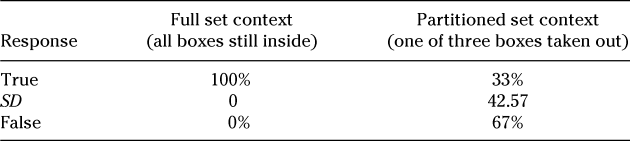
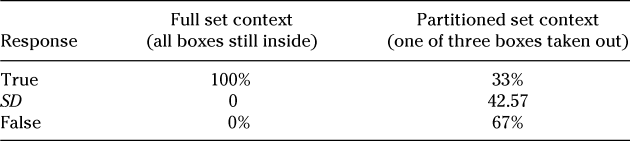
Results and Discussion. The results for the fourth experiment are summarized in Table 4. The familiar pattern once again emerges in the form of a strong preference for the full set interpretation, which is judged to be true 100% of the time in supporting contexts. In contrast, the partitioned set interpretation is accepted just 33% of the time in favoring contexts; this difference is significant, t(9) = 5.01, p < .001. The acceptance rate for the partitioned set reading is obviously higher than the 9% reported for monolingual adult speakers of Korean and may well reflect the influence of English. However, it is worth noting that in a separate experiment reported in Lee et al. (Reference O’Grady, Lee and Choo2010), a group of 10 participants (including 7 from the current study) judged the corresponding English sentences to be true in partitioned set contexts at the much higher rate of 54%.
Interpretive preferences of adult heritage learners
Discussion
In sum, there is reason to believe that heritage learners of Korean, whether children or adults, strongly favor the full set interpretation of not-all sentences in Korean. This is quite remarkable. Given that scope is a highly abstract phenomenon and because sentences containing a negated verb with a universally quantified direct object are quite rare in Korean, it would not be surprising to find that heritage learners manifest interpretive deficits, parallel to those observed for case and other phenomena. In fact, however, the child and adult heritage learners in the current study behave just like their native-speaker counterparts in strongly favoring the full set interpretation. In this regard at least, there are no apparent signs of partial acquisition in children, no signs of attrition in adults, and little sign of transfer in either group.
The only apparent difference between heritage learners and their monolingual native-speaker counterparts with respect to Korean scope involves a somewhat higher rate of acceptance of the partitioned set interpretation, presumably due to the influence of English. Crucially, though, this influence is sharply circumscribed—it does not undermine the heritage learners’ willingness to accept the full set interpretation in Korean, which is typically difficult to access in English, and it does not lead to a preference for the partitioned set interpretation, which is strongly favored in English.
The processing perspective on scope offers a straightforward explanation for how the scopal preferences of Korean are acquired and maintained with relatively little support from the input. Put simply, the full set reading is favored in Korean over the partitioned set interpretation by learners and speakers of all types because it places fewer demands on the processor.
CONCLUDING REMARKS
The special interest of heritage language learning lies in the fact that it offers a new challenge for the study of language acquisition—the necessity of explaining not only how the properties of language are acquired with such apparent ease in response to relatively simple forms of experience but also how some of these properties fail to be acquired. As noted at the outset, the search for an answer to this puzzle presents opportunities to investigate the nature of the human faculty for language and its interaction with experience. The tentative conclusion that can be drawn in this regard is that the facts of partial language acquisition offer support for the emergentist view that a simple processor lies at the heart of the human language faculty. This helps explain two very different sorts of facts.
First, processing considerations seem crucial to an account of why certain form-meaning mappings are more difficult to acquire than others, manifesting slower development in monolingual settings and developmental shortfalls in the circumstances under which heritage languages are typically learned. As examples from Korean and Spanish helped illustrate, problematic mappings are characterized by low acoustic salience on the phonetic side or by a lack of transparency on the semantic side, or both. Such factors—alone or in combination—make it difficult for the processor to identify and strengthen the relationship between form and meaning that ultimately feeds acquisition. The natural remedy for this situation lies in exposure to a large number of instantiations of the difficult mapping, thereby increasing the chances of encountering enough clear-cut cases to support learning. Crucially, however, this opportunity may not be available in the case of heritage learners, whose L1 input declines precipitously at a relatively early point in development. In such cases, the processor fails to establish particular mappings, leading to the sorts of morphosyntactic deficits commonly observed in the literature on heritage language learning, including the difficulties that have been discussed here.
Second—and of perhaps even greater interest—processing considerations are crucial to understanding the success of language acquisition in certain circumstances. The interpretation of scope in Korean is a case in point. Because the partitioned set interpretation places a greater demand on processing resources (given the need for backtracking), the full set reading constitutes the default in Korean, independent of the sparse input relevant to this structure and despite the potential for influence in the opposite direction from a dominant second language (English). The results of the current study thus provide strong evidence that child and adult heritage learners are influenced by the processor in just this way, ultimately reflecting the scopal preferences of adult native speakers of Korean despite vast differences in available input.
This, then, is the emergentist story. Heritage language learning is no different than language acquisition in a monolingual setting. It requires the same sort of input conditions and it draws on exactly the same resources. Foremost among those resources is a processor with two very plausible properties. On the one hand, it is sensitive to the frequency of form-meaning mappings in proportion to their difficulty, as determined by factors such as acoustic salience and semantic transparency. On the other hand, in accordance with widely held assumptions, it favors mappings that minimize the burden on working memory. The interaction of these two simple processing propensities with the quality and quantity of the available input offers the promise of a unified explanation for why language acquisition succeeds—and fails—in the ways that it does.