Introduction
The beginning of the 19th century saw the end of the Protestant Ascendancy in Ireland, as the Irish parliament was persuaded to vote itself out of existence. The resulting Act of Union brought Irish politics into Westminster and British policies into Ireland. If the 18th century had been a period of Georgian extremes, when Dublin became known as the second city of empire, the 19th century ushered in a period of relative decline. After the end of the Napoleonic War, the rapid industrialisation of the English and Scottish economies would see Ireland's agriculturally based economy slide backwards as poverty wielded an increasingly iron grip over much of the island. Between 1845/6 and 1849/50, some five years of famine and fever decimated the population. Over a million people died and another million and a half fled the country in the biggest mass migration ever witnessed in the British Isles (Woodham-Smith Reference Woodham-Smith1991). It is the argument of this paper that after this point, Ireland experienced a premature ‘ageing’ of its society, with not only proportionately more people aged over 60 but also increasing sickness and a declining life expectancy amongst the over-60 s.
Many accounts of this period have focused upon the famine, the massive loss of life and the near terminal decline of Ireland's population but relatively less has been written about the conditions facing older people both at that time and especially since then. The aim of this paper is to redress that balance by examining the plight of older people during and in the half century after this particularly difficult period in Ireland's history. Drawing primarily upon material from the Irish censuses that were conducted from 1821 to 1901, I examine how blighted later life would become in Ireland and the extent to which older people found themselves trapped between poverty and infirmity. To do so, the paper will address three inter-linked themes: the changing demography of the country during the course of the 19th century; the extent of morbidity and mortality affecting the older population; and thirdly, the place and significance of the workhouse in the lives of those over 60 – the aged of this period.
Before launching an account of Ireland's demographics, some preliminary remarks should be made concerning the significance of the Act of Union for Ireland and its people. By inserting Irish politics and politicians into the British parliament, 19th-century Ireland became a sort of testing ground for British social policy as England began to ‘re-imagine’ its sister island through its ‘Victorian’ eyes (Monacelli Reference Monacelli2010). One by-product of this ‘re-imagining’ was the establishment of a national census, which became more detailed and more intrusive than those conducted in England and Wales and in Scotland (Jordan Reference Jordan1997). Further, behind the incorporation of Ireland's governance into the British state lay a strong political intent of proofing ‘Britain’ against future international threats from competing powers that had arisen in the past from various alliances between countries such as France and Spain and disaffected members of the Irish elites. Part of this ‘proofing’ was the deliberate attempt to ‘Anglicise’ the country in a manner that some later historians have viewed as bordering on the ‘genocidal’, in the sense that this policy sought to bring about an end of the ‘imagined community’ of the Irish as the inalienably ‘other’ (Coogan Reference Coogan2013).
Whatever the political motives behind the British government's gathering of national statistics for Ireland, the result is that we have more detailed accounts of the health and welfare, the housing and land ownership, the educational skills, linguistic preferences and religious affiliation of the population of Ireland from the mid-century onwards than for any of the other countries of the British Isles. How far those facts constituted an ‘objectification’ or ‘othering’ of the population and how far they created the conditions for a new reflexivity within the population can be debated, but the consequences for developing a historical understanding of old age in Ireland are substantial.
The census and Irish demography in the 19th century
The first Irish census took place in 1821 following the passage of an Act of Parliament in 1815. An earlier attempt had been made to conduct a national census in 1813 but this proved unsuccessful as only a quarter of the counties furnished complete returns, the rest submitting either incomplete, inaccurate or no returns at all (Census of Ireland 1821 General Report, cited in Linehan Reference Linehan1991: 93). The government revised the provisions for taking the census, vesting responsibility with the Bench of Magistrates at quarter sessions rather than, as originally planned, with the Grand Juries. These latter bodies were essentially self-appointed bodies of local landlords and merchants who collected local taxes and administered the law within each county, who were generally more interested in furthering their own local interests than in functioning as state bureaucrats.
The 1821 census provided information on all named individuals in the island of Ireland, the enumerators recording in officially supplied note books the age and occupation of everyone resident in each district following instructions issued to the Bench of Magistrates through the assistant barristers and recorders of each county (Linehan Reference Linehan1991: 93–4). In terms of detail, the Irish census was ahead of that conducted in England, Scotland and Wales, since individuals' precise ages were not collected for these countries until 1841. The 1821 Irish census therefore provides the first detailed demographic portrait of the age structure of any of the countries making up the British Isles.
In 1831 another unsuccessful census was completed. Because of charges of over-counting by the enumerators, no report on the census was published (Jordan Reference Jordan1997; Vaughan and Fitzpatrick Reference Vaughan and Fitzpatrick1978). The next 1841 census provided the real model of all future censuses conducted in Ireland, during British rule. Here systematic inquiry was made employing two pre-established forms, Form A which detailed the particulars of each individual enumerated, as recorded by the head of household, and Form B, which was a return of the houses in each district, whether or not occupied, and with details not just of the families living there but also the nature and quality of the building itself, to be completed by the enumerators after they had visited each building or household. A further innovation was the use of the police force as enumerators, a departure from previous censuses and from the methods employed in the other countries of the British Isles, where census enumerators were drawn from the local authorities.
From 1851 onwards, information was collected on educational status (ability to read and write), language (English, Irish (Gaelic) or both) and, from 1861, religious affiliation.Footnote 1 A separate form was used to record returns from institutions, such as the details of those residing on census night in asylums, hospitals, prisons, schools, colleges and workhouses. Finally, detailed information was collected on the state of health of the population, recording the numbers designated ‘sick’ amongst those living at home and those resident in institutions. Stimulated by the devastation wreaked upon the population by the Great Famine (1845–1849), the subsequent censuses included a much greater investigation of the health of the Irish population than that conducted elsewhere in the British Isles. A separate report was issued in 1853, entitled The Census of Ireland for the Year 1851. Part III. Report on the Status of Disease (British Parliamentary Papers (BPP) 1856a ). Introducing their report, the commissioners stated: ‘No similar attempt has, we believe, been yet made to collect and tabulate the diseases presented on a single day in even a limited portion of any other country’ (BPP 1856a : 1). They divided the data into two broad classifications – ‘permanent maladies' and ‘temporary maladies'. The former included ‘the deaf and dumb, the blind, the lunatic idiotic, paralytic and epileptic, and the lame and decrepit’ (BPP 1856a : 1); the temporary maladies included those ordinary acute and chronic maladies whose duration ‘is comparatively limited’ even if the limit is one imposed by their ‘fatal termination’ such as cancer, phthisis (tuberculosis) and pneumonia. Although this information was collected as part of the basic census of 1851, further enquiries were made of those identified as ‘permanently’ or ‘temporarily’ sick to confirm the initial categorisation and to elaborate where possible cause and consequence.
All subsequent censuses through to 1911 included information about permanent illnesses, but after 1871 detailed information on ‘episodic’ sickness by age group was dropped and only the broadest reports were provided on rates of ‘temporary sickness' for the population as a whole. Consequently, while it is possible to track the changing institutionalised population through the records of the permanent sick, any analysis of the epidemiology of age and ‘episodic’ sickness must be restricted to the period 1851–1871, after which we must rely less upon these measures of morbidity. At the same time, following the mandatory registration of births, deaths and marriages, in 1865, it has become possible to track changing life expectancy rates at various points in the lifecourse, for the period 1871–1901, via the website of the Central Statistical Office, Ireland, enabling mortality to replace morbidity as an indicator of the state of health of the older population.
The ‘premature’ ageing of Irish society, 1821–1901
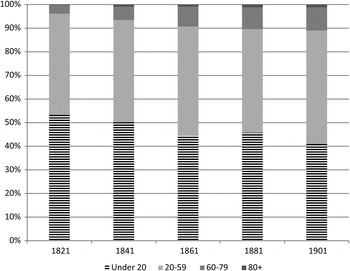
As already noted, chronological age was not considered of significance in counting the size of the population in the first three English censuses (1801, 1811 and 1821) and it was not until 1841 that individual ages were recorded by the English and Scottish enumerators. In contrast, the first successful Irish census, held in 1821, had recorded individual ages in a practice that was repeated in 1841 and in all subsequent censuses held until independence. Changes in the age structure of the Irish population during this period are illustrated in Figure 1.
Age structure of the Irish population, 1821–1901.

Before considering the changes in age structure over this period, it is important to note the progressive decline in the size of the Irish population as a whole. In 1821, the estimated population of Ireland was just under 6.8 million; by 1841, it had grown to over 8.1 million. By 1851, it had plummeted to some 6.5 million and it would continue to fall throughout the next half century, dropping to below 4.5 million by 1901. Not only did the numbers fall, but as Figure 1 illustrates, the country's age profile changed substantially.
In both of the pre-famine censuses, the Irish population was distinctly ‘youthful’. Half the population were aged under 20 years with some 5 per cent aged 60 and over.Footnote 2 In the post-famine censuses, the proportion of the over-60 s steadily rose while the number of children and young people fell. From 1841 to 1891, the number of children and young people in the population dropped from 4,252,382 to 2,078,975, a decline of over 50 per cent; the number of people of working age also fell from 3,516,100 to 2,131,876, a decline of 39 per cent; while the number of those aged 60 and over declined by only 7 per cent, over the same period, from 527,411 to 492,113. Death and emigration had an immediate effect, reducing the numbers of infants (under the age of five) by over 37 per cent and the number of children and young people (5–19 years of age) by over 15 per cent in the period between the 1841 and 1851 censuses, while the over-60 population dropped by over 11 per cent. The continuing decline in the population after 1851, however, was largely the result of emigration. Figures on the ages of those emigrating during the 1850s indicate that of the 3.1 million children and young people enumerated in the 1851 census, approximately 9 per cent emigrated in the next five years. Of the 2.9 million adults of working age (20–59 years of age), 15 per cent emigrated. In contrast, of the 473,000 people aged 60 and over enumerated in the census, a mere 1 per cent were reported to have emigrated. It seems likely that some 3,770,162 men, women and children emigrated from Ireland in the period 1851 to 1900 and of these a mere 0.67 per cent were aged 60 or over, with almost equal numbers of men and women.Footnote 3 In short, over 99 per cent of Irish post-famine emigrants were children or adults of working age. It seems not unreasonable to assume that this massive level of emigration by selectively reducing the numbers of children and of those of child-bearing age was responsible for making Ireland a prematurely ‘ageing’ society. Because, as I will later show, there was no improvement in the health or longevity of the over-60 population, this ‘ageing’ effect was quite different from the ‘healthy’ ageing that has been witnessed among many economically developed countries during the latter half of the 20th century.
‘Age heaping’ and its effects
How accurate were the recordings of age at this time? How far can any analysis be pursued that is based upon population age estimates derived from 19th-century censuses with many of the population being ‘unschooled’? The phenomenon of age heaping – i.e. the tendency to give adult ages to the nearest decade or five-year period such as 55, 60, 65, 70, and so on, ignoring the years in between – has long been recognised (Woods Reference Woods2000). Detailed estimates of age heaping and age exaggeration have been made of sub-samples drawn from the early 20th-century Irish censuses, before and after the introduction of the old-age pension (Budd and Guinnane Reference Budd and Guinnane1991). These analyses suggest that (a) age misreporting was more often the result of carelessness than deliberation and (b) it was more evident among poorer, less well-educated and older people. The authors suggest that although there was a specific impact arising from the introduction of the old-age pension in 1908, this led not to any greater distortion of age, but rather greater attention being paid in reporting ages. Somewhat reassuringly, they add that ‘[h]istorical analyses which are concerned less with the absolute proportion … and more with changes in that proportion are less vulnerable to the problems noted’ (Budd and Guinnane Reference Budd and Guinnane1991: 516). Even so, if the trend to exaggerate one's age is more evident among the older population, as well as among the less well-educated and the poorer, then the increasing education and improved literacy observed during this same period should lead to progressively lower rates of age exaggeration – which might suggest that the ‘ageing’ of the Irish population during the Victorian period was if anything greater than the census figures reveal, since the earlier censuses might have been affected by greater age exaggeration.
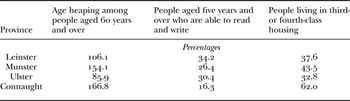
One way of exploring this is to examine ageing in two contrasting provinces of Ireland, comparing rates of ‘ageing’ in a province where age heaping was highly prevalent, its people generally poorer, less well-educated and less literate, with one where age heaping was less evident, the people generally richer and, on the whole, better educated. Table 1 shows provincial data on age heaping, literacy and the numbers living in third- or fourth-class housing, derived from the general report of the 1841 census (BPP 1843). For the purposes of this study, age heaping has been calculated for ages 60 and above by averaging the percentage ratio of those reporting their age as 60, 70 or 80, compared with those reporting their ages as 61–69, 71–79 or 81–89, for each province. Data on education was obtained from the 1841 county censual returns on the numbers able to read and write, and on poverty from similar returns based upon the enumerators' four-class ratings of the quality of the building where the household was located.
Inter-provincial variation in education, household poverty and age heaping in the 1841 Irish census

Source: Irish Census Report 1841; BPP (1843) (accessed online at www.histpop.org/ohpr/servlet/Browse?path=Browse/Census).
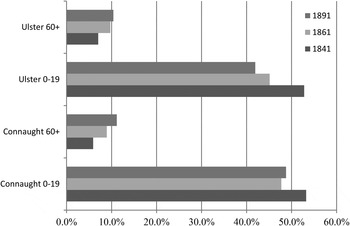
Since Connaught and Ulster provide the most marked contrast in terms of age heaping among those aged 60 and above, these two provinces were chosen to explore the effect of such differences in the practice of age heaping on the relative ‘ageing’ of their populations. Figure 2 shows the change in the proportion of under-20 s and over-60 s, in the population of these two provinces, during the period from 1841 to 1891. As can be seen, despite the substantial difference in apparent age heaping between the two provinces, both exhibit the same tendency towards an ageing of the population over this half-century. In both provinces, the young – those aged below 20 – ceased to be a clear majority of the population (i.e. over 50%) while the old – those aged 60 and over – were no longer the small minority they had been before the famine. Age heaping seems to play little part, then, in accounting for, or distorting, the ageing of Irish society during this period.
Age heaping and its impact on the ageing of Irish Society, 1841–1891: Connaught versus Ulster.

Ageing, Irish demography and the rest of the British Isles
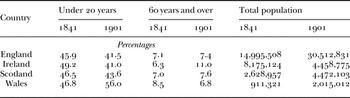
To gauge the distinctiveness of the patterns noted above, we can compare Ireland's situation with that obtaining in England, Scotland and Wales. Table 2 shows the percentage of the population aged under 20 and the percentage aged over 60 in each of the four countries of the British Isles, during the period 1841–1891. As can be seen from these figures, there was scarcely any increase in the size of the over-60 population in England or Scotland, while the population aged 60 years and over nearly doubled as a proportion of Ireland's population. It would take England, Scotland and Wales – along with most other Western countries – until the middle of the 20th century before they reached a similar kind of age structure in their population. Within the context of the British Isles, and Europe more generally, Ireland's societal ageing was distinct.
Proportion under 20 (young) and over 60 (old) in the countries of the British Isles, 1841–1901

Source: Census Reports 1841 for England & Wales, Scotland, and Ireland and Census Report 1901 for The British Empire (accessed online at www.histpop.org/ohpr/servlet/Browse?path=Browse/Census).
A further point of distinction can be noted, that of the changing gender distribution of the over-60 population in Ireland. In 1851, men represented 44.5 per cent of the over-60 population in Ireland, women represented 55.5 per cent. These figures are similar to those in Great Britain where in 1851 the proportion of men among the over-60 s was 45.4 per cent (BPP 1851: appendix, cliv). In subsequent Irish censuses, the proportion of men among the over-60 s rose steadily, from 46.7 per cent in 1861, to 47.9 per cent in 1871, 48.5 per cent in 1881, 48.3 per cent in 1891, so that, by 1901, men made up virtually half of the older Irish population (49.2%). In England, Scotland and Wales, by comparison, the proportion of older men to women fell over the same period, dropping to some 44.2 per cent by 1901 (Census of the British Empire 1901: 12). Not only had Ireland's population prematurely aged compared with that of the rest of the British Isles (and much of continental Europe), its older population was proportionately more equally gendered. The issue of gender will be pursued further when we come to consider differences in mortality and rates of institutionalisation among the over-60 s.
Morbidity, mortality and the aged
The famine not only instituted a change in the age structure of Ireland's population, it drew greater attention to the country's state of health. From the 1851 census onwards, special attention was paid to enumerating the sick within the various sections of the population – a national ‘first’ for British-ruled Ireland. It is possible to chart some aspects in the relationship between sickness, age and poverty in post-famine Ireland at least between 1851 and 1871, although after that detailed information on rates of sickness at home by age group ceased being reported. Consequently, for the period after 1871 I will turn to the more general changes in health as observed in the mortality rates of the over-60 population.
Concepts of sickness were evolving in the mid-19th century. While the classical ‘Galenist’ tradition of constitutional medicine still survived, it was looking increasingly archaic as medicine sought to promote a more empirical, investigative approach to individual diseases. A new ‘public health’ awareness was beginning to appear, heralded by the publication of Chadwick's (Reference Chadwick1842) Report on the Sanitary Condition of the Labouring Population. By background a lawyer, Edwin Chadwick had become interested in the issue of public health as a result of his work on reforming the English Poor Laws, and the recent emergence of cholera as the ‘new’ plague that was spreading across Europe (La Berge Reference La Berge1988: 26). Cholera has been described as ‘shocking to the nineteenth century sensibility’ coming ‘at a time when European literature and culture were celebrating the ‘age of the beautiful death’ with diseases like typhoid or tuberculosis being accorded a transforming, almost beatifying influence on their victims', producing symptoms that were the very opposite – abject, degrading and reeking of disgust (Evans Reference Evans, Ranger and Slack1995: 154). Although relatively few people died during the epidemic, it was clear to many people that cholera was a disease of the poor that seemed to thrive in conditions of poverty and squalor.
Chadwick's work, and that of his colleague, Southwood Smith, promoted the idea that the physical conditions of a person's life strongly determined their susceptibility to disease and mortality. The poor got sick and died at a greater rate because they lived in unsanitary conditions. It was, Chadwick believed, the responsibility of government to prevent disease and reduce mortality by ensuring access to clean water and the provision of effective sewage systems. Chadwick insisted upon a disease model in accounting for mortality, turning away from ‘constitutional medicine’ where disease reflects an injury to the constitution with varying symptomatic consequences that depend as much upon the person's constitution as on the injury itself (Hamlin Reference Hamlin1995: 860). Earlier medical writers had argued that diseases such as fevers were indicators of poor conditions, reflecting the state of misery of a population (Hamlin Reference Hamlin1995); Chadwick aligned himself with the new school, favouring the naming of discrete diseases as causes of ill health, causes that could be combatted not so much by relieving poverty but by making the conditions of the poor cleaner and healthier.
The 1851 Irish census took place in the wake of this new sanitarianism. It recorded a multitude of diseases both as causes of death and as sources of sickness. These were tabulated in two extensive volumes giving details of morbidity by age group (BPP 1856a , 1856b ). Sickness was classified into that which represented ‘permanent’ impairments, such as blindness, deafness, epilepsy, idiocy, lameness and lunacy, and those diseases deemed ‘temporary’ such as cancer, typhoid and typhus, heart disease and phthisis (tuberculosis). The Irish census data followed broadly the system of classification instituted by William Farr and W. M. Burke at the General Register Office, although from 1851 to 1871 the various ‘temporary maladies' were presented alongside the classification adopted by Sir W. R. Wilde and their Irish/Gaelic names. From 1881 onwards, the nomenclature followed exactly that of the General Register Office but no further detailed reports and tables relating to deaths and disease by age group were produced.
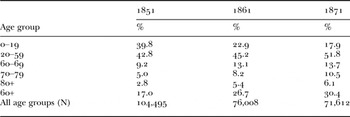
Table 3 illustrates the prevalence of all forms of temporary sickness by age from 1851 to 1871. People over 60 accounted for some 7.5 per cent of the total population and represented some 17 per cent of the total amount of reported sickness in 1851. While there was a relatively greater degree of ill health among the older population than among those aged below 60, nevertheless over 80 per cent of the sickness reported among those living at home or in institutions was accounted for by the ‘non-elderly’. In this rather constrained sense, people aged 60 and above in 19th-century post-famine Ireland were not especially sick. By 1861, when the immediate effects of the famine on the population's health had dissipated, those under 60 still accounted for over two-thirds of all reported sickness while those over 60 accounted for just over a quarter (26.5%). By 1871, this figure had risen to almost one in three of those suffering ‘temporary sickness' being aged over 60. Although the absolute rates of temporary sickness fell in the decades following the famine, the principal decline was in rates of sickness among children while those afflicted with the various temporary maladies of the time were increasingly members of the older population.
Prevalence of ‘temporary sicknesses' by age group, 1851–1871

Source: Census of Ireland, Report on the State of Disease, 1851 and 1861 (accessed online at www.histpop.org/ohpr/servlet/Browse?path=Browse/Census).
Things look somewhat different when one examines the ‘in-patient’ population – those occupying workhouse infirmary beds and general hospital beds. Ireland had established a system of voluntary hospitals – county infirmaries, fever hospitals and a scattering of more specialist hospitals – towards the end of the 18th century. After the union, these provisions were made more systematic by various acts of parliament passed in the first three decades of the 19th century, inaugurating county infirmaries, lunatic asylums, fever hospitals and an extensive range of dispensaries designed primarily to provide ‘out-patient’ care and treatment for the poor. It was, as Cassell has noted ‘an impressive achievement’ and by the 1840s there were ‘some 750 institutions treating approximately a million patients annually’ (Cassell Reference Cassell1997: 15). But for the politicking of Thomas Wakely, the editor of The Lancet and staunch advocate of the professional power of (English) medicine, a further act, the Medical Charities Bill, which was due to be passed in 1837, might have seen Ireland develop the first ‘truly centralised, comprehensive and securely financed system of state medical care decades ahead of England and other western nations' (Cassell Reference Cassell1997: 47).
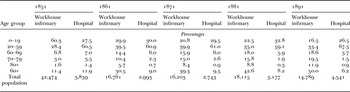
With the passage of the Poor Law in 1838, these various sources of ‘outpatient’ and ‘in-patient’ care for the sick poor were supplemented by the ‘medical’ facilities within the new workhouses. Over 130 workhouses were built ‘from similar plans according to their sizes, of similar materials and at nearly the same time’ (Enhanced British Parliamentary Papers on Ireland (EBPPI) 1844: 1). Each workhouse had its own infirmary wings, one for male and one for female residents, designed to address sickness among the destitute of all ages in the institution. Table 4 compares the age structure of these two ‘institutionalised’ sick populations during the period 1851–1891 – sick paupers in the workhouse infirmaries versus the sick poor in hospitals.
Age structure of inmates in Irish workhouse infirmaries versus those in Irish hospitals, 1851–1891

Source: Censuses for Ireland 1851–1891 (accessed online at www.histpop.org/ohpr/servlet/Browse?path=Browse/Census).
In 1851, when the impact of the famine was still evident in the numbers of people receiving indoor relief either in the workhouses themselves or in their infirmaries, the majority occupying workhouse infirmary beds were children or young people. The majority of those in the fever hospitals, county infirmaries or specialist hospitals were adults of working age. The proportion of people aged 60 and over in workhouse infirmary beds (11.4%) was very similar to the proportion occupying general hospital beds (11.9%). Though greater than the relative proportion of the over-60 population in the country as a whole, these figures were only slightly below the proportion of the over-60 s who were recorded as temporarily ‘sick’ in the 1851 census.
Over the next half century, this picture would change. The number of workhouses and their ‘regime’ remained fairly constant throughout this period, even though the number of inmates dropped. The infirmaries attached to the workhouse became progressively less and less suited both in terms of design, facilities and staffing to the needs of the aged and infirm inmates who increasingly populated them (British Medical Journal Special Commission 1895: 740). By 1903, an Irish physician, Dr. Edward Thompson wrote in the British Medical Journal that ‘most of the workhouses are nearly empty … [caring for] …the broken down remnants of the unfortunate and neglected army of labour … where the poor pass their time in filth and idleness waiting their call to the grave’ (Thompson Reference Thompson1903: 1410–1). Although the overall number of hospitals scarcely changed, the number of hospital beds grew – from under 3,000 in 1851–1860 rising to 4,500 by 1891. There were also changes in the types of hospital. In 1851 there were 36 infirmaries, 15 general hospitals, 61 fever hospitals, 11 lying in [maternity] hospitals and two specialist hospitals; by 1891 there were 34 infirmaries, 26 general hospitals, 29 fever hospitals, seven lying in hospitals and 28 specialist hospitals – with a significant decline in fever hospitals and growth in the specialist hospitals (BPP 1894: table 128).
In 1891, there were proportionately fewer older people occupying a hospital bed (6.2%) than their representation in the general population (10.5%). On the other hand, 50 per cent of those occupying a workhouse infirmary bed were aged 60 or over. The sick paupers were overwhelmingly aged; the hospitalised sick were definitely not. This was not due to any developments within the workhouse infirmaries by better meeting the needs of the sick aged nor to any improved services made available there. The lack of trained staff, the reliance upon the paupers themselves to provide care to the aged sick and infirm, and the general insanitary conditions prevailing within the infirmary seem if anything to have worsened – points duly noted by the Special Commission of the British Medical Journal's inquiry into the nursing and administration of Irish workhouses and infirmaries (British Medical Journal Special Commission 1895). Although pauper nurses were subsequently banned and new requirements made that each Board of Guardians employ a ‘qualified’ or ‘trained’ nurse in their workhouse (House of Commons Parliamentary Papers (HCPP) 1902b, appendix XXIII), Thompson was still voicing similar criticisms when he reported that ‘there is hardly a workhouse in Ireland where there is a night nurse’ while the sanitary arrangement ‘consists of a bucket which is passed round in the morning or when wanted from one patient to another’ (Thompson Reference Thompson1903: 1411). In short, while the old were progressively less likely to gain access to general infirmaries and county hospitals if sick, they were progressively more likely to find a bed in the workhouse hospital, a bed that was distinctly a second-class, pauper bed.
One reason that Victorian hospitals were reluctant to admit older people was the effect of older patients on the hospitals' success rates (Smith Reference Smith1990: 254). Critically ill or not, older people were more likely to die. In the period from 1841 to 1901, life expectancy for those over 60 in Ireland worsened. Although life expectancy data at age 65 from 1841 are based upon estimates calculated from censuses and hence may be affected by age heaping, after the introduction of mandatory registration of births and deaths in 1865, figures for life expectancy and mortality rates from 1870 onwards are considered relatively accurate (Whelan Reference Whelan2010). These show a slight but constant decline in later-life expectancy within the general population. Average male life expectancy at age 65 fell from 10.9 years in 1841 to 10.5 in 1891, while female life expectancy fell from 10.8 to 10.3 years over the same period (Central Statistical Office, Ireland 2014). For women aged 62, the probability of dying within the next year (qx) rose from 0.029 in 1871 to 0.035 in 1891; for women aged 67, it rose from 0.047 to 0.054. For men of similar ages the probability of dying also rose – from 0.030 in 1871 to 0.034 for 62 year olds and from 0.047 to 0.051 for 67 year olds (Whelan Reference Whelan2010). Taken together with evidence from the last Census report on deaths, published in 1875, that the number of deaths among those aged 60 years and under 80 ‘have steadily increased during the past three decades' (BPP 1875: lxxiv) and evidence that deaths in the workhouse from ‘infirmity, debility and old age’ rose from 13,357 in 1851 to 27,286 in 1871 (while the overall numbers in the workhouse declined from 249,877 to 48,926), these figures do imply an overall worsening of the health and life prospects for Ireland's older population, men and women alike. Given the actuarial evidence concerning the life-shortening effects of poverty (Smith Reference Smith1990), and the reports just noted concerning the situation in the workhouses, it seems improbable that Ireland's ageing paupers were exempt from a similar foreshortening of their later life.
Aged in the workhouse
As Irish society slowly aged in the decades after the famine, the aged swelled the ranks of the ‘temporary’ sick and faced a seemingly steady decline in their life expectancy. This final section of the paper turns to the question of poverty and the changing demographics of the workhouse – Ireland's registered paupers – during this time. While poverty was an endemic feature among the ‘lower classes', the Victorians made a distinction between the poor and paupers. Paupers were the destitute, those unable to survive without external support. Paupers, not the poor, were meant to be the sole beneficiaries – or victims – of the new Victorian Poor Law (Englander Reference Englander2013; Himmelfarb Reference Himmelfarb1997). In 1838, the Westminster parliament enacted the first Irish Poor Law (Nicholls Reference Nicholls1856), closely modelled on the new Poor Law that had been championed in England and Wales by Edwin Chadwick. There was one difference: the Irish Poor Law insisted that relief should only be given according to the principal of ‘less eligibility’. There would be no outdoor relief.
The majority of workhouses were erected by the various Poor Law Unions between 1842 and 1846 in direct consequence of the 1838 Act (EBPPI 1844). Under the terms of the Act, each union was charged with providing a source of indoor relief, via the establishment of a workhouse, for the destitute of their district; no outdoor relief was permitted and no law of settlement made (Ingram Reference Ingram1864: 51). After 1846, numerous temporary and auxiliary workhouses were set up to cope with the vast increase in destitution following in the wake of the famine. Outdoor relief was then permitted, to be provided only to those unable to gain entry to their local workhouse because it was either full or there was fever amongst its inmates.
As in England, if for rather different reasons, there had been much controversy over the introduction of a Poor Law system in Ireland. While in England, many pamphlets and protesting letters focused upon the comparative harshness of the new Act and its restrictions denying the level of outdoor relief that had been afforded under the old Elizabethan Poor Laws, most of the voices opposing poor relief in Ireland argued against any provision for the poor, claiming that such a law risked either ‘pauperising’ the rich while swelling the ranks of paupers or corrupting the charitable spirit in Irish society (Benn-Walsh Reference Benn-Walsh1831; Bicheno Reference Bicheno1830: see also Gray Reference Gray2009). Only after the famine hit Ireland and the workhouses became the only national source of relief were such criticisms muted. Homes and farmlands were abandoned and the workhouses had to turn thousands away as they strained to house the helpless and homeless across all four of Ireland's provinces. In the year 1841, some 31,000 people were reported to be receiving indoor relief in the various workhouses thus far established, serving fewer than four people in a thousand of the total population (Grimshaw Reference Grimshaw1888/89: 359). With the arrival of the famine, large numbers of ‘auxiliary’ and ‘temporary’ workhouse establishments were quickly erected, designed to try to cope with the mass destitution of the population. By 1848, the numbers receiving indoor poor relief reached over 700,000 or 11 per cent of the total population, necessitating that some receive outdoor relief simply because there were insufficient workhouse places for the huge numbers in need (Grimshaw Reference Grimshaw1888/89: 359). Many of these auxiliary structures became sources incubating disease and mortality rates in the workhouse soared during the late 1840s. Still the destitute sought relief there, having little alternative other than to starve to death in the fields.
The workhouse soon acquired the same reputation it had had in England, Scotland and Wales. In the very first annual report of the Irish Poor Law commissioners, they noted with regret that ‘the unwillingness of poor persons to avail themselves of this mode of relief has been so great that they have sacrificed their own lives or the lives of their children … by refusing such relief altogether’ (EBPPI 1848: 13, para. 34). It too became ‘a place of last resort, and to die [there] … a fate which was feared by all’ (Ó Gráda Reference Ó Gráda2002: 143). Although the restrictions on providing outdoor relief were much harsher than elsewhere in the British Isles, with no right to relief implied, the impact of the famine did give some leeway to the Poor Law guardians, enabling them to provide outdoor relief, albeit in very limited circumstances, while granting to some, though not to all of the poor, the right to relief (Ingram Reference Ingram1864: 52–4). With time, the relative ‘flexibility’ of relief grew; the numbers afforded outdoor relief increased from 8,500 in 1851 to over 225,000 by 1881 (Grimshaw Reference Grimshaw1888/89; Purdy Reference Purdy1862). Even so, compared with the rest of the British Isles the Irish workhouse provided the dominant form of poor relief in Ireland throughout the period, largely determining who were or were not paupers. As illustration, in 1860, only 12 per cent of registered paupers received indoor relief in England, 8 per cent in Wales and 7 per cent in Scotland. In Ireland, the figure was 97 per cent. For every outdoor Irish pauper, there were some 40 in the workhouse (Purdy Reference Purdy1862: 30).
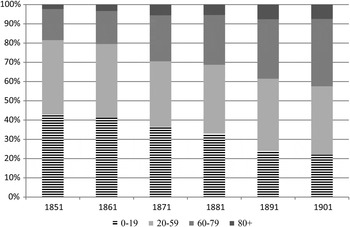
Over time, the pauper population grew older. In 1851, almost half of the inmates were aged under 20. By 1901, the proportion of children and young people had dropped to less than a quarter. In contrast, less than a fifth of the workhouse population in 1851 had been aged 60 or over; by 1901, almost half were. As one author has reminisced, at the turn of the century the workhouse seemed full of ‘old men and women, queer looking women with shawls and long grey hair [who] looked at you in a frightened sort of way and hurried down the street’ (Mac Thomais Reference Mac Thomais1973: 54). This change in age structure of the workhouse population in Ireland is illustrated in Figure 3.
Age structure of the Irish workhouse population, 1851–1901.

This shows the extent of the ageing of the workhouse population and by implication the relative growth of impoverishment among the over-60 s during this period. Of the total population of Ireland, standing as 6,552,386 at the time of the 1851 census, 249,877 (3.8%) were receiving indoor relief – i.e. the number that were recorded as inmates of the workhouses. There were 473,441 people aged 60 or more in the Irish population at that time, of whom some 8,495 (1.8%) were inmates in the workhouses. This was the most desperate of times for the country: there were more inmates in the workhouses than at any other time in the history of these institutions, but they were mostly children and young people (Ó Gráda Reference Ó Gráda1999: 183).
As the situation improved and the overall numbers of workhouse inmates fell, the number of children and young people in the workhouses declined most sharply, followed by those of working age. People aged over 60 became the typical recipients of indoor relief. In 1861, the overall numbers in the workhouse had fallen to a fifth of the figure for 1851–50,010, representing just under 1 per cent (0.86%) of the total population. At this time, over a fifth (10,264) were aged 60 or over, representing 3.5 per cent of the total over-60 population. By 1871, the numbers of workhouse inmates had fallen further, to 48,926 – but because of the continuing decline in the population, still representing more or less the same 0.90 per cent of the population. Then 2.4 per cent of the population aged 60 and above were inmates of the workhouse, compared with just 0.71 per cent of those under 20 and 0.68 per cent of those aged 20–59. By 1872, one workhouse medical officer noted that since outdoor relief was becoming increasingly available it ‘gave the option to them of that class who were able to leave the house to do so’ leaving ‘none but those incapacitated by infirmity to remain’ (cited by Crossman Reference Crossman2014: 127). By 1901, the overall number of workhouse inmates had dropped to 42,932 (though still representing some 0.95 per cent of the population for the reason already mentioned) but among the over-60 s, numbers had risen to 15,234, representing 3.7 per cent of the total age group, compared with 0.51 per cent of those under 20 and 0.70 per cent of those aged 20–59 years old. These numbers were still low compared with the situation in England and Wales, where, in 1900, some 4.9 per cent of the over 65 population were in the workhouse (Thane Reference Thane2000: 171–2, tables 9.1 and 9.2) and Ireland continued to set a higher ‘bar’ for entry as it had done throughout.
From 1861 onwards, slightly more older men than women received indoor relief, though the figures tended to vary from near equality (50.2%) in 1891 to mild inequality of representation (53%) in 1901. Table 5 illustrates the overall rise in the numbers of aged indoor paupers during the second half of the century.
Numbers (and proportion) of young, working age and older people in the workhouse population, 1851–1901

Note: 1. Estimates based upon 1851 Census material adjusted by data presented in the Commissioners for Administering Laws for Relief of the Poor in Ireland: Fourteenth Annual Report (EBPPI 1861: CMD 2803).
Source: Censuses of Ireland 1851–1901 (accessed online at www.histpop.org/ohpr/servlet/Browse?path=Browse/Census).
Not only were so designated aged paupers an increasing percentage of the over-60 population in Ireland, they made up an increasing percentage of the pauper population itself. According to the seventh annual report of the Poor Law commissioners for Ireland, in 1854 there were on average 1,833 people ‘disabled by old age and infirmity’ receiving outdoor relief – just over 20 per cent of the total number of outdoor paupers (BPP 1854). By 1901, that figure had risen to some 32,393 deemed ‘disabled by old age and infirmity’ out of a total of 88,492 outdoor paupers – representing a rise both in absolute numbers and as a proportion of all recipients of outdoor relief.Footnote 4 More detailed figures of the chronological ages of those receiving indoor and outdoor relief are only available from 1901 but they reflect the same trend. In 1906, some 50,697 people over 60 years of age were registered paupers. This figure includes just over 50 per cent of the total number of registered paupers receiving indoor or outdoor relief. It represented as paupers some 7.5 per cent of all Irish men aged 60 and over and twice that rate – 13 per cent – of all Irish women of a similar age (HCPP 1910: 17, appendix XXXI). It might be argued that the growth in the absolute numbers of paupers reflects changing criteria in terms of eligibility, particularly after the widespread transfer of power during the 1880s when membership of many Poor Law Union Boards switched from being dominated by land-owners to a majority being land-holders (Crossman Reference Crossman2014: 3). But this hardly explains the rising proportion of the over-60 s receiving relief, compared with children or with those of working age (i.e. 15–59 years old). Even allowing for a necessary relativity in assessing rates of poverty or destitution, what seems clear is that age and infirmity increasingly dominated the constitution of pauperdom in Ireland during the late Victoria period. By contrast, gender was less defining, unlike the case in England where ‘women were a majority of adult recipients of Poor Law relief’ (Thane Reference Thane1978: 30).
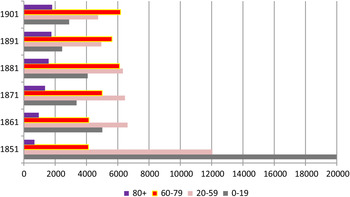
What of their state of health? Figure 4 shows the numbers of paupers who were in the workhouse infirmaries on the night of successive censuses from 1851 to 1901. In 1851 there were many children and young people in the infirmaries, no doubt as a direct consequence of the famine and subsequent disease. Subsequently, their numbers dropped, while the number of workhouse inmates in their sixties, seventies and eighties steadily increased. There was no fall in their numbers between 1851 and 1861, when, after the immediate impact of the famine, there was a general emptying out of many auxiliary and temporary workhouses.
Numbers of workhouse inmates resident in the infirmaries on census night, by age group, 1851–1901.

After legislation passed in 1862, the workhouse infirmary became a source of direct entry to the workhouse for the sick poor without their having to claim absolute destitution and, as a result, it was claimed ‘the aged and infirm … were indiscriminately admitted to the workhouse infirmaries' (Geary Reference Geary2004: 215). Given, however, the poorer standards of medical and nursing care available, there was a general decline in the overall proportion of sick admissions to the workhouse – dropping from 36 per cent of all admissions in 1860 to 23 per cent in 1890 (Crossman Reference Crossman, Reinarz and Schwarz2013: 126). The relative accumulation of the old and infirm in the workhouses and their infirmaries reflected the relative helplessness of their position. By the close of the 19th century, Irish workhouses were widely recognised as a ‘blight’ and a ‘curse’ upon older people (though more usually treated as a curse upon old men despite more or less equal numbers of old men and old women).
Writing in the British Medical Journal, an Irish physician, Dr Edward Thompson, noted that if one compared ‘the treatment and comfort’ of the lunatic asylum with that of the workhouse, ‘the asylum is a palace, the workhouse a hovel’; no wonder, he claimed, that the Irish people ‘look upon the Irish workhouse with horror and shun its portals' (Thompson Reference Thompson1903: 1411). He concluded by asking a rhetorical question ‘Will the time ever come when the destitute aged worker instead of being shut up in an institution he regards with horror shall be boarded out among his neighbours and comrades … call it by any name – old-age pension or outdoor relief – the poor man could be more cheaply and comfortably maintained outside than he is or ever will be as an indoor pauper’ (Thompson Reference Thompson1903: 1412). Some five years later, that call would be heeded when the Old Age Pension Act was passed in the British Parliament (Ó Gráda Reference Ó Gráda2002).
When The Times published the first statistics on the recipients of the new pensions, they revealed that not only did more Irish people aged 70 and above receive the pension, but proportionately more Irish pensioners received the full allowance (The Times, 21 January 1909). The result was a significant gain in the socio-economic status of the aged in Ireland, reversing the progressive emiseration of the previous century. The full pension (5 shillings per week) represented just under 50 per cent of the average labourer's wage in Ireland; it represented much less in England – just under a third – when set against the average labourer's wage there of 17 shillings and 5 pence. As Ó Gráda (Reference Ó Gráda2002) has pointed out, for women the gains were even greater as the pension more or less matched the pay of domestic outworkers. In short, the pension had a marked and significant effect, leading some to write wryly of the renewed efforts of sons and daughters to rescue their newly ‘valued’ aged parents from the workhouse (Arnold Reference Arnold1912). More objectively, the effect could be observed in the workhouse population itself. The numbers of aged infirm inmates (the over-70 s) dropped from 9,507 in 1901, representing just over 5 per cent of the over-70 s, to 7,830, representing a mere 2.5 per cent in 1911. For the old, the long, hard 19th century seemed well and truly over.
Conclusion
Compared with its start as a youthful, growing society, by the end of Victoria's reign, Ireland was ageing. Not only was it ageing, but its aged were increasingly to be found among the registered paupers. Life expectancy of older men and women decreased and there is evidence that mortality rates in the workhouse increased. These trends followed in the wake of the famine and represent one of its least frequently commented upon consequences. The loss of life and of family support associated with the migration of so many young adults must have impacted upon the support and wellbeing of ageing parents. This must have been hard to cope with, for many older poor people, particularly when there were few if any other resources for older people to draw upon, save their labour and their family – no other resources except of course the resource of last resort, the workhouse.
Ireland was distinct in experiencing such a ‘premature’ ageing of its population during the 19th century. Much of the rest of Europe was growing stronger, richer and more populous. As improved diet and health reduced infant mortality, Europe's population more than doubled, from 143 million people to 291 million between the period 1800–1900 and in most cases European nations were becoming more, not less ‘youthful’ (Goldewijk Reference Goldewijk2005: 354). On the eve of the First World War, there were few who expressed any concerns about the ageing of their population. Quite the opposite, concerns were expressed about the quality, the health and the moral vitality of the nation's youth – the unchecked reproduction of the ‘less fit’ (Soloway Reference Soloway1995: 18). The union with Britain had not benefited Ireland, despite – or because of – the extension of English policies to Irish society. Older people seemed to have borne much of that suffering, a suffering that has been largely ignored or neglected in studies of Ireland's Victorian past.
The aim of this paper has been to try to redress that omission. As Crossman has pointed out, one of the reasons for the Irish Poor Law having been overlooked as a topic for historical research has been ‘the apparent paucity of surviving sources' resulting from the destruction of the archives of the Irish Poor Law Commissioners and Local Government Board in 1921 (Crossman Reference Crossman2014: 2). Nevertheless, there is considerable potential for analysis on the basis of the census reports themselves and of the various reports of the Poor Law commissioners, and subsequently those of the Local Government Board. In contrast with the relief extended to people over 65 in England, Scotland and Wales, in Ireland the workhouse was from the start, and remained throughout, the principal source of relief for young and old alike (Purdy Reference Purdy1862; Shackleton Reference Shackleton1881/2; Thomson Reference Thomson1984: 457). There was not nearly the level of ‘outdoor relief’ available to Irish people, including Irish older people, that Thomson noted in Victorian-era England and Wales, even after the relaxation of the ‘least eligible’ rule introduced during the latter decades of the 19th century (Crossman Reference Crossman, Gestrich, King and Raphael2006: 246). It was not Irish independence that changed the circumstances of older people in Ireland but the introduction of the Old Age Pension Act in 1908 (Ó Gráda Reference Ó Gráda2002; Pugh Reference Pugh2002). By that time, however, many of the ‘other Victorians' referred to in this paper had long since passed away.