INTRODUCTION
Coccolithophores are a group of marine algae (Haptophyta: Coccolithophyceae) (Silva et al., Reference Silva, Throndsen and Eikrem2007) that are unicellular, floating and have smaller cell sizes, with their longest dimensions rarely exceeding 30 µm (most often <10 µm). The bodies of these living species are covered by calcareous shells (coccoliths and calcium carbonate) that are synthesized during the calcification process by utilizing dissolved inorganic carbon in seawater (Paasche, Reference Paasche2002). Because of the optical properties of coccoliths (birefringence and backscattering), large coccolithophore blooms can be detected by satellite remote sensing (Brown & Yoder, Reference Brown and Yoder1994; Balch et al., Reference Balch, Drapeau, Bowler and Booth2007).
Living coccolithophores broadly inhabit in the world oceans, from tropical or subtropical offshore waters to higher latitude open seas and coastal gulfs (Winter et al., Reference Winter, Jordan, Roth, Winter and Siesser1994; Hays et al., Reference Hays, Warner, John, Harbour and Holligan1995; Haidar & Thierstein, Reference Haidar and Thierstein2001; Balestra et al., Reference Balestra, Marino, Monechi, Marano and Locaiono2008). The biogeography of coccolithphores has been studied in the Pacific Ocean for decades (Okada & Honjo, Reference Okada and Honjo1970, Reference Okada and Honjo1973, Reference Okada and Honjo1975; Okada & McIntyre, Reference Okada and McIntyre1977; Hagino et al., Reference Hagino, Okada and Matsuoka2000; Hattori et al., Reference Hattori, Koike, Tachikawa, Saito and Nagasawa2004). Taxonomic and ecological research on living coccolithophore assemblages in the waters of the China Seas has been reported in the literature, especially in the South China Sea (SCS) (Yang et al., Reference Yang, Wei and Chen2003; Chen et al., Reference Chen, Chen and Chung2007) and the East China Sea (ECS) (Yang et al., Reference Yang, Wei and Gong2001, Reference Yang, Wei, Chen, Ji, Gong, Lin and Lee2004). To date, a total of seventy species of coccolithophores have been documented in the waters of the China Seas (see publications on TaiBNET website http://taibnet.sinica.edu.tw). They were classified into four orders and ten families, with Syracosphaeraceae being the largest family group (twenty-one species).
Fewer coccolithophore investigations have been conducted in the Yellow Sea (YS) and the ECS in the past. For this reason, the aims of this study are the following: (1) to determine the species composition and ecological distribution of coccolithophores in waters of the YS and the ECS; (2) to identify any newly recorded species from the samples that were collected in these regions; and (3) to photographically depict the new species, in addition to providing a checklist.
MATERIALS AND METHODS
Cruise track
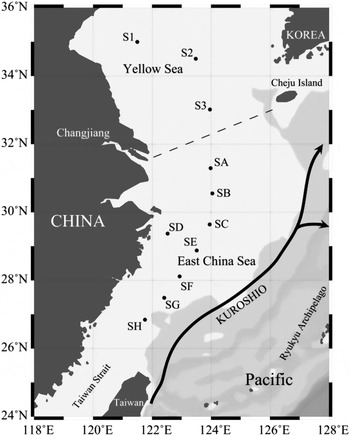
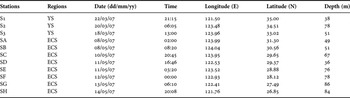
Two 973-II project cruises were undertaken on the RV ‘Beidou' along the continental shelves of the YS and the ECS neighbouring the north-west Pacific Ocean (Figure 1). The first cruise (from 17 March to 23 March 2007) investigated the YS, while the second cruise (from 7 May to 14 May 2007) surveyed the ECS—from north-east of the Taiwan Strait to the Changjiang Estuary. A total of eleven sites (YS: S1–S3; ECS: SA–SH) were chosen for the biogeographical study of coccolithophores (Table 1). These sampling stations covered different hydrochemical conditions, from the oligotrophic Kuroshio-influenced offshore area to the eutrophic coastal seawaters.
A map showing the sampling stations superimposed on the topographical map of the Yellow Sea and East China Sea during two spring cruises. Dashed line indicates the division of the two seas. Arrows show the Kuroshio flow path after it passes through the north-east of Taiwan.

Baseline information of the sampling sites during the two cruises.

Field sampling
Seawater samples were collected below the surface (~2 m in depth) using a rosette Sea-Bird CTD sampler equipped with eight 5-l Go-Flo bottles. Immediately, 0.5 l supsamples were filtered onto 0.4 µm pore-size (25 mm in diameter) Nuclepore polycarbonate membrane filters (Millipore Corporation) using a vacuum pump under low pressure (<100 mm Hg). Each membrane with its filtered particles was then transferred to a plastic Petri dish and frozen at –20°C until analysed.
Species taxonomy
Upon returning to the laboratory, all of the samples were defrosted at room temperature. The filters were subsequently dried for 48 hours at 40°C in an oven. A piece of the membrane (~1 cm2) was cut and mounted onto an aluminium stub and then coated with platinum using an ion-sputtering coater (HITACHI IB-3). Species identification was performed under 2000× magnification using a KYKY-2800B scanning electron microscope (SEM). The entire cut portion of the membrane was examined to avoid missing rare species. Coccoliths and coccospheres were differentiated based on their morphological differences (Okada & McIntyre, Reference Okada and McIntyre1977; Kleijne, Reference Kleijne1991, Reference Kleijne1992; Winter & Siesser, Reference Winter and Siesser1994; Cros et al., Reference Cros and Fortuño2000; Cros & Fortuñe, Reference Kleijne, Jordan, Heimdal, Samtleben, Chamberlain and Cros2002; Kleijne et al., Reference Cros, Kleijne, Zeltner, Billard and Young2002; Young et al., Reference Young, Geisen, Cros, Kleijne, Sprengel, Probert and Østergaard2003). SEM photographs were taken when liths and intact spheres were encountered in the scope. The length of the detached coccolith and the diameter of the coccosphere were measured simultaneously. The number of coccolith plates on the cell was obtained by doubling the count of plates on the front side.
RESULTS
Taxonomic composition
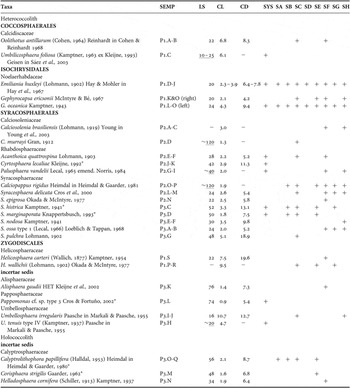
A total of twenty-seven marine-living coccolithophore species were examined from the samples collected during the two spring cruises (Table 2). Most of them (twenty-four species) were heterococcolithophores, with only three species being holococcolithophores. These species belonged to ten families and four orders (Coccosphaerales, Isochrysidales, Syracosphaerales and Zygodiscales), with some additional species incertae sedis. Nearly half of the living coccolithophores that were encountered (thirteen species) were in the order Syracosphaerales and were divided into three families (Calciosoleniaceae, Rhabdosphaeraceae and Syracosphaeraceae). Within the family Syracosphaeraceae, the genus Syracosphaera was the largest group, with seven of the species recorded falling into this genus.
Taxonomic list of living coccolithophore species that were found during the two spring cruises along the continental shelves of the Yellow Sea (YS) and the East China Sea (ECS) in 2007 (SEMP, scanning electronic microscope images in the plates; LS, the number of plates per cell; CL, measured coccolith length (μm); CD, measured coccosphere diameter (μm); SYS, sampling stations in the YS waters; SA–SH, sampling stations in the ECS waters; HET, heterococcolithophore stage of life-cycle; *, species that have never been previously documented in the literature on the waters of the China Seas; underlined LS data refer to Yang & Wei (Reference Yang and Wei2003); species groupings refer to the systematic classification scheme outlined by Young et al. (Reference Young, Geisen, Cros, Kleijne, Sprengel, Probert and Østergaard2003)).

The dominant forms of the coccolithophores in the surveyed seawater, based on their frequency of occurrence, were Emiliania huxleyi (Lohmann) Hay & Mohler and Gephyrocapsa oceanica Kamptner. These two species appeared at all of the sampling sites during the cruises. Other abundant species were Calciopappus rigidus Heimdal, S. histrica Kamptner, G. ericsonii McIntyre & Bé, S. delicata Cros, S. marginaporata Knappertsbusch and Calyptrolithophora papillifera (Halldal) Heimdal.
Morphological characteristics
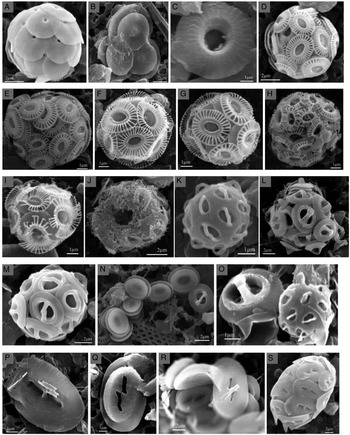
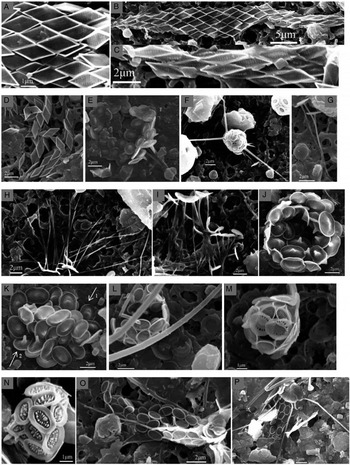
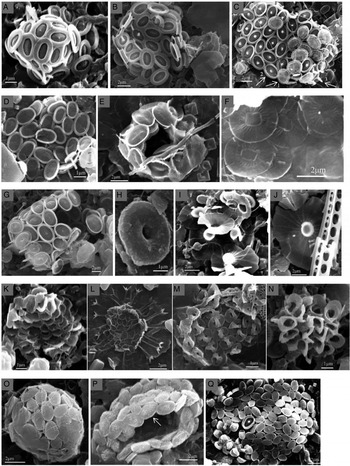
Most of the coccolithophore species reported here have a spherical or ellipsoidal cell shape. The majority of the coccoliths that appeared in the samples are the heterococcolith type, which is more robust than the smaller, loosely packed crystalline holococcoliths. SEM photographs of the twenty-seven species are shown in Plates 1–3. The heterococcolithophore species are displayed in Plates 1, 2 and 3 (Figures A–L), while the other holococcolithophore species are shown in Plate 3 (Figures M–Q).
(A, B) Oolithotus antillarum; (C) Umbilicosphaera foliosa; (D–J) Emiliania huxleyi (D, E: type A; F, G: type B/C; H: type C (corroded); I: corroded; J: malformed); (K, O (right)): Gephyrocapsa ericsonii; (L–O (left)): Gephyrocapsa oceanica; (P–R) Helicosphaera wallichii; (S) Helicosphaera carteri.

(A–C) Calciosolenia brasiliensis; (D) Calciosolenia murrayi; (E, F) Acanthoica quattrospina; (G–I) Palusphaera vandelii; (J, K) Cyrtosphaera lecaliae; (L, M) Syracosphaera delicata; (N) Syracosphaera epigrosa; (O, P) Calciopappus rigidus.

(A, B) Syracosphaera ossa type 1; (C) Syracosphaera histrica; (D) Syracosphaera marginaporata; (E, F) Syracosphaera nodosa; (G) Syracosphaera pulchra; (H) Umbellosphaera tenuis type IV; (I, J) Umbellosphaera irregularis; (K) Alisphaera gaudii HET; (L) Pappomonas cf. sp. type 3; (M) Corisphaera strigilis; (N) Helladosphaera cornifera; (O–Q) Calyptrolithophora papillifera.

The measured coccolith length and cell diameter are described in Table 2. Umbellosphaera irregularis Paasche, Helicosphaera wallichii (Lohmann) Okada & McIntyre and H. carteri (Wallich) Kamptner had relatively large coccoliths (>7 µm) compared to the other species, while H. carteri, S. pulchra Lohmann and S. histrica formed bigger coccospheres (cell diameter >13.1 µm).
Six species of living coccolithophores were recorded for the first time from the coastal waters of the China Seas (according to species records on TaiBNET). They were Cyrtosphaera lecaliae Kleijne, S. histrica, S. marginaporata, Pappomonas cf. sp. type 3 Cros & Fortuño, C. papillifera and Corisphaera strigilis Gaarder. Their morphological characteristics are described below (referred to Young et al., Reference Young, Geisen, Cros, Kleijne, Sprengel, Probert and Østergaard2003).
Cyrtosphaera lecaliae (Plate 2, Figures J, K): coccolith with narrow rim, elliptical, slight inflection on sides, conical hat protrusion. Body coccoliths (BCs) protrusion end in papilla, less prominent, around 50 laths, length ~2.9 µm (see arrow 1 in Figure K). Circum-flagellar coccoliths (CFCs) protrusion modified into spine, better developed (see arrow 2 in Figure K). Coccosphere is ~11.3 µm in diameter.
Syracosphaera histrica (Plate 3, Figure C): exothecal coccoliths (XCs, only exists in species of genus Syracosphaera) are dome-shaped (flatter), rim sub-horizontal, flange-like, radial cycle forms vertical part of wall, numerous elements with rib-like slits (see arrow 1). BCs are elliptical, ~3.3 µm long, central area with radial laths, low spine in centre (see arrow 2). CFCs with well-developed spine, ~1.3 µm high (see arrow 3). Coccosphere is ~13.1 µm in diameter.
Syracosphaera marginaporata (Plate 3, Figure D): BCs are ~1.8 µm long, with narrow and smooth rim, laths narrow initially defining ring of pores, then usually merge to form a broad and smooth central mass. CFCs with narrow tall spine. Coccosphere is ~7.5 µm in diameter.
Pappomonas cf. sp. type 3 (Plate 3, Figure L): BCs are ~0.9 µm long. CFCs process ~2.2 µm high, long and slender with narrow conical calyx of four plates. Coccosphere is ~5.4 µm in diameter.
Calyptrolithophora papillifera (Plate 3, Figures O–Q): BCs are ~2.1 µm long, distal surface flat, hexagonal mesh fabric to tube and distal cover. CFCs vaulted with flat hexagonal mesh plates, an irregular area of parallel strings of crystallites occurs between these plates (see arrow in Figure P). Coccosphere is ~8.7 µm in diameter.
Corisphaera strigilis (Plate 3, Figure M): BCs are ~1.6 µm long, with oblique whaleback-shaped bridge. CFCs are similar with bridge that extended into leaf. Coccosphere is ~6.8 µm in diameter.
Three types of E. huxleyi (Plate 1, Figures D–H) were documented in this study. They were type A, type B/C and type C. Their morphological characteristics are described below.
Type A (huxleyi, Figures D, E): with medium size liths, 2.8–3.2 µm long, distal shield elements robust, central area elements curved. Coccosphere is 7.6–7.8 µm in diameter.
Type B/C (Figures F, G): with medium size liths, 3.4–3.9 µm long, distal shield elements delicate. Coccosphere is 6.4–7.5 µm in diameter.
Type C (kleijneae, Figure H): with small liths, ~2.3 µm long, distal shield elements delicate, central area open or covered by a thin plate. Coccosphere is ~6.9 µm in diameter.
Habitat distribution
During the two spring cruises, twenty-three species were recorded in the ECS waters, which was two times more than the number of species found in the YS waters (ten species). The sampling sites adjacent to the main Kuroshio path exhibited higher species diversity. The total number of species encountered at each of these stations were 14 (SC), 14 (SF), 10 (SH), 9 (SE), 7 (SG) and 6 (SB). These habitats were located in pelagic seawaters that were far offshore and usually had deep water depths. Only the widespread species E. huxleyi and G. oceanica could be found in the sample from onshore station SD. Calyptrolithophora papillifera also existed in the waters of station SA in addition to E. huxleyi and G. oceanica.
Compared with the distributions of E. huxleyi and G. oceanica, C. rigidus frequently occurred in the Kuroshio influenced regions (stations SB, SC and SE–SH) rather than coastal seawaters (station SD). Similar distribution patterns also existed in G. ericsonii, S. delicata, S. histrica and S. marginaporata. No holococcolithophore species were collected in the YS waters. It is noteworthy that among the six new species of marine-living coccolithphores recorded in the YS and the ECS, half of them occurred frequently in the surveyed waters.
DISCUSSION
The sampling sites, located on the broad continental shelves of the YS and the ECS, were adjacent to the north-west portion of the Pacific Ocean. The Kuroshio, which originated from the North Equatorial Current, flowed from north-east of Taiwan and intruded onto the shelf of the ECS before encountering the Ryukyu Ridge (Hsueh, Reference Hsueh2000). The Kuroshio seawaters were characterized by high sea surface temperatures and salinity, interacted with the shelf waters of the ECS, and thus strongly influenced the species composition and habitat distribution of the offshore areas.
The coccolithophores (K-strategists) preferentially dwelled in stable and well-stratified waters and possessed a high affinity for nutrients (Iglesias-Rodríguez et al., Reference Iglesias-Rodríguez, Brown, Doney, Kleypas, Kolber, Kolber, Hayes and Falkowski2002). Laboratory experiments illustrated that Emiliania huxleyi reached high cell densities both at high and low N:P ratios and with high and low nutrient concentrations (Egge & Aksnes, Reference Egge and Aksnes1992). Similar results were found in mesocosm enclosures, where different nutrient regimes had no influence on the gross growth rate of populations of E. huxleyi (van der Wal et al., Reference van der Wal, van Bleijswijk and Egge1994). Field observations also showed that blooms of E. huxleyi almost always occurred in areas where nitrite and phosphate concentrations were very low (Fernández et al., Reference Fernández, Boyd, Holligan and Harbour1993). Coccolithophores could outcompete other phytoplankton species and survive in oligotrophic waters by relying on their combined ability to use non-nitrate N (Palenik & Henson, Reference Palenik and Henson1997) and their exceptional P-acquisition capacity (Riegman et al., Reference Riegman, Stolte, Noordeloos and Slezak2000).
Early surveys by Yang et al. Reference Yang, Wei and Gong(2001, Reference Yang, Wei and Chen2003, Reference Yang, Wei, Chen, Ji, Gong, Lin and Lee2004) and Chen et al. (Reference Chen, Chen and Chung2007) documented a total of forty-one, thirty-one, ten and twenty-two species of living coccolithophores, respectively. The predominant coccolithophore forms, such as E. huxleyi, Gephyrocopsa oceanica, Umbellosphaera spp. and Syracosphaera spp., were recorded during most seasons in either the central and north-east waters of the SCS or the north-east portion of Taiwan as well as the waters of the ECS. Our results showed the same distribution patterns. Emiliania huxleyi and G. oceanica were identified at all of the sampling sites. Syraocosphaea histrica, S. delicata and S. marginaporata occurred frequently.
In the present study, a total of six coccolithophore species were documented for the first time from the coastal waters of the China Seas. Interestingly, Cyrtasphaera lecaliae and Pappomonas cf. sp. type 3 were identified from the samples that were collected in the YS. Despite the shallow water depths of the YS, coccolithophores in these high latitude seawaters might exhibit varied adaptive strategies, resulting in the different taxonomic compositions of their assemblages. Corisphaera strigilis was examined from the middle continental shelf waters of ECS (station SE). Previous literature pointed out the resemblance of this species to certain species in different genera (Norris, Reference Norris1985; Kleijne, Reference Kleijne1991). Coccoliths of species in the genus Corisphaera were stomatal and proved to be zygoliths with enlarged bridges. The record of this holococcolithophore might provide supplemental information for current research on species diversity and conservation in the marginal China Seas. Additionally, S. histrica, S. marginaporata and Calyptrolithophora papillifera had high frequencies of occurrence among the sampling sites. The emergence of these three newly-recorded species might be due to seasonal variations in distribution because the present two cruises were conducted in the spring season, while the previous investigations concentrated more on the summer and winter seasons.
The shelf waters of the YS and the ECS and the adjacent waters near the main Kuroshio paths were ideal habitats for the growth and reproduction of living coccolithophores. However, due to the variations in the nutrient status of the coccolithophore cells and their ambient environment conditions, there may be discrepancies with respect to the number of species encountered, cell size, coccolith length, coccosphere diameter and the number of plates per cell. A great deal of compiled work has previously been done by Yang & Wei (Reference Yang and Wei2003) on the number of coccoliths for each coccosphere. They pointed out that intraspecific variation, the types and arrangement of coccoliths in a coccosphere, as well as nutrient availability within different oceanographic settings were all responsible for the varied ratios of coccoliths/coccosphere. Considering the uncertainty of parameters shown in Table 2, caution is required when using them in the conversion of coccolith-based carbonate estimation.
An interesting finding of this work is the morphological variations of corroded and malformed coccolithophores that were encountered in the YS waters (SEM images of H, I and J on Plate 1). The malformation of coccoliths has already been documented in the previous investigations and is subject to various hypotheses. Okada & Honjo (Reference Okada and Honjo1975) suggested that the deformation of coccolith morphology was a result of nitrogen deficiency. Kleijne (Reference Kleijne1990) described the difference between corroded and malformed coccolith morphologies and considered low salinity and nutrient depletion of the surface waters as the main causes. Yang et al. (Reference Yang, Wei, Chen, Ji, Gong, Lin and Lee2004) proposed that the phenomenon of restricted coccolith formation was associated with deficiency of nitrate in the ambient waters. However, results in the upwelling system showed that the malformation was not related to in situ nutrient deficiency (Giraudeau et al., Reference Giraudeau, Monteiro and Nikodemus1993). In our study, the malformation of coccoliths seems independent of nutrient deficiency, since relative high surface concentrations of nitrate (>2 µM) and phosphate (>0.2 µM) were recorded in the three sites of YS. The collapsed coccospheres in the specimens were similar to those corroded forms described by Kleijne (Reference Kleijne1990), suggesting a dissolution effect in the water column.
In the present study, we report a total of twenty-seven species that were found during two cruises. Nevertheless, no holococcolithophores were sampled in the YS waters. Thus, to obtain a better understanding of the coccolithophore biogeography in the China Seas, further research should be conducted in varied seasons and concentrate more on regions at high latitudes such as the Bohai Sea and the northern YS.
ACKNOWLEDGEMENTS
The authors thank the crews of the ‘Beidou' for their help in sample collection. Accepted manuscript only: we thank the anonymous referees for their comments. This research was supported by the National Natural Science Foundation of China (NSFC) (grant number 40976102) and the Open Foundation of Laboratory of Marine Ecosystem and Biogeochemistry, State Oceanic Administration (grant number LMEB200702).