Introduction
Providing housing for homeless Veterans has become a national priority. However, housing is only the first step in long-term recovery, which includes a more complete integration of homeless Veterans into the community. To understand the processes associated with, and to enhance aspects of, recovery (defined here as improvements in and maintenance of community integration) in homeless Veterans, we need to understand its underlying factors. Our work on homeless Veterans has defined community integration in terms of three separate factors: (1) social and family relationships; (2) obtaining work, going to school, and other productive activities; and (3) being able to live independently (Brekke, Levin, Wolkon, Sobel, & Slade, Reference Brekke, Levin, Wolkon, Sobel and Slade1993; Brekke, Raine, Ansel, & Lencz, Reference Brekke, Raine, Ansel and Lencz1997). One challenge in identifying the processes contributing to community integration has been to assess samples of homeless individuals who are at the same starting point in their recovery. By recruiting participants who have a housing voucher provided by the Department of Housing and Urban Development – Veterans Affairs Supportive Housing (HUD-VASH) program, but not have yet received housing, we can measure factors that might be associated with recovery and a common baseline. Understanding these factors will ultimately help to identify where to direct recovery-oriented interventions.
In our prior study which focused on homeless Veterans with a psychotic disorder (Study 1, Green et al., this issue), we found a pattern of predictors of community integration that was different from that generally seen in those diagnosed with psychotic disorders. An interview-based subscale of motivation and pleasure (MAP) from the Clinical Assessment Interview for Negative Symptoms (CAINS; Kring, Gur, Blanchard, Horan, and Reise, Reference Kring, Gur, Blanchard, Horan and Reise2013) was strongly associated with community integration at baseline (prior to receiving housing) and, associated with community integration 12 months later, while measures of cognition, both social and non-social, were less influential. This pattern is different from what is seen in non-homeless samples with a psychotic disorder in which all three domains are highly predictive of community integration (Green, Hellemann, Horan, Lee, & Wynn, Reference Green, Hellemann, Horan, Lee and Wynn2012). Homeless Veterans without psychotic disorders may have similar or different determinants for community integration after receiving housing as those with a psychotic disorder.
The data presented in this current study come from the second of two independent studies (Study 1 included Veterans with psychotic disorders while this study (Study 2) included Veterans without psychotic disorders). Therefore, the two samples of recently-housed Veterans are diagnostically non-overlapping but may have complementary findings. The current study included some different performance-based and interview assessments, as well as an additional measurement of community integration. Both studies evaluated the same domains of determinants (i.e. perception, non-social cognition, social cognition, and motivation), although there were some differences in the exact tests used. Thus, if the findings are consistent across studies, we would have added confidence in the conclusions. On the other hand, we may find different patterns of results which could suggest different avenues for improving community integration in homeless Veterans for distinct diagnoses.
The current study had three specific goals. First, we explored whether there were baseline differences on demographic, perceptual, cognitive, motivational, and community integration variables in those who returned for assessment at 12 months compared with those who did not. Given that homeless individuals have fluctuating stability in their environments, including access to mail and reliable phone services, we anticipated that many participants would not return at 12 months. Second, we assessed potential predictors of community integration (perception, non-social cognition, social cognition, and motivation) at baseline when participants had received vouchers for housing but were not yet housed, and 12 months later for those who returned. We examined the relationships of these predictors to community integration cross-sectionally and 12 months later. Finally, for any baseline variable that correlated with 12-month community integration, we conducted cross-lagged panel analyses, which is informative regarding whether one set of variables appears to have a causal influence on another set of variables. The current study examined whether there is a similar pattern of relationships between predictors and community integration in a non-psychotic homeless Veteran sample. Both studies sought to understand the factors that influence community integration in recently-housed Veterans without psychotic disorders and to identify potential intervention targets for Veterans for recovery.
Methods
A total of 82 homeless Veterans without a history of psychotic disorders received an assessment at baseline when they had received a voucher from the HUD-VASH program for housing but were not yet housed. Forty-one of these participants returned for an evaluation after 12 months.
Unlike the recruitment for Study 1 that also used VA administrative databases to identify potential participants with specific diagnoses, staff members for this study recruited broadly only by attending regular HUD-VASH orientation meetings held on the campus of the VA Greater Los Angeles Healthcare System (GLA) where they made announcements and distributed information about the study.
General inclusion criteria included age between 18 and 65 years; estimated premorbid IQ > 70; and English proficiency. General exclusion criteria included any history of a psychotic disorder, or a medical, physical, cognitive, or language impairment so severe as to adversely affect validity of data or provide informed consent. All participants provided written informed consent in accordance with procedures approved by the Institutional Review Board at GLA. Baseline data from this sample have been previously reported (Horan et al., Reference Horan, Wynn, Gabrielian, Glynn, Hellemann, Kern and Green2020); this paper is the first to report the prospective, longitudinal data from this sample.
Assessments and measures
Clinical assessments
All interviewers were trained at the Treatment Unit of the VISN 22 Mental Illness Research, Education and Clinical Center (MIRECC) to a minimum kappa of 0.75 for key psychotic and mood items. Diagnoses were determined using the Structured Clinical Interview for DSM-5 (SCID-5) (First, Williams, Karg, & Spitzer, Reference First, Williams, Karg and Spitzer2015) mood disorder, psychotic disorder, post-traumatic stress disorder (PTSD), and substance use disorder modules, as well as all available medical records.
Although positive psychotic symptoms from the Brief Psychiatric Rating Scale (BPRS) were most relevant to the sample with psychosis (Study 1), we considered the total score from the BPRS to be a more useful indicator of general clinical symptoms for this broader group. Hence, general psychiatric symptoms were assessed with the UCLA expanded 24-item BPRS (Ventura et al., Reference Ventura, Lukoff, Nuechterlein, Liberman, Green and Shaner1993). We also report reduced expressiveness (e.g. alogia, affective flattening) assessed with the CAINS (Kring et al., Reference Kring, Gur, Blanchard, Horan and Reise2013) Expressive Symptoms subscale (four items).
For all remaining assessments, we briefly mention those measures that were used in Study 1 and provide references. We will provide more details in this section about additional measures that were not part of Study 1.
Perception
The perceptual measures included one visual task (object backward masking) (Reavis et al., Reference Reavis, Lee, Wynn, Engel, Jimenez and Green2017) and one auditory task (mismatch negativity, MMN) (Naatanen, Jiang, Lavikainen, Reinikainen, & Paavilainen, Reference Naatanen, Jiang, Lavikainen, Reinikainen and Paavilainen1993; Näätänen, Reference Näätänen1992). The current study did not include the location masking task that was part of Study 1.
Non-social cognition
Non-social cognition was assessed using the Neurocognitive Composite of the MATRICS Consensus Cognitive Battery (MCCB) (Nuechterlein & Green, Reference Nuechterlein and Green2006). Standardized T-scores were computed for each cognitive domain used in the Neurocognitive Composite, correcting for age and gender.
Social cognition
The current study utilized the Empathic Accuracy task (Lee, Zaki, Harvey, Ochsner, & Green, Reference Lee, Zaki, Harvey, Ochsner and Green2011) as in Study 1, but included two additional social cognitive measures: one behavioral measure of face affect identification and an electroencephalography (EEG) measure of facial processing.
Facial affect recognition was assessed using stimuli from the Ekman dataset (Ekman & Friesen, Reference Ekman and Friesen1976). Participants saw one of seven different facial expressions (anger, disgust, fear, happiness, surprise, sadness, or neutral) and identified which expression the face was showing. A total of 56 faces (eight per category) were shown. The dependent variable was the total correct.
For EEG facial processing, we measured the N170 event-related potential (ERP) (Wynn, Lee, Horan, & Green, Reference Wynn, Lee, Horan and Green2008). Briefly, subjects were shown pictures of faces or houses, each presented for 500 ms, using E-Prime 2.0 (Psychology Software Tools, Inc., Sharpsburg, PA). In separate blocks, participants had to either identify the emotion on the face or whether a building was one- or two-stories tall. EEG recordings were acquired with a Neuroscan Synamps2 amplifier (Compumedics Neuroscan, Charlotte, NC). Data were sampled at 1000 Hz from electrodes Fz, Cz, Pz, P7, P8, O1, and O2, and processed offline using BrainVision Analyzer 2 (Brain Products, Gilching, Germany). We examined the face-sensitive N170 component, a negative voltage event-related potential seen approximately 170 ms after the presentation of a face. The N170 was indexed as the mean voltage between 150 and 190 ms averaged over electrodes P7 and P8; a more negative value indicates a larger neural response to the face.
Motivation
We obtained ratings from the CAINS MAP subscale (nine items), which assesses asociality, avolition, and anhedonia; we used the MAP subscale to assess motivation, while the Expression scale was viewed as a non-motivational clinical measure. Additionally, we obtained ratings from the Defeatist Performance Attitudes (DPAS) and Dysfunctional Need for Approval (DNAS) subscales of the Dysfunctional Attitudes Scale (Weissman, Reference Weissman1978). These attitudes are linked to amotivation (Campellone, Sanchez, & Kring, Reference Campellone, Sanchez and Kring2016).
Community integration
As with Study 1, we assessed Work and Productive Activities (‘Work’) and Independent Living/Self Care (‘Independent Living’) with the Role Functioning Scale (Goodman, Sewell, Cooley, & Leavitt, Reference Goodman, Sewell, Cooley and Leavitt1993). For social integration, we added the Social Disconnectedness Scale (Cutrona & Russell, Reference Cutrona and Russell1987) to complement the Social Connections and Family Interactions ratings from the Role Functioning Scale (RFS) (Goodman et al., Reference Goodman, Sewell, Cooley and Leavitt1993) and the Lubben Social Network Scale (Lubben, Reference Lubben1988). We computed a composite social integration index by first obtaining standardized scores for each scale, and then calculating the average of the three standardized scores.
Data analyses
The analyses for this paper paralleled those of Study 1. Specifically, group differences between those who returned at 12 months and those who did not were examined with t tests or chi-square comparisons. Associations between baseline predictors (i.e. motivation, perception, non-social, and social cognition variables) and baseline and 12–month functional outcomes (social integration, work and productive activities, independent living) were assessed with Pearson correlations after ensuring that the distributions were normal and appropriate for that statistic. These analyses were conducted among those subjects who had functional assessments at baseline and follow-up. We used cross-lagged panel analyses (Kenny, Reference Kenny1975) to better interpret longitudinal associations between baseline predictors and subsequent community integration. These analyses examine the likelihood of causality by evaluating the strength of the relationships between baseline Measure A with 12-month Measure B compared to the relationships between baseline Measure B with 12-month Measure A. If one is statistically different than the other, it suggests that the baseline measure drives the 12-month measure, rather than the other way around, consistent with a causal influence of one variable on another over time. All analyses were conducted with an alpha level of 0.05, two-tailed.
Results
Baseline characteristics
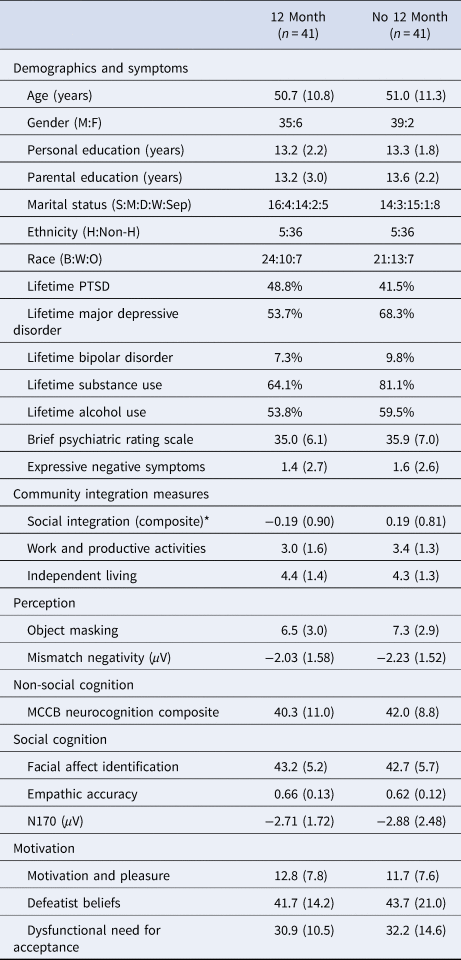
The baseline characteristics for demographic, symptom ratings, community integration measures, and predictors are shown in Table 1 for those who returned for testing at 12 months (n = 41) and those who did not return for testing (n = 41). Both samples had a mean age in the early 50s and tended to be male, black, and single. Across samples, there was a high prevalence of participants with a lifetime history of major depressive disorder (61.0%), PTSD (45.1%), and a history of lifetime substance (70.7%) and/or alcohol abuse (58.5%). The groups were comparable on all measures at baseline, except those who returned at the 12-month follow-up had a significantly lower rating on the community integration composite, t 80 = 2.00, p = 0.049. Of those who returned for testing at 12 months, we could confirm that 27 out of 41 (65.9%) had obtained housing. However, as the information in the records is incomplete the actual number is likely much higher.
Mean (standard deviation) at baseline for demographics, symptom ratings, community integration outcome measures, and predictors of outcome, presented separately for those with and without 12-month follow up data

Marital: S, single; M, married; D, divorced; W, widowed; Sep, separated.
Ethnicity: H, hispanic; Non-H, non-hispanic.
Race: B, black; W, white; O, other.
Note: some declined to answer or provide information.
* p < 0.05.
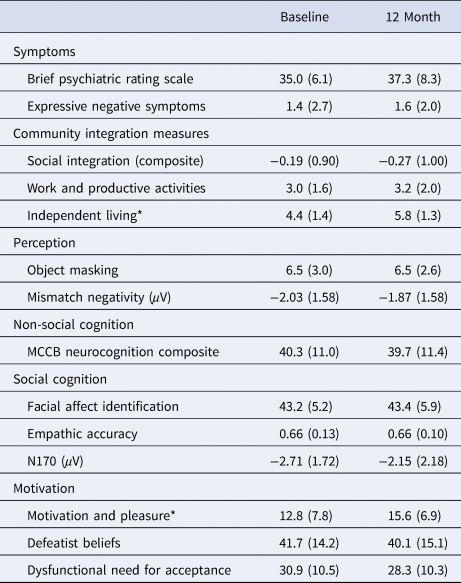
Table 2 shows the baseline and 12-month follow-up data restricted to those who returned for the 12-month follow up. There were no significant differences in any of the measures with the exception of independent living and MAP. As expected, ratings of independent living improved from baseline to 12-months given that the participants received housing. Unexpectedly, ratings of MAP got worse from baseline to 12-months (i.e. MAP score increased). To examine the stability of the community integration measures over time (social integration, work, independent living), we examined correlations between the baseline and 12-month ratings. Ratings of community integration were highly correlated over the 12-month period, r = 0.77, p < 0.001; ratings of work and productive activities were moderately correlated, r = 0.37, p < 0.05; and correlations of independent living were extremely low, r = −0.01, p > 0.5.
Means (standard deviation) of predictors of outcomes, community integration outcome measures, and symptom ratings at baseline and for those who returned for the 12-month follow-up

Note: some declined to answer or provide information.
* p < 0.05.
Regarding comparisons between those with no 12-month follow-up data, we lost contact with 34 and seven were discharged from the HUD-VASH program. Given the small number of discharges, we did not perform comparisons between these two groups.
Correlations
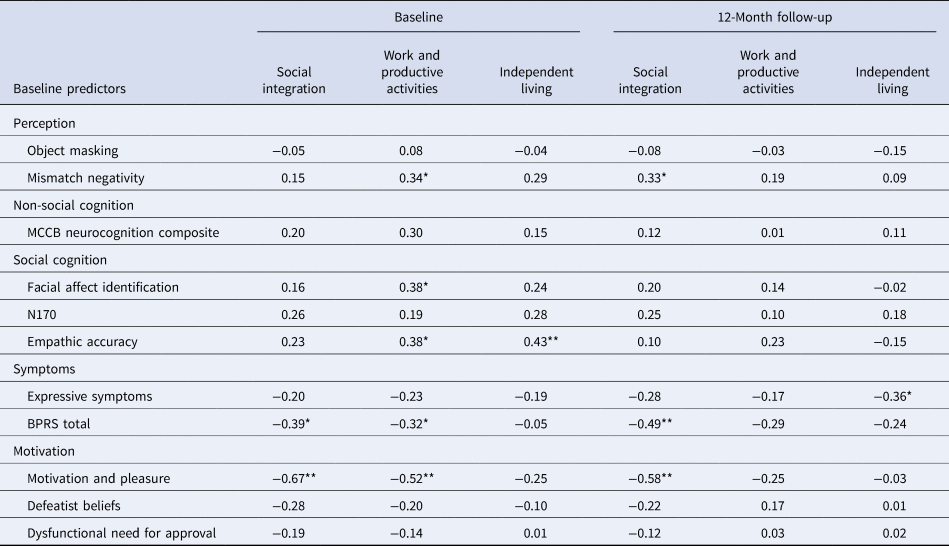
We next examined correlations between baseline measures of perception, non-social cognition, social cognition, general psychiatric symptoms, and motivation to baseline and 12-month measures of social integration, work, and independent living. As shown in Table 3, only one baseline measure of perception, MMN, was correlated with baseline work and with 12-month social integration. However, the relationship was in an unexpected direction, with worse MMN (i.e. more positive scores) correlating with higher ratings of work and social integration. For social cognition, better baseline facial affects identification performance correlated with higher ratings of work at baseline; greater empathic accuracy correlated with higher ratings of work and independent living at baseline. Lower baseline expressive symptoms were correlated with higher ratings on independent living at 12 months. Lower general symptoms at baseline, as assessed by the BPRS total score, were associated with higher levels of social integration at baseline and at 12-month follow-up as well as with better work outcomes at baseline. Finally, better ratings on the MAP subscale from the CAINS (i.e. lower scores) at baseline were highly correlated with better ratings of social integration at baseline (r = −0.67, p < 0.001) and at the 12-month follow-up (r = −0.58, p < 0.001). Furthermore, better MAP ratings were correlated with better work at baseline (r = −0.52, p < 0.001) but not at 12-months. The correlations that survive a highly conservative Bonferroni correction (i.e. division by 33) include both the cross-sectional and longitudinal associations between MAP and social integration.
Correlations between baseline predictors of motivation, social cognition, non-social cognition and perception and baseline and 12-month follow-up measures of social integration, work and productive activities, and independent living

*p < 0.05, **p < 0.01.
Interpreting longitudinal associations between predictors and community integration
Significant correlations between longitudinal predictors and a 12-month functional outcome were further examined with cross-lagged panel analyses. The cross-sectional and longitudinal associations between these measures are presented as four panels in Fig. 1. Better social integration at baseline was associated with better 12-month MAP ratings, and better MAP ratings at baseline were significantly associated with better 12-month social integration (r's = −0.59 and −0.58, p's < 0.001). The difference between these two cross-correlations was not significant (z = 0.08, p < 0.94). Similarly, worse MMN at baseline was associated with better social integration at 12 months (r = 0.33, p = 0.035), but not the other way around (r = −0.02, p = 0.90); the difference between the cross-correlations was significant (z = 2.00, p < 0.05). Lower expressive symptoms at baseline were significantly associated with better independent living at 12 months (r = −0.36, p = 0.024), but the reverse association was not significant (r = 0.06, p = 0.70). In this case, the difference between the cross-correlations was significant (z = −2.07, p < 0.04), suggesting that expressive symptoms at baseline might be driving independent living status at 12 months. Lower general psychiatric symptoms (BPRS total score) at baseline correlated significantly with better social integration at 12 months (r = −0.49, p < 0.001), but the reverse association was not significant (r = −0.12, p = 0.453). Here, again, the difference between the cross-correlations was significant (z = −2.12, p < 0.04), suggesting that higher general symptoms had a causal influence on social integration at 12 months.
Cross-lagged panel analysis of the longitudinal association between (a) motivation and pleasure and social integration; (b) expressive negative symptoms and independent living; (c) mismatch negativity and social integration; and (d) BPRS total score and social integration.

Discussion
In this project, we evaluated potential predictors of community integration (including perception, non-social cognition, social cognition, general psychiatric symptoms, and motivation) in homeless Veterans without a history of psychotic disorders who were engaged in a permanent supportive housing program, at baseline and after 12 months. The strongest longitudinal association observed was between a baseline measure of motivation, the MAP subscale from the CAINS, and social integration at 12 months. We also found that general psychiatric symptoms were predictive of community integration. Moreover, we found two significant, albeit weaker, longitudinal associations with community integration: baseline expressive symptoms and independent living at 12 months; and baseline mismatch negativity and social integration at 12 months. In addition to these longitudinal associations, we observed several cross-sectional associations at baseline between the MAP and BPRS symptoms and measures of social integration and work and productive activities. However, we did not find many associations at 12 months with the other predictors, including perception, non-social cognition, and social cognition.
Nearly all predictors (e.g. perception, cognition, etc.) and outcome measures were stable from baseline to 12 months, with the exception of two variables: independent living and, interestingly, CAINS MAP. Independent living ratings improved with provision of housing, which was fully expected. However, once housed the current sample actually showed a worsening of motivation (as measured with the CAINS MAP). We can speculate that for some Veterans receiving housing is actually disruptive to their previously normal routine. For example, the Veteran might be housed in a unit outside of their normal home area. A new and unfamiliar environment may create a situation in which they do not look forward to new activities and social contacts while they adjust to their new housing situation (i.e. reduced motivation).
We found four longitudinal associations between baseline variables and 12-month community integration, two of which showed a pattern consistent with a causal relationship. The first was that baseline expressive symptoms (e.g. alogia, affective flattening) appeared to have a causal effect on independent living at 12 months. The second significant result was that general psychiatric symptoms at baseline appeared to have a causal effect on social integration at 12 months. We also found that motivation was related to both baseline and follow-up measures of social integration but did not show a pattern consistent with a causal relationship within this time period. We also found a relationship between baseline MMN amplitudes and 12-month social integration that was not consistent with a causal relationship and the pattern was in the opposite direction as predicted (i.e. worse MMN associated with better social integration). The findings from the cross-lagged panel analyses should be interpreted with caution, however, as these analyses are dependent on when sampling occurs. It is possible that different causal patterns would emerge, or significant effects would become nonsignificant, if we used more frequent sampling or a longer follow up period.
One limitation of the current study is the rather high rate of attrition over the 12-month assessment period, which may have led to Type 2 errors. However, given the consistency of the findings in the current study and in Study 1 (Green et al., this issue), add confidence to the findings with motivation. Recently-housed Veterans tend to be difficult to monitor and engage in treatment over time. Another limitation is that assessments of work and independent living were not as comprehensive as the assessments of social integration (i.e. we had a single measure each for work/productive activities and independent living, but three separate measures of social integration) and were done at long intervals. We are actively pursuing novel methodologies, i.e. smartphone-based assessments, to overcome these limitations and get a higher response rate over time, more frequent assessments, and data that capture in-the-moment measures of community integration. A further limitation is that we did not consider whether socioenvironmental factors (e.g. pollution, crime rate, poverty rate, etc.) or important neurological factors, such as traumatic brain injuries (Stubbs et al., Reference Stubbs, Thornton, Sevick, Silverberg, Barr, Honer and Panenka2020), impact community integration.
Overall discussion of Studies 1 and 2.
A comparison of Studies 1 and 2 reveals findings that are consistent across these independent and diagnostically distinct projects, as well as findings that are sample-specific. Given the independent confirmation, we have more confidence in the common findings, namely that motivational factors are strongly associated with community integration both at baseline and at 12 months in Veterans with and without a psychotic disorder who have experienced homelessness. In Study 1, those motivational variables included the MAP subscale of the CAINS and the Dysfunctional Need for Acceptance of the DAS. In Study 2, the finding was for the MAP subscale. In both studies, the correlations with the MAP were substantial (stronger than −0.6 at baseline and −0.5 at 12 months). The finding that both groups exhibit motivational negative symptoms and that these symptoms are related to important functional outcomes is consistent with recent findings showing that negative symptoms, including those related to MAP, are transdiagnostic in nature and occur in people with and without schizophrenia-spectrum disorders (Strauss & Cohen, Reference Strauss and Cohen2017).
It is possible that some of the association between motivation factors and community integration is due to overlap in the measurements used. For example, the measure of motivation with the largest correlation in both studies (MAP from the CAINS) asked about the frequency of pleasurable activities in the previous week, similar to some items from the community integration questionnaires. However, it is hard to fully explain this association between motivation and community integration solely by shared measurement because the correlation was specific for social integration (not work or independent living) at 12 months, and the association also was present in Study 1 for a motivational belief, which did not have obvious content overlap with community integration. Nonetheless, we acknowledge that measurement overlap remains an open question.
Based on such remaining questions, it is important for subsequent studies to examine the nature of the association between motivation and community integration, as well as the specific component(s) of motivation responsible for it. Unfortunately, the studies did not include performance-based or electrophysiological measures of motivation that could shed light on the specific aspects or stages of motivation that account for these associations and could provide a stronger mechanistic explanation. At this point, we do not know which key motivational components, including anticipatory pleasure, in-the-moment pleasure, reward valuation, or some aspect of decision-making (Barch, Pagliaccio, & Luking, Reference Barch, Pagliaccio and Luking2016; Strauss & Cohen, Reference Strauss and Cohen2017), lead to community integration. We also do not know the extent to which the motivational deficits are general, v. specific to social stimuli (i.e. social motivation). Similarly, we do not know whether the motivational impairments are the same across diagnoses. For example, motivational deficits are present in disorders such as schizophrenia, depression, and bipolar disorder, but the underlying mechanisms may differ (Barch et al., Reference Barch, Pagliaccio and Luking2016; Caseras, Lawrence, Murphy, Wise, & Phillips, Reference Caseras, Lawrence, Murphy, Wise and Phillips2013; Llerena, Wynn, Hajcak, Green, & Horan, Reference Llerena, Wynn, Hajcak, Green and Horan2016; Simon et al., Reference Simon, Cordeiro, Weber, Friedrich, Wolf, Weisbrod and Kaiser2015; Wessa, Kanske, & Linke, Reference Wessa, Kanske and Linke2014).
Some of the longitudinal findings are consistent with causal mechanisms and others are not. Notably the associations with motivational factors and integration were not significant on cross-lagged analyses. These results suggest that motivation and community integration are closely associated, but they are already intertwined by the time of the baseline assessment. Also, we were limited in detecting causal relationships considering that community integration changed so little over 12 months (except for independent living which improved for participants with housing). While these two studies demonstrate a linkage of motivation and community integration, they could not firmly establish the nature of this relationship over time.
Although the sample-specific findings are intriguing, we did not have hypotheses for how the patterns between samples would differ. Thus, these findings require replication. A key difference between projects is that one measure of social cognition (empathic accuracy) was associated with independent living at 12 months, but only in the sample that had a history of psychosis. The association also was significant on the cross-lagged panel analyses from baseline to 12 months, suggesting a causal relationship. This finding is consistent with observation that social cognition is a determinant of community integration in schizophrenia (Fett et al., Reference Fett, Viechtbauer, Dominguez, Penn, van Os and Krabbendam2011; Green et al., Reference Green, Hellemann, Horan, Lee and Wynn2012), though we only found it for one aspect of community integration.
Clinical symptoms had significant associations with 12-month community integration in the sample without psychotic diagnoses. General psychiatric symptoms from the BPRS were associated with social integration and expressive symptoms from the CAINS were associated with independent living; both associations were significant on cross-lagged analyses. One interpretation is that clinical psychiatric symptoms have more functional significance in samples without psychotic symptoms, perhaps because individuals who have a history of psychosis have greater functional limitations from cognitive and motivational factors.
One key consideration is that both studies included US Veterans who had access to a range of housing and case management support which might partially compensate for reductions in cognitive and/or motivational factors. This possible compensation by support structures might explain a consistent lack of findings: that non-social cognition did not show an expected relationship with community integration across both samples. Hence, the patterns of correlations might not apply to non-Veterans who do not always have access to such support. Notably, the associations with motivational factors were sufficiently strong that, either they exceed the compensation available from VA supports, or that the supports themselves do not compensate for this type of individual limitation.
These two papers emphasize the importance of considering intervention in homelessness as a two-stage process that has similarities to the multi-stage situation for severe mental illness (SMI). Interventions for SMI involve an initial phase focused on remission (i.e. clinical stabilization and symptom reduction) that is followed by a focus on recovery (i.e. improvements in community integration and then maintaining them). Similarly, interventions for homelessness involve an initial phase that addresses the immediate problem of lack of housing and then is followed by a focus on recovery, which is also largely defined as community integration. For both SMI and homelessness, the relatively limited efforts to enhance recovery are dwarfed by the long-standing and substantial efforts to address the first phase of the problem. This reduced focus on recovery is unfortunate because even when services are available, as with the VA homeless programs, we know that community integration does not occur automatically. The goal of the projects presented in these two papers was to begin to understand the nature of recovery in homelessness and the variables that are most clearly related to it. Knowledge of these factors will help to identify where to direct recovery-oriented interventions.
Acknowledgements
This study was funded by the Research Enhancement Award Program to Enhance Community Integration in Homeless Veterans Rehabilitation Research and Development grant D1875-F from the Department of Veteran Affairs to Dr Green.
Conflict of interest
Dr Green has been a paid consultant for Biogen, Click Therapeutics, Lundbeck, and Roche, a member of the Scientific Board of Cadent. Dr Marder has been a paid consultant for Biogen, Lundbeck, Roche, Newron, Avanir, Allergan, and Sunovion. Dr Horan is an employee of VeriSci. The remaining authors have no disclosures.