Introduction
Grain production potential is influenced mainly by agroclimate and land use (Ahmad et al. Reference Ahmad2014; Chun et al. Reference Chun2016). Although terrain, soil and other environmental conditions also have a significant effect on grain production potential, no reports relating to these particular factors have been released in decades (Li et al. Reference Li2015). Thus, the current impact of terrain, soil and other environmental conditions on grain production potential is generally stable. Agricultural climate resources, such as light, temperature, water and heat conditions required for crop growth and development, could be associated with an improvement or decline in grain production potential (Lobell & Asner Reference Lobell and Asner2003; Ciais et al. Reference Ciais2005; Anwar et al. Reference Anwar2015). Additionally, land use change directly alters the quantity, quality and spatial distribution of cultivated land, and can lead to modifications in grain production potential (Farina et al. Reference Farina2011; Liu et al. Reference Liu2015).
Research studies have shown that the global climate has undergone significant changes in the past century and is characterized by warming (IPCC 2014). The fifth assessment report of the Intergovernmental Panel on Climate Change (IPCC) noted that the surface temperature of the Earth has been increasing continuously in the past three decades. The average global temperature increased by 0.85 °C between 1880 and 2012, and the rate of temperature increase between 1951 and 2012 was almost twice that from 1880 to 1950 (IPCC 2014; Qin & Stocker Reference Qin and Stocker2014).
Global climate change would have a profound effect on both natural and socioeconomic systems (Neumann et al. Reference Neumann2010; Lobell & Gourdji Reference Lobell and Gourdji2012). Climate elements not only provide material and energy for crop growth but are also major limiting factors in the implementation of agricultural technology (Loustau et al. Reference Loustau2005; Liu et al. Reference Liu, Liu and Guo2010; Lobell et al. Reference Lobell, Schlenker and Costa-Roberts2011). Indeed, the agricultural system is among those systems most vulnerable to climate change (Gay et al. Reference Gay2006; Zhao et al. Reference Zhao, Guo and Zhang2010). Global climate change has led to alterations in the quantity and quality of agricultural climate resources related to food production (Supit et al. Reference Supit2010; Moriondo et al. Reference Moriondo, Giannakopoulos and Bindi2011; Reynolds et al. Reference Reynolds2011). More specifically, the changes in quantity and matching of agricultural climate resources have affected the agricultural climate production potential and planting system and ultimately impacted global food production safety (Schmidhuber & Tubiello Reference Schmidhuber and Tubiello2007; Xu et al. Reference Xu2007; Piao et al. Reference Piao2010). Accordingly, the impact of climate change on agricultural production, food security, rural socioeconomic conditions and farmer income has become a focus of global climate change research (Tang et al. Reference Tang2000; Howden et al. Reference Howden2007; Tao et al. Reference Tao2008; Zhou et al. Reference Zhou, Qin and Bao2011).
In addition to affecting the grain production potential directly by changing the distribution of agroclimate resources, climate change has also contributed indirectly to grain production potential by affecting land use (Uleberg et al. Reference Uleberg2014; Zhong et al. Reference Zhong2015). Over the past 20 years, with the introduction of the LUCC (Land Use/Land Cover change) research programme and the Global Land Program (GLP), questions on how the supply of ecosystem services may be affected by a human–environment coupling system at different scales and contexts have entered the forefront of global change research (Fischer et al. Reference Fischer, Zuurbier and van de Vooren2008; Gaál et al. Reference Gaál, Quiroga and Fernandez-Haddad2014). Research has promoted the study of the ecological and environmental effects of land use change (Fischer & Sun Reference Fischer and Sun2001; Liu et al. Reference Liu2005). The impact of land use changes on grain production potential has also become an important component of scholarships on land use/cover change and its effects (Xie et al. Reference Xie2004; Wang et al. Reference Wang2012; Liu et al. Reference Liu2015).
Currently, the mature simulation model of grain production potential can be summarized under these three categories: (1) Potential decay method (i.e. the environmental factor step-by-step correction model), which estimates grain production potential by the successive correction of photosynthetic production potential, light and temperature production potential, climate production potential and land production potential (Liu et al. Reference Liu2005). (2) Climate factor synthesis model (i.e. a method employing an empirical formula to calculate grain production potential), including the Global Agro-ecological Zone (GAEZ) model (Fischer et al. Reference Fischer2002) and Wahningen method (van Ittersum et al. Reference van Ittersum2003). (3) Crop growth process simulation models, such as the CERES (Jones & Thornton Reference Jones and Thornton2003, Yun Reference Yun2003), EPIC (Priya & Shibasaki Reference Priya and Shibasaki2001) and CROPGRO models (Basso et al. Reference Basso2001; Batchelor et al. Reference Batchelor, Basso and Paz2002). Most of these models were developed and validated based on field-scale experiments and are often difficult to use at a regional and global scale. In addition, these models require the extensive input of parameters. These technical limitations thereby restrict the application of these models in developing countries. The GAEZ model is widely used in developing countries because of its scientific rigor, data availability, computational simplicity and its ability to more confidently reflect the multi-year average status of regional crop production potential (Xie et al. Reference Xie2004; Xu et al. Reference Xu2007; Liu et al. Reference Liu2015).
Several recent studies have focused on the impact of climate change on the production of different crops as well as alterations in production due to modifications in land use. Lobell et al. (Reference Lobell, Schlenker and Costa-Roberts2011) analysed climate change since 1980 and its effect on the production of maize, wheat, rice and soybean at a global scale; Knox et al. (Reference Knox2012) assessed the projected impacts of climate change on the yield of eight major crops at a regional scale; Abraha & Savage (Reference Abraha and Savage2006) investigated the effect of climate change on the grain yield of maize at a local scale; Liu et al. (Reference Liu2015) indicated that changes in land use between 2000 and 2010 resulted in a 13-million-tonne reduction in grain production potential in China. However, few studies have pointed out that the changes in production in certain regions are caused mainly by climate change or land use change.
The impact of climate change varies significantly with the region, e.g. traditional agricultural areas, farming–pastoral ecotone and ecologically vulnerable areas (Liu et al. Reference Liu, Liu and Guo2010; Chen et al. Reference Chen2011; Zhang et al. Reference Zhang2014; Zhong et al. Reference Zhong2015). Thus, there is an urgent need for effective responses and adaptations for diverse agricultural districts and agricultural production modes (Chourghal et al. Reference Chourghal2016; Kumar Reference Kumar2016). The ecotones with ecological vulnerability represent the key regions for addressing climate change because of their poor natural environment, concentrated poverty and climate sensitivity vis-à-vis agricultural production and farmer livelihoods (Pan et al. Reference Pan2011; Wilcox & Makowski Reference Wilcox and Makowski2014).
Therefore, ecotones were selected in the present study as the research theme for exploring trends and main influential factors related to changes in grain production potential in the context of climate change and land use change. Changes in grain production potential resulting from climate change and land use change were quantified separately to identify the main factor affecting grain production potential in the region using the GAEZ model. This approach aimed to highlight the coordination patterns and differences between grain production potential and radiation, temperature and water resources. Additionally, the current research analysed differences in the impact of different factors on grain production potential and identified the predominant constraints of grain production in one region. Moreover, the theoretical and practical significance of the rational use of climate resources to improve the understanding of grain production potential is explored and schemes to increase productivity are developed.
Materials and methods
Study area
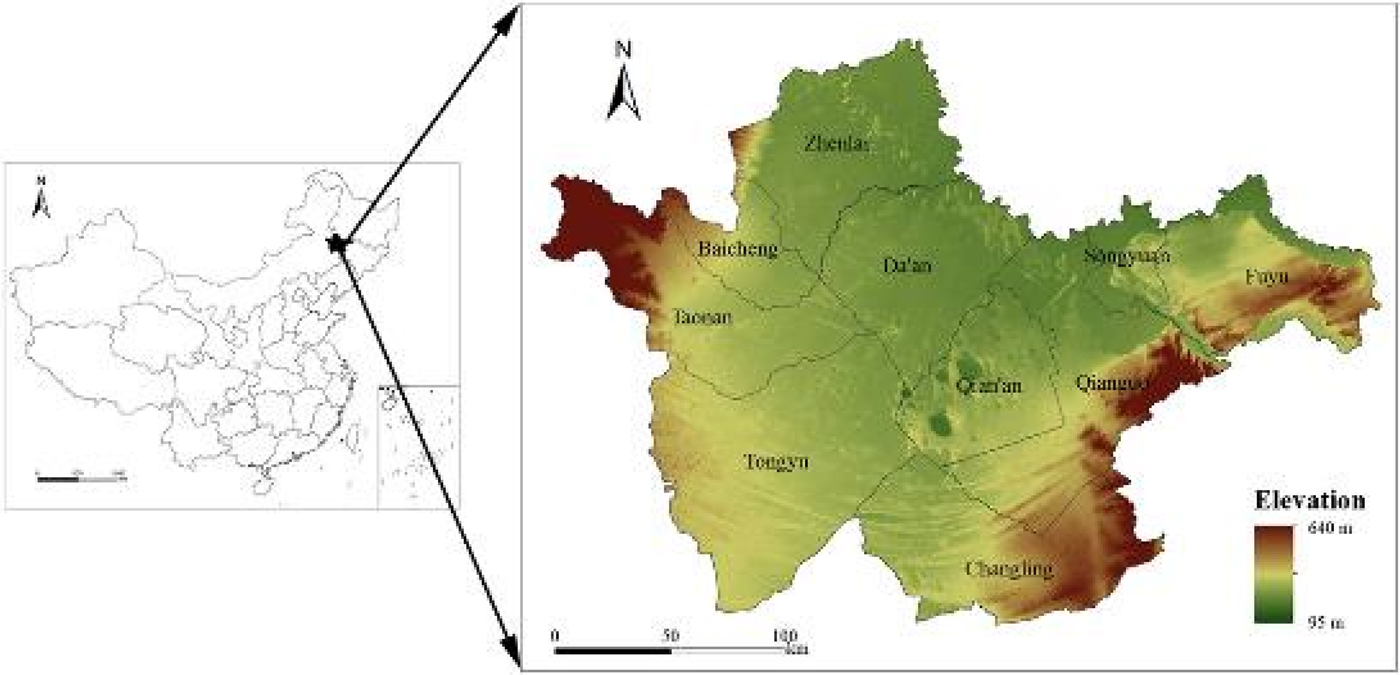
West Jilin, China (43°59′–46°18′N, 121°38′–126°12′E) covers approximately 46 900 km2 and consists of ten counties: Baicheng, Songyuan, Fuyu, Qian'an, Changlin, Tongyu, Qianguo, Da'an, Taonan and Zhenlai (Fig. 1). It represents a typical ecotone area, existing in the alluvial and flood plain, with an average elevation of 160 m. Soil in West Jilin is mainly composed of light black soil and meadow soil (National Standard of the People's Republic of China 2009). It has a temperate continental climate, semi-humid to semi-arid, with an average annual temperature of 4–5 °C. Average annual precipitation declines from 500 to 350 mm from east to west and annual evaporation across the whole region is between 1500 and 1900 mm. The 10 °C annual accumulated temperature is 2800–3000 °C and annual average sunlight hour is 2900 h. The total annual radiation is 5100–5200 MJ, the frost-free period is 140–160 days and the average relative humidity is 60–65%. Several studies have shown that in the past 60 years, the average temperature in West Jilin has increased by 2 °C, a rate higher than the global average (Shen et al. Reference Shen, Wu and Du2014; Zhao et al. Reference Zhao2017). At the same time, the annual precipitation amount, currently approximately 100 mm lower than that in the 1950s, has decreased significantly (Tang et al. Reference Tang2005; Sun et al. Reference Sun, Wu and Yang2006; Shen et al. Reference Shen, Zheng and Lei2017).
Location of the study area.

Data sources
The data used in the present study included land use data, meteorological data, soil data, topographic data and socioeconomic statistics from the ten counties, to discuss the spatial pattern of grain production potential in West Jilin.
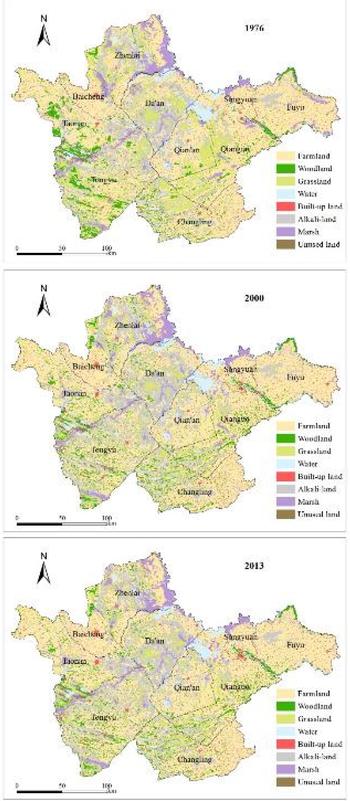
Land use data included the years of 1976, 2000 and 2013, and was obtained primarily via visual interpretation of MSS (Landsat multispectral scanner), TM (thematic mapper) and OLI (operational land imager) remote-sensing images. Land use was classified as one of eight types: farmland, woodland, grassland, water, built-up land, alkali-land, marshland and unused, according to criteria from the Chinese Academy of Sciences land resource classification system and West Jilin's ecological environment (Fig. 2).
Land use of West Jilin in 1976, 2000 and 2013.

Climate data were downloaded from the China Meteorological Science Data Sharing Service Network, including monthly rainfall, maximum temperature, minimum temperature, wind speed, relative humidity, hours of sunlight, sunlight percentage and total radiation in 2000–2015. The Anusplin interpolation model ver 4.2 (Hutchinson Reference Hutchinson2001), developed by the Australian National University, was used to interpolate data from meteorology stations. The model was based on the smooth spline function and considered the influence of terrain and other factors; thus, this model's accuracy was ostensibly higher than that of general interpolation methods.
Soil data were obtained from China Soil Database (http://vdb3.soil.csdb.cn/), which was developed by the Chinese Academy of Sciences Resource and Environmental Science Data Center and includes soil type, soil composition, soil depth, soil water-holding capacity and other attributes. Terrain data were obtained from Digital Elevation Model (DEM) data provided by the U.S. Space Shuttle Radar Topography Mission (SRTM). The SRTM-DEM frameworks used in the present study had a spatial resolution of 90 m. Socioeconomic data were primarily from the Jilin Province National Economic Statistics (1949–1978) (top secret), the Jilin Province Statistical Yearbooks from 1992 to 2013. The results showed that grain crops were predominantly maize and rice, and maize and rice account for 0.90 of total grain production in West Jilin.
In addition, China promulgated and implemented the Grassland Law of the People's Republic of China (NPC 2002) and strengthened the management of grassland around 2000, which impacted land use in ecotones significantly. Therefore, the current study assessed two-time intervals, namely, period 1 (1976–2000) and period 2 (2000–2013).
Global Agro-ecological Zones model
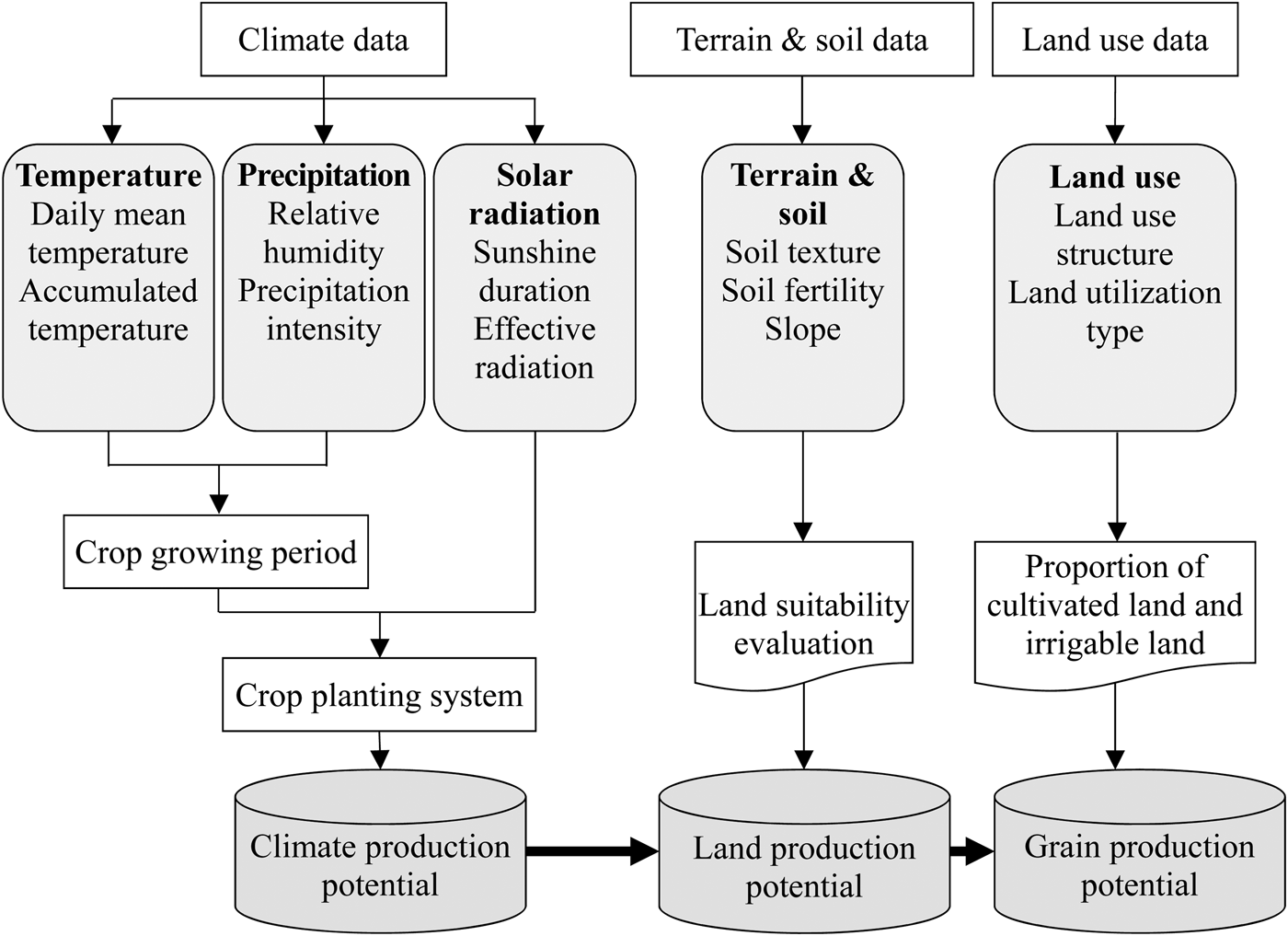
The GAEZ model is a large-scale land productivity model developed jointly by the Food and Agriculture Organization of the United Nations (FAO) and International Institute for Applied Systems Research Institute (IIASA). The model can estimate the climatic suitability of planted crops based on climatic conditions and also calculate the grain production potential (GrPP) by using a progressively limiting method (Fig. 3), i.e. photosynthetic potential productivity (only limited by light), light-temperature potential productivity (limited by light and temperature), climatic potential productivity (limited by light, temperature and water), land potential productivity (limited by light, temperature, water and soil) and agricultural potential productivity (limited by agricultural input level and management methods). The results of this model framed the grain production potential under two simulated scenarios, including rain-fed and irrigation conditions. The impact of precipitation on crop yields was considered under rain-fed conditions, whereas the irrigation condition assumed that water was sufficient (i.e. regardless of the impact of moisture on grain production potential). For each grid, the grain production potential was calculated as follows:
 $$Y = Y_{\rm r} \times (1 - p) + Y_{\rm i} \times p$$
where Y is the grain production potential, Y r the grain production potential under rain-fed conditions, Y i the grain production potential under irrigation conditions and p the proportion of irrigated land.
Organization of the GAEZ model.

Scenario analysis
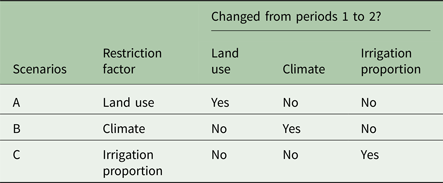
Differences in grain production potential were constrained directly by alterations in climate change, land use change and changes in irrigation proportion of cultivated land. Therefore, a scenario analysis was conducted to detect alterations in grain production potential due to climate change, land use change and irrigation proportion change, respectively (Table 1). Three scenarios were considered, examining the effects of changing one variable on the grain production potential in both periods 1 and 2, with the remaining two variables remaining at 1976 levels. Scenario A considered only the effects of land use change, Scenario B considered only the effects of climate change and Scenario C considered only the effects of changes in irrigation proportion. Grain production potential in each scenario was simulated using the GAEZ model. Thus, differences in grain production potential caused by changes in land use, climate and irrigation proportion were calculated as follows:
 $$\Delta {\rm GrP}{\rm P}_{\rm l} = {\rm GrPP} - {\rm GrP}{\rm P}_{\rm l}$$
 $$\Delta {\rm GrP}{\rm P}_{\rm c} = {\rm GrPP} - {\rm GrP}{\rm P}_{\rm c}$$
 $$\Delta {\rm GrP}{\rm P}_{\rm i} = {\rm GrPP} - {\rm GrP}{\rm P}_{\rm i}$$
where ΔGrPPl, ΔGrPPc and ΔGrPPi are the grain production potential changes caused by alterations in land use, climate and irrigation percentage, respectively; GrPP is the grain production potential in the actual change condition; GrPPl, GrPPc and GrPPi are the grain production potentials in scenarios A, B and C, respectively.
Scenarios assessed in the present study

Results
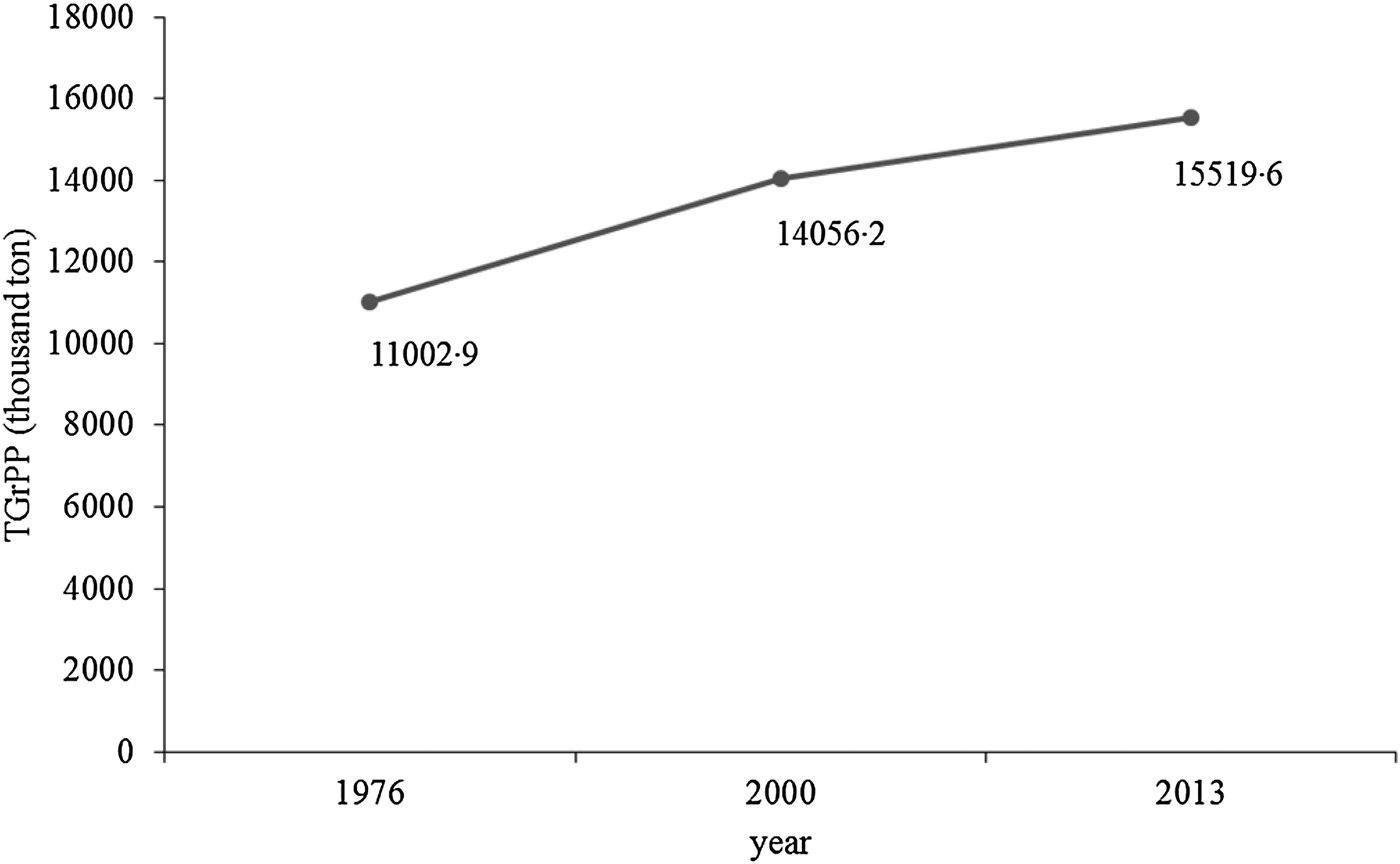
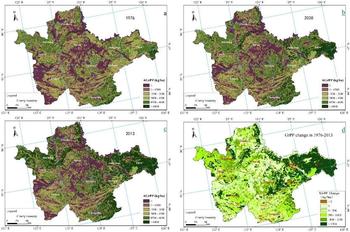
Zonal statistics in ArcGIS 10.0 was used to calculate the grain production potential in West Jilin. The results showed that the total grain production potential (TGrPP) had increased continuously since 1976 (Figs 4 and 5a–c). There was an increase of 4516.7 thousand tons in total grain production potential in West Jilin between 1976 and 2013, with an average annual increase of 118.9 thousand tons. The total grain production potential in West Jilin was 15 519.6 thousand tonnes in 2013. During 1976–2013, the increase in grain production potential (AGrPP) was concentrated mainly in the eastern region of West Jilin, where the grain production potential increased by more than 1500 kg/ha (Fig. 5d). The extent of variation of grain production potential in the other regions was small, ranging from 0 to 500 kg/ha. The grain production potential in some regions declined.
Changes in total grain production potential in West Jilin.

Distribution and changes in grain production potential of West Jilin.

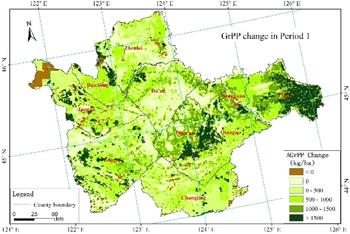
Changes in grain production potential in period 1 (1976–2000)
In 1976 and 2000, the total grain production potential in West Jilin was 11 002.9 thousand tons and 14 065.2 thousand tonnes, respectively, with a total increase of 3053.3 thousand tonnes and an average annual increase of 127.2 thousand tonnes per annum. In 1976, grain production potential in the eastern, western and southern parts of West Jilin was relativity high and generally more than 4000 kg/ha. However, grain production potential in central and south-western West Jilin was low because the land was less cultivated and possessed more alkali land and grassland than other regions. For example, grain production potential was highest in Baicheng (3753.81 kg/ha) and lowest in Tongyu (1290.03 kg/ha).
However, in 2000, the county with highest grain production potential was Fuyu (4917.88 kg/ha), followed by Baicheng (4493.03 kg/ha) and Songyuan (3936.18 kg/ha). The lowest grain production potential in 2000 was recorded for Tongyu (1847.19 kg/ha); however, its potential increased by 557.16 kg/ha compared with 1976. Thus, the grain production potential of West Jilin generally increased during period 1 (Fig. 6).
Changes in grain production potential of West Jilin in period 1.

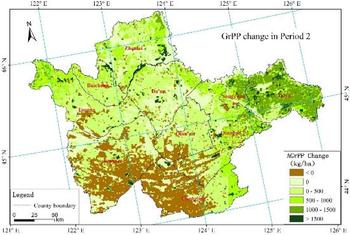
Changes in grain production potential in period 2 (2000–2013)
Total grain production potential in West Jilin increased by 1463.4 thousand tonnes in period 2 with an average annual increase of 121.6 thousand tonnes, lower than in period 1. As in period 1, Fuyu had the largest increase in total grain production potential (369.3 thousand tonnes), while the increase in Tongyu was the lowest at 12.9 thousand tonnes. In summary, total grain production potential in West Jilin increased by 10.4% from 2000 to 2013. In 2013, grain production potential in the eastern, south-eastern and north-western parts of West Jilin was greater than other regions, at >4500 kg/ha, and was >6000 kg/ha in some locations (Fig. 7). In contrast, grain production potential in central and south-western West Jilin was generally <2500 kg/ha. In Tongyu, located in the south-west of the province, grain production potential was <2000 kg/ha. In period 2, the grain production potential of each county increased. The largest increase occurred in Fuyu, which had an average increase of nearly 1000 kg/ha. Grain production potential was lowest in Tongyu, and it had the smallest increase (10.77 kg/ha).
Changes in grain production potential of West Jilin in period 2.

Scenario A: impact of land use change on grain production potential
In general, grain production potential in West Jilin has continued to increase over the past 37 years due to changes in land use (Table 2). In 2013, grain production potential was as high as 2571.68 kg/ha, which was 9.6% higher than the potential in 1976. Vis-à-vis total grain production potential, land use change impacted positively on grain production potential between 1976 and 2013, i.e. it increased total grain production potential in West Jilin. The total grain production potential increased by 1054.6 thousand tonnes during this period.
Changes in AGrPP and TGrPP under different scenarios

AGrPP, increase in grain production potential; TGrPP, total grain production potential.
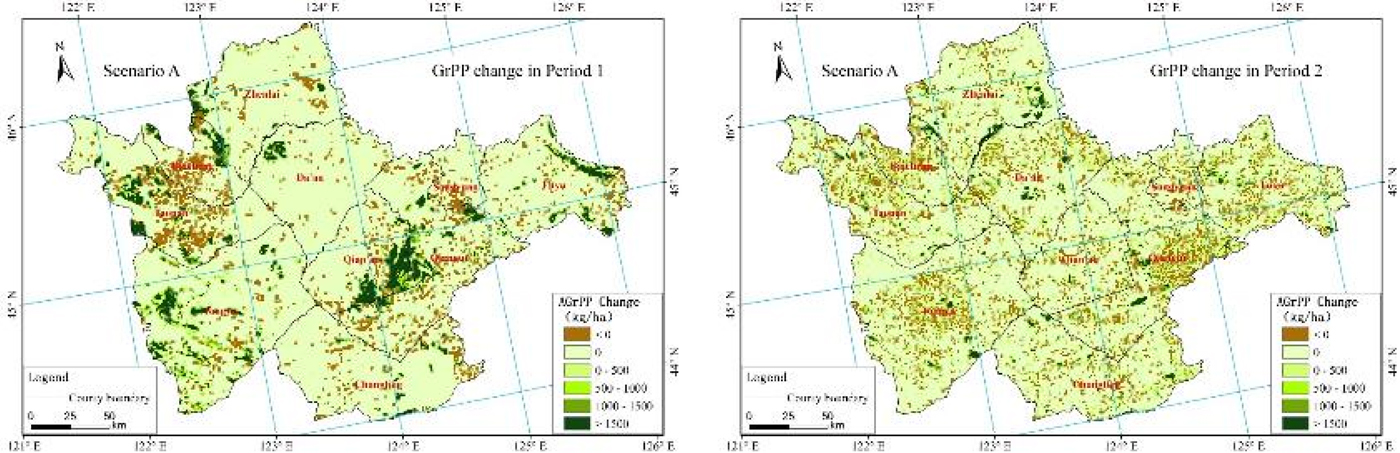
In period 1, land use change resulted in an increase in grain production potential from 2346.75 to 2517.32 kg/ha and total grain production potential increased by 799.7 thousand tonnes, with an average annual increase of >30 000 tonnes per annum. Land use change had a greater impact on the east-central, south-western, north-western and north-eastern regions of West Jilin (Fig. 8); the grain production potential of these regions increased by approximately 1500 kg/ha. Land use change had the most significant impact on grain production potential in Songyuan. However, grain production potential decreased in some parts of West Jilin because of changes in land use.
Impact of land use change on grain production potential.
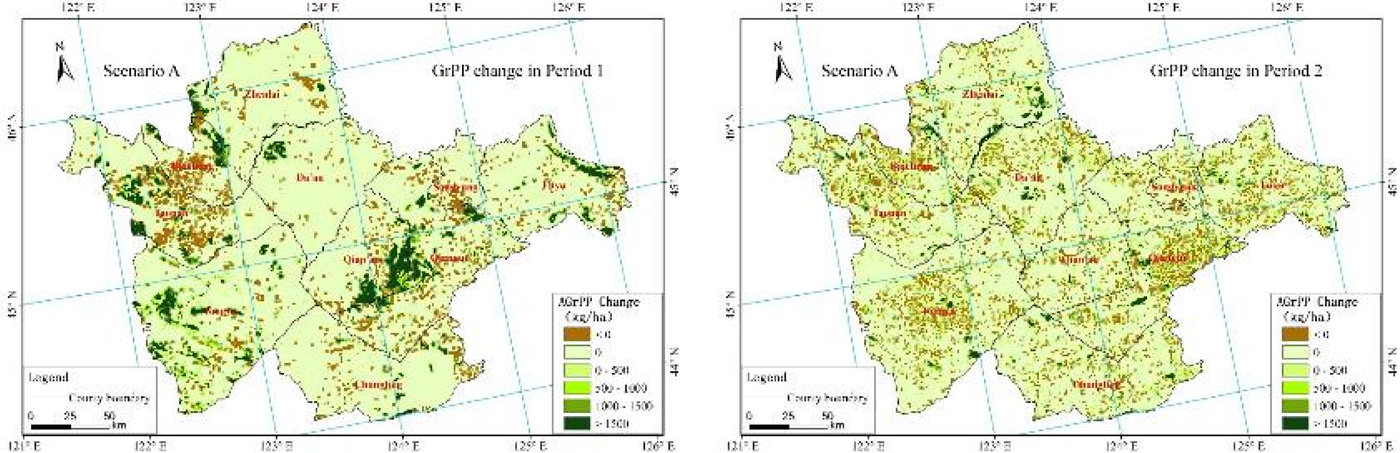
In period 2, changes in land use resulted in an increase in grain production potential in West Jilin by 54.36 kg/ha and total grain production potential increased from 11 802.6 to 12 057.5 thousand tonnes, indicating a 2.2% increase. Although land use change led to a decrease in grain production potential in some areas, grain production potential and total grain production potential of each county increased, except in Songyuan (Fig. 8). For example, grain production potential of Zhenlai and Da'an increased by 110.01 kg/ha and 95.28 kg/ha, respectively, and was influenced by land use change; these two counties showed the most extensive alterations in grain production potential due to land use change. Moreover, the largest increase in total grain production potential was observed in Zhenlai and Da'an (58.9 and 46.7 thousand tonnes, respectively). Baicheng exhibited the smallest alterations in grain production potential due to changes in land use.
Scenario B: impact of climate change on grain production potential
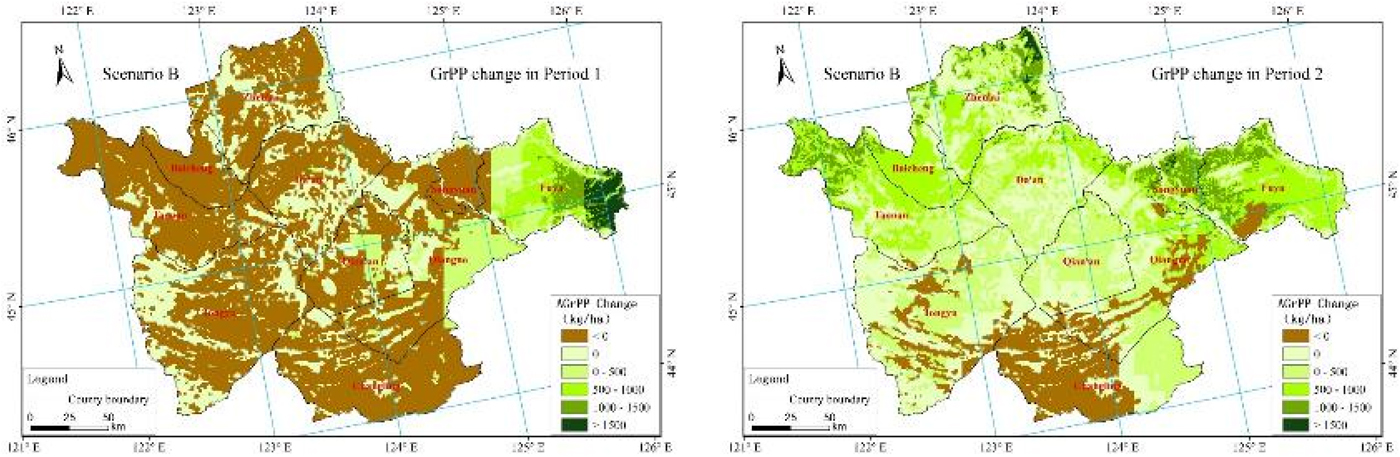
In the past 37 years, climate change has influenced grain production potential significantly. In period 1, total grain production potential in West Jilin decreased by 689.9 thousand tonnes due to climate change, from 2346.75 to 2199.62 kg/ha (Table 2). Considering spatial distribution, grain production potential only increased in the eastern region of West Jilin (Fig. 9). Climate change had the greatest impact on total grain production potential of Taonan, with a total reduction of 342.7 thousand tonnes. Qianguo and Qian'an were least influenced by climate change.
Impact of climate change on grain production potential.

Climate change had the most significant impact on grain production potential in north-eastern, northern and north-western West Jilin. Due to favourable water and heat conditions, these regions, with the continuous growth of grain production potential, showed the greatest increase in total grain production potential. In Zhenlai, Songyuan, Taonan and Baicheng, grain production potential increased by 27.7, 23.3, 20.9 and 20.2%, respectively, due to climate change. Overall, climate change had the greatest impact on Fuyu, where, in 2013, total grain production potential increased by 281.1 thousand tonnes compared with that in 2000.
Scenario C: impact of irrigation percentage change on grain production potential
The average irrigation percentages of West Jilin in 1976, 2000 and 2013 were 19.4, 44.3 and 38.2%, respectively. As a result of the changes in irrigation percentage, grain production potential increased by 466.83 kg/ha and total grain production potential increased by 2188.7 thousand tonnes in period 1. Furthermore, the change in irrigation percentage caused an average decrease in average and total grain production potential, by 114.36 kg/ha and 536.2 thousand tonnes, respectively, in period 2 (Table 2).
In period 1, increased irrigation percentage resulted in a general increase in grain production potential in West Jilin, with the greatest increase at 1444.2 kg/ha. Irrigation percentage change had a substantial influence on grain production potential in north-western and north-eastern West Jilin and a minor impact in the central region (Fig. 10). Irrigation percentage change had the greatest influence on the total grain production potential of Fuyu. Total grain production potential in Songyuan was least affected by changes in irrigation percentage, increasing by <100 thousand tonnes in period 1.
Impact of irrigation percentage change on grain production potential.

In period 2, the grain production potential of West Jilin decreased by 353.8 kg/ha, which was due to a decrease in irrigation percentage (Fig. 10). As in period 1, the decrease in irrigation percentage decreased grain production significantly in the north-west and north-east, whereas minimal effects were observed in central and southwestern West Jilin. The grain production potential of Baicheng decreased by 203.55 kg/ha in response to a decrease in irrigation percentage. In addition, the effect of decreasing irrigation percentage on Songyuan and Fuyu was also substantial. Lower irrigation percentage affected total grain production potential of Tongyu and Da'an minimally, whereas that of Fuyu and Taonan were mostly affected by irrigation percentage decreases in period 2. The decrease in irrigation percentage had the least effect on total grain production potential of Songyuan, which only increased by 22.5 thousand tonnes in period 2.
Discussion
The effects of changes in land use, climate and irrigation proportion on grain production potential differed between periods. In period 1, differences in land use change and irrigation proportion influenced grain production potential positively, whereas climate change imparted a yield-decreasing effect. However, climate change presented a yield-improving effect and was the predominant factor in the observed increase in grain production potential in period 2. The impact of land use change on grain production potential was also positive, but significantly lower than that of climate change since 2000. Irrigation proportion change had a yield-decreasing effect in period 2.
The influence of land use change on grain production potential was achieved primarily through the conversion between farmland and other land use types such as grassland, marshland, woodland and built-up land (Li et al. Reference Li2015). In period 1, there were 232.4 thousand ha of other types of land use converted to cultivated land in West Jilin, resulting in an increase in total grain production potential of 1082.9 thousand tonnes. The conversion of grassland to cultivated land resulted in an increase in total grain production potential by 575.4 thousand tonnes, accounting for more than half of the increase in total grain production potential caused by land use change. Although the conversion of grassland to farmland resulted in an increase in grain production potential, it may also cause serious environmental damage (Alix-Garcia et al. Reference Alix-Garcia, Bartlett and Saah2013; Gingrich et al. Reference Gingrich2015). For example, grassland reclamation not only destroys grassland resources and reduces the vegetation coverage, it also disrupts the balance between salt and water in the soil, exacerbates soil moisture evaporation and salt accumulation processes, and triggers soil salinization (Wang & Li Reference Wang and Li2013; Werling et al. Reference Werling2014). Simultaneously, the area of farmland converted to other land use types was 63.6 thousand ha, which in turn resulted in a decrease in total grain production potential by 141.6 thousand tonnes. A large amount of farmland was occupied and a total of 22.8 thousand ha of farmland was converted into woodland as a result of shelterbelt construction (Liu et al. Reference Liu2014; Wang et al. Reference Wang2014), resulting in a loss of 65.6 thousand tonnes in total grain production potential. Furthermore, there was an increase in the demand for built-up land West Jilin's population increased by more than 1 million people in period 1 (Lerner et al. Reference Lerner, Sweeney and Eakin2013); >0.95 of the new built-up land was converted from cultivated land, resulting in a total grain production potential decrease of 25.4 thousand tonnes.
The main climatic reason for the decline of grain production potential in period 1 was decreasing precipitation and increasing temperature in West Jilin, resulting in aridification. Compared with 1976, annual precipitation in 2000 had decreased by approximately 25 mm and average annual temperature increased by about 1 °C. The decrease in precipitation led to insufficient soil water availability during crop growth and development, which affects crops’ root, stem and leaf development directly, thereby decreasing photosynthetic rates and ultimately reducing grain production potential (Wilcox & Makowski Reference Wilcox and Makowski2014). Although an increase in temperature enhances photosynthesis, West Jilin had limited rainfall and so the high-temperatures exacerbated soil moisture evaporation and crop water transpiration, inevitably leading to the reduction of grain production potential.
In period 2, there was a net increase of 254.9 thousand tonnes in total grain production potential due to land use change; this consisted of an increase of 338.2 thousand tonnes caused by the conversion of other land use types to cultivated land and a decrease of 83.3 thousand tonnes as a result of the conversion of farmland to other types of land use. The total area of farmland converted to other land types use was 36.8 thousand ha, 12.7 thousand ha of which was converted to built-up land due to urban sprawl consuming arable land as a result of socioeconomic development and population growth (Batisani & Yarnal Reference Batisani and Yarnal2009; Wei et al. Reference Wei, Xiu and Sun2013), thereby leading to total grain production potential losses of 31 thousand tonnes. This was the main reason for changing land use, which in turn decreased total grain production potential. Human activities and climate change resulted in a decline in the quality and salinization of the cultivated land, which contributed to a reduction in total grain production potential by 17.6 thousand tonnes. Moreover, there were 10.9 and 7.2 thousand ha of cultivated land converted to woodland and grassland, respectively; the result of a government policy of returning farmland to woodland and grassland. However, about 89.8 thousand ha of other land use types were converted to arable land; the conversion of marshland to cultivated land had the greatest effect on the increase in total grain production potential, leading to an increase of 128.5 thousand tonnes and accounting for more than one-third of the total increase due to land use change. Although a policy of returning farmland to grassland had been implemented, there were still nearly 25 thousand ha of grassland that were converted to arable land due to human activities, thereby increasing the total grain production potential by approximately 84.7 thousand tonnes. In recent years, the government and scientific research departments have increased their investment in alkali land management and supported plant rice policies to effectively manage alkali land resources, leading to an increase of 18.6 thousand tonnes in total grain production potential.
Meanwhile, annual precipitation increased by 158.8 mm and the average annual temperature fell by 0.13 °C. Climate change increased grain production potential by 11.5% in West Jilin and increased total grain production potential by 1190 thousand tonnes. In summary, the impact of climate on grain production potential was positive, leading to a decrease in grain production potential in only south-western West Jilin. This outcome was probably because south-western West Jilin is more arid than the other regions, and the annual rainfall in 2013 was only about 2.8 mm higher than in 2000, whereas the temperature increased by >0.3 °C, representing the smallest precipitation increase and largest temperature increase. This pattern further diminished environmental conditions and restricted food production. For example, climate change led to a 1.3% decrease in grain production potential and a 21.6 thousand tonnes reduction in total grain production potential in Changling.
Conclusions
Using meteorological, soil, topographic and land use data, and related sources, the grain production potential of West Jilin under distinct environmental conditions in different years was estimated using the GAEZ model. Grain production potential in West Jilin increased from 1976 to 2013. The average annual increase of grain production potential in period 1 (1976–2000) was higher than that in period 2 (2000–2013). In period 1, grain production potential in West Jilin was largely affected by changes in irrigation percentage, thereby resulting in an increase in grain production potential of 466.83 kg/ha. Land use change also prompted an increase in grain production potential. The conversion of grassland to farmland was the most important land use change factor for the increase in grain production potential. Climate change negatively affected grain production potential. In period 2, changes in climate and land use both had a yield-improving effect, whereas the increase in grain production potential resulting from climate change was much greater than that caused by land use change. However, the decline in irrigation percentage resulted in a decrease in grain production potential. Therefore, increasing farmland area might not be the optimal way of ensuring food security. Increasing investment in agriculture, improving land quality, and raising the conversion rate of grain production potential to actual production are apparently more effective schemes in ensuring national food security and achieving sustainable land use.
Acknowledgement
This research was conducted under the auspices of National Natural Science Foundation of China (grant no. 41701094).