In a private market, public goods tend to be undersupplied because they are nonrivalrous and nonexcludable. Government provision is the general solution to this inefficient level of public goods today, but economic theory suggests other possibilities, most notably mechanism design, which uses incentives to induce agents to purchase the optimal amount of the public good. The problem with such mechanisms, however, is that it is impossible to achieve this optimal level of production and at the same time meet budget balance requirements and induce agents to comply. As a result, mechanisms of this sort have rarely been implemented by governing bodies.
One remarkable exception is the Athenian liturgical system in the Classical period (479–322). (All dates are BCE.) This liturgical system provided a solution for the provision of public goods where direct government taxation and procurement were not feasible. The trierarchy, or the command, outfitting, and maintenance of a war ship for one year, was at the core of this liturgical system, and I evaluate its success in advancing the private provision of a public good—namely naval military services. Using mechanism design theory and the surviving evidence regarding public goods provision in Athens, I investigate the institution of the trierarchy as a revelation mechanism and identify problems with using such a mechanism to provide public goods in general.1
Fudenberg and Tirole, Game Theory. Note that game theory, of which mechanism design is a subset, is a model of behavior in general; it is not restricted to economic dealings narrowly defined.
The article models the provision of Athenian naval defense in light of the resource base, institutional constraints, and asymmetric information among citizens and the government. Mechanism design is the appropriate tool here because the system was introduced following Kleisthenes's democratizing reforms at the end of the sixth century, and can thus be considered a departure from the historical mold. It was, roughly speaking, a new institutional solution to a problem—just the sort of thing for which mechanism design was created. Mechanism design has the added advantage of providing a theoretical framework for investigating welfare questions of efficiency, feasibility, and budget balance. This enhances our ability to understand the evolving constraints facing Athens through the fifth and fourth centuries, and the resulting insights should interest not just economists or economic historians but all ancient historians as well.
Traditional explanations of Athenian compliance rely on altruistic or noneconomic incentives, particularly the concepts of aretē, a complex form of military honor, and timē, another form of public honor.2
Rahe, “Primacy”; and Finley, Studies. See also Whitehead, “Competitive Outlay.”
Millett, “Maritime Loans”; Cohen, Athenian Economy; Silverman, “Trierarchy”; and Shipton, Leasing.
Although ancient historians have examined the liturgical institutions of Athens and extant evidence surrounding them, mechanism design theory yields a deeper understanding of the behavior involved.4
For example, Gabrielsen, “Diadikasia Documents” and Financing the Athenian Fleet; Whitehead, “Competitive Outlay”; and Athenian Institution.
From extant records pertaining to the trierarchy, family wealth, liturgical history, and the political structure of Athens, the article tests the functionality of the institutional mechanism of the trierarchy by analyzing the incentives and behavior of the individual agents affected by it.5
On trierarchy, see Davies, Athenian Propertied Families; Gabrielsen, Financing the Athenian Fleet; Inscriptiones Graecae (IG) II2: 1604–1632; IG II2: 1928–1932). On family wealth and liturgical history, see Davies, Athenian Propertied Families. On the political structure of Athens, see Traill, Political Organization; Osborne, Demos; and Whitehead, Demes.
Although the data are limited, the article adds to our understanding of Athenian democracy and economy by placing the trierarchy into the framework of a mechanism design problem for the private provision of national defense under asymmetric information. The mechanism successfully created incentives that provided privately for a public good in an efficient manner. Data analysis also strengthens our understanding of the Athenian behavior, as those who exchanged properties formally, probably at court order, give many indications of having hidden or greater wealth to protect.
HISTORY
The first major victory for the Athenian navy came at Salamis in 479. By repelling the Persians with perhaps as many as 200 new triremes, the Athenians established themselves as the pre-eminent Greek polis.6
Thucydides 1.14, 1.74, and 1.112; and Gabrielsen, Financing the Athenian Fleet, p. 37.
Herodotus 7.144; Aristotle Athenaion Politeia 22.7; and Wallinga, Ships.
By 480 it is clear that Athens had formally developed its liturgical system for the provision of public goods ranging from choregia (festival plays) to the trierarchy. This liturgical system probably stemmed from the democratic reforms of the ruler Kleisthenes in 508/7. Peter Wilson provides an in-depth investigation of the choregia which supports the idea that public munificence was driven by economic interest in prestige and that this was manipulated by the state to improve the quality and preparedness of the trierarchs as well.8
Wilson, Athenian Institution, p. 48.
Carl Lyttkens, for one, attributes the origins of the liturgical system to rational actors signaling their eligibility for public service under the new requirements that began to separate aristocracy from civic opportunity.9
Lyttkens, “Effects.”
Whitehead, Demes.
Traill, Political Organization. Though much is unknown about the trittys' purpose (Whitehead, Demes, introduction), Aristotle (Athenaion Politeia 21.2) indicates that the country was divided into trittys so that each tribe might share resources across city, land, and coast. As a risk-sharing strategy, this is reasonable.
Demes varied in status and wealth. As such, the burden of trierarchies fell unequally across demes. In the early sixth century, Solon had divided citizens into four groups, based on their properties' annual agricultural output. The three upper groups were landowners and these persons formed the base for liturgical service. Amongst these landowners, wealth took three main forms: visible, self-proclaimed, and actual. Lyttkens investigated the theoretical marginal effects of the taxation mechanisms (direct and indirect) on the citizenry and found significant incentive to hide wealth.12
Lyttkens, “Effects.”
THE TRIERARCHY
The Mechanism
Under Kleisthenes's reforms, we see a revelation mechanism constructed that attempts to align true wealth with civic duty. The council does not observe true wealth, only visible wealth. Visible wealth (

) is the amount of wealth that the community might easily inspect. The most prominent form is landholding, but it also includes slaves, mine contracts, ownership of a workshop, or similar assets.
13Gabrielsen, Financing the Athenian Fleet, pp. 43–67.

) might be identical to visible wealth, or might either exaggerate or diminish the value of one's property. It represents a citizen's willingness-to-pay. We label the difference between visible wealth and self-proclaimed wealth as

. This may have either a positive or negative value; if political standing or other nonmonetary rewards accrued from performing liturgies, then one might overstate one's wealth.
True wealth (θi) might also equal visible or self-proclaimed wealth, but might also include monies lent out to bankers or in other private arrangements that could potentially be kept secret. Keeping wealth secret put that wealth at risk, because the secrecy made its holders less accountable.
14Cohen, Athenian Economy.
) that first determined the individuals liable for liturgical service in any given year.
15Gabrielsen, Financing the Athenian Fleet, p. 42.
Once the boule identified the purportedly wealthiest citizens, visible wealth determined whether or not an individual actually carried out the service or attempted the antidosis-challenge to avoid it instead. This challenge allowed an individual charged with performing a trierarchy the opportunity to prove another individual more fit (wealthier) to carry it out. The mechanism was clever; if an individual challenged another in the antidosis, the challenged citizen had three choices. He might agree that he was indeed wealthier (

), where citizen i is the challenger and citizen j the challenged, and perform the trierarchy himself. If the challenged citizen did not agree, two choices remained. He might simply have offered to swap his visible wealth for that of his challenger's, and then the challenger would have had to perform the trierarchy with this new level of wealth. Alternatively, he might rather have let the court decide, based on investigation of wealth. In that case, the court would designate either the challenger or the challenged citizen (each one facing a positive probability of being selected); the selected one would have kept his own wealth and had to perform the trierarchy. The intention of the mechanism was to shift responsibility for public expenditures from those who appeared to have the most wealth to those who actually did by creating incentives that either revealed true wealth and enabled a state-mandated shift of responsibilities accordingly, or induced a private redistribution of the responsibilities to the parties who benefited most from performing the liturgies.
The Game
If we model the liturgical system as a one-shot game, there are multiple potential equilibria: to participate without using the antidosis; to go to court; or to trade properties privately such that the offer is attractive to the challenger because it is more beneficial than the expected court outcome but is attractive to the challenged because it is less costly than the expected court outcome. The different equilibria are possible in particular because though outlays on the ship itself might be expected to be approximately equal across trierarchs, the opportunity costs may have varied greatly. Independent farmers, for example, would have had more difficulty being away from the fields during the summer, which was the campaign season. Aretē, timē, or some other public honor that was not directly economic might have increased political power and the potential for welfare gain through better seats at festivals or financial opportunities, effectively reducing the cost of the trierarchy by differing amounts according to individual preferences.16
Carter, Quiet Athenian; and Gabrielsen, Financing the Athenian Fleet, pp. 10–11.
Wilson, Athenian Institution, pp. 111–13.

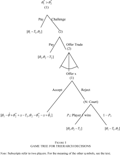
FIGURE 1 GAME TREE FOR TRIERARCH DECISIONS
I define the conditions for the equilibria by backward induction. Appendix 1 presents the formal mathematical analysis; the workings of the game and its conclusions are described here.
First, I define the game. The possible actions of the players are listed first, with a quick explanation of the real-world scenario. See Table 1 for a visual representation of the mechanism.
STAGE ONE: GENERALS ASSIGNED TRIERARCHIES
Each year the demes reported on the visible wealth (
) of their members (though the exact procedure is unknown) so that the generals (strategoi) could assign trierarchies to the Athenians with the highest levels of visible wealth.
18The number of trierarchs increases from about 400 to 1,200 throughout the time period in question, while the number of ships remained about 300. Four hundred or so trierarchs were selected; exemptions were given to unsuitable cases including orphans, very old men, and individuals who were already providing another liturgy in that year, or had performed a trierarchy in the previous year (Demosthenes 14.16). These amounted to about 100 individuals per year.
Gabrielsen, Financing the Athenian Fleet, pp. 68–102.
, or their visible type (wealth).
STAGE TWO: PLAYER ONE (ASSIGNED A TRIERARCHY) CHOSE TO PAY OR CHALLENGE
Player One chose between paying for the trierarchy (resolving the game) and challenging Player Two, an individual not assigned a trierarchy, to the antidosis. In the case of a challenge, the interaction proceeded. Without a challenge, the payoffs were simply Player One's true wealth adjusted for the tax as he bore it (in other words the cost of the trierarchy to him), T1. Though we do not know with what frequency the antidosis was invoked, discharge of another's assigned trierarchy may have been fairly commonplace in spite of the limited records mentioning it directly. For example, Demosthenes suggests by casual acknowledgement that the practice was not unusual.20
The First Phillipic, in which Demosthenes describes the slow and haphazard way in which the trierarchy could hamper war efforts, and states, “it is not until the news comes that we appoint our trierarchs and institute exchanges of property for them, and inquire into ways and means.” (Demosthenes, Speeches, 4.36). Against Meidias, in which Demosthenes describes Meidias and Thrasylochus entering his home and challenging him to take over their trierarchy. (Demosthenes, Speeches, 21)
STAGE THREE: PLAYER TWO (CHALLENGED) PAID OR TRADED PROPERTY
In the case of a challenge, Player Two chose between accepting responsibility for the trierarchy (resolving the game) or making a property exchange offer. If Player Two accepted the trierarchy, the payoffs were such that Player One maintained his true wealth, and Player Two's true wealth was reduced by the cost of the trierarchy to him, T2. If Player Two contested, then a property exchange offer was made. In making a property exchange offer, Player Two chose to list the property that he would exchange for Player One's self-proclaimed wealth (

).
STAGE FOUR: PLAYER ONE ACCEPTED OR REJECTED PLAYER TWO'S OFFER
Player One decided whether or not to accept Player Two's offer of exchange (

).
21This exchange would take the form of a self-disclosed, “exhaustive” property listing.
STAGE FIVE: THE COURT MADE A DECISION
With probability P1, Player One was found to be the in the right and would not have to pay for the liturgy. Player Two would have been spared paying with probability (1 − P1). P1 is a decreasing function of both proclaimed and visible wealth of Player One, and an increasing function of proclaimed and visible wealth of Player Two, and it may of course have been affected by other considerations, such as popularity. In court, each agent would try to uncover the hidden portions of the other's wealth, or the difference between his proclaimed wealth and his true wealth, in order to avoid the trierarchy. Thus, when choosing an opponent for the antidosis one would select the agent for whom one had the most valuable private information.
OUTCOMES
In the static game, there will be a property swap only if offering the trade makes Player Two better off than risking a court case and only if accepting the trade makes Player One better off than risking a court case. This is only possible if T2 ≥ T1, or, in other words, if the cost of discharging the trierarchy is higher for Player Two than for Player One (See Appendix 1).
Additionally, for citizens to participate voluntarily and without a challenge, they must have expected that the cost of the trierarchy after a court appeal was less than or equal to zero or that there was simply no one to challenge with a positive probability of receiving a favorable outcome from the court. Only then would going ahead and performing the trierarchy leave them better off.
The mechanism of the antidosis therefore revealed that players with no chance of winning in court did not issue challenges, most likely due to their greater wealth, provided that the trierarchy was costly. Alternatively, the present value of the trierarchy might have been essentially zero because payments for it could be postponed and in the meantime it would bring in public honors.22
There exists also the possibility that the trierarchy would prove profitable, in addition to any purchase of political capital. It is suggested that contractors hired out to serve would take on the responsibility for a lump sum payment, indicating the potential for private gain through plunder or other similar tools. Accounts of large booty include a case in 355 when two trierarchs seized over nine talents from a merchant in Naukritis (Gabrielsen, Financing the Athenian Fleet). This profitability is certainly dampened in expected value by the considerable risk undertaken.
To summarize, trierarchs would “participate voluntarily” when the trierarchy was costless (or possibly profitable) or there was no eligible substitute. They would choose the antidosis otherwise. The challenged trierarch would make an acceptable offer for property exchange when his costs of the trierarchy were higher than the citizen originally chosen and when the offer would compensate for the possibility of an adverse court ruling. Though the citizen might still volunteer for the tangible gains of political power, the existence of the antidosis mechanism belies the strength of this incentive. I pursue this question of incentives quantitatively.
Long-Run Considerations for Trierarchs
In many cases, as far as our records indicate, individuals did not go to court, and they did participate without challenge in discharging their trierarchies. Of the 492 trierarchs for which we have records, only 110 are known with certainty to have gone to court for issues relating to public expenditures such as the trierarchy (see Appendix 2 for discussion of our knowledge of court cases and the trierarchy).23
There are some cases where the epigraphical record is unclear as to whether two appearances of a similar name are for one individual or two individuals in the same family. Davies's assessment of the record is used here (Davies, Athenian Propertied Families).
Davies, Wealth; Whitehead, “Competitive Outlay”; and Wilson, Athenian Institution, p. 172ff.
Gabrielsen, Financing the Athenian Fleet, p. 11ff.
Note also that performing a trierarchy would reduce one's visible wealth and the probabilities of being assigned a future trierarchy both initially and through court hearings. Also, past unchallenged trierarchal participation was used often as a signal that a person was not as well off as his opponent because he had already spent so much money on the state:
For it is the duty of honest jurymen to give respite to those citizens, when they have need of such help, who, when prosperous, willingly perform public services… but as to those who consider lost whatever money they spend on the state, you should bring them to the list of [trierarchs].26
Demosthenes, 42.25.
Efficiency, Budget Balance, and Feasibility
Before I analyze the data, however, let us examine the trierarchy from a welfare standpoint. A mechanism such as the trierarchy elicits compliance with a principal's (here, the polis's) goals—and does so in spite of privately held information—by providing incentives for agents to contribute appropriately (as defined by their willingness to pay, or marginal rate of substitution) to the public good. Yet as theory predicts, however, it is generally impossible to achieve efficient provision, feasibility, and budget balance simultaneously in cases with several agents.27
Fudenberg and Tirole, Game Theory, p. 268ff.
By efficiency, I mean that the level of naval service provision maximizes the sum value of benefits to the community from such service; in other words, the addition or removal of additional trierarchs would lower overall social welfare generated by the naval defense. If the trierarchy is efficient, the sum of the citizens' marginal rates of substitution for naval services equals the marginal rate of transformation of resources for providing these services.
To achieve feasibility, all agents' individual rationality constraints must be met. In other words, the trierarchy must be one in which citizens are willing to participate. Both the antidosis and the distributions of monies from the state affect feasibility; with greater state funds dispersals, the citizen's cost of participating in the trierarchy is lowered and so participation is therefore more likely.
Budget balance requires funds expended must equal funds collected. Here, the trierarchs all must pay for their trierarchies rather than become public debtors for budget balance to hold. Again, it is in general impossible for all three criteria to be met simultaneously. Without state intervention, naval protection would be undersupplied, and the situation could only be remedied if the state subsidized the operation or coerced agents into paying (thereby violating feasibility). What tradeoffs did Athens choose, and with what repercussions?
Efficiency of the trierarchy would require that the individuals with the highest net returns to performing the trierarchies do so, in effect minimizing the cost (and maximizing the benefit) to the polis. The mechanism of the trierarchy was set up so that this efficiency should be achievable. That is, if the individuals with the most property and most land in Attica had the highest valuation from preserving independence and democracy and garnering the other benefits of performing the trierarchies, then the mechanism would work efficiently to provide naval defense at the lowest total cost to the state. This seems a reasonable interpretation of the general incentives Athenians faced. The mechanism does appear to place the burden not only on those who are the wealthiest but also those with the lowest cost of compliance.28
These individuals would have the highest valuations for quality within the ship for which they had responsibility so that the underprovision of quality would be minimized as well. This would be an important consideration as there was no fixed figure for expenditure for the trierarchy or any other liturgy. One's actual duties consisted of manning the trireme with rowers and more experienced seamen. The military personnel on board were at least partially fed and paid by the state. Because the Mediterranean was full of warships and oarsmen could be hard to find, the ships were often manned by non-Athenians. Competition for crews among city-states could be fierce and sometimes battle could be won simply by hiring away sufficient numbers of the enemy's crew. Such was the major expense of the trierarch (Rosivach, “Manning the Athenian Fleet”; and Gabrielsen, Financing the Athenian Fleet. At times ships might also be commanded by hired noncitizens (Jordan, “Metic Trierarchs”).
As stated, in theory optimal provision would require a system where the sum of the individual marginal rates of substitution for the navy over other goods was equal to the marginal rate of transformation (Samuelson's condition). However, considering naval defense as a type of discrete good, by which there is either sufficient protection from attack or there is not, the question of optimal provision of naval power becomes simpler to analyze.29
This ignores the gains from using the navy for other purposes, such as pirating or offensive actions. To consider more fully the offensive role of the Athenian navy in this time period, one could use the evolution of hegemonic power Athens influenced over the Aegean as a measure of the success and failure of naval provisioning over time.
The citizens did not let the ships sit completely underutilized, however, as there are several known cases of using equipment from one trireme for another, or even using equipment for personal needs.
The feasibility constraint requires that the expected payoff from participating in the mechanism is greater than zero.31
Using the expected payoff to a type relies on the Bayesian individual rationality constraint, which allows players' decisions to remain sensitive to the beliefs they have about each others' types and actions, rather than a stricter dominant strategy constraint (see Fudenberg and Tirole, Game Theory, pp. 270–71.
One important concern here (which affected efficiency, feasibility, and budget balance) was that after an individual was assigned to his ship, he often did not know with certainty if he would be needed that year. The probability that he would be needed was a function of the political climate; if tensions were high between Athens and another seafaring nation, the demands on the navy would be much higher. Thus one might have been more willing to accept responsibility for a trierarchy in a peaceful year than otherwise. The evidence suggests that wars were indeed a big instigator for reforms within the trierarchal system.32
Cawkwell, “Athenian Naval Power”; and Gabrielsen, Financing the Athenian Fleet, pp. 173–217.
In these years of warfare, changes to the trierarchal mechanism were frequently proposed or incorporated, and public debts from trierarchies were collected with more rigor. A brief discussion of the wars and the reforms that resulted puts the questions of the budget balance and feasibility into perspective. Overall, it appears that the mechanism moved from one (in the fifth century) where the state supplemented funds so that the budget balance requirement did not matter to one (in the fourth century) where efficiency declined or public debts were incurred. The mechanism also evolved to become more forgiving by including syntrierarchies, or partnerships in which several individuals shared responsibility for a single ship. The partnerships helped spread the financial burden during the fourth century in an attempt to maintain the institution.
In 411, after the disastrous naval losses at Syracuse and at the beginning of the final stage of the Peloponnesian Wars, an internal oligarchic coup by a group known as the Four Hundred (it consisted of some of the richest Athenians) briefly overthrew Athenian democracy. By this point, Athens had lost virtually all of her empire, and the lengthy war had drained local resources as well.33
Thucydides 8.1.
Until further reforms in the mid-300s, syntrierarchies usually included two individuals. Individuals were allowed to choose their partners if they wished one, and so that the many compliance problems one might face with an unwilling partner could be avoided, most chose trusted family members for partners, upon whom they could most easily place sanctions for defaults.
At the conclusion of the war in 404, Athens' defeat resulted in another brief overthrow of democracy and significant reduction in the role of the navy. Spartan naval rule of the Aegean, however, never took substantial root and the Athenian triremes continued to be an important force amidst shifting allegiances throughout most of the fourth Century.
In 358 Athens was about to enter a war abroad with Philip of Macedon over Amphipolis, and some of the polis's richest island subjects overthrew Athenian leadership in the Social War. At this time, reforms promoted by Periandros were accepted, which diffused costs further, in order to make it easier to support a navy big enough for battle. The idea of these reforms was to spread the liability for the trierarchies out over a larger group of citizens in each year. Whereas before there had been about 300 trierarchs, one for each of 300 warships, now there were 1,200 trierarchs appointed for all 300 ships.35
Gabrielsen, Financing the Athenian Fleet, pp. 182–99.
Ibid., p. 182.
Ibid., p. 174.
Davies, Wealth.
Two years later, after several defeats (for example, Macedonia, Rhodes, Chios), the Athenians pushed for, and succeeded in gaining, the collection of many old trierarchal debts. Some of these had been outstanding for 20 years. Apparently rules regarding trierarchal debts were relatively lax in peacetime.39
Gabrielsen, Financing the Athenian Fleet, p. 158.
The punishment for not paying other public debts was a doubling of the debt enforced by the confiscation of property. Trierarchy debts, while doubled, apparently were not enforced through confiscation. It is understood that the financing must have come from the eisphora (property tax), or increased taxes on foreigners and resident aliens (Gabrielsen, Financing the Athenian Fleet).
A half-generation later, in 340, again on the brink of war, Demosthenes tried to change the system by again spreading each individual's duties across ships, partly in order to enlist those who might not be able to pay for an entire ship but could pay for a fraction.41
Gabrielsen, Financing the Athenian Fleet, pp. 207–13.
Either these improvements were insufficient or else the threat of Alexander the Great was far greater than expected. The trierarchy ended in 322, with the defeat of Athens and its incorporation into the Macedonian empire.
DATA AND ECONOMETRIC ANALYSIS
Overview
I now turn to examining quantitatively the probability that an individual attempted to avoid the trierarchy's responsibilities through the antidosis. This probability is a function of the types of known wealth (land, mines, etc.) for the individual and the deme, additional liturgical service, and generational variables indicating when in the Classical period an individual would have been liable. I also analyze cases where an individual performs more than one trierarchy as a function of the same variables. I look for evidence that individuals with greater wealth and lower costs undertook more of the trierarchal burden. In identifying the aspects of wealth that promoted voluntary private provision of this public good, we are able to understand better how the Athenian democratic system could provide such a successful navy with such significant institutional constraints on its resources. And we can do so without casting aside economic reasoning or invoking unusual altruism among Athenian citizens.
The data set was compiled from three main sources. The first, Athenian Propertied Families, catalogues all of the extant evidence on wealthy families in Attica from 600 through 300.42
Davies, Athenian Propertied Families.
Osborne, Demos. Strictly speaking, what Osborne gives is the ratio of wealthy individuals to the bouleutic quota for each deme. The bouleutic quota was the number of representatives sent to the boule by each of the demes. While the bouleutic quota bore a strongly positive relationship to the total citizen population of a deme (Whitehead, Demes, pp. 22–23; and Traill, Political Organization, p. 56), it is not a one-to-one relationship.
Traill, Political Organization.
I first discuss the variables and investigate cross-tabulations of key components of the data to summarize the evidence. Two separate regressions are then used to analyze the characteristics that would move individuals away from the solution of using the antidosis or going to court and toward the uncontested contribution equilibria. The limitations of the data and potential sample biases are discussed for each variable.
The first regression investigates the probability that an individual went to court over a trierarchy as a function of his deme, the number of trierarchies he performed, whether or not he performed a trierarchy subject to Demosthenes's reforms in 340, the generation in which the trierarchies were performed, his other liturgical duties, his known public office holdings, the source of his wealth (land, silver mines, or workshops), his known associations with bankers, and whether his ancestor was known to have performed a trierarchy. Though we do not distinguish whether the individual initiated the court case or had it initiated against him, in either case the results suggest which characteristics would cause an individual to avoid uncontested participation in the trierarchy.
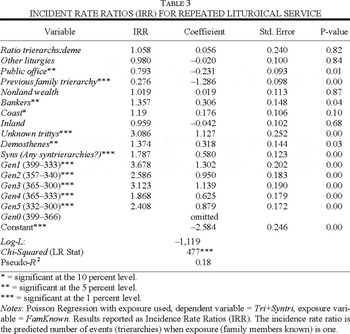
The second regression investigates the number of trierarchies performed by individuals using a Poisson regression because we cannot say much about individuals who were not trierarchs. It also controls for “exposure” in the epigraphic record. This regression complements the first by illuminating which individuals in the sample might be considered wealthiest, with the lowest costs, and which individuals were most influenced by altruistic preferences. If these actions can be explained as economic decisions, then the argument that aretē drove uncontested provision is not necessary.
Discussion of Variables
The limited epigraphical record raises questions of sample selection that are worth discussing here along with the institutional framework and the historical interpretation of the variables. As much as possible, this article strives to reduce the potential biases by relying on primary sources. Although the limited amount of extant data makes sophisticated econometric techniques difficult, we can use the Poisson regression to control, in a sense, for the available historical record when we look at multiple trierarchies performed by an individual, because we can condition the results on the exposure of known family members to recorded history.
Table 1 provides descriptive statistics for the dataset. The quantitative analysis is limited to the fourth century due to these data limitations. In the fifth century, it is understood that the state's distributions from the silver mines were greater than in the following century, so that the individual trierarchical burden was likely lower, and we would expect greater voluntary compliance.
Legal Action
Diadikasia, the dependent variable in the first regression, is a dummy variable recording whether or not we know today if the agent was involved in an antidosis case (Diadikasia = 1 for antidosis case). At least 110 of the 492 trierarchies of which we know were involved in a transfer of liability from one agent to another.45
Gabrielsen, “Diadikasia Documents.”
The remaining individuals require a bit more interpretation, as their place on the list of antidosis cases in our sample comes from their presence on the diadikasia documents of 380/79.46
IG II2:1928–1932.

Community
Trittyes, or thirtieths, divided each of the ten tribes (phylai) so that it contained communities distinguishable as coastal, urban, and inland. These need not have been adjacent for each tribe, and deme membership does not necessarily reflect habitation. Nonetheless, demes-men formed communities in which individuals most likely knew more about each other than they did about individuals outside the deme (with the exception perhaps of neighboring landowners), and as with other direct and indirect taxes, would be competing mainly within their deme to determine their service requirements. Incentives and opportunities for gathering better information about your fellow demes-men were greater than they were across demes or trittyes for other purposes (for example, deme-level liturgical services) as well, and so membership in these communities separates citizens into a variety of potential types. I investigate whether the type of community has an identifiable impact on the spread of the liturgical burden across types of citizens. A dummy variable (Coast) indicates whether a trittys was coastal rather than inland (Inland) or in the city (City), or of unknown location (Unk. trittyes). I investigate this demographic divide. For example, citizens residing in urban trittyes may have had better access to Athens, perhaps increasing political activity and the number of trierarchs from that community. Coastal trittyes and their demes may have been more susceptible to naval attack, and this may have increased the likelihood of trierarchs if they held greater individual interest in naval defense.
Number of Trierarchies
Trierarchies is a variable counting how many trierarchies we know for an individual. Syntrierarchies counts the number of joint trierarchies undertaken. Tri-total sums these contributions equally, while Syns is a dummy variable indicating whether any of the total is composed of presumably less costly syntrierarchies. Because many of the records have been lost or destroyed over time, there is no way of knowing for sure what percentage of the true number of trierarchs these represent. If all 300 ships went out every year for about 58 years (about 380 to 322), there should have been more than 18,600 trierarch-years. We know of 492 trierarchs, and about 650 trierarch-years, which would be approximately 3 percent. As all ships did not go out each year, the actual percentage is likely higher. When one looks at the spread of known trierarchs across the fourth century, there are more known for generations with wars than without. Thus we expect a fairly representative, though small, sample of the ships going out in any given generation.
There may also have been a shortage of trierarchs, as the naval records for various years list up to one half of the potential fleet as “unallotted,” or without trierarchs for the year.47
Gabrielsen, Financing the Athenian Fleet, p. 180.
Ibid., pp. 180–82.
For some cases, the actual year of service for a trierarch is unknown, and only a range of years is available. At least 97 of the 492 individuals in the sample performed more than one trierarchy. The maximum number of known trierarchies or syntrierarchies performed by an individual is nine. This is the dependent variable for the second regression. It would have been preferable to have a sample of nontrierarchs to compare with trierarchs, or to be able to compare based on the actual expenditures, but unfortunately neither of these were possible because these names come only from documents recording trierarchs and rely instead on statistical adjustments for truncated count data.
Demosthenes
If an individual performed more than one trierarchy in the same year after the implementation of Demosthenes's reforms, the cost of each is expected to be lower. A dummy variable (Demosthenes) indicating such participation is included because the law was purported to have caught many individuals who had been shirking their civic duty prior to the law. Thus, those individuals who performed trierarchies under this law were perhaps less likely to have gone to court because they had managed to keep
below the amount that would place them on the lists in the first place, but when the list was expanded to include more individuals they were brought into the system. At this point there were fewer people available to be challenged because they had also been assigned as trierarchs. This variable affects about 6 percent of the sample.
If an individual were performing more than one trierarchy, as in the second generation, one would expect that the Demosthenes law would have a positive effect, as it spreads responsibilities across ships.
Generations
Dummy variables Gen0, Gen1, Gen2, Gen3, Gen4, and Gen5 indicate the time during which the trierarchy was carried out. There are three generations of 33 years for which we know of trierarchs, and the other three distinguish individuals who served in more than one generation. Gen0 (omitted, 9 percent of sample) corresponds to the first generation, from 399–366. Gen1 (5 percent of sample) includes those who participated in both the first generation (Gen0) and the second generation (365–333, Gen4). Gen2 (26 percent) is the portion of the second generation known under Periandros's law, from 357 to 340. Gen3 (9 percent) marks those who participated in both the second generation and the third one (332–300). Gen4 (25 percent) represents the second generation, from 365–334 (if specific information does not put them more clearly in Gen2) and Gen5 (26 percent) the third generation, from 332 to 300. The expected signs and importance of these variables are in relative terms to the service of the first generation, a period in which there was little warfare. For court cases, theory alone gives us little guidance; it may be that there is a positive influence on the numbers of cases going to court in years that there are more trierarchs (such as during wars) but a negative influence in times of war when the demand for national security was higher and the willingness to pay increased. For the case of multiple trierarchies, participation across generations (Gen1, Gen3) should be a positive influence on the number of trierarchies as they imply at least two syntrierarchies, while the other generations might have a positive or negative influence, as the war years were also years of mechanism reforms that spread the cost burden.
Nonland Wealth
Nonland wealth is a dummy variable (Nonland) marking those who were known to have made money from renting silver mines from Athens or from the ownership of a workshop. Because the mines were technically owned by the state, they were not included in an individual's list of assets and therefore would be a good way to hide wealth from taxation. They were, however, more risky than land and there are reports of individuals being financially ruined by their mining enterprises.
49Finley, Studies.
, would not change), they would not fear court and might go more often. This variable includes about 11 percent of the sample.
Other Liturgies
A dummy variable (Other Liturgies) indicates whether the individual had provided other liturgical services. Unfortunately this variable is subject to severe underreporting because the records were not nearly as inclusive as those for the trierarchy. For instance, while several individuals a year would pay for a choregia, only the winner would be recorded. These choregia winners are the most common source of knowledge we have for this variable. The bias in this case is that the winners of the choregia are much more likely to have spent more money on their production, and are therefore arguably among the richer of the trierarchs.50
Davies, Athenian Propertied Families.
Public Office
This is a dummy variable (Public Office) indicating known service in public office. This suggests both interest and ability in politics. It is taken to indicate that the individual may desire political capital from his expenditures on the state. Like Other Liturgies and Bankers, this variable may be significantly underreported and does not differentiate between types of office due to a lack of information.
Banker Interactions
The dummy variable Bankers marks whether an individual was known to have dealings with a banker. Banking in general was a risky affair; unlike all other market transactions, banking occurred without witnesses.51
Cohen, Athenian Economy.
An additional possibility is that the individuals were using bankers to hide wealth and they went to court anyway, thinking it safe, but their hidden wealth became known through the process. We dismiss this possibility by investigating the data. Of the approximately 468 known trierarchs, 20 had known associations with bankers.52
There are some cases where the epigraphical record is unclear as to whether two appearances of a similar name are for one individual or two individuals in the same family. Davies's assessment of the record is used here (Davies, Athenian Propertied Families).
Davies, Athenian Propertied Families.
Whether Pasion and his family's actions are actually different from other trierarch's or only appear so from the unusual presence of evidence, the manner of inclusion in the empirical analysis is the same and is required in order to avoid omitted variable bias.
Ancestors' Actions
If an individual had an ancestor who was a trierarch (Previous Family Trierarch), then others might perceive his wealth to be high. Such a person would stay out of court because it would be harder to prove that someone else was wealthier. The probability of losing in court was thus high, so one would make one's hidden wealth vulnerable to exposure with little chance of relief from the trierarchy. Alternatively, this sort of person might have been able to invoke his service as evidence of volunteerism and might therefore appeal to the court rather than simply paying. Because wealth did not change much from generation to generation, it is likely that an ancestral trierarchy signals significant wealth and likely additional trierarchies.
I also use Davies's work to tally the known members of a trierarch's family throughout the historical record, and use this to contextualize the number of trierarchies known for an individual.55
Davies, Athenian Propertied Families.
Deme Wealth
Ratio Trierarchs to Deme attempts to gauge the perceived availability of substitutes from one's deme by calculating the ratio of all the known trierarchs for a deme to all known wealthy members of the deme during the classical period (600–300). Thus we have a relative view of the liturgical burden of the deme. One would expect the sign on this variable to be negative: if there are more wealthy individuals in the deme who are already participating, it will be harder to find a substitute.

Results of Regression on Trading of Financial Duties
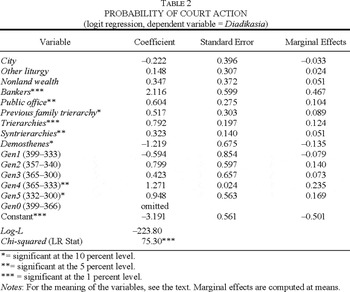
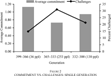
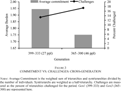
The results of the logit regression on whether a trierarch was involved in a transfer of financial duties, most likely resulting from a court decision, are shown in Table 2. Hereafter, we refer to this transfer as going to court for expositional purposes. Overall, the greatest marginal effect on the probability that a person went to court was from known associations with bankers, which raised the odds 47 percent. This was statistically significant at the 99 percent level. Other factors of significance (at or above the 90 percent level), in descending order of effect, were being a member of generation 4 (365–333), which raised the odds by 24 percent (see Figures 2 and 3 for visual representation of the differences in trierarchy burdens and court cases across generations), the number of trierarchies (12 percent), holding of public office (10 percent), a previous family trierarchy (9 percent), and syntrierarchies (5 percent). Of the statistically insignificant variables, none would have particularly large effects if they were significant. It is somewhat reassuring that City does not have a large or significant effect because it seems likely that records are not biased toward Athens proper and may indicate that local knowledge of a neighbor's wealth was more important than proximity to the boule.56
Several other specifications with different regional variables all show similar lack of importance.

FIGURE 2 COMMITMENT VS. CHALLENGES: SINGLE GENERATION
As expected, individuals were less likely (by 14 percent, with a coefficient significant at the 10 percent level) to have gone to court if they were subject to Demosthenes's law (so that costs of compliance were considerably lower in expectation). In the second generation, it does appear that Athens was facing a budget crisis for funding of the trierarchy. Having tapped the richest families for a century and a half, Athens tried several reforms. Periandros's first attempt at reform in 358/57 set the eligible number of trierarchs at 1,200 per year and led to more and more individuals serving as syntrierarchs to spread costs and ease shortages, though for the most part individual trierarchs remained the norm.57
Gabrielsen, Financing the Athenian Fleet, pp. 182–99.

FIGURE 3 COMMITMENT VS. CHALLENGES: CROSS-GENERATION
These results support the hypothesis that the reasons for performing a trierarchy were not simply prestige and power. The mechanism design of the institution had teeth; the antidosis was necessary for the provision of the public good. The increased probability of court appearances that accompanied an increased number of trierarchies might stem from two factors. First, there might be diminishing returns to providing trierarchies, so that additional calls for service would instigate greater efforts to avoid service. On the other hand, visible wealth in the form of past trierarchies might cause the community to expect more service. We investigate these possibilities with a second regression on the factors that caused an individual to perform more than one trierarchy.

Results of Regression on Multiple Trierarchies
The results of this Poisson regression on the total number of trierarchies and syntrierarchies are recorded in Table 3. Statistically significant incidence rate ratios (IRRs) greater than one indicate that the variable increases the likelihood of performing more than one trierarchy, whereas IRRs less than one indicate that it decreases it. In an effort to control for the holes in the historical record and for the fact that we do not see nontrierarchs, we use known family members to condition the results for the disparities in our knowledge of the family histories.58
If Ej is the exposure, the expected number of events Cj will be

where rj = exp(b0 + b1 * x(1,j) + … + bk * x(k,j)) is the incidence rate ratio.
The constant term contains the effect of being in Gen0, so that all subsequent generations are relative to this constant.
The demographic variables generally support the idea that coastal trittyes invested more in performing trierarchies, with a statistically significant IRR of 1.19 as compared to city trittyes (the omitted category). Interestingly, the trittyes in unknown locations also increased the odds of performing multiple liturgies, with an IRR of 3.09.60
Only 4 percent of the sample has an unknown trittys location, and city appears underrepresented at 24 percent of the sample, if we assume that trierarchies are distributed evenly across the types of trittyes. However, city had one of the highest populations of non-Athenians and thetes (the landless, liturgically exempt, class of citizens) so there may be a smaller percentage of eligible citizens for the trierarchy. If the unknown trittyes are mostly city trittyes and we group them together, the magnitudes of the influence of coast and inland do not change much, but they lose statistical significance. On the other hand, the sample is 33 percent coastal trittyes (and 39 percent inland). If more of the unknown trierarchs come from coastal trittyes, as would support the idea that they had more at stake, then this strengthens the magnitude and statistical significance of the coastal trittyes.
The other significant increase come from known relationships with bankers (IRR = 1.4). As discussed previously, in large part this likely reflects actual noncitizen or new-citizen bankers performing multiple trierarchies in order to gain citizenship or prestige.61
Because we know so much about the case of the banker Pasion and his family (see Davies, Athenian Propertied Families) with respect to the trierarchy, we are able to link the significance of the banking association variable to this family's interests directly. The strong positive relationship between banking and trierarchies corroborates the suspicion that Pasion and his descendants were attempting to purchase prestige. This is strengthened by the use of the exposure model, which conditions the estimates on the level of knowledge about family members, so that the greater incidence within that family is taken into account in the estimates and still returns a result that suggests the behavior of the set of those known to have banking connections, dominated by that family, is significantly different from the behavior of other trierarchs and their families.
Having previous family trierarchs greatly reduces the odds of performing multiple trierarchies. The argument that you should be relieved of responsibility because your ancestors' efforts have depleted your wealth apparently worked. Holding other public office also reduced the incidence rate for multiple trierarchies. If citizens used both the trierarchy and public office to garner public respect and the prizes that accompanied it, then the two appear to have been substitutes as well. This is also compatible with the possibility that the returns to the choregia and the trierarchy differed in terms of honors and socio-political capital, so that those seeking more glory were more likely to participate in the choregia and less likely to participate in the trierarchy. Combined with the information in the first regression, we can safely say that many citizens found alternatives to costly service if they could.
CONCLUSIONS
The trierarchy functioned as an institutional mechanism that provided for the private provision of an essential public good, the Athenian Navy. From its inception at the end of the sixth century, the mechanism worked toward the simultaneously impossible goals of providing a fleet of the optimal size, a balanced budget, and voluntary compliance. It met with sufficient success, however, to support the city-state's growing hegemonic influence in the Aegean Sea until Alexander the Great absorbed Athens into the Macedonian Empire.
Despite a paucity of data, we can combine the epigraphical and archaeological records and analyze individual's behavior quantitatively. Evidence on types of wealth holdings, court actions, community identity, and family choices show that the mechanism did not rely on non-economic incentives. Athenians, long credited with purely altruistic behavior or unusual glory-seeking, actually functioned as economic decision-makers. Even the political gains are quantifiable in holdings of public office.
The model is useful to economists as an example of a mechanism implemented in the real world but also provides some insights for ancient economy. Using an economic model and quantitative analysis together to investigate the motivations of the Ancient Greeks helps fill in some of the unknowns. The theoretical constraints required by the mechanism for feasibility, budget balance, and efficiency provide a framework for a broader understanding of the long-run success, and ultimate failure, of the trierarchy to provide naval defense. As the budget options of the state changed, the mechanism also changed. In the fifth century, when state distributions were significant and the individual burden was low, trierarchies not analyzed here show that feasibility and efficiency were easier to attain. As the individual burden increased, compliance became more coerced, and the navy ultimately failed to maintain Athens as an independent state.
The equilibria of the game suggest that economically self-interested individuals would not necessarily go to court, and the existence of the mechanism belies the traditional belief that Athenians sought mainly noneconomic rewards. The citizens did challenge their responsibility for the trierarchy when it was in their best interest, and they worked to avoid the cost. Visible wealth led to the need to comply, and the provision of naval services appears to have been carried out by those most financially able to do so at the lowest cost. The antidosis was a necessary part of the mechanism design, and long-run requirements for wealth preservation might result in even greater voluntary compliance with the trierarchy.
Appendix 1: Mathematical Expression of the Mechanism
We formalize the game, sketching the incentive compatibility constraints corresponding to the textual discussion. Table 1 provides visual representation of the mechanism.
GAME SET-UP
Citizens vary in true wealth, θi, and visible wealth,
.
Stage One: Generals assign trierarchies
Generals rank citizens (types) by visible wealth (
).
Selected types have

and are considered Player Ones. Unselected types have lower visible wealth (or other exemptions) and are potential Player Twos.
Stage Two: Player One (assigned a trierarchy) chooses to pay or challenge
Player One chooses between paying for the trierarchy (resolving the game) and challenging a Player Two (an individual not assigned a trierarchy) to the antidosis.
In the case of a challenge, the game proceeds to Stage Three. In a challenge, Player One asserts that his self-proclaimed worth is
(which may be greater than, less than, or equal to his visible wealth

) is less than Player Two's true wealth, i.e.,

. Without a challenge, the game ends and payoffs are simply their true wealth adjusted for the tax:
- Player One: θ1 − T1, where T1 is the cost of the trierarchy to the trierarch, and
- Player Two: θ2.62
Player One will presumably choose the Player Two he believes has the highest wealth given both public and private information (in other words the person he has the highest chance of convincing to trade or against whom he is most likely to win in court).
Stage Three: Player Two (challenged) pays or trades property
In the case of a challenge, Player Two chooses between accepting responsibility for the trierarchy (resolving the game) or making a property exchange offer. If Player Two accepts the trierarchy, the game ends and payoffs are:
- Player One: θ1,
- Player Two: θ2 – T2, where T2 is the cost of the trierarchy to the challenged citizen.
If Player Two contests, then a property exchange offer is made. In making a property exchange offer, Player Two chooses to list the property that he is willing exchange (his visible wealth plus a portion of his private wealth,

) for Player One's self-proclaimed wealth (
).
Stage Four: Player One accepts or rejects Player Two's offer
Player One decides whether or not to accept Player Two's offer of exchange,
.
If he accepts, the game ends, property is exchanged, and he discharges the trierarchy. Payoffs to each player are then:
- Player One: ,

- Player Two: ,


Where x is the amount that Player Two is willing to increase his visible wealth in order to facilitate the switch. If Player One rejects the offer, the case goes to court (Stage Five).
Stage Five: The court makes a decision
With probability P1, Player One is found to be the in the right, and does not pay for the liturgy. Player Two is spared with probability (1 – P1). Note that P1 is a decreasing function of
and
, and an increasing function of

and

. The expected payoffs if the game reaches this final stage are therefore:
- P1θ1 + (1 – P1)(θ1 – T1), and
- Player Two: P1(θ2 – T2) + (1 – P1)θ2.
BACKWARD INDUCTION OF THE CONDITIONS FOR EQUILIBRIUM
Conditions for property swap to occur
In the static game, there will be a property swap only if the offer to trade is such that

, where
is the difference between visible wealth and self proclaimed wealth. Simplified, an exchange is only possible if

. This can be shown with a set of theorems that solve the game through backwards induction.
Theorem 1: Player Two will offer

Proof: Player Two will make an offer such that his payoff for acceptance is no less than his expected payoff from rejection. In accepting, he gives up his visible wealth plus a premium, x, in exchange for Player One's declared wealth. In rejecting, the case goes to court, and with probability (1 – P1), Player Two is found less wealthy and maintains his wealth (LHS), while with probability P1, Player Two is found the wealthier and must discharge the trierarchy, for an expected outcome depicted on the RHS of the equation

or simplifying,

Theorem 2: Player One will accept Player Two's offer only if

Proof: Player One's incentive compatibility constraint requires that accepting the trade (LHS) is better than the expected outcome of the court deliberations (RHS)

which simplifies to:

Lemma: Acceptable offers that Player Two can make to Player One are in the range where

Lemma: A necessary condition for an acceptable offer is that
63In the case that T1 = T2 = T, there exists a unique acceptable exchange offer where


In the static game, it will also be true that citizens will not willingly participate without challenge unless the expected cost of the trierarchy after a court appeal is less than or equal to zero or there is no possible individual to challenge with a positive probability of receiving a favorable outcome from the court.
Theorem 3: Player One will not accept the trierarchy without challenge unless T1 ≤ 0 or P1 = 0
Player One's incentive compatibility constraints require that if he is to participate immediately rather than challenge a player, then

As shown above, to accept this offer,

is necessary. By substitution,

must be satisfied for volunteering to be preferred to such an offer. In the more likely case that an unacceptable offer is made, Player One's incentive compatibility constraints require that

, which also reduces to the condition that 0 ≥ P1 T1. QED.
Appendix 2: The Diadikasia Documents
Though there is considerable controversy over the exact meaning of the diadikasia documents, as Inscriptiones Graecae (IG) II2 1928–1932 are known, no one disputes that the “B instead of A” format refers to such a transfer as required in the antidosis. A variety of opinions have been offered.64
Davies, Athenian Propertied Families and Wealth; and Gabrielsen, “Diadikasia Documents” and Financing the Athenian Fleet, pp. 70–71.
If the replacements listed on these documents went through the court process, then we can assume that the agent listed as the replacement lost the case. If the replacements did not go through the courts, but instead “voluntarily” accepted the debt, we must assume that they benefited more than they would have had they risked going to court. It would be wonderful to know for certain which case is true. Most presentations of the diadikasia documents do assume they reflect court-ordered decisions; this is consistent with the decision to record the event. In the possible case that they do not, however, we can still interpret the activity as a function of wealth and private incentives, and as a reflection on the institutions for public munificence. Whether the trade was due to a court decision or not, the existence of a trade implies that agents involved had not truthfully revealed their wealth in the initial stage of the game. Since we are not concerned in the empirical analysis with whether or not the agent in question actually won or lost in court, the crucial information contained by these diadikasia documents is that there was a recorded transfer of fiscal duty to the state.
Special thanks go to the anonymous reviewers, Robert Wallace, Joel Mokyr, Louis Cain, Alan Taylor, Tom Hillman, Thomas Lurquin, the Triangle Economic History Workshop, and the participants of the 2003 Cliometrics Conference for their encouragement, assistance, and advice.