The zone of the shoreline that is constantly washed by waves or tides, called the swash zone, has received greater attention in recent years in view of the safety of the beach environment and its importance for health since it is an attractive recreational area, especially for children (World Health Organization, 2003). In particular, the World Health Organization (WHO) expressed concern over the role of the swash zone interstitial water (SZIW) which occupy interstices, or spaces between the sand grains, and offer micro-habitats where organic matter may be accumulated, and where a warm and moist environment may be conducive to the growth of certain microbial pathogens protected from dilution with open waters (WHO, 2003). Considerable exposure to pathogens is a likely occurrence as a significant percentage of time is spent in the swash zone by bathers, particularly children, who play, wade and swim there. However, despite these problem-suggestive issues, epidemiological evidence for such risks has not been found and the swash zone has not been sufficiently investigated to rule out potential risks (WHO, 2003). Hence, although it has been demonstrated that SZIW may show high concentrations of faecal indicator bacteria, scant information is available on the potential role of SZIW as a reservoir of potential microbial pathogens (Genthner et al., Reference Genthner, James, Yates and Friedman2005). Fungi that are often found in the environment as saprotrophs may act as opportunistic pathogens, especially in immuno-compromised patients (Hoog et al., Reference Hoog, Guarro, Gené and Figueras2000). In the beach environment fungi have mostly been isolated from beach sand, including a number of genera and species that are potential pathogens for humans (Mancini et al., Reference Mancini, D'Angelo, Pierdominici, Ferrari, Anselmo, Venturi, Fazzo, Formichetti, Iaconelli and Pennelli2005; Salvo & Fabiano, Reference Salvo and Fabiano2007; Vogel et al., Reference Vogel, Rogerson, Schatz, Laubach, Tallman and Fell2007; Abdallaoui et al., Reference Abdallaoui, Boutayeb and Guessous-Idrissi2007). However, to date, no study has been designed to examine the presence and concentrations of fungi in the SZIW. In this paper we report higher concentrations and diversity of filamentous fungi and yeasts in the SZIW than from adjacent beach sand collected at an urban beach located in the Genoa City (Sturla Beach, Italy). The study site (44°23′31″N 8°59′00″E) is a microtidal exposed beach characterized by a small length (~200 m) and width (~30 m), moderate wave action (wave height generally lower than 3 m), mixed sediment and a shore slope lower than 5%. The beach is subjected to strong anthropic pressures, being situated in a heavily urbanized area close to a minor stream and an urban sewage outfall.
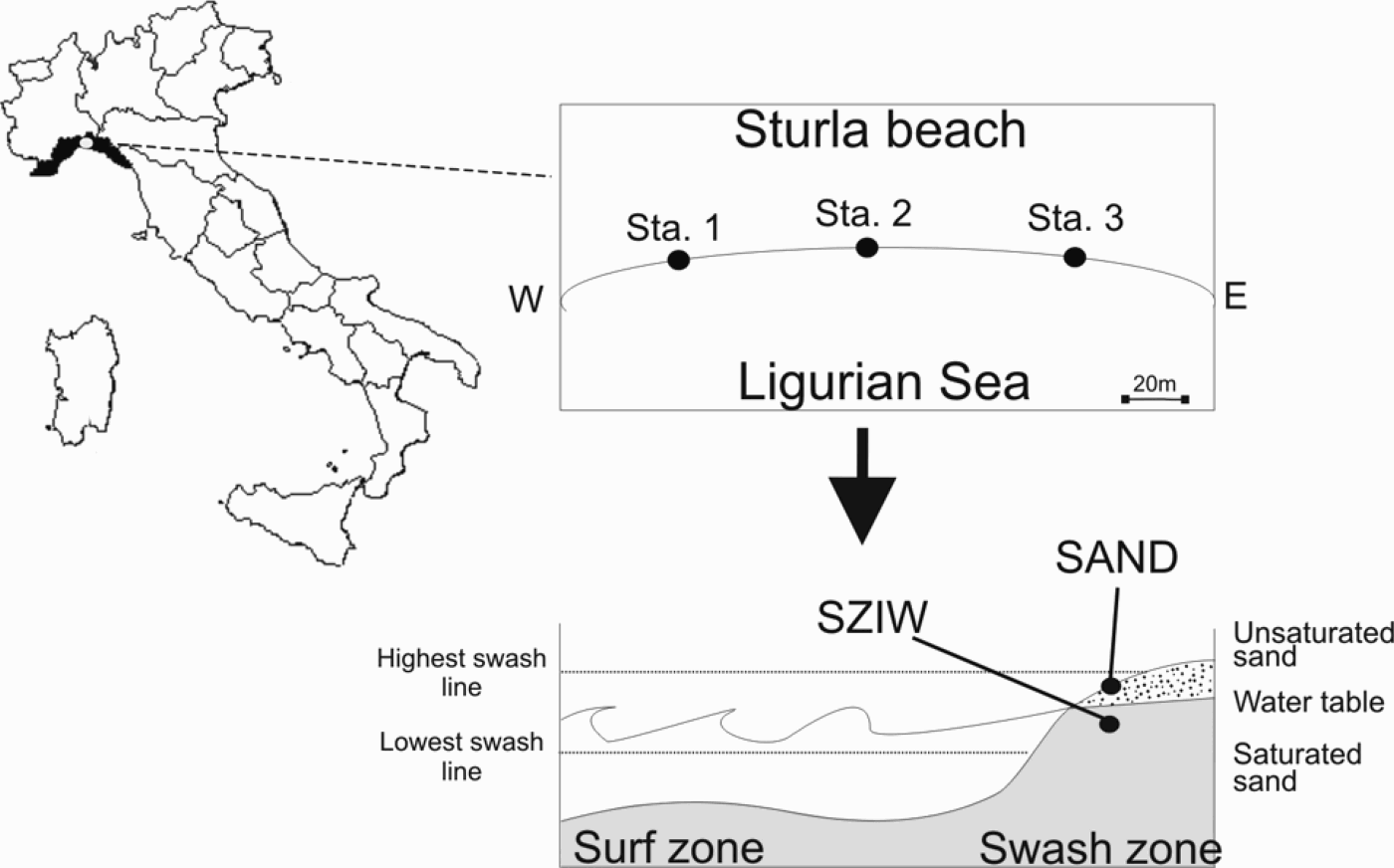
Interstitial water and sand samples (100 ml) were collected in the swash zone at three sampling locations positioned at the west, middle and east side of the beach in June and August 2005 (Figure 1). Sample sites were determined by first locating the landward edge of the swash zone, which is the zone alternatively covered and exposed by waves and then chosen 1 m inland from the outer edge of the swash zone. For collection of interstitial water samples the depth of dry sand was measured and removed with a shovel from each sample point. Using a sterile post-hole digger a 6-inch diameter hole was made in the moist sand. The hole was dug deep enough to allow free interstitial water to accumulate. Once the interstitial water entered the hole, a sterilized well casing was inserted to prevent the hole from collapsing. At each location, for each sampling occasion, independent samples were taken in triplicate over an area of ~15 m2.
Study site and experimental design at Sturla Beach (Genoa City, Mediterranean Sea).

Filamentous fungi and yeasts were isolated from collected samples by the dilution plate method (Warcup, Reference Warcup1960). Each sample was cultured in modified Sabouraud (Sab), 15% agar, 10% glucose, 5% neopeptone, at 24°C in the dark using Petri dishes (12 cm diameter) (Hyde & Pointing, Reference Hyde and Pointing2000). The Petri dishes were inspected daily for up to 20 days to detect the development of colonies. The number of single colonies of filamentous fungi and yeasts were counted using a stereomicroscope (Stemi DV4, Zeiss Universal Microscope, Germany) and expressed as number of colony-forming units (CFU) per 100 ml. Isolation was carried out by taking the microfungi from the dishes and transplanting them onto specific media. The strains isolated were identified in accordance with conventional mycology methods based mainly on observing their micro- and macro-morphological characteristics and their different trophic and physiological requirements. When possible, the isolated strains were identified at the species level and lodged at the Mycoteca Universitatis Taurinensis (MUT) in Turin (Italy). Unidentified strains that differed in their macro-morphological and physiological characteristics were counted and summed with the number of identified strains to yield the number of ‘total different strains’. Analysis of faecal indicator bacteria (total coliforms, faecal coliforms and total enterococci) was also performed immediately after sample collection by membrane filtration (MF) techniques (Clesceri et al., Reference Clesceri, Greenberg and Eaton1998). Temperature and total protein concentration (Hartree, Reference Hartree1972) were finally determined in all of the analysed samples. To test the null hypothesis that the concentrations of total fungi were the same in the SZIW and in the beach sand, a three-way analysis of variance (ANOVA) was performed.
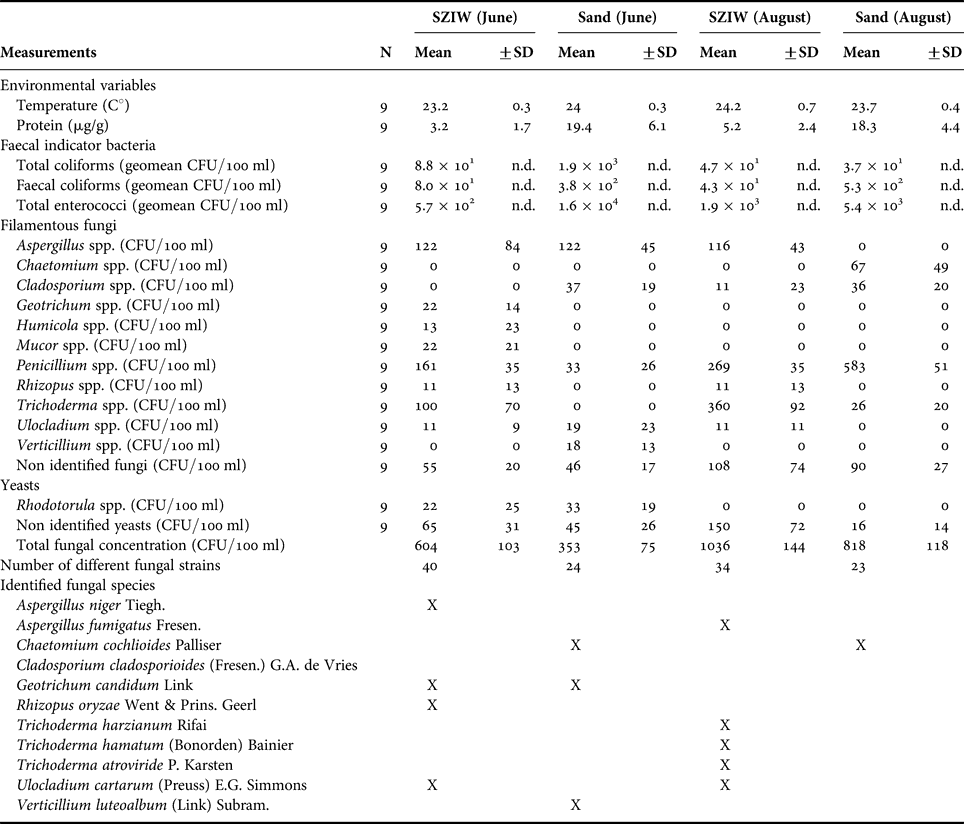
Thirty-six SZIW and beach sand samples were analysed for the presence of filamentous fungi and yeasts. Globally, a total of 11 genera of filamentous fungi and one genus of yeast were identified (Table 1). Unexpectedly the SZIW had the highest counts of total filamentous fungi and yeasts while sediment samples always displayed lower counts (ANOVA, P < 0.05). The SZIW also harboured higher fungal diversity with ten genera and 74 different strains isolated from this matrix (Table 1) while only eight genera and 47 different strains were isolated from the beach sand samples. Microscopic analysis of the SZIW revealed the presence of ubiquitous genera. Some of these were previously isolated from Mediterranean beaches, such as Aspergillus, Cladosporium, and Penicillium (Mancini et al., Reference Mancini, D'Angelo, Pierdominici, Ferrari, Anselmo, Venturi, Fazzo, Formichetti, Iaconelli and Pennelli2005). Opportunistic pathogens (e.g. Aspergillus niger) or plant pathogens (Trichoderma spp.) were also isolated from the SZWI as well as yeasts (Rhodotorula spp.) (Table 1). On the other hand Aspergillus fumigatus, which is a species frequently reported as a human pathogen, was only identified in the sediment while dermatophyte genera and keratinolytic fungi, which are known agents of human infection, have not been isolated from any of the analysed samples (Table 1). The high concentration and diversity of fungi in the SZIW compared with beach sand, is to our knowledge, for the first time reported. Interestingly, the concentrations of fungi were found to be correlated to temperature values (N = 18, P < 0.05) and protein concentrations (N = 18, P < 0.05) but uncorrelated to the concentration of faecal indicator bacteria (N = 18, P > 0.05). In a speculative way we may infer that the higher fungal concentrations and diversity found in the SZIW than in the beach sand probably depend upon an optimal combination of environmental factors in this matrix, such as high water content, presence of organic matter, optimal temperature and the absence of light. The SZIW may thus constitute an important reservoir of fungal micro-organisms in the beach environment.
Environmental variables, faecal indicators and fungi in the SWIZ and beach sand at Sturla Beach in June and August 2005.

N, number of samples; SD, standard deviation; n.d., no data; X, presence.