Significant outcomes
• No significant difference between patients and controls in allelic frequencies or genotypic distributions of SNP P1635.
• Significant difference between the case and control groups for SNP P1655.
• Significant positive association between A-C haplotype and SCZ and a protective effect for A-G haplotype.
Limitations
• To further validate these results, more case and control samples are needed.
• The SNPs may act in haplotypes, so analysis of more SNPs are suggested.
• The SNPs may be in linkage disequilibrium with other SNPs.
Introduction
Schizophrenia (SCZ) is a severe psychiatric disorder that affects approximately 1% of the population with devastating life-long sequences (Reference Karayiorgou and Gogos1,Reference Hanson and Gottesman2). It is characterised by positive symptoms, including hallucination and delusion, and negative symptoms, including emotions deficits, social isolation, impairments in attention and cognition (Reference Gogos and Gerber3). Recent linkage studies showed several SCZ susceptibility genes such as Nerugulin1, Epsin4 and Dystrobrevin binding protein-1 (Dysbindin) (Reference Gogos and Gerber3–Reference Harrison and Owen7). The human dystrobrevin binding protein-1 (DTNBP1) gene spanning a region of approximately 140 kb on chromosome 6p22.3 has 10 exons which encodes dysbindin, a coiled-coil-containing protein (Reference Veroni, Grasso, Macchia, Ramoni, Ceccarini, Petrucci and Macioce8). The protein was initially found to interact with α- and β-dystrobrevin (DTNA and DTNB) in the brain and muscle of mice (Reference Benson, Newey, Martin-Rendon, Hawkes and Blake9). The latter proteins are members of the dystrophin-associated protein complex (DPC), which links the cytoskeleton to the extracellular matrix (Reference Benson, Newey, Martin-Rendon, Hawkes and Blake9), and are involved in the process of signal transduction such as regulating nicotinic receptor cluster and recruiting specific signalling molecules like neuronal nitric oxide synthase (Reference Pimm, McQuillin and Thirumalai10). Dysbindin is also an essential component in the biogenesis of lysosome-related organelles complex 1 (BLOC-1) and interacts with all seven other components of BLOC-1 (Reference Nazarian, Starcevic, Spencer and Dell'Angelica11). Dystrophin is co-localised with postsynaptic GABA receptor subtypes in cortex, cerebellum and hippocampus. Therefore, it could be implicated in the pathophysiology of affective disorders (Reference Knuesel, Mastrocola, Zuellig, Bornhauser, Schaub and Fritschy12). With regard to abnormalities found with signal transduction, receptor systems and synaptic connections in affective disorders, and the function of dysbindin, the gene might be regarded as a good candidate in the genetic liability to affective disorders (Reference Krystal, Sanacora and Blumberg13–Reference Duman, Malberg, Nakagawa and D'Sa17). Along with above findings, many molecular genetic studies have been published on dysbindin gene and SCZ; Straub et al. were the first investigators to report a significant association for the gene polymorphism in 270 Irish high density SCZ families (Reference Straub, Jiang and MacLean18). Later on, other studies performed on German-Israeli (Reference Schwab, Knapp and Mondabon19), Chinese (Reference Tang, Zhou and Fan20) and Bulgarian populations (Reference Kirov, Ivanov and Williams21) led to significant association between the gene and SCZ. However, it should be mentioned that a number of studies do not confirm these results (Reference De Luca, Voineskos, Shinkai, Wong and Kennedy22,Reference Van Den Bogaert, Schumacher and Schulze23). As there is an evident necessity to study various ethnic populations, we launched this study to investigate a possible association between P1635 (rs3213207) and P1655 (rs2619539) polymorphisms in dysbindin gene with SCZ in an Iranian population.
Materials and methods
Subjects
Totally, 115 patients with SCZ (mean age ± SD, 39.18 ± 10.82, 92 male and 23 female) were recruited in this study from SCZ patients referred to Iran Psychiatric Institute and Iran Psychiatric Hospital, Tehran, Iran. A total of 117 age, sex and ethnic origin matched unrelated healthy volunteers were sampled. All the patients were assessed for SCZ using DSM-IV criteria. All the subjects of this study signed the written consent forms after being explained the purpose and method of the study. This study was approved by the ethics committee of the School of Medicine, Tehran University of Medical Sciences and Iran psychiatric hospital.
Genotyping
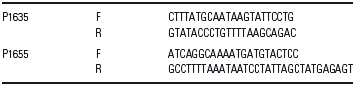
About 5 ml of whole blood sample was taken from each subject. DNA was extracted using a standard salting out protocol. Genotyping was performed by the PCR-RFLP method. Primers for two SNPs P1635 (rs3213207) and P1655 (rs2619539) of the dysbindin gene were synthesised (Table 1) (Reference Kishimoto, Ujike and Motohashi24).
Sequence of primers used in the study
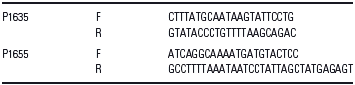
F, forward primer; R, reverse primer.
PCR reactions were carried out in a thermocycler instrument (Applied Biosystems, GeneAmp 2720, Singapore) under the following conditions: 94 °C for 4 min, 30 cycles including denaturing at 94 °C for 30 s, annealing for 30 s at 51 °C and 57 °C for P1635 and P1655, respectively and extension at 72 °C for 30 s. A final extension was followed at 72 °C for 5 min (P1635) and 7 min (P1655).
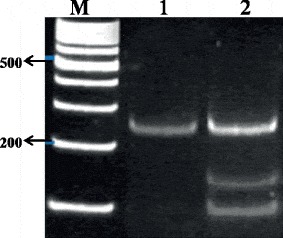
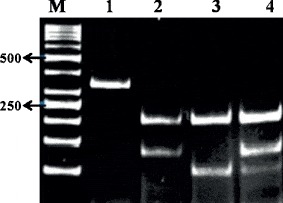
Then, the PCR products were digested by appropriate restriction enzymes BSeN1 for P1635 (5–8 h at 65 °C) and Hinf1 for P1655 (overnight at 37 °C). The digested products were electrophoresed on 2.0% agarose gel for P1635 and on 9.0% polyacrylamaide gel for P1655 and were stained with ethidium bromide (Figs 1 and 2). A subset of genotypes of P1635 and P1655 were confirmed by direct sequencing.
P1635 genotyping by PCR-RFLP, M: 100-bp DNA ladder, 1: AA, 2: AG.

P1655 genotyping by PCR-RFLP, M: 100-bp DNA ladder, 1: PCR product (328 bp), 2: CC, 3: GG, 4: GC.

Statistical analysis
Data were analysed using SPSS statistical software (SPSS Inc.,SPSS/PC+, Chicago, IL, USA). All tests were two-sided and p < 0.05 was considered statistically significant. Significance of differences in proportions between groups was assessed by the chi-square test. Checks for deviation of genotypes from Hardy-Weinberg equilibrium were based on Fisher-Exact method.
To control for multiple testing and to balance the amount of type I and II errors, the Benjamini and Hochberg false discovery rate (i.e. the expected proportion of rejected true null hypothesis among rejected hypotheses) was used. The false discovery rate level was set at 5% (Reference Benjamini and Hochberg25,Reference Benjamini, Krieger and Yekutieli26).
Assignment of haplotype carrier status to individual cases was carried out by PHASE software v2.1.1, which utilises Bayesian approach to reconstructing haplotypes (Reference Stephens, Smith and Donnelly27).
Results
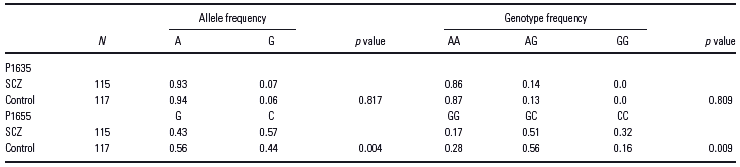
Allelic frequencies and genotype distributions for each SNP compared between SCZ patients and controls are shown in Table 2. The genotype distributions of patients and control subjects were within the values expected from Hardy-Weinberg equilibrium for each SNP.
Allelic frequencies and the genotype distribution of the dysbindin gene polymorphismsin the case and control groups
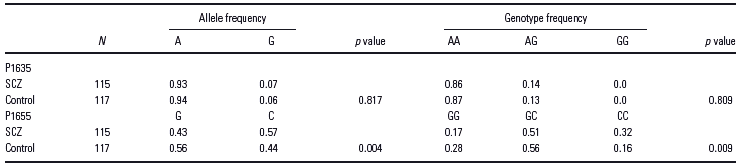
We found a statistically significant difference between patients and controls in the frequencies of the genotypes or alleles at P1655 of the dysbindin gene (P1655 genotype; OR = 1.71, 95% CI = 1.19–2.47, p = 0.009). However, no significant difference was observed in the genotypic distribution or allelic frequencies between patients and controls at P1635 (P1635: genotype (OR = 1.09, 95% CI = 0.54–2.22, p = 0.809). Also, we found the odds ratio of 2.447 (p = 0.005) for individuals genotyped CC versus those genotyped GG or GC (Table 2).
Four possible haplotypes were observed in the studied populations: 1: AG (0.482), 2: AC (0.447), 3: GG (0.007) and 4: GC (0.064). Haplotype analyses showed an association between the A-C haplotype and SCZ (p = 0.004). Table 3 shows the distributions of the haplotypes in the case and control groups. After controlling for multiple comparisons by Benjamini-Hochberg procedure, all of the initially identified significant associations remained statistically significant.
Haplotype association between patients with schizophrenia and controls

NS, not significant; p c, corrected p value for multiple testing.
Discussion
We found a significant association between the P1655 SNP and SCZ. The C allele of P1655 was shown to be a risk factor for SCZ in the studied Iranian subjects. A significant difference was also observed between the case and control groups for the CC genotype of P1655. Some reports have shown no association between P1655 and SCZ in Japanese (Reference Tochigi, Zhang and Ohashi28) and Korean (Reference Joo, Lee, Jeong, Ahn, Koo and Kim29) populations. Unlike the findings of other studies (Reference Kishimoto, Ujike and Motohashi24,Reference Galehdari, Ajam, Pooryasin, Foroughmand and Kazeminejad30), we did not find a significant difference between the case and control for P1635. In a recent study on a South Iranian population, the A allele was associated with decreased risk of SCZ (OR = 0.27, 95% CI 0.48–52, p < 0.001) in SCZ patients. Similar to our finding, the GG genotype was not detected in the study (Reference Galehdari, Ajam, Pooryasin, Foroughmand and Kazeminejad30). The G allele of P1635 was found to be a risk factor for SCZ in the Japanese (Reference Kishimoto, Ujike and Motohashi24).
As linkage disequilibrium has previously been established to occur between the two SNPs with a 6.86-kb physical distance (Reference Kishimoto, Ujike and Motohashi24,Reference Tochigi, Zhang and Ohashi28,Reference Tosato, Ruggeri and Bonetto31), upon haplotype analysis constructed by P1635-P1655 of the dysbindin gene, and as the most striking findings in our study, a strong association of A-C haplotype with SCZ was revealed (p = 0.004). The A-G haplotype was significantly more common in control subjects than in patients with SCZ (OR = 0.57, 95% CI 1.18–2.42; p = 0.003) implying a substantial protective role. However, other Asian studies have failed to show such P1635-P1655 haplotype associations with SCZ (Reference Tochigi, Zhang and Ohashi28,Reference Joo, Lee, Jeong, Ahn, Koo and Kim29).
Although these SNPs and most of the risk markers were located in introns spanning DTNBP1, it could be thought they may influence risk for SCZ in at least three major ways:
1 Dysbindin gene has 3 major mRNA (isoforms a, b and c) and 12 different mRNA transcripts resulting from alternative splicing (Reference Williams, Preece and Morris32); these markers may be involved in the post-transcriptional alternative RNA splicing process, so that genetic variation in pre-mRNA may produce different mRNAs, that can be translated to different dysbindin proteins with differing activities.
2 These intronic SNPs and their haplotypes might influence the expression of dysbindin protein in the brain and thus influence the susceptibility to SCZ. Some studies have shown haplotype-specific and allele-specific expression of dysbindin in the brain (Reference Bray, Preece, Williams, Moskvina, Buckland, Owen and O'Donovan33), and some others have shown important reduction of dysbindin expression in the brains of patients with SCZ (Reference Numakawa, Yagasaki and Ishimoto34–Reference Weickert, Straub and McClintock36), it is possible that cis-acting variants may contribute to the role of dysbindin in the aetiology of SCZ.
3 These markers could also be in linkage disequilibrium with a functional SNP. However, despite intensive resequencing studies (Reference Williams, Preece and Morris32), no DTNBP1 coding variants have yet been identified.
In conclusion, this study suggested that dysbindin gene is likely to be related to the development of SCZ in an Iranian population. However, more studies with more SNPs in dysbindin gene, enough sample size and on different ethnic groups are required. Further investigation on other genes and environmental factors interacting with dysbindin protein would lead to a more comprehensive understanding of the dysbindin gene and SCZ.
Acknowledgements
This research has been supported by Tehran University of Medical Sciences and Health services grant No. 10547. We also thank the staff of Iran Psychiatric Institute and Iran Psychiatric Hospital for their supports. We would like to express our deepest gratitude to all the patients and healthy controls who agreed to participate in this study.