Introduction
Odontogenic infection is a frequently missed cause of recalcitrant or difficult-to-treat sinusitis. Raman et al. found that the histopathological inflammatory changes in odontogenic sinusitis were more severe than those associated with rhinogenic sinusitis.Reference Raman, Papagiannopoulos, Kuhar, Gattuso, Batra and Tajudeen1 A recent study compared the 22-item Sino-Nasal Outcome Test (SNOT-22) scores of rhinogenic sinusitis and odontogenic sinusitis patients; while the total scores were not significantly different between the two groups, odontogenic sinusitis patients scored significantly higher with regard to emotional disturbances.Reference Simuntis, Vaitkus, Kubilius, Padervinskis, Tušas and Leketas2
The real incidence of odontogenic sinusitis remains controversial. Nearly 10 per cent of sinusitis cases are attributed to odontogenic causes, with a few publications reporting a higher incidence of odontogenic sinusitis, of up to 40 per cent.Reference Melén, Lindahl, Andréasson and Rundcrantz3,Reference Puglisi, Privitera, Maiolino, Serra, Garotta and Blandino4 Matsumoto et al. reviewed 190 cases with unilateral maxillary sinus opacification, and found dental causes in 70 per cent.Reference Matsumoto, Ikeda, Yokoi and Kohno5 Some publications reported that the increasing rate of dental procedures and surgical procedures was associated with a rising incidence of odontogenic sinusitis.Reference Lopatin, Sysolyatin, Sysolyatin and Melnikov6 A systematic review of the causes of odontogenic sinusitis in 674 patients showed that 65.7 per cent of cases were iatrogenic following dental treatment, and 33.4 per cent of cases were due to dental infections.Reference Lechien, Filleul, Costa de Araujo, Hsieh, Chantrain and Saussez7
Odontogenic sinusitis is commonly harder to treat than rhinogenic sinusitis because of missed dental causes, mixed microbiology and more severe histopathological inflammatory changes.Reference Raman, Papagiannopoulos, Kuhar, Gattuso, Batra and Tajudeen1,Reference Workman, Adappa and Granquist8 To date, there is no agreement about the best sequence of treatments for odontogenic sinusitis, and no established guidelines for its diagnosis and treatment. This 10-year study discusses the reasons behind misdiagnosis of odontogenic sinusitis. We also present our management protocol, which aims to decrease the incidence of misdiagnosis and improve the outcome of treatment for odontogenic sinusitis.
Materials and methods
This retrospective study included 74 patients with odontogenic sinusitis who were diagnosed and treated over 10 years (2010–2019).
Odontogenic sinusitis was diagnosed based on the presence of dental pathology or a recent dental procedure related to the affected maxillary sinus and unilateral opacification of the maxillary sinus adjacent to the dental pathology. Patients with bilateral sinus opacifications due to allergy or chronic sinusitis were included if they fulfilled the previous criteria with greater opacification and involvement of the maxillary sinus adjacent to the dental pathology or procedure.
Patients with fungal infections were excluded from the study because this constitutes a different disease entity. Likewise, patients with unilateral maxillary sinus opacification unrelated to dental inflammation or a dental procedure, and those whose final diagnosis was not odontogenic sinusitis, were also excluded from the study.
All patients underwent full medical and dental histories, physical examinations, nasal endoscopies, dental examinations by endodontists or periodontists, and high-resolution sinus computed tomography (CT) scans. The CT scans were reviewed twice. The first review was performed routinely by the radiologist in charge and the second by a senior radiologist blinded to the initial report.
The following data were collected: demographics; pertinent history, including dental treatments; symptoms; endoscopic findings; diseased teeth and any underlying dental pathologies; and CT reports.
The treatment was discussed and planned mutually with the dentists. Treatment options included dental procedures, surgery or restorations, antibiotics, and functional endoscopic sinus surgery (FESS). Patients with oroantral fistulae were treated by intra-oral repair using a buccal flap and/or fat pad. Functional endoscopic sinus surgery was performed when needed.
The study was approved by the institutional review board of the hospital, and all patients signed informed consent forms based on the Helsinki declaration.
Results
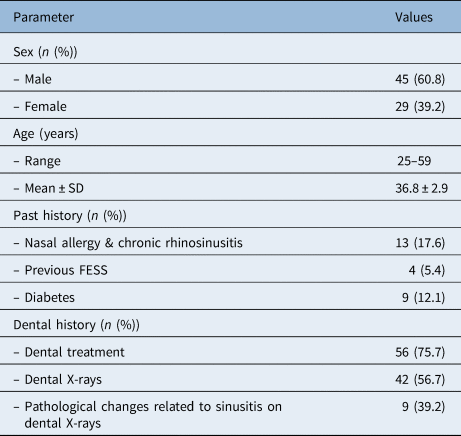
The study included 74 patients with confirmed odontogenic sinusitis. The demographic data and pertinent history of the patients are shown in Table 1. The patients comprised 45 males (60.8 per cent) and 29 females (39.2 per cent). Their mean age was 36.8 years (range, 25–59 years). Thirteen patients (17.6 per cent) suffered from nasal allergy and chronic rhinosinusitis, and four patients (5.4 per cent) had undergone previous sinus surgery. Nine patients (12.1 per cent) were diabetics.
Patients’ demographic details and pertinent history

SD = standard deviation; FESS = functional endoscopic sinus surgery
Fifty-six patients (75.7 per cent) had received dental treatment during the last year, but only 13 (23.1 per cent) mentioned it voluntarily without being asked about it. Forty-two patients (56.7 per cent) had dental X-rays (periapical and bitewing), with dental pathologies being detected in only 29 (39.2 per cent).
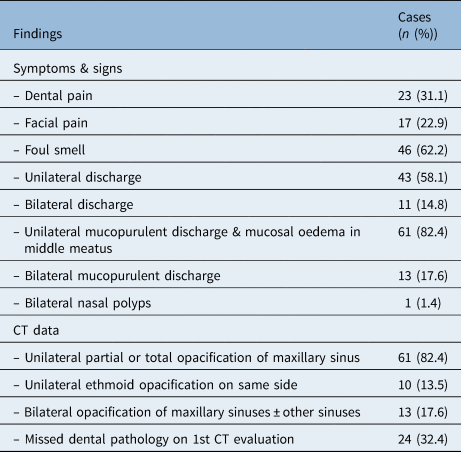
The mean duration of symptoms was 1.9 years (range, 1.5 months to 6 years). Dental pain was present in 23 patients (31.1 per cent) and facial pain was present in 17 (22.9 per cent) (Table 2). Foul smell with or without bad taste was the commonest symptom, and was present in 46 patients (62.6 per cent). Unilateral nasal discharge was present in 43 patients (58.1 per cent) and bilateral nasal discharge was present in 11 (14.8 per cent), all of whom had positive history of allergy and/or chronic rhinosinusitis.
Patients’ clinical and CT findings

CT = computed tomography
Unilateral mucopurulent discharge in the middle meatus and mucosal oedema was the commonest finding on nasal endoscopy and was seen in 61 patients (82.4 per cent). Bilateral discharge was seen in 13 patients (17.6 per cent) and nasal polyps were seen in only 1 (1.4 per cent). All bilateral cases had positive history of chronic rhinosinusitis and/or allergy.
All patients had CT scans of the paranasal sinuses (Table 2). Dental pathologies were missed on the first CT evaluation in 24 patients (32.4 per cent). Unilateral maxillary sinus opacification was the commonest finding and was reported in 61 patients (82.4 per cent). Unilateral ethmoid opacification was seen in 10 patients (13.5 per cent) on the same side as maxillary opacification. Bilateral opacification of the maxillary sinuses (and other sinuses) was seen in 13 patients (17.6 per cent), all of whom had positive history of chronic rhinosinusitis and/or allergy.
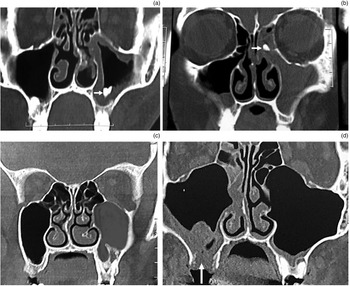
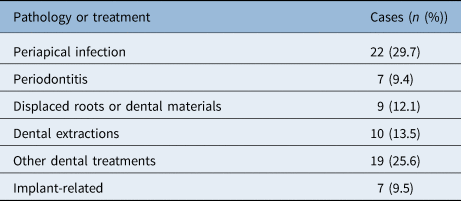
Odontogenic sinusitis followed dental procedures in 45 patients (60.7 per cent) (Table 3). Displaced roots or dental materials in the sinus cavity (Figure 1a and 1b) were present in nine patients (12.1 per cent). In all of these patients, the displaced roots or materials were removed by FESS with complete resolution of sinusitis. Periapical infection (Figure 1c) was the causative factor in 22 patients (29.7 per cent), while periodontal infection was diagnosed in only 7 (9.5 per cent). Dental extractions resulted in oroantral fistulae (Figure 1d) in 10 patients (13.5 per cent).
Coronal computed tomography scans showing: (a) displaced tooth roots (white arrow) inside the maxillary sinus, with concentric thickening of the sinus mucosa; (b) migration of displaced dental material into the middle meatus (white arrow), with total opacification of the maxillary and anterior ethmoid sinuses; (c) a typical case of odontogenic sinusitis with total opacification of the left maxillary sinus (all other sinuses are clear); the last two maxillary molar teeth show extensive caries with evidence of a 12 mm periapical cyst surrounding the apex of the second molar tooth; and (d) a large oroantral fistula (white arrow) and extensive mucosal thickening of the right maxillary sinus.


The most frequently affected teeth were the first molar (40.5 per cent), second molar (25.7 per cent), second premolar (21.6 per cent) and third molar (12.2 per cent).
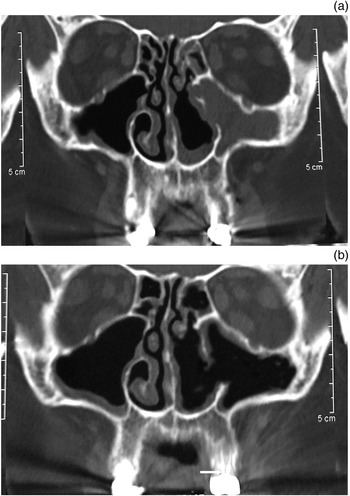
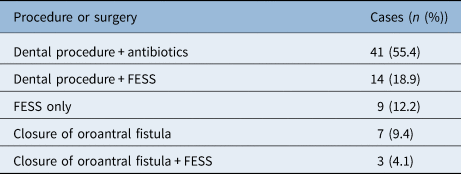
Forty-one patients (55.4 per cent) were successfully treated by different dental procedures and antibiotics based on culture and sensitivity testing (Table 4). The mean duration of antibiotherapy was 14 days (range, 10–21 days), and disease resolution occurred within 1 month of treatment. In two patients who had undergone previous FESS, maxillary sinusitis resolved after successful dental treatment and antibiotherapy only, without the need for revision FESS (Figure 2).
Coronal computed tomography scans of: (a) a patient who was treated surgically three times for his left maxillary sinusitis without resolution of the infection; and (b) the same patient after successful endodontic treatment (white arrow), showing complete resolution of the infection with no need for further endoscopic sinus surgery.


Fourteen patients needed FESS following dental treatments. The decision to perform FESS was based on two criteria: (1) persistence of symptoms; and (2) persistent evidence of disease on post-treatment sinus CT scans and nasal endoscopy.
Nine of the patients who required FESS had the ethmoid sinuses involved unilaterally on the same site as odontogenic sinusitis. Two of these patients had undergone previous FESS, and one had sinusitis related to a dental implant that did not resolve after intra-oral treatment. Five patients who had a history of chronic rhinosinusitis needed FESS in addition to the dental procedure. Patients with displaced roots or dental materials (nine cases) were treated by FESS only, with complete resolution of the infection in all patients, and none of the patients required sublabial antrostomy to remove the foreign body.
Oroantral fistulae were treated with a buccal advancement flap and intra-operative sinus irrigation with antibiotics. Three patients needed FESS (middle meatal antrostomy) to drain the maxillary sinus. Two patients with large fistulae required closure of the oroantral communication with buccal fat pads; this resulted in good healing, without perforation or shrinkage of the flap.
Discussion
Odontogenic sinusitis can be defined as sinusitis where radiographic and clinical features point to a dental origin. As the maxillary sinus is always the primary site of inflammation, the term ‘odontogenic maxillary sinusitis’ is sometimes used as a synonym.
In many cases, the diagnosis can be reached when foul smell and unilateral nasal discharge are associated with unilateral maxillary opacification and a recent history of dental infection or treatment. However, the diagnosis of odontogenic sinusitis may not be easy in all cases for several reasons. First, dental pain may not be present in all cases.Reference Brook9–Reference Pokorny and Tataryn11 In our series, dental pain was reported by only 23 patients (31.1 per cent). Second, the diagnosis of odontogenic sinusitis may be missed by radiologists, especially if they are not given enough clinical information.Reference Whyte and Boeddinghaus12 In the present series, dental pathology was noted in only 22 of 42 pre-CT dental films (53 per cent) and was missed in 24 of 74 initial sinus CT reports (32.4 per cent). Third, almost half of the patients did not report their previous dental procedures.Reference Troeltzsch, Pache, Troeltzsch, Kaeppler, Ehrenfeld and Otto13 In our series, 56 patients (75.5 per cent) had undergone previous dental treatment, but only 13 (23.1 per cent) mentioned it voluntarily without being asked about it. Fourth, in implant-associated sinusitis, there may be a long latent period between implant surgery and the development of nasal symptoms.Reference Troeltzsch, Pache, Troeltzsch, Kaeppler, Ehrenfeld and Otto13
In the present series, foul smell and unilateral nasal discharge were the commonest symptoms (62.2 per cent and 58.1 per cent, respectively). Two recent studies found that malodour was the most characteristic symptom of odontogenic sinusitis.Reference Simuntis, Vaitkus, Kubilius, Padervinskis, Tušas and Leketas2,Reference Goyal, Ahmad, Turfe, Peterson and Craig14 In addition, in agreement with previous reports,Reference Lechien, Filleul, Costa de Araujo, Hsieh, Chantrain and Saussez7 the first and second molar teeth were the most frequently involved teeth in our series, followed by the second premolar and third molar teeth.
Paranasal CT is the ‘gold standard’ for diagnosis of odontogenic sinusitis.Reference Workman, Adappa and Granquist8 Intra-oral radiographs and panoramic radiographs provide suboptimal information about the maxillary sinus; these radiographs did not detect dental pathologies in 47 per cent of patients who had dental films. However, radiologists may miss the diagnosis of dental pathologies in CT scans, as happened in 32.4 per cent of the first CT evaluations in our series.
Unilateral partial or total opacification of the maxillary sinus was observed in 82.4 per cent of our patients. This finding supports other reports indicating that unilateral opacification of the maxillary sinus on imaging is dental in origin until proved otherwise.Reference Matsumoto, Ikeda, Yokoi and Kohno5,Reference Whyte and Chapeikin15 Whyte and Boeddinghaus reported that extension from the maxillary sinus to other sinuses may be seen in up to 60–70 per cent of cases.Reference Whyte and Boeddinghaus12 In our series, ethmoid opacification was seen in 10 patients (13.5 per cent), and all needed FESS in addition to dental procedures.
In a retrospective study, Saibene et al. reported bilateral involvement in 18.7 per cent of their cases. However, the authors did not comment on the incidence of allergies and chronic sinusitis in their series.Reference Saibene, Pipolo, Lozza, Maccari, Portaleone and Scotti16 In the present study, bilateral opacification of the maxillary sinuses was observed in 13 patients (17.6 per cent). All of these patients gave a positive history of nasal allergies and/or chronic rhinosinusitis. In addition, in all patients, other sinuses were opacified.
In our series, iatrogenic causes of odontogenic sinusitis accounted for 60.7 per cent of cases. This agrees with previous reports stating that rising rates of dental surgery and procedures may be the cause of increased incidence of odontogenic sinusitis.Reference Mehra and Jeong17 This highlights the importance of radiographic evaluation of the relationship between the dental roots of the premolar and molar teeth and the maxillary sinus floor before dental extractions and root canal procedures.
Periapical inflammation was the commonest inflammatory cause of odontogenic sinusitis in our series and was diagnosed in 22 patients (29.7 per cent). Mucosal thickening along the floor of the maxillary sinus is usually the first radiological sign seen in patients with periapical infection. The severity of mucosal thickening is related to both the extent of periapical inflammation and the proximity of the roots to the sinus floor.Reference Shanbhag, Karnik, Shirke and Shanbhag18,Reference Eggmann, Connert, Bühler, Dagassan-Berndt, Weiger and Walter19 However, retrospective reviews of sinus CT or cone beam CT images of asymptomatic patients showed mucosal thickening in 29–53 per cent.Reference Vidal, Coutinho, Carvalho Ferreira, Souza and Gonçalves20,Reference Nascimento, Pontual, Pontual, Freitas, Perez and Ramos-Perez21 Moreover, mucosal thickening is more common with advancing ageReference Vidal, Coutinho, Carvalho Ferreira, Souza and Gonçalves20 and after dental restorations.Reference Whyte and Boeddinghaus12 Therefore, mucosal thickening in the absence of symptoms and other radiological signs suggestive of odontogenic sinusitis should not be considered a definite sign of dental sinus infection. Likewise, maxillary retention cysts are not related to dental pathology or treatment, and should be differentiated from cysts of dental origin. Periodontitis is a less frequent cause of odontogenic sinusitis, although it may be associated with mucosal thickening in up to 40 per cent of cases.Reference Phothikhun, Suphanantachat, Chuenchompoonut and Nisapakultorn22,Reference Ren, Zhao, Liu, Wang and Pan23 Periodontitis was encountered in only 9.4 per cent of our cases.
Identification of the dental cause is key to successful treatment of odontogenic sinusitis. However, to date, there is no consensus about the ideal treatment protocol for odontogenic sinusitis. In many cases, treatment of dental causative factors and appropriate antibiotics are sufficient to control the infection. This happened in 55.4 per cent of our cases within one month after treatment.
The decision to perform FESS was based on two criteria: (1) persistence of symptoms; and (2) objective evidence of disease on post-treatment sinus CT scans or nasal endoscopy after the completion of dental treatment and a full antibiotic course. Fourteen patients needed FESS following dental treatment. Nine of these patients also had opacification of the ostiomeatal complex. In two patients who had undergone previous FESS, the disease resolved after dental treatment without further sinus operations, emphasising the importance of the detection and treatment of dental pathologies when dental causation is suspected. Patients with displaced foreign bodies or roots inside the maxillary sinus cavity needed only FESS to extract the displaced material.
There are several known risk factors for the development of oroantral fistula.Reference Whyte and Boeddinghaus12 Our series included 10 patients with oroantral fistulae. All patients were treated with a buccal advancement flap and intra-operative sinus irrigation with antibiotics. Three patients needed FESS to clean the maxillary sinus, and two patients needed a buccal fat pad to successfully close the fistulous tract.
Insertion of implants to replace missing teeth for functional and cosmetic reasons has become a common procedure.Reference Whyte and Boeddinghaus12 The incidence of odontogenic sinusitis increases when there is infection close to the edentulous segment.Reference Manor, Mardinger, Bietlitum, Nashef, Nissan and Chaushu24 Sinusitis associated with dental implants may resolve in many cases with antibiotics and anti-inflammatories, or may require intra-oral surgery with or without FESS. In the present series, implant-related sinusitis resolved with medical treatment in five out of seven patients. Two patients needed further intra-oral surgery, and one needed FESS later on to resolve inflammation completely.
The main limitation of our study is its retrospective design. Retrospective studies have some known limitations, including information bias, possible inaccurate recall and an inability to control variables.Reference Sedgwick25 Throughout the present work, we considered these limitations and did our best to avoid them.
• Odontogenic sinusitis is one cause of recalcitrant sinusitis
• The diagnosis of odontogenic sinusitis may be missed for several reasons
• To date, there is no consensus as to the best sequence of treatments for odontogenic sinusitis
• Dental treatment should be the first step in the treatment protocol unless otherwise indicated; endoscopic sinus surgery is needed in selected cases
• Successful odontogenic sinusitis management requires good communication with radiologists for diagnosis and with dentists for proper treatment
Conclusion
The diagnosis of odontogenic sinusitis may be missed by radiologists and rhinologists alike for several reasons, including inadequate history-taking and radiographic evaluation. The data in the present work demonstrate that dental assessment and treatment should be the logical first step in the management protocol unless otherwise indicated. Functional endoscopic sinus surgery is needed for patients with persistent sinusitis after proper dental treatment and a full antibiotic course, and for those who have displaced foreign materials and dental roots within the sinus cavity.
Competing interests
None declared